
2027 What is a Medical Administrative Assistant? Job Description & Career

Co-Founder and Chief Data Scientist
Becoming a medical administrative assistant is a practical way to enter healthcare without becoming a nurse, physician, or direct-care clinician. The role focuses on the business side of patient care: scheduling visits, organizing records, communicating with patients, processing forms, supporting billing workflows, and helping clinics run smoothly.
This guide is for students, career changers, and entry-level healthcare workers who want to know whether medical administration is a good career move in 2026. You will learn what the job involves, what education is usually needed, when certification matters, where jobs are available, how salaries vary, and how to choose a training path that fits your budget and career goals.
Quick answer: Is becoming a medical administrative assistant worth it?
For many people, yes. Medical administrative assistant work can be a strong entry point into healthcare because it usually does not require a state license, offers employment across many healthcare settings, and can lead to roles in billing, coding, office management, patient access, or healthcare administration. The Bureau of Labor Statistics reported about 783,900 medical assistants employed in 2023 and projected 15% employment growth from 2023 to 2033 for medical assistants, which is much faster than the average for all occupations.
The best candidates are organized, comfortable using healthcare software, able to communicate professionally with patients, and willing to learn medical terminology, insurance processes, privacy rules, and electronic health record systems.
Why this career appeals to many entry-level healthcare workers
- Strong employment outlook. The field benefits from continued healthcare demand. BLS projected 15% growth from 2023 to 2033 for medical assistants.
- Multiple workplace options. Medical administrative assistants may work in physician offices, hospitals, outpatient centers, dental offices, insurance companies, public health agencies, long-term care facilities, and virtual care environments.
- Clear advancement routes. With experience and targeted training, professionals can move toward billing and coding, patient access, practice coordination, office management, or healthcare administration.
- What does a medical administrative assistant do?
- What education is required to become a medical administrative assistant in 2026?
- Do medical administrative assistants need a license or certification?
- Where do medical administrative assistants work?
- What skills do employers look for?
- How much do medical administrative assistants earn?
- Which employers tend to pay more?
- Which professional organizations support this career?
- How should you choose an affordable online training program?
- Can extra certifications expand your options?
- What challenges should you expect in this job?
- How can medical administrative assistants advance?
- What is the job outlook?
- How are technology and business skills changing the role?
- Can more education improve career prospects?
- What long-term career paths are available?
- Can non-traditional degrees help in medical administration?
What does a medical administrative assistant do?
A medical administrative assistant, also called a medical secretary in some workplaces, handles front-office and clerical responsibilities in healthcare settings. The role supports physicians, nurses, clinical staff, and patients by keeping scheduling, records, communication, and administrative workflows organized.
The role is related to medical assisting, but it is usually more office-focused than clinical. A clinical medical assistant may take vital signs, prepare patients for procedures, or assist with exams. A billing and coding specialist concentrates on diagnostic and procedure codes, claims, and reimbursement. A medical administrative assistant typically manages the patient-facing and office operations side of care. For a broader comparison of duties, Research.com explains the job responsibilities of a medical assistant.
| Role | Main focus | Common duties | Best fit for |
| Medical administrative assistant | Healthcare office support | Scheduling, patient intake, records, calls, forms, referrals, insurance verification | People who like organization, communication, and healthcare operations |
| Clinical medical assistant | Patient care support | Taking vital signs, preparing exam rooms, assisting providers, documenting patient information | People who want more direct interaction with clinical care |
| Medical billing and coding specialist | Revenue cycle and claims | Assigning codes, reviewing claims, checking documentation, working with payers | People who prefer detail-heavy records, compliance, and insurance work |
What education is required to become a medical administrative assistant in 2026?
Most medical administrative assistant jobs require at least a high school diploma or GED. However, many employers prefer candidates who have completed a certificate, diploma, or associate-level medical assisting or healthcare administration program, especially when the role involves electronic health records, insurance tasks, coding basics, or patient access responsibilities.
| Education path | What it usually prepares you for | When it makes sense |
| High school diploma or GED | Entry-level front desk, receptionist, or clerical roles with employer training | You want to start quickly and are willing to learn systems on the job |
| Certificate or diploma program | Medical terminology, office procedures, records, scheduling, billing basics, healthcare privacy | You want a shorter, career-focused training option |
| Associate degree | Broader medical assisting or health services preparation, often with general education coursework | You want a stronger credential or may continue into healthcare administration later |
| Bachelor’s degree in healthcare administration | Management, policy, operations, finance, and healthcare leadership concepts | You are aiming beyond entry-level office support toward supervisory or administrative roles |
| On-the-job training | Employer-specific software, scheduling systems, billing workflows, office policies, and communication protocols | You already have transferable office or customer service experience |
Students comparing formal programs should look for curriculum that includes medical terminology, electronic health records, appointment management, insurance verification, medical law and ethics, privacy practices, communication, and basic billing processes. Some employers also value programs accredited by organizations such as CAAHEP, especially when students plan to pursue certain certifications. Research.com’s guide to the best medical assistant programs can help you compare online options.
Cost is another important factor. Tuition, books, exam fees, technology fees, and externship requirements can change the real price of training. If you are budgeting for school, review Research.com’s explanation of how much a medical assistant program costs before enrolling.
Do medical administrative assistants need a license or certification?
Medical administrative assistants generally do not need a state-issued license. That is a major difference from licensed practical nurses, who must meet state licensing rules. Research.com covers this distinction in its comparison of a licensed practical nurse and medical assistant.
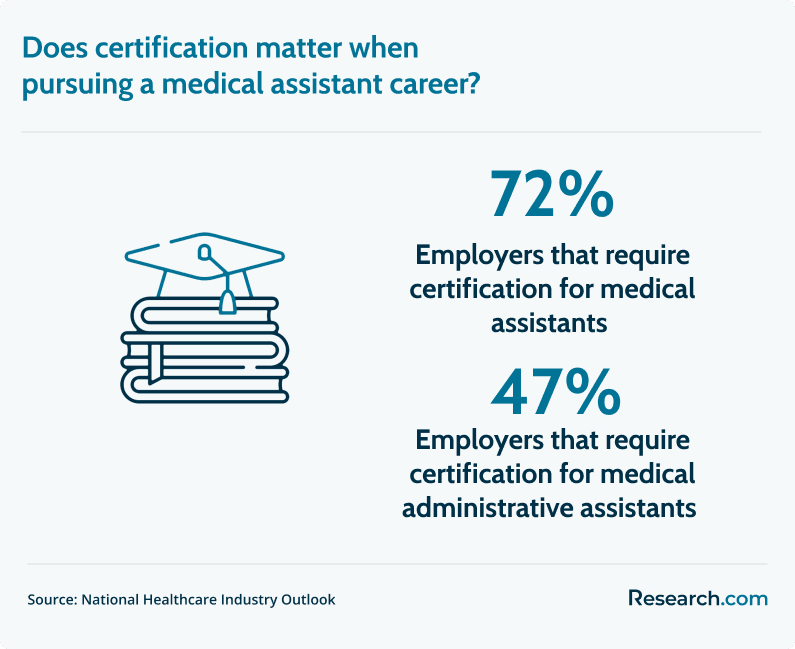
Certification is not always legally required, but it can matter in hiring. According to the National Healthcare Industry Outlook (2025), 72% of employers require certification for medical assistants, and 47% require certification specifically for medical administrative assistants. Certification can be especially useful if you have limited experience, are applying to competitive healthcare systems, or want to demonstrate knowledge of medical office procedures.
| Certification | Issuing organization | Best for | Important note |
| Certified Medical Administrative Assistant (CMAA) | National Healthcareer Association (NHA) | Front-office medical administration, patient records, scheduling, and healthcare office procedures | One of the most relevant credentials for administrative medical assistant roles |
| Certified Medical Assistant (CMA) | American Association of Medical Assistants (AAMA) | Medical assistants who want a credential covering both administrative and clinical tasks | Must be renewed every 60 months through continuing education or by retaking the exam |
| Certified Professional Coder (CPC) | American Academy of Professional Coders (AAPC) | Professionals who want to move into medical coding and claims-related work | More specialized than a general administrative assistant credential |
| Certified Medical Office Manager (CMOM) | Practice Management Institute (PMI) and similar organizations | Experienced assistants preparing for office management or supervisory responsibilities | Best pursued after gaining practical medical office experience |
If you are applying without prior healthcare experience, certification can help your resume stand out. Research.com also offers practical advice on getting a medical assistant job with no experience.
Where do medical administrative assistants work?
Medical administrative assistants are employed across the healthcare system. The right workplace depends on your preferred pace, patient interaction level, schedule, and interest in billing, records, patient intake, or departmental coordination.
- Physician offices. These are the largest employment setting for medical assistants, accounting for 56% of employment in this field. Duties often include scheduling, phones, check-in and check-out, insurance verification, records, and provider support.
- Hospitals. State, local, and private hospitals employ 16% of medical assistants. Hospital roles can involve admissions, departmental scheduling, patient records, authorizations, and coordination across larger teams.
- Outpatient care centers. These centers account for 9% of employment and may involve specialized services, higher patient volume, and more complex scheduling or documentation workflows.
- Offices of other health practitioners. These offices account for 8% of employment and may include chiropractors, optometrists, podiatrists, and similar providers.
- Dental offices. Administrative work in dental practices includes appointment management, patient records, billing, claims, and communication. If you are comparing roles, Research.com explains the difference between a medical assistant and dental assistant salary.
- Health insurance companies. Assistants in insurer settings may review coverage details, respond to member or provider questions, verify information, and support claims-related workflows.
- Government health agencies. Public health departments may need administrative staff for records, program coordination, patient communication, and data processing.
- Long-term care facilities and nursing homes. These settings need support for admissions, records, scheduling, family communication, and insurance documentation.
- Pharmaceutical and medical device companies. Administrative roles may support documentation, department coordination, research-related paperwork, or customer communication. If you are considering a more pharmacy-centered route, Research.com compares a pharmacy technician and medical assistant.
According to the chart below, physician offices employ the largest share of medical assistants, followed by hospitals, outpatient care centers, and offices of other health practitioners.
What skills do employers look for?
Medical administrative assistants need more than basic office skills. They work with protected health information, anxious patients, time-sensitive schedules, insurance rules, and healthcare teams that depend on accurate communication.
| Skill area | Why it matters | How to build it |
| Medical terminology | Helps you understand provider notes, referrals, records, and patient questions | Take a course, use flashcards, and practice with sample forms |
| Patient communication | Patients may be stressed, confused, or frustrated when contacting a healthcare office | Practice clear explanations, active listening, and professional phone etiquette |
| Electronic health records | Most offices rely on digital systems for records, scheduling, documentation, and billing support | Choose training with EHR practice or seek employer-provided software training |
| Critical thinking | Scheduling conflicts, incomplete forms, insurance problems, and urgent patient messages require judgment | Learn office protocols and ask how issues should be escalated |
| Time management | Front-office roles often involve interruptions, multiple calls, and competing priorities | Use task lists, prioritize urgent items, and confirm deadlines |
| Professionalism and confidentiality | Healthcare offices require trust, discretion, and consistent respect for privacy | Study healthcare privacy expectations and practice careful documentation habits |
NHA’s 2025 Industry Outlook also highlights employer interest in clinical experience, patient communication, critical thinking, professionalism or soft skills, and time management. Additional capabilities such as medical scribing, health coaching, EHR super-user knowledge, phone screening or triage support, and helping patients understand medical information can make candidates more competitive. Many of these topics appear in a standard medical assistant course curriculum.
How much do medical administrative assistants earn?
According to ZipRecruiter (2025), the average medical administrative assistant salary is approximately $44,460 per year. Actual pay can vary widely based on experience, employer type, geographic location, certification, and whether the job includes specialized billing, coding, records, or patient access duties.
- Experience. Entry-level assistants typically earn less than professionals who can independently manage scheduling systems, insurance verification, referrals, provider calendars, or records workflows.
- Certification. Credentials such as the CMAA, CMA, CPC, or CMOM can support stronger job applications, especially when employers require or prefer certified candidates.
- Location. ZipRecruiter (2025) lists top-paying cities for medical administrative assistants as Soledad, CA ($66,508); Nome, AK ($55,153); Berkeley, CA ($54,439); Berlin Corners, VT ($54,340); and Atherton, CA ($53,885).
- Employer setting. Outpatient centers and hospitals may pay more than some physician offices because of higher patient volume, specialized services, or more complex operations.
Which employers tend to pay more?
Salary data often groups medical administrative assistants with medical assistants more broadly, so pay comparisons should be interpreted carefully. According to BLS for 2023, median average salary by employer type varies across settings. Outpatient care centers reported $46,090, hospitals reported $44,350, and offices of physicians reported $40,670.
| Employer type | Salary figure stated | What may affect pay |
| Outpatient care centers | $46,090 | Specialized services, high patient flow, complex scheduling, and documentation demands |
| Hospitals | $44,350 | Large departments, high patient volume, admissions workflows, and more layered coordination |
| Offices of physicians | $40,670 | More common entry point, smaller teams, and varied responsibilities depending on practice size |
| Offices of other health practitioners | Not stated in the source text | Pay may depend on specialty, location, patient volume, and office structure |
The highest-paying job is not always the best fit. A hospital position may offer more complexity and shift variation, while a smaller physician office may offer more predictable routines and closer relationships with providers and patients.
Which professional organizations support this career?
Professional organizations can help medical administrative assistants prepare for certification, find continuing education, track industry expectations, and understand career pathways.
- National Healthcareer Association (NHA). NHA offers the Certified Medical Administrative Assistant credential and provides exam preparation, continuing education, and career resources.
- American Association of Medical Assistants (AAMA). AAMA supports medical assistants broadly through certification, continuing education, professional updates, and member resources.
- Medical Group Management Association (MGMA). MGMA is useful for professionals interested in practice management, healthcare operations, billing, coding, and office leadership.
- National Association of Healthcare Access Management (NAHAM). NAHAM focuses on patient access, registration, scheduling, and related front-end healthcare operations.
- American Medical Billing Association (AMBA). AMBA may benefit assistants who want to specialize in medical billing, claims, and reimbursement workflows.
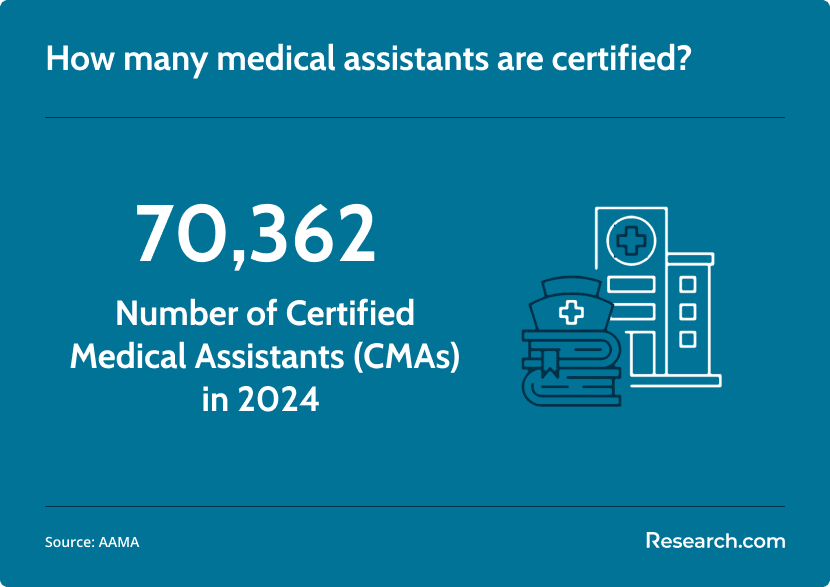
Certification can help candidates signal readiness in a competitive market. The American Association of Medical Assistants reported 70,362 CMAs as of October 2024.
How should you choose an affordable online training program?
An affordable program is not always the cheapest one. The best choice is a program that teaches the skills employers expect, prepares you for relevant certification if needed, fits your schedule, and does not leave you paying for coursework that does not support your goals.
| What to check | Why it matters | Question to ask before enrolling |
| Accreditation and recognition | Some credentials and employers may prefer or require specific program quality standards | Is this program recognized by employers or certification bodies in my area? |
| Curriculum | Medical office roles require terminology, records, scheduling, privacy, insurance, and communication skills | Does the program include EHR practice, medical terminology, billing basics, and healthcare law or ethics? |
| Certification preparation | Certification can improve job prospects where employers prefer certified candidates | Which certification exam does this program prepare students for? |
| Total cost | Tuition may not include books, exam fees, software, background checks, or other expenses | What is the full cost from enrollment through certification? |
| Career support | Resume help, externship guidance, and employer connections can support job placement | Does the school provide career coaching or help finding practical experience? |
| Schedule flexibility | Many learners balance school with work, caregiving, or other obligations | Can I complete coursework part time, asynchronously, or on an accelerated schedule? |
If you are interested in combining administrative training with coding skills, Research.com’s overview of the cheapest medical billing and coding program options can help you compare cost-conscious pathways.
Can extra certifications expand your options?
Additional certifications can broaden your opportunities when they match a realistic career direction. A billing and coding credential may help if you want revenue cycle work. A medical office management credential can support advancement after you gain experience. A general clinical or allied health credential may help you understand care delivery, but it should not distract from your main goal unless you truly want to move into that area.
For example, an ultrasound tech certification online may be useful for someone exploring diagnostic imaging or allied health, but it is not a standard requirement for medical administrative assistant jobs. Choose extra credentials based on job postings in your target market, not because a program sounds impressive.
What challenges should you expect in this job?
Medical administrative assistants often work at the point where patients, providers, insurers, and office systems meet. That can make the role rewarding, but it also creates pressure.
| Common challenge | Why it happens | Better strategy |
| High call and patient volume | Healthcare offices may handle constant appointment requests, questions, and follow-ups | Use scripts, prioritize urgent needs, and document every interaction clearly |
| Insurance and billing complexity | Coverage rules, authorizations, claims, and patient balances can be confusing | Build billing literacy and know when to escalate questions |
| Privacy and compliance pressure | Administrative staff handle sensitive patient information every day | Follow office protocols and avoid discussing patient information outside approved channels |
| Changing software systems | EHR, scheduling, billing, and telehealth platforms continue to evolve | Seek training and become comfortable learning new digital tools |
| Emotional patient interactions | Patients may be ill, anxious, frustrated, or worried about cost | Stay calm, listen carefully, and use clear next steps |
If billing and coding tasks are a major part of your desired role, training through the best medical billing and coding online courses may help strengthen your technical preparation.
How can medical administrative assistants advance?
Advancement usually comes from combining experience with targeted skill development. The fastest path is not always a new degree; sometimes it is becoming the person in the office who understands the EHR, solves scheduling problems, trains new staff, or manages complex insurance workflows.
- Pursue continuing education. Short courses, workshops, and professional development can help you stay current with billing updates, healthcare regulations, EHR changes, and patient access practices.
- Specialize in billing, coding, or records. Revenue cycle and health information skills can lead to roles beyond basic front-desk administration.
- Become highly skilled with technology. EHR systems, practice management software, telehealth tools, and patient portals are central to modern medical offices.
- Build leadership skills. Assistants who can train staff, improve workflows, handle conflict, and manage priorities may move toward lead assistant, office coordinator, or office manager roles.
- Consider a clinical bridge path if your goals change. Some medical assistants pursue a MA to LPN bridge program if they want to move into licensed nursing and direct patient care.
What is the job outlook?
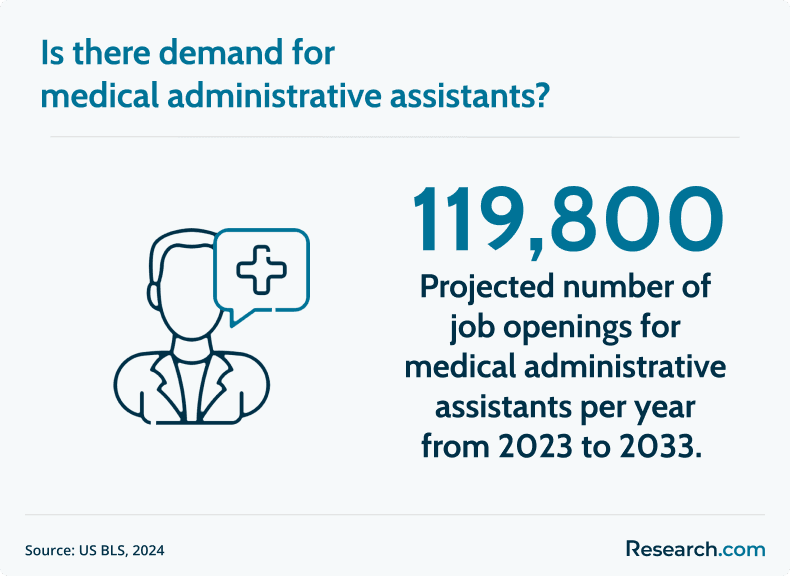
The job outlook is favorable. BLS projected 15% employment growth for medical assistants from 2023 to 2033 and about 119,800 job openings per year. Growth is tied to continued healthcare demand, an aging population, and the need for administrative and clinical support in medical settings.
The healthcare support occupational group, which includes medical administrative assistants, ranked 1st among the top 10 fastest-growing occupational groups, with a 15.2% growth rate. This does not guarantee employment for every applicant, but it does show that healthcare support work remains a strong labor-market category.
How are technology and business skills changing the role?
Medical administrative assistants increasingly work with digital tools that affect scheduling, reminders, patient intake, billing, referrals, and records. Automation may reduce some repetitive tasks, but it also raises expectations: employers may want assistants who can troubleshoot portals, support telehealth workflows, understand data accuracy, and help patients navigate digital systems.
Business skills also matter. Understanding workflow design, customer service, process improvement, and basic operations can help assistants move into coordinator or office management roles. For professionals who want broader business preparation, Research.com’s guide to fast paced online business degrees may be useful, especially for those planning a longer-term move into management.
Can more education improve career prospects?
Additional education can help when it aligns with a specific career goal. A certificate may be enough for entry-level office support. An associate degree may offer broader preparation and more flexibility. A bachelor’s degree in healthcare administration, public health, business, or a related field may support advancement into management, compliance, operations, or program coordination.
A public health degree online may be relevant for assistants who want to move toward community health programs, policy support, health education, population health, or administrative roles in public health agencies. It is less necessary for someone who wants to remain in front-office medical administration.
What long-term career paths are available?
Medical administrative assistant experience can lead to several longer-term healthcare careers. The right path depends on whether you prefer people-facing operations, records and data, billing and reimbursement, management, or direct patient care.
| Career direction | Possible next roles | What to build |
| Medical office operations | Lead medical receptionist, office coordinator, practice coordinator, office manager | Scheduling systems, staff training, workflow improvement, patient service, leadership |
| Billing and coding | Billing specialist, coding specialist, revenue cycle assistant, claims support | Coding rules, payer processes, documentation accuracy, certification preparation |
| Patient access | Patient access representative, registration specialist, referral coordinator | Insurance verification, authorizations, communication, intake workflows |
| Health information | Records technician, EHR support, health information assistant | Data accuracy, privacy, EHR systems, records management |
| Healthcare administration | Practice manager, department coordinator, healthcare administrator | Management, finance, compliance, operations, strategic planning |
If your goal is higher-level healthcare leadership, it can help to study the skills and credentials associated with the highest paid careers in healthcare administration.
Can non-traditional degrees help in medical administration?
Yes, but only when the degree gives you transferable skills that healthcare employers value. Business, management, communications, information systems, and public health programs can all support medical administration careers if you can connect your coursework to scheduling, compliance, patient service, operations, records, or leadership.
Some less obvious degrees may still help if they include management and operations training. For example, cheap sports management programs online may include coursework in leadership, team coordination, budgeting, and organizational operations. However, candidates from non-healthcare backgrounds should usually add medical terminology, healthcare privacy, EHR, or billing training to compete for medical office roles.
Common mistakes to avoid
- Choosing a program based only on tuition. A low price is not helpful if the program lacks certification preparation, relevant coursework, or employer recognition.
- Assuming certification is never needed. Certification may not be legally required, but many employers prefer or require it.
- Ignoring accreditation and eligibility rules. Some certifications or employers may have specific education requirements.
- Overlooking total costs. Exam fees, books, software, technology requirements, and background checks can change affordability.
- Using rankings as the only decision tool. A highly ranked program may still be wrong for your schedule, budget, location, or career target.
- Assuming salary outcomes are guaranteed. Pay depends on location, employer, experience, credentials, and job responsibilities.
- Enrolling in unrelated credentials too soon. Extra certifications are useful only when they support a realistic job goal.
Questions to ask before choosing this career
- Do I prefer administrative healthcare work, or do I want direct patient care?
- Am I comfortable speaking with patients by phone, portal, and in person?
- Can I stay organized while handling interruptions and urgent requests?
- Do local employers prefer CMAA, CMA, CPC, or another credential?
- Which setting fits me best: physician office, hospital, outpatient center, insurance company, or public health agency?
- What is the full cost of training, including certification exams?
- Does the program teach EHR systems, insurance verification, medical terminology, and healthcare privacy?
- What advancement path interests me most: office management, billing and coding, patient access, health information, or healthcare administration?
References
- American Association of Medical Assistants. (n.d.). Certification. Retrieved from https://www.aama-ntl.org/certification
- Bureau of Labor Statistics. (2023). Medical assistants. U.S. Department of Labor. Retrieved from https://www.bls.gov/ooh/healthcare/medical-assistants.htm
- National Healthcareer Association. (2023). Industry outlook. Retrieved from https://info.nhanow.com/outlook
- ZipRecruiter. (n.d.). Medical administrative assistant salary. Retrieved from https://www.ziprecruiter.com/Salaries/Medical-Administration-Assistant-Salary
- ACI. (2023). NHA industry outlook shows growing healthcare jobs. Retrieved from https://aci.edu/blog/nha-industry-outlook-shows-growing-healthcare-jobs-updated
Key Insights
- Medical administrative assistant work is a healthcare office career focused on scheduling, patient communication, records, insurance support, and workflow coordination rather than licensed clinical care.
- A high school diploma or GED may be enough for some entry-level roles, but formal training and certification can improve competitiveness, especially where employers prefer certified candidates.
- Certification is not usually a state licensing requirement, but the National Healthcare Industry Outlook (2025) reported that 47% of employers require certification specifically for medical administrative assistants.
- ZipRecruiter (2025) lists the average medical administrative assistant salary at approximately $44,460 per year, but pay depends heavily on location, employer type, experience, and specialization.
- Outpatient care centers and hospitals may offer stronger pay potential than some physician offices, but they can also involve higher patient volume and more complex workflows.
- BLS projected 15% employment growth from 2023 to 2033 for medical assistants, with about 119,800 job openings per year, making this a strong entry-level healthcare pathway.
- The best long-term strategy is to start with core medical office skills, earn a relevant certification if local employers value it, then specialize in billing, coding, patient access, EHR systems, or office management.
Other Things To Know About Becoming a Medical Administrative Assistant
Certifications such as Certified Medical Administrative Assistant (CMAA) from the National Healthcareer Association can enhance career prospects. In 2027, these certifications validate skills in medical office management and can be essential for career advancement in the healthcare sector.
Medical administrative assistants use electronic health record systems, practice management software, scheduling platforms, and medical billing tools. Common systems include Epic, Cerner, and athenahealth. These tools help manage appointments, patient records, insurance data, and front-desk workflows while supporting HIPAA-compliant handling of information.


