
2027 Medical Assistant Job Description & Duties: What They Do

Co-Founder and Chief Data Scientist
Choosing a medical assistant career means deciding whether you want a healthcare role that combines direct patient contact with front-office responsibilities. Medical assistants are often the first and last people patients interact with during a visit, and they help physicians, nurses, and office teams keep care moving safely and efficiently.
This guide explains what medical assistants do, how the role differs from nursing and physician assistant careers, what training and certifications employers recognize, where medical assistants work, and how salary and job outlook vary by setting and location. It is designed for prospective students, career changers, current medical assisting students, and working medical assistants planning their next step.
Quick answer: What should you know about medical assistant duties and career prospects?
- Medical assistants handle both clinical support and administrative work in physicians’ offices, hospitals, outpatient care centers, urgent care clinics, and specialty practices.
- Certification is not mandatory in every state, but credentials such as CMA, RMA, NCMA, CCMA, and CMAA can make a candidate more competitive and may improve salary potential.
- The average salary for medical assistants in the U.S. is around $42,000 per year, though pay varies by state, employer type, experience, and certification.
- What does a medical assistant do each day?
- What is the average medical assistant salary for 2027?
- How is a medical assistant different from a nurse or physician assistant?
- What skills do successful medical assistants need?
- What clinical tasks are medical assistants allowed to perform?
- Which states offer the highest pay for medical assistants?
- What education do you need to become a medical assistant?
- How can you reduce the cost of medical assistant training and certification?
- How is technology changing medical assisting?
- Do medical assistants need certification, and which credentials matter most?
- How long does it take to become a medical assistant?
- What challenges do medical assistants commonly face?
- Which specialized certifications can help medical assistants advance?
- Should medical assistants pursue public health degrees?
- How can additional academic credentials support career growth?
- Where do medical assistants work?
- What is the job outlook for medical assistants?
- How can an online biology bachelor’s degree help a medical assistant?
- How can medical assistants move into higher healthcare roles?
- Can healthcare administration credentials improve advancement options?
What does a medical assistant do on a daily basis?
A medical assistant’s day depends on the employer, specialty, and state scope-of-practice rules. In a small physician’s office, one person may answer phones, room patients, record vital signs, and help with procedures. In a hospital clinic or large outpatient center, duties may be more specialized.
| Work area | Typical duties | Why it matters |
| Administrative support | Scheduling visits, answering patient calls, updating records, processing insurance information, preparing forms, and coordinating referrals | Keeps the practice organized and helps patients move through the care process without delays |
| Patient intake | Greeting patients, confirming medical histories, documenting symptoms, preparing patients for exams, and explaining basic visit steps | Creates a smoother visit and helps clinicians start with accurate information |
| Clinical support | Taking vital signs, assisting with exams, preparing supplies, collecting specimens, and performing basic tests when permitted | Allows physicians and nurses to focus on diagnosis, treatment, and higher-level clinical decisions |
| Equipment and room preparation | Stocking exam rooms, cleaning instruments, preparing trays, checking supplies, and following infection-control procedures | Protects patient safety and prevents interruptions during appointments |
| Team coordination | Communicating with clinicians, lab staff, billing teams, and patients about next steps | Reduces confusion and supports continuity of care |
Common daily responsibilities include:
- Managing front-office workflow: Medical assistants schedule appointments, organize patient records, answer phones, support billing and coding processes, and help maintain accurate documentation.
- Supporting patients before and after visits: They welcome patients, gather medical histories, explain routine procedures, and review follow-up instructions provided by the clinician.
- Performing basic clinical tasks: Depending on state rules and employer policy, they may take vital signs, prepare patients for examinations, administer injections, draw blood, or run simple lab tests. Students interested in other hands-on diagnostic roles may also compare medical assisting with ultrasound tech programs online.
- Maintaining supplies and sterile environments: They help ensure exam rooms are clean, stocked, and ready for patient care.
- Connecting administrative and clinical teams: Medical assistants often serve as the link between the front desk, clinicians, laboratories, and patients.
How much is the average salary for medical assistants for 2027?
According to 2025 data from job board Indeed, medical assistants in the US earned an average base salary of $47,116. Pay is not the same across all jobs. Location, experience, certification, employer type, shift schedule, and specialty can all affect compensation. The lowest 10% of medical assistants earn less than $33,500 annually, while the highest 10% make over $56,480 per year.
Medical assistants in hospitals and specialty clinics may earn more than those in some physician offices or outpatient care settings, although pay patterns vary by region and employer. Certification can also influence hiring and salary potential. Employers may prefer Certified Medical Assistants, Registered Medical Assistants, or candidates with added skills in phlebotomy, EKG testing, insurance processes, or electronic health records. For a state-by-state comparison, review this guide to medical assistant salary.
| Factor | How it can affect pay |
| State and city | Higher-cost or high-demand labor markets may offer stronger wages. |
| Certification | Credentials such as CMA or RMA may improve competitiveness for better-paying roles. |
| Experience | More experienced medical assistants may qualify for lead, specialty, or supervisory duties. |
| Employer type | Hospitals, outpatient care centers, and specialty practices may have different wage structures. |
| Additional skills | Phlebotomy, EKG, billing, coding, and EHR proficiency can make a candidate more valuable. |
How does a medical assistant's role differ from that of a nurse or physician assistant?
Medical assistants, nurses, and physician assistants all support patient care, but they do not have the same education requirements, legal authority, or clinical responsibilities. The main difference is scope of practice: medical assistants support care under supervision, nurses provide licensed nursing care, and physician assistants can diagnose and treat patients within their authorized scope.
| Role | Typical education | Main responsibilities | Decision-making authority |
| Medical assistant | Certificate, diploma, associate degree, or employer-based training | Administrative tasks, patient intake, vital signs, basic clinical support, specimen collection, and procedure assistance | Cannot diagnose, independently treat, or create care plans |
| Nurse | LPN or RN education pathway with state licensure | Direct nursing care, medication administration, patient education, care coordination, and monitoring | Practices under nursing licensure and state board rules |
| Physician assistant | Master’s degree and required certification/licensure | Diagnosing conditions, prescribing medications, ordering tests, and developing treatment plans under applicable supervision rules | Can make clinical decisions within state law and physician collaboration requirements |
- Training requirements differ: Medical assistants often complete a one-year certificate or two-year associate degree, while nurses need state-approved nursing education and licensure. Some RNs later choose accelerated options such as an RN to BSN in 6 months.
- Scope of practice is narrower for medical assistants: Medical assistants may support exams and perform delegated tasks, but they do not diagnose illnesses or design treatment plans.
- Work settings may differ: Medical assistants are common in outpatient clinics and physician offices, while nurses and physician assistants are also widely employed in hospitals, emergency departments, and specialized clinical units.
- Licensure rules are not the same: Nurses must be licensed by state boards. Physician assistants must pass the PANCE exam and meet certification and continuing education requirements. Medical assistant certification is often voluntary, although many employers prefer it.
Medical assistants who want more clinical responsibility often use the role as a starting point for nursing. Depending on prior education and admission requirements, a 12 month RN program online may be one option to research. Prospective nursing students should also compare the differences in requirements for ADN AAD and AAS degrees before choosing a school.
What are the key skills required to become a successful medical assistant?
Strong medical assistants are organized, calm under pressure, accurate with details, and comfortable switching between people-focused care and documentation-heavy office work. The job rewards reliability as much as technical ability.
- Clinical readiness: Medical assistants need to take accurate vital signs, prepare patients for exams, assist with procedures, collect specimens, and follow infection-control practices.
- Administrative accuracy: Scheduling, patient records, insurance information, referrals, billing details, and office communications require careful organization.
- Communication and empathy: Patients may be anxious, uncomfortable, or confused. Medical assistants must explain routine steps clearly and know when to escalate questions to clinicians.
- Attention to detail: Small mistakes in documentation, medication information, specimens, or patient identifiers can create safety issues.
- Time management: Clinics move quickly, so medical assistants must prioritize urgent needs while keeping routine tasks on track.
- Technology comfort: Electronic health records, patient portals, digital scheduling systems, and telehealth workflows are increasingly part of the role.
Many of these skills transfer to other healthcare careers. For example, patient care, communication, and detail orientation are useful in nursing and respiratory therapy. If you are comparing clinical career paths, it may help to review an RN vs RT degree program comparison.
What clinical procedures can medical assistants legally perform?
Medical assistants can perform many hands-on tasks, but their legal scope depends on state law, employer policy, training, and the level of physician or clinician supervision. They are not licensed independent providers, so they should never accept duties that exceed their authorized scope.
In many states and workplaces, medical assistants may be allowed to perform tasks such as:
- Recording vital signs: Blood pressure, pulse, temperature, respiratory rate, height, weight, and related intake measurements.
- Administering injections or medications under supervision: Some states and employers allow intramuscular, subcutaneous, or intradermal injections when properly delegated.
- Drawing blood and collecting specimens: Medical assistants may perform phlebotomy, urine collection, throat swabs, and other basic sample collection when trained and permitted.
- Providing basic wound support: They may clean wounds, apply dressings, remove sutures or staples, or assist with minor procedures if allowed by state and workplace policy.
- Assisting with tests and examinations: This can include preparing equipment, positioning patients, and helping with EKGs, spirometry, vision screenings, or other routine procedures.
Students interested in other short-term clinical pathways may compare medical assisting with 1-year radiology tech programs, though radiologic technology has different education, certification, and clinical requirements.
Tasks medical assistants should not perform without proper authority
- Diagnosing medical conditions
- Creating treatment plans
- Prescribing medication
- Providing independent medical advice
- Performing procedures prohibited by state law or employer policy
Which states pay medical assistants the highest salaries?
Medical assistant pay differs by state because labor demand, cost of living, healthcare access, and employer mix vary across the country. Washington is the highest-paying state for medical assistants, with a median annual salary of $52,600. Alaska follows with a median salary of $50,160. Other high-paying states include California at $46,690, Massachusetts at $47,770, and Minnesota at $48,890. These figures are above the national median of $42,000.
| State | Median annual salary | What to consider before relocating |
| Washington | $52,600 | Compare wages with housing, transportation, and local certification preferences. |
| Alaska | $50,160 | Remote healthcare needs may affect hiring, but cost of living can be high. |
| Minnesota | $48,890 | Large health systems and specialty clinics may create varied opportunities. |
| Massachusetts | $47,770 | Urban medical centers may offer opportunities, but living costs can be significant. |
| California | $46,690 | Pay may vary widely between metropolitan and nonmetropolitan areas. |
The chart below shows the top 5 states with the highest average salary for medical assistants:
What education is required to become a medical assistant?
The minimum requirement is usually a high school diploma or GED, but many employers prefer applicants who have completed a formal medical assisting program. Formal training helps students learn medical terminology, anatomy, pharmacology basics, clinical procedures, billing, scheduling, and patient record management.
| Path | Typical length | Best for | Important trade-off |
| High school diploma or GED plus on-the-job training | Varies by employer | Applicants in markets where employers train entry-level staff | May limit job options if employers prefer formal training or certification |
| Certificate or diploma program | 9 to 12 months | Students who want a faster route into the workforce | May provide less general education than an associate degree |
| Associate degree in medical assisting | Two years | Students who want broader coursework or may transfer credits later | Takes longer and may cost more than a certificate |
| Certification after training | Depends on exam eligibility | Graduates who want stronger employer recognition | Requires exam preparation and possible fees |
- High school diploma or GED: This is the basic starting point for training or entry-level employment.
- Certificate or diploma: These programs often focus on job-ready clinical and administrative skills.
- Associate degree: A two-year program can provide a broader academic foundation and may help students who plan to continue their education.
- Professional certification: Credentials such as CMA or RMA may improve employability even when not legally required.
- On-the-job training: Some employers train medical assistants internally, but formal education and certification can make candidates more competitive. Healthcare workers considering later advancement may also explore options such as a paramedic to RN bridge program online.
Before enrolling, confirm whether the program is accredited, whether it includes externship or clinical experience, whether graduates are eligible for certification exams, and whether credits can transfer if you later pursue another healthcare degree.
How can I manage the costs of medical assistant training and certification?
The true cost of becoming a medical assistant is more than tuition. Students should also account for textbooks, uniforms, lab supplies, background checks, immunizations, exam fees, transportation, and lost income if they reduce work hours. Comparing programs only by advertised tuition can lead to underestimating the total investment.
- Choose an accredited program when possible: Accreditation can affect certification eligibility and employer confidence.
- Ask for a full cost breakdown: Request tuition, fees, supplies, exam costs, and externship-related expenses in writing.
- Compare payment options: Some schools offer payment plans, scholarships, employer partnerships, or bundled certification preparation.
- Look for stackable skills: Programs that include billing, coding, EHR, phlebotomy, or EKG exposure may improve flexibility.
- Review related healthcare training costs: If you are comparing office-based healthcare roles, information on medical coding certification cost can help you evaluate alternatives.
Medical assisting is often shorter and less expensive than longer healthcare pathways. For example, radiographer vs radiologist degree programs differ substantially in educational depth, training length, and cost because radiologists must complete far more advanced medical education than radiographers.
How is technology enhancing the role of medical assistants?
Medical assistants increasingly work with electronic health records, digital scheduling systems, patient portals, telemedicine platforms, e-prescribing workflows, and automated reminders. These tools can reduce paperwork and improve access to patient information, but they also raise expectations for accuracy, privacy, and cybersecurity awareness.
Technology does not remove the need for medical assistants. Instead, it changes what employers expect. A strong candidate should be comfortable entering data accurately, protecting patient information, navigating EHR screens, helping patients with digital forms, and supporting telehealth rooming processes. Students who want flexible training options can compare accredited online medical assisting programs, especially if they need coursework that fits around work or family schedules.
Do medical assistants need certification, and which ones are most recognized?
Certification is not legally required in most states, but many employers prefer it and some roles may require it. Certification signals that a medical assistant has met a recognized standard of knowledge and skills. It can be especially useful for new graduates, career changers, and medical assistants applying to competitive health systems.
| Credential | Issuing organization | Best fit |
| Certified Medical Assistant (CMA) | American Association of Medical Assistants (AAMA) | Graduates of accredited programs seeking a widely recognized credential |
| Registered Medical Assistant (RMA) | American Medical Technologists (AMT) | Candidates qualifying through education, experience, or military training |
| National Certified Medical Assistant (NCMA) | National Center for Competency Testing (NCCT) | Applicants with formal training or relevant work experience |
| Certified Clinical Medical Assistant (CCMA) | National Healthcareer Association (NHA) | Medical assistants focused on patient care, phlebotomy, and EKG-related duties |
| Certified Medical Administrative Assistant (CMAA) | National Healthcareer Association (NHA) | Professionals focused on scheduling, billing support, office operations, and administrative functions |
Before choosing a certification, check local job postings. If employers in your area frequently request one credential over another, that should influence your decision.
How long does it take to become a medical assistant?
The timeline depends on the training route. Certificate and diploma programs commonly take 9 to 12 months, while associate degree programs usually take two years. Some accelerated programs compress the curriculum for students who can manage a faster pace, but shorter programs may require more intensive weekly study and less scheduling flexibility.
If speed is your priority, compare program length, externship requirements, certification eligibility, and job placement support before enrolling. For more detail on accelerated options, see How long does it take to become a medical assistant?.
What common challenges do medical assistants encounter?
Medical assisting can be rewarding, but it is not a low-pressure job. The role often requires handling several urgent tasks at once while staying accurate, professional, and patient-centered.
| Challenge | Why it happens | Better approach |
| Role overload | Medical assistants may be asked to balance phone calls, rooming patients, chart updates, and clinical support at the same time. | Clarify priorities with supervisors and develop repeatable workflows. |
| Scope-of-practice confusion | Rules vary by state and employer, which can make boundaries unclear. | Ask for written policies and decline tasks that exceed permitted duties. |
| Emotional strain | Patients may be worried, angry, in pain, or dealing with difficult diagnoses. | Use calm communication and escalate complex concerns to licensed clinicians. |
| Technology demands | EHR systems, portals, and telehealth workflows change frequently. | Seek regular training and document questions when systems change. |
| Limited advancement without more credentials | Some employers reserve leadership or specialized roles for certified or degree-prepared candidates. | Plan whether certification, specialty training, or further education is worth the investment. |
If long-term income growth or management is a major goal, compare clinical advancement with administrative options. Researching healthcare administration jobs salary can help you understand whether a business-side healthcare path fits your goals.
What specialized certifications can further elevate your career as a medical assistant?
After gaining experience, medical assistants may strengthen their resumes with focused credentials or training in areas such as phlebotomy, EKG testing, medical billing, coding, ophthalmology, podiatry, or administrative management. The best specialization depends on the type of employer you want to work for.
- Phlebotomy: Useful in labs, outpatient clinics, and practices that collect blood specimens frequently.
- EKG training: Helpful in cardiology offices, urgent care, and primary care settings.
- Medical billing and coding: Valuable for medical assistants who want to move toward revenue cycle or office administration.
- Specialty practice training: Dermatology, pediatrics, cardiology, orthopedics, and other specialties may require additional procedure knowledge.
- Diagnostic career exploration: Medical assistants interested in imaging may research pathways through the best ultrasound tech schools.
Should medical assistants consider pursuing advanced public health degrees?
A public health degree is not necessary for most medical assistant jobs. However, it may make sense for professionals who want to move into community health, health education, program coordination, policy, epidemiology support, or healthcare leadership. A master’s in public health can build knowledge in health policy, population health, epidemiology, data analysis, and program management.
This path is most appropriate when your goal is to move beyond routine clinic duties into broader health systems or community-level work. If cost is a concern, compare options such as the cheapest masters in public health online before committing to graduate study.
How can additional academic credentials elevate a medical assistant’s career?
Additional academic credentials can help medical assistants qualify for supervisory, administrative, laboratory, public health, or clinical career pathways. The right credential depends on whether you want to stay in patient care, move into management, pursue nursing, enter allied health, or build a stronger science background.
A biology degree may support students who want deeper preparation in anatomy, physiology, genetics, microbiology, or pre-professional healthcare coursework. If that direction fits your goals, compare options such as the fastest online biology degree.
What healthcare settings or industries hire medical assistants?
Medical assistants work across outpatient and clinical environments. According to the U.S. Bureau of Labor Statistics (BLS), major employing industries include outpatient care centers, hospitals, physicians’ offices, offices of other health practitioners, and ambulatory healthcare services.
| Industry or setting | Common duties | Average salary cited |
| Outpatient Care Centers | Routine tests, patient records, care coordination, and communication between patients and providers | $46,090 |
| Hospitals (State, Local, and Private) | Blood draws, patient preparation, procedure support, and coordination with clinical staff | $44,350 |
| Offices of Physicians | Patient histories, exam support, scheduling, records, and administrative tasks | $40,670 |
| Offices of Other Health Practitioners | Support for chiropractors, podiatrists, and other practitioners | $36,480 |
| Ambulatory Healthcare Services | Mixed administrative and clinical support across mobile, outpatient, and specialty care services | Varies by employer and location |
In specialized settings, medical assistants may work alongside other allied health professionals. For example, in nephrology clinics, they may support patient records and care coordination with a dialysis technician for patients receiving kidney disease treatment.
The chart below shows the average salaries of medical assistants in different industries:
What is the job outlook for medical assistants over the next decade?
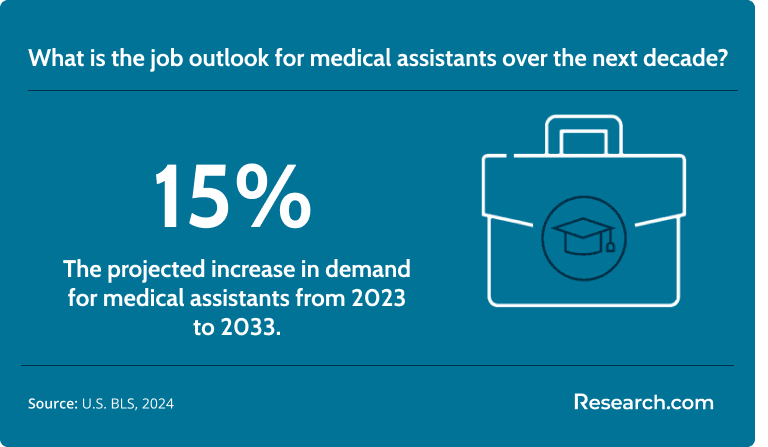
The employment outlook is strong. According to the U.S. Bureau of Labor Statistics (BLS), employment of medical assistants is projected to grow 15 percent from 2023 to 2033, which is much faster than the average for all occupations. The BLS also projects approximately 119,800 job openings each year, on average, over the decade.
Openings are expected to come from both new demand and replacement needs as workers change occupations or leave the labor force, including retirement. Demand is also supported by the need for healthcare services among an aging population and by continued reliance on outpatient care.
How can an online biology bachelor's degree enhance my medical assisting career?
An online biology bachelor’s degree can help medical assistants build a deeper scientific foundation in human biology, physiology, microbiology, and related subjects. This may be useful for professionals planning to apply to nursing, physician assistant, laboratory science, public health, or other advanced healthcare programs.
It is not required for entry-level medical assisting, so students should weigh cost, time, transfer credit, and career goals carefully. If the goal is to combine clinical experience with broader science preparation, compare programs in an online biology bachelors degree guide.
How can medical assistants advance to higher healthcare roles?
Medical assistants can advance by building experience, earning certification, specializing, or returning to school. The best next step depends on whether you want more clinical responsibility, a higher salary ceiling, leadership duties, or a transition into another healthcare profession.
| Goal | Possible next step | Why it may help |
| Become more competitive in current role | Earn CMA, RMA, CCMA, or another recognized credential | Shows verified competency and may meet employer preferences |
| Move into specialty clinical support | Add phlebotomy, EKG, or specialty practice training | Can qualify you for specialized clinics or expanded duties |
| Transition to nursing | Complete nursing prerequisites and apply to an LPN or RN pathway | Provides licensed clinical authority and broader patient care responsibilities |
| Move into administration | Study healthcare administration, billing, coding, or office management | Supports roles in operations, scheduling, compliance, and team leadership |
| Pursue advanced clinical fields | Complete required science coursework and degree prerequisites | May support future applications to advanced healthcare programs |
Some professionals explore long-term clinical paths that require much more education, such as pharmacy. If you are comparing advanced healthcare options, research requirements carefully before considering online Pharm D programs.
Can acquiring healthcare administration credentials enhance my career advancement?
Healthcare administration credentials can be valuable for medical assistants who want to move away from routine clinical duties and toward office leadership, operations, compliance, scheduling management, patient access, or revenue cycle support. These credentials can build skills in healthcare finance, supervision, workflow improvement, and regulatory awareness.
This path is best for medical assistants who enjoy organization, problem-solving, and team coordination more than hands-on clinical tasks. If you want a faster route to management-focused coursework, compare options such as an accelerated healthcare administration degree online.
How to choose the right medical assistant program
A good medical assistant program should prepare you for both the job and the certification exam you may want to take. Do not choose only by speed or price. A very short or inexpensive program may be a poor investment if employers do not recognize it or if it does not qualify you for certification.
- Check accreditation: Confirm whether the school and program meet recognized standards and whether graduates are eligible for major certification exams.
- Review the curriculum: Look for medical terminology, anatomy, clinical procedures, pharmacology basics, EHR training, billing, coding, and patient communication.
- Ask about externships: Hands-on clinical experience can help you build confidence and employer connections.
- Compare total cost: Include fees, supplies, textbooks, uniforms, background checks, immunizations, and certification exam costs.
- Evaluate student support: Ask about tutoring, exam preparation, career services, resume help, and job placement support.
- Look at local employer preferences: Search job postings in your area to see which certifications and skills are most requested.
Common mistakes to avoid before becoming a medical assistant
- Choosing a program without checking certification eligibility: Some employers prefer specific credentials, so confirm your program supports your target exam.
- Focusing only on tuition: Fees, supplies, exam costs, and transportation can change the real cost of training.
- Assuming online training is enough by itself: Many students still need hands-on labs, clinical practice, or externship experience.
- Ignoring state scope-of-practice rules: Legal duties vary, especially for injections, medications, and phlebotomy.
- Expecting guaranteed salary outcomes: Salary depends on location, employer, certification, experience, and demand.
- Skipping EHR and technology skills: Digital documentation is now central to many medical assisting roles.
- Not planning the next step: If you want to become a nurse, sonographer, administrator, or public health professional later, choose a program with transferable value when possible.
Questions to ask before enrolling in a medical assistant program
- Is the program accredited, and by which organization?
- Which certification exams will I be eligible to take after graduation?
- Does the program include an externship or clinical placement?
- What is the total cost, including books, supplies, uniforms, fees, and exam expenses?
- Are classes online, in person, hybrid, full-time, or part-time?
- What EHR, billing, coding, phlebotomy, or EKG training is included?
- What percentage of graduates find medical assistant jobs?
- Do local employers hire graduates from this program?
- Will credits transfer if I later pursue an associate or bachelor’s degree?
- What academic and career support is available if I struggle or need help finding a job?
Here’s what graduates have to say about their medical assisting degrees:
-
: "
My psychology background has made medical assisting especially meaningful. Understanding how patients respond to stress and uncertainty helps me offer calmer, more compassionate support during appointments. – Hailey
"
-
: "
Studying psychology strengthened my communication skills, which I use every day with patients who are nervous, uncomfortable, or unsure about what comes next. – Alex
"
-
: "
I did not expect psychology to connect so naturally with medical assisting. It helps me notice emotional distress, build trust, and support patient-centered care in practical ways. – Claire
"
Key Insights
- Medical assistants combine clinical support and administrative work, so the role is best for people who want patient interaction and can stay organized in a fast-moving setting.
- Certification is not always legally required, but credentials such as CMA, RMA, NCMA, CCMA, and CMAA can improve employability and may support better pay opportunities.
- According to 2025 Indeed data, medical assistants in the US earned an average base salary of $47,116, while pay varies by state, employer, experience, and certification.
- Washington, Alaska, Minnesota, Massachusetts, and California are among the higher-paying states listed, with Washington at $52,600 and Alaska at $50,160.
- The BLS projects medical assistant employment to grow 15 percent from 2023 to 2033, with approximately 119,800 job openings each year, on average, over the decade.
- Before enrolling in a program, verify accreditation, certification eligibility, externship access, total cost, and whether local employers recognize the credential.
- Medical assisting can be a career on its own or a stepping stone into nursing, healthcare administration, public health, sonography, biology-based pathways, or other allied health fields.
Resources:
- All Allied Health Schools. (2025). How Much Do Medical Assistants Make? (2025 Salary by State). All Allied Health Schools
- Indeed. (n.d.). Medical assistant salary in United States. Indeed.
- U.S. Bureau of Labor Statistics. (2024). Occupational Outlook Handbook: Medical Assistants. U.S. Bureau of Labor Statistics
Other Things You Should Know About Medical Assistant Job Description & Duties
Yes, in 2027, medical assistants can draw blood and give injections. These tasks are typically performed under the supervision of a licensed healthcare provider, and state regulations may vary. Medical assistants often undergo specific training to ensure they perform these procedures safely and effectively.
Yes. Medical assistants are often cross-trained to handle both patient care and office tasks. Clinical duties can include taking vital signs, preparing exam rooms, and collecting specimens, while administrative duties may include scheduling appointments, updating records, and handling insurance forms.





