2027 Radiographer vs. Radiologist Degree Programs: Explaining the Difference

Co-Founder and Chief Data Scientist
If you are comparing a radiographer degree with a radiologist degree, you are not choosing between two versions of the same job. You are choosing between an allied health imaging career and a physician career. Radiographers, often called radiologic technologists, operate imaging equipment and work directly with patients during exams such as X-rays, CT scans, and MRIs. Radiologists are doctors who read imaging studies, diagnose conditions, consult with other physicians, and may perform image-guided procedures.
This guide is designed for students considering medical imaging, healthcare workers planning their next credential, and anyone weighing a faster radiography route against the much longer radiologist pathway. It compares prerequisites, tuition, coursework, clinical training, licensing, specializations, salaries, job outlook, technology trends, work-life balance, and the practical questions you should ask before enrolling.
Quick Answer: Radiographer Degree vs. Radiologist Degree
A radiographer degree is generally the quicker and lower-cost path into medical imaging, with many students entering the field through a two-year associate degree. A radiologist pathway takes far longer because radiologists are physicians who complete a bachelor’s degree, medical school, residency, medical licensure exams, and often fellowship training. Radiographers earn an average of $75,250 per year, while radiologists earn $353,960 per year, largely because radiologists complete many more years of training and carry physician-level diagnostic responsibility.
| Factor | Radiographer Degree Path | Radiologist Degree Path |
| Main role | Conducts imaging exams and helps patients through the imaging process | Reads imaging studies, diagnoses disease, and may deliver image-guided treatment |
| Typical entry education | Associate degree in radiologic technology | Bachelor’s degree, then medical school and residency |
| Common timeline | About two years through the standard associate degree route | At least eight years of education, followed by residency and possible fellowship training |
| Typical cost difference | Associate program tuition often runs from $5,000 to $6,000 per year | Medical school tuition alone often exceeds $50,000 per year |
| Average salary | $75,250 per year | $353,960 per year |
| Best fit for | Students seeking a hands-on imaging career with faster workforce entry | Students prepared for physician training and diagnostic medical decision-making |
What to Know Before Choosing Radiography or Radiology
- The commitment is not comparable. Radiographers may qualify for entry-level employment after a two-year associate degree, with tuition commonly ranging from $5,000 to $6,000 per year. Radiologists follow the medical doctor route, and medical school tuition alone often exceeds $50,000 per year.
- Higher pay comes with a much longer training pathway. Radiographers earn a median annual salary of $75,250, while radiologists earn $353,960. Radiologic technologists and technicians are expected to add 13,100 new jobs from 2023 to 2033, while radiologists are projected to have 1,000 annual job openings.
- Specialization can change your options. Radiographers can build careers in MRI, CT, mammography, bone densitometry, and interventional radiography support. Radiologists can subspecialize in areas such as neuroradiology, pediatric radiology, musculoskeletal imaging, cardiovascular radiology, and interventional radiology.
- The daily responsibilities are fundamentally different. Radiographers position patients, run imaging equipment, manage image quality, and follow radiation safety practices. Radiologists interpret studies, write diagnostic reports, advise physicians, and may perform procedures guided by imaging.
- The best choice is not simply the highest salary. Radiography is often the better fit if you want practical healthcare work sooner. Radiology is more appropriate if your goal is to become a physician and you are ready for a long, costly, academically demanding path.
- Radiographer vs. Radiologist Degree Programs: What are the differences?
- Radiographer vs. Radiologist Degree Programs: What are the prerequisites?
- Radiographer vs. Radiologist Degree Programs: How much do they cost?
- What courses are typically in a radiographer degree program?
- What courses are typically in a radiologist degree program?
- What are the specializations for the radiographer degree and radiologist degree programs?
- Radiographer vs. Radiologist Degree Programs: How long do they take?
- Radiographer vs. Radiologist: What are their responsibilities?
- What are the financing and scholarship options for medical imaging education?
- How does work-life balance compare between radiographers and radiologists?
- Radiographer vs. Radiologist: How much do they earn?
- How are technological advancements transforming radiologic careers?
- What is the job outlook for radiographer degree and radiologist degree careers?
- How do accreditation and program quality affect career outcomes?
- What role do professional associations and networking play in career development?
- What emerging trends are shaping medical imaging education?
- What are the common challenges faced by radiography and radiology professionals?
- Can radiography and radiology degrees benefit from a healthcare administration online degree?
- How do you choose between a radiographer degree and a radiologist degree career?
- Can additional healthcare credentials enhance your career opportunities?
- Can radiography and radiology professionals transition to healthcare administration roles?
Radiographer vs. Radiologist Degree Programs: What are the differences?
Radiography and radiology both belong to the medical imaging field, but the degrees prepare students for very different scopes of practice. Radiography programs train imaging technologists to produce safe, accurate images. Radiologist training prepares physicians to interpret those images, diagnose medical conditions, recommend next steps, and sometimes perform minimally invasive image-guided procedures.
The key distinction is authority. A radiographer is a technical healthcare professional who works directly with patients and imaging equipment. A radiologist is a licensed physician responsible for medical interpretation and diagnostic conclusions. That difference affects admissions, education length, cost, certification, liability, and income.
Education pathways
- Radiographer degree programs: These programs teach students to use X-ray, CT, MRI, and other imaging technologies. Training usually covers patient positioning, anatomy, radiation protection, image quality, and supervised clinical practice. Students commonly complete either a two-year associate degree or a four-year bachelor’s degree in radiologic technology or radiologic sciences.
- Radiologist degree programs: This route starts with undergraduate premedical preparation and continues through medical school, physician licensing exams, diagnostic radiology residency, and sometimes fellowship training. Students study medical science, clinical care, pathology, imaging physics, diagnostic interpretation, and image-guided procedures at the physician level.
Admission expectations
- Radiography programs: Applicants typically need a high school diploma or GED, a foundation in math and science, and in some cases prerequisite college courses or an entrance assessment. Admission may also depend on clinical seat availability.
- Radiology physician pathway: Future radiologists must complete a bachelor’s degree with strong preparation in biology, chemistry, physics, and related sciences before applying to medical school. Medical school admission is competitive and commonly considers grades, MCAT scores, patient-care exposure, recommendations, and evidence of commitment to medicine.
Certification and licensing
- Radiographers: Graduates usually prepare for certification through the American Registry of Radiologic Technologists and must meet applicable state licensure rules. Additional ARRT credentials can support movement into MRI, CT, mammography, and other modalities.
- Radiologists: Radiologists complete physician licensing exams such as USMLE or COMLEX, finish radiology residency, obtain state medical licensure, and pursue board certification through the American Board of Radiology. Subspecialty practice often involves fellowship training.
Time and financial commitment
- Radiographers: Many students can enter the workforce after completing a two-year associate degree. Tuition is far lower than medical training in many cases, with associate program tuition commonly ranging from $5,000 to $6,000 per year.
- Radiologists: The pathway includes at least eight years of education before residency, and medical school tuition alone often exceeds $50,000 per year. Residents generally earn a stipend during training, but undergraduate and medical school debt may remain significant.
In practical terms, radiography is a shorter technical healthcare pathway, while radiology is a physician pathway built around diagnosis, consultation, and treatment planning. Your decision should factor in academic readiness, debt tolerance, desired responsibility, lifestyle expectations, and the kind of patient care you want to provide.
Radiographer vs. Radiologist Degree Programs: What are the prerequisites?
Prerequisites differ because radiography begins at the allied health level, while radiology begins with preparation for medical school. Radiography programs often accept students after high school or after required college prerequisites. Radiologist training requires undergraduate completion first, then medical school and graduate medical education.
Typical educational prerequisites
| Requirement | Radiographer Programs | Radiologist Pathway |
| Minimum academic starting point | High school diploma or GED | Bachelor’s degree before medical school |
| Common prerequisite subjects | Math, biology, physics, anatomy, and medical terminology | Biology, chemistry, physics, calculus, and other premedical sciences |
| Admissions competitiveness | Depends on school standards and available clinical placements | Highly competitive because medical school seats are limited |
| Clinical preparation | Background check, drug screening, immunization documentation, and readiness for supervised clinical rotations | Clinical shadowing, healthcare experience, research exposure, and strong recommendations are often valuable |
Alternative entry routes: 1-year radiology tech programs
Students searching for the shortest imaging-related credential often find limited-scope X-ray technician programs. Some 1 year radiology tech programs may prepare students for basic supervised X-ray duties. However, limited-scope programs usually do not lead to the same employment range as full radiologic technologist training. If your goal is broad eligibility for radiologic technologist jobs, an associate degree is usually the more useful route.
Additional requirements before clinical training
- Radiographer students: Before clinical rotations, programs commonly require CPR certification, immunization records, health forms, background checks, and drug screening because students train in patient-care settings.
- Aspiring radiologists: Medical school applicants need strong academic preparation, clinical exposure, professionalism, and evidence that they can handle the demands of physician education.
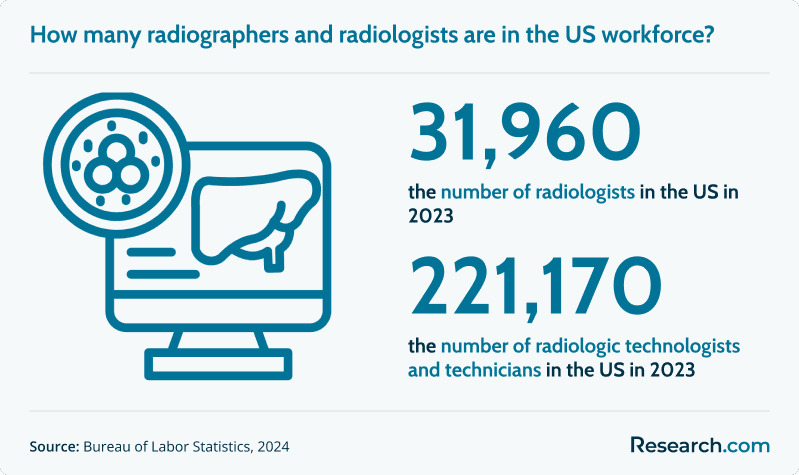
Start planning early. Radiography applicants should focus on prerequisites, accredited program admission, and clinical readiness. Future radiologists should plan for premedical coursework, physician shadowing, MCAT preparation, and a financing strategy. In 2023, there were around 31,960 radiologists and 221,170 radiologic technologists and technicians in the US.
Radiographer vs. Radiologist Degree Programs: How much do they cost?
Cost is one of the biggest decision points. Radiographer programs may be affordable, particularly at community colleges. The radiologist route includes undergraduate education plus medical school, so the total cost is much higher before full independent practice begins.
Radiographer degree costs
- Associate degree: The most common entry option is a two-year associate degree, with tuition typically ranging from $5,000 to $6,000 per year. In-state students at public community colleges may pay less than students attending private or out-of-state programs.
- Bachelor’s degree: A four-year radiologic sciences degree is not always necessary for entry-level practice, but it may help with specialization, leadership, or future graduate study. Annual costs range from $15,000 to $43,000+ per year, depending on the institution.
- Master’s degree: Some working technologists pursue graduate study for teaching, administration, research, or quality improvement roles. These programs typically cost $30,000 to $50,000+ in total.
- Indirect expenses: Published tuition does not cover every cost. Students should budget for books, technology, uniforms, immunizations, exam fees, transportation to clinical sites, housing, meals, and personal expenses. Some programs estimate indirect costs around $26,000 per year.
Radiologist education costs
- Undergraduate degree: Future radiologists must complete a bachelor’s degree before medical school. Tuition ranges from $10,000 to $40,000 per year, totaling $40,000 to $160,000.
- Medical school: Medical school tuition typically exceeds $50,000 per year, with total costs often reaching $200,000 to $300,000+.
- Residency: Radiology residents do not pay tuition for residency and typically receive a stipend of $60,000 to $70,000 per year. That income helps, but it may not fully offset debt accumulated earlier.
Total cost comparison
| Path | Estimated education cost stated | How to interpret the cost |
| Radiographer, associate degree | $7,000–$9,500 total | The lowest-cost option listed and the fastest common route into full-scope radiologic technology work |
| Radiographer, bachelor’s degree | $30,000–$50,000+ total | Potentially worthwhile for leadership, specialization, or degree-completion goals |
| Radiographer, master’s degree | $30,000–$50,000+ total | Most relevant for technologists targeting administration, education, research, or advanced professional roles |
| Radiologist, bachelor’s plus medical school | $240,000–$460,000+ total | Requires a physician career commitment and careful planning around borrowing and repayment |
What courses are typically in a radiographer degree program?
Radiographer coursework centers on producing diagnostic images safely, caring for patients, operating imaging equipment, and applying sound technical judgment. Associate degrees focus on entry-level practice, while bachelor’s programs often add advanced modalities, leadership, management, research, or quality improvement.
Common associate degree courses
- Radiographic procedures: Students practice patient positioning, imaging technique selection, and X-ray image production.
- Radiation physics: This course introduces X-ray generation, equipment operation, radiation behavior, and technical factors that influence image quality.
- Anatomy and physiology: Students learn body systems and structures so they can obtain accurate images and communicate clearly with clinical teams.
- Patient care and ethics: Training covers communication, privacy, safety, infection control, professional conduct, and patient support during exams.
- Clinical practicum: Supervised rotations in hospitals, clinics, or imaging centers give students hands-on experience with real patients and equipment.
Students who need flexibility can compare online associate radiology tech programs. Even when lectures are delivered online, clinical training must still be completed in person at approved sites.
Common bachelor’s degree courses
- Computed tomography and magnetic resonance imaging: Students study cross-sectional anatomy, scanning protocols, image reconstruction, and advanced imaging workflows.
- Healthcare administration: Management courses may cover staffing, budgeting, supervision, quality improvement, and imaging department operations.
- Radiation biology and protection: Students learn how radiation affects tissue and how to reduce unnecessary exposure for patients, staff, and themselves.
Master’s-level options for radiographers
A master’s degree in radiologic sciences is usually not required for front-line imaging jobs. It may make sense for experienced technologists who want to teach, manage imaging departments, contribute to research, work in healthcare administration, or lead quality and policy initiatives. The decision should be tied to a clear promotion or career-change goal.
What to look for in radiographer coursework
- Clinical experience that is extensive enough to build real patient-care confidence
- Preparation for certification exams and state licensure requirements
- Training in digital imaging, quality control, and radiation safety
- Transparent policies for clinical placement, transfer credit, progression standards, and dismissal rules
What courses are typically in a radiologist degree program?
Radiologist training is medical training first and imaging specialization second. Students build a science foundation in college, complete medical school, then train as radiology residents. Each stage adds depth: basic science, clinical medicine, imaging interpretation, and supervised physician practice.
Undergraduate coursework before medical school
Aspiring radiologists can choose different undergraduate majors, but they must complete the science courses needed for medical school admission. Common preparation includes:
- Biology: Courses such as anatomy, genetics, cell biology, and organismal biology help students prepare for medical science.
- Chemistry: General and organic chemistry support later work in biochemistry, physiology, and pharmacology.
- Physics: Physics provides a foundation for understanding energy, radiation, and imaging principles used in diagnostic medicine.
- Mathematics: Calculus and statistics strengthen quantitative reasoning for medical coursework and research interpretation.
- Psychology or social sciences: These courses support communication, behavioral understanding, and patient-centered care.
Medical school coursework
Medical school lasts four years and combines classroom instruction with clinical rotations. Early training usually emphasizes foundational medical sciences, while later training places students in supervised patient-care environments.
- Anatomy and physiology: Students examine human structure and function in the depth required for physician practice.
- Pathology: Future physicians learn how diseases develop and how abnormal findings appear across organ systems.
- Pharmacology: Students study medications, drug effects, interactions, and clinical decisions, including issues relevant to contrast agents.
- Clinical rotations: Students rotate through multiple specialties and may complete radiology electives before applying for residency.
Radiology residency training
After earning an MD or DO, graduates enter radiology residency, which lasts four to five years. Residency develops the skills needed to interpret imaging studies, communicate findings, and manage radiology consultations.
- Diagnostic imaging: Residents train across X-ray, CT, MRI, ultrasound, nuclear medicine, and other imaging modalities.
- Radiologic physics: Training includes imaging science, quality assurance, and radiation safety.
- Interventional radiology exposure: Residents may gain experience with image-guided procedures such as biopsies and catheter placements.
Some radiologists complete fellowships in neuroradiology, pediatric radiology, musculoskeletal radiology, interventional radiology, or another subspecialty. Practice settings vary; the largest number—around 20,000—work in physicians' offices, where the average salary is approximately $392,790. Other employers include general medical and surgical hospitals, medical and diagnostic laboratories, and academic institutions.
What are the specializations for the radiographer degree and radiologist degree programs?
Specialization helps imaging professionals move beyond a general starting point. Radiographers usually specialize by adding modality training, clinical experience, and post-primary credentials. Radiologists specialize through residency focus, board certification, and often fellowship training. Some professionals also strengthen their profiles with related healthcare certifications.
Radiographer specializations
- Magnetic resonance imaging: MRI technologists use MRI scanners to create detailed soft-tissue images. Additional certification, such as an ARRT credential, is commonly expected for this pathway.
- Computed tomography: CT technologists produce cross-sectional images using X-ray technology. CT may be introduced during degree coursework, but certification can be important for career mobility.
- Mammography: Mammography technologists perform breast imaging for screening and diagnostic purposes. Depending on the state, extra training or licensure may be required.
- Interventional radiology support: Radiographers in interventional settings assist physicians during minimally invasive image-guided procedures. This work may require post-primary certification or significant employer-based training.
- Bone densitometry: Technologists in this specialty perform scans used to evaluate bone density and osteoporosis risk. Training may be offered through shorter certificate options.
Radiologist specializations
- Neuroradiology: Focuses on imaging of the brain, spine, and nervous system, including stroke, tumors, and neurodegenerative disease.
- Pediatric radiology: Concentrates on imaging infants, children, and adolescents, requiring knowledge of child-specific anatomy and disease patterns.
- Musculoskeletal radiology: Covers bones, joints, muscles, and soft tissues, often supporting orthopedic, trauma, and sports medicine care.
- Cardiovascular radiology: Focuses on the heart and blood vessels to help evaluate cardiac and vascular conditions.
- Interventional radiology: Interventional radiologists are physicians who use imaging guidance to perform procedures such as stent placements and tumor ablations.
Certification and specialization planning
Radiographers may document specialized competence through ARRT credentials or the Nuclear Medicine Technology Certification Board. Radiologists typically pursue board certification through the American Board of Radiology and may add subspecialty credentials after fellowship training. Before committing to a specialty, confirm whether it requires a degree, state licensure, supervised clinical cases, post-primary certification, fellowship training, or employer-sponsored preparation.
Radiographer vs. Radiologist Degree Programs: How long do they take?
Radiography can lead to employment much sooner than radiology. The radiologist pathway is longer because it is a full physician training route. When comparing timelines, also consider opportunity cost: years spent in school are years before full-time professional earnings begin.
| Stage | Radiographer Timeline | Radiologist Timeline |
| Initial education | Associate degree, commonly two years | Bachelor’s degree before medical school |
| Professional school | Not required beyond radiography training for entry-level practice | Four years of medical school after the bachelor’s degree |
| Post-degree training | Certification and state licensure preparation may add time | Five-year radiology residency, with optional one- or two-year fellowship |
| Common entry point to practice | About two years for many full-scope radiologic technologist jobs | At least 13 years of education and training before independent practice |
Radiographer timeline
- Associate degree: A two-year associate degree in radiologic technology is the standard route for many radiologic technologist positions. It prepares students for clinical work and ARRT certification. Students comparing healthcare entry paths may also look at online nursing degrees you can finish in 12 months if they already have qualifying credits and are considering nursing instead.
- Certification and licensure: Graduates of accredited programs generally prepare for the ARRT exam and any required state licensure. Timing depends on exam dates, preparation, and state processing.
Note: The fastest way to become a radiology tech may involve limited-scope X-ray certificate training that takes about a year. That shorter path is not always the best long-term option because full-scope radiologic technologist roles usually require an associate degree.
Advanced education for radiographers
- Bachelor’s degree: A four-year radiologic sciences degree can support advanced modality training, supervisory roles, or future graduate study. This is similar to the distinction in an ADN program vs AAD and AAS nursing degrees comparison: associate-level education may qualify someone for practice in certain healthcare fields, while bachelor’s education can expand advancement options.
- Master’s degree and certifications: Additional education may help technologists move into administration, education, research, radiation therapy, MRI, or other specialized areas. Many graduate programs require an additional two years.
Radiologist timeline
- Medical school and residency: Radiologists complete four years of medical school after earning a bachelor’s degree, then complete a five-year radiology residency.
- Fellowship and board certification: Some radiologists complete one or two additional years of fellowship training in a subspecialty before meeting board certification and state licensure requirements for independent practice.
Radiographer vs. Radiologist: What are their responsibilities?
Radiographers and radiologists collaborate throughout the imaging process, but they do not do the same work. Radiographers acquire the images and care for patients during exams. Radiologists interpret the images and communicate medical findings to the care team.
Radiographer responsibilities
- Performing imaging exams: Radiographers operate X-ray, CT, MRI, and other imaging equipment according to physician orders and established protocols.
- Protecting patient safety: They verify procedures, position patients correctly, use dose-reduction practices when appropriate, and follow radiation safety rules.
- Supporting the patient experience: They explain exams, assist patients who are anxious or in pain, and adjust positioning for mobility limitations.
- Maintaining image quality: Radiographers evaluate whether images are properly positioned, technically acceptable, and clear enough for interpretation.
- Coordinating with healthcare teams: They communicate with radiologists, nurses, physicians, and other technologists to keep imaging services accurate and efficient.
Radiologist responsibilities
- Interpreting medical images: Radiologists review X-rays, CT scans, MRIs, ultrasounds, and other studies to identify normal and abnormal findings.
- Preparing diagnostic reports: They document findings, share results with referring physicians, and may recommend follow-up imaging or additional evaluation.
- Performing image-guided procedures: Interventional radiologists may perform biopsies, catheter placements, stent procedures, tumor ablations, and other minimally invasive treatments.
- Consulting on patient care: Radiologists help clinicians choose appropriate imaging studies and interpret findings in the context of a patient’s condition.
If you prefer direct patient interaction, technical procedures, and a faster entry into clinical work, radiography may be a better fit. If you want physician-level diagnostic authority and are prepared for years of advanced training, radiology may match your goals.
What are the financing and scholarship options for medical imaging education?
Your financing plan should match the size of the credential. Radiography students may reduce costs through community college tuition, transfer credits, employer tuition assistance, grants, and scholarships. Future radiologists need a longer financial strategy that accounts for undergraduate tuition, medical school debt, residency income, and repayment options.
Ways to reduce radiography education costs
- Choose an accredited community college program when it meets certification and state licensure requirements.
- Ask whether published tuition includes clinical fees, uniforms, background checks, immunizations, textbooks, and certification exam fees.
- Apply for federal grants, state grants, institutional aid, healthcare workforce scholarships, and work-study opportunities.
- Compare total program cost with local wages instead of relying only on national salary figures.
- Ask current or future employers whether they offer tuition assistance for bachelor’s completion or advanced modality training.
Students comparing healthcare credentials may also review adjacent program costs, such as how much is medical billing and coding school, to see how tuition, program length, and clinical requirements vary across healthcare fields. If you are weighing multiple patient-care careers, a respiratory therapy and nursing degree programs comparison can help you compare licensure, aid eligibility, flexibility, and long-term options.
How does work-life balance compare between radiographers and radiologists?
Work-life balance depends heavily on employer, setting, specialty, and seniority. Radiographers often work shift-based schedules in hospitals, emergency departments, outpatient imaging centers, and clinics. Hospital jobs may include evenings, weekends, holidays, or call, while outpatient imaging centers may offer more regular hours.
Radiologists typically earn more, but they also carry greater diagnostic responsibility. Their schedules may involve heavy reading volumes, emergency imaging, call coverage, procedure days, and rapid report turnaround. A hospital-based emergency radiologist may have a very different schedule from an outpatient diagnostic radiologist or a teleradiology physician.
| Work-life factor | Radiographer | Radiologist |
| Schedule predictability | Often shift-based; outpatient roles may provide more consistent hours | May include call, high-volume interpretation, procedures, and urgent consultations |
| Patient contact | Frequent direct interaction with patients | Varies; diagnostic radiologists may have less direct contact, while interventional radiologists have more |
| Stress sources | Physical demands, positioning challenges, time pressure, emergency cases, and radiation safety | Diagnostic responsibility, complex findings, liability, procedural risk, and workload pressure |
| Flexibility over time | May improve with modality specialization or outpatient employment | May improve with subspecialty choice, practice model, seniority, or tele-radiology arrangements |
Students who want to test healthcare work before committing to imaging may compare entry-level options and review medical assistant training cost as part of broader career planning.
Radiographer vs. Radiologist: How much do they earn?
Radiologists earn much more than radiographers because they are physicians who complete extensive education, residency training, licensure, and diagnostic preparation. Radiographers earn an average of $75,250 per year. Radiologists earn an average of $353,960 per year.
Radiography earnings compared with other associate-level healthcare careers
Radiography can offer competitive earnings relative to its training length. Radiologic and MRI technologists have a median salary of $76,020, which is higher than the stated earnings for health information technologists ($62,990) and veterinary technologists ($43,740). Top-paying states for radiographers include California ($103,150) and Massachusetts ($93,270).
How radiographers can increase earning potential
- Add post-primary credentials in CT, MRI, mammography, or interventional radiography support.
- Target settings or regions where specialized imaging skills command stronger pay.
- Complete a bachelor’s degree when it clearly supports supervision, education, or advanced modality opportunities.
- Evaluate tuition against salary goals before choosing an expensive degree-completion program.
For working radiographers, a cheap distance learning degree may be useful if it is accredited, recognized by employers, and tied to a specific advancement plan. The chart below shows average salary differences between radiographers and radiologists.
How are technological advancements transforming radiologic careers?
Medical imaging is increasingly digital, software-driven, and data-intensive. Radiographers work with digital imaging platforms, dose monitoring tools, advanced scanners, electronic health records, and image-processing systems. Radiologists use technology to manage high image volumes, prioritize studies, identify possible abnormalities, support reporting, and improve workflow.
Artificial intelligence should not be viewed as a simple replacement for imaging professionals. It is better understood as a workflow and decision-support tool. Radiographers still need patient-care skill, positioning expertise, safety judgment, and equipment knowledge. Radiologists still hold responsibility for interpretation, clinical communication, and diagnostic conclusions.
Skills becoming more important
- Fluency with digital imaging systems and picture archiving platforms
- Understanding of radiation dose optimization and quality assurance
- Ability to adapt to updated protocols, scanners, and software tools
- Commitment to continuing education and certification maintenance
- For radiologists, the judgment to evaluate AI-assisted findings critically rather than accepting them without review
Students considering faster healthcare entry while exploring imaging careers may also compare accelerated options such as What is the fastest you can become a medical assistant?.
What is the job outlook for radiographer degree and radiologist degree careers?
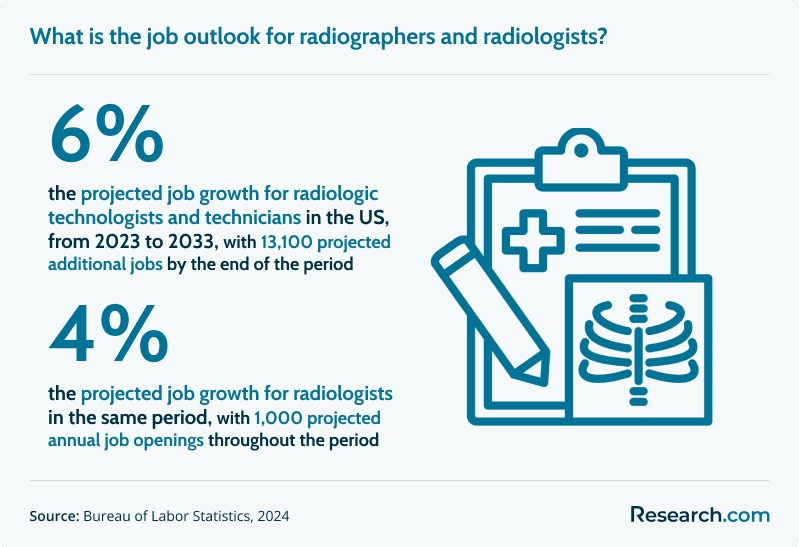
Radiologic technologists and technicians are projected to grow by 6% from 2023 to 2033, adding 13,100 new positions. Imaging remains central to diagnosis and treatment, and demand is also influenced by healthcare needs associated with an aging population.
Radiologists are projected to grow by 4% during the same period, with 1,000 annual job openings. Even with a slightly lower growth rate than radiologic technologists and technicians, radiologists remain essential for diagnosis, consultation, specialty care, and image-guided treatment planning.
Both occupations have meaningful healthcare demand, but they serve different needs. Radiographers help meet high-volume imaging service demand. Radiologists provide physician-level interpretation and clinical decision support.
How do accreditation and program quality affect career outcomes?
Accreditation and program quality can affect certification eligibility, state licensure, transfer credit, clinical readiness, and employer trust. A cheap program is not a bargain if it does not lead to the credential or license needed for employment.
Questions to ask before enrolling
| Question | Why it matters |
| Is the program accredited or accepted for certification and state licensure? | You may need recognized education to qualify for exams or licensure. |
| Where do students complete clinical rotations? | Clinical site quality affects hands-on training, networking, and job readiness. |
| What are the certification exam pass rates? | Pass rates can show whether coursework prepares students for credentialing. |
| What are the completion and job placement outcomes? | Graduation and employment data help you judge value beyond tuition price. |
| Do credits transfer into bachelor’s or advanced programs? | Transfer options matter if you plan to specialize or continue your education later. |
Students comparing imaging with other diagnostic careers may also research an ultrasound tech school to understand how sonography duties, training, and credentialing differ from radiography.
What role do professional associations and networking play in career development?
Professional associations help imaging professionals keep up with standards, continuing education, credential maintenance, and career opportunities. Networking is also valuable because clinical placements, mentorship, modality training, job referrals, and fellowship or practice opportunities often develop through professional relationships.
How networking helps radiographers and radiologists
- Introduces students to clinical mentors and potential employers
- Helps technologists learn about openings in MRI, CT, mammography, or interventional support
- Provides access to conferences, continuing education, and professional guidance
- Supports radiologists pursuing fellowship, academic appointments, research, or private-practice roles
- Creates pathways into leadership, quality improvement, healthcare policy, and department management
Some imaging professionals later add public health, policy, or management education. If that direction interests you, reviewing options such as the cheapest online masters in public health can help you decide whether population health or administration aligns with your goals.
What emerging trends are shaping medical imaging education?
Medical imaging programs are adapting as employers expect graduates to understand digital workflow, safety practices, interprofessional communication, and technology-supported care. Strong programs may include more training in AI-supported workflow, advanced protocols, data literacy, patient communication, and quality improvement.
Trends students should watch
- AI-assisted imaging workflows: Students should know where AI may help with triage, quality checks, and interpretation support, as well as where human judgment remains essential.
- Advanced modality demand: Skills in CT, MRI, mammography, and interventional support can improve advancement options for radiographers.
- Hybrid learning: Some schools offer online lecture coursework while requiring in-person clinical training.
- Credential stacking: Working technologists may add certifications over time rather than completing every credential at the start.
- Greater focus on patient experience: Imaging professionals must combine technical accuracy with empathy, safety, and clear communication.
Students pursuing physician-level radiology need a strong science foundation before medical school. Those seeking flexible science preparation can compare options such as the quickest bachelor's degree in biology online, while confirming that coursework satisfies medical school prerequisites.
What are the common challenges faced by radiography and radiology professionals?
Both fields can be meaningful, but they also require precision, resilience, ethical judgment, and ongoing learning. Students should understand these pressures before choosing a program.
Common challenges
- Technology changes quickly: Imaging professionals must keep pace with new scanners, protocols, software, and quality standards.
- Clinical work can be physically demanding: Radiographers may stand for long periods, move equipment, and help position patients with limited mobility.
- Radiation safety requires consistency: Imaging teams must follow safety protocols to protect patients, coworkers, and themselves.
- Radiologists carry diagnostic responsibility: Delayed or missed findings can have serious consequences, creating significant professional pressure.
- Burnout can occur: High patient volume, urgent cases, call schedules, physical demands, and administrative work can affect well-being.
- Rules can change: Professionals must maintain licensure, continuing education, and certification requirements as standards evolve.
A broader science background can improve long-term flexibility. Students still deciding among healthcare and science options may compare online biology degree programs, especially if they are considering medical school, research, or another health profession.
Can radiography and radiology degrees benefit from a healthcare administration online degree?
Yes, but usually after clinical experience. A healthcare administration credential is not required to become a radiographer or radiologist. It can be useful for professionals who want to move into supervision, operations, compliance, quality improvement, policy, or department leadership.
Radiographers may use administration training to pursue roles such as lead technologist, imaging supervisor, clinical coordinator, or department manager. Radiologists may benefit from management education when taking on medical director duties, practice leadership, service-line planning, or executive responsibilities. Professionals who need flexible study can explore a healthcare administration online degree if it matches their career stage and goals.
How do you choose between a radiographer degree and a radiologist degree career?
The right path depends on how much time, debt, academic intensity, and responsibility you are willing to take on. Radiography usually fits students who want to enter healthcare sooner, work directly with patients, and develop technical imaging expertise. Radiology fits students who want to become physicians, interpret complex imaging studies, and accept a long training path in exchange for higher earning potential and diagnostic authority.
Choose radiography if you want:
- A faster route into the medical imaging workforce
- Lower education costs than medical school
- Hands-on patient care and equipment-based clinical work
- Room to specialize in MRI, CT, mammography, or interventional radiology support
- A career that can often begin with an associate degree
Choose radiology if you want:
- To become a physician
- Authority to interpret imaging studies and make diagnostic judgments
- Higher earning potential after extensive training
- Subspecialty options such as neuroradiology or interventional radiology
- A career centered on medical decision-making, consultation, and advanced procedures
Consider another healthcare path if:
- You want healthcare work but are not sure imaging is the right specialty
- You need a shorter entry-level credential before committing to a degree
- You are unsure whether patient care, medical imaging technology, or physician training matches your strengths
- You prefer administration, coding, laboratory work, nursing, public health, or another allied health role
Students interested in radiography who need flexible study options can compare online medical degree programs, especially for bachelor’s completion or related healthcare advancement. Keep in mind that programs involving clinical practice still require in-person training.
If you are not ready to choose radiography or medical school, an entry-level healthcare role may help you test your interest. Reviewing medical assistant job duties can show how general patient-facing clinical work differs from imaging careers.
Common mistakes to avoid
| Mistake | Better approach |
| Choosing the cheapest program without checking quality | Confirm accreditation, certification eligibility, clinical placement quality, and graduate outcomes. |
| Assuming every online radiology-related program leads to licensure | Verify state rules and confirm that required in-person clinical training is included. |
| Comparing salaries without comparing training length | Include tuition, borrowing, lost earnings, residency duration, and lifestyle differences in the calculation. |
| Relying only on rankings | Evaluate fit, clinical sites, pass rates, total cost, transfer options, and employer reputation. |
| Assuming specialization happens automatically | Ask what certification, fellowship, supervised experience, or licensure is needed for the specialty. |
| Overlooking transfer credit rules | Check whether credits apply toward bachelor’s completion or future graduate study. |
Can additional healthcare credentials enhance your career opportunities?
Additional credentials can help when they are tied to a specific role. For radiographers, the most useful add-ons are often modality certifications, bachelor’s completion, leadership coursework, or healthcare administration training. For radiologists, fellowship training, board certification, research credentials, and leadership education may be more relevant.
Not every credential pays off. Before enrolling, ask whether employers recognize it, whether it qualifies you for a job you actually want, and whether the likely career benefit justifies the tuition and time. Some professionals explore broader healthcare pathways, including options such as a pharmacist degree online, but that represents a different career direction and should be evaluated separately.
Can radiography and radiology professionals transition to healthcare administration roles?
Yes. Imaging professionals often understand clinical workflow, documentation, compliance, patient safety, staffing, and quality control, which are all useful in healthcare administration. The transition is usually strongest after building clinical experience and then adding training in management, finance, operations, or leadership.
Possible administration roles for imaging professionals
- Lead technologist
- Imaging department supervisor
- Clinical education coordinator
- Radiology operations manager
- Quality and safety coordinator
- Imaging service-line administrator
- Medical director or physician leader for radiologists
Professionals planning to move from imaging into management can compare roles related to some of the highest paying administrative jobs in healthcare. The strongest path usually builds on clinical imaging experience rather than replacing it completely.
Key Insights
- Radiography and radiology share the medical imaging environment, but they lead to different professions. Radiographers perform imaging exams; radiologists are physicians who interpret images and guide diagnosis or treatment.
- Radiography is the faster and lower-cost route. Many students pursue a two-year associate degree, while radiologists complete undergraduate education, medical school, residency, licensure, and often fellowship training.
- The salary difference reflects the training and responsibility difference. Radiographers earn an average of $75,250 per year, while radiologists earn $353,960 per year.
- Both fields show continued labor-market demand. Radiologic technologists and technicians are projected to add 13,100 new positions from 2023 to 2033, while radiologists are projected to have 1,000 annual job openings.
- Specialization can expand options. Radiographers may move into CT, MRI, mammography, bone densitometry, or interventional support; radiologists may specialize in neuroradiology, pediatric radiology, musculoskeletal radiology, cardiovascular radiology, or interventional radiology.
- Program quality matters. Accreditation, certification eligibility, state licensure alignment, clinical placements, exam pass rates, and transfer policies should be checked before enrolling.
- Choose based on fit, not salary alone. Radiography is better for students who want hands-on imaging work sooner. Radiology is better for students committed to becoming physicians and prepared for a long, costly, demanding training process.
References:
- Bureau of Labor Statistics. (2024). Diagnostic medical sonographers and cardiovascular technologists and technicians. U.S. Department of Labor. Retrieved March 11, 2025, from BLS.
- Bureau of Labor Statistics. (2024). Occupational employment and wages, May 2023 - 29-1224 radiologists. U.S. Department of Labor. Retrieved March 11, 2025, from BLS.
- Bureau of Labor Statistics. (2024). Radiologic and MRI technologists. U.S. Department of Labor. Retrieved March 11, 2025, from BLS.
- CareerOneStop. (2024). Radiologists. U.S. Department of Labor. Retrieved March 11, 2025, from CareerOneStop.
- CareerOneStop. (2025). Radiologic technologists and technicians. U.S. Department of Labor. Retrieved March 11, 2025, from CareerOneStop.
Other Things You Should Know About Radiographer vs. Radiologist Degree Programs
In 2027, radiographers typically complete a 2-4 year undergraduate program focusing on medical imaging. In contrast, radiologists must complete a bachelor's degree, followed by medical school and a residency in radiology, often taking 12-15 years total.
Yes, a radiographer can become a radiologist, but it requires additional education and training. Radiographers typically hold an associate or bachelor's degree, while radiologists need a medical degree followed by residency. Transitioning requires completing medical school and specialized training in radiology.