
2027 Best Online Dental Hygiene Programs

Co-Founder and Chief Data Scientist
Choosing an online dental hygiene program is not the same as choosing a fully online general education degree. Dental hygiene is a licensed, hands-on healthcare profession, so students must look closely at accreditation, clinical requirements, state licensure rules, transfer credits, and whether a program is designed for new students or already licensed dental hygienists completing a bachelor’s degree.
This guide is for prospective dental hygiene students, licensed hygienists considering a bachelor’s completion program, dental assistants exploring advancement, and working adults comparing online healthcare degrees. It explains what online dental hygiene programs include, how they compare with campus programs, what they cost, which schools stand out, how licensure and accreditation work, and how to judge whether the investment fits your career goals.
Quick Answer: Are Online Dental Hygiene Programs Worth Considering?
Online dental hygiene programs can be a practical option if the program is accredited, accepted for licensure in your state, and matches your current education level. Many online options are degree-completion programs for licensed dental hygienists who already have an associate degree or certificate. Students who are new to the field usually still need in-person clinical training, labs, and supervised patient care.
- Dental hygienists in the US typically earn between $66,470 and $120,060 annually.
- The US Bureau of Labor Statistics reported a median annual salary of $94,260, or about $45.32 per hour, for dental hygienists.
- BLS projections show a 7% increase in dental hygienist employment through 2034, with about 15,300 openings expected each year.
- Online dental hygiene programs may take two to four years, depending on degree level, transfer credits, enrollment pace, and program design.
- Program costs commonly range from $12,000 to $36,500, though total expenses vary by school, residency status, fees, and required materials.
What can I expect from an online dental hygiene program?
An online dental hygiene program combines science-based oral health education with professional preparation for patient care, prevention, health education, and dental practice support. However, “online” can mean different things. Some programs deliver only didactic coursework online, while clinical training happens in person. Others are bachelor’s completion programs for licensed dental hygienists and may not require new clinical placements.
Coursework often covers dental radiology, periodontics, pharmacology, oral anatomy, patient assessment, dental materials, infection control, community dental health, and practice management. Students also build communication, documentation, critical thinking, patient education, and problem-solving skills.
Dental hygienists commonly perform oral health assessments, clean teeth, take or assist with X-rays, apply preventive treatments, educate patients on home care, document patient records, and work with dentists to support treatment plans. Because the role involves direct patient care, students should expect strict professional standards, clinical competency requirements, and state-specific licensing rules.
Where can I work with an online dental hygiene degree?
Graduates of accredited dental hygiene programs may work in several oral healthcare and public health settings, depending on licensure, education level, experience, and state practice regulations.
- Dental offices. Many dental hygienists work in private dental practices, where they provide preventive cleanings, screen for oral health issues, support treatment planning, educate patients, and maintain clinical records.
- Clinics. Community clinics, specialty clinics, and group practices may employ dental hygienists to provide preventive care, patient education, and support for broader dental services.
- Public health agencies. Dental hygienists may help deliver community oral health education, school-based outreach, prevention programs, screenings, and services for underserved populations.
- Education and training settings. Experienced hygienists with additional education may teach, train students, develop educational materials, or support continuing education programs.
- Dental product and business roles. Some professionals move into dental sales, practice management, consulting, research support, or product education.
Before enrolling, verify whether the program meets the licensing requirements in the state where you plan to work. Completing an online program does not automatically guarantee licensure eligibility in every jurisdiction.
How much can I make with an online dental hygiene degree?
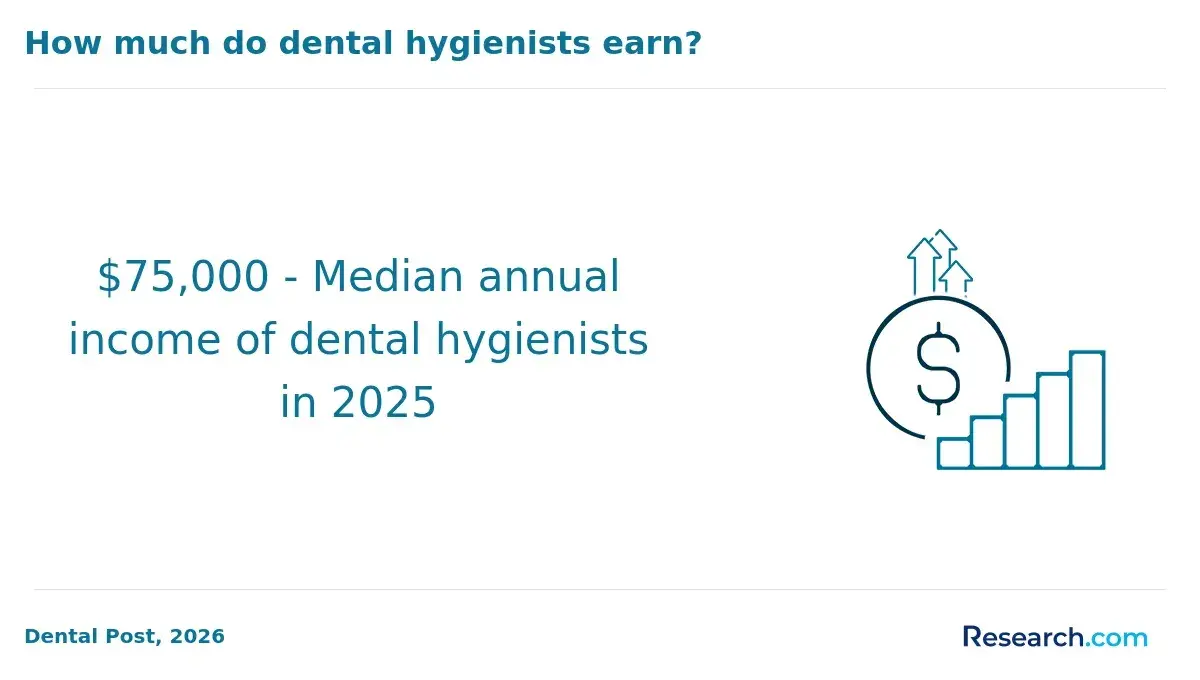
Salary depends on location, employer type, experience, schedule, credentials, and local demand. The US Bureau of Labor Statistics reported that dental hygienists earned a median annual salary of $94,260, or about $45.32 per hour. Dental Post reported a different figure, showing hygienists earning $75,000 yearly.
Across the US, dental hygienist earnings commonly range from $66,470 at the 10th percentile to $120,060 at the 90th percentile. Higher-paying markets can be competitive and may require experience, strong clinical skills, expanded functions where permitted, and flexibility in work setting or schedule.
- 2026 list of the best online dental hygiene programs
- How long does it take to complete an online dental hygiene program?
- How does an online dental hygiene program compare to an on-campus program?
- What is the average cost of an online dental hygiene program?
- What financial aid is available for online dental hygiene students?
- What are the prerequisites for enrolling in an online dental hygiene program?
- What courses are usually included in an online dental hygiene program?
- What specializations or focus areas are available?
- How should you choose the best online dental hygiene program?
- What should you do after completing an online dental hygiene program?
- What is the return on investment for an online dental hygiene degree?
- Can additional certifications improve your dental hygiene career?
- How can networking and mentorship help dental hygienists advance?
- Can accelerated healthcare certifications complement dental hygiene training?
- Do employers value online dental hygiene degrees?
- Are online dental hygiene programs accredited?
- Is an advanced degree useful for dental hygienists?
- What careers are available after an online dental hygiene program?
- What is the job market for dental hygiene graduates?
- How can you balance work, life, and online study?
- Can dental hygiene graduates transition into other healthcare fields?
- What advancement opportunities exist in dental hygiene?
- How to choose the right online dental hygiene program for your goals
2026 List of the Best Online Dental Hygiene Programs
How do we rank schools?
Research.com evaluates programs using a structured ranking methodology that considers institutional data, program characteristics, affordability, academic reputation, and other relevant indicators. For this list, data were reviewed from established sources, including:
- Peterson’s data set;
- College Scorecard database;
- National Center for Education Statistics; and
- IPEDS database.
Because dental hygiene is a licensure-connected field, rankings should be used as a starting point rather than the only basis for enrollment. Students should also confirm CODA accreditation, state authorization, clinical expectations, transfer policies, and licensure alignment before applying.
| School | Program length | Cost per credit | Credits required | Accreditation |
| Farmingdale State College | Two years | $295 (in-state); $708 (out-of-state) | 64 | Commission on Dental Accreditation (CODA) |
| Northern Arizona University | Four years | $377.87 | 120 | CODA |
| Eastern Washington University | Two years | $380 | 40 | CODA |
| University of Michigan-Ann Arbor | Four years | $1,115 (in-state); $2,731 (out-of-state) | 36 credits | CODA |
| Minnesota State University-Mankato | Two years | $356 | 32 | CODA |
| Old Dominion University | Two years | $393 (in-state); $423 (out-of-state) | 120 | CODA |
| Massachusetts College of Pharmacy and Health Sciences | Four years | $850 | 36 | CODA |
| Ohio State University-Main Campus | One to five years | $515 | 55 | CODA |
| University of Missouri-Kansas City | Four years | $465 (in-state); $625 (out-of-state) | 36 | CODA |
| Ferris State University | Three years | $526 | 60 | CODA |
1. Farmingdale State College
The Bachelor of Science in Dental Hygiene from Farmingdale State College is built for dental hygienists who want to expand their professional scope and prepare for broader responsibilities in oral healthcare. The curriculum connects dental hygiene theory with practical professional application. Applicants must hold an associate degree in dental hygiene accredited by the American Dental Association and must be licensed dental hygienists.
- Program Length: Two years
- Cost per Credit: $295 (in-state); $708 (out-of-state)
- Required Credits to Graduate: 64
- Accreditation: Commission on Dental Accreditation (CODA)
2. Northern Arizona University
Northern Arizona University offers a dental hygiene pathway structured across four 16-week semesters, a five-week summer session, and a two-week internship completed before classes begin. Meeting minimum admission criteria allows a student to apply, but it does not guarantee acceptance into the program.
- Program Length: Four years
- Cost per Credit: $377.87
- Required Credits to Graduate: 120
- Accreditation: CODA
3. Eastern Washington University
The Bachelor of Science in Dental Hygiene at Eastern Washington University follows a two-plus-two model. Students complete two years of prerequisites and university requirements, followed by two years, or five semesters, of dental hygiene coursework. Admission requires a certificate or associate degree.
- Program Length: Two years
- Cost per Credit: $380
- Required Credits to Graduate: 40
- Accreditation: CODA
4. University of Michigan-Ann Arbor
The Dental Hygiene Degree Completion program at the University of Michigan-Ann Arbor is intended for students who want advanced professional preparation in dental hygiene. The curriculum includes scientific reasoning, evidence-based practice, leadership, professional development, and care for specific population groups. Applicants must have valid dental hygiene licenses.
- Program Length: Four years
- Cost per Credit: $1,115 (in-state); $2,731 (out-of-state)
- Required Credits to Graduate: 36 credits
- Accreditation: CODA
5. Minnesota State University-Mankato
Minnesota State University-Mankato offers an online Dental Hygiene Degree Completion Program leading to a Bachelor of Science in Dental Hygiene. The program is designed for personal and professional growth among practicing hygienists. Applicants must hold a valid dental hygiene license and have a minimum GPA of 2.0.
- Program Length: Two years
- Cost per Credit: $356
- Required Credits to Graduate: 32
- Accreditation: CODA
6. Old Dominion University
Old Dominion University serves licensed dental hygienists seeking a bachelor’s degree. The degree completion program is fully online and does not require clinical components. Students may choose a fully online option or a hybrid format with some campus-based coursework. Undergraduates planning to continue to a master’s degree may apply up to 12 graduate credits to both degrees at the same time.
- Program Length: Two years
- Cost per Credit: $393 (in-state); $423 (out-of-state)
- Required Credits to Graduate: 120
- Accreditation: CODA
7. Massachusetts College of Pharmacy and Health Sciences
The Massachusetts College of Pharmacy and Health Sciences offers a bachelor’s completion option for associate-trained dental hygienists. The online format supports part-time study while students continue working, though one on-campus orientation in Boston is required before the fall start. Students study dental hygiene practice, general healthcare, and oral health, and may transfer up to 44 credits of arts and sciences coursework.
- Program Length: Four years
- Cost per Credit: $850
- Required Credits to Graduate: 36
- Accreditation: CODA
8. Ohio State University-Main Campus
Ohio State University offers a fully asynchronous bachelor’s degree completion program for licensed hygienists with an associate degree or certificate. Coursework includes contemporary dental hygiene issues, periodontal therapy, practice management, and research methods. The program is designed to align with distance education standards across most states.
- Program Length: One to five years
- Cost per Credit: $515
- Required Credits to Graduate: 55
- Accreditation: CODA
9. University of Missouri-Kansas City
The University of Missouri-Kansas City offers an online bachelor’s completion program that combines synchronous and asynchronous coursework. It is designed for registered dental hygienists who want a part-time format while continuing to work or manage other responsibilities. Graduates may pursue advancement in areas such as advanced clinical practice, program administration, public health, and research.
- Program Length: Four years
- Cost per Credit: $465 (in-state); $625 (out-of-state)
- Required Credits to Graduate: 36
- Accreditation: CODA
10. Ferris State University
Ferris State University offers an online dental hygiene degree completion program for students who have completed, or are in the final semester of, an associate degree in dental hygiene. The program is designed for online delivery and allows students to complete coursework with flexibility in time and location.
- Program Length: Three years
- Cost per Credit: $526
- Required Credits to Graduate: 60
- Accreditation: CODA
Key Findings About Online Dental Hygiene Programs
- Online dental hygiene programs commonly take two to four years, depending on degree type, enrollment pace, transfer credits, and program structure.
- Tuition for online dental hygiene programs typically ranges from $12,000 to $36,500.
- Students may qualify for federal grants, federal loans, work-study, scholarships, employer tuition assistance, or military education benefits.
- Admission requirements often include proof of high school completion, prerequisite coursework, recommendations, and a personal statement or essay.
- Dental hygienists earn a median annual salary of $94,260, with higher compensation reported in places such as the District of Columbia, California, and Washington.
- Employment for dental hygienists is projected to grow 7% through 2034, with about 15,300 openings expected annually.
How long does it take to complete an online dental hygiene program?
Completion time depends on whether you are entering the field for the first time or finishing a higher credential after becoming licensed. Many online bachelor’s completion programs are built for current hygienists and may be shorter than a full four-year pathway because they accept prior dental hygiene coursework.
- Program type. Associate programs often take two to three years, while bachelor’s programs may take four years or more. Degree-completion programs can be shorter for students with previous dental hygiene education.
- Enrollment status. Full-time students usually finish more quickly, while part-time students may need additional semesters.
- Transfer credits. Prior college coursework, general education credits, and dental hygiene credits can reduce the number of courses still required.
- Program structure. Some programs use fixed cohorts, while others offer more flexible pacing or accelerated options.
As with online pharmacy technician programs, the right timeline depends on your starting point, work schedule, and whether you can meet any clinical or in-person requirements.
How does an online dental hygiene program compare to an on-campus program?
The biggest difference is not course quality; it is delivery and clinical logistics. Accredited online and campus programs must cover rigorous professional content, but online students need to be especially careful about technology requirements, clinical placement expectations, state authorization, and whether the program is intended for licensure or degree completion.
| Factor | Online dental hygiene program | On-campus dental hygiene program |
| Best fit | Working hygienists, students needing flexible coursework, or learners completing a bachelor’s degree | Students who want structured, in-person labs, campus support, and direct faculty interaction |
| Schedule | Often more flexible, especially if courses are asynchronous | Usually follows set class, lab, and clinic times |
| Clinical training | May require approved local sites or may not include new clinical work in completion programs | Often integrated into campus clinics or nearby clinical sites |
| Learning environment | Uses recorded lectures, online discussions, interactive modules, and virtual meetings | Relies more on face-to-face instruction, live demonstrations, and campus-based labs |
| Cost considerations | May reduce commuting or relocation costs, but technology fees and online course fees can apply | May involve commuting, housing, parking, and campus-based fees |
| Accountability | Requires strong self-management and consistent study habits | Provides more built-in structure and direct peer interaction |
Scheduling
Online formats can make it easier to continue working, care for family, or study outside standard business hours. However, flexibility does not mean a lighter workload. Students still need time for lectures, assignments, exams, projects, and any required labs or clinical experiences.
Learning Environment
Campus programs provide immediate in-person access to instructors, classmates, labs, and clinical spaces. Online programs rely more heavily on digital learning platforms, discussion boards, video instruction, virtual office hours, and independent study.
Pace
Traditional programs often follow fixed weekly schedules and semester deadlines. Online programs may allow more control over when students complete coursework, although most still set due dates, exam windows, and progression rules.
Instructional Approaches
Online dental hygiene courses may use recorded lectures, interactive case studies, virtual discussions, live sessions, and digital simulations. Campus programs typically emphasize in-person lectures, demonstrations, labs, and direct supervised practice.
Courses
An accredited dental hygiene program should cover the professional knowledge required for safe and effective practice, regardless of delivery format. Online options may be offered at the associate, bachelor’s, master’s, or doctoral level, but students should confirm whether the program is designed for initial licensure or post-licensure advancement.
What is the average cost of an online dental hygiene program?
Research.com’s review found that online dental hygiene program costs generally range from $12,000 to $36,500. Your actual total may differ based on degree level, school reputation, program length, residency status, transferred credits, technology charges, textbooks, clinical materials, instruments, testing fees, and travel for any in-person requirements.
College Tuition Compare reported in-state tuition of $9,398 and out-of-state tuition of $25,841. Online programs may still involve additional costs, but they can reduce or eliminate some expenses tied to commuting, parking, relocation, and campus housing.
For on-campus students, living costs can significantly change the real price of attendance. The annual cost of living for on-campus college students falls just short of $15,000, while food expenses alone are estimated to be at least $400, which is twice the expected cost of preparing meals at home. Education Data also reported a 4% annual increase in higher education costs, resulting in more than a twofold rise throughout the 21st century.
The table below summarizes average total attendance costs for dental hygiene programs according to College Tuition Compare, 2025.
| Cost category | Reported amount |
| Vocational Program | $68,917 |
| In-State | $9,398 |
| Out-of-State | $25,841 |
What are the financial aid options for students enrolling in an online dental hygiene program?
Students in dental hygiene and related healthcare programs, including online medical office administration associate degrees, should compare aid options before deciding how much to borrow. Start with funding that does not need to be repaid, then evaluate federal loans before considering private loans.
Federal Financial Aid
- Free Application for Federal Student Aid (FAFSA). Completing the FAFSA is the main step for determining eligibility for federal grants, loans, and work-study, whether you study online or on campus.
- Federal Pell Grant. This need-based grant supports undergraduate students with exceptional financial need and does not have to be repaid.
- Direct Subsidized Loans. These federal loans are available to undergraduate students with demonstrated financial need. Interest does not accrue while the student is enrolled at least half-time.
- Direct Unsubsidized Loans. These loans are not based on financial need. Interest accrues while the student is in school and during grace periods.
Scholarships and Grants
Dental hygiene students may find scholarships through dental associations, professional organizations, schools, community foundations, and healthcare groups. Eligibility may be based on academics, financial need, career goals, service commitment, or membership status.
Employer Assistance
Some dental practices, clinics, hospitals, or healthcare employers offer tuition reimbursement, continuing education support, or loan repayment assistance. Working hygienists considering bachelor’s completion programs should ask HR or practice leadership about education benefits before enrolling.
Military Tuition Assistance
Active-duty service members and eligible dependents may qualify for military tuition assistance or education benefits that can reduce out-of-pocket costs.
Private Loans
Private loans can help fill remaining funding gaps, but they often have different borrower protections, interest rates, and repayment terms than federal loans. Compare repayment obligations carefully before borrowing.
What are the prerequisites for enrolling in an online dental hygiene program?
Admission requirements vary sharply because some programs admit first-time dental hygiene students, while others accept only licensed dental hygienists. Always read the admissions page carefully and confirm whether you meet both academic and professional requirements.
Common Admission Requirements
- Educational background. Applicants generally need a high school diploma or equivalent. Some programs require college prerequisites such as biology, chemistry, anatomy, or physiology.
- Prior dental hygiene credential. Many online bachelor’s completion programs require an associate degree, certificate, current dental hygiene license, or registered dental hygienist status.
- GPA. Schools commonly set a minimum GPA, often around 3, although requirements differ by institution.
- Standardized tests. Some programs may request SAT, ACT, TOEFL, IELTS, or GRE scores, depending on the applicant and degree level.
- Letters of recommendation. Applicants may need references from teachers, counselors, supervisors, or healthcare professionals who can speak to their readiness.
- Personal statement or essay. Many schools ask students to explain their motivation, professional goals, and fit for dental hygiene.
Online healthcare programs, including online public health programs, are often chosen for flexibility. Still, flexibility does not replace licensure planning. Students should verify whether online coursework, clinical expectations, and state rules align with their intended career location.
Prerequisite Skills
- Communication. Dental hygienists must explain procedures, calm anxious patients, document clearly, and collaborate with dentists and staff.
- Critical thinking. Students need to interpret patient information, identify oral health risks, follow protocols, and respond appropriately during care.
- Manual dexterity. The profession requires precise hand skills, hand-eye coordination, and safe use of dental instruments.
- Time management. Online students must manage coursework, deadlines, exams, and clinical or work responsibilities without constant in-person reminders.
- Technology readiness. Students need reliable internet access, compatible devices, and comfort using learning platforms, video tools, and digital resources.
What courses are typically in an online dental hygiene program?
Courses vary by degree level, but accredited dental hygiene programs generally combine biomedical science, oral health theory, patient care, ethics, public health, and professional practice. Students who previously completed online dental assistant certificate programs may recognize some introductory concepts, but dental hygiene education goes deeper into assessment, prevention, instrumentation, and patient management.
- Oral Anatomy and Physiology. Students study the structure and function of teeth, gums, oral tissues, and supporting systems.
- Dental Radiography. This course covers safe X-ray techniques, radiation protection, image capture, processing, and interpretation basics.
- Dental Hygiene Fundamentals. Students learn patient assessment, charting, infection control, instrumentation, preventive care, and patient education.
- Periodontology. Coursework focuses on gum disease, supporting tooth structures, assessment, treatment planning, and maintenance of periodontal health.
- Dental Pharmacology. Students examine medications used in dental care, side effects, interactions, and implications for treatment.
- Dental Materials. This course introduces common materials such as cements, impression materials, and restorative materials used in dental settings.
- Dental Health Education and Promotion. Students learn how to teach patients about oral hygiene, prevention, nutrition, and behavior change.
- Community Dental Health. Coursework examines oral health disparities, public health principles, community outreach, and prevention programs.
- Practice Management. Some programs include documentation, billing concepts, insurance, leadership, compliance, and workflow in dental offices.
What types of specializations are available in online dental hygiene programs?
Most online dental hygiene programs emphasize the core education needed for professional practice or degree completion. Some programs offer electives, concentrations, or projects that let students focus on a career interest. These focus areas may not always be formal specializations, but they can help students build targeted skills.
- Public Health Dental Hygiene. Focuses on community prevention, oral health education, underserved populations, and public health outreach.
- Gerontology and Dental Hygiene. Examines oral health needs among older adults, including age-related conditions and care considerations.
- Oral Pathology and Radiology. Builds stronger skills in identifying oral abnormalities and interpreting dental imaging.
- Dental Education and Training. Prepares students to teach patients, support workshops, train staff, or move toward academic roles.
- Dental Practice Management. Covers administrative, operational, billing, coding, compliance, and leadership topics in dental practices.
Formal advanced specializations may require additional education, certification, or state-specific authorization beyond a standard online dental hygiene curriculum. Like the top genetic counseling programs, specialized healthcare preparation often depends on credentialing rules, supervised experience, and post-degree training.
How to choose the best online dental hygiene program?
The best online dental hygiene program is the one that matches your licensure needs, academic background, schedule, budget, and career goal. A highly ranked program is not useful if it does not accept students from your state, fails to meet your licensing pathway, or does not transfer enough of your previous credits.
- Confirm availability in your location. Ask whether the program accepts students from your state or country and whether state authorization restrictions apply.
- Check CODA accreditation. The most important program-level accreditor in dental hygiene is CODA. Accreditation can affect licensure eligibility, employer confidence, and credit transfer.
- Clarify the target student. Determine whether the program is for new students, dental assistants, licensed hygienists, or associate-trained hygienists completing a bachelor’s degree.
- Review clinical and in-person requirements. Ask whether labs, externships, practicums, orientations, exams, or campus visits are required.
- Compare course delivery. Asynchronous programs offer more scheduling control, while synchronous programs require live attendance. Hybrid programs may include both online and in-person work.
- Study transfer credit rules. Transfer policies can affect your timeline and total cost more than the advertised tuition rate.
- Calculate total cost. Include tuition, technology fees, books, instruments, background checks, uniforms, exam fees, travel, and lost work hours.
- Evaluate support services. Look for advising, technical support, tutoring, library access, career services, licensure guidance, and faculty availability.
- Verify technology requirements. Make sure your device, internet speed, software, webcam, and exam monitoring setup meet program expectations.
How to Choose the Right Online Dental Hygiene Program for Your Goals
Start with your end goal and work backward. A student seeking first-time licensure needs a different program than a licensed hygienist who wants a bachelor’s degree for teaching, public health, leadership, or graduate school.
Step 1: Identify your current status
- Are you a high school graduate or career changer with no dental background?
- Are you a dental assistant looking to move into dental hygiene?
- Are you already a licensed dental hygienist with an associate degree or certificate?
- Are you preparing for graduate study, education, public health, or management?
Step 2: Match the program to your licensure plan
Contact the state dental board where you plan to work. Ask whether the program’s accreditation, clinical structure, and degree type meet licensure requirements. Do not rely only on a school’s national reputation.
Step 3: Compare affordability beyond tuition
Tuition is only one part of cost. Include fees, books, clinical supplies, travel, exam costs, and the time you may need to reduce work hours. If price is a major concern, compare broader affordable online options such as the most affordable online colleges for working adults, then verify whether any relevant dental hygiene pathway meets your professional requirements.
Step 4: Ask the program direct questions
- Is this program CODA-accredited?
- Does it meet licensure requirements in my state?
- Is it intended for initial licensure or degree completion?
- How many credits will transfer from my prior coursework?
- Are any campus visits, labs, practicums, internships, or clinical hours required?
- What percentage of students complete the program?
- What support is available for online students?
- What is the total estimated cost, including fees and materials?
Step 5: Choose based on fit, not only ranking
Rankings can help narrow your list, but the final decision should depend on accreditation, licensure compatibility, cost, transfer credit, scheduling, clinical requirements, and your intended career path.
What’s next after an online dental hygiene program?
After finishing an online dental hygiene program, your next step depends on whether you are seeking initial licensure, advancing as a current hygienist, or preparing for a nonclinical role. New graduates may need to complete state licensing exams, submit transcripts, pass background checks, and satisfy state board requirements. Licensed hygienists completing a bachelor’s degree may use the credential to pursue leadership, education, public health, research support, or graduate study.
Some graduates add targeted credentials in periodontal therapy, pediatric dentistry, radiography, practice management, or patient education. Others broaden their healthcare profile through medical certificate programs that complement dental hygiene experience.
Students who want to move beyond clinical practice may consider bachelor’s or master’s study in public health, healthcare administration, education, or healthcare management. These paths can support roles in program coordination, policy, teaching, administration, and community health.
What is the return on investment for an online dental hygiene degree?
ROI depends on the relationship between total program cost, time to completion, licensing eligibility, salary potential, and career mobility. A lower-cost program is not automatically the best investment if it delays licensure, does not meet your state’s requirements, or accepts few transfer credits. A more expensive program may still be reasonable if it shortens your timeline, supports advancement, or fits your work schedule.
To estimate ROI, compare tuition and fees against likely earnings in your state and desired setting. Also consider whether online study lets you keep working, avoid relocation, reduce commuting costs, or finish a bachelor’s degree while maintaining income. For hygienists planning long-term advancement, later graduate study through online master degree programs may expand opportunities in education, administration, public health, or leadership.
Can additional certifications boost my dental hygiene career?
Additional certifications can help dental hygienists build focused skills, but they should be chosen carefully. The best credential is one that supports your actual role, is respected by employers, and meets any state-specific practice rules. Useful areas may include infection control, radiography, local regulations, patient communication, practice management, or public health education.
Hygienists interested in administrative or operational roles may also benefit from understanding reimbursement, documentation, and coding. For example, learning about medical billing and coding certification cost can help professionals compare administrative training options before investing in an additional credential.
How can networking and mentorship drive my career success in dental hygiene?
Career growth in dental hygiene often comes from more than technical skill. Mentors, professional associations, continuing education events, dental conferences, and online professional communities can help hygienists learn about job openings, expanded roles, new technologies, leadership paths, and graduate programs.
Mentorship is especially valuable for hygienists who want to move into teaching, public health, research, sales, or management. A mentor can help you understand which credentials matter, how to document clinical accomplishments, and when an advanced degree is worth the cost. Professionals comparing broader healthcare compensation paths may also review the highest paid medical jobs to understand how dental hygiene fits within the wider healthcare labor market.
Can accelerated healthcare certifications complement my online dental hygiene degree?
Accelerated healthcare certifications can be useful when they add skills that dental hygiene alone does not cover. They may support cross-training, administrative flexibility, patient support, or career exploration. However, they should not distract from licensure requirements or replace accredited dental hygiene training.
For example, fast medical assistant programs may appeal to students who want broader clinical exposure or a quicker entry point into healthcare while planning a longer dental hygiene pathway. Before enrolling, compare scope of practice, employer demand, certification recognition, and whether the credential helps your specific goal.
Do employers value online dental hygiene degrees?
Employers are most likely to value an online dental hygiene degree when it comes from an accredited institution, aligns with licensing expectations, and is supported by strong clinical preparation or relevant professional experience. For degree-completion programs, employers often focus less on the online format and more on whether the hygienist is licensed, competent, reliable, and able to contribute to patient care or practice goals.
Applicants can strengthen the value of an online credential by documenting clinical experience, continuing education, certifications, patient education work, leadership responsibilities, and measurable practice contributions. Similar to students comparing healthcare pathways such as best accelerated PharmD degree programs, dental hygiene students should prioritize accreditation, outcomes, and professional recognition over convenience alone.
Are online dental hygiene programs accredited to meet industry standards?
Accreditation is one of the most important checks in dental hygiene education. CODA accreditation indicates that a dental hygiene program has been evaluated against recognized standards for curriculum, faculty, clinical preparation, assessment, and program quality. Institutional accreditation also matters for financial aid eligibility, transfer credit, and graduate school admission.
Students should verify accreditation directly through official school pages and accreditor resources. Do not assume that every online healthcare program is appropriate for licensure. Accredited programs may also provide a stronger foundation for future healthcare study, including options such as affordable online doctorate in pharmacy programs, if a student later decides to pursue a different advanced clinical path.
Is pursuing an advanced degree beneficial for my dental hygiene career?
An advanced degree may be useful for dental hygienists who want to move beyond chairside clinical care. Graduate education can support roles in teaching, public health, research, administration, healthcare leadership, and policy. It may be less necessary for hygienists who want to remain primarily in clinical practice unless a specific employer or role requires it.
Before committing to graduate school, compare the cost with the roles you want. A healthcare administration pathway may help hygienists interested in operations, staffing, compliance, budgeting, or organizational leadership. Students evaluating this route can review the benefits of a master’s in healthcare administration before deciding whether the degree fits their career goals.
What career paths are available for graduates of online dental hygiene programs?
An online dental hygiene degree can support several career directions, especially when paired with licensure, experience, and targeted professional development.
- Dental Hygienist. Dental hygienists provide preventive oral care, assess oral health, clean teeth, support treatment plans, educate patients, and maintain records. The average annual salary is $94,260, though pay varies by location, experience, employer, and schedule.
- Oral Health Educator. Oral health educators teach individuals and communities about prevention, oral hygiene, and access to care. They may work with schools, nonprofits, clinics, or public health programs. The average annual salary is $50,531.
- Dental Sales Representative. Professionals in this path use dental knowledge to explain, demonstrate, and sell dental products or equipment. The average income for this path is around $93,694.
Dental hygienist salaries may be lower than the national average starting salary for dentists, but the education length, cost, licensing pathway, and scope of practice are also different. Salaries can vary substantially based on geography, work setting, experience, and local demand. States such as Alaska, California, and Washington may offer above-average compensation.
The chart below shows average annual salaries for selected career paths available to online dental hygiene program graduates.
What is the job market for graduates of online dental hygiene programs?
The labor market for dental hygienists is supported by preventive oral healthcare needs, an aging population, and ongoing demand for dental services. According to BLS, dental hygienist employment is expected to grow 7% through 2034, which is faster than the average for all occupations.
There were about 221,600 dental hygienist positions in the US, and projections indicate about 15,300 job openings each year over the next decade. Job availability will still vary by state, metropolitan area, rural access needs, employer type, and local competition.
How can I balance work, life, and studying while enrolled in an online dental hygiene program?
Online dental hygiene programs can be flexible, but they are still demanding. Students often underestimate the time needed for science courses, clinical preparation, exams, projects, and group assignments. A realistic schedule is essential, especially for working adults and parents.
- Build a weekly study calendar. Block time for lectures, readings, assignments, exam review, and discussion posts. Treat study time like a work shift.
- Use small, measurable goals. Instead of planning to “study all weekend,” set goals such as finishing one module, reviewing radiography terms, or completing a case assignment.
- Use asynchronous flexibility wisely. If lectures are recorded, watch them during your most productive hours rather than postponing work until deadlines pile up.
- Talk with your employer early. If you are working, ask whether flexible hours, reduced overtime, shift adjustments, or tuition support are possible.
- Create a support system. Tell family members, friends, and classmates when you need protected study time or help with daily responsibilities.
- Protect your health. Sleep, nutrition, exercise, and breaks matter. Burnout can damage academic performance and clinical readiness.
- Prepare for peak weeks. Midterms, finals, clinical deadlines, and major projects require extra time. Plan ahead before those periods arrive.
Are there any other healthcare fields I can transition into with an online dental hygiene degree?
Dental hygiene can provide a foundation for movement into public health, healthcare administration, education, sales, research support, and practice management. Some hygienists use their clinical background to shift toward operations or leadership roles in healthcare organizations.
If healthcare administration is your target, compare relevant degree pathways, including accelerated MHA programs online. Before switching fields, consider whether you want less clinical work, more leadership responsibility, broader healthcare policy exposure, or a different salary-growth path.
What career advancement opportunities are there in dental hygiene?
Career advancement in dental hygiene usually comes from a combination of experience, continuing education, expanded responsibilities, certifications, bachelor’s or graduate education, and professional networking. Common advancement paths include:
- Dental Hygiene Educator. Experienced hygienists may teach in dental hygiene or dental assisting programs. A master’s degree or education-focused credentials may be required for some teaching roles.
- Periodontal Therapy Specialist. Hygienists may deepen their expertise in gum disease management, scaling and root planing, maintenance care, and advanced periodontal protocols.
- Public Health Dentistry. Public health-focused hygienists may design prevention programs, conduct outreach, educate communities, and work to improve access to oral healthcare.
- Oral Health Researcher. Research-oriented professionals may work with academic institutions, public health agencies, or organizations studying oral disease, prevention, and treatment methods.
- Management and Leadership Roles. Dental hygienists with business or healthcare administration training may supervise teams, coordinate clinical workflows, manage compliance, or support dental practice operations.
Advanced roles often require specialized knowledge that overlaps with science, healthcare systems, management, or education. Students comparing broader science-related options may also find it useful to review high-paying careers for biology majors to understand how advanced healthcare and life science skills can translate across roles.
Common Mistakes to Avoid When Choosing an Online Dental Hygiene Program
| Mistake | Why it creates problems | Better approach |
| Choosing a program without checking CODA accreditation | It may affect licensure eligibility, employer recognition, and credit transfer. | Verify accreditation with the school and accrediting body before applying. |
| Assuming every online program leads to licensure | Many online programs are degree-completion options for already licensed hygienists. | Confirm whether the program is for initial licensure or post-licensure advancement. |
| Looking only at tuition | Fees, instruments, exams, travel, books, and lost work hours can change the true cost. | Request a full cost estimate from the program. |
| Ignoring state requirements | Dental hygiene licensure rules vary by state. | Contact your state dental board before enrolling. |
| Overlooking clinical logistics | Some programs require local clinical sites, campus visits, internships, or labs. | Ask exactly where and how clinical requirements are completed. |
| Relying only on rankings | A ranked program may not fit your schedule, budget, state, or transfer-credit situation. | Use rankings as a shortlist, then compare fit and licensure alignment. |
Current Trends Affecting Dental Hygiene Students
- Preventive care remains central. According to the Centers for Disease Control and Prevention, over a quarter of Americans have untreated dental cavities, and more than half of adults aged 30 and older show signs of gum disease. This reinforces the need for prevention, patient education, and access to oral healthcare.
- Digital tools are changing practice. Dental hygienists increasingly work with digital imaging, electronic health records, patient education software, and practice management systems.
- Teledentistry and remote education are expanding access. Online learning and virtual communication tools can support education and consultation, but hands-on clinical competence remains essential.
- Employers value adaptable hygienists. Skills in patient communication, technology, documentation, infection control, and interdisciplinary care can help graduates stand out.
- Credential planning matters more. As online options grow, students must be more careful about accreditation, state authorization, and whether a program supports licensure or advancement.
Key Insights
- Online dental hygiene programs are most valuable when they are accredited, licensure-aligned, affordable, and appropriate for your current education level.
- Many online programs are bachelor’s completion pathways for licensed dental hygienists, not entry-level programs for students with no clinical background.
- Dental hygienists earn a median annual salary of $94,260, with reported earnings ranging from $66,470 to $120,060 depending on percentile, location, and experience.
- The field is projected to grow 7% through 2034, with about 15,300 openings expected annually, but local job markets still vary.
- Total cost matters more than tuition alone. Include fees, transfer credits, clinical expenses, technology, travel, and time away from work.
- CODA accreditation and state licensure compatibility should be checked before applying, not after admission.
- The best program is not automatically the highest ranked. It is the one that fits your licensing plan, schedule, budget, transfer-credit profile, and long-term career goal.
References:
- American Dental Association. (2025). 2025-26 Survey of Dental Hygiene Education Programs. Commission on Dental Accreditation. https://www.ada.org/resources/research/health-policy-institute/dental-education
- Dental Post. (2026). 2026 Dental Salary Survey Report. https://www.dentalpost.net/blog/2026-salary-survey-report-breakdown
- Hanson, M. (2026, February 14). Average Cost of College & Tuition. Education Data Initiative. https://educationdata.org/average-cost-of-college
- U.S. Bureau of Labor Statistics. (2024, May). Occupational Employment and Wage Statistics Query System. Retrieved February 2026, from https://data.bls.gov/oes/#/industry/000000
- U.S. Bureau of Labor Statistics. (2025, August 28). Occupational projections, 2024–2034, and worker characteristics, 2024. Retrieved February 2026, from https://www.bls.gov/emp/tables/occupational-projections-and-characteristics.htm
- ZipRecruiter. (2026). Dental Sales Representative Salary. Retrieved February 2026, from https://www.ziprecruiter.com/Salaries/Dental-Sales-Representative-Salary
Other Things You Should Know About Online Dental Hygiene Programs
In 2027, prerequisites for top online dental hygiene programs typically include a high school diploma or GED, completion of science courses like biology and chemistry, and sometimes healthcare experience. Some programs may also require specific standardized test scores or CPR certification.
An online dental hygiene program should be accredited by the Commission on Dental Accreditation (CODA). CODA accreditation matters because most state dental boards require graduation from a CODA-accredited program before allowing licensure, and nonaccredited programs may not qualify you for the National Board Dental Hygiene Examination.


