
2027 Fastest Online Exercise Science Degree Programs

Co-Founder and Chief Data Scientist
Exercise science draws in learners who are driven by movement, performance, and health. Whether you’re passionate about coaching, rehabilitation, or optimizing the human body, this field attracts people who want their careers to stay active and hands-on.
Online degree programs now make it easier to pursue this path with efficient, remote-first learning structures that reduce delays and fast-track entry into applied roles across fitness, healthcare, and sports science.
In this article, I’ll walk you through what to expect from the fastest online exercise science degree programs available today. I’ll explore how quickly you can complete this degree, what kinds of transfer credits and prior experience may shorten your timeline, and how these programs are structured to keep momentum high.
What are the benefits of getting an online exercise science degree?
- Online exercise science degree graduates work in healthcare, fitness, education, and corporate wellness sectors, entering roles in hospitals, gyms, schools, and labs.
- Graduates may earn median annual salaries of $58,160 as physiologists, $60,250 as athletic trainers, and $44,190 as fitness instructors.
- Accelerated online formats allow students to complete degree requirements in less time, supporting quicker access to job opportunities.
What can I expect from online exercise science degree programs?
Online exercise science degree programs are built to deliver both academic depth and practical preparation for careers in human performance, fitness, and allied health. Coursework typically blends foundational science with applied techniques, moving from anatomy and biomechanics to exercise prescription, nutrition, and behavior change.
Some programs also incorporate coaching theory or kinesiology labs, which are adapted for remote delivery. Capstone projects or internships often round out the experience, giving students a way to demonstrate professional readiness.
Because these programs are designed with flexibility in mind, online learners benefit from features that support both pacing and accessibility. Asynchronous courses allow students to complete lectures, discussions, and assessments on their own schedule. Many programs offer year-round enrollment or short-format terms, which can help motivated students graduate faster.
Virtual labs, streaming demonstrations, and mobile-friendly platforms make it easier to complete skill-based content without sacrificing rigor. Instructors typically remain accessible through video advising, email, and discussion boards, ensuring support even across time zones.
Altogether, the online format emphasizes efficiency and continuity, especially for learners who want to move into the field without long delays.
Where can I work with an online exercise science degree?
Graduates of online exercise science degree programs are qualified to work across several industries where knowledge of human movement, performance, and wellness is applied. The flexibility of online learning often allows students to enter the workforce more quickly, helping them meet demand in growing fields that prioritize efficiency and health-focused outcomes.
Here are the primary sectors where graduates commonly find employment:
- Healthcare and Rehabilitation: Hospitals, outpatient clinics, cardiac rehab centers, and sports medicine facilities rely on exercise science professionals to support therapeutic exercise programming and assist with recovery-based interventions.
- Fitness and Recreation: Health clubs, community fitness centers, and athletic training facilities hire graduates to lead exercise sessions, design performance plans, and supervise recreational wellness programs.
- Education: K–12 schools and community colleges offer opportunities in physical education, coaching, and support roles for those with additional certifications or advanced study in teaching and curriculum development.
- Corporate Wellness: Employers across sectors develop internal wellness and injury prevention programs where exercise science graduates contribute through fitness assessments, ergonomic planning, and health promotion strategies.
- Research and Public Agencies: Universities, research labs, and government organizations engage exercise science graduates in data collection, human performance monitoring, and workplace health studies.
Whether your goals involve working directly with clients, supporting healthcare teams, or contributing to population-level wellness, an online exercise science degree offers a flexible and time-efficient entry point into a wide range of impactful careers.
How much can I make with an online exercise science degree?
Online exercise science degree graduates enter a range of fields where salaries reflect the blend of clinical knowledge and practical skills gained during their training. According to the Bureau of Labor Statistics (BLS), earnings vary by role and setting, but most positions offer solid starting pay with upward mobility. Accelerated online formats can also reduce the time to employment, allowing professionals to begin earning sooner.
Here are a few of the most common roles and what professionals in each can typically expect to earn:
- Exercise Physiologists: Median annual wage of $58,160, with the middle 50% earning between $35,460 and $54,860 (BLS, 2024).
- Athletic Trainers: Median annual wage of $60,250, with the middle 50% earning between $48,800 and $75,780 (BLS, 2025).
- Fitness Trainers and Instructors: Median annual wage of $44,190, with earnings ranging from $28,690 to $76,100 depending on setting and experience (BLS, 2024).
Some graduates also move into wellness coordination, strength and conditioning, or preventive health roles where salaries may align with health education and program management fields. Completing a fast-paced online program allows graduates to enter these income-producing roles more quickly, making it easier to start gaining experience and building toward higher-paying opportunities.
- List of Online Exercise Science Degree Programs for 2027 Programs List
- How long does it typically take to complete an accelerated online exercise science degree? How long does it typically take to complete an accelerated online exercise science degree?
- How do fast-track online exercise science degree programs compare to on-campus programs? How do fast-track online exercise science degree programs compare to on-campus programs?
- What is the average cost of accelerated online exercise science degree programs? Average Cost
- What are the financial aid options for students enrolling in online exercise science degree programs? Financial Aid
- What are the prerequisites for enrolling in online exercise science degree RN programs? Program Prerequisites
- What courses are typically in online exercise science degree programs? What courses are typically in online exercise science degree programs?
- What types of specializations are available in online exercise science degree programs? Specializations
- How to choose the best fast-track online exercise science degree programs? How to choose the best fast-track online exercise science degree programs?
- What career paths are available for graduates of online exercise science degree programs? Career Paths
- What is the job market for graduates of online exercise science degree programs? Job Market
- Are fast-track online exercise science programs accredited and recognized by industry? Are fast-track online exercise science programs accredited and recognized by industry?
- Are fast-track online exercise science degrees suitable for every learning style? Are fast-track online exercise science degrees suitable for every learning style?
- How do fast-track online exercise science degrees compare to other online health-related degrees? How do fast-track online exercise science degrees compare to other online health-related degrees?
- What challenges might impact success in a fast-track online exercise science degree? What challenges might impact success in a fast-track online exercise science degree?
Fastest Online Exercise Science Degree Programs for 2026
Choosing an accelerated online exercise science degree is not just about finding the shortest program. The better question is whether a program can help you graduate sooner while still giving you the science foundation, applied experience, accreditation, and career preparation needed for fitness, wellness, coaching, rehabilitation support, or graduate study.
This guide is for students who want a flexible bachelor’s degree in exercise science, kinesiology, health and human performance, or a closely related field without spending more time or money than necessary. You will learn which online programs offer faster pacing, generous transfer policies, certification preparation, field experience, and transparent tuition so you can compare options with less guesswork.
Quick answer: What is the fastest online exercise science degree?
The fastest online exercise science degree is usually a transfer-friendly bachelor’s program with short terms, year-round enrollment, and a clear course sequence. Students who bring substantial prior college credit may finish in about 20 months to 2.5 years, while first-time full-time students should usually expect closer to 3 to 4 years. Speed depends heavily on accepted transfer credits, course load, start dates, prerequisite requirements, and whether internships or fieldwork must be completed in person.
How this list was developed
This ranking emphasizes programs that combine flexible online delivery with credible academic structure. Using Research.com’s ranking methodology, the selection process considered completion speed, transfer-credit flexibility, term length, tuition transparency, accreditation status, applied learning requirements, and alignment with exercise science career preparation.
The programs below are not ranked only by speed. A very short program is not automatically the best choice if it lacks science depth, student support, internship access, or recognition by employers and graduate schools. The strongest options balance efficient completion with academic quality and practical preparation.
Institutional and program information was reviewed using reliable U.S.-based sources, including the Integrated Postsecondary Education Data System (IPEDS), Peterson’s Distance Learning database, the U.S. Department of Education’s College Scorecard, and the National Center for Education Statistics (NCES).
| School | Online degree | Best fit | Notable acceleration feature |
| Franklin University | BS in Exercise Science | Adult learners with transfer credits | 6- and 12-week terms; up to 94 transfer credits |
| Pennsylvania Western University | BS in Exercise Science | Students seeking embedded fitness credentials | 6- and 12-week formats with certification-focused coursework |
| Oregon State University | BS in Kinesiology | Students wanting a broad kinesiology foundation | Four 11-week quarters per year |
| Eastern Oregon University | BS in Health and Human Performance | Transfer students seeking applied learning | Up to 135 transfer credits accepted |
| Texas A&M University–Commerce | BS in Kinesiology | Students wanting online or hybrid flexibility | Continuous enrollment options within a semester structure |
| Southern New Hampshire University | BS in Health Science | Students open to a broader health science pathway | Eight-week terms; up to 90 transfer credits |
| University of Kansas | BAS in Exercise Science | Students interested in applied exercise science and internships | Flexible semesters and generous transfer options |
| University of South Florida | BS in Exercise Science and Kinesiology | Students who want a structured upper-division cohort | Clear final-two-year course sequencing |
| Methodist University | BS in Exercise and Sport Science | Students seeking internships and certification readiness | Eight-week terms; up to 93 transfer credits |
| Concordia University, St. Paul | BA in Exercise Science | Students wanting multiple start dates and CPT preparation | Six annual start dates |
1. Franklin University
Franklin University offers a fully online Bachelor of Science in Exercise Science built for working adults and transfer students who want a practical route to degree completion. Its 6- and 12-week course formats make it easier to maintain momentum, and students may transfer up to 94 credits if their prior coursework qualifies. The tuition guarantee also helps students plan costs with fewer surprises over time.
- Program length: Approximately 20 months with awarded transfer credits
- Tracks or concentrations: None; students follow a core exercise science curriculum with elective flexibility
- Cost per credit: $398
- Credits required: 120
- Accreditation: Higher Learning Commission (HLC)
2. Pennsylvania Western University
Pennsylvania Western University delivers a fully online Bachelor of Science in Exercise Science with a Human Performance and Wellness concentration. The program is useful for students who want academic coursework tied to practical credentials, since embedded preparation may include the NASM Certified Personal Trainer and NASE Certified Speed Specialist. Its 6- and 12-week course options support steady progress for full-time online learners.
- Program length: Typically 3 years with full-time enrollment
- Tracks or concentrations: Human Performance and Wellness
- Cost per credit: $322
- Credits required: 120
- Accreditation: Middle States Commission on Higher Education (MSCHE)
3. Oregon State University
Oregon State University offers a fully online Bachelor of Science in Kinesiology through OSU Ecampus. The program uses four 11-week quarters each year and requires an experiential component, which helps students connect movement science, physiology, and health concepts to applied settings. It is a strong option for students who want a respected public university with a structured online learning model.
- Program length: Four quarters per year with 180 quarter credits required
- Tracks or concentrations: None; students complete a core kinesiology curriculum and may consider optional minors
- Cost per credit: $384
- Credits required: 180 quarter credits, equivalent to 120 semester credits
- Accreditation: Northwest Commission on Colleges and Universities (NWCCU)
4. Eastern Oregon University
Eastern Oregon University provides a fully online Bachelor of Science in Health and Human Performance with an Exercise Science concentration. Students can start at multiple points during the year through the school’s quarter calendar, and the curriculum includes internships and a capstone for applied learning. Transfer students may be able to bring in up to 135 credits, which can substantially shorten the path to graduation.
- Program length: 180 quarter credits, typically completed in 3 to 4 years
- Tracks or concentrations: Exercise Science within Health and Human Performance
- Cost per credit: $329 per quarter credit
- Credits required: 180 quarter credits
- Accreditation: NWCCU
5. Texas A&M University–Commerce
Texas A&M University–Commerce offers a Bachelor of Science in Kinesiology with an Exercise Science concentration that can be completed fully online or in a hybrid format. The program includes experiential fieldwork through regional partnerships and follows a traditional semester calendar with enrollment options that can help students continue moving through requirements. It is especially relevant for learners who want a public university option connected to the Texas A&M System.
- Program length: Typically 4 years with full-time enrollment
- Tracks or concentrations: Exercise Science within Kinesiology
- Cost per credit: $275, including $225 base tuition plus $50 distance learning fee
- Credits required: 120
- Accreditation: Southern Association of Colleges and Schools Commission on Colleges (SACSCOC)
6. Southern New Hampshire University
Southern New Hampshire University offers a fully online Bachelor of Science in Health Science rather than a narrowly titled exercise science degree. It may still appeal to students interested in human movement, health promotion, clinical foundations, and preparation for graduate study. Eight-week terms and the ability to transfer up to 90 credits make it a flexible choice for students seeking a broader health-focused bachelor’s pathway.
- Program length: Typically under 4 years with full-time enrollment
- Tracks or concentrations: None; students complete a focused health science curriculum with elective flexibility
- Cost per credit: $342
- Credits required: 120
- Accreditation: New England Commission of Higher Education (NECHE)
7. University of Kansas
The University of Kansas offers a fully online Bachelor of Applied Science in Exercise Science that combines scientific coursework with applied experiences such as internships and lab-based learning. The curriculum can support preparation for credentials from organizations such as the National Association of Speed and Explosion (NASCA) and the International Society of Sports Nutrition (ISSN). Students who need a flexible semester-based schedule and credit-transfer options may find this program practical.
- Program length: Typically 3 to 4 years with full-time enrollment
- Tracks or concentrations: Exercise Science within Applied Science
- Cost per credit: Approximately $485
- Credits required: 120
- Accreditation: HLC
8. University of South Florida
The University of South Florida offers a fully online Bachelor of Science in Exercise Science and Kinesiology through its College of Education. The program combines foundational coursework with lab and field experiences and uses a cohort model during the final two years. This structure can be helpful for students who want predictable sequencing rather than a fully self-directed course plan.
- Program length: Typically 3 to 4 years with full-time enrollment
- Tracks or concentrations: None; students complete a core Exercise Science and Kinesiology curriculum
- Cost per credit: $213.65 for in-state students and $577.47 for out-of-state students
- Credits required: 120
- Accreditation: SACSCOC
9. Methodist University
Methodist University offers a fully online Bachelor of Science in Exercise and Sport Science with coursework in physiology, biomechanics, nutrition, and related performance topics. Two required internships give students practical exposure, and eight-week terms support faster progress. Students may transfer up to 93 credits, making the program especially relevant for those who already have college coursework.
- Program length: Typically 2.5 to 4 years depending on transfer credits
- Tracks or concentrations: None; students complete a broad Exercise and Sport Science major
- Cost per credit: $435
- Credits required: 124
- Accreditation: SACSCOC
10. Concordia University St. Paul
Concordia University, St. Paul offers a fully online Bachelor of Arts in Exercise Science through CSP Global. The curriculum includes preparation aligned with the American College of Sports Medicine Certified Personal Trainer (ACSM-CPT) and National Strength and Conditioning Association Certified Personal Trainer (NSCA-CPT) credentials. Six annual start dates make the program convenient for students who do not want to wait for a traditional fall or spring admission cycle.
- Program length: Typically 2 to 4 years, depending on transfer credits
- Tracks or concentrations: None; students complete a core Exercise Science curriculum with elective flexibility
- Cost per credit: $420
- Credits required: 120
- Accreditation: HLC
How long does an accelerated online exercise science degree take?
Most online exercise science bachelor’s degrees require 120 semester credits or the equivalent. A traditional full-time student usually plans for about four years, but accelerated formats can shorten that timeline if the student takes courses year-round, transfers previous credits, or enrolls in condensed terms. Students comparing timeline and return on investment should also consider how the degree may affect their exercise science degree earning potential.
| Path | Typical timeline | Who it fits best | Main caution |
| First-time full-time student | Usually 3 to 4 years in an accelerated structure | Students who can take heavy course loads consistently | Science courses can be difficult to compress without strong study habits |
| Transfer student with many credits | About 20 months to 2.5 years in the most transfer-friendly programs | Adults with prior college, military training, or eligible certifications | Not every credit will apply to major requirements |
| Part-time working student | Often 4 to 6 years | Students balancing employment, caregiving, or military responsibilities | Longer enrollment can increase total fees and delay career goals |
| Year-round accelerated learner | Often about 2.5 to 3 years | Students comfortable taking summer, winter, or back-to-back short-term courses | Burnout risk is higher without planned breaks |
The biggest time-saver is usually transfer credit, not the online format by itself. Before enrolling, ask each school for an official transfer evaluation and a term-by-term graduation plan. A program that advertises fast completion may still take longer if prerequisites, lab courses, internship placements, or general education requirements are not already satisfied.
- Condensed terms: Six-, eight-, or 12-week courses can help students complete more credits each year.
- Transfer policies: Programs that accept up to 90 or more credits can shorten the degree substantially for qualified applicants.
- Year-round scheduling: Summer and multiple annual start dates help students avoid long gaps between required courses.
- Fieldwork requirements: Internships, practicums, and labs can affect completion time if placement approval takes longer than expected.
Fast-track online vs. on-campus exercise science programs
Online and campus-based exercise science programs can lead to similar academic outcomes when they are accredited, well designed, and include adequate applied learning. The real difference is how students complete lectures, labs, advising, peer interaction, and field experiences. Students comparing accelerated formats in other fields, such as the shortest masters in gifted education online, will notice the same basic trade-off: online study can be faster and more flexible, but it requires more self-direction.
| Factor | Fast-track online program | On-campus program | Decision guidance |
| Schedule | Often asynchronous, with short terms and multiple start dates | Usually tied to fixed class times and semester calendars | Choose online if work or location limits your availability |
| Labs and practice | May use virtual labs, home activities, local placements, or remote assessments | Often uses campus labs and in-person faculty supervision | Choose campus if you learn best through frequent face-to-face demonstrations |
| Networking | Depends on discussion boards, video meetings, online clubs, and local internships | Often easier through campus events, athletic departments, and nearby clinics | Online students should intentionally build local professional contacts |
| Cost structure | May reduce housing and commuting costs | May include more campus fees, housing, and transportation expenses | Compare total cost, not tuition alone |
| Completion speed | Can be faster with transfer credits and year-round courses | Usually follows a more traditional four-year plan | Ask for a written degree map before assuming online will be shorter |
A fast-track online program makes sense if you are organized, comfortable learning science content independently, and able to arrange any required local field experience. A campus program may be better if you want daily access to labs, athletics facilities, faculty, and in-person peer support.
How much do accelerated online exercise science degrees cost?
Costs vary by institution, residency status, transfer credits, and fees. The programs in this guide show a wide range of per-credit tuition, from public university rates to private nonprofit rates. Because most bachelor’s degrees require 120 credits or the equivalent, even a modest per-credit difference can significantly change the total price.
| Cost category | Typical example from listed programs | What to verify before enrolling |
| Lower listed public tuition | $213.65 in-state at University of South Florida; $275 at Texas A&M University–Commerce | Whether you qualify for in-state or online tuition and what fees are added |
| Mid-range listed tuition | $322 at Pennsylvania Western University; $329 per quarter credit at Eastern Oregon University; $342 at Southern New Hampshire University; $384 at Oregon State University; $398 at Franklin University | How quarter credits convert, whether books or materials are included, and whether tuition is locked |
| Higher listed tuition | $420 at Concordia University, St. Paul; $435 at Methodist University; approximately $485 at University of Kansas; $577.47 out-of-state at University of South Florida | Whether transfer credits, scholarships, or employer support lower your net cost |
| Additional expenses | Lab kit fees, technology charges, background checks, internship-related costs, certification exam fees | Which costs are mandatory and which are optional |
Public institutions listed here include rates often ranging from $322 to $384 per credit, which would place a 120-credit degree at roughly $38,640–$46,080 before fees when those rates apply. Private or nonprofit university rates listed here often fall between $420 and $525 per credit, which can put 120-credit tuition at $50,400–$63,000 before fees. Individual programs may cost more or less depending on residency, transfer credits, term structure, and institutional aid.
Students who plan to move into administrative, clinical, or graduate pathways should compare tuition with likely next steps. For example, someone considering healthcare leadership later may want to understand how education requirements differ from roles covered in this guide to health services manager salary and career paths.
The graph below shows the top states where exercise physiologists, one possible outcome for exercise science graduates, report the highest salaries.
Financial aid options for online exercise science students
Accelerated online students should complete the FAFSA and ask each school whether online learners are eligible for the same aid as campus students. Financial aid may come from federal programs, state aid, institutional scholarships, professional associations, employer benefits, veterans benefits, or private scholarships. Similar aid categories may also apply to students comparing other accelerated online options, including the shortest online bachelor's degree in emergency management.
- ACSM Foundation Research and Program Grants: The American College of Sports Medicine Foundation provides more than $150,000 annually to support students in exercise science and sports medicine.
- Charles M. Tipton Student Research Award: This award recognizes two student research projects each year and includes travel support for presenting at the ACSM Annual Meeting.
- GSSI Diversity in Sports Science Award: The Gatorade Sports Science Institute and ACSM provide $6,000, mentorship, and conference registration for graduate students from underrepresented groups.
- GSSI-ACSM Young Scholar Professional Development Grant: This opportunity supports undergraduate or master’s students studying exercise physiology or sports nutrition through funding and conference access.
- Raymond A. Weiss Research Endowment: This fund supports student-led, hypothesis-driven research projects in exercise science.
- Federal Pell Grants, loans, and work-study: Students who complete the FAFSA may qualify for need-based grants of up to $7,395 annually, federal loans, and part-time work-study opportunities.
- Employer tuition assistance: Qualified educational assistance programs can reimburse up to $5,250 per employee per year for eligible expenses.
- Veterans benefits: The Post-9/11 GI Bill® and other VA education benefits may cover full tuition and fees for eligible military-affiliated students.
Do not compare programs by sticker price alone. Ask for a net price estimate after transfer credits, grants, employer benefits, military benefits, and program fees are applied.
Admissions requirements for online exercise science bachelor’s programs
Most online exercise science bachelor’s programs require standard undergraduate admission materials, but accelerated programs may be less forgiving if students are missing science or math prerequisites. Before applying, confirm whether you can enter directly into major courses or whether you need additional general education or lab science coursework first.
| Requirement | What schools commonly ask for | Why it matters in an accelerated format |
| High school completion | High school diploma or GED with official transcripts | Establishes undergraduate eligibility |
| Prior college transcripts | Official records from all colleges attended | Determines transfer credit and realistic completion time |
| Minimum GPA | Often a cumulative GPA of 2.5 to 3.0 | Signals readiness for anatomy, physiology, and quantitative coursework |
| Science preparation | Biology, chemistry with lab, anatomy, or physiology may be expected | Missing prerequisites can delay entry into upper-division courses |
| Math preparation | Algebra, statistics, or another quantitative course | Supports fitness testing, data interpretation, and research literacy |
| Technology access | Reliable internet, current computer, webcam or software access when required | Online labs, proctored exams, and virtual advising depend on stable technology |
| Fieldwork clearance | Immunizations, background check, or site approval when practicums are required | Internship delays can push back graduation |
Students interested in school-based fitness, coaching, or physical education should also compare degree requirements with PE teacher qualifications, because teacher licensure usually involves separate state-specific rules beyond a general exercise science curriculum.
Common courses in online exercise science degree programs
Exercise science is an applied health and movement science field. Coursework usually combines human biology, movement analysis, fitness testing, behavior change, injury prevention, and practical exercise programming. Programs may also include internships, capstones, or lab activities so students can connect theory to real people and settings.
Course sequencing matters in accelerated programs. Anatomy and physiology often come before biomechanics, exercise physiology, or prescription courses. Students comparing structured online formats in other disciplines, such as the shortest master's degree in adult education online, should pay attention to prerequisite chains because they can affect graduation speed. The same is true for students looking at highly sequenced quantitative programs such as the shortest bachelor's in mathematics online.
- Anatomy and physiology: Covers major body systems, including the muscular, skeletal, cardiovascular, and respiratory systems.
- Kinesiology and biomechanics: Studies body movement, joint mechanics, posture, gait, and performance-related motion.
- Exercise physiology: Explains how the body responds and adapts to acute and long-term physical activity.
- Nutrition for health and performance: Introduces macronutrients, hydration, energy balance, recovery, and dietary planning concepts.
- Fitness assessment and exercise prescription: Teaches screening, testing protocols, individualized program design, and progress monitoring.
- Sport and exercise psychology: Examines motivation, adherence, goal setting, confidence, and behavior change.
- Emergency response and safety: Covers CPR, injury response, risk management, and emergency procedures.
- Research methods or evidence-based practice: Helps students interpret studies, evaluate claims, and apply current evidence.
- Capstone, practicum, or field experience: Gives students applied practice in settings such as fitness centers, wellness programs, clinics, or community organizations. Students exploring teaching-related careers can also compare the degree with resources explaining what science teachers do.
Exercise science specializations and when to choose them
Not every online exercise science program has formal concentrations, but many allow students to shape their path through electives, internships, certification preparation, or related minors. A specialization is most useful when it connects directly to the population or work setting you want after graduation.
| Specialization | Focus | Best for students interested in |
| Strength and conditioning | Training design, periodization, athletic performance, injury risk reduction | Coaching, athlete development, tactical fitness, performance facilities |
| Clinical exercise physiology | Exercise for chronic disease, rehabilitation support, therapeutic programming | Cardiac rehab support, hospital wellness, graduate health programs |
| Sports performance and coaching | Biomechanics, sport psychology, leadership, athlete monitoring | School, club, collegiate, or private coaching environments |
| Health and wellness management | Behavior change, program planning, wellness promotion, organizational health | Corporate wellness, community health, recreation, health promotion |
| Nutrition and metabolism | Sports nutrition, energy systems, dietary strategies, recovery | Fitness coaching, performance support, future nutrition-related study |
| Adapted physical activity | Inclusive exercise planning for people with disabilities or varied needs | Community fitness, inclusive recreation, special populations programming |
| Occupational ergonomics | Workplace movement, injury prevention, ergonomic assessment | Workplace wellness, occupational health, corporate safety support |
Students who want to move into sports administration later should also look at leadership preparation and compare requirements with resources on how to become an athletic director.
How to choose the best fast-track online exercise science program
The best accelerated program is the one that helps you finish efficiently without creating problems later with transfer acceptance, graduate school prerequisites, certification eligibility, or employer recognition. Use the checklist below before committing.
- Confirm institutional accreditation: The school should be institutionally accredited by an agency recognized by the U.S. Department of Education or the Council for Higher Education Accreditation.
- Check programmatic accreditation when relevant: Some exercise science programs may seek recognition through the Commission on Accreditation of Allied Health Education Programs (CAAHEP). Not every legitimate bachelor’s program has programmatic accreditation, but you should understand whether it matters for your goals.
- Request a transfer-credit review: Ask how many credits apply to general education, major requirements, electives, and upper-division coursework.
- Ask for a graduation plan: A written term-by-term plan is more useful than a general “finish faster” claim.
- Review lab and fieldwork requirements: Confirm whether labs are virtual, local, hybrid, or campus-based and whether you must find your own internship site.
- Compare certification alignment: If you want ACSM, NSCA, NASM, or other credentials, ask how the curriculum prepares students and whether exam fees are included.
- Evaluate faculty expertise: Look for instructors with advanced degrees, clinical experience, coaching experience, research backgrounds, or relevant industry certifications.
- Measure support services: Accelerated students need proactive advising, tutoring, technical support, library access, and career services.
- Look at outcomes carefully: Graduation rates, placement data, certification pass rates, and graduate school acceptance information are useful when schools publish them.
- Calculate total cost: Include tuition, fees, books, lab kits, technology, background checks, internship expenses, and certification exams.
- : "Before enrolling, ask the admissions office this direct question: “Based on my transcripts and intended pace, what is the earliest realistic graduation date, and what could delay it?”"
Career paths with an online exercise science degree
An online exercise science degree can prepare students for roles in fitness, wellness, sports performance, community health, and some clinical support environments. However, job titles and legal scope of practice vary. Some roles require only a bachelor’s degree and certification, while others require graduate education, licensure, or supervised clinical training.
| Career path | What the role does | Additional requirements to check |
| Exercise physiologist | Develops exercise programs that support cardiovascular, pulmonary, metabolic, or general health goals | Employer requirements, clinical experience, and certification expectations |
| Strength and conditioning coach | Designs sport-specific training programs to improve performance and reduce injury risk | Coaching experience and industry certifications |
| Personal trainer | Works with clients on strength, endurance, mobility, and fitness goals | Personal training certification, liability insurance, and local business requirements |
| Corporate wellness program manager | Plans employee wellness initiatives, fitness programs, and health promotion activities | Experience in program management, communication, and workplace wellness |
| Clinical exercise specialist | Supports therapeutic exercise programming in collaboration with healthcare professionals | Clinical setting requirements and supervised experience |
| Athletic trainer | Provides injury prevention, emergency care, and rehabilitation support for athletes | Separate accredited athletic training education and licensure are commonly required |
| Health coach | Guides clients through lifestyle, exercise, and behavior-change goals | Health coaching credentials and scope-of-practice rules |
| Fitness director | Manages staff, programming, member safety, and operations at fitness or recreation facilities | Leadership experience and business skills |
| Sport performance analyst | Uses movement data, testing tools, and performance metrics to support athlete development | Data analysis skills and technology experience |
Graduates who want clinical authority, rehabilitation licensure, or advanced healthcare roles should plan for additional education. A bachelor’s degree in exercise science can be a stepping stone, but it is not the same as becoming a physical therapist, occupational therapist, physician assistant, registered dietitian, or athletic trainer.
The graph below illustrates employment projections for exercise physiologists through 2033.
Job market outlook for exercise science graduates
The labor market for exercise science graduates depends on the exact role. Fitness, wellness, and sports performance roles may be accessible after a bachelor’s degree plus certifications, while clinical or rehabilitation-focused careers often require additional credentials. Students should review job postings in their target state before assuming a degree title alone will qualify them.
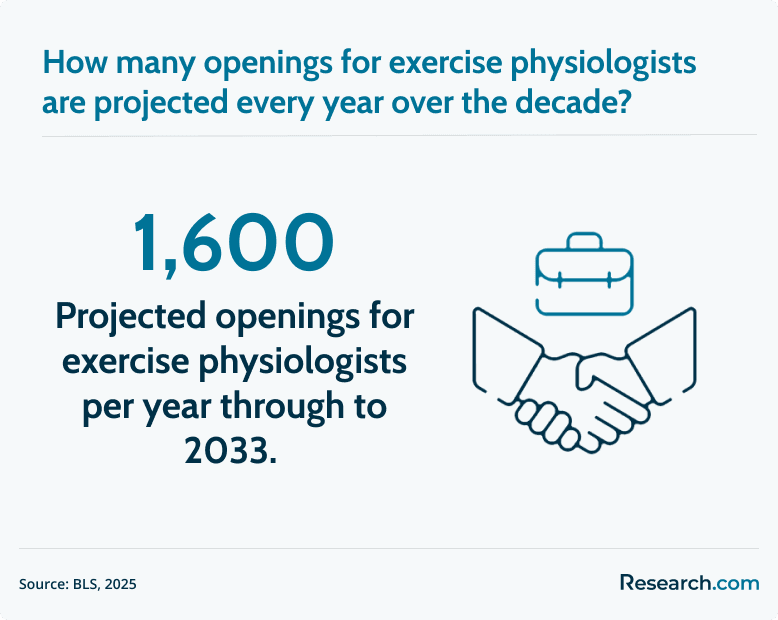
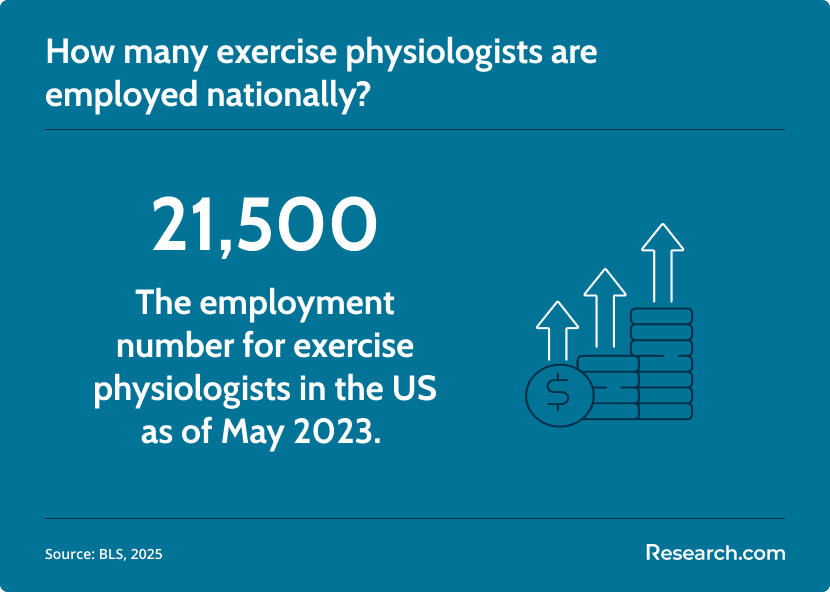
- Exercise physiologists: Employment is projected to grow 9% from 2024 to 2034, with approximately 1,600 openings each year in hospitals, outpatient clinics, and wellness programs.
- Fitness trainers and instructors: Employment is expected to grow 14%, with about 73,700 openings annually in personal training, group fitness, corporate fitness, and related settings.
- Physical therapists: This occupation requires additional education, but the field is projected to grow 14%, which may interest students considering graduate study.
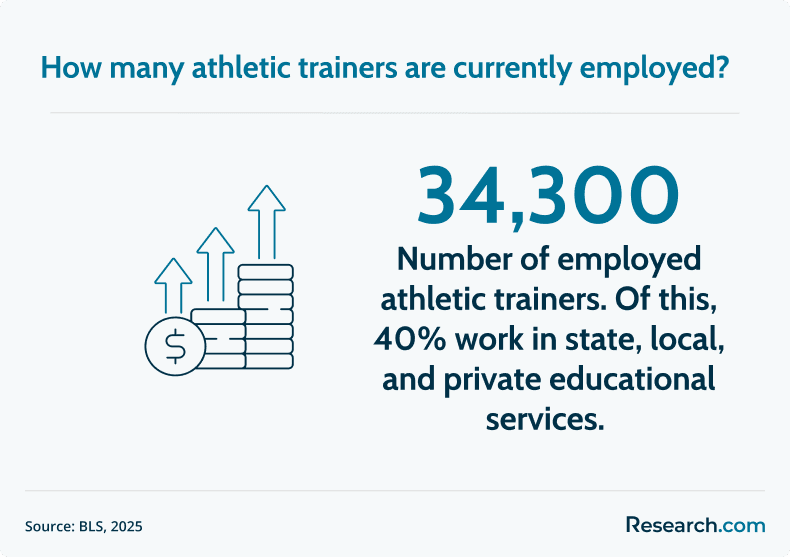
- Athletic trainers: Projected growth of 19% reflects demand in K–12 schools, colleges, healthcare facilities, and athletics settings, but this career has separate education and licensure expectations.
Students comparing exercise science with broader healthcare majors can review the health science average salary and related career pathways to understand how outcomes differ by role and credential level.
Are fast-track online exercise science programs accredited and industry-recognized?
Accreditation matters because it affects transfer credit, federal financial aid eligibility, graduate school recognition, and employer confidence. At minimum, confirm that the institution is properly accredited. Then ask whether the specific exercise science program has programmatic accreditation, professional recognition, or curriculum alignment with certification bodies relevant to your goals.
Industry recognition is not limited to accreditation. Employers may also value certifications, internships, coaching experience, CPR credentials, software skills, and demonstrated ability to work with clients or patients. Students comparing low-cost career-focused online education in other fields, such as the cheapest online medical billing and coding courses, should use the same principle: the credential should be recognized by the employers or graduate programs you care about.
Are fast-track online exercise science degrees right for every learning style?
Accelerated online exercise science programs work best for students who can manage deadlines, learn scientific material independently, communicate proactively, and stay engaged without daily in-person reminders. Courses such as anatomy, physiology, biomechanics, and exercise prescription can move quickly in short terms, so students need consistent weekly study time.
This format may not be ideal if you need frequent face-to-face lab demonstrations, struggle with self-paced work, or want a highly social campus environment. If your primary interest is healthcare administration rather than movement science, you may want to compare alternatives such as affordable online healthcare administration degree programs.
| You may thrive online if... | You may prefer another format if... |
| You can study independently and ask for help early | You need frequent in-person explanations to understand science content |
| You already work in fitness, wellness, coaching, or healthcare support | You need access to campus labs or athletic facilities several times per week |
| You have transfer credits and want to finish efficiently | You are starting from scratch and want a slower adjustment to college-level science |
| You can arrange local internships or practical experiences | You want the school to provide most networking and placement opportunities on campus |
Exercise science vs. other online health-related degrees
Exercise science is the right fit if you want to study movement, performance, fitness assessment, exercise prescription, and human physiology. It is less ideal if your main goal is medical records, billing, healthcare data, administration, or business operations. Students interested in technology-driven healthcare roles may want to compare an affordable health information management online degree with exercise science before deciding.
| Degree type | Main academic focus | Better fit for |
| Exercise science or kinesiology | Movement, physiology, biomechanics, fitness assessment, exercise programming | Fitness, wellness, coaching, performance, rehabilitation support, graduate health prerequisites |
| Health science | Broad healthcare foundations, public health, clinical concepts, health systems | Students who want flexibility across healthcare or graduate school options |
| Healthcare administration | Management, policy, finance, operations, healthcare organizations | Students who prefer leadership and operations over direct fitness or movement work |
| Health information management | Medical data, coding systems, records, compliance, healthcare technology | Students interested in healthcare data, documentation, and information systems |
Challenges that can affect success in a fast-track online exercise science degree
Accelerated online programs can be effective, but they also create pressure. Students may face compressed science courses, fewer spontaneous networking opportunities, local internship logistics, technology problems, and limited hands-on feedback if the program is not well supported. Comparing support systems across other online career programs, such as accredited medical billing and coding schools online, can help students see how advising, placement help, and financial aid support differ by field.
| Common mistake | Why it causes problems | Better approach |
| Choosing the shortest advertised timeline | The timeline may assume maximum transfer credits or a heavy course load | Request a personalized degree plan based on your transcripts |
| Ignoring accreditation | Credits may not transfer, aid may be affected, or graduate schools may question the degree | Verify institutional accreditation and any relevant programmatic recognition |
| Looking only at tuition | Fees, books, labs, background checks, and certifications can add cost | Compare total net cost after aid and transfer credits |
| Assuming online means no hands-on requirements | Many programs still require labs, practicums, internships, or local experiences | Ask exactly how practical requirements are completed |
| Overloading short terms | Condensed anatomy, physiology, or biomechanics courses can be demanding | Start with a manageable course load and increase only after proving you can keep pace |
| Assuming the degree guarantees a specific job | Employers may require certifications, experience, graduate education, or licensure | Review job postings and certification requirements in your target role and state |
What graduates say about fast-track online exercise science programs
- Luis: "Earning my exercise science degree online let me keep working full time as a personal trainer while building stronger academic credentials. The coursework connected well with certification preparation, and I passed the ACSM-CPT on my first attempt. After graduating, I expanded my client base and felt more confident increasing my rates."
- Austin: "I started the program while working in a physical therapy support role. Courses in biomechanics and kinesiology helped me understand patient movement more clearly, and that knowledge contributed to a promotion and a $7,000 raise within six months of finishing. Being able to study after work made the degree realistic."
- Alexis: "Returning to school in my 40s felt intimidating, but the online format gave me structure without forcing me to leave my job. Faculty support helped me stay on track, and I recently opened a fitness consulting practice with two corporate clients already under contract."
Questions to ask before enrolling
- How many of my transfer credits will count toward the major, not just electives?
- What is the fastest realistic graduation date for my specific situation?
- Are labs, practicums, internships, or capstones required, and how are they completed online?
- Does the curriculum prepare students for ACSM, NSCA, NASM, or other certifications?
- Are certification exam fees, lab kits, books, or technology costs included in tuition?
- Will the degree meet prerequisites for graduate programs I may want later?
- What career services are available to online students?
- What happens if I need to slow down from full-time to part-time enrollment?
References
- Bureau of Labor Statistics. Exercise Physiologists. Occupational Employment and Wages. https://www.bls.gov/oes/2023/may/oes291128.htm
- Bureau of Labor Statistics. How to Become an Exercise Physiologist. https://www.bls.gov/ooh/healthcare/exercise-physiologists.htm#tab-4
- Bureau of Labor Statistics. Fitness Trainers and Instructors. Occupational Employment and Wages. https://www.bls.gov/oes/2023/may/oes399031.htm
- Bureau of Labor Statistics. Athletic Trainers. Occupational Outlook Handbook. https://www.bls.gov/ooh/healthcare/athletic-trainers.htm
- Commission on Accreditation of Allied Health Education Programs. Exercise Sciences. https://www.caahep.org/committees-on-accreditation/exercise-science/
- Federal Student Aid. Types of Financial Aid: Grants, Work-Study, and Loans. https://studentaid.gov/understand-aid/types
- Internal Revenue Service. Educational assistance programs can help pay workers’ student loans. https://www.irs.gov/newsroom/reminder-educational-assistance-programs-can-help-pay-workers-student-loans
- Internal Revenue Service. Frequently asked questions about educational assistance programs. https://www.irs.gov/newsroom/frequently-asked-questions-about-educational-assistance-programs
- Learn.org. Affordable Online Exercise Science Degrees. https://learn.org/articles/affordable_online_degrees_exercise_science.html
- U.S. Department of Veterans Affairs. Post-9/11 GI Bill® benefits. https://www.va.gov/education/about-gi-bill-benefits/post-9-11/ VA education benefits overview
Key Insights
- The fastest path usually depends on transfer credit. Programs with short terms help, but accepted credits often make the biggest difference in graduation time.
- Online does not mean easier. Accelerated anatomy, physiology, biomechanics, and exercise prescription courses require disciplined weekly study.
- Accreditation should be verified before price or speed. Confirm institutional accreditation first, then check whether programmatic recognition matters for your career or graduate school goals.
- Total cost is more important than tuition per credit. Add fees, books, lab kits, technology costs, internship expenses, and certification exam costs before comparing programs.
- Career outcomes vary by role. Fitness and wellness roles may be available with a bachelor’s degree and certifications, while clinical, rehabilitation, athletic training, and physical therapy careers may require additional education or licensure.
- Ask for a personalized degree map. A school’s advertised timeline is only useful if it reflects your transcripts, course load, prerequisites, and fieldwork requirements.
Other Things You Should Know About Online Exercise Science Degree Programs
In 2027, the fastest online exercise science degree programs can typically be completed in 12 to 18 months. Accelerated formats allow students to quickly progress through coursework via condensed schedules, making it possible to earn a degree in a shorter time than traditional paths.
Yes. Many accelerated online exercise science programs accept transfer credits for general education and approved major coursework, often up to 90 semester credits in a 120-credit bachelor’s degree. Some schools also cap transfer credit age at 5 to 10 years for science courses.


