
2027 Fastest Online Master's in Adult Education Programs

Co-Founder and Chief Data Scientist
Choosing a fast online master’s in adult education is not just about finishing quickly. It is about preparing to teach, train, and support adults at a time when the need for effective adult learning is growing. As of 2023, the share of low-performing adults in the U.S. rose to 28%, compared with 19% in 2017, while the share of high-performing adults declined slightly. That widening skills gap affects literacy, workforce readiness, English language learning, and access to career mobility.
This guide is for teachers, corporate trainers, workforce development professionals, nonprofit educators, military trainers, community college staff, and career changers who want a graduate credential without pausing their lives for a traditional campus program. You will learn how fast online master’s in adult education programs work, what they cost, which schools offer accelerated options, how to compare programs, and what career outcomes are realistic.
Quick answer: Is a fast online master’s in adult education worth it?
A fast online master’s in adult education can be worth it if you want to move into adult basic education, ESL instruction, corporate training, instructional design, workforce development, community college teaching, or adult learning program leadership. The fastest programs can often be completed in 12 to 18 months, but the best choice depends on accreditation, tuition, course format, practicum requirements, employer recognition, and whether the curriculum fits your target role.
- Common career outcomes include adult education instructor, ESL teacher, GED teacher, curriculum designer, corporate trainer, workforce development specialist, and education program coordinator.
- Adult basic and secondary education and ESL teachers earned a median annual wage of around $59,950 as of May 2024.
- Online delivery can be a strong fit for working adults because many programs use asynchronous coursework, shorter terms, and flexible pacing.
| Best fit | Why it may make sense | What to verify first |
| Working educators | The degree can deepen knowledge of adult learning theory, curriculum design, assessment, and literacy instruction. | Check whether the program supports your intended teaching setting or licensure needs. |
| Corporate trainers and HR professionals | Adult education coursework can translate well to workplace learning, employee training, and learning and development roles. | Look for courses in instructional design, program evaluation, workforce education, and digital learning. |
| Career changers | An accelerated online format can help you build a graduate-level foundation without relocating or leaving work. | Confirm admission requirements, field experience expectations, and career support for nonteachers. |
| Future doctoral students | A master’s degree can provide research preparation and a pathway into education leadership or policy doctoral programs. | Ask whether credits, research courses, and capstone work align with doctoral admissions expectations. |
What can you expect from an online master’s in adult education?
An online master’s in adult education teaches students how adults learn, how to design instruction for adult learners, and how to evaluate programs that serve working adults, English language learners, returning students, and people seeking career advancement. Unlike K-12 education programs, adult education programs focus on learners who bring work histories, family responsibilities, prior schooling, cultural differences, and practical goals into the classroom or training environment.
Coursework commonly covers adult learning theory, instructional planning, assessment, curriculum development, educational research, program evaluation, and technology-supported instruction. Depending on the school, students may also study workforce education, literacy, community college teaching, higher education administration, ESL instruction, or organizational development.
Accelerated online programs usually compress the timeline by using shorter academic terms, year-round enrollment, heavier course loads, or structured cohorts. Many students complete a capstone, portfolio, applied research project, or practicum that connects coursework to a real adult learning setting.
Where can graduates work with a master’s in adult education?
Graduates can work wherever adults need structured learning support. That includes community colleges, adult learning centers, public school adult education divisions, nonprofit organizations, correctional institutions, workforce development agencies, English language programs, and continuing education departments.
The degree also has strong relevance outside traditional classrooms. Businesses, healthcare organizations, government agencies, manufacturers, technology companies, and professional associations need employees who can create training materials, teach job skills, evaluate learning outcomes, and manage continuing education programs. In these settings, graduates may work as instructional designers, learning and development coordinators, training specialists, curriculum developers, or consultants.
| Work setting | Typical responsibilities | Program features to prioritize |
| Adult basic education or GED programs | Teach literacy, numeracy, high school equivalency preparation, and study skills. | Adult literacy, assessment, learner support, and program planning. |
| ESL and multilingual learner programs | Support adult English language learners in community, academic, or workforce settings. | ESL coursework, language acquisition, cultural responsiveness, and field experience. |
| Corporate training | Design and deliver employee onboarding, compliance training, skills training, and leadership development. | Instructional design, workplace learning, digital learning tools, and evaluation methods. |
| Community colleges | Teach, advise, coordinate programs, or support adult and returning students. | Community college teaching, higher education administration, and adult learner services. |
| Workforce development agencies | Build programs that connect adult learners with job readiness, reskilling, and career pathways. | Workforce education, program evaluation, partnerships, and grant-funded program management. |
How much can you make with a master’s in adult education?
Pay varies by job title, employer type, location, experience, and whether the role is classroom-based, administrative, or corporate. According to the U.S. Bureau of Labor Statistics, adult basic and secondary education and ESL teachers earned a median annual salary of $59,950 in May 2024. Government and public education roles may also include benefits that should be considered when comparing compensation.
Some related roles pay more, especially when they involve instructional design, training strategy, program leadership, or specialized technical training. Training and development specialists earned a median salary of $65,350, while instructional coordinators earned around $71,250 per year as of the latest BLS data. With experience and leadership responsibilities, salaries can exceed $80,000, particularly in sectors such as technology or healthcare.
| Role | Salary information stated in available data | Career note |
| Adult basic and secondary education and ESL teacher | Median annual salary of $59,950 in May 2024 | Often found in adult education centers, public programs, community organizations, and ESL settings. |
| Training and development specialist | Median salary of $65,350 | Common in corporate, government, healthcare, manufacturing, and professional training environments. |
| Instructional coordinator | Around $71,250 per year | Often involves curriculum review, instructional improvement, teacher support, or program evaluation. |
- Fastest Online Master’s in Adult Education Programs for 2027
- How long does a fast online master’s in adult education take?
- Online vs. on-campus master’s in adult education: which format is better?
- How much does a fast online master’s in adult education cost?
- What financial aid is available for online adult education master’s students?
- What are the admission requirements?
- What courses are included?
- What specializations can you choose?
- How should you choose the best accelerated program?
- What careers can you pursue after graduation?
- What is the job market for adult education graduates?
- Can this degree lead to doctoral study?
- Why do accreditation and student support matter?
- Can interdisciplinary study strengthen an adult education career?
- Which complementary certifications may help?
Fastest Online Master’s in Adult Education Programs for 2027
The programs below are designed for students who want an accelerated route into adult education, workforce learning, continuing education, or training leadership. If you are comparing education degrees by speed, you may also want to review related options such as the fastest online master’s in gifted education programs, but adult education programs are distinct because they focus on adult learners rather than children or adolescents.
How Research.com ranks schools
Research.com developed this ranking to help prospective graduate students compare fast online master’s in adult education programs using transparent and data-informed criteria. The review considers factors such as program length, flexibility, academic quality, institutional credibility, and value for students balancing graduate study with work or family responsibilities.
Data sources used in the ranking process include the IPEDS database, Peterson’s database, including the Distance Learning Licensed Data Set, the College Scorecard database, and the National Center for Education Statistics. You can review the broader ranking process on Research.com’s methodology page.
| Rank | School | Program length | Credits | Cost per credit | Accreditation |
| 1 | University of Arkansas | 12 to 18 months | 33 | $440 | Higher Learning Commission (HLC) |
| 2 | North Carolina State University | 18 months | 36 | $562 | Southern Association of Colleges and Schools Commission on Colleges (SACSCOC) |
| 3 | Penn State World Campus | 18 to 24 months (accelerated path available) | 30 | $1,017 | Middle States Commission on Higher Education (MSCHE) |
| 4 | East Carolina University | 18 months | 36 | $249 (in-state), $893 (out-of-state) | SACSCOC |
| 5 | University of South Florida | 18 to 24 months (accelerated options available) | 33 | $347 (in-state), $875 (out-of-state) | SACSCOC |
| 6 | Texas State University | 18 to 24 months | 36 | $347 (in-state), $756 (out-of-state) | SACSCOC |
| 7 | University of Georgia | 20 to 24 months | 33 | $629 | SACSCOC |
| 8 | Ball State University | 18 months | 30 | $449 | HLC |
| 9 | University of Wisconsin–Milwaukee | 18 to 24 months | 33 | $672 | HLC |
| 10 | Portland State University | 18 to 24 months | 45 | $540 | Northwest Commission on Colleges and Universities (NWCCU) |
1. University of Arkansas
The University of Arkansas offers a 100% online M.Ed. in Adult and Lifelong Learning for professionals interested in adult education, continuing education, workforce development, and nontraditional learning environments. The university began offering distance education options as early as 2009. The program emphasizes applied learning, leadership, and research skills, and its asynchronous structure supports students who need an accelerated but flexible format.
- Program length: 12 to 18 months
- Track/concentration: Adult and Lifelong Learning
- Cost per credit: $440
- Required credits to graduate: 33
- Accreditation: Higher Learning Commission (HLC)
2. North Carolina State University
North Carolina State University offers an Online M.Ed. in Adult and Community College Education through its College of Education. The program is built for students pursuing roles in community colleges, adult learning centers, government training programs, and workforce education. NC State’s online graduate programs began in the early 2000s, and most coursework is asynchronous, with some optional synchronous engagement opportunities.
- Program length: 18 months
- Tracks/concentrations: Community College Teaching, Workforce and Continuing Education
- Cost per credit: $562
- Required credits to graduate: 36
- Accreditation: Southern Association of Colleges and Schools Commission on Colleges (SACSCOC)
3. Penn State World Campus
Penn State offers an Online Master of Education in Lifelong Learning and Adult Education that launched in 2002. The curriculum is designed for educators, trainers, and professionals who teach adults across academic, community, and workplace settings. Students study adult learning theory, program planning, and instructional practice through fully online courses that are primarily asynchronous.
- Program length: 18 to 24 months (accelerated path available)
- Tracks/concentrations: General Adult Education, Distance Education, and Family Literacy
- Cost per credit: $1,017
- Required credits to graduate: 30
- Accreditation: Middle States Commission on Higher Education (MSCHE)
4. East Carolina University
East Carolina University offers an Online MAEd in Adult Education that prepares students for work in adult literacy, workforce training, continuing education, and learning leadership. The program has been available fully online since 2007 and includes study in adult learning theory and instructional design. Full-time students may use accelerated options to complete the degree more quickly.
- Program length: 18 months
- Tracks/concentrations: Community and College Teaching, Human Resource Development
- Cost per credit: $249 (in-state), $893 (out-of-state)
- Required credits to graduate: 36
- Accreditation: SACSCOC
5. University of South Florida
The University of South Florida offers an Online M.Ed. in Curriculum and Instruction with an Adult Education Concentration. Online offerings began in 2008, and the program combines research-based coursework with practical preparation for roles in higher education, corporate training, nonprofit education, and other adult learning settings. Fieldwork components are included.
- Program length: 18 to 24 months (accelerated options available)
- Track/concentration: Adult Education
- Cost per credit: $347 (in-state), $875 (out-of-state)
- Required credits to graduate: 33
- Accreditation: SACSCOC
6. Texas State University
Texas State University offers an Online M.Ed. in Adult, Professional, and Community Education (APCE) for students interested in community learning, education administration, and workplace education. Available online since 2011, the program blends theory, research, and practice through asynchronous coursework and part-time or full-time enrollment options.
- Program length: 18 to 24 months
- Track/concentration: General Adult Education
- Cost per credit: $347 (in-state), $756 (out-of-state)
- Required credits to graduate: 36
- Accreditation: SACSCOC
7. University of Georgia
The University of Georgia offers an Online M.Ed. in Learning, Leadership, and Organization Development. Although broader than a traditional adult education degree, it applies adult learning principles to leadership, training systems, and organizational development. UGA has offered online graduate education since 2013 and emphasizes faculty engagement and interactive learning.
- Program length: 20 to 24 months
- Track/concentration: Learning, Leadership, and Organizational Development
- Cost per credit: $629
- Required credits to graduate: 33
- Accreditation: SACSCOC
8. Ball State University
Ball State University offers an Online Master of Arts in Adult and Community Education. The program was first introduced online in the early 2000s and is intended for professionals in education, nonprofit work, and community outreach. Coursework focuses on adult learning, diversity, and community-based education, with fast-track flexibility available.
- Program length: 18 months
- Tracks/concentrations: Adult Education, Community Education
- Cost per credit: $449
- Required credits to graduate: 30
- Accreditation: HLC
9. University of Wisconsin–Milwaukee
The University of Wisconsin–Milwaukee offers an Online MS in Adult, Continuing, and Higher Education Administration (ACHEA). The program prepares students for mid-level and leadership work in continuing education, higher education administration, and adult learning. It began offering the program online in 2014 and provides evening and online course options for working professionals.
- Program length: 18 to 24 months
- Tracks/concentrations: Higher Education, Continuing Education, Leadership
- Cost per credit: $672
- Required credits to graduate: 33
- Accreditation: HLC
10. Portland State University
Portland State University offers an Online MS in Postsecondary, Adult, and Continuing Education (PACE). The degree is designed for professionals who want leadership roles in adult education, community colleges, workforce development, and continuing education. Since launching the online format in 2012, PSU has offered collaborative online learning with part-time and full-time study options.
- Program length: 18 to 24 months
- Track/concentration: PACE General Track
- Cost per credit: $540
- Required credits to graduate: 45
- Accreditation: Northwest Commission on Colleges and Universities (NWCCU)
How long does it take to complete a fast online master’s in adult education?
Many accelerated online master’s in adult education programs can be finished in 12 to 18 months, depending on the number of credits required, course availability, transfer policy, and whether you enroll full time. Students comparing shorter education credentials may also look at options such as the fastest online ESL graduate certificate programs, but a master’s degree is broader and usually requires more coursework than a certificate.
Program pace usually depends on format. Cohort-based programs move students through a fixed sequence with classmates, while more flexible programs may allow students to adjust course loads each term. Full-time students may take two to three courses during accelerated eight-week or 10-week terms. Part-time students can still finish faster than in many traditional formats if they take courses year-round.
| Completion pace | Typical student profile | Trade-off |
| 12 to 18 months | Students who can handle a heavy course load and structured deadlines. | Fastest route, but less room for schedule disruption. |
| 18 to 24 months | Working professionals who want speed but need more balance. | More manageable workload, but slightly longer time to graduation. |
| Part-time accelerated study | Students with full-time jobs, caregiving duties, or unpredictable schedules. | Greater flexibility, but completion depends on course rotation and persistence. |
How does an online master’s in adult education compare to an on-campus program?
Online and campus-based adult education master’s programs often cover similar academic material, including adult learning theory, curriculum design, research, and program assessment. The main differences are schedule, interaction style, pacing, access to campus resources, and how much structure you want. Students comparing online professional education options may notice similar trade-offs in fields such as the fastest online counselor education degree programs.
| Factor | Online master’s in adult education | On-campus master’s in adult education |
| Schedule | Often asynchronous or hybrid, which helps students study around work. | Usually requires fixed class times and travel to campus. |
| Speed | More likely to offer accelerated terms or year-round pacing. | Often follows a traditional semester calendar. |
| Interaction | Uses discussion boards, video meetings, digital collaboration, and learning platforms. | Provides face-to-face classroom interaction and easier access to campus events. |
| Access | Allows students to enroll without relocating or commuting. | Best for students who live near campus or want in-person academic community. |
| Best for | Working adults, parents, military students, and professionals seeking flexibility. | Students who prefer live classroom discussion and campus-based networking. |
Neither format is automatically better. The stronger choice is the one that fits your schedule, learning style, budget, and career goal while still coming from an accredited institution.
What is the average cost of a fast online master’s in adult education program?
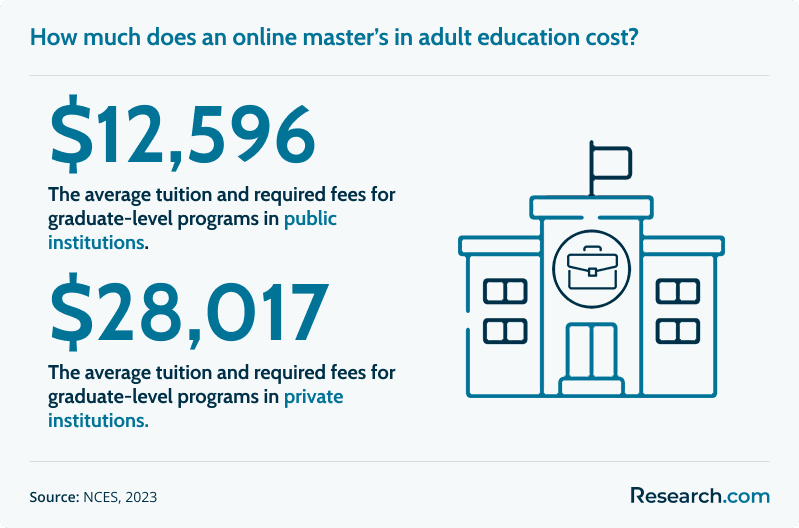
Costs differ widely by school type, residency status, credit requirements, and tuition model. According to NCES, average graduate tuition and required fees at public institutions are around $12,596 per year, while private schools charge an average of $28,017 per year.
Online students may save on commuting, relocation, parking, housing, and some campus-based expenses. However, they should still watch for technology fees, online course fees, proctoring charges, books, software, graduation fees, and practicum-related costs. If affordability is your main concern, it may help to compare pricing patterns with related education rankings such as the most affordable online master’s in gifted education programs.
| Cost factor | Why it matters | Question to ask |
| Per-credit tuition | Programs with the same annual tuition can have very different total costs if credit requirements differ. | How many credits are required to graduate? |
| Residency status | Public universities may charge different rates for in-state and out-of-state students. | Do online students pay a separate online rate? |
| Program fees | Extra fees can make a low tuition rate less affordable than it appears. | What fees are mandatory for online graduate students? |
| Course load | Accelerated study may increase short-term payment pressure. | Can I pay by term, by credit, or through an employer reimbursement plan? |
| Transfer credits | Accepted transfer credits can reduce both time and cost. | How many graduate credits can be transferred? |
What financial aid options are available for online master’s in adult education students?
Online graduate students should evaluate financial aid before assuming they must pay the full cost themselves. Availability depends on institutional eligibility, enrollment intensity, academic progress, and individual financial circumstances.
- Federal student aid: Eligible graduate students may use Direct Unsubsidized Loans and Graduate PLUS Loans after completing the FAFSA.
- Scholarships and grants: Colleges, education departments, foundations, and professional associations may offer awards for graduate students in education.
- Employer tuition assistance: School districts, companies, nonprofits, government agencies, and healthcare employers may reimburse tuition when the degree supports the employee’s role.
- Graduate assistantships: Some online students may qualify for remote research, teaching, advising, or administrative assistantships, although availability varies by institution.
- State aid programs: Depending on where you live and work, state grants, workforce development funds, or teaching-related support may be available.
Students focused on cost should compare several related education options, including the most affordable online master’s in multilingual learner education, especially if their career interests include adult ESL, community education, or multilingual learner support.
What are the prerequisites for enrolling in a fast online master’s in adult education program?
Admission requirements vary by university, but most fast online master’s in adult education programs expect applicants to show academic readiness, professional purpose, and an interest in adult learning. Requirements may resemble other accelerated education pathways, including a fast online physical education degree, but adult education programs usually place more emphasis on training, teaching, advising, or program experience with adult learners.
- A bachelor’s degree from a regionally accredited institution
- Minimum GPA, typically 2.75–3.0 on a 4.0 scale
- Transcripts from all colleges or universities attended
- Resume or CV
- Letters of recommendation
- Personal statement, goals essay, or statement of professional purpose
- Preferred experience in teaching, training, tutoring, advising, instructional support, community education, or workforce development
According to Zippia, 62% of adult education teachers hold a bachelor’s degree, 24% hold master’s degrees, and 9% hold associate degrees. Prior experience can strengthen an application, especially if it shows direct work with learners. Applicants who are building education experience may find it helpful to understand what teaching assistants do before applying.
Some applicants enter adult education through specialized teaching or wellness pathways. For example, students interested in adult physical education, recreation, or wellness instruction may want to review physical education teacher certification and requirements to understand where separate credentials may apply.
What courses are typically included in a fast online master’s in adult education program?
Fast online adult education master’s programs usually combine theory, applied teaching strategies, research, and program design. The curriculum is different from a K-12-focused program, although students comparing graduate education options may also review the fastest online special education master’s programs to understand how different education specialties structure graduate coursework.
| Course area | What students learn | Why it matters professionally |
| Foundations of adult learning | Historical, philosophical, psychological, and social foundations of adult education. | Helps educators understand how adults differ from younger learners. |
| Instructional strategies for adults | How to design, facilitate, and assess learning experiences for adult students. | Supports teaching in classrooms, training rooms, online courses, and community programs. |
| Program planning and evaluation | How to build, manage, measure, and improve adult education programs. | Useful for coordinators, administrators, workforce programs, and nonprofit education leaders. |
| Curriculum development | How to create learning objectives, materials, activities, and assessments. | Applies to GED instruction, ESL programs, workplace training, and continuing education. |
| Diversity and multicultural issues | How culture, language, identity, access, and equity shape adult learning. | Important for ESL, community education, correctional education, and public programs. |
| Research methods in education | How to interpret research, collect evidence, and apply findings to practice. | Prepares students for capstone projects, program evaluation, and doctoral study. |
Electives may cover digital learning, workplace training, higher education administration, family literacy, community education, instructional technology, or leadership, depending on the program.
What types of specializations are available in online master’s in adult education programs?
Specializations help students align graduate study with a specific type of adult learner or work setting. This is different from choosing a broader education degree such as a fast online early childhood development degree, which prepares students for much younger learners.
| Specialization | Best for | Career direction |
| ESL education | Students who want to support adult English language learners. | ESL instructor, language program coordinator, community-based language educator. Students considering this path can also review an ESL teacher salary and career guide. |
| Community or continuing education | Students interested in nonprofit programs, public education, outreach, and lifelong learning. | Community educator, continuing education coordinator, adult learning program manager. |
| Corporate or workforce training | Trainers, HR professionals, and learning and development staff. | Corporate trainer, instructional designer, workforce development specialist. |
| Higher education or postsecondary administration | Students who want to support adult learners in colleges and universities. | Academic advisor, student services professional, community college instructor, program coordinator. |
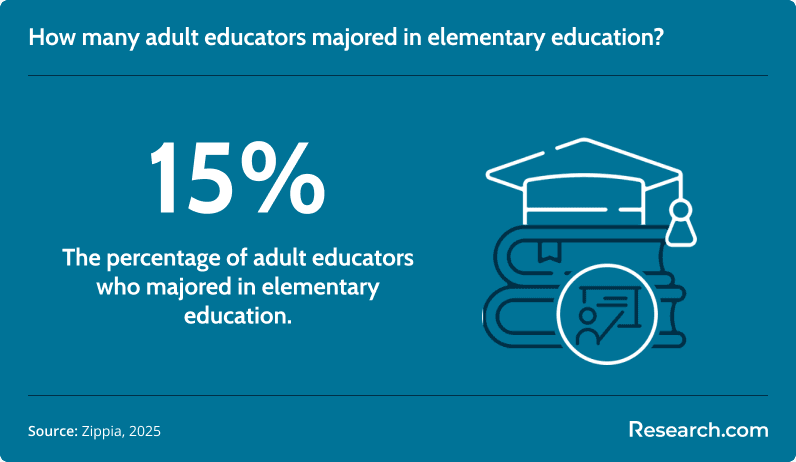
Zippia reports that 15% of adult education teachers major in elementary education, while others study fields such as general education or English. Those backgrounds can support graduate specialization choices, especially for students moving from K-12 teaching, tutoring, writing instruction, ESL, or community education into adult-focused roles.
How do you choose the best among the fastest online master’s in adult education programs?
The best accelerated program is not simply the shortest one. A program should be fast enough to match your timeline, affordable enough to justify the investment, and focused enough to support your intended career. The same decision logic applies when comparing other accelerated professional pathways, such as a fast dental assistant to dental hygienist bridge program: speed matters, but it should not come at the expense of quality or career fit.
- Confirm accreditation: Use the U.S. Department of Education’s accreditation database to verify the institution’s status.
- Match the curriculum to your goal: ESL, workforce training, higher education, and community education require different course strengths.
- Compare total cost, not only tuition: Add fees, books, technology costs, residency differences, and required credits.
- Check flexibility: Ask whether courses are asynchronous, synchronous, cohort-based, self-paced, or offered in short terms.
- Review applied requirements: Capstones, practica, portfolios, and fieldwork can strengthen learning but may require time coordination.
- Look at student support: Strong online programs provide advising, library access, technical support, career services, and faculty availability.
- Ask about transfer credits: Prior graduate coursework may reduce time to completion if the program accepts it.
| Question to ask before enrolling | Why it matters |
| Is the institution accredited by a recognized accreditor? | Accreditation can affect financial aid eligibility, employer recognition, and transferability. |
| Can the program be completed in 12 to 18 months? | Some programs advertise flexibility but may not offer every course often enough for fast completion. |
| Does the curriculum include my target area? | A general adult education program may not be enough if you need ESL, instructional design, or higher education coursework. |
| Are courses asynchronous? | Asynchronous classes are often easier for full-time workers and students in different time zones. |
| What career services are available to online graduate students? | Online students should receive meaningful support, not just access to coursework. |
| Are field experiences required? | Fieldwork can be valuable, but students should know whether it can be completed locally or at work. |
What career paths are available for graduates of online master’s in adult education programs?
Graduates can pursue roles in education, training, workforce development, nonprofit programming, government learning initiatives, and higher education. Some students also use the degree as a foundation for advanced study in leadership or policy, including options such as fast online educational policy degree programs.
According to BLS, adult basic and secondary education and ESL teachers held approximately 41,700 jobs in 2023. The largest share, 34%, worked in local elementary and secondary schools. Private educational services accounted for 13%, while junior colleges represented 11% local and 11% state.
- Adult basic education teacher
- GED or high school equivalency instructor
- ESL instructor
- Community college educator
- Corporate trainer
- Instructional designer
- Workforce development specialist
- Education program coordinator
- Continuing education administrator
- Curriculum developer
Some graduates later move into adjacent education or learner-support fields. For example, educators who become interested in communication and language support may research pathways such as moving from teacher to SLP, although speech-language pathology has separate degree and licensure requirements.
What is the job market like for graduates of an online master’s in adult education program?
The labor market is mixed. BLS projects a 13% decline in employment for adult basic and secondary education and ESL teachers from 2023 to 2033. That decline is tied partly to funding patterns and changing adult education delivery models. Students should not assume that a master’s degree guarantees a classroom teaching job.
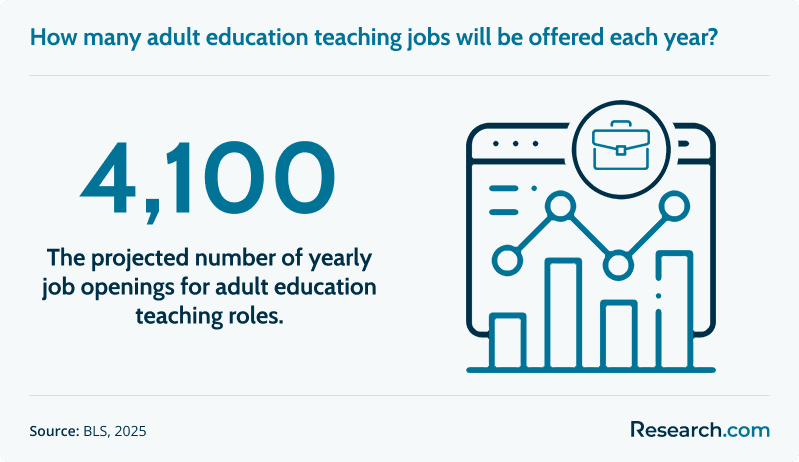
At the same time, BLS projects about 4,100 job openings per year on average because of retirements and turnover. Graduates may improve their competitiveness by pairing adult education expertise with ESL, instructional design, workforce development, digital learning, program evaluation, or leadership experience.
The strongest opportunities may be in roles that connect adult learning to reskilling, digital literacy, English language acquisition, workplace training, continuing education, and learner support. Students should evaluate programs based on how well they prepare graduates for both traditional adult education roles and broader training-related careers.
Current trends affecting adult education careers
Adult education is being shaped by workforce reskilling, digital instruction, employer-based training, English language learning needs, and the use of learning technologies. These trends do not remove the need for skilled educators; they change what educators are expected to know. Graduates who understand both adult learning theory and technology-supported instruction may be better positioned for roles in online learning, corporate training, community programs, and workforce development.
AI and automation are also changing training needs. Many workers need help adapting to new tools, changing job tasks, and digital platforms. Adult educators who can translate complex skills into practical learning experiences may find opportunities beyond traditional classroom teaching.
Common mistakes to avoid when choosing a fast online master’s in adult education
| Mistake | Why it can hurt you | Better approach |
| Choosing only the shortest program | A fast degree may not serve you if it lacks the specialization or support you need. | Compare speed alongside curriculum, accreditation, faculty, and career alignment. |
| Ignoring accreditation | Unrecognized accreditation can affect financial aid, employer acceptance, and future doctoral options. | Verify institutional accreditation before applying. |
| Looking only at tuition | Fees, credit requirements, residency rates, and books can change the real cost. | Calculate total program cost before comparing schools. |
| Assuming online means self-paced | Many online programs still have weekly deadlines, group work, and fixed course sequences. | Ask whether the format is asynchronous, synchronous, cohort-based, or self-paced. |
| Overlooking licensure or certification requirements | Some teaching roles may require credentials beyond the master’s degree. | Check requirements for your state, employer, and target role. |
| Relying only on rankings | A highly ranked program may not match your schedule, budget, or career goal. | Use rankings as a starting point, then evaluate personal fit. |
Practical steps before you apply
- Define your target role. Decide whether you want adult literacy, ESL, community college teaching, corporate training, instructional design, workforce development, or administration.
- Shortlist accredited schools. Remove any program that does not meet institutional accreditation expectations.
- Compare curriculum maps. Look beyond program titles and review required courses, electives, capstones, fieldwork, and specialization options.
- Estimate the full cost. Include tuition, fees, books, technology, lost work time, and transportation if any in-person requirements exist.
- Ask about pace. Confirm whether the school can realistically support completion in 12 to 18 months.
- Contact admissions and faculty. Ask how online students receive advising, career support, research help, and technical assistance.
- Check employer value. If you work in education, government, healthcare, or corporate training, ask whether your employer recognizes the credential and offers tuition assistance.
- Plan your weekly workload. Accelerated programs require consistent time. Make sure the schedule is sustainable before enrolling.
Is a fast online master’s in adult education a pathway to doctoral advancement?
Yes, it can be, especially for students who want future roles in higher education leadership, adult learning research, instructional design leadership, workforce policy, or education administration. A strong master’s program can build research, evaluation, writing, and leadership skills that support doctoral study. Students planning this route may compare doctoral options such as the fastest online EdD programs.
Before enrolling, ask whether the master’s program includes graduate research methods, a thesis or capstone, faculty mentorship, and academic writing preparation. If you already know you want doctoral study, choose a program that fits both immediate career needs and long-term admission expectations. This section is closely connected to doctoral planning for adult education graduates.
How do accreditation and institutional support influence online master’s in adult education programs?
Accreditation matters because it signals that an institution meets recognized academic standards. It can also affect financial aid eligibility, employer confidence, graduate transfer credit, and doctoral admissions. Students considering leadership pathways may also compare advanced options such as the most affordable online doctorate in educational leadership programs.
Institutional support is just as important for online students. Look for dedicated academic advising, accessible faculty, library services, writing support, technical help, career coaching, and networking opportunities. A fast program with weak support can become difficult to complete, especially for students studying while working full time. For more detail, return to the accreditation and support checklist when comparing schools.
Can interdisciplinary perspectives accelerate career growth in adult education?
Interdisciplinary study can strengthen an adult education career when it builds skills that employers value, such as ethical reasoning, communication, organizational analysis, technology use, cultural awareness, or workforce strategy. For instance, students who want a broader analytical foundation may explore areas such as an accelerated online philosophy degree, although the best complementary study depends on the learner population and work setting.
Adult educators often work across sectors: schools, businesses, nonprofits, community agencies, and government programs. The ability to connect education with workforce needs, language learning, technology, leadership, and social context can make graduates more adaptable. If this is your goal, revisit interdisciplinary career planning in adult education as you choose electives.
Can complementary certifications bolster your adult education career?
Additional credentials can help when they align with a specific role. Useful add-ons may include ESL-related preparation, instructional design credentials, workforce development training, project management, learning technology, or industry-specific trainer certifications. Students should avoid collecting credentials randomly; each one should support a clear career objective.
Some professionals also explore adjacent graduate preparation in learner support fields, including online speech language pathology programs. However, speech-language pathology follows its own academic and licensure pathway, so it should be treated as a distinct career route rather than a simple add-on to adult education. Use the complementary certification section to decide whether another credential strengthens your specific adult education plan.
Key Insights
- Fast online master’s in adult education programs can often be completed in 12 to 18 months, but course sequencing, enrollment status, and required credits determine the actual timeline.
- The degree is most useful when it is tied to a clear goal, such as adult literacy, ESL instruction, corporate training, instructional design, workforce development, community college teaching, or education program coordination.
- Adult basic and secondary education and ESL teachers earned a median annual salary of $59,950 in May 2024, while related roles such as training and development specialist and instructional coordinator reported higher median figures in the data cited.
- Cost varies significantly. NCES reports average graduate tuition and required fees of around $12,596 per year at public institutions and $28,017 per year at private schools.
- Accreditation should be nonnegotiable. It affects financial aid, employer recognition, and future academic options.
- The job market requires caution: BLS projects a 13% decline for adult basic and secondary education and ESL teachers from 2023 to 2033, but about 4,100 openings per year on average are still expected because of turnover and retirements.
- The strongest candidates often pair adult education knowledge with a practical specialization, such as ESL, instructional design, workforce training, digital learning, or program evaluation.
References:
- BLS. (2025, April 18). Adult basic and secondary education and ESL teachers. bls.gov.
- NCES. (2023). Average and percentiles of graduate tuition and required fees in degree-granting postsecondary institutions, by control of institution: Academic year 1989-90 through 2021-22. nces.ed.gov.
- NCES. (2024, December 10). Press Release-U.S. Adults Score on Par With International Average in Literacy Skills, Below International Average in Numeracy and Problem-Solving Skills in Survey of Adult Skills. nces.ed.gov.
- Zippia. (2025, January 8). Best Colleges and Degrees for Adult Education Teachers. zippia.com.
Other Things You Should Know About Online Master's in Adult Education Programs
Many accelerated online master’s in adult education programs require a supervised practicum or internship, often 100 to 150 hours, to document applied teaching or training experience. Some programs waive this requirement for applicants who already hold substantial professional adult-learning experience or a current teaching role.
A minimum GPA of 3.0 is typically required for admission to the fastest online master's programs in adult education in 2027. Some programs may consider applicants with lower GPAs on a case-by-case basis, often involving supplementary materials like recommendation letters.


