
2027 How to Become an ESL Teacher: Salary & Career Paths

Co-Founder and Chief Data Scientist
Becoming an ESL teacher can lead to classroom, online, international, tutoring, curriculum, and educational leadership opportunities—but the right path depends on where you want to teach. A public school ESL role usually requires a degree, state credential, and English learner endorsement, while many online or overseas jobs focus more on a bachelor’s degree plus TEFL, TESOL, or CELTA certification.
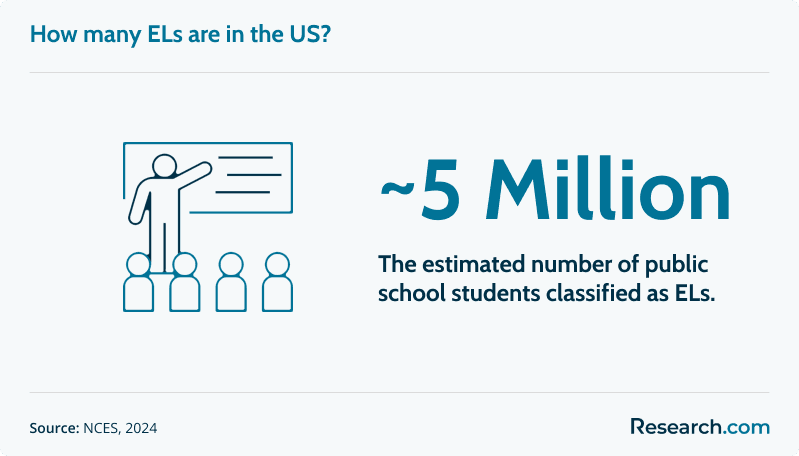
The field remains attractive because English language learning is tied to education access, migration, global business, and remote learning. The global English as a Second Language (ESL) market was valued at approximately $10 billion in 2023 and is projected to reach $18 billion by 2032, with a compound annual growth rate (CAGR) of 6.4%. In the US, the National Center for Education Statistics (NCES) reports that more than five million public school students are classified as English learners (ELs), representing over 10% of the total public school student population.
This guide explains how to become an ESL teacher for 2027, what credentials employers look for, how online and international jobs compare, what ESL teachers earn, and how to decide whether this career fits your goals.
Quick Answer: How do you become an ESL teacher?
To become an ESL teacher, you typically earn a bachelor’s degree, complete ESL-focused training or certification, gain supervised or practical teaching experience, and apply for jobs that match your setting: public schools, private language institutes, universities, online platforms, corporate training, tutoring, or overseas programs. Public school roles often require a state teaching license, while many international and online employers prefer TEFL, TESOL, or CELTA certification.
- Most common starting requirement: a bachelor’s degree, often in education, English, linguistics, or a related field.
- Common ESL credentials: TEFL, TESOL, CELTA, or a state ESL/English learner endorsement.
- Typical workplaces: K-12 schools, colleges, adult education programs, language schools, online teaching platforms, companies, and private tutoring businesses.
- Important strengths: cultural awareness, lesson planning, grammar knowledge, assessment, patience, classroom management, and comfort with digital teaching tools.
- Steps to become an ESL teacher for 2027
- What ESL teachers do
- Education, certification, and licensing requirements
- How to find ESL teaching jobs for 2027
- ESL teacher salary and earning factors
- Online ESL teaching vs. teaching abroad
- Work visa requirements for teaching ESL internationally
- Trends shaping ESL teaching
- Common ESL teaching challenges and how to handle them
- Skills ESL teachers need
- Career advancement options for ESL teachers
- How to start an ESL tutoring business
- Professional development for ESL teachers
- How advanced degrees can support ESL career growth
- Networking and mentorship in ESL careers
- Alternative degrees and related career options
Steps to become an ESL teacher for 2027
The process for becoming an ESL teacher is not identical everywhere. A US public school district, an overseas language academy, an online platform, and a private tutoring client may all evaluate candidates differently. The safest approach is to build a credential stack that includes education, ESL-specific training, observed practice, and evidence that you can teach real learners effectively.
1. Decide where you want to teach
Your target setting determines your requirements. Before choosing a program or certification, decide whether you are aiming for public schools, adult education, online tutoring, university pathways, corporate English, or teaching abroad.
| Teaching goal | Typical credential expectation | Best fit for |
| US public school ESL teacher | Bachelor’s degree, state teaching license, and ESL or English learner endorsement where required | Teachers who want structured school-year employment and long-term classroom roles |
| Private language school teacher | Bachelor’s degree and TESOL, TEFL, or CELTA certification, depending on employer | Teachers who want to work with adults, international students, or mixed-level groups |
| Online ESL teacher | Often a bachelor’s degree, ESL certificate, teaching experience, and strong online delivery skills | Teachers who want remote work, schedule flexibility, or supplemental income |
| ESL teacher abroad | Bachelor’s degree, TEFL/TESOL certification, employer contract, and work visa eligibility | Teachers interested in cultural immersion and international experience |
| Private ESL tutor or business owner | No single universal requirement, but certification, testimonials, niche expertise, and lesson results matter | Independent educators who want control over pricing, curriculum, and student selection |
2. Earn a relevant degree
Many ESL roles prefer or require at least a bachelor’s degree. Common majors include education, English, linguistics, applied linguistics, communication, and related humanities or social science fields. If you are interested in the broader study of language, speech patterns, and language acquisition, reviewing careers in linguistics can help you see how ESL teaching connects to translation, language research, speech technology, and education.
3. Complete an ESL certification or endorsement
ESL certification helps employers see that you understand second-language acquisition, lesson sequencing, learner assessment, pronunciation support, grammar instruction, and culturally responsive teaching. Common options include TESOL, TEFL, and the Certificate in English Language Teaching to Adults (CELTA).
Do not choose a certificate based only on price or speed. Check whether the credential is accepted by the type of employer you want, whether it includes observed teaching practice, and whether it matches your intended student group.
4. Gain teaching experience before applying widely
Experience matters because ESL teaching is highly practical. You need to know how to explain meaning without over-talking, correct errors without discouraging students, adjust a lesson when learners are confused, and manage groups with different proficiency levels.
- Volunteer with community adult education or immigrant support programs.
- Assist an ESL teacher in a school, nonprofit, library, or language center.
- Tutor one-on-one to practice diagnostics, feedback, and lesson pacing.
- Teach online trial lessons to build confidence with digital whiteboards, screen sharing, and virtual engagement.
- Create sample lesson plans that show how you teach vocabulary, grammar, speaking, listening, reading, and writing.
5. Prepare a focused ESL teaching portfolio
A strong ESL application should show more than credentials. Include a resume, teaching philosophy, sample lesson plan, assessment example, short teaching video if requested, references, and evidence of experience with multilingual learners. If you are applying abroad, prepare scanned documents early because schools may ask for degree copies, certificates, transcripts, background checks, or notarized paperwork.
6. Apply to roles that match your credentials
Start with jobs aligned to your strongest qualification. If you have a teaching license, school districts may be a logical first step. If you have TEFL certification and want travel, international schools or language institutes may be a better match. If you need flexibility, online platforms or private tutoring may allow you to build experience while working toward additional credentials.
What does an ESL teacher do?
An ESL teacher helps students whose first language is not English improve their listening, speaking, reading, and writing skills. The work is not limited to grammar drills. Effective ESL teachers help learners use English for school, work, immigration processes, college preparation, social interaction, professional communication, and daily life.
Day-to-day responsibilities often include evaluating students’ proficiency levels, designing lessons, teaching vocabulary and grammar in context, leading speaking activities, supporting reading comprehension, giving writing feedback, preparing assessments, documenting progress, and adapting instruction for learners with different language backgrounds.
| Responsibility | What it looks like in practice |
| Language assessment | Identifying each learner’s current level in listening, speaking, reading, and writing |
| Lesson planning | Creating lessons with clear objectives, activities, practice time, and measurable outcomes |
| Speaking and pronunciation support | Helping students communicate clearly through conversation practice, modeling, and correction |
| Reading and writing instruction | Teaching comprehension strategies, academic vocabulary, sentence structure, paragraph writing, and revision |
| Cultural and classroom support | Helping learners understand expectations in schools, workplaces, and community settings |
| Progress monitoring | Using quizzes, rubrics, writing samples, speaking tasks, and observation to track growth |
Some ESL teachers specialize in business English, academic English, TOEFL or IELTS preparation, pronunciation, young learners, adult literacy, or English for specific industries. Others broaden their communication expertise through programs such as an affordable online master’s degree in communications, especially if they want to move into training, curriculum, or communication-focused roles.
Education, certification, and licensing requirements for ESL teachers
ESL requirements vary by employer, country, learner age group, and school type. According to Zippia, 70% of ESL teachers hold a bachelor’s degree, 19% have a master’s degree, and 5% have an associate degree. Those figures reflect how common bachelor’s-level preparation is in the field, but they do not mean every job has the same standard.
Degree options for future ESL teachers
| Education path | When it makes sense | Possible limitations |
| Associate degree | May support tutoring, paraprofessional work, or transfer into a bachelor’s program | Usually not enough for licensed public school teaching or many international jobs |
| Bachelor’s in education | Good fit for future K-12 teachers who want classroom preparation and licensure pathways | May need an added ESL endorsement depending on location |
| Bachelor’s in English or linguistics | Useful for language-focused teaching, tutoring, international roles, or graduate study | May not include teacher licensure unless paired with an education program |
| Master’s in TESOL, education, or applied linguistics | Helpful for advanced teaching, curriculum, higher education, leadership, or competitive roles | Costs more and may not be necessary for entry-level online or overseas jobs |
| Alternative certification or endorsement | Useful for career changers or licensed teachers adding ESL authorization | Requirements differ significantly by state, school system, or country |
Common ESL certifications
- TEFL: Often used for teaching English in countries where English is not the primary language.
- TESOL: Broadly used for teaching English to speakers of other languages in many settings.
- CELTA: A recognized adult English language teaching qualification, especially for teachers working with adult learners.
- State teaching license or ESL endorsement: Commonly required for public school ESL positions in regulated school systems.
If your goal is a licensed school role, an online teaching degree may help you compare education programs that align with teacher preparation. If you already teach and want graduate-level preparation, an online master’s in education can support advancement, though you should confirm whether a program meets your state or employer’s credential requirements.
How do I get a teaching credential?
For regulated school roles, a teaching credential usually involves completing an approved educator preparation program, finishing required pedagogy and fieldwork, passing required exams, and applying through the appropriate state or licensing authority. Requirements differ by state and country, so prospective ESL teachers should verify rules before enrolling. For a broader explanation, see How do I get a teaching credential?.
How to find an ESL teaching job for 2027
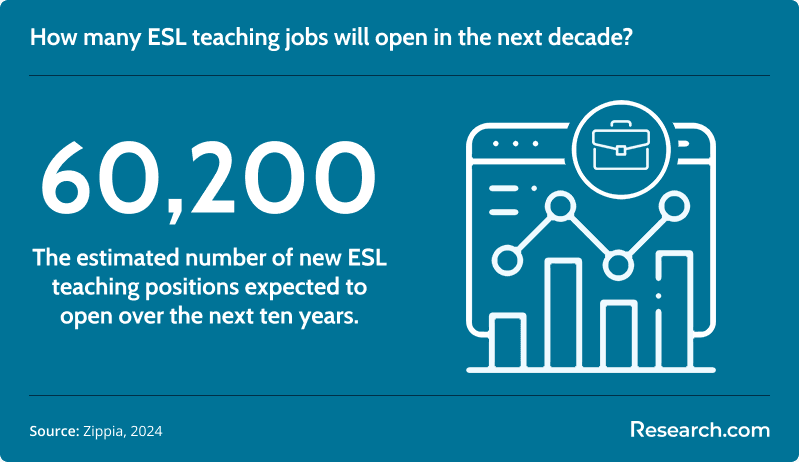
The ESL job search works best when you target a specific employer type instead of applying everywhere with the same resume. The field includes school districts, colleges, private academies, nonprofits, online companies, corporate training providers, and overseas programs. Zippia reports an estimated 60,200 new positions projected over the next decade and nearly one million ESL teachers currently employed in the US.
Where ESL teachers commonly work
- Public schools: ESL teachers support English learners within elementary, middle, and high school settings.
- Private schools: Some private schools serve international students or multilingual learners who need English support.
- Community colleges and universities: ESL instructors may teach academic English, writing, speaking, or pathway courses.
- Adult education programs: These programs often serve immigrants, refugees, workers, and community learners.
- International language schools: Private institutes abroad hire teachers for children, teens, adults, test prep, and business English.
- Online ESL platforms: Remote roles may involve structured lessons, conversation practice, test preparation, or private tutoring.
- Corporate training providers: Companies may hire ESL instructors to improve employees’ workplace English and cross-border communication.
How to strengthen your ESL job application
- Match your resume to the learner group: K-12, adult, online, business, academic, or test preparation.
- List certifications clearly, including provider, completion date, practicum hours if applicable, and specialization.
- Use specific teaching examples instead of broad claims such as “good communicator.”
- Prepare a sample lesson plan tied to a measurable objective.
- Collect references from supervisors, mentor teachers, tutoring clients, or education program faculty.
- For international jobs, verify visa requirements before signing a contract.
If you want to deepen subject-matter knowledge in English, literature, writing, or language instruction, an affordable online English degree may be worth comparing with education-focused degree options.
ESL teacher salary and earning factors for 2027
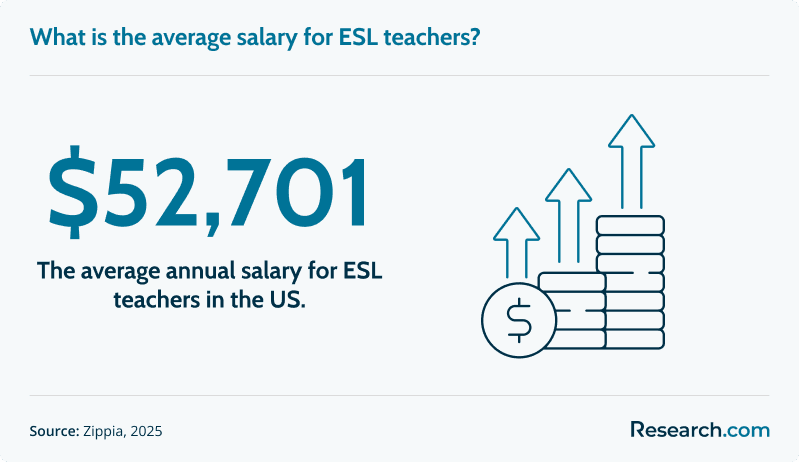
The average ESL teacher salary in the US is $52,701 per year, with typical salaries ranging from $40,000 to $68,000. ESL teachers earn an average of $25.34 per hour. Pay varies by location, employer type, credentials, grade level, workload, contract structure, and whether the role is full-time, part-time, private, online, or overseas.
The highest average salaries are found in Connecticut, and teachers in metropolitan areas generally earn more than those in rural districts. However, salary comparisons should consider local cost of living, benefits, union contracts, paid planning time, housing support abroad, and whether online teaching hours are guaranteed.
| Factor | How it can affect earnings |
| Location | Urban districts and higher-cost regions may offer higher pay, while rural areas may pay less but have different living costs |
| Credential level | Licensed teachers or teachers with graduate degrees may qualify for roles with higher salary schedules |
| Employer type | Public schools, universities, private academies, online platforms, and tutoring businesses use different pay models |
| Specialization | Business English, test preparation, academic English, and special populations may command stronger rates in some markets |
| Schedule stability | Full-time school roles may provide steadier income, while online and private tutoring may fluctuate by student demand |
| Additional qualifications | Graduate study or related credentials may support moves into specialized teaching, leadership, or support roles |
Teachers who want to work with students who need additional instructional support may also explore specialized graduate options, including the cheapest online special education master’s degree, while confirming that the program aligns with state licensure or endorsement rules.
Should you teach ESL online or abroad?
Teaching ESL online and teaching ESL abroad can both be rewarding, but they suit different goals. Online teaching is often better for flexibility and remote work. Teaching abroad is usually better for cultural immersion, full-time international experience, and working within a local school or language institute.
| Comparison point | Teaching ESL online | Teaching ESL abroad |
| Best for | Flexible schedules, remote work, side income, private tutoring, or working with global learners from home | International experience, cultural immersion, full-time school contracts, and in-person classroom practice |
| Common requirements | ESL certification, strong internet connection, online teaching tools, and often a bachelor’s degree | Bachelor’s degree, TEFL/TESOL certification, employer contract, and visa eligibility in many countries |
| Income stability | May vary by platform, bookings, cancellations, and student retention | May be more stable when tied to a school contract, though conditions vary by country and employer |
| Benefits | Work location flexibility and lower relocation barriers | Some countries or employers may offer benefits such as housing allowances or health insurance |
| Main risks | Unpaid preparation time, inconsistent student bookings, platform policy changes, and market competition | Visa problems, contract misunderstandings, culture shock, relocation costs, and limited local labor protections |
Choose online ESL teaching if...
- You need location flexibility or want to teach part-time.
- You are building experience before applying to schools or overseas programs.
- You enjoy one-on-one or small-group teaching through digital tools.
- You are comfortable marketing yourself or adapting to platform rules.
Choose teaching abroad if...
- You want to live in another country while teaching.
- You are prepared for visa paperwork, relocation logistics, and cultural adjustment.
- You prefer in-person teaching and a structured institutional environment.
- You want international experience that may strengthen future education or training roles.
If you are comparing ESL with other careers that combine communication, travel, and independent scheduling, you may also want to read about how to become a pharmaceutical sales rep. It is a very different career path, but it can help career changers compare teaching with sales-oriented roles.
Do you need a work visa to teach ESL in different countries?
Yes. Most countries require ESL teachers to obtain a work visa before starting paid employment. Visa rules depend on the country, employer, contract type, citizenship, education level, background check requirements, and whether the role is full-time or short-term.
- China, Japan, and South Korea: A bachelor’s degree, TEFL/TESOL certification, and a contract from a local employer are usually required for a work visa.
- European Union: Non-EU citizens may face more restrictive hiring and visa rules, and some countries prioritize local or EU-based teachers.
- Middle East: These roles can offer strong salaries and benefits, but work visas often require advanced degrees or more substantial credentials.
Entering a country on a tourist visa with the intention of working can create legal, financial, and employment risks. Before accepting an offer, verify the visa category, who pays filing costs, whether dependents are covered, what happens if the contract ends early, and whether the employer has a record of successfully sponsoring teachers.
Trends shaping ESL teaching for the future
ESL teaching is changing as schools, employers, and learners use more digital platforms, adaptive tools, and flexible learning models. The strongest teachers are not being replaced by technology; they are learning how to use it responsibly while preserving human feedback, motivation, and cultural context.
AI-supported instruction and assessment
AI-powered language tools can help generate practice prompts, provide instant grammar feedback, support pronunciation practice, and identify patterns in learner errors. ESL teachers still need to evaluate whether the feedback is accurate, age-appropriate, culturally sensitive, and aligned with learning goals.
Blended and online learning
Many ESL programs now combine live instruction with self-paced materials, video assignments, digital quizzes, and learning management systems. This rewards teachers who can design lessons that work both synchronously and asynchronously.
Greater focus on practical English
Learners often want English for specific outcomes: college admission, workplace communication, healthcare interactions, customer service, immigration interviews, or professional advancement. Teachers who can design goal-based lessons may stand out.
Leadership and advanced education pathways
Experienced ESL teachers sometimes move into program administration, teacher training, assessment, curriculum design, or educational leadership. For educators considering doctoral-level leadership preparation, 2 year Ed D programs may be one option to compare carefully, especially for those interested in research-based school improvement or administrative roles.
How do I get a teaching credential for ESL roles?
A teaching credential is most important when you want to teach ESL in a regulated K-12 public school setting. The process generally includes an approved teacher preparation program, required coursework, supervised classroom practice, exams, background checks, and an application to the state or licensing body. Some teachers earn a general teaching license first and then add an ESL endorsement; others complete ESL preparation as part of their initial certification route.
Because credential rules are not uniform, ask each program directly whether it prepares candidates for ESL, English learner, bilingual, or TESOL-related licensure in your state. Do not assume that an online program automatically qualifies you for licensure where you live.
Common ESL teaching challenges and how to handle them
ESL teaching can be deeply meaningful, but it is also demanding. Teachers often work with mixed proficiency levels, limited instructional time, large classes, trauma-affected learners, uneven technology access, and pressure to show measurable language growth.
| Challenge | Why it matters | Better approach |
| Mixed-level classes | Students may range from beginners to advanced learners in the same room | Use tiered tasks, flexible grouping, sentence frames, and extension activities |
| Over-correcting students | Too much correction can reduce confidence and speaking participation | Prioritize errors that block meaning, then give focused feedback after fluency practice |
| Cultural misunderstanding | Classroom expectations, body language, and participation norms differ across cultures | Explain expectations clearly and learn about students’ educational backgrounds |
| Online disengagement | Virtual learners may multitask or hesitate to speak | Use short tasks, visuals, breakout practice, polls, and clear participation routines |
| Administrative workload | Assessment, documentation, and reporting can reduce planning time | Create reusable rubrics, templates, progress trackers, and lesson structures |
| Teacher burnout | Emotional labor and preparation demands can accumulate quickly | Set boundaries, collaborate with peers, reuse strong materials, and pursue targeted support |
Teachers who want to move into school improvement, program management, or broader education leadership may compare leadership-focused pathways such as a PhD in organizational leadership. This type of degree is not required for ESL teaching, but it may interest educators planning long-term leadership or research-oriented careers.
Skills ESL teachers need
Strong ESL teachers combine language knowledge with practical teaching judgment. They know how English works, but they also know how to make the language usable for learners at different ages, proficiency levels, and confidence levels.
- Lesson planning: Building lessons with a clear language objective, model, guided practice, communicative activity, and assessment.
- Grammar and vocabulary instruction: Explaining patterns clearly without turning every lesson into a lecture.
- Classroom management: Creating routines that keep learners active, respectful, and willing to participate.
- Cultural responsiveness: Recognizing that students bring different schooling experiences, communication styles, and expectations.
- Assessment and feedback: Measuring progress through speaking tasks, writing samples, reading checks, listening activities, and targeted correction.
- Adaptability: Adjusting materials when students need more scaffolding, faster pacing, or different examples.
- Technology fluency: Using video platforms, learning management systems, digital whiteboards, captions, quizzes, and multimedia resources effectively.
- Patience and encouragement: Helping learners take risks with language even when they make mistakes.
If you are comparing ESL with other education roles, reviewing PE teacher education requirements can show how certification expectations differ across teaching specialties. Both fields require student engagement and planning, but ESL focuses on language development while physical education centers on movement, fitness, and health-related instruction.
The chart below highlights common skills ESL teachers include on their resumes, showing how the role blends instructional, interpersonal, and technical abilities.
Career advancement options for ESL teachers
ESL teaching can be a long-term classroom career or a stepping stone into education leadership, curriculum, assessment, instructional design, corporate training, or higher education. Advancement usually depends on experience, credentials, specialization, and evidence that you can improve learner outcomes.
| Career path | What the role involves | Common preparation |
| Senior ESL teacher | Mentoring newer teachers, leading professional learning, and handling advanced classes | Teaching experience, strong evaluations, and specialized ESL training |
| Curriculum developer | Creating lesson sequences, assessments, textbooks, digital materials, or program resources | Classroom experience, curriculum knowledge, writing ability, and assessment skills |
| Academic coordinator or program director | Managing ESL programs, schedules, instructors, placement testing, and quality standards | Leadership experience, graduate study, and administrative skills |
| University lecturer | Teaching academic English, composition, TESOL courses, or language support classes | Often a master’s or doctorate in education, linguistics, TESOL, or a related field |
| Corporate ESL trainer | Helping employees improve business writing, meetings, presentations, and professional communication | Business English expertise, adult education skills, and workplace communication knowledge |
| Content creator or course author | Developing online lessons, apps, textbooks, worksheets, videos, or self-study courses | Teaching expertise, instructional design, writing, and digital media skills |
When should ESL teachers consider a career change?
A career change may make sense if you enjoy student support but want a different work environment, more case management, law-related responsibilities, or public service roles. For example, the parole officer career path involves supervision, counseling, legal compliance, and reentry support rather than classroom instruction. Comparing unrelated careers can clarify whether you want to remain in education or transfer your communication skills elsewhere.
How to move up without leaving teaching
- Develop a specialization such as academic English, pronunciation, business English, or test preparation.
- Ask to mentor newer teachers or lead a small professional development session.
- Document measurable student progress and examples of successful lesson design.
- Build skills in curriculum writing, placement testing, and program evaluation.
- Consider graduate study only when it supports a specific career move, not simply because it sounds impressive.
How to start your own ESL teaching business or private tutoring service
Private ESL tutoring gives teachers more control over students, schedule, pricing, curriculum, and teaching format. It also requires business skills. Unlike a school job, independent tutoring does not guarantee enrollment, payment consistency, or benefits, so planning matters.
1. Choose a clear tutoring niche
A broad offer such as “I teach English” is harder to market than a specific outcome. Stronger niches include:
- Conversation practice for adult learners.
- Business English for meetings, emails, and presentations.
- TOEFL or IELTS preparation for university applicants.
- Academic writing for multilingual college students.
- English for healthcare, hospitality, technology, or customer service.
- Young learner ESL with games, phonics, and parent communication.
2. Build proof that your teaching works
Prospective students want confidence before paying. Create a short teaching profile, sample lesson, student testimonials when available, a placement process, and a clear explanation of how you measure progress.
3. Set pricing, packages, and policies
Independent teachers should define session length, rates, cancellation rules, rescheduling windows, payment methods, package discounts, and whether materials are included. Clear policies prevent misunderstandings and protect your time.
4. Market your services consistently
- Create a simple professional website or tutoring profile.
- Use LinkedIn for business English or professional learners.
- Join relevant local, school, immigrant support, parent, or professional communities.
- Offer a short diagnostic consultation rather than unlimited free lessons.
- Ask satisfied students for referrals and testimonials.
5. Track outcomes and improve your offer
Keep records of learner goals, attendance, assignments, assessment results, and feedback. Over time, this helps you refine your niche, justify your rates, and identify which students you serve best.
If you are exploring non-classroom or outdoor public service roles instead, the steps to becoming a park ranger offer a useful contrast. Park ranger work involves conservation, visitor education, public safety, and field responsibilities rather than language instruction.
How can ongoing professional development strengthen ESL teaching?
Professional development helps ESL teachers stay current with instructional methods, language assessment, classroom technology, learner-centered design, and culturally responsive practices. It is especially valuable because ESL classrooms can change quickly as student populations, technology tools, and employer expectations evolve.
- Attend TESOL, TEFL, bilingual education, or adult education workshops.
- Study second-language acquisition and evidence-based literacy instruction.
- Learn how to use AI tools responsibly for practice, feedback, and lesson support.
- Observe experienced ESL teachers and discuss lesson decisions afterward.
- Join peer groups that share materials, classroom strategies, and job leads.
- Build adjacent knowledge in history, culture, communication, or policy when it supports your learners.
Some educators also pursue interdisciplinary graduate study for broader teaching context. For example, cheapest online master history programs may interest teachers who want stronger historical and cultural foundations for curriculum, though such degrees are not a substitute for ESL-specific preparation.
How can advanced degrees enhance an ESL teaching career?
An advanced degree can help ESL teachers move into higher-level instruction, curriculum leadership, program administration, teacher training, or research-informed practice. It is most useful when connected to a defined career goal.
Consider graduate study if you want to teach at a college or university, qualify for leadership roles, deepen expertise in TESOL or applied linguistics, increase competitiveness for specialized positions, or move into education administration. If your goal is school leadership or program management, comparing options such as the cheapest masters in educational leadership may help you evaluate cost, flexibility, and career fit.
Questions to ask before enrolling in an advanced degree
- Does the degree meet licensure, endorsement, or salary-lane requirements where I work?
- Will the program include TESOL, bilingual education, applied linguistics, literacy, or leadership coursework relevant to my goals?
- Can I use transfer credits or employer tuition assistance?
- What practicum, capstone, or research experience is included?
- Will the program help me qualify for the role I want, or would a shorter certificate be enough?
How can professional networking and mentorship boost an ESL teaching career?
Networking helps ESL teachers find jobs, exchange lesson ideas, understand employer expectations, and avoid working in isolation. Mentorship is especially useful for new teachers who need feedback on pacing, correction techniques, classroom management, and student assessment.
- Join local or national TESOL-related groups.
- Ask experienced teachers to review a lesson plan or observe a class.
- Attend webinars and conferences focused on English learners, adult education, or bilingual education.
- Connect with school librarians, instructional designers, special education staff, counselors, and curriculum specialists.
- Build relationships with teachers in the countries or platforms where you want to work.
ESL teachers who enjoy information access, research support, educational technology, and resource curation may also explore careers related to library science, especially if they want to work in academic support, school libraries, digital learning, or community education settings.
Can alternative degrees unlock new career pathways for ESL teachers?
Yes, but the degree should match the career direction. ESL teachers often develop transferable skills in communication, assessment, lesson design, intercultural understanding, writing feedback, and learner support. Alternative degrees can expand those strengths into related areas.
| Alternative field | How it can connect to ESL experience | Possible roles |
| Library science | Builds skills in research support, information literacy, digital resources, and academic services | School librarian, academic support specialist, digital resource coordinator |
| Communications | Strengthens messaging, professional writing, public speaking, and training skills | Corporate trainer, communication coach, curriculum writer |
| Educational leadership | Prepares teachers for program management, supervision, and school improvement work | ESL coordinator, academic director, education administrator |
| Special education | Supports work with learners who need language and learning accommodations | Specialized teacher, intervention support role, inclusion-focused educator |
| Organizational leadership | Develops strategy, team leadership, training, and change management skills | Training manager, nonprofit education leader, program director |
For teachers considering library and information-focused roles, this guide to masters in library science careers can help clarify how research, digital tools, and learning support may intersect with ESL experience.
Common mistakes to avoid when becoming an ESL teacher
Many ESL career setbacks come from choosing credentials too quickly or assuming one certificate works for every job. Before spending money, make sure your path fits your target employer and location.
| Mistake | Why it can hurt you | What to do instead |
| Choosing the cheapest certificate without checking recognition | Some employers may not accept low-quality or non-recognized credentials | Ask target employers which TEFL, TESOL, CELTA, or endorsement options they accept |
| Assuming online certification equals public school licensure | Public schools often require state-approved teacher preparation and licensing | Verify state credential rules before enrolling |
| Ignoring visa rules for overseas jobs | You may accept a job you cannot legally perform | Confirm visa requirements, employer sponsorship, and documentation timelines |
| Applying with a generic teaching resume | Employers may not see your ESL-specific skills | Highlight learner levels, lesson types, assessment methods, and multilingual classroom experience |
| Focusing only on salary | Benefits, cost of living, unpaid prep time, and schedule stability change real earnings | Compare total compensation, workload, housing, healthcare, and contract terms |
| Underestimating classroom management | Language knowledge alone does not create an effective class | Practice routines, grouping strategies, participation structures, and feedback methods |
What do ESL teachers say about their career journey?
-
: "
Becoming an ESL teacher has been a rewarding journey, allowing me to connect with students from all over the world. The demand for ESL educators is growing, and with nearly a million of us in the US, there's no shortage of opportunities. I’ve been able to earn a stable income while making a real impact on my students’ lives. Annie
"
-
: "
I started teaching ESL online during grad school, and it quickly turned into a full-time career. The flexibility is unbeatable, and with a decent salary, I’ve been able to support myself while working from anywhere. Seeing my students gain confidence in English is the most fulfilling part of the job. John
"
-
: "
After earning my TESOL certification, I moved abroad to teach, and it was the best decision of my life. Many countries offer competitive salaries and benefits like housing allowances, making it a great way to travel while working. Teaching ESL has given me financial stability and a global perspective I never imagined. Elena
"
Key Insights
- ESL teaching requirements depend heavily on the setting. Public school jobs usually require formal licensure, while many online and international roles focus on a bachelor’s degree plus TEFL, TESOL, or CELTA certification.
- The US need for ESL support is substantial: more than five million public school students are English learners, representing over 10% of public school enrollment.
- Education matters in this field. Zippia reports that 70% of ESL teachers hold a bachelor’s degree, 19% hold a master’s degree, and 5% hold an associate degree.
- The average ESL teacher salary in the US is $52,701 per year, with a typical range of $40,000 to $68,000 and an average hourly wage of $25.34.
- Teaching online offers flexibility, but income can fluctuate. Teaching abroad can provide cultural immersion and structured contracts, but visa rules and relocation risks require careful research.
- The best ESL teachers combine language expertise with patience, cultural responsiveness, assessment skill, classroom management, and practical lesson design.
- Before paying for a degree or certificate, confirm that it is accepted by your target employers, supports your intended location, and aligns with licensure or visa rules if applicable.
References:
- Business Research Insights. (2025, March 3). ESL (English as a Second Language) market size to 2032. businessresearchinsights.com.
- NCES. (2024, May). COE - English Learners in Public Schools. nces.ed.gov.
- Zippa. (2024, July 25). ESL teacher Trends. Zippia.
- Zippia. (2025, January 8). Best Colleges and Degrees for ESL Teachers. Zippia.
- Zippia. (2025, January 8). ESL Teacher Demographics and Statistics [2025]: Number of ESL teachers in the US. Zippia.
- Zippia. (2025, January 8). ESL Teacher salary (March 2025). Zippia.
- Zippia. (2025, January 8). ESL Teacher skills for your resume and career. Zippia.
Other Things You Should Know About Becoming an ESL Teacher
To become an ESL teacher in 2027, you typically need a bachelor's degree in education or a related field, a TEFL or TESOL certification, and proficiency in English. Requirements may vary by region, with some areas also requiring teaching experience or additional language proficiency tests.
Yes. Public schools in the United States usually require a state-issued teaching license or endorsement, plus ESL or English for Speakers of Other Languages certification in that state. Many districts also require a bachelor’s degree, a background check, and supervised student-teaching or practicum hours.
To become an ESL teacher in 2027, certifications such as the TESOL (Teaching English to Speakers of Other Languages) or CELTA (Certificate in English Language Teaching to Adults) are commonly required. These programs typically involve 120 hours of study and are recognized globally.





