
2027 Fastest Online Nutrition Degree Programs

Co-Founder and Chief Data Scientist
Thinking of speeding into a nutrition career? The Bureau of Labor Statistics pegs median pay for dietitians and nutritionists at $73,850 in May 2024, a jump from Data USA’s $57,516 average in 2022. With employment projected to grow 7% between 2023-33, enrolling in one of the fastest 100%-online nutrition bachelor’s programs offers a brisk return on tuition.
Accelerated terms and generous transfer-credit policies slice semesters off costs, let you meet licensing prerequisites sooner, and position you for graduate study or immediate roles in clinical, community, or corporate wellness—without pausing your current job.
What are the benefits of completing the fastest online nutrition degree programs?
- Dietitians and nutritionists earn a $73,850 median salary (May 2024) according to BLS, rewarding faster degree completion.
- BLS projects 7% job growth 2023-33, adding 6,100 openings yearly—strong incentive to graduate quickly.
- Zippia notes graduates move into clinical dietetics, sports nutrition, corporate wellness, or health-coaching, broadening career mobility.
What can I expect from the fastest online nutrition degree programs?
Accelerated online nutrition bachelor’s tracks run on short 5- to 8-week modules, letting you stack courses back-to-back instead of following long semesters. ASU Online, for instance, delivers courses in 7.5-week sessions with multiple annual start dates, while Husson University’s programs use rolling seven-week terms year-round. Purdue Global structures its calendar around 10-week terms and generous credit-for-prior-learning policies to speed completion.
Expect fully asynchronous lectures, proctored online exams, and science-heavy core classes—nutritional biochemistry, medical nutrition therapy, and a senior capstone—outlined in typical 120- to 180-credit plans. Because these programs meet didactic prerequisites remotely, you can finish degree requirements—and sit for state licensure or graduate admission—often a year sooner than traditional four-year paths.
Where can I work with the fastest online nutrition degree programs?
Graduates step into a healthcare sector hungry for food-as-medicine expertise. Hospitals, community clinics, and corporate wellness groups rely on bachelor-trained nutritionists for counseling, menu planning, and preventive-health programming. According to May 2023 Occupational Employment and Wage Statistics, the five largest employers for dietitians and nutritionists are:
- General Medical & Surgical Hospitals – 19,580 positions
- Outpatient Care Centers – 6,790 positions
- Offices of Other Health Practitioners – 6,770 positions
- Special Food Services – 6,630 positions
- Skilled Nursing Facilities – 5,470 positions
As for the top states hiring nutrition graduates, the same OEWS release shows where jobs cluster most heavily:
- California – 9,940 employed
- New York – 5,200 employed
- Texas – 4,980 employed
- Florida – 4,430 employed
- Pennsylvania – 3,630 employed
These states host large hospital networks, public-health agencies, and food-service companies, giving new nutritionists multiple entry points—from clinical diet tech roles to corporate wellness coaching—right after completing an accelerated online degree.
How much can I make with the fastest online nutrition degree programs?
The U.S. Bureau of Labor Statistics (BLS) reports a $73,850 median annual wage for dietitians and nutritionists in May 2024, with 7% job growth projected through 2033. Earnings vary by setting, credentials, and location, so comparing multiple salary trackers gives a clearer pay window. Below are 2025 snapshots from the most referenced platforms:
- Zippia (average): $49,877
- Salary.com (average): $61,517
- ZipRecruiter (average): $54,137
- Indeed (average): $25.19 per hour ≈ $52,400 year).
- PayScale (average): $53,996.
- Glassdoor (average base): $64,739.
Across sources, most entry-level to mid-career nutritionists land between $50 k and $65 k, with higher ceilings for clinical specialists, corporate wellness consultants, and those holding the Registered Dietitian credential.
- Fastest Online Nutrition Degree Programs for 2027 List of Programs
- How long does it take to complete the fastest online nutrition degree program? Program Duration
- How does an online nutrition degree compare to an on-campus program? Online vs Campus
- What is the average cost of the fastest online nutrition degree program? Program Cost
- What are the financial aid options for students enrolling in the fastest online nutrition degree program? Financial Aid
- What are the prerequisites for enrolling in the fastest online nutrition degree program? Admission Requirements
- What courses are typically in the fastest online nutrition degree program? What courses are typically in the fastest online nutrition degree program?
- What types of specializations are available in online nutrition degree programs? What types of specializations are available in online nutrition degree programs?
- How do you choose the best among the fastest online nutrition degree programs? How do you choose the best among the fastest online nutrition degree programs?
- What career paths are available for graduates of online nutrition degree programs? What career paths are available for graduates of online nutrition degree programs?
- What is the job market like for graduates with the fastest online nutrition degree? Job Outlook
- How do online nutrition programs enhance practical industry experience? How do online nutrition programs enhance practical industry experience?
- What student support services are essential for thriving in online nutrition programs? What student support services are essential for thriving in online nutrition programs?
Fastest Online Nutrition Degree Programs for 2027
Choosing an online nutrition bachelor’s degree is not only about finding a school with flexible classes. If your goal is to graduate quickly, you also need to compare transfer-credit limits, course length, start dates, accreditation, dietetics eligibility, and total cost. A program that looks fast on paper may still take four years if it has strict course sequencing, limited summer options, or clinical requirements that are hard to complete near your home.
This guide is for students who want a faster path into nutrition, wellness, dietetics, public health, health coaching, or graduate study. It explains which online nutrition programs offer accelerated formats, what “fast” really means, how costs compare, what prerequisites to expect, and how to avoid choosing a program that does not match your career goals.
If you are still comparing broader options, start with this overview of a nutrition degree online, then use the ranking and decision sections below to narrow your list.
Quick Answer: What Is the Fastest Online Nutrition Degree?
The fastest online nutrition bachelor’s programs are usually designed for students who already have transfer credits, an associate degree, prior college coursework, or the ability to study year-round. Many programs still list a standard four-year timeline, but accelerated terms, summer enrollment, and generous transfer policies can shorten completion to about two to three years for qualified students.
Among the programs reviewed here, Husson University lists a 24 – 30 month path with continuous, year-round enrollment, while Purdue University Global reports that many bachelor’s students finish in about two years by using transfer credits and accelerated coursework. Students pursuing the Registered Dietitian Nutritionist path should pay especially close attention to ACEND accreditation because speed alone is not enough if the program does not meet dietetics requirements.
How We Identified Fast Online Nutrition Programs
Research.com evaluates online nutrition programs using a structured ranking methodology that considers completion speed, online delivery, accreditation, transfer options, and publicly available college data. The goal is not to reward the shortest advertised timeline alone; it is to identify programs that can realistically help students finish faster without sacrificing recognized academic standards.
Our review draws from major education data sources, including the IPEDS database from the National Center for Education Statistics, the Peterson’s database and its Distance Learning data, and the College Scorecard database. These sources help verify institutional information, costs, online program availability, and student outcome indicators.
Fastest Online Nutrition Degree Programs: At-a-Glance Comparison
| Rank | School and Program | Program Cost | Expected Duration | Total Credits | Accreditation Listed |
| 1 | Purdue University Global – Bachelor of Science in Nutrition | $371/credit | 3–4 years (fast-track possible) | 180 credits | HLC (Higher Learning Commission) |
| 2 | Arizona State University – Bachelor of Science in Nutritional Science | $956/credit | ~4 years (accelerated scheduling available) | 120 credits | HLC (Higher Learning Commission) |
| 3 | University of Arizona – Bachelor of Science in Nutritional Sciences | $525/credit | 4 years | 120 credits | ACEND (Accreditation Council for Education in Nutrition and Dietetics) |
| 4 | Husson University – Bachelor of Science in Nutrition and Health | $448 per credit | 24 – 30 months (with continuous, year-round enrollment) | 120 credits | NECHE (New England Commission of Higher Education) |
| 5 | Kansas State University – Bachelor of Science in Nutrition and Dietetics | $989/credit | 4 years (possible in ~3 years with transfer credits) | 120 credits | ACEND; HLC (Higher Learning Commission) |
| 6 | University of Alabama – Bachelor of Science in Food and Nutrition | $385/credit | 4 years (accelerated pace possible) | 120 credits | ACEND; SACSCOC (Southern Association of Colleges and Schools) |
| 7 | Grand Canyon University – Bachelor of Science in Nutritional Sciences | $687/credit | 4 years (accelerated 7-week courses) | 120 credits | ACEND; HLC (Higher Learning Commission) |
| 8 | University of Northern Colorado – Bachelor of Science in Nutrition | $809/credit | 4 years (can be accelerated) | 120 credits | HLC (Higher Learning Commission) |
| 9 | University of North Dakota – Bachelor of Science in Human Nutrition | $390/credit | 4 years (flexible pacing) | 120 credits | HLC (Higher Learning Commission) / ACEND (Didactic coursework for RDN eligibility) |
| 10 | North Carolina Central University – Bachelor of Science in Nutrition and Dietetics | $699/credit | 4 years (possible in ~3 years with credits transferred) | 120 credits | ACEND; SACSCOC (Southern Association of Colleges and Schools) |
1. Purdue University Global – Bachelor of Science in Nutrition
Purdue University Global offers an online Bachelor of Science in Nutrition built for adult learners who need flexible scheduling and multiple start opportunities. The program covers nutrition, wellness, and holistic health, with an optional holistic nutrition concentration for students who want a broader wellness-focused curriculum.
This program is especially useful for students bringing prior college credits because Purdue Global’s online model supports transfer credit and faster course progression. Many Purdue Global bachelor’s students finish in about two years on average, making this one of the strongest options for students trying to shorten the path to a nutrition degree.
- Program cost: $371/credit
- Program duration: 3–4 years (fast-track possible)
- Total credits: 180 credits
- Accreditation: HLC (Higher Learning Commission)
2. Arizona State University – Bachelor of Science in Nutritional Science
Arizona State University delivers its Bachelor of Science in Nutritional Science through ASU Online, using the same academic framework students would expect from the university’s campus-based programs. The curriculum emphasizes nutrition science, biology, disease prevention, and integrative approaches to health.
ASU’s 7.5-week online sessions can help motivated students move through courses more efficiently than a traditional semester schedule. Multiple start dates, online advising, and digital student resources make the program a good fit for learners who want a large public university with an accelerated online course structure.
- Program cost: $956/credit
- Program duration: ~4 years (accelerated scheduling available)
- Total credits: 120 credits
- Accreditation: HLC (Higher Learning Commission)
3. University of Arizona – Bachelor of Science in Nutritional Sciences
The University of Arizona offers a fully online Bachelor of Science in Nutritional Sciences with two tracks: Dietetics and Nutrition. The Dietetics track is ACEND-accredited and is designed for students who plan to continue toward Registered Dietitian preparation. The Nutrition track is better suited for students interested in wellness, community health, or non-licensure nutrition roles.
This program is a strong choice for students who want a science-based online degree from a flagship public university. Courses are available year-round, and summer enrollment can help students reduce time to completion while still completing the required nutrition science sequence.
- Program cost: $525/credit
- Program duration: 4 years
- Total credits: 120 credits
- Accreditation: ACEND (Accreditation Council for Education in Nutrition and Dietetics)
4. Husson University – Bachelor of Science in Nutrition and Health
Husson University offers a fully online Bachelor of Science in Nutrition and Health through its College of Health and Pharmacy. The program combines nutrition science with practical wellness applications, making it relevant for students who want to work in health promotion, nutrition education, or wellness-focused roles.
Husson stands out for speed. Eight-week sessions, six annual start dates, year-round scheduling, and transfer-friendly policies give students a realistic way to complete the program faster than the traditional four-year pace.
- Program cost: $448 per credit
- Program duration: 24 – 30 months (with continuous, year-round enrollment)
- Total credits needed to graduate: 120 credits
- Program/School Accreditation: NECHE (New England Commission of Higher Education)
5. Kansas State University – Bachelor of Science in Nutrition and Dietetics
Kansas State University offers an online Bachelor of Science in Nutrition and Dietetics that functions as an ACEND-accredited Didactic Program in Dietetics. This makes it especially important for students who intend to pursue the Registered Dietitian Nutritionist pathway.
The curriculum is science-heavy and includes biology, chemistry, nutrient metabolism, and medical nutrition therapy. Students may also compare K-State’s online Dietetics B.S. with its Nutrition & Health B.S. to determine whether they need the dietetics route or a broader nutrition degree. Transfer credits and summer courses can help shorten the timeline for students with prior coursework.
- Program cost: $989/credit
- Program duration: 4 years (possible in ~3 years with transfer credits)
- Total credits: 120 credits
- Accreditation: ACEND; HLC (Higher Learning Commission)
6. University of Alabama – Bachelor of Science in Food and Nutrition
The University of Alabama offers its Bachelor of Science in Food and Nutrition through the Nutrition by Distance program. Students can choose a Didactic Program in Dietetics track for RDN preparation or a nutrition science track for other food, wellness, and health-related career goals.
The asynchronous format is designed for students who need scheduling flexibility. With fall, spring, and summer enrollment, motivated students can take a heavier year-round load and potentially reduce the time required to earn the degree.
- Program cost: $385/credit
- Program duration: 4 years (accelerated pace possible)
- Total credits: 120 credits
- Accreditation: ACEND; SACSCOC (Southern Association of Colleges and Schools)
7. Grand Canyon University – Bachelor of Science in Nutritional Sciences
Grand Canyon University offers an online Bachelor of Science in Nutritional Sciences with 7-week courses. The program covers biology, anatomy, chemistry, and advanced nutrition topics, giving students a broad foundation in human nutrition.
GCU may be especially attractive to transfer students because the university allows up to 90 transfer credits. Students starting with substantial prior coursework may be able to finish significantly faster than those beginning with no credits. Students planning to pursue the Registered Dietitian path should verify all current ACEND and graduate-level requirements before enrolling.
- Program cost: $687/credit
- Program duration: 4 years (accelerated 7-week courses)
- Total credits: 120 credits
- Accreditation: ACEND; HLC (Higher Learning Commission)
8. University of Northern Colorado – Bachelor of Science in Nutrition
The University of Northern Colorado offers an online Bachelor of Science in Nutrition for students who are not pursuing the RD credential. The program emphasizes nutrition science, physiology, public health, and the connection between diet and disease.
UNC’s Extended Campus format can work well for students who want a structured online plan. Transfer credits for general education coursework, sequence-based scheduling, and year-round planning may help students finish in about 3 to 3.5 years.
- Program cost: $809/credit
- Program duration: 4 years (can be accelerated)
- Total credits: 120 credits
- Accreditation: HLC (Higher Learning Commission)
9. University of North Dakota – Bachelor of Science in Human Nutrition
The University of North Dakota offers a fully online Bachelor of Science in Human Nutrition with coursework in nutrition across the lifespan, nutrition education, and medical nutrition therapy. UND’s distance education experience and flexible course options can help students manage an accelerated schedule.
The program may appeal to students who want online flexibility and consistent tuition policies. Summer terms and self-paced enroll-anytime courses for selected requirements can help focused students move through the 120-credit curriculum more quickly.
- Program cost: $390/credit
- Program duration: 4 years (flexible pacing)
- Total credits: 120 credits
- Accreditation: HLC (Higher Learning Commission) / ACEND (Didactic coursework for RDN eligibility)
10. North Carolina Central University – Bachelor of Science in Nutrition and Dietetics
North Carolina Central University offers an online Bachelor of Science in Nutrition and Dietetics through its Department of Nutrition. As an ACEND-accredited Didactic Program in Dietetics, the curriculum is designed for students who want required coursework for the Registered Dietitian pathway.
NCCU’s online format follows a traditional semester calendar, but transfer credits and summer courses can shorten the timeline. Students with previous college work or an associate degree may be able to complete the program in about 3 years with transfer credits.
- Program cost: $699/credit
- Program duration: 4 years (possible in ~3 years with credits transferred)
- Total credits: 120 credits
- Accreditation: ACEND; SACSCOC (Southern Association of Colleges and Schools)
How Long Does It Take to Complete the Fastest Online Nutrition Degree Program?
A traditional bachelor’s degree is commonly planned around about 48 months of study, and only 44% of first-time students complete within that window. Online nutrition programs can be faster, but the actual timeline depends heavily on transfer credits, course sequencing, summer enrollment, and whether the student is pursuing a dietetics track.
The fastest options are usually not “four years compressed into one.” Instead, they rely on practical acceleration tools: eight-week sessions, 7.5-week sessions, 10-week terms, year-round enrollment, multiple start dates, and prior-credit evaluation. Husson University lists a 24 – 30 month completion option with continuous enrollment, while Purdue University Global reports that many bachelor’s students finish in about two years. Arizona State University uses 7.5-week courses that allow students to stack more sessions during the year.
Kansas State’s online dietetics program accepts up to 60 transfer hours and offers summer blocks, which can make a three-year finish realistic for some students. The same acceleration logic applies in other fields, such as the shortest counselor education degrees online, where transfer credit and intensive terms can reduce time-to-degree.
| Student Situation | Likely Timeline | What Makes the Difference |
| First-time college student with no transfer credits | Often close to 4 years | Must complete general education, prerequisites, and major courses |
| Student with an associate degree or substantial credits | Often about 2 to 3 years | Transfer credits remove lower-division requirements |
| Highly motivated year-round student | Roughly 24–30 months in the fastest cohorts | Uses short terms, summer study, and no long breaks |
| Student pursuing RDN preparation | May take longer than a general nutrition track | ACEND coursework, verification requirements, and supervised practice planning can affect pace |
Online Nutrition Degree vs. On-Campus Nutrition Degree
Accredited online nutrition degrees can carry the same institutional accreditation and academic expectations as campus programs. Employers increasingly view online and traditional credentials as comparable when the school is reputable and the program meets relevant requirements; Drexel University Online notes that online and on-campus degrees can be evaluated similarly depending on program quality and accreditation.
The main difference is delivery. Online programs use recorded lectures, discussion boards, virtual labs, case studies, proctored exams, and remote advising. On-campus programs offer in-person labs, face-to-face faculty access, and easier access to local clinical networking. For students who work full-time, care for family, or cannot relocate, online learning can be the more practical option.
| Factor | Online Nutrition Degree | On-Campus Nutrition Degree |
| Schedule | Often asynchronous or partially asynchronous | Usually follows fixed class times |
| Speed | May offer 7-week, 7.5-week, 8-week, or 10-week terms | Often follows semester pacing |
| Cost Factors | May reduce housing and commuting expenses | May include housing, transportation, and campus fees |
| Hands-on Learning | Uses virtual labs, simulations, and local placement options when available | Offers more immediate access to campus labs and local facilities |
| Best For | Working adults, transfer students, remote learners, and career changers | Students who want in-person cohorts, labs, and campus networking |
Online students may also combine nutrition with related digital health pathways, such as an online Masters in Health Informatics, without changing campuses. The best choice depends on your schedule, learning style, budget, and whether your career goal requires supervised practice or local clinical placement.
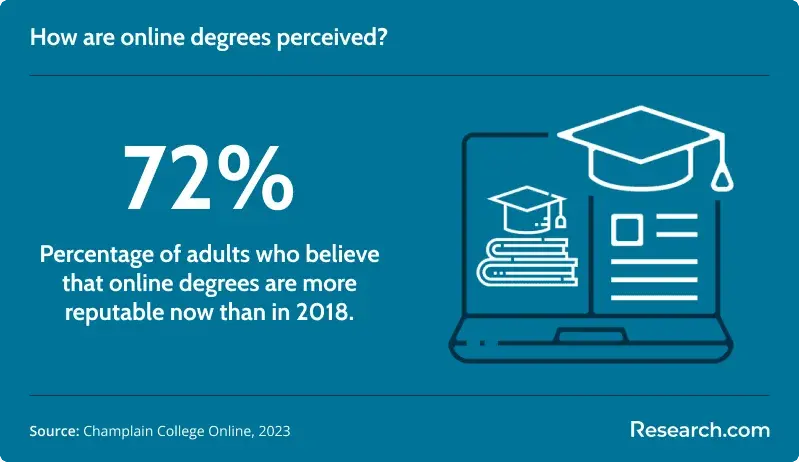
A 2023 Champlain College Online survey found that 72% of U.S. adults viewed online degrees as more reputable than they did in 2018. That shift helps explain why students are increasingly comfortable choosing online nutrition programs when accreditation and career alignment are clear.
What Does the Fastest Online Nutrition Degree Cost?
Accelerated online programs can lower indirect costs, but they are not automatically inexpensive. For the 2024-25 academic year, colleges offering Foods, Nutrition, and Wellness Studies reported average undergraduate tuition of $29,638 per year. That figure sits between the national mean for all public four-year in-state programs ($9,750) and private non-profit tuition ($38,421) cited by the Education Data Initiative in March 2025.
Credit pricing matters because fast programs usually charge by the credit. In 2025, U.S. colleges averaged $314 per credit for residents and $695 for out-of-state students. Similar credit-based cost comparisons are common in other accelerated fields, including the shortest online software engineering programs.
Fast-track nutrition bachelor’s programs commonly require 120–180 credits. In this ranking, the lower listed rate is $371/credit and the higher listed rate is $989/credit, producing estimated tuition ranges of about $44,500 to roughly $118,700. Students should still calculate their own cost because fees, transfer credits, residency policies, books, technology charges, and repeated courses can change the final amount.
| Cost Factor | Why It Matters | Question to Ask |
| Per-credit tuition | This is usually the largest direct cost in an online program | Is tuition the same for online, in-state, and out-of-state students? |
| Transfer credits | Accepted credits can reduce both time and total tuition | How many of my credits will apply to the major, not just electives? |
| Online fees | Technology, proctoring, and distance-learning fees can add up | What fees are charged every term or every course? |
| Course sequencing | A delayed prerequisite can extend your graduation date | Are required science and dietetics courses offered every term? |
| RDN pathway costs | Dietetics students may need additional supervised practice or graduate study | Does this bachelor’s degree fully support my next RDN step? |
The chart below highlights the 2024-25 Foods, Nutrition, and Wellness Studies tuition comparison: $10,572 in-state and $29,638 out-of-state at the undergraduate level, with graduate rates only slightly higher. The numbers show why transfer credit and accelerated pacing are central to affordability.
Financial Aid Options for Online Nutrition Degree Students
Online nutrition students may qualify for many of the same aid sources as campus students, as long as they attend an eligible accredited institution and meet enrollment requirements. In 2019-20, 72% of undergraduates received some form of financial aid, with an average award of $14,100.
- Federal Pell Grant: up to $7,395 for 2024-25; need-based and does not need to be repaid
- Direct Subsidized/Unsubsidized Loans: fixed-rate federal loans; 34% of students borrow
- American Opportunity Tax Credit: eligible students may claim up to $2,500 per student each year
- Institutional & State Grants: 28% of undergraduates receive college grants, and 23% receive state aid
- Federal Work-Study: part-time campus or remote work opportunities for 5% of students
- Employer Tuition Assistance: 8% of U.S. companies now cover online bachelor’s tuition, according to a 2025 SHRM survey
- Military & VA Benefits: GI Bill and Yellow Ribbon benefits can apply at participating schools, based on the DoD FY 2024 report
The FAFSA is the starting point for most students because it determines access to federal aid and is often used by states and colleges for additional awards. Students in other accelerated online fields, including the shortest public policy masters programs online, typically follow the same first step.
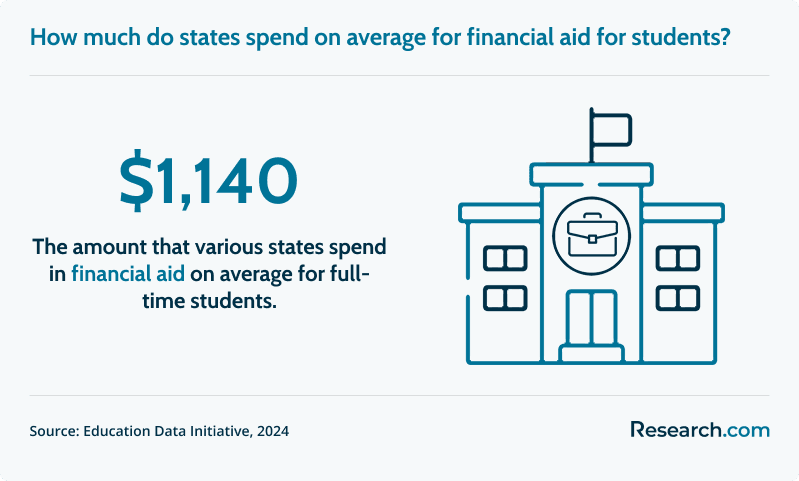
The visual below shows that state governments provide an average of $1,140 per full-time student in financial aid, according to the 2024 Education Data Initiative. State aid can combine with federal grants, employer assistance, and institutional scholarships to lower out-of-pocket costs.
Admission Requirements and Prerequisites for Fast Online Nutrition Degrees
Accelerated nutrition programs move quickly, so schools usually want evidence that applicants are ready for college-level science and online learning. Requirements vary, but most programs ask for academic records, proof of high school completion, and transcripts from any prior college coursework.
- High school diploma or GED, often with a minimum cumulative GPA such as 2.0–2.5 at schools such as Purdue Global
- Official transcripts from all colleges attended, especially if you want transfer credits applied
- Foundational science coursework, commonly including chemistry and biology; Kansas State’s dietetics track lists both
- College algebra or statistics to show quantitative readiness, reflected in ASU Online’s first-year admission grid
- Personal statement and résumé describing nutrition interests or related experience, as used by the University of Alabama
- Test-optional admissions at many institutions; fewer than half of four-year colleges required SAT/ACT in 2024, according to NCES
- Reliable internet access, basic computer skills, and comfort using online learning platforms
If you are comparing nutrition with nearby health and performance fields, this guide to what you can do with an exercise science degree can help you understand adjacent career paths.
Common Courses in an Accelerated Online Nutrition Degree
Fast does not mean light. Accelerated nutrition programs still cover the scientific and applied content expected in a bachelor’s curriculum. Courses may be compressed into short sessions, but students still need to master metabolism, lifecycle nutrition, community health, counseling, and research literacy.
- Human Nutrition Fundamentals: macronutrients, micronutrients, dietary guidelines, and nutrition needs across populations
- Nutritional Biochemistry: metabolism, enzymes, cellular pathways, and nutrient function; Purdue Global includes this type of requirement
- Lifecycle Nutrition: nutrition needs from infancy through older adulthood, aligned with UA’s 59-credit major core
- Medical Nutrition Therapy I & II: nutrition interventions for disease states; Kansas State lists both course sequences
- Food Science & Safety: food chemistry, sanitation, quality control, and virtual lab applications
- Community Nutrition: population health, program planning, public policy, and outreach
- Nutrition Education & Counseling: client communication, motivational strategies, and behavior-change theory
- Research Methods in Nutrition: statistics, study design, and evidence evaluation, useful for graduate study or leadership roles in healthcare management programs online
These courses support skills employers value, including patient interaction, public-health outreach, WIC program knowledge, and medical nutrition therapy. The chart below shows how 2025 résumés reflect those competencies.
Specializations Available in Online Nutrition Programs
A specialization can help you align the degree with a clearer career outcome. Before choosing one, confirm whether it supports your intended role, especially if you plan to pursue licensure, graduate school, coaching work, or public health employment.
| Specialization | Best Fit | What to Verify |
| Dietetics (DPD) | Students planning for dietetic internships and the RDN exam | ACEND alignment, verification statement, and current RDN pathway requirements |
| Sports Nutrition | Students interested in athletic performance, exercise metabolism, and body composition | Whether the program includes applied sports nutrition coursework |
| Holistic Nutrition | Learners focused on whole-food approaches, gut health, and wellness education | Scope-of-practice limits and employer recognition |
| Functional Nutrition | Students interested in lifestyle, inflammation, genomics, and personalized dietary strategies | Whether the curriculum is evidence-based and appropriate for your career goals |
| Public Health Nutrition | Students considering community nutrition, policy work, or a public health major pathway | Coursework in epidemiology, population health, and program planning |
| Nutrition Coaching & Counseling | Students interested in wellness coaching, remote support, or client education | Whether the program prepares you for non-licensed coaching roles only |
Accelerated specializations can be useful when they focus your skill set without adding unnecessary credits. The same principle applies in technical fields such as the shortest online cybersecurity master's degree programs, where focused tracks help students build career-specific expertise efficiently.
How to Choose the Best Fast Online Nutrition Degree Program
The best program is not always the shortest one. It is the fastest program that still fits your career target, budget, state requirements, and learning style. Use the following steps before enrolling.
- Confirm accreditation first. Look for recognized institutional accreditation. If you plan to become a Registered Dietitian Nutritionist, verify ACEND status and ask whether graduates receive the required verification statement.
- Map your transfer credits. Do not rely on a general “up to 90 credits” claim. Ask for a degree audit showing exactly which courses apply to general education, prerequisites, major requirements, and electives.
- Review course sequencing. A program with short terms can still be slow if required science courses are offered only once a year.
- Calculate total cost, not just tuition. Include technology fees, books, proctoring, lab materials, repeated coursework, and any extra requirements for dietetics preparation.
- Check whether the program matches your career goal. A general nutrition degree may be enough for wellness or coaching roles, but it may not meet dietetics requirements.
- Evaluate online student support. Strong advising, tutoring, technical help, library access, and internship guidance can prevent delays.
- Verify state authorization and licensure fit. Make sure the school can enroll students in your state and that the program supports any state-specific requirements relevant to your career plan.
Who Should Choose a Fast Online Nutrition Degree?
A fast online nutrition degree can be a smart choice if you already have transfer credits, need to keep working while studying, want a career in wellness or nutrition education, or plan to use the bachelor’s degree as a foundation for graduate study. It can also work well for career changers who are disciplined enough to handle compressed science courses.
You may want a different route if you need extensive in-person lab access, prefer highly structured face-to-face learning, have limited time for intensive coursework, or are pursuing the RDN pathway without understanding the additional supervised practice and graduate-level requirements that may apply.
| Choose a Fast Online Nutrition Degree If... | Consider Another Option If... |
| You have prior credits and want to finish sooner | You are starting from zero credits and need a slower pace |
| You need asynchronous or flexible coursework | You learn best through in-person labs and live class discussions |
| You are targeting wellness, coaching, public health, or nutrition education roles | You need a very specific licensure pathway and have not confirmed eligibility |
| You can study year-round without long breaks | You have limited weekly study time and may struggle in short terms |
Career Paths for Online Nutrition Degree Graduates
Nutrition graduates can enter several health, wellness, food service, and public health roles. Career options depend on the program’s accreditation, whether the student completes dietetics requirements, state rules, experience, and any graduate education or supervised practice required for advanced credentials.
- Nutrition Assistant / Dietary Aide: supports meal preparation, intake documentation, and food-service tasks in hospitals or long-term-care settings
- Dietetic Technician: assists RDNs with menu planning, nutrition support, and basic counseling after passing the NDTR exam
- Nutritionist / Health Coach: develops wellness plans for individuals, communities, or employers; median pay tops $57 k in 2022
- Registered Dietitian Nutritionist (RDN): provides medical nutrition therapy and may qualify for licensure authority; median salary is $73,850
- Clinical Nutrition Manager: manages inpatient nutrition operations and supervises dietetics staff
- Director of Nutrition Services: oversees food, nutrition, quality, staffing, and budget decisions across facilities
- Chief Wellness Officer / VP of Health Strategy: leads organization-wide wellness, chronic-disease prevention, and health strategy initiatives
Job Market Outlook for Nutrition Degree Graduates
The labor market for dietitians and nutritionists is growing steadily. The Bureau of Labor Statistics reports median pay of $73,850 and 7% growth from 2023-33, with 6,100 openings annually. HRSA projections also anticipate national demand climbing 21% by 2030 under changing care-delivery models.
Data USA counted 106,000 practitioners in 2022, with 66% employed by general medical and surgical hospitals, the largest employer group. Indeed listed 8,200 U.S. dietitian vacancies in July 2025. State employment is concentrated in California (9,940 jobs), New York (5,200), and Texas (4,980), reflecting large hospital networks and public-health infrastructure.
Hospitals remain important, but outpatient care centers, long-term-care facilities, corporate wellness programs, public health organizations, and tele-nutrition platforms are also expanding opportunities for graduates who combine nutrition science with communication, technology, and preventive-health skills.
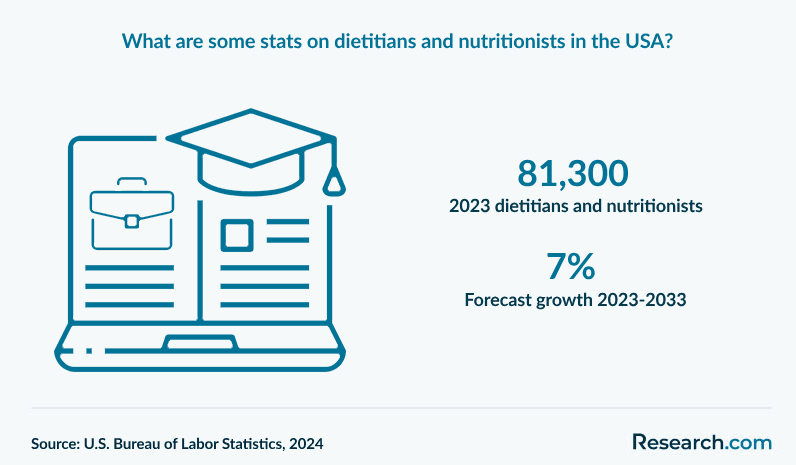
The Bureau of Labor Statistics graphic below reinforces this outlook, showing 81,300 practicing dietitians and nutritionists in 2023 and a 7% growth projection through 2033.
Challenges Students Face in Online Nutrition Degree Programs
Online nutrition degrees are flexible, but accelerated formats can be demanding. Students must manage compressed science courses, proctored exams, virtual labs, group projects, and deadlines without the structure of a physical classroom. The biggest risk is underestimating the time required for chemistry, physiology, biochemistry, and medical nutrition therapy.
Some students also struggle to find hands-on experience if their program does not provide strong local placement guidance. This matters most for students aiming for dietetics or clinical roles. Students exploring other health-related online training options, such as low cost medical billing and coding classes online, should make the same check: flexible scheduling is helpful only when the program also supports practical career preparation.
How Online Nutrition Programs Build Practical Experience
Well-designed online nutrition programs use case studies, virtual simulations, remote projects, local preceptor arrangements, mentorship, and applied assignments to connect coursework with professional practice. These experiences can help students practice counseling, dietary assessment, chart review, public-health planning, and food-service decision-making.
Before enrolling, ask whether the school helps students identify local opportunities or whether students must arrange all practical experience independently. Similar questions apply in allied health programs such as medical billing and coding online schools, where employer relevance and applied learning can affect career readiness.
What Graduates Say About Online Nutrition Degree Programs
- : "“I completed my coursework while living overseas. Because discussions were time-shifted, I could still participate with classmates, and the proctored exam process worked smoothly. My program covered the ACEND knowledge requirements I needed, so I moved into an online dietetic internship and passed the RD exam on my first attempt.” — Anya"
- : "“Earning my bachelor’s in 26 months while working full-time took planning, but the seven-week blocks made it possible to take more than one course in a term. Virtual simulation labs helped me understand hospital charting software, and I accepted a clinical tech role two weeks after graduation without moving.” — Mariela"
- : "“Zoom-based group projects helped me practice counseling with classmates from different states. Since lectures were recorded, I could replay difficult metabolism lessons late at night. The format saved me a year of tuition and let me keep my wellness-coaching business open.” — Devin"
Emerging Trends in Online Nutrition Education
Online nutrition programs are increasingly shaped by digital health. Telehealth consultations, AI-driven dietary planning tools, virtual lab simulations, wearable technology insights, and data-informed nutrition coaching are becoming more relevant to how students learn and how graduates work with clients or patients.
These trends do not replace nutrition science fundamentals. Instead, they add new tools for assessment, communication, monitoring, and personalized education. Students comparing nutrition with broader healthcare administration pathways can also review the cheapest healthcare administration degree online programs to understand how digital health skills are affecting adjacent fields.
Student Support Services That Matter in Online Nutrition Programs
Support services can determine whether an accelerated program feels manageable or overwhelming. Look for responsive academic advising, nutrition faculty access, online tutoring for science courses, technical support, library databases, career coaching, internship guidance, and clear degree planning.
Students should also ask whether the program provides help with graduate school planning, RDN pathway questions, résumé development, and local experiential learning. Related digital health fields, including affordable online health information management, depend on similar online support systems for student success.
Common Mistakes to Avoid
| Mistake | Why It Can Hurt You | Better Approach |
| Choosing the shortest program without checking accreditation | The degree may not support your intended career or dietetics pathway | Verify institutional accreditation and ACEND status when relevant |
| Assuming all nutrition degrees lead to RDN eligibility | General nutrition tracks may not meet dietetics requirements | Ask whether the program provides a verification statement and supports RDN preparation |
| Looking only at per-credit tuition | Fees, transfer limits, and repeated prerequisites can raise total cost | Request a full cost estimate based on your transfer evaluation |
| Ignoring course sequencing | Unavailable prerequisites can delay graduation even in short-term programs | Ask for a term-by-term graduation plan before enrolling |
| Relying only on rankings | A highly ranked school may not fit your schedule, budget, or career goal | Use rankings as a shortlist, then compare accreditation, cost, support, and outcomes |
| Assuming salary outcomes are guaranteed | Pay varies by credential, state, employer, experience, and licensure | Compare career requirements and local job postings before committing |
Questions to Ask Before Enrolling
- Is the program fully online, or are there in-person labs, internships, practicums, or campus visits?
- How many of my transfer credits will apply directly to the degree?
- Are major courses offered every term, or only during specific semesters?
- Can I study year-round, including summer?
- Does the program support the Registered Dietitian Nutritionist pathway?
- Will I receive a verification statement if I complete the dietetics track?
- What is the total cost after fees, books, and technology charges?
- What online tutoring and faculty support are available for science-heavy courses?
- Does the school help students find local experiential learning or supervised practice options?
- Is the school authorized to enroll students in my state?
Key Insights
- The fastest online nutrition degrees are usually fastest for students with transfer credits, year-round availability, and the discipline to handle short terms.
- Husson University lists a 24 – 30 month completion option, while Purdue University Global reports many bachelor’s students finishing in about two years.
- Students pursuing the RDN pathway should prioritize ACEND status, verification statements, and supervised practice planning over speed alone.
- Costs vary widely: listed tuition in this ranking ranges from $371–$989 per credit, with estimated total program costs of ≈ $44 k–$119 k.
- Dietitians and nutritionists had a median wage of $73,850 in May 2024, with 7% projected employment growth from 2023-33 and 6,100 openings yearly.
- Online learning can be credible and flexible, but students must confirm accreditation, transfer policies, course sequencing, support services, and state authorization before enrolling.
- The best fast program is not simply the shortest; it is the one that gets you to your specific career goal without unnecessary debt, lost credits, or licensure surprises.
References
- Arizona State University Online. Online food and nutrition bachelor’s program information.
- Bureau of Labor Statistics. Occupational outlook for dietitians and nutritionists.
- Bureau of Labor Statistics. Occupational employment and wage data for dietitians and nutritionists.
- College Board. Published tuition price trends at public institutions.
- CollegeTuitionCompare. Foods, Nutrition, and Wellness Studies tuition data.
- Data USA. Dietitians and nutritionists workforce profile.
- Drexel University Online. Comparison of online and on-campus degrees.
- Education Data Initiative. Average college cost and tuition data.
- Federal Student Aid. Federal Pell Grant guidance.
- Glassdoor. Nutritionist salary estimates.
- Grand Canyon University. Bachelor of Science in Nutritional Sciences program page.
- Health Resources and Services Administration. Registered dietitian supply and demand projections.
- Husson University. Bachelor of Science in Nutrition and Health program page.
- Indeed. Nutritionist salary information.
- Internal Revenue Service. American Opportunity Tax Credit details.
- Kansas State University Online. Online dietetics bachelor’s program information.
- National Center for Education Statistics. Undergraduate student financial aid release.
- National Center for Education Statistics. IPEDS tuition and fees trend table.
- North Carolina Central University. Nutrition and Dietetics B.S. program details.
- PayScale. Nutritionist salary research.
- Purdue University Global. Online Bachelor of Science in Nutrition program page.
- Salary.com. Nutritionist salary benchmark data.
- University of Alabama Online. Online B.S. in Food and Nutrition program page.
- University of Arizona Online. Online Bachelor of Science in Nutrition and Dietetics program page.
- University of North Dakota. Bachelor of Science in Human Nutrition program page.
- University of Northern Colorado. Online B.S. in Nutrition program page.
- ZipRecruiter. Nutritionist salary data.
- Zippia. Nutritionist salary and career data.
Other Things You Should Know About the Fastest Online Nutrition Degree Programs
Yes. Many accelerated online nutrition programs accept transfer credits, often up to 60 semester credits for a bachelor’s degree. Some schools also grant credit for prior learning or approved professional training, which can reduce the number of remaining courses and shorten completion time.
To find reputable accredited institutions offering fast online nutrition degree programs in 2027, research schools accredited by recognized agencies such as the Accreditation Council for Education in Nutrition and Dietetics (ACEND). Check each institution's program duration, curriculum, and faculty expertise to ensure quality education.


