2027 AI Master's Degrees for Manufacturing Professionals

Co-Founder and Chief Data Scientist
For manufacturing professionals, the main question is no longer whether artificial intelligence will affect production work; it is how quickly they can build the technical fluency to use it responsibly and effectively. AI is already shaping predictive maintenance, automated inspection, robotics, production scheduling, inventory planning, and supply chain risk analysis. Professionals who understand both factory operations and AI systems are better positioned to lead these projects than candidates with only general software or analytics training.
An AI master’s degree can be a strong option for engineers, production leaders, quality specialists, maintenance professionals, and operations analysts who want to move into advanced manufacturing, smart factory, or Industry 4.0 roles. The right program should match your current technical background, work schedule, budget, and career goal. Some programs assume strong programming and math preparation, while others offer bridge coursework for experienced professionals who need to strengthen computing foundations.
This guide explains what an AI master’s degree for manufacturing professionals typically covers, which roles benefit most, how to compare accredited programs, what admissions requirements to expect, how online and on-campus formats differ, what costs and timelines may look like, and which concentrations or certifications can improve career value.
Key Things You Should Know
- AI master's degrees in 2026 increasingly integrate manufacturing-specific skills, addressing automation, predictive maintenance, and supply chain optimization in response to Industry 4.0 demands.
- Enrollment growth in AI programs tailored for manufacturing professionals exceeds 18% annually, reflecting rising workforce demand for AI-driven manufacturing expertise.
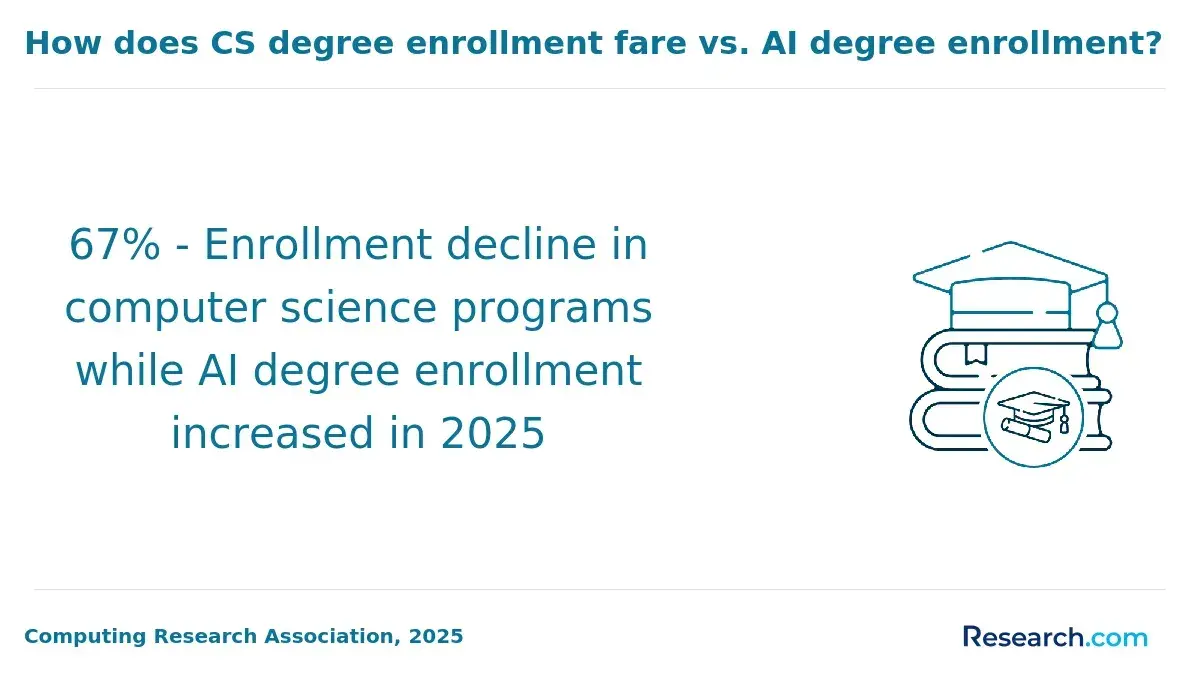
- Graduates from these programs report a median salary increase of 25% compared to traditional engineering roles, highlighting AI's impact on manufacturing career advancement.
What is an AI master's degree for manufacturing professionals?
An AI master’s degree for manufacturing professionals is a graduate program that teaches students how to apply artificial intelligence, machine learning, automation, robotics, and data analytics to industrial operations. Unlike a general AI degree, a manufacturing-focused pathway connects algorithms to production problems: machine downtime, inconsistent quality, waste, bottlenecks, labor planning, inventory volatility, and supply chain disruptions.
Students typically learn how to build and evaluate predictive models, analyze sensor and production data, design computer vision systems for inspection, and support automation projects that improve throughput or reliability. Common applications include predictive maintenance, defect detection, robotic process optimization, demand forecasting, and digital twin simulations.
IBM's Global AI Adoption Index 2024 reveals that 42% of organizations actively use AI, up from 35% the previous year, which helps explain why manufacturing employers increasingly value professionals who can connect AI tools with real production constraints. In practice, this degree is most useful when it combines three areas: AI theory, hands-on technical implementation, and manufacturing domain knowledge.
Programs may expect students to work with programming languages such as Python and AI frameworks such as TensorFlow or PyTorch. Manufacturing professionals may also benefit from familiarity with systems such as MES and ERP platforms, because AI projects often depend on production, quality, maintenance, and supply chain data stored across these environments.
Graduates commonly pursue roles such as AI engineer, manufacturing data scientist, automation specialist, predictive maintenance analyst, robotics integration specialist, or smart manufacturing consultant. For readers still comparing broader academic pathways, AI degree options can help clarify how artificial intelligence credentials translate into career paths beyond manufacturing.
Which manufacturing roles benefit most from an AI master's degree?
The manufacturing roles that benefit most from an AI master’s degree are those responsible for improving performance, reducing downtime, increasing quality, or interpreting operational data. The degree is especially valuable for professionals who already understand production systems and want the technical skills to design, evaluate, or lead AI-enabled improvements.
- Process engineers: Use AI models to analyze process variation, reduce waste, improve throughput, and identify bottlenecks that are difficult to detect through manual review alone.
- Quality control specialists: Apply machine learning and computer vision to detect defects faster, standardize inspection, and reduce the risk of recalls or rework.
- Maintenance engineers: Build or manage predictive maintenance systems that analyze sensor data and maintenance histories to anticipate equipment failures before they stop production.
- Production managers: Use AI-supported scheduling, forecasting, and resource allocation tools to improve labor planning, equipment utilization, and delivery reliability.
- Supply chain coordinators: Apply forecasting and optimization methods to improve demand planning, inventory control, supplier risk analysis, and logistics decisions.
- Automation and robotics professionals: Combine mechanical systems knowledge with AI programming to support autonomous operations, robotic inspection, and adaptive manufacturing cells.
According to the World Economic Forum's Future of Jobs Report 2025, "AI and Machine Learning Specialists" rank among the fastest-growing roles globally through 2030. In manufacturing, that growth is tied to the need for workers who can turn factory data into reliable operational decisions, not just build models in isolation.
The strongest candidates usually bring both technical and operational credibility. A data scientist who understands production constraints can design more practical models, while a manufacturing engineer with AI training can better evaluate vendor claims, lead implementation teams, and avoid expensive automation mistakes.
Professionals who want a broader engineering foundation before or alongside AI training may also compare options such as an online mechanical engineering degree, especially if their long-term goals include product design, automation, or industrial systems leadership.
How do you choose an accredited AI master's program for manufacturing?
To choose an accredited AI master’s program for manufacturing, start with institutional credibility, then evaluate whether the curriculum actually supports manufacturing use cases. A well-known AI curriculum is not automatically the best fit if it lacks applied coursework in robotics, industrial analytics, predictive maintenance, quality automation, or smart manufacturing systems.
First, confirm that the institution is accredited by an agency recognized by the U.S. Department of Education. Accreditation matters because it signals that the school meets academic quality standards and is often required for federal financial aid eligibility. It can also affect employer tuition reimbursement, transfer credit review, and the perceived value of the degree.
Next, compare outcomes and affordability. Resources such as the College Scorecard can help applicants review median graduate earnings and average student debt. Programs with median earnings exceeding $80,000 soon after graduation often offer a strong return on investment, but applicants should still consider total cost, debt, location, career goals, and whether graduates enter AI-related roles.
Key factors to compare
- Manufacturing relevance: Look for coursework or projects in machine learning for operations, robotics, predictive maintenance, computer vision, industrial IoT, supply chain analytics, or smart factories.
- Hands-on learning: Prioritize programs with applied projects, capstones, internships, labs, or industry datasets rather than programs built mainly around theory.
- Faculty expertise: Review whether faculty research or professional work connects AI with manufacturing, automation, industrial engineering, robotics, or data-intensive operations.
- Format and schedule: Working professionals should compare asynchronous coursework, evening classes, part-time enrollment, and residency requirements.
- Career support: Look for employer partnerships, alumni outcomes, technical interview preparation, internship support, and access to manufacturing or technology recruiters.
- Cost transparency: Request a full tuition and fee breakdown, including technology fees, software costs, residency travel, and any required campus visits.
A common mistake is choosing the most technical-sounding AI program without checking whether it supports your current background. If you have strong manufacturing experience but limited coding or math preparation, ask whether the program offers bridge courses or conditional admission. If you already have advanced programming skills, focus instead on research labs, electives, and employer-connected projects.
Applicants comparing flexible online learning models across technical disciplines may find it useful to review how other applied programs structure remote coursework, including a game design degree online.
What prerequisites and admission requirements do AI master's programs typically require?
AI master’s programs for manufacturing professionals typically require a bachelor’s degree and evidence that the applicant can handle graduate-level computing, mathematics, and analytics coursework. Many programs prefer applicants from engineering, computer science, mathematics, statistics, industrial engineering, or related STEM fields, but some also consider experienced manufacturing professionals who complete prerequisite or bridge coursework.
Common academic prerequisites
- Programming experience, often in Python or C++
- Data structures and algorithms
- Linear algebra
- Statistics and probability
- Calculus or other quantitative coursework, depending on the program
- Introductory machine learning, databases, or robotics for more advanced programs
Applicants from non-technical backgrounds may need to complete prerequisite classes before full admission or during the first term. This is not necessarily a barrier, but it can affect cost, timeline, and workload. Manufacturing professionals should ask whether prerequisite credits count toward the degree or are billed separately.
Typical application materials
- Official transcripts
- Letters of recommendation
- Statement of purpose
- Résumé or CV
- Evidence of relevant work experience, especially in manufacturing, industrial engineering, operations, automation, or technology roles
- GRE scores when required, though the requirement is declining at many institutions
- English proficiency scores for international applicants
International students may need to prove English proficiency, and many engineering and technology programs require TOEFL iBT scores above 90 to 100 because of the technical reading, writing, and collaboration involved. Applicants should verify each program’s current requirements directly, since thresholds and accepted tests can vary.
Admissions committees usually look for more than grades. They want evidence that applicants can reason quantitatively, learn technical tools, and apply AI to real problems. A strong manufacturing résumé can help, but it will not replace missing programming or math preparation in highly technical programs.
Professionals evaluating adjacent technical pathways may also compare online cyber security degrees, especially if their interests include industrial control systems, operational technology security, or risk management in connected factories.
What courses and skills are taught in AI master's programs for manufacturing?
AI master’s programs for manufacturing usually teach a mix of machine learning, data engineering, automation, robotics, and applied analytics. The goal is not only to understand AI models but also to deploy them in environments where downtime, safety, quality, compliance, and integration with existing systems matter.
Common course areas
- Machine learning and deep learning: Model training, evaluation, classification, regression, neural networks, and practical model selection.
- Predictive maintenance: Sensor data analysis, anomaly detection, remaining useful life estimation, and maintenance decision support.
- Computer vision: Image processing and model development for defect detection, measurement, inspection, and quality assurance.
- Robotics and automation: Robot perception, control, sensor integration, and AI-supported automation in production settings.
- Data engineering: Data pipelines, databases, cloud platforms, and preparation of large manufacturing datasets for analysis.
- Digital twins and simulation: Virtual models of processes, equipment, or production systems used to test changes before implementation.
- Supply chain analytics: Forecasting, optimization, inventory planning, and risk analysis.
- Industrial cybersecurity: Security considerations for connected equipment, industrial IoT, and operational technology environments.
Technical skills often include Python, R, TensorFlow, PyTorch, data visualization, SQL, model deployment, and cloud-based AI tools. Students may also learn to work with IoT devices, production data streams, and simulation platforms used in modern manufacturing operations.
Strong programs also teach implementation judgment. A model that performs well in a lab may fail on a production line if the data is incomplete, sensors drift, operators cannot interpret alerts, or the system does not integrate with existing workflows. For that reason, hands-on projects are especially valuable. Capstones may involve building a defect detection model, creating a predictive maintenance dashboard, optimizing production schedules, or evaluating a digital twin scenario.
The LinkedIn Work Change Report 2024 highlights AI literacy as one of the fastest-growing skills across industries, reinforcing the need for professionals who can understand AI outputs, question model limitations, and communicate results to technical and nontechnical teams.
Soft skills also matter. Manufacturing AI projects often require cross-functional coordination among engineering, IT, operations, maintenance, quality, safety, and leadership teams. Programs that include project management, ethical AI use, documentation, and communication can better prepare graduates to lead implementation rather than simply perform analysis.
How do online AI master's programs compare with on-campus options for manufacturing students?
Online AI master’s programs are often the better fit for manufacturing professionals who need to keep working while studying. They can reduce relocation barriers, support part-time enrollment, and allow students to complete coursework around shift schedules, plant responsibilities, and project deadlines. According to BestColleges' Online Education Trends Report 2024, 94% of online students recommend online education, showing broad acceptance of the format.
Many online AI programs cover the same core topics as on-campus options, including machine learning, predictive analytics, robotics, and data-driven decision-making. Strong online programs use recorded lectures, live sessions, virtual labs, coding environments, discussion platforms, and remote collaboration tools. However, applicants should look closely at how the program handles hands-on learning, because manufacturing AI often benefits from access to labs, equipment, real datasets, or industry-sponsored projects.
Online programs may be a better fit if you need:
- Flexible scheduling while maintaining full-time employment
- No relocation or commute
- Part-time pacing
- Access to programs outside your local region
- Lower disruption to family or work responsibilities
On-campus programs may be a better fit if you want:
- Direct access to robotics, automation, or manufacturing labs
- More frequent faculty interaction
- In-person networking with classmates, researchers, and employers
- Research assistantships or lab-based projects
- Internships tied to local manufacturing or technology employers
Employers increasingly recognize online degrees from reputable, accredited institutions, but the school’s reputation, curriculum rigor, and project experience still matter. Applicants should avoid assuming that “online” automatically means easier or less technical. A strong online AI master’s program can be demanding, especially for students balancing graduate coursework with production responsibilities.
Before choosing a format, ask whether online students have equal access to faculty, career services, software tools, capstone projects, and employer networks. Also confirm whether any required residencies, exams, labs, or presentations involve travel, because those requirements can affect cost and scheduling.
How long does an AI master's degree take, and what does it cost?
Most AI master’s programs for manufacturing professionals take 18 to 24 months of full-time study. Part-time and online options often extend the timeline to three years or more, which may be more realistic for students balancing coursework with full-time manufacturing roles. Many programs require 30 to 36 credit hours.
Cost varies widely by institution type, residency status, delivery format, and fees. Public universities typically charge between $10,000 and $25,000 per year for graduate tuition, while private nonprofit schools often exceed $30,000 annually, according to data from the National Center for Education Statistics (NCES, 2024). Students should also budget for textbooks, AI software licenses, technology fees, and possible travel for residencies, labs, presentations, or industry partnership activities.
Questions to ask before estimating total cost
- Is tuition charged per credit, per term, or as a flat program rate?
- Are online students charged different fees than on-campus students?
- Do prerequisite or bridge courses add extra cost?
- Are software, cloud computing, lab, or technology fees required?
- Are there mandatory campus visits or travel costs?
- Can transfer credits, prior graduate coursework, or employer training reduce the number of required credits?
- Does the employer offer tuition assistance or reimbursement?
Some programs offer accelerated pathways, while others allow students to slow down during demanding work periods. Manufacturing professionals should be cautious with very compressed programs if they are new to programming, statistics, or machine learning, because the learning curve can be steep.
Return on investment depends on more than tuition. Compare the program’s manufacturing relevance, alumni outcomes, employer connections, and how well the curriculum maps to your target role. A lower-cost program may be a strong choice if it is accredited and practical; a higher-cost program may be worthwhile if it offers stronger labs, industry projects, or career mobility. Request a detailed tuition breakdown and review financial aid, scholarships, assistantships, and employer support before enrolling.
What concentration options align AI training with manufacturing and Industry 4.0 goals?
Concentrations that align AI training with manufacturing and Industry 4.0 goals usually focus on robotics, computer vision, automation, predictive analytics, smart factories, and cyber-physical systems. The best choice depends on whether your career goal is closer to equipment, quality, operations, supply chain, or digital transformation leadership.
- Robotics: Best for professionals interested in autonomous systems, robot programming, human-machine collaboration, sensor integration, and flexible automation.
- Computer vision: Strong fit for quality control, inspection automation, measurement, defect detection, and visual monitoring of production environments.
- Predictive analytics: Useful for maintenance, reliability engineering, process optimization, forecasting, and performance monitoring.
- Automation and control: Relevant for engineers working with production systems, industrial equipment, control strategies, and AI-supported decision-making.
- Supply chain analytics: Appropriate for professionals focused on demand planning, inventory, logistics, supplier risk, and production scheduling.
- Industrial IoT and smart manufacturing: Best for students interested in connected equipment, data acquisition, digital twins, and cyber-physical systems.
According to the International Federation of Robotics (World Robotics 2024), global annual installations of industrial robots remain near record highs, underscoring the need for AI expertise in robotics and automation. Programs with coursework in robot kinematics, sensor integration, and human-machine collaboration can be especially valuable for professionals working in advanced manufacturing environments.
When comparing concentrations, look beyond the title. Review course descriptions, capstone options, lab access, datasets, faculty expertise, and employer partnerships. A concentration labeled “AI systems” may be highly relevant if it includes industrial projects, while a “manufacturing” concentration may be less useful if it lacks current AI tools or applied data work.
What certifications complement an AI master's degree in manufacturing?
Certifications can complement an AI master’s degree by showing practical skill in platforms, tools, methods, or manufacturing standards. They are not a substitute for graduate training, but they can help professionals demonstrate readiness for specific tasks such as cloud deployment, process improvement, robotics programming, or industrial data analysis.
The most useful certification depends on your target role. A manufacturing data scientist may benefit from cloud and data credentials, while an automation engineer may gain more from robotics or industrial systems certifications. The AWS Certified AI Practitioner, introduced in 2024, validates foundational AI knowledge within cloud environments and can be relevant because many manufacturing firms use cloud-based AI for automation, analytics, and predictive maintenance.
- Certified Manufacturing Engineer (CMfgE): Validates advanced manufacturing process knowledge that can strengthen AI-driven production optimization work.
- Microsoft Certified: Azure AI Engineer Associate: Emphasizes building and deploying AI solutions on Azure, which is relevant to industrial IoT and smart manufacturing environments.
- Certified Data Scientist (various providers): Demonstrates proficiency in data modeling and data manipulation, both of which support manufacturing quality control and operations analytics.
- Six Sigma Green or Black Belt: Highlights process improvement expertise that pairs well with AI initiatives focused on efficiency, variation reduction, and quality improvement.
Robotics and automation certifications, including FANUC or ABB Robotics certificates, may also be valuable for professionals working directly with industrial robots. These credentials can help bridge the gap between AI model development and physical implementation on the factory floor.
Data from the AWS AI certification rollout shows rapid growth in vendor-specific credentials, reinforcing the advantage of pairing a graduate degree with targeted certifications. Before investing, review job postings in your target market and identify which tools or credentials employers actually request. The best certification is the one that supports your next role, not simply the one with the broadest name recognition.
What are typical salaries and job outlook for manufacturing AI graduates?
Manufacturing professionals with a master’s degree in artificial intelligence often earn between $90,000 and $140,000 annually, depending on role, experience, location, employer, and technical depth. Entry-level positions such as AI analysts or junior data scientists typically start around $85,000, while experienced AI engineers, machine learning specialists, or manufacturing AI consultants can earn upwards of $130,000.
The job outlook is strong because manufacturers are using AI to improve productivity, reduce downtime, strengthen quality control, and support supply chain decisions. Data scientist employment is projected to grow 35% over the next decade, significantly faster than average. This growth supports demand for roles such as predictive maintenance analyst, automation engineer, manufacturing data scientist, AI solutions architect, and supply chain optimization specialist.
Salary potential is usually highest for professionals who combine AI skills with deep domain expertise. For example, a candidate who understands Python, data analytics platforms, and IoT devices may be competitive for technical roles, but a candidate who also understands production constraints, maintenance workflows, quality systems, and plant operations can be more valuable in manufacturing-specific AI projects.
High-tech and automotive manufacturing sectors often offer stronger compensation because their AI applications can be complex and capital-intensive. However, job quality and career growth also depend on project maturity. Some employers have advanced AI teams and clean data pipelines, while others are still building the infrastructure needed for reliable analytics.
To improve career prospects, students should prioritize applied projects, internships, capstones, certifications, and portfolios that show measurable manufacturing outcomes. Examples include reducing false defect detections, improving forecast accuracy, identifying equipment failure patterns, or building dashboards that support production decisions. Employers are more likely to trust candidates who can explain not only how a model works, but also how it improves manufacturing performance.
Other Things You Should Know About Artificial Intelligence
Typically, applicants need a bachelor's degree in engineering, computer science, or a related field, along with relevant work experience in manufacturing. Proficiency in mathematics, programming, and understanding of AI principles is often required. Specific requirements may vary by institution.
Yes. Many programs require either a thesis or a capstone project, usually worth 6 to 12 credits. In manufacturing-focused AI degrees, the project often applies machine learning, predictive maintenance, or quality-control analytics to a real production case and is supervised by a faculty adviser.
Core subjects typically include Machine Learning, Industrial Automation, and Computational Data Analysis. These courses are designed to equip professionals with the knowledge to apply AI solutions effectively within the manufacturing sector. Advanced Robotics and AI-driven Supply Chain Management might also be included.
Graduates with a 2027 AI Master's Degree in Manufacturing can pursue roles such as AI systems engineer, automation specialist, and smart manufacturing consultant. For those exploring similar fields, consider an AI for finance graduate program to broaden opportunities across industries.
References
- Best AI Training for Manufacturing Teams (2026) https://iternal.ai/ai-training-for-manufacturing
- What to Look for in a Master’s in AI Program | University of Bridgeport https://www.bridgeport.edu/news/masters-in-artificial-intelligence-program-what-to-look-for/
- Finding Your Dream Master's Program in AI | Towards Data Science https://towardsdatascience.com/finding-your-dream-masters-program-in-ai-17f525c89151/
- Application and admission - Master Artificial Intelligence https://www.uva.nl/shared-content/programmas/en/masters/artificial-intelligence/application-and-admission/international-prior-education/international-prior-education-foldout-menu.html
- AI Engineer Job Outlook 2025: Trends, Salaries, and Skills – 365 Data Science https://365datascience.com/career-advice/career-guides/ai-engineer-job-outlook-2025/
- AI in Manufacturing https://schoolofai.amityonline.com/certifications/ai-in-manufacturing
- Master in Data Science and AI for competitive Manufacturing | EIT Deep Tech Talent Initiative https://www.eitdeeptechtalent.eu/courses/master-in-data-science-and-ai-for-competitive-manufacturing/
- Robots, AI, Automation: 7 industrial jobs of the future https://www.esilv.fr/en/robots-ai-additive-manufacturing-7-industrial-jobs-of-the-future/
- MSc in Data Science and AI for a Competitive Manufacturing - EIT Campus https://eit-campus.eu/course/manufacturing/msc-in-data-science-and-ai-for-a-competitive-manufacturing
- MS in AI in USA Admission: A Comprehensive Guide to Pursuing a Master's Degree in Artificial Intelligence https://mentr-me.com/blogs/ms-in-ai-in-usa-admission-process