
2027 Data Science Careers: Guide to Career Paths, Options & Salary

Co-Founder and Chief Data Scientist
Choosing a data science career in 2026 means deciding whether your mix of math, programming, business judgment, and curiosity can translate into real workplace value. The field is attractive because organizations are producing and using more data than ever: in 2024, the amount of data created, captured, copied, and consumed worldwide reached 149 zettabytes and is projected to rise to 181 zettabytes in 2025 (Statista, 2024).
This guide is for students, career changers, and working professionals who want a realistic view of data science jobs—not just the hype. You will learn what data scientists do, how much they earn, which industries hire them, what education paths are available, how certificates compare with degrees, and what steps can help you enter or advance in the field.
Quick Answer: Is Data Science a Good Career Path?
Data science can be a strong career choice for people who enjoy solving problems with data, learning technical tools, and explaining findings to decision-makers. The field offers high salary potential, broad industry demand, and strong projected job growth, but it also requires continuous skill development, ethical judgment, and comfort with ambiguity.
What advantages come with choosing a data science career?
- Strong labor market demand: Organizations increasingly rely on data to guide decisions, which supports long-term demand for professionals who can analyze, model, and interpret information.
- High earning potential: Many data scientists earn around $100,000 or more annually, and BLS data shows a 2024 median annual salary of $112,590 for data scientists.
- Transferable skills: Programming, statistical analysis, visualization, and business communication are valuable across technology, finance, healthcare, government, retail, and research roles.
- Room to specialize: Data science can lead to work in machine learning, AI, cybersecurity, health informatics, bioinformatics, fraud detection, marketing analytics, and business intelligence.
- Continuous growth: New tools, methods, and AI systems keep the field intellectually challenging, but they also require ongoing learning.
What can I expect from a data science career?
A data science career usually combines technical analysis, business problem-solving, and communication. The day-to-day work can vary widely by employer, but most roles involve collecting data, cleaning messy datasets, building models, testing assumptions, visualizing results, and explaining what the analysis means for a real decision.
| What to expect | What it means in practice |
| Analytical problem-solving | You will turn unclear business, research, or operational questions into measurable problems that can be studied with data. |
| Technical work | You may use programming languages, databases, statistical methods, machine learning models, and visualization platforms. |
| Collaboration | Most projects require working with product teams, executives, engineers, researchers, clinicians, marketers, or finance leaders. |
| Business communication | Your findings must be understandable to people who may not know statistics or programming. |
| Continuous learning | Tools and employer expectations change quickly, especially as AI and automation become more common in analytics workflows. |
| Career mobility | Experienced professionals can move into senior data science, machine learning, analytics leadership, research, consulting, or specialized domain roles. |
Where can I work with a data science career?
Data scientists are hired in many sectors because nearly every organization produces data that can be used to improve products, reduce risk, forecast demand, or understand customer and user behavior. In 2024, 28.2% of data scientists worked in technology and engineering (365 Data Science, 2024), but the field is not limited to tech companies.
| Industry | How data scientists contribute |
| Technology | Analyze product usage, improve recommendation systems, test features, support AI systems, and guide product development. |
| Finance and banking | Support fraud detection, credit risk modeling, customer segmentation, investment analysis, and compliance monitoring. |
| Healthcare | Study patient data, support predictive modeling, improve care delivery, and help identify patterns that may inform treatment or operations. |
| Retail and e-commerce | Forecast demand, personalize marketing, analyze pricing, study customer behavior, and improve supply chain decisions. |
| Academia and research | Analyze large research datasets, develop computational methods, publish findings, and support scientific discovery. |
| Government and nonprofits | Evaluate programs, improve public services, analyze social issues, and support data-informed policy decisions. |
Other employment areas reported for data scientists include insurance carriers and related activities (9%), management of companies and enterprises (8%), management, scientific, and technical consulting services (7%), and scientific research and development services (5%). These figures show why data science can support several career directions instead of a single narrow job track.
How much can I make with a data science career?
Based on the latest BLS data (2025), data scientists in 2024 earned a median annual salary of $112,590, with reported earnings ranging from $58,510 to $174,790. Glassdoor figures cited for 2026 show entry-level data scientist income at $87,963, while senior professionals can earn as much as $150,769 each year.
Actual pay depends on several factors, including experience, education, technical specialization, employer type, location, cost of living, industry, and how much business impact the role carries. A data scientist building machine learning systems for a technology firm may be evaluated differently from an analyst supporting internal reporting at a smaller organization.
| Salary factor | Why it matters |
| Experience level | Entry-level roles usually focus on cleaning data, reporting, and model support, while senior roles may involve strategy, architecture, mentorship, and stakeholder ownership. |
| Education | Bachelor’s degrees are common, but graduate study may help with research-heavy, machine learning, AI, or leadership-oriented positions. |
| Industry | Finance, technology, consulting, healthcare, and research organizations may value different combinations of modeling, compliance, product, and domain expertise. |
| Location | Compensation often reflects local labor markets and cost of living, especially in major technology and finance hubs. |
| Specialization | Skills in AI, machine learning, cybersecurity analytics, bioinformatics, health informatics, and cloud-based data systems may influence opportunities. |
- Why data science remains a compelling career option
- Current job outlook for data scientists
- Core skills employers expect
- How to start a data science career
- Whether a certificate is enough for a data science job
- How to move into advanced data science roles
- Ethical responsibilities in data science
- Ways to pay for data science education
- Alternative careers for data science professionals
- When bioinformatics specialization makes sense
- How mentorship and networking help career growth
- How data science supports cybersecurity
- How to transition into data science from another field
- How AI programs can strengthen your career outlook
- How to compare data science degree programs
- Why health informatics can be a practical specialization
- Educational paths that complement data science
- How to gain practical data science experience
- How domain expertise improves data science work
- Major challenges data scientists face
- Common mistakes to avoid before choosing this path
What Data Science Graduates Say About Their Careers
- Aiken: Aiken describes data science as a way to turn complex information into stories that healthcare teams can use. For this graduate, the most meaningful part of the work is helping others make better decisions through clear analysis and visualization.
- Sanjay: Sanjay emphasizes collaboration. Data science projects often involve brainstorming with colleagues, working with stakeholders, and translating technical results into outcomes that people can act on.
- Elise: Elise values the field’s constant learning curve. From mastering algorithms to tracking emerging technologies, the role rewards professionals who are willing to keep improving their skills.
Key Findings
- Employment for data scientists is projected to grow by 34% from 2024 to 2034.
- In the current workforce, 51% of data scientists have a bachelor’s degree and 34% have a master’s degree.
- 31% of data scientists remain in their current roles for an average of five to seven years.
- Python remains central to the field: 63% of professionals use it in their work, 71% of educators teach it, and 88% of students learn it during their studies.
- Many organizations already rely heavily on data: one survey found that 44% of their decisions are mostly driven by data.
Why pursue a career in data science?
A practical data scientist job description centers on using data to answer questions, identify patterns, build models, and support decisions. The work matters because companies, healthcare systems, public agencies, and research organizations need people who can turn raw information into reliable insight.
In an S&P Global Market Intelligence survey, organizations reported that 44% of their decisions are mostly driven by data. McKinsey has also described a shift toward organizations that run on data-driven insights by 2025, a trend that helps explain why data skills are no longer limited to traditional technology departments.
The strongest reason to pursue data science is not salary alone. The field is best suited to people who like working through uncertainty, testing ideas, learning new tools, and communicating evidence-based recommendations. It can also be meaningful work when applied to public health, financial access, cybersecurity, climate research, education, or government services.
However, data science is not ideal for everyone. If you dislike programming, statistics, technical troubleshooting, or explaining complex findings to nontechnical audiences, another analytics-adjacent role may be a better fit.
What is the current job market outlook for data scientists?
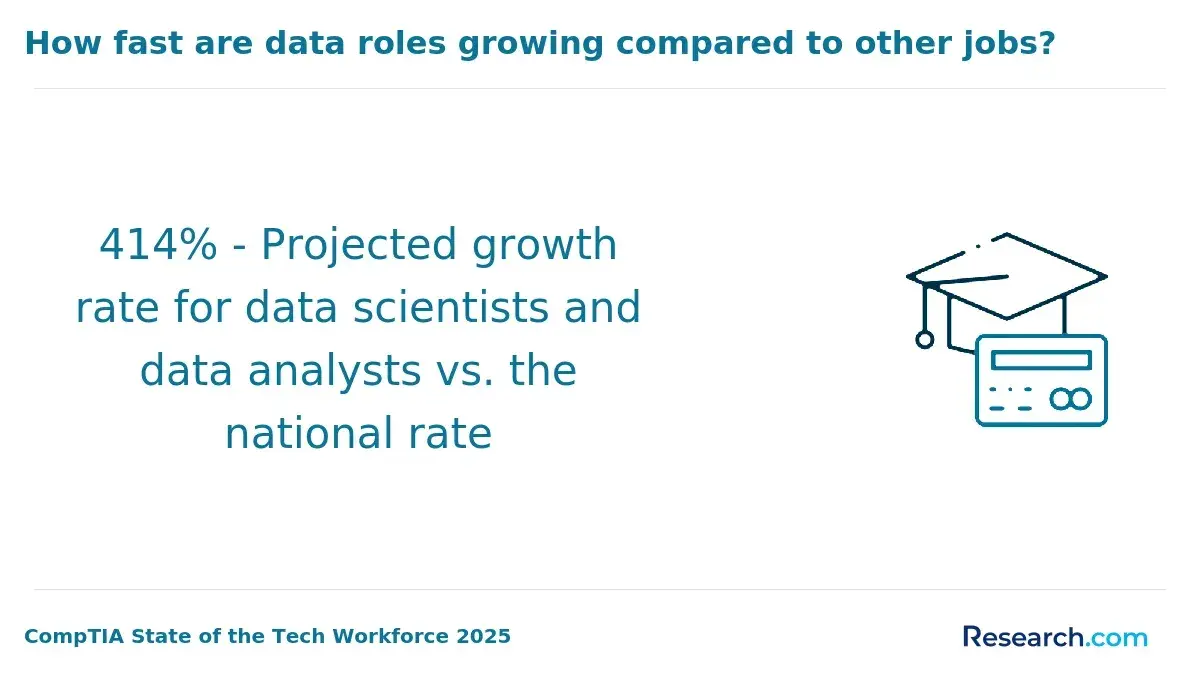
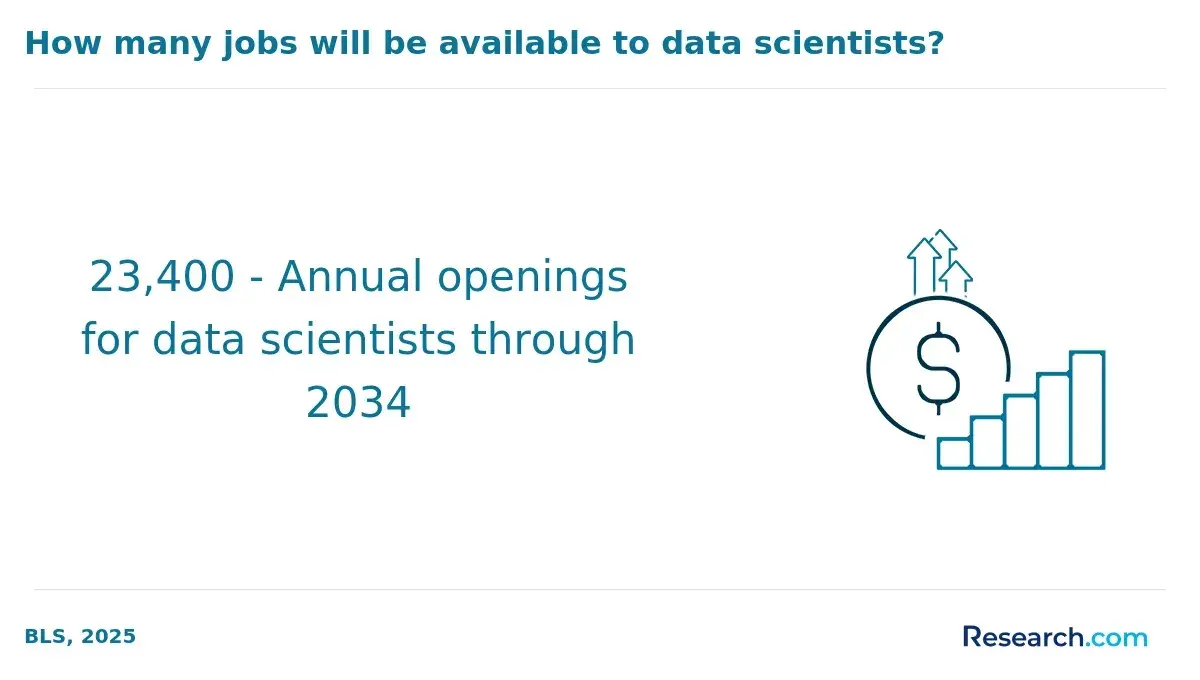
The labor market outlook for data scientists is strong. In 2024, there were 245,900 data scientists in the United States. BLS projections show an average of 23,400 data scientist job openings each year from 2024 to 2034, with employment expected to grow by 34% during that period.
This growth reflects demand for professionals who can work with large datasets, automation, AI-assisted analytics, and machine learning models. It also reflects broader business needs: organizations want better forecasting, faster risk detection, more personalized services, and stronger evidence for strategic decisions.
Students should still be realistic. Strong growth does not mean every applicant will find a role quickly. Employers often expect a portfolio, technical interviews, evidence of project work, and the ability to connect analysis to business outcomes.
What are the key skills needed for a career in data science?
Data science requires more than knowing a few tools. Employers typically look for a combination of statistics, programming, data management, modeling, visualization, communication, and domain understanding. The most competitive candidates can explain not only how a model works, but also when its results should or should not be trusted.
| Skill area | What you need to learn | Why employers care |
| Statistical and data analysis | Probability, hypothesis testing, regression, distributions, sampling, and model evaluation. | These skills help you interpret data accurately and avoid misleading conclusions. |
| Data visualization | Dashboards, charts, storytelling, and visual design for technical and nontechnical audiences. | Decision-makers often need clear visuals before they can act on analysis. A data analytics degree commonly includes visualization coursework. |
| Programming | Python, C/C++, Perl, Java, SQL, scripting, data pipelines, and reproducible notebooks. | Programming allows you to clean, transform, model, and automate work with large datasets. Students who want deeper coding preparation may compare a programming degree online. |
| Mathematics | Linear algebra, calculus, probability, optimization, and the math behind machine learning. | Mathematical fluency helps you understand model behavior instead of treating tools as black boxes. |
| Computer and data systems | Databases, cloud tools, version control, APIs, and data storage concepts. | Real-world data science depends on reliable data access, reproducible workflows, and collaboration with technical teams. |
| Communication | Writing, presenting, stakeholder management, and explaining uncertainty. | Insights have limited value if leaders cannot understand the recommendation, risk, or limitation. |
Python is especially important. Python is used by 57.9% of developers worldwide and was the top language on GitHub in 2024 (GitHub, 2024). In data science education and practice, the language is common because it supports analysis, automation, machine learning, visualization, and experimentation.
How to start your career in data science?
You can begin with several education paths, but the right starting point depends on your background, timeline, budget, and target role. An associate degree may help you qualify for technical support, junior analytics, web, or data-adjacent roles. A bachelor’s degree is more common for aspiring data scientists because it provides broader training in programming, statistics, databases, machine learning, and computer science.
Students comparing related programs may also consider an online computer science degree, analytics, mathematics, statistics, or information technology. These programs can support data science careers when paired with strong project work and relevant tools.
| Education path | Best for | Possible roles and salaries |
| Associate degree in data science or a related field | Students seeking a lower-cost entry point, technical foundations, or a pathway to transfer into a bachelor’s program. | Statistical Assistants ($53,420), Computer Support Specialists ($76,060), and Web Developers ($87,580). An associate’s degree can also help students build foundational programming and database skills. |
| Bachelor’s degree in data science | Students aiming for stronger preparation in programming, statistics, research, machine learning, and applied analytics. | Market Research Analysts ($78,880), Budget Analysts ($87,680), and Financial Analysts ($108,790). A data analytics online degree can also lead to business-focused analytics roles. |
| Certificate or boot camp | Career changers or degree holders who need targeted skills, portfolio projects, or tool-specific training. | Potential fit for junior analyst, data technician, business intelligence, or portfolio-based entry roles, depending on prior experience. |
| Master’s degree | Professionals seeking advanced modeling, AI, machine learning, research, or leadership opportunities. | Data Scientists ($115,240), Statisticians ($105,510), and Economists ($128,180). |
A smart entry strategy is to build from fundamentals to proof of ability: learn Python and SQL, study statistics, complete projects with real datasets, publish your work in a portfolio, and practice explaining your findings in business terms.
Can you get a data science job with just a certificate?
Yes, a certificate can help you get into data science, but it is usually strongest when combined with prior education, work experience, a portfolio, or domain expertise. A certificate alone may be enough for some junior analytics or data support roles, but many data scientist positions still prefer or require a degree.
According to Zippia (2025), 51% of data scientists have a bachelor’s degree and 34% have a master’s degree. That does not mean a certificate is useless. It means certificate students should be strategic: choose programs that teach hands-on tools, require applied projects, and help you demonstrate skills in machine learning, data cleaning, notebooks, modeling, and communication.
Depending on the institution, earning a data science certificate may take 10 months or more. Common professional certificate options include:
- IBM Data Science Professional Certificate
- Data Science Council of America (DASCA) Senior Data Scientist (SDS)
- SAS Certified Data Scientist
- Data Science Council of America (DASCA) Principal Data Scientist (PDS)
- Open Certified Data Scientist (Open CDS)
| Certificate may be enough when... | A degree may be better when... |
| You already have a degree in math, engineering, computer science, economics, business, science, or another quantitative field. | You are starting with little technical background and need structured preparation in math, programming, statistics, and computing. |
| You can show strong portfolio projects using real datasets and explain your methods clearly. | You want roles in research, advanced machine learning, AI, academia, or highly technical modeling. |
| You are targeting junior analyst, reporting, business intelligence, or data operations roles first. | You want the widest eligibility for data scientist postings that list degree requirements. |
| You have domain expertise in healthcare, finance, marketing, cybersecurity, or operations. | You plan to pursue graduate study or long-term advancement in technical leadership. |
How can I advance my career in data science?
Advancement in data science usually comes from a mix of stronger technical depth, business impact, leadership, and specialization. A graduate degree can help, especially if you want to work in machine learning, research, AI, risk modeling, advanced analytics, or academic settings.
Data science is often included among discussions of the most valuable degrees because of its broad applications and salary potential. At the master’s level, students may study software engineering, applied statistics, analytics, risk analysis, data mining, data management, and machine learning. At the doctoral level, coursework may include mathematical tools for data science, deep learning, natural language processing, and computational cognitive modeling.
| Advanced path | Career direction | Example roles and salaries |
| Master’s degree in data science | Advanced analytics, applied machine learning, technical leadership, risk analysis, or specialized industry work. | Data Scientists ($115,240), Statisticians ($105,510), and Economists ($128,180). |
| Doctorate in data science or a related field | Research, academia, advanced AI systems, computational science, and executive-level technical strategy. | Computer and Information Research Scientists ($155,880), Top Executives ($246,440), and Postsecondary Computer Science Teachers ($91,760). |
| Specialized credentials | Focused advancement in AI, cloud analytics, cybersecurity, health informatics, bioinformatics, or business intelligence. | Best for professionals who already know which domain or technical niche they want to pursue. |
Graduate education can accelerate advancement, but it does not replace experience. Employers still look for evidence that you can frame problems, work with messy data, collaborate with teams, and deliver usable recommendations.
What ethical considerations should data scientists keep in mind?
Data scientists often work with sensitive, incomplete, or potentially biased data. That makes ethics part of the job, not an optional add-on. Poor data practices can harm individuals, expose organizations to legal risk, and damage public trust.
Data privacy and protection
Personal and sensitive data should be collected, stored, and analyzed securely. Data scientists must understand privacy requirements such as GDPR or CCPA when applicable and should use anonymization or minimization practices when individual identities are not needed.
Bias and fairness
Algorithms can reproduce or intensify bias when training data reflects unequal systems or flawed assumptions. Data scientists should test for bias, document limitations, and evaluate whether model outputs create unfair outcomes for different groups.
Transparency
Stakeholders should understand where the data came from, how it was processed, what assumptions shaped the analysis, and what the model can or cannot conclude. Clear documentation improves accountability.
Informed consent
When people provide data, they should understand how it may be used. Consent practices matter most in sensitive areas such as health, education, finance, and consumer behavior.
Honest communication
Data scientists should avoid overstating results, hiding uncertainty, or selecting only findings that support a preferred decision. A misleading chart or model can be as damaging as a flawed calculation.
Social responsibility
Analytics in healthcare, finance, public safety, hiring, education, and government can affect real people. Professionals should weigh the social impact of their work and challenge uses of data that may cause preventable harm.
Students who want to build advanced expertise quickly may compare one year master programs that include ethics, governance, and applied analytics alongside technical coursework.
How can students finance their data science education?
Data science education can be expensive, especially at the bachelor’s and graduate levels. Before enrolling, students should compare total cost, financial aid, transfer credit policies, program length, and likely career outcomes—not just tuition per credit.
- Federal aid: Eligible students may use federal student loans, grants, and work-study programs to help pay tuition, fees, and related education expenses.
- Private loans: Banks and other lenders may offer loans, but these can have higher interest rates or less flexible repayment terms than federal options.
- Employer support: Some employers offer tuition reimbursement or education benefits for workers pursuing relevant technical skills.
- Scholarships and grants: Universities, nonprofits, professional associations, and industry groups may provide awards based on merit, financial need, identity, field of study, or career goals.
Scholarship opportunities related to data science and STEM include:
- Science, Mathematics, and Research for Transformation (SMART) Scholarship: For undergraduate, master's, and doctoral students enrolled in STEM degrees.
- ACM SIGHPC Computational & Data Science Fellowships: For women or students from racial/ethnic backgrounds pursuing a graduate degree in computational or data science.
- MinneAnalytics Scholarships: For undergraduate students planning careers in analytics.
- American Statistical Association Pride Scholarship: For graduate students in data science who identify as LGBTQ+.
What else can a data scientist do?
Data science skills are portable. Zippia (2025) reported that, among 3,198 data scientist resumes, 31% of data scientists stayed in their current positions for five to seven years. Some professionals remain in data science long term, while others move into adjacent fields that use analysis, experimentation, modeling, or data-informed decision-making.
| Alternative role | Average annual pay | How data science skills apply |
| SEO Specialists | $55,815 | Use search data, traffic patterns, testing, and content performance analysis to improve visibility and lead generation. |
| Litigation Analysts | $54,666 | Organize evidence, manage databases, analyze documents, and support complex legal research. |
| Quantitative Researchers | $109,482 | Analyze data, test financial or business models, and support data-based investment or strategy decisions. |
| UX Analysts | $92,137 | Study user behavior, preferences, and interactions to improve digital products and user experience. |
| Fraud Analysts | $82,640 | Detect unusual transaction patterns, build risk rules, and support fraud prevention strategies. |
Should I specialize in bioinformatics to enhance my data science career?
Bioinformatics can be a smart specialization if you want to apply data science to biology, genomics, pharmaceuticals, public health, or healthcare research. The field combines computational methods with biological data, which can make your skill set more specialized than general analytics training.
A targeted program such as a bioinformatics degree online may help students build the technical and scientific background needed for roles involving genomic data, clinical research, laboratory informatics, or biomedical analytics. This path is most useful if you are genuinely interested in life sciences, not just looking for a niche label.
How can networking and mentorship elevate a data science career?
Networking and mentorship can shorten the learning curve in data science. A mentor can help you choose projects, prepare for interviews, understand employer expectations, and avoid overinvesting in tools that are not relevant to your target roles.
Useful networking strategies include joining data science communities, attending meetups or conferences, contributing to open-source or portfolio projects, asking for informational interviews, and participating in school or employer-sponsored mentorship programs. Students who need faster technical preparation may also compare an accelerated computer science program if they want a broader computing foundation.
How can data science improve cybersecurity practices?
Data science supports cybersecurity by helping teams identify suspicious patterns, detect anomalies, classify threats, and prioritize risks. Machine learning and statistical monitoring can be used to analyze network traffic, user behavior, system logs, and transaction data.
Cybersecurity analytics works best when data science is combined with security fundamentals. Professionals interested in this crossover may benefit from programs that cover risk management, networks, incident response, and threat detection. Students comparing cost-conscious options can review cheap cybersecurity degrees to see how cybersecurity training can complement analytics skills.
How does one transition into a data science career from other fields?
Transitioning into data science is possible, but it requires a deliberate plan. The best path depends on your current background. A finance professional may already have quantitative and business skills. A software developer may need stronger statistics. A healthcare worker may bring valuable domain expertise but need programming and analytics training.
- Map your transferable skills: Identify experience in analysis, research, programming, reporting, databases, experimentation, statistics, or domain decision-making.
- Build the technical foundation: Study Python, SQL, statistics, probability, data cleaning, visualization, and basic machine learning.
- Create portfolio projects: Use public datasets or work-approved internal datasets to show that you can define a problem, analyze data, explain limitations, and make recommendations.
- Get practical exposure: Look for internships, contract projects, volunteer analytics work, freelance projects, or internal stretch assignments.
- Join professional communities: Attend industry events, participate in forums, ask for feedback, and connect with professionals in your target sector.
- Consider formal training: Certificates, graduate programs, or related careers in technology can help career changers fill gaps and signal commitment.
How can advanced AI programs future-proof your data science career?
AI is reshaping data science work by automating parts of coding, model development, reporting, and data exploration. This does not eliminate the need for data scientists; it changes what employers value. Professionals who understand model limitations, data quality, AI governance, experimentation, and deployment will be better positioned than those who only know how to run tools.
An accelerated online master's degree in artificial intelligence may help professionals deepen their knowledge of algorithms, automation, machine learning systems, and applied AI strategy. This option is most useful for students who already have a technical base and want to move toward advanced modeling or AI-focused roles.
Specialized graduate study can also connect data science with life sciences, healthcare, and genomics. For example, online bioinformatics masters programs may help professionals combine computational analysis with biological and medical data applications.
How can students choose the best data science degree program?
The best data science degree program is not necessarily the highest-ranked or most expensive one. It is the program that matches your goals, budget, background, learning format, and target job market. Students should compare both academic quality and career support before enrolling.
| What to evaluate | Questions to ask before enrolling |
| Accreditation and institutional quality | Is the school accredited? Does the program come from a department with strength in computer science, statistics, mathematics, engineering, business analytics, or a related field? |
| Curriculum | Does the coursework cover programming, statistics, machine learning, databases, visualization, ethics, and applied projects? |
| Specializations | Can you focus on AI, big data analytics, business intelligence, health informatics, cybersecurity, bioinformatics, or another relevant area? |
| Delivery format | Can you study online, on campus, hybrid, full-time, or part-time? An online data analyst degree may be useful for students who need flexibility. |
| Hands-on learning | Are there capstones, internships, labs, industry projects, research opportunities, or portfolio-building assignments? |
| Career support | Does the program offer employer connections, alumni networks, resume support, interview preparation, and mentorship? |
| Total cost | What is the full cost after fees, books, technology charges, travel, and lost work time? What financial aid or employer support is available? |
Why consider health informatics as a specialization in data science?
Health informatics is a practical data science specialization for students interested in healthcare operations, patient data, clinical systems, public health analytics, or predictive tools for care delivery. It requires both technical skill and an understanding of healthcare workflows, privacy, and decision-making.
Students who want this interdisciplinary path can compare health informatics programs online. This specialization is a better fit for people who want to work close to healthcare systems than for those seeking purely general machine learning roles.
What other educational paths can complement a career in data science?
Data science pairs well with several fields. Artificial intelligence can strengthen modeling and automation skills; cybersecurity can add risk and threat analysis; health informatics and bioinformatics can open healthcare and life science roles; business analytics can support management-facing careers.
Students who want deeper AI preparation may begin by researching online masters in artificial intelligence. The best complementary path depends on the problems you want to solve, not simply which credential sounds most advanced.
What are the best ways to gain practical experience in data science?
Practical experience is often the difference between knowing data science concepts and being ready for a job. Employers want proof that you can work with imperfect data, make defensible choices, and communicate outcomes.
- Build personal projects: Analyze public datasets, create predictive models, build dashboards, or compare methods. Focus on clear problem statements and explanations, not just code.
- Complete internships: Internships expose you to real business constraints, team workflows, data privacy concerns, and stakeholder communication.
- Join online competitions: Platforms such as Kaggle can help you practice modeling and learn from other approaches, though competition projects should not be your only portfolio evidence.
- Freelance or volunteer: Small projects for nonprofits, local businesses, or freelance clients can help you practice scoping and delivery.
- Use advanced coursework: A master’s program may provide structured projects, research, and capstone work. Cost-conscious students can compare the cheapest online data science masters programs while evaluating quality and fit.
What should go into a data science portfolio?
- A clear question or business problem.
- A description of the dataset and its limitations.
- Code that is organized and reproducible.
- Visualizations that support the analysis.
- A model or analytical method with evaluation metrics.
- A plain-language summary of findings and recommendations.
- An explanation of ethical, privacy, or bias concerns when relevant.
How can acquiring domain-specific expertise enhance data science projects?
Domain knowledge helps data scientists ask better questions, choose better features, recognize suspicious results, and recommend actions that make sense in context. A technically correct model can still fail if it ignores how an industry actually works.
For example, data science applied to design, urban planning, or built environments may benefit from knowledge of architecture and spatial decision-making. Students interested in that crossover could explore a cheap masters in architecture degree as one example of how domain expertise can complement analytical training.
What challenges do data scientists face in their jobs?
Data science can be rewarding, but the work comes with real challenges. Many projects involve messy data, unclear goals, shifting stakeholder expectations, privacy concerns, and pressure to produce quick answers from imperfect information.
- Skills gaps: Employer expectations can move faster than formal education. Professionals often need ongoing training in tools, modeling methods, cloud systems, and AI-supported workflows. Research on ongoing data-driven training and upskilling initiatives highlights the importance of continuous development.
- Data privacy and security: Data analytics and IT leaders continue to prioritize privacy and security (ISACA, 2026). Data scientists must understand access controls, compliance requirements, and safe handling of sensitive data.
- Bias and ethics: Models can produce unfair or misleading results when data is biased, incomplete, or poorly interpreted. Responsible professionals test assumptions and communicate limitations.
- Stakeholder communication: Technical work can fail if the results are not understandable, timely, or relevant to the decision at hand.
- Unclear project scope: Data science projects often begin with broad questions. Defining the right problem is sometimes harder than building the model.
Common mistakes to avoid when planning a data science career
| Mistake | Better approach |
| Choosing a program only because it has “data science” in the title. | Review the curriculum, faculty expertise, projects, accreditation, cost, and career support. |
| Ignoring statistics and focusing only on coding. | Build a balanced foundation in statistics, probability, programming, databases, and communication. |
| Assuming a certificate guarantees a data scientist title. | Use certificates to build skills, then prove ability through projects, experience, and interviews. |
| Relying only on rankings. | Compare outcomes, fit, flexibility, affordability, and whether the program supports your target role. |
| Building portfolio projects with no business explanation. | Show the problem, method, results, limitations, and recommendation in plain language. |
| Overlooking data ethics and privacy. | Learn responsible data handling, bias testing, consent issues, and transparent reporting. |
| Assuming salary outcomes are guaranteed. | Treat salary data as a benchmark, not a promise. Pay varies by role, location, employer, specialization, and experience. |
References
- Glassdoor. (2024a, February 10). How much does an entry level data scientist make? https://www.glassdoor.com/Salaries/entry-level-data-scientist-salary-SRCH_KO0,26.htm
- Glassdoor. (2024b, March 12). How much does a senior data scientist make? https://www.glassdoor.com/Salaries/senior-data-scientist-salary-SRCH_KO0,21.htm
- U.S. Bureau of Labor Statistics. (2023a, September 6). Data scientists. Occupational Outlook Handbook. https://www.bls.gov/ooh/math/data-scientists.htm
- U.S. Bureau of Labor Statistics. (2025, August 8). Occupational projections, 2024–2034, and worker characteristics, 2024. Retrieved February 2026, from https://www.bls.gov/emp/tables/occupational-projections-and-characteristics.htm
- Zippia. (2025). Data scientist demographics and statistics in the US https://www.zippia.com/data-scientist-jobs/demographics
Key Insights
- Data science is a strong career path for people who combine technical ability with curiosity, business judgment, and communication skills.
- The field offers high salary potential: BLS data shows a 2024 median annual salary of $112,590 for data scientists, with earnings ranging from $58,510 to $174,790.
- Job growth is projected to be strong, with 23,400 average annual openings and 34% employment growth expected from 2024 to 2034.
- A bachelor’s degree is the most common education level among data scientists, but certificates, associate degrees, master’s degrees, and doctoral programs can each make sense depending on your goals.
- Certificates are most effective when paired with portfolio projects, prior experience, or domain expertise; they are not automatic substitutes for degree requirements in every job posting.
- Python, SQL, statistics, visualization, machine learning, and communication are core skills, but domain knowledge can make your work more valuable in healthcare, finance, cybersecurity, bioinformatics, and other sectors.
- Before choosing a program, evaluate accreditation, curriculum, hands-on learning, total cost, career support, flexibility, and whether the program matches your target role.
- The biggest career mistake is treating data science as only a tools-based field. Long-term success depends on asking better questions, handling data responsibly, explaining uncertainty, and producing insights people can actually use.
Other Things You Should Know About Data Science Careers
In 2027, data scientists should focus on mastering advanced machine learning algorithms, proficiency in AI ethics, and expertise in cloud-based solutions. Familiarity with tools like TensorFlow and PyTorch, along with blockchain analytics, will also be valuable for staying competitive in the field.
The job outlook for data science careers in 2027 remains strong, with demand continuing to rise across various industries. Organizations seek data scientists to leverage big data for strategic decision-making, resulting in competitive salaries and opportunities for growth in this high-demand field.
In 2027, data scientists can expect an average salary range between $95,000 and $165,000 annually. Factors influencing salary include experience level, industry, geographic location, and specific technical skills. Professionals specialized in machine learning or artificial intelligence may command higher salaries due to increased demand.


