
2027 How to Become a Cybersecurity Consultant

Co-Founder and Chief Data Scientist
Becoming a cybersecurity consultant is a career path for professionals who want to help organizations find security weaknesses, reduce cyber risk, respond to incidents, and meet compliance obligations. The role matters more in 2027 because companies are handling more sensitive data across cloud platforms, remote work environments, third-party tools, and AI-enabled systems—while attackers continue to adapt.
This guide explains what cybersecurity consultants do, how to enter the field, which degrees and certifications can help, what skills employers and clients look for, how much consultants can earn, and how to judge whether the education investment is worth it. It is written for students, career changers, IT professionals, and early-career cybersecurity workers who want a practical roadmap rather than a generic job description.
Quick answer: How do you become a cybersecurity consultant?
To become a cybersecurity consultant, build a foundation in IT, networking, systems security, and risk management; earn a relevant degree or equivalent technical training; gain hands-on experience in security operations or IT roles; add recognized certifications such as CompTIA Security+, CEH, CISSP, CISM, or OSCP; and create a portfolio that proves you can assess vulnerabilities, explain risk, and recommend realistic security improvements. Most consultants do not start directly in consulting—they usually move into the role after working as security analysts, IT specialists, penetration testers, systems administrators, or incident response professionals.
Key things to know before pursuing cybersecurity consulting
- Cybersecurity consultants advise organizations in industries such as finance, healthcare, government, education, manufacturing, e-commerce, and technology on how to protect systems, data, networks, and users.
- The median salary for cybersecurity consultants is approximately $102,603, but compensation varies by experience, location, certifications, employer type, and specialization.
- The career can be financially strong and intellectually rewarding, but it also requires constant learning, clear client communication, ethical judgment, and the ability to work under pressure during audits or security incidents.
- Career roadmap for becoming a cybersecurity consultant
- What cybersecurity consultants do
- Skills cybersecurity consultants need in 2027
- Best degree paths for future cybersecurity consultants
- Ways to get hands-on cybersecurity consulting experience
- Cybersecurity certifications that can strengthen your consulting profile
- Average cybersecurity consultant salary
- Job outlook for cybersecurity consultants in 2027
- Common tools used by cybersecurity consultants
- How to improve the return on your cybersecurity education
- Challenges and common mistakes in cybersecurity consulting
- How interdisciplinary learning can improve cybersecurity consulting
- How consultants build lasting client trust
- Remote work security challenges for consultants in 2027
- Balancing technical depth with leadership
- Legal and ethical duties of cybersecurity consultants in 2027
- Trends changing cybersecurity consulting in 2027
- How consultants prove business value
- How health informatics concepts can support cybersecurity strategy
How do you start your career as a cybersecurity consultant?
The most reliable path into cybersecurity consulting is to combine formal learning, technical practice, business communication, and progressive job experience. Clients pay consultants for judgment, not just tool knowledge, so you need to understand how security decisions affect budgets, operations, compliance, and risk.
Step-by-step path to cybersecurity consulting
| Career stage | What to focus on | Why it matters for consulting |
| Foundation | Learn networking, operating systems, basic scripting, cloud concepts, and security fundamentals. | Consultants must understand how systems actually work before they can evaluate risk or recommend controls. |
| Education | Earn a degree in cybersecurity, computer science, information technology, software engineering, or a related field. | A degree can help with entry-level screening, structured technical training, and long-term advancement. |
| Entry-level experience | Work in IT support, systems administration, help desk, security operations, junior analyst, or network support roles. | Real environments teach you how security policies, users, software, and infrastructure interact. |
| Certifications | Add credentials that match your target role, such as CompTIA Security+, CEH, CISSP, CISM, or OSCP. | Certifications can validate specialized skills and help clients or employers assess your readiness. |
| Portfolio | Document labs, vulnerability reports, audit-style findings, secure configurations, penetration testing practice, or incident response exercises. | A portfolio gives hiring managers and clients evidence of how you think, test, communicate, and solve problems. |
| Consulting readiness | Practice writing executive summaries, risk ratings, remediation plans, and client presentations. | Consulting requires translating technical findings into decisions that nontechnical leaders can act on. |
1. Choose education that supports your target role
- A bachelor’s degree in cybersecurity, computer science, information technology, or a related technical discipline is a common starting point. Students comparing broader computing programs may also review options such as the most affordable online software engineering degree programs if they want a software-heavy route into security.
- Look for coursework in network security, ethical hacking, cryptography, cloud security, risk management, security policy, and secure software development.
- Pair your degree with certifications when they match your goal. For example, CompTIA Security+ is often useful early, while CISSP and CISM are more aligned with experienced professionals and advisory roles.
2. Get real technical experience before selling yourself as a consultant
- Apply for internships in IT, security operations, infrastructure, cloud administration, or compliance teams where you can work with monitoring tools, firewalls, identity systems, logs, and vulnerability management processes.
- Start in roles such as IT specialist, junior security analyst, help desk technician, system administrator, or network support associate if you are not yet ready for a security-only position.
- Take small, ethical projects that build judgment: security awareness materials, basic hardening checklists, lab-based penetration testing, log analysis practice, or nonprofit technology support.
3. Build a portfolio that shows both analysis and communication
- Use GitHub, LinkedIn, or a personal website to document sanitized projects, home labs, scripts, security writeups, and mock risk assessments. Do not publish sensitive client or employer information.
- Include examples that show how you identify a vulnerability, assess its impact, prioritize remediation, and explain the finding to a nontechnical stakeholder.
- Use clear report formats. A strong consultant can produce a technical appendix and an executive summary that both describe the same risk at the right level of detail.
4. Build a professional network early
- Join cybersecurity associations, local security groups, online communities, or professional organizations such as ISACA or (ISC)2 to learn from practitioners and stay visible in the field.
- Use cybersecurity conferences and industry events such as DEF CON, RSA Conference, and local meetups to meet peers, recruiters, mentors, vendors, and potential collaborators.
- Participate professionally in forums and discussion groups. Asking thoughtful questions and sharing useful technical notes can help you build credibility before you apply for consulting roles.
5. Keep your skills current
- Follow security advisories, vendor updates, threat intelligence reports, and reputable training providers so your advice does not become outdated.
- Ask which credential fills a specific gap before enrolling. If you are comparing flexible credentials, Research.com’s guide to online certifications that can pay well can help you evaluate options by career relevance rather than name recognition alone.
6. Use career resources strategically
- Search job boards for consultant, analyst, compliance, penetration testing, cloud security, GRC, and incident response roles to see which skills employers repeatedly request.
- Tailor your resume to outcomes: risks reduced, controls implemented, vulnerabilities remediated, reports delivered, tools used, and teams supported.
- If speed matters and you already have some transfer credits or IT background, an accelerated cyber security online degree may help you move through the education requirement faster, but you should still compare accreditation, workload, cost, and career support.
What is a cybersecurity consultant?
A cybersecurity consultant is an external or internal advisor who helps organizations understand, reduce, and manage digital security risk. Consultants may evaluate infrastructure, test applications, review compliance requirements, investigate incidents, build security programs, train employees, or advise executives on security strategy.
The role is different from a purely operational security job. A security analyst may monitor alerts every day inside one organization, while a consultant often works across multiple clients, projects, industries, or risk areas. Because of that, consultants need technical depth, documentation skills, business awareness, and strong professional judgment.
Core responsibilities
- Risk assessments: Review systems, policies, vendors, networks, and applications to identify weaknesses and prioritize the risks that matter most.
- Vulnerability testing: Use scanning, configuration review, penetration testing, and secure design analysis to uncover security gaps.
- Security strategy: Recommend controls, timelines, budgets, staffing changes, governance processes, and technology improvements that fit the client’s environment.
- Employee training: Help reduce human error by teaching staff how to identify phishing attempts, protect credentials, handle data, and follow security policies.
- Incident response: Support containment, investigation, recovery, reporting, and lessons learned after a breach or suspected compromise.
- Compliance support: Help organizations align security practices with privacy, industry, contractual, and regulatory expectations.
If you are still deciding whether to pursue the field through a degree program, Research.com’s guide asking whether a cybersecurity degree is worth it can help you compare the cost, career value, and alternatives.
What skills are required to become a cybersecurity consultant for 2027?
Cybersecurity consulting requires more than knowing how to run tools. The strongest consultants can investigate technical problems, explain risk clearly, work with different departments, and recommend fixes that clients can actually implement.
| Skill area | What it includes | How consultants use it |
| Programming and scripting | Python, Java, C++, automation scripts, secure coding concepts, and code review basics. | Used to analyze software behavior, automate checks, understand application risk, and communicate with development teams. |
| Operating systems | Windows, Linux, macOS, permissions, services, patching, logging, and endpoint hardening. | Used to identify misconfigurations, privilege issues, malware indicators, and insecure administrative practices. |
| Networking | TCP/IP, DNS, routing, segmentation, VPNs, wireless security, and tools such as Wireshark. | Used to trace traffic, detect anomalies, evaluate architecture, and recommend secure network designs. |
| Cloud and identity | Cloud security models, access control, multifactor authentication, privileged accounts, and identity governance. | Used to secure distributed infrastructure, remote teams, and SaaS-heavy environments. |
| Risk analysis | Threat modeling, likelihood and impact analysis, control mapping, and prioritization. | Used to help clients decide which security issues need immediate funding and which can be scheduled later. |
| Communication | Client interviews, reporting, executive summaries, presentations, and difficult conversations. | Used to turn technical findings into practical decisions for managers, executives, auditors, and IT teams. |
| Collaboration | Working with legal, compliance, IT, HR, finance, operations, vendors, and leadership. | Used to implement security improvements without disrupting the business unnecessarily. |
Technical skills
- Secure programming knowledge: Consultants do not always work as developers, but they should understand how insecure code, poor input validation, weak authentication, and dependency risks create exposure.
- Operating system expertise: Familiarity with Windows, Linux, and macOS helps consultants evaluate endpoints, servers, access controls, logs, and patching practices.
- Network security knowledge: Consultants need to understand protocols, segmentation, firewalls, VPNs, DNS, traffic analysis, and network monitoring tools.
Analytical skills
- Threat recognition: Consultants must connect technical signals, attacker behavior, business processes, and known vulnerabilities to spot meaningful risk.
- Problem-solving: Good recommendations balance security, usability, cost, staffing, timeline, and compliance obligations.
Client-facing skills
- Plain-language communication: Clients need clear explanations of what is wrong, why it matters, what to do next, and what could happen if they delay.
- Stakeholder management: Consultants often work with teams that have competing priorities, so diplomacy and structure matter.
What are the best degree programs for aspiring cybersecurity consultants?
The best degree depends on your starting point and the type of consulting you want to do. Cybersecurity degrees offer the most direct route, while computer science, information technology, and software engineering degrees can be strong alternatives for students who want broader technical flexibility. Some learners also explore skills-based routes, including online trade school programs available, but consulting roles often reward deeper experience and recognized credentials.
| Degree option | Best for | Typical strengths | Potential limitation |
| Bachelor’s in Cybersecurity | Students who want the most direct academic preparation for security roles. | Network security, ethical hacking, cryptography, compliance, incident response, and risk management. | May be narrower than computer science if you later want to move outside security. |
| Master’s in Information Security | Professionals seeking senior consulting, security leadership, risk, or governance roles. | Policy, security architecture, advanced threat analysis, leadership, compliance, and program management. | Usually works best after you already have technical or security experience. |
| Computer Science | Students who want strong programming, algorithms, systems, and software foundations. | Software security, systems thinking, development knowledge, and technical adaptability. | May require you to add cybersecurity electives, labs, or certifications. |
| Information Technology | Learners who want practical preparation for infrastructure, systems, cloud, and support roles. | Networks, systems administration, databases, cloud platforms, and enterprise technology operations. | Security depth varies by program and concentration. |
| Software Engineering | Students interested in application security, secure development, DevSecOps, or product security consulting. | Software design, testing, secure coding, development lifecycle, and engineering collaboration. | Less focused on governance, incident response, and compliance unless paired with security training. |
Bachelor’s in cybersecurity
- What it covers: Common subjects include ethical hacking, network defense, cryptography, digital forensics, security policy, risk management, and compliance concepts such as GDPR and HIPAA.
- Why it helps: A cybersecurity bachelor’s degree can prepare graduates for roles such as security analyst, junior consultant, penetration testing associate, or security operations specialist.
- How it translates to work: Graduates may begin by scanning systems, reviewing access controls, analyzing security alerts, writing risk reports, and supporting remediation plans.
Master’s in information security
- What it covers: Advanced programs often emphasize security governance, threat analysis, policy development, enterprise risk, security leadership, and incident management.
- Why it helps: A master’s degree can support movement into senior consulting, risk management, security program leadership, or executive advisory work.
- How it translates to work: Graduates may lead assessments, manage incident response planning, advise on security investments, or design organization-wide security programs.
Alternative technology degrees
Alternative degree paths can still lead to cybersecurity consulting if you add security labs, internships, certifications, and relevant work experience. Students comparing broader technology options may encounter programs such as an online game development degree, but they should check whether the curriculum includes secure coding, networking, systems, or security electives before treating it as a cybersecurity pathway.
- Computer science: Strong for students who want deep programming, systems, algorithms, and software security knowledge.
- Information technology: Useful for students who want hands-on infrastructure, cloud, endpoint, and enterprise systems knowledge.
- Software engineering: Helpful for application security, DevSecOps, code review, and secure product development consulting.
- Related design or technical degrees: Programs such as a UI UX design bachelor's degree online are not a direct cybersecurity route, but user-centered design knowledge can help consultants communicate security processes and reduce risky user behavior when paired with technical training.
How can you gain practical experience in cybersecurity consulting?
Hands-on experience is what turns classroom knowledge into consulting credibility. Employers and clients want to see that you can work with real systems, document findings, and recommend fixes that fit operational constraints.
- Internships: Seek placements with IT, risk, audit, security operations, cloud, or infrastructure teams where you can work with SIEM systems, firewalls, endpoint tools, identity platforms, and vulnerability scanners.
- Entry-level technology roles: Help desk, network support, systems administration, and IT operations roles build the infrastructure knowledge that consultants rely on later.
- Freelance or volunteer projects: Support small organizations with security awareness, password policy reviews, asset inventories, or basic configuration improvements, while staying within legal and ethical boundaries.
- Capture-the-flag competitions: Use CTFs to practice exploitation concepts, reverse engineering, web security, cryptography puzzles, and analytical thinking in a controlled environment.
- Home labs: Build safe practice environments with virtual machines, vulnerable test applications, network monitoring tools, and simulated attacks.
- Open-source participation: Contribute documentation, testing, or security-focused improvements to projects that welcome responsible participation.
If you are weighing cybersecurity against shorter vocational routes, you may also want to compare it with other trade school majors and career outcomes before committing to a degree.
What are the top cybersecurity certifications for consultants for 2027?
Certifications can help you prove specific competencies, but they should support your career stage. A beginner does not need the same credential as a senior risk advisor, and a penetration tester does not need the same credential as a governance consultant.
| Certification | Best fit | Consulting value |
| CompTIA Security+ | Beginners and early-career IT professionals. | Shows baseline knowledge of security concepts, threats, controls, and risk. |
| CEH | Learners interested in ethical hacking and vulnerability assessment. | Signals familiarity with offensive security concepts and testing methods. |
| OSCP | Hands-on penetration testing candidates. | Demonstrates practical offensive security problem-solving and technical persistence. |
| CISSP | Experienced professionals moving into senior security, architecture, or advisory work. | Supports credibility in security management, risk, governance, and broad security domains. |
| CISM | Professionals focused on security leadership, governance, compliance, and program management. | Helps consultants advise clients on security programs, policies, and management controls. |
- CISSP: Often associated with advanced security knowledge and management-level responsibilities.
- CISM: Useful for consultants who advise on governance, security programs, compliance, and risk management.
- CEH: Focuses on ethical hacking concepts, vulnerability assessment, and attacker techniques.
- CompTIA Security+: A common starting certification for people building a foundation in cybersecurity.
- OSCP: A hands-on option for professionals aiming at penetration testing and offensive security consulting.
How much do cybersecurity consultants earn on average?
Cybersecurity consulting can be a high-paying technology career, but earnings are not guaranteed. Pay depends on experience, location, industry, certifications, employer type, specialization, and whether the consultant works independently or for a firm. Roles related to consulting, such as cyber security analyst positions, can also serve as stepping stones into higher-responsibility advisory work.
Salary by experience level
| Experience level | Typical annual earnings stated | What usually changes at this level |
| Entry-level | $70,000 to $90,000 | Consultants usually handle defined tasks, support assessments, prepare documentation, and learn client delivery methods. |
| Mid-level | $100,000 to $130,000 | Professionals often manage workstreams, conduct more complex assessments, lead client conversations, and mentor junior staff. |
| Senior-level | $150,000 or more | Senior consultants may advise executives, lead major engagements, manage teams, specialize in high-risk sectors, or own client relationships. |
Factors that affect pay
- Location: Compensation can be higher in major technology and business markets such as Texas, New York, or California, though cost of living also matters.
- Certifications: Credentials such as CISSP, CEH, CISM, and OSCP can support higher compensation when paired with proven experience.
- Industry: Finance and healthcare may pay more for specialized security knowledge because of strict compliance and data protection requirements.
- Specialization: Cloud security, penetration testing, incident response, identity security, governance, and risk advisory can lead to different salary ranges.
- Business model: Independent consultants may have more income upside but also carry business development, insurance, tax, and client acquisition responsibilities.
What is the job outlook for cybersecurity consultants for 2027?
The job outlook for cybersecurity consultants is strong because organizations continue to face ransomware, phishing, cloud misconfigurations, supply chain exposure, identity attacks, and regulatory pressure. The broader cybersecurity labor market supports consulting demand, especially for professionals who can connect security work to business risk.
Job market signals
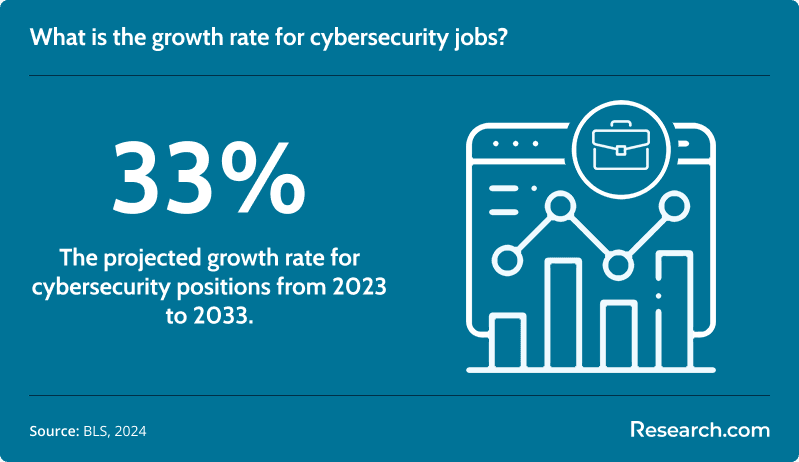
- Projected growth rate: Cybersecurity jobs are forecasted to grow by 33% from 2023 to 2033, showing continued demand for professionals who can protect systems and respond to evolving threats.
- Demand drivers: Organizations need help with cloud adoption, remote access, regulatory compliance, incident response planning, vendor risk, AI-related security concerns, and protection of sensitive data.
Industries that hire cybersecurity consultants
- Finance: Banks, investment firms, insurers, and payment companies need strong controls to protect customer data, reduce fraud, and meet compliance expectations.
- Healthcare: Providers, insurers, and health technology companies need support protecting patient information and complying with HIPAA and related requirements.
- Government: Public agencies and contractors need cybersecurity expertise for critical infrastructure, national security, citizen data, and procurement requirements.
- Technology: Software, cloud, AI, and platform companies need security reviews, product security support, identity controls, and incident readiness.
- Education, manufacturing, and e-commerce: These sectors increasingly need help with ransomware prevention, account security, payment data, operational technology, and vendor risk.
What tools do cybersecurity consultants use for 2027?
Cybersecurity consultants use tools to test systems, monitor activity, analyze incidents, document risk, and support remediation. Related roles such as a cyber crime investigator may use some overlapping tools, especially for evidence review, incident analysis, and threat investigation.
| Tool category | Examples | Primary use |
| Penetration testing tools | Metasploit, Burp Suite | Simulate attacks, test web applications, validate vulnerabilities, and evaluate exploitability. |
| Network monitoring tools | SolarWinds, Nagios | Track network performance, detect unusual activity, and support availability and security monitoring. |
| Threat intelligence platforms | Recorded Future, ThreatConnect | Collect and analyze information about threats, attacker behavior, indicators, and emerging risks. |
| SIEM platforms | Splunk, IBM QRadar | Aggregate logs, correlate alerts, support investigation, and help teams respond to incidents. |
Tools are useful only when the consultant understands the environment, validates results, and explains the business impact. A long scan report with no prioritization is not consulting; a focused risk-based remediation plan is.
How can I maximize the return on my cybersecurity education investment?
To improve the return on your cybersecurity education, compare total cost, transfer credit policies, accreditation, program outcomes, certification preparation, hands-on labs, internship access, and the specific roles graduates are prepared to pursue. Do not judge a program by tuition alone. A cheaper program with weak career support may cost you more time, while a more expensive program may not be worth it if it lacks relevant labs, employer recognition, or flexible scheduling.
Start by estimating your full cost: tuition, fees, books, certification exams, technology requirements, time away from work, and commuting if applicable. Then compare those costs with the skills and credentials you need for your target role. Reviewing cyber security online degree cost information can help you identify lower-cost options, but you should still verify academic quality and fit.
Questions to ask before enrolling
- Is the institution properly accredited?
- Does the curriculum include labs, cloud security, risk management, incident response, and secure networking?
- Can you transfer previous credits or professional experience?
- Does the program prepare students for certifications you actually need?
- Are internships, career coaching, employer partnerships, or portfolio projects included?
- Will the schedule work with your job and family responsibilities?
- Does the program support your target path: analyst, penetration tester, GRC consultant, cloud security specialist, or security manager?
What are the common challenges cybersecurity consultants face?
Cybersecurity consulting can be demanding because consultants must solve technical problems while managing budgets, client expectations, compliance pressures, and time-sensitive incidents. The hardest parts of the job are often not the tools—they are prioritization, communication, and decision-making under uncertainty.
Common challenges
- Fast-changing threats: Attack techniques, vulnerabilities, cloud risks, and AI-enabled tactics require continuous learning.
- Limited client budgets: Consultants often need to explain why preventive controls are worth funding before a breach occurs.
- Compliance complexity: Requirements involving GDPR, CCPA, or ISO 27001 can be detailed, time-consuming, and difficult to align across business units.
- Communication gaps: Clients may misunderstand technical findings unless the consultant explains risk in plain language with practical next steps.
- High-pressure engagements: Breaches, audits, board meetings, and failed controls can create stressful deadlines and burnout risk.
Common mistakes to avoid
| Mistake | Why it hurts your career or client work | Better approach |
| Choosing a program without checking accreditation | Credits, employer recognition, and financial aid options may be affected. | Verify accreditation before enrolling or paying application fees. |
| Focusing only on tuition | Low cost does not guarantee strong labs, career services, or employer value. | Compare total cost, curriculum, outcomes, support, and flexibility. |
| Collecting certifications without experience | Credentials alone do not prove you can solve real security problems. | Pair certifications with labs, projects, internships, and job experience. |
| Writing reports full of jargon | Executives may not understand the risk or approve remediation. | Use clear findings, business impact, priority levels, and action steps. |
| Assuming every vulnerability is equally urgent | Clients may waste time on low-impact issues while high-risk gaps remain. | Prioritize by exploitability, business impact, exposure, and compensating controls. |
| Ignoring legal and ethical boundaries | Unauthorized testing can create legal, professional, and reputational consequences. | Get written authorization, define scope, protect data, and document work carefully. |
How can interdisciplinary studies enhance cybersecurity consulting expertise?
Interdisciplinary study can make cybersecurity consultants better at pattern recognition, systems thinking, privacy analysis, and communication across specialized teams. For example, professionals who study analytics-heavy fields such as bioinformatics may develop stronger skills in data interpretation, anomaly detection, and complex modeling. A program such as an MS in bioinformatics is not a standard cybersecurity requirement, but the analytical habits developed in that field can support advanced security work when paired with technical cybersecurity training.
How do cybersecurity consultants foster long-term client trust and satisfaction?
Consultants earn trust by being accurate, transparent, responsive, and realistic. Clients need advisors who explain trade-offs clearly, avoid exaggerating threats, protect confidential information, and follow through after delivering a report.
- Set expectations early: Define scope, timelines, access requirements, deliverables, assumptions, and limitations before work begins.
- Report clearly: Provide executive summaries, technical evidence, risk ratings, and remediation guidance that the client can act on.
- Stay available after delivery: Post-engagement support helps clients interpret findings, prioritize fixes, and answer leadership questions.
- Adapt to the client’s reality: Recommendations should consider staffing, budget, operations, compliance, and business priorities.
- Keep learning: Cross-disciplinary programs, including bioinformatics online masters options, can broaden analytical thinking, but consultants should connect that learning directly to security problems.
How do cybersecurity consultants overcome remote work challenges for 2027?
Remote and hybrid work expand the security perimeter. Consultants must evaluate identity controls, endpoint protection, cloud configurations, collaboration tools, VPN or zero trust access, device management, and user behavior outside the office.
- Assess whether remote access uses strong authentication, least privilege, logging, and device compliance checks.
- Review endpoint security for laptops, mobile devices, unmanaged devices, and bring-your-own-device policies.
- Evaluate cloud storage, collaboration platforms, and file-sharing practices for data exposure risks.
- Train employees on phishing, secure home networks, password managers, and safe handling of sensitive information.
- Use secure project management and communication practices during consulting engagements.
Consultants who want broader technical training may compare flexible engineering-related programs, including affordable online universities for engineering, but they should prioritize coursework that directly supports security architecture, cloud systems, or infrastructure protection.
How do cybersecurity consultants balance technical expertise with leadership?
As consultants advance, they spend more time influencing decisions, guiding teams, and advising executives. Technical credibility still matters, but senior consultants must also define strategy, manage risk conversations, lead projects, and help organizations make security investments.
- Translate technical issues into business risk: Explain how a weakness could affect revenue, operations, compliance, reputation, or safety.
- Lead without overwhelming: Give clients enough evidence to trust the recommendation without burying them in unnecessary detail.
- Manage projects: Consulting work depends on scope control, milestones, documentation, stakeholder meetings, and change management.
- Use emerging technology carefully: Programs such as AI online degrees can deepen technical perspective, but consultants should apply AI knowledge with careful attention to security, privacy, and validation.
What are the legal and ethical responsibilities of cybersecurity consultants for 2027?
Cybersecurity consultants often receive access to sensitive systems, confidential documents, personal data, logs, credentials, and vulnerability information. That access creates serious legal and ethical duties. Consultants must work within written authorization, respect scope, protect client data, avoid conflicts of interest, and provide honest recommendations.
Key responsibilities
- Authorization: Do not scan, test, access, exploit, or monitor systems without clear written approval.
- Scope control: Follow the agreed testing boundaries, time windows, systems, methods, and escalation procedures.
- Confidentiality: Protect client data, credentials, reports, evidence, and internal communications.
- Accurate reporting: Do not inflate risks, hide limitations, exaggerate results, or recommend unnecessary products for personal gain.
- Privacy awareness: Understand how data protection, breach notification, and industry rules affect the engagement.
- Professional development: Continuing education, including technical programs such as a 1 year computer science degree online, can support competence, but ethical practice depends on judgment and accountability as much as credentials.
What emerging trends are reshaping cybersecurity consulting for 2027?
Cybersecurity consulting is being reshaped by AI-assisted attacks and defenses, automation, cloud migration, zero trust architecture, identity-centered security, regulatory scrutiny, and the need to secure remote work. Consultants who understand these shifts can give more useful advice than those who rely only on traditional perimeter defense models.
- AI and automation: Security teams are using analytics and automation to detect suspicious activity faster, while attackers may also use automation to scale attacks.
- Zero Trust: More organizations are moving toward models that continuously verify users, devices, access, and context rather than assuming internal networks are safe.
- Cloud and SaaS security: Misconfigurations, identity permissions, data exposure, and shared responsibility models remain major consulting areas.
- Regulatory pressure: Privacy, breach reporting, vendor risk, and industry-specific compliance continue to influence security budgets and consulting projects.
- Skills-based hiring: Employers still value degrees, but portfolios, labs, certifications, and demonstrated problem-solving are increasingly important for career mobility.
Students comparing broader technology outcomes can also review computer science degree jobs to understand how cybersecurity consulting fits within the larger computing career market.
How do cybersecurity consultants demonstrate quantifiable value to their clients?
Consultants prove value by showing how their work reduces risk, improves compliance readiness, strengthens resilience, or helps the organization make better security decisions. The best deliverables connect technical findings to measurable business outcomes.
Useful value indicators
- Reduction in repeated security incidents after remediation.
- Improved system uptime after better monitoring, access controls, or configuration management.
- Cost savings from avoided breaches, improved processes, or better prioritization of security spending.
- Closure of high-risk vulnerabilities within agreed timelines.
- Improved audit readiness and clearer documentation of controls.
- More effective executive decision-making through risk-based reporting.
Professionals who want to strengthen infrastructure, systems, and enterprise technology knowledge can also study information technology online as one route toward cybersecurity roles.
How can interdisciplinary insights from health informatics enhance cybersecurity strategies?
Health informatics emphasizes privacy, data quality, interoperability, pattern recognition, and responsible handling of sensitive information. Those concepts can help cybersecurity consultants think more carefully about data flows, access controls, risk modeling, and incident response in healthcare and other data-intensive sectors.
A health informatics bachelor's degree online is not a substitute for cybersecurity training, but it may be useful for professionals who want to specialize in healthcare security, patient data protection, analytics-driven risk assessment, or privacy-focused consulting.
Key Insights
- Cybersecurity consulting is best suited for people who can combine technical investigation with business-focused communication and ethical judgment.
- Most consultants build experience first through IT, security analyst, systems administration, penetration testing, compliance, or incident response roles.
- A cybersecurity degree is the most direct academic path, but computer science, IT, and software engineering degrees can also work if you add security experience and certifications.
- Certifications should match your career stage: CompTIA Security+ is more foundational, while CISSP, CISM, CEH, and OSCP support different consulting specializations.
- Entry-level consultants typically earn $70,000 to $90,000 annually, mid-level professionals earn $100,000 to $130,000, and senior consultants can earn $150,000 or more depending on credentials, location, industry, and experience.
- Cybersecurity jobs are projected to grow by 33% from 2023 to 2033, supporting a strong outlook for consultants who keep their skills current.
- The biggest mistakes are choosing an unverified program, relying only on certifications, ignoring hands-on experience, writing unclear reports, and failing to respect legal or ethical boundaries.
- To maximize education ROI, compare accreditation, total cost, labs, certification alignment, transfer credits, career services, and fit with your target cybersecurity role.
References:
- BLS. (2024, August 29). Occupational Outlook Handbook: Information Security Analysts. BLS.
- Data USA. (2024). Computer & Information Systems Security. datausa.io.
- Indeed. (2024). Cybersecurity consultant salary in United States. indeed.com.
- IT Governance USA. (2024, June 19). Data breaches and cyber attacks – USA Report 2024 - IT Governance USA blog. itgovernanceusa.com.
- SANS Institute. (2024). SANS Institute Answers the White House Call to Help Build a Diverse Cybersecurity Talent Pipeline and Fill 700,000 Jobs Across the United States. prnewswire.com.
Other Things You Should Know About Becoming a Cybersecurity Consultant
To become a cybersecurity consultant in 2027, a bachelor's degree in cybersecurity, computer science, or a related field is recommended. Pursuing certifications like Certified Information Systems Security Professional (CISSP) or Certified Ethical Hacker (CEH) can enhance expertise and credibility in the field.
In 2027, cybersecurity consultants need to be proficient in threat modeling, penetration testing, and incident response. Familiarity with AI-driven security tools and zero-trust architecture is crucial, along with strong analytical skills and the ability to communicate complex technical information clearly to non-experts.


