
2027 How to Become a Cybercrime Investigator

Co-Founder and Chief Data Scientist
Becoming a cybercrime investigator is a career decision that sits at the intersection of cybersecurity, digital forensics, law, and investigative work. The role is growing in importance because organizations now face ransomware, fraud, data theft, cloud breaches, insider threats, and cross-border attacks that can disrupt operations and create legal exposure.
This guide is for students, career changers, IT professionals, cybersecurity analysts, law enforcement personnel, and digital forensics beginners who want a practical roadmap into cybercrime investigation. You will learn what education is useful, how long the path can take, which skills and certifications matter, where investigators work, what salaries may look like, and how to evaluate whether this career fits your goals.
Quick Answer: How Do You Become a Cybercrime Investigator?
Most cybercrime investigators build the role through a combination of a relevant degree, hands-on cybersecurity or IT experience, digital forensics training, professional certifications, and familiarity with evidence handling and cybercrime law. A computer science degree can help, but it is not the only route. Cybersecurity, digital forensics, information technology, and criminal justice programs with cybercrime coursework can also prepare candidates for entry-level roles.
For many people, the full path takes 5 to 10 years when undergraduate education, early career experience, certification preparation, and specialized investigation training are included. Faster routes are possible for people who already work in IT, cybersecurity, law enforcement, compliance, or incident response.
Key Things You Should Know About Becoming a Cybercrime Investigator
- Technical depth matters. You need to understand networks, operating systems, logs, cloud environments, malware behavior, and common attack methods well enough to reconstruct what happened during an incident.
- Digital forensics is central to the job. Investigators must know how to identify, preserve, recover, and analyze digital evidence without damaging its integrity or making it unusable in legal proceedings.
- Legal awareness is not optional. Cybercrime investigations involve privacy rights, chain of custody, search authority, jurisdiction, cross-border data access, and evidentiary standards.
- Analysis and communication are just as important as tools. Strong investigators can spot patterns, test hypotheses, explain technical findings to nontechnical audiences, and write reports that can withstand scrutiny.
- Step-by-step path to becoming a cybercrime investigator
- Typical timeline for entering cybercrime investigation
- Whether you need a computer science background
- Core duties and technical responsibilities
- Cybercrime investigation career paths
- Emerging challenges in cybercrime investigations
- How advanced education can support career growth
- Legal and ethical concerns investigators must understand
- Soft skills needed for investigative work
- Common workplaces for cybercrime investigators
- How online IT education can help with cybercrime investigation
- Privacy, evidence, and legal challenges Online IT degree considerations
- Cybercrime investigator salary expectations
- How emerging technologies improve investigations
- How artificial intelligence is changing cybercrime investigation
- Job outlook for cybercrime investigators
- Mentorship and networking for career advancement
- Interdisciplinary education and cyber investigations
- Health informatics lessons for cybercrime work Interdisciplinary preparation Career networking Job outlook Key insights Practitioner reflections Additional planning questions
What is the step-by-step process to become a cybercrime investigator?
To become a cybercrime investigator, plan for a structured path that combines education, technical practice, evidence-handling discipline, and real-world exposure to cybersecurity incidents. The work matters because breaches are costly: according to IBM's Cost of a Data Breach Report 2023, the average cost of a data breach at larger organizations reached an all-time high of $4.45 million, representing a 2.3% increase from 2022 and a 15.3% increase from 2020.
1. Choose an education path that matches your target role
Common majors include cybersecurity, computer science, information technology, digital forensics, and criminal justice with cybercrime coursework. If cost and flexibility are priorities, compare options such as an affordable online cybersecurity degree before committing to a program.
- Cybersecurity programs are useful for roles tied to threat detection, incident response, and security operations.
- Computer science programs help with programming, systems, malware analysis, and technical problem-solving.
- Digital forensics programs are especially relevant for evidence recovery, imaging, chain of custody, and forensic reporting.
- Criminal justice programs with cybercrime training may fit candidates who want law enforcement or investigative roles.
2. Build practical technical skills before applying for investigator roles
Employers usually want proof that you can work with real systems, not just describe cybersecurity concepts. Practice with operating systems, networking, log analysis, scripting, database basics, cloud environments, and forensic tools. Python, SQL, EnCase, FTK, Autopsy, and packet analysis tools are commonly useful, depending on the role.
3. Get experience through internships, labs, IT support, security operations, or law enforcement
Many cybercrime investigators begin in adjacent roles. IT support, help desk, network administration, cybersecurity analyst, SOC analyst, fraud analyst, compliance analyst, or law enforcement investigator positions can all build relevant experience. Moving from a technical role into cyber investigations is often easier than trying to enter directly with no hands-on background.
4. Earn certifications when they support your career goal
Certifications can validate skills, but they should match your intended specialty. CompTIA Security+ can support early cybersecurity credibility. Certified Ethical Hacker (CEH), GIAC Certified Forensic Analyst (GCFA), Certified Information Systems Security Professional (CISSP), Certified Computer Examiner (CCE), and Certified Cyber Forensics Professional (CCFP) may be relevant depending on experience level and job requirements.
5. Apply for roles in government, law enforcement, consulting, or the private sector
Cybercrime investigators work in agencies such as the FBI, Secret Service, and local police departments, as well as corporations and consulting firms. Private-sector openings may focus on fraud, data breach response, insider threats, ransomware, or intellectual property theft. If you are comparing adjacent roles, reviewing the path to become a cybersecurity consultant can help you understand how investigation and advisory careers overlap.
Healthcare is one area where cyber investigations are especially important. Healthcare organizations were the top target for ransomware attacks in the U.S. in 2023, with 249 incidents reported to the FBI. Hackers often target these organizations due to their willingness to pay ransoms to maintain critical services.
| Step | What to Focus On | Why It Matters |
| Education | Cybersecurity, computer science, IT, digital forensics, or cyber-focused criminal justice | Builds the technical and legal foundation for investigative work |
| Hands-on practice | Networking, logs, forensics tools, scripting, system administration, cloud basics | Helps you analyze real evidence and understand how attacks unfold |
| Experience | Internships, SOC roles, IT support, cybersecurity analyst work, law enforcement exposure | Creates the judgment needed to handle incidents and evidence responsibly |
| Certifications | Security+, CEH, GCFA, CISSP, CCE, CCFP | Can demonstrate competence and help meet employer screening requirements |
| Specialization | Digital forensics, malware, incident response, fraud, threat intelligence | Positions you for roles that require deeper investigative expertise |
How long does it take to become a cybercrime investigator?
For many candidates, becoming a fully qualified cybercrime investigator takes 5 to 10 years. That estimate includes college study, early technical experience, certification preparation, and progression into investigation-focused work. The timeline can be shorter for people who already have IT, cybersecurity, law enforcement, fraud, or compliance experience.
| Stage | Typical Timeframe | What Happens During This Stage |
| Bachelor’s degree | 3–4 years | Students study cybersecurity, computer science, digital forensics, criminal justice, IT systems, or related subjects. Some learners use online cybersecurity courses with certificates to build targeted skills. |
| Entry-level experience | 1–3 years | Candidates build hands-on ability through internships, IT support, SOC analyst work, fraud analysis, or junior cybersecurity positions. |
| Certification preparation | 3–12 months per certification | Preparation time varies by background and certification difficulty. Common options include CompTIA Security+, CEH, and CISSP. |
| On-the-job specialization | 1–5 years | Professionals deepen their skills in evidence handling, incident response, malware analysis, cloud investigations, or law enforcement cybercrime units. |
If finishing school faster is a priority, an accelerated online cybersecurity degree may be worth comparing. Before enrolling, confirm accreditation, transfer credit rules, course intensity, internship access, and whether the program includes hands-on labs rather than only theory.
Is a computer science background essential for cybercrime investigation?
A computer science background is helpful but not mandatory. Cybercrime investigation requires technical fluency, investigative judgment, legal awareness, and careful evidence handling. Computer science can strengthen the technical side, but cybersecurity, digital forensics, information technology, and cyber-focused criminal justice programs can also lead to this career.
The need for technical understanding is increasing because data breaches are becoming more complex, with 40% involving multiple environments. Public cloud breaches are the most expensive, averaging $5.17 million.
If you are comparing education routes, broader affordable online degree options may help you identify programs that fit your budget and schedule.
When computer science is especially useful
- Malware and code analysis: Programming knowledge helps when reviewing malicious scripts, reverse-engineering malware, or understanding software vulnerabilities.
- Systems and networks: Operating systems, databases, and network architecture courses help investigators understand how attackers gain access and move through environments.
- Logical problem-solving: Computer science training can strengthen the structured thinking needed to connect scattered evidence into a defensible conclusion.
When another background may be enough
- Digital forensics: A forensics-focused degree may be more directly relevant if your goal is device imaging, file recovery, chain of custody, and evidence reporting.
- Cybersecurity operations: A cybersecurity degree can be strong preparation for incident response, threat hunting, and breach investigation.
- Law enforcement: Criminal justice experience can be valuable when combined with cybercrime, forensics, and technology training.
For candidates who already have a bachelor’s degree and want deeper technical preparation, programs such as the cheapest online master’s in computer science options in the USA can be compared against cybersecurity and digital forensics graduate programs.
| Education Background | Best Fit | Potential Gap to Address |
| Computer science | Malware analysis, reverse engineering, systems investigation | Legal process, evidence handling, digital forensics procedures |
| Cybersecurity | Incident response, breach analysis, threat detection | Criminal procedure, courtroom-ready reporting, deeper forensics |
| Digital forensics | Evidence recovery, device analysis, forensic documentation | Advanced networking, cloud security, scripting |
| Criminal justice | Law enforcement cybercrime units, fraud investigations | Technical systems knowledge, cybersecurity tools, network analysis |
| Information technology | Infrastructure investigations, system logs, endpoint analysis | Formal forensic methodology and cybercrime law |
What are the main responsibilities of a cybercrime investigator?
Cybercrime investigators reconstruct digital events. Their work may involve identifying how an intrusion happened, preserving evidence, tracing attacker activity, documenting losses, supporting legal action, and recommending controls to prevent repeat incidents.
- Digital evidence handling: Collect, preserve, document, and analyze electronic evidence while maintaining integrity and chain of custody.
- Data recovery: Recover deleted, damaged, encrypted, or hidden data from computers, mobile devices, storage media, and cloud services when legally authorized.
- Network investigation: Review logs, traffic records, firewall data, VPN activity, and network segmentation to understand attacker movement.
- Endpoint and registry analysis: Examine Windows registry artifacts, file activity, installed programs, user behavior, and malware indicators.
- Disk and memory imaging: Create and analyze forensic images using tools and methods such as dd and Autopsy.
- Malware analysis: Use static analysis and dynamic analysis to understand malicious behavior, identify indicators of compromise, and support containment.
- Reverse engineering: Break down suspicious code to understand how it works, what systems it affects, and how it may be linked to broader campaigns.
- Reporting: Write clear technical reports that explain findings, methods, evidence limitations, and conclusions in language that legal, executive, or law enforcement audiences can use.
Typical day-to-day tasks
| Task | What the Investigator Does | Decision or Outcome |
| Incident triage | Reviews alerts, system logs, user reports, and initial evidence | Determines whether an event requires a formal investigation |
| Evidence preservation | Images devices, captures logs, documents access, and protects original evidence | Maintains defensibility of findings |
| Forensic analysis | Examines files, timelines, metadata, registry entries, memory, and network records | Reconstructs what happened and when |
| Attribution support | Correlates indicators, infrastructure, behavior, and threat intelligence | Supports but does not overstate conclusions about responsible actors |
| Remediation support | Shares indicators and root-cause findings with security teams | Helps contain threats and reduce recurrence |
What are the possible career paths within cybercrime investigation?
Cybercrime investigation is not one job title. It includes roles in digital forensics, incident response, threat intelligence, malware analysis, fraud investigation, law enforcement, consulting, and corporate security. The right path depends on whether you prefer technical analysis, field investigation, legal case support, intelligence work, or business risk reduction.
Cyberattack consequences can be severe. A cyberattack can cripple businesses, with 60% of small firms attacked closing their doors within half a year.
| Career Path | Main Focus | Best For Candidates Who Enjoy |
| Digital Forensics Analyst | Recovering, preserving, and analyzing evidence from computers, phones, servers, and storage systems | Detailed evidence work, forensic tools, documentation |
| Cybercrime Investigator in Law Enforcement | Investigating hacking, identity theft, online fraud, exploitation, and data breaches | Case building, victim interviews, legal process, interagency coordination |
| Incident Responder or Cybersecurity Incident Analyst | Containing security incidents, identifying root causes, and reducing system damage | Fast-paced response, technical troubleshooting, security operations |
| Cyber Intelligence Analyst | Monitoring threat activity, assessing attacker behavior, and producing intelligence reports | Research, pattern recognition, geopolitical or criminal threat analysis |
| Malware Analyst | Reverse-engineering malicious code and identifying how to detect and neutralize it | Programming, binary analysis, technical depth |
If you are still deciding whether a cybersecurity education is the right investment, review this guide on whether a cybersecurity degree is worth it before choosing a program.
What are the emerging challenges in cybercrime investigations?
Cybercrime investigations are becoming harder because attackers use stronger encryption, cloud platforms, anonymization tools, decentralized infrastructure, ransomware-as-a-service models, and international hosting arrangements. These issues can make it difficult to identify suspects, obtain records, preserve volatile evidence, and coordinate across jurisdictions.
Another challenge is evidence volume. Investigators may need to review endpoint logs, cloud audit trails, identity access records, email headers, chat records, cryptocurrency transactions, and mobile device data in the same case. Training that starts with fundamentals can help career changers build confidence; for some learners, comparing the easiest cybersecurity degree options may be one way to identify accessible entry points, though “easy” should never be the only selection factor.
Key challenges to prepare for
- Encryption: Investigators may not always be able to access content, even when they can prove suspicious activity occurred.
- Cloud and multi-environment attacks: Evidence may be split across identity providers, SaaS platforms, endpoints, and public cloud infrastructure.
- Cross-border data access: Legal authority in one country may not automatically apply to servers, accounts, or suspects in another.
- Ransomware pressure: Organizations often need fast answers while legal, insurance, operational, and law enforcement decisions are unfolding.
- AI-enabled threats: Attackers can use automation to scale phishing, social engineering, malware development, and reconnaissance.
How can advanced education enhance a cybercrime investigator’s career?
Advanced education can help investigators move from tool use to strategy. Graduate coursework may deepen knowledge in digital forensics, secure systems, data analytics, cyber law, incident response management, threat intelligence, and research methods. It can also help professionals qualify for leadership, consulting, or specialized technical roles.
An online cybersecurity degree may be useful for working professionals who need flexibility, but the program should be evaluated carefully. Look for hands-on labs, qualified faculty, recognized accreditation, career services, cyber range access, and coursework aligned with your intended specialization.
When an advanced degree may make sense
- You want to move into senior forensic analysis, security leadership, or consulting.
- You need structured training in law, governance, evidence, and risk management.
- You already have technical experience but want a credential that supports advancement.
- Your employer values graduate education for promotion or specialized assignments.
When certifications or experience may be a better next step
- You lack hands-on experience and need practical labs or entry-level work first.
- Your target job description emphasizes specific tools or certifications more than graduate credentials.
- You are trying to reduce cost and can gain equivalent skills through employer training, labs, or focused certificates.
Legal and ethical issues to understand before you investigate
Cybercrime investigators must work inside legal and ethical boundaries. Mishandled evidence can weaken a case, violate privacy rights, or expose an organization to liability. Investigators should understand search authority, consent, scope of authorization, data minimization, privileged material, documentation, chain of custody, and reporting obligations.
Cyber investigation is also a profession where career outcomes and pay vary by specialization. If you are comparing broader technical careers, this overview of computer science jobs and salary paths can provide context, but pay should not be the only reason to choose cybercrime investigation.
What soft skills are crucial for cybercrime investigators?
Technical ability gets you into the evidence. Soft skills help you make the evidence useful. Cybercrime investigators often work with attorneys, executives, victims, law enforcement officers, system administrators, insurers, compliance teams, and external consultants. Clear judgment and communication can determine whether findings lead to action.
- Critical thinking: Separate facts from assumptions and avoid jumping to conclusions before evidence supports them.
- Clear writing: Produce reports that explain methods, findings, and limitations in a defensible way.
- Interviewing and listening: Gather information from users, victims, administrators, and stakeholders without leading them or contaminating the record.
- Adaptability: Adjust quickly when evidence points in a different direction or when systems are unfamiliar.
- Ethical judgment: Respect privacy, avoid unauthorized access, and escalate legal concerns when needed.
- Team communication: Coordinate with incident response, legal, compliance, executive, and law enforcement teams under pressure.
Programs such as an online master’s in computer science can strengthen technical reasoning, but investigators should also practice report writing, briefing, stakeholder communication, and evidence explanation.
Where do cybercrime investigators typically work?
Cybercrime investigators work wherever digital evidence, cyber incidents, fraud, or data theft create risk. They may investigate individual criminal cases, help organizations understand the cost of a data breach, or support large-scale cyber defense programs.
| Work Setting | Typical Focus | Examples of Work |
| Law Enforcement Agencies | Criminal cyber investigations | Hacking, identity theft, online fraud, exploitation cases, evidence collection, coordination with other agencies |
| Government and Intelligence Agencies | National security, cyber defense, and critical infrastructure protection | State-sponsored cyberattack analysis, counter-terrorism support, threat intelligence, protection of government systems |
| Private Corporations | Business security and internal investigations | Data breach response, insider threats, intellectual property theft, fraud, incident containment |
| Financial Institutions | Financial cybercrime and fraud | Phishing, account takeover, identity theft, online fraud, attacks against financial data |
| Consulting Firms | Client-based investigations and incident response | Digital forensics, breach investigations, vulnerability assessments, expert reporting |
How does an online information technology degree contribute to success in cybercrime investigation?
An information technology degree can be a practical foundation for cybercrime investigation because it teaches how systems are built, connected, secured, and maintained. That knowledge is valuable when reviewing logs, identifying misconfigurations, tracing user activity, or understanding how attackers exploited an environment.
An online information technology degree may fit learners who want a broad technical base before specializing in cybersecurity or forensics. To make the degree more relevant, choose electives or projects in networking, scripting, cloud computing, database systems, cybersecurity, and digital forensics.
Best-fit learners for an online IT degree
- Career changers who need structured technical fundamentals.
- Working adults who need flexibility while building cyber investigation skills.
- Students who are not ready to specialize immediately but want a technology career path.
- IT professionals who want a credential before moving toward cybersecurity, forensics, or incident response.
What are the legal and ethical challenges in cybercrime investigations?
Cybercrime investigations can involve sensitive personal data, proprietary business records, privileged communications, and evidence stored across multiple jurisdictions. Investigators must understand what they are authorized to access, how to document collection, when to involve legal counsel, and how to avoid over-collecting data unrelated to the case.
Evidence integrity is especially important. If a device is altered, logs are overwritten, timestamps are misunderstood, or the chain of custody is incomplete, the investigation may lose credibility. Ethical practice also requires investigators to avoid exaggerating attribution, overstating certainty, or using methods that exceed authorization.
Some technology learners explore adjacent fields, including online game design classes, to improve problem-solving and systems thinking. However, cybercrime investigators still need formal training in evidence handling, cybersecurity, legal process, and professional ethics.
| Challenge | Risk | Better Practice |
| Unclear authorization | Accessing systems or accounts outside the investigation scope | Confirm written authority, scope, and escalation procedures before collecting evidence |
| Poor chain of custody | Evidence may be challenged or excluded | Document who handled evidence, when, why, and how it was stored |
| Cross-border evidence | Data access may violate jurisdictional rules | Work with legal counsel and appropriate authorities before requesting or transferring data |
| Privacy overreach | Collection may expose unrelated personal or confidential information | Use data minimization and restrict access to relevant evidence |
| Overstated conclusions | Reports may mislead decision-makers or legal teams | Separate facts, assumptions, probabilities, and limitations clearly |
What is the average salary for a cybercrime investigator?
Cybercrime investigator pay varies by location, employer, experience level, clearance requirements, specialization, and certification profile. In general, the median salary for cybercrime investigators in the United States is around $80,000 to $95,000 per year, while experienced professionals in specialized private-sector or consulting roles may earn more.
Salary comparisons often overlap with cybersecurity analyst roles. If you are evaluating related positions, this guide to cybersecurity analyst salary and career paths can help you compare adjacent options.
Global cybercrime damage costs are projected to increase by 15% annually over the next two years, reaching $9.5 trillion in 2024 and $10.5 trillion in 2025, up from $3 trillion in 2015. That broader risk environment is one reason organizations continue to invest in investigation, response, and prevention capabilities.
Average salary by experience level
| Experience Level | Typical Salary Range | Common Role Characteristics |
| Entry-Level (0–3 years) | $50,000 and $70,000 annually | Junior investigator, forensic technician, SOC analyst, fraud analyst, or early incident response role |
| Mid-Level (4–8 years) | $70,000 to $100,000 | Independent case work, deeper forensic analysis, incident response leadership, stakeholder reporting |
| Senior-Level (9+ years) | $100,000 to $140,000 or more | Complex investigations, management, expert consulting, specialized technical analysis, high-risk cases |
Average salary by industry
| Industry | Typical Salary Range | Why Pay May Differ |
| Government and Law Enforcement | $60,000 and $90,000 | Pay may depend on agency, rank, clearance, locality, and government pay structures |
| Private Corporations | $80,000 to $120,000 | Finance, healthcare, and technology employers often face high data protection and incident response needs |
| Consulting Firms | $80,000 and $130,000 | Client-facing breach response, expert work, and performance bonuses may affect compensation |
How specialization and certification can affect pay
Investigators with certifications like Certified Cyber Crime Investigator (CCCI), Certified Ethical Hacker (CEH), or Certified Information Systems Security Professional (CISSP) often earn 10–20% more than average. Specialized skills in malware analysis, digital forensics, and incident response can also improve earning potential.
If you need a faster technical path, an accelerated computer science degree may be worth comparing with cybersecurity and digital forensics options.
How location can affect pay
- High-Pay Regions: Cybercrime investigators in tech-heavy and high-cost living areas, such as California (Silicon Valley), New York, and Washington, D.C., may see salaries 20–30% above the national average.
- Average-Pay Regions: In locations with a lower cost of living, such as the Midwest, the salary of a cybercrime investigator may range from $60,000 to $90,000 for similar roles.
How can emerging technologies boost investigation effectiveness?
New investigative technologies help cybercrime teams process large evidence sets, connect events across systems, and identify activity that manual review might miss. Useful technologies include automated forensic platforms, endpoint detection and response tools, security information and event management systems, cloud logging tools, blockchain analytics, machine learning-assisted anomaly detection, and case management platforms.
Technology does not replace investigator judgment. Tools can speed correlation and triage, but investigators still need to verify findings, document methods, protect evidence, and explain limitations. Candidates with an engineering mindset may benefit from understanding systems design and technical trade-offs; comparing programs at the most affordable online colleges for engineering degrees can be useful for learners considering broader technical preparation.
How is artificial intelligence reshaping cybercrime investigations?
Artificial intelligence is changing both sides of cybercrime investigation. Attackers may use AI-supported tools to scale phishing, automate reconnaissance, generate deceptive content, or speed malware development. Investigators can also use AI-assisted tools to analyze large datasets, detect anomalies, cluster related activity, summarize logs, and prioritize leads.
The main advantage of AI is speed. The main risk is overreliance. Investigators should validate AI outputs, check for false positives, preserve original evidence, and avoid presenting machine-generated conclusions as proven facts without human review. Students who want deeper exposure to AI concepts can explore online artificial intelligence degree programs alongside cybersecurity or forensics training.
What is the job outlook for cybercrime investigators over the next decade?
The outlook for cybercrime investigators is strong because organizations, government agencies, and law enforcement bodies need professionals who can investigate breaches, fraud, ransomware, and digital evidence. Demand is closely connected to broader cybersecurity hiring, incident response needs, and the growing complexity of attacks.
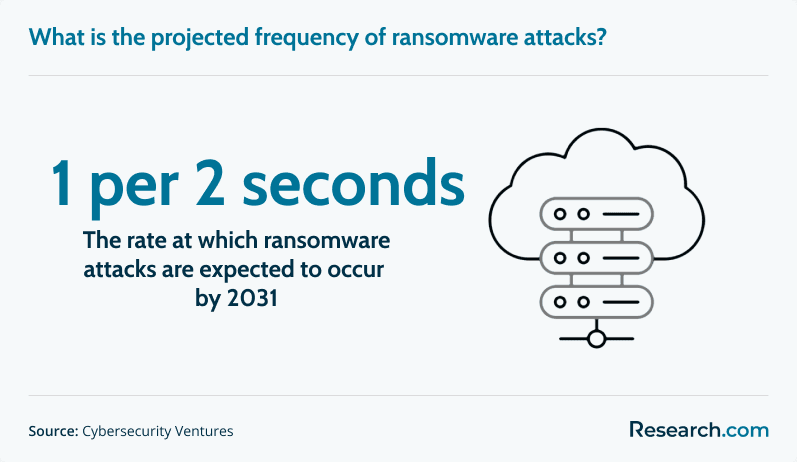
Ransomware attacks surged in 2021, hitting businesses every 11 seconds, up from every 14 seconds in 2019. This trend is accelerating, with attacks expected to occur every two seconds by 2031.
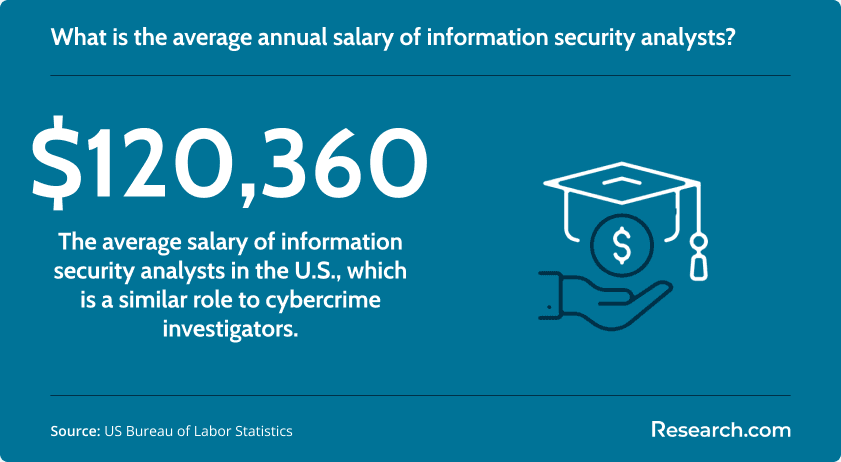
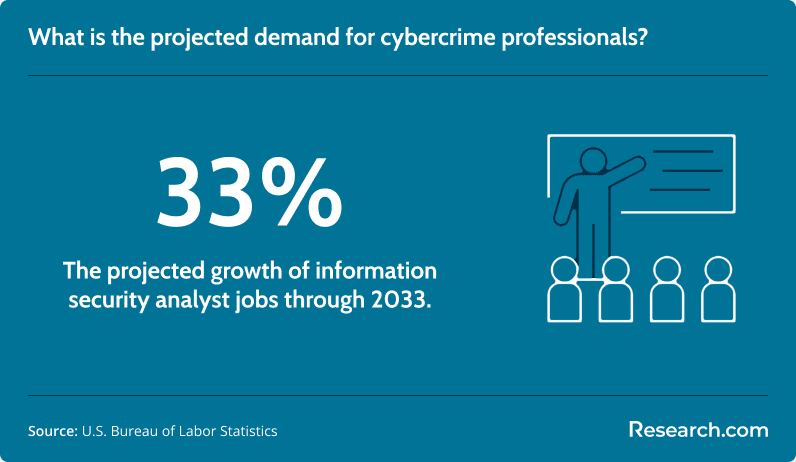
The Bureau of Labor Statistics reports that the median annual wage for information security analysts was $120,360 in May 2023 and the demand for this role is projected to grow 33% through 2033. Information security analyst is not identical to cybercrime investigator, but the roles overlap in incident response, threat analysis, security controls, and breach investigation.
Some professionals use graduate study to move into analytics-heavy investigation work. For example, a low-cost online master’s in data science may support careers that require evidence correlation, anomaly detection, and large-scale data analysis.
How can mentorship and professional networking enhance career growth in cybercrime investigation?
Mentorship can shorten the learning curve in cybercrime investigation because experienced professionals can explain how cases really unfold, where beginners make mistakes, and how to balance technical curiosity with legal limits. Mentors can also help you choose certifications, prepare for interviews, review reports, and understand specialization options.
Networking is also important because cybercrime investigation often involves collaboration across security teams, legal departments, vendors, law enforcement, and professional associations. A cybersecurity degree can provide academic preparation, but relationships with practitioners can expose you to current tools, hiring expectations, and case-based learning.
Practical ways to build a professional network
- Join cybersecurity, digital forensics, fraud examination, or law enforcement technology groups.
- Attend local security meetups, conferences, webinars, and capture-the-flag events.
- Ask experienced investigators for informational interviews rather than immediate job referrals.
- Contribute to labs, open-source tools, writeups, or research notes that demonstrate skill.
- Practice explaining technical findings clearly to nontechnical people.
What are the benefits of interdisciplinary education in cybercrime investigations?
Cybercrime cases rarely fit neatly inside one discipline. A ransomware case may involve network security, business continuity, law, insurance, finance, human behavior, cloud systems, and communications. Interdisciplinary education can help investigators understand both the technical evidence and the organizational context.
Useful complementary fields include law, criminal justice, data science, psychology, accounting, risk management, electrical engineering, and health informatics. If you are evaluating technical study outside cybersecurity, understanding the cost of an electrical engineering degree may help you compare broader academic investments against more specialized cyber programs.
When interdisciplinary study is especially valuable
- You want to investigate financial fraud, healthcare breaches, industrial systems, or critical infrastructure attacks.
- You plan to work with attorneys, compliance officers, executives, or law enforcement agencies.
- You need to interpret technical evidence in a business, legal, or public safety context.
- You want to move into leadership, consulting, or expert witness support later in your career.
How can insights from health informatics complement cybercrime investigation strategies?
Health informatics can complement cybercrime investigation because it focuses on secure data systems, interoperability, privacy, analytics, and high-stakes information workflows. Those concepts are relevant when investigators examine healthcare breaches, ransomware attacks, access misuse, data integrity concerns, or system availability failures.
Methods used in health informatics, such as anomaly detection, audit trail review, data governance, and workflow analysis, can help investigators identify unusual access patterns and understand operational impact. Learners interested in healthcare-focused cyber investigations may compare online health informatics degrees with cybersecurity, IT, and digital forensics programs.
How to choose the right program or training path
The best preparation depends on your current background and target role. A high school graduate may need a full degree and internships. An IT professional may need forensics labs and certifications. A law enforcement officer may need technical coursework and cybercrime investigation training. A cybersecurity analyst may need evidence handling and legal process training.
| If You Are... | Strong Next Step | What to Avoid |
| A new college student | Choose a cybersecurity, computer science, IT, digital forensics, or cybercrime-focused criminal justice program with labs | Picking a program based only on title without reviewing courses and hands-on requirements |
| An IT professional | Add cybersecurity, forensics, scripting, and incident response training | Assuming general IT experience automatically qualifies you for evidence-based investigations |
| A cybersecurity analyst | Build digital forensics, report writing, and legal evidence skills | Focusing only on detection tools and ignoring chain of custody |
| A law enforcement professional | Complete technical training in networks, devices, cloud systems, and cybercrime evidence | Relying only on traditional investigative experience without technical upskilling |
| A career changer | Start with fundamentals, labs, entry-level IT or security work, and realistic certification planning | Buying expensive advanced training before understanding basic systems and networks |
Common mistakes to avoid when preparing for this career
| Mistake | Why It Can Hurt You | Better Choice |
| Choosing a school without checking accreditation | Credits, financial aid, employer recognition, or graduate school options may be affected | Verify institutional accreditation and program quality before enrolling |
| Looking only at tuition | Fees, tools, labs, certification costs, and lost time can change the real cost | Compare total program cost, support services, and career relevance |
| Assuming all online programs are equal | Some programs may lack hands-on labs, cyber ranges, or forensic practice | Review course projects, tools, faculty background, and student support |
| Ignoring legal training | Technical findings may become unusable if evidence is mishandled | Study chain of custody, privacy, authorization, and reporting requirements |
| Collecting certifications without a plan | Random credentials may not match job descriptions or skill gaps | Choose certifications based on target roles and employer expectations |
| Expecting salary outcomes to be guaranteed | Pay varies by location, employer, clearance, experience, and specialization | Compare job postings in your region and build evidence of practical skill |
Questions to ask before pursuing cybercrime investigation
- Do I prefer technical analysis, law enforcement casework, consulting, fraud investigation, or incident response?
- Am I willing to keep learning as attack methods, tools, and laws change?
- Can I write clearly enough for legal, executive, and technical audiences?
- Does my target role require a degree, certification, clearance, law enforcement status, or prior cybersecurity experience?
- Will the program I am considering provide hands-on labs, forensics tools, and career support?
- Can I handle sensitive evidence, victim impact, and high-pressure incidents ethically and professionally?
Key Insights
- Cybercrime investigation is a specialized career that combines cybersecurity, digital forensics, legal process, and analytical reporting.
- A computer science background is valuable, but cybersecurity, IT, digital forensics, and cyber-focused criminal justice programs can also prepare candidates for the field.
- Many candidates need 5 to 10 years to become fully qualified when education, early experience, certifications, and specialization are included.
- The median annual wage for information security analysts was $120,360 in May 2023 and the demand for this role is projected to grow 33% through 2033.
- Ransomware attacks surged in 2021, hitting businesses every 11 seconds, up from every 14 seconds in 2019. This trend is accelerating, with attacks expected to occur every two seconds by 2031.
- Global cybercrime damage costs are projected to increase by 15% annually over the next two years, reaching $9.5 trillion in 2024 and $10.5 trillion in 2025, up from $3 trillion in 2015.
- According to IBM's Cost of a Data Breach Report 2023, the average cost of a data breach at larger organizations reached an all-time high of $4.45 million, representing a 2.3% increase from 2022 and a 15.3% increase from 2020.
- Data breaches are increasingly complex, with 40% involving multiple environments. Public cloud breaches are the most expensive, averaging $5.17 million.
- The best preparation path depends on your starting point: students may need a degree and internships, IT professionals may need forensics training, and law enforcement professionals may need stronger technical coursework.
- Do not choose a program based only on speed, price, or title. Check accreditation, hands-on labs, faculty expertise, career support, and alignment with your target role.
What practitioners say about becoming a cybercrime investigator
Cybercrime investigation lets me apply technical skills to real cases where people and organizations have been harmed. The work can be demanding, but solving complex digital evidence problems and helping build accountability is deeply meaningful. Alex
This field blends detective work with technology. Each investigation teaches something new, whether it involves recovering data, tracing suspicious activity, or explaining findings to people who need clear answers. Sally
The pace of the work keeps you learning. Cases change, tools evolve, and collaboration matters. I have worked with specialists across different organizations, and the ability to keep improving is one of the reasons I value this career. David
References:
- Bureau of Labor Statistics (2024). Information security analysts occupational outlook.
- CM Alliance (2024). Major cyber attacks, data breaches, and ransomware attacks.
- Cybersecurity Ventures (2024). Cybersecurity almanac 2024.
- IBM (2024). Cost of a data breach report 2023.
- Texas Workforce Commission & CompTIA (2022). Texas CompTIA Cyberstates 2022.
Other Things You Should Know About Becoming a Cybercrime Investigator
The EC-Council CHFI and GIAC GCFA certifications are common proof of digital forensics skills. CHFI focuses on computer forensics and evidence handling, while GCFA tests incident response and forensic analysis. Many employers also value CompTIA Security+ as a baseline credential.
Recommended certifications for cybercrime investigators in 2026 include Certified Ethical Hacker (CEH), Certified Information Systems Security Professional (CISSP), and Cybercrime Forensics Analyst (CCFA). Each certification provides specialized skills vital for addressing the complexities and technicalities of modern cybercrime investigations.


