2027 Most Affordable Online Information Technology Degrees

Co-Founder and Chief Data Scientist
Choosing an affordable online information technology degree is not just a tuition comparison. The best option depends on accreditation, transfer credit policies, required credits, specializations, career support, hands-on labs, and whether the program prepares you for the IT roles you actually want. This guide is for students comparing low-cost online IT bachelor’s programs, working adults who need flexible study options, and career changers trying to decide whether an IT degree is worth the time and cost.
You will find a ranked list of affordable online information technology programs, salary and job-market data, common IT specializations, financial aid options, online-versus-campus trade-offs, and practical questions to ask before enrolling. The goal is to help you choose a program that is affordable, credible, and aligned with your career plans.
Quick Answer: Is an Affordable Online Information Technology Degree Worth It?
An affordable online information technology degree can be worth it if the school is accredited, the curriculum includes practical technical skills, and the total cost fits your expected career outcome. Online programs can reduce costs tied to commuting, housing, and campus fees, while allowing many students to keep working. However, price alone should not drive the decision. A low-cost program with weak support, limited technical labs, or poor transfer-credit policies may cost more in the long run.
- An IT degree can prepare graduates for roles in technical support, networking, cybersecurity, software development, database administration, systems analysis, cloud computing, and IT management.
- Online IT programs may help students save on on-campus fees, room and board, transportation, and time away from work.
- Salary outcomes vary by role, experience, location, and specialization. Reported figures in this guide range from $60,810 for computer support specialists to more than $100,000 for several advanced IT occupations.
What Can You Expect From an Information Technology Degree?
An information technology degree teaches students how organizations use computer systems, software, networks, databases, cloud platforms, and security tools to solve business and operational problems. Compared with a purely theoretical technology program, IT degrees often emphasize practical implementation: configuring systems, supporting users, securing infrastructure, analyzing data, and managing technology projects.
Core Skills You Can Build
- Technical foundations: Students typically study computer hardware, operating systems, databases, networks, programming, cybersecurity principles, and systems administration.
- Troubleshooting and problem solving: IT work often involves diagnosing errors, identifying root causes, testing fixes, and documenting solutions.
- Communication: IT professionals must explain technical issues to managers, clients, faculty, patients, customers, or employees who may not have a technical background.
- Project and systems thinking: Many programs include systems analysis, project management, and business process improvement so students can understand how technology decisions affect organizations.
- Adaptability: Because tools and platforms change quickly, strong IT programs teach students how to learn new technologies, not only how to use one specific product.
Where Can You Work With an Information Technology Degree?
IT graduates work across nearly every sector because organizations depend on secure networks, reliable data, digital services, and technical support. Career direction often depends on your specialization, internships, certifications, and project experience.
| Industry or Setting | How IT Skills Are Used | Possible Career Focus |
| Financial services and fintech | Support online banking systems, payment platforms, trading systems, data security, and financial analytics. | Cybersecurity, data analytics, systems analysis, software development |
| Healthcare | Maintain electronic health records, telehealth tools, medical data systems, and secure patient information workflows. | Healthcare informatics, data management, security, systems administration |
| Education | Support school networks, learning management systems, classroom technology, student data systems, and user support. | IT support, network administration, educational technology |
| Government agencies | Maintain public-facing digital services, internal networks, cybersecurity systems, and large-scale information systems. | Cybersecurity, systems administration, database management |
| Startups and technology companies | Build, test, secure, and scale digital products, applications, platforms, and internal systems. | Software development, cloud computing, web development, data analytics |
| Blockchain and cryptocurrency | Develop blockchain applications, smart contracts, digital wallets, and secure distributed systems. | Blockchain development, cybersecurity, software engineering |
Students who want to move deeper into analytics may eventually consider graduate study in related fields, including some of the cheapest data science masters online programs.
How Much Can You Make With an Information Technology Degree?
Salary depends on job title, technical specialization, location, employer, experience, certifications, and degree level. The figures below are reported by the cited sources and should be used as planning benchmarks, not guaranteed outcomes.
| Source | Reported Role or Degree | Reported Salary or Wage |
| Payscale | Bachelor’s Degree, Information Technology (IT) | $74,000 |
| Payscale | Master of Science (MS), Information Technology (IT) | $96,000 |
| Payscale | Information Technologist | $57,012 |
| Indeed | IT Security Specialist | $82,514 |
| Indeed | Database Manager | $63,493 |
| Indeed | Data Analyst | $74,377 |
| Indeed | Systems Analyst | $79,891 |
| Indeed | IT Analyst | $80,191 |
| Bureau of Labor Statistics | Median annual wage for computer and information technology occupations | $104,420 |
| Bureau of Labor Statistics | Computer Systems Analysts | $103,800 |
| Bureau of Labor Statistics | Software Developers | $132,270 |
| DataUSA.io | Average wage for Computer and Information Sciences and Support Services majors | $109,80589 |
| Salary.com | Average Information Technology salary | $231,624 |
| Salary.com | Information Tech | $59,952 |
| Salary.com | Entry Level Information Technology | $70,819 |
- 2027 List of Affordable Online Information Technology Programs
- Key Findings
- How long does it take to complete an information technology degree program?
- How does an online information technology degree compare to an on-campus program?
- What is the average cost of an information technology degree program?
- What are the financial aid options for students enrolling in an information technology degree program?
- How to find online schools that accept FAFSA?
- What are the prerequisites for enrolling in an information technology degree program?
- What courses are typically in an information technology degree program?
- What types of specializations are available in information technology degree programs?
- What is the return on investment for an information technology degree?
- How do IT degree programs integrate emerging technologies?
- Is a Management Information Systems degree a good major?
- What role do career services and industry partnerships play in IT programs?
- Can combining information technology with biotechnology boost your career prospects?
- How can integrating healthcare management with IT expand your career opportunities?
- Do IT degree programs address ethical and regulatory challenges?
- Is pursuing bioinformatics a valuable complement to an IT degree?
- How does one choose the best information technology degree program?
- What career paths are available for graduates of information technology degree programs?
- What is the job market for graduates with an information technology degree?
- What are the best degrees for high-paying careers in IT?
2027 List of Affordable Online Information Technology Programs
How We Ranked Schools
This ranking is designed to help students compare affordable online information technology programs using publicly available education data and program-level information. Because a degree is a major financial and career decision, affordability is considered alongside factors such as accreditation, required credits, program structure, and available concentrations.
The list was developed using Research.com’s research methodology and information from the following sources:
- IPEDS database
- Peterson's database, including the Distance Learning Licensed Data Set
- The College Scorecard database
- The National Center for Education Statistics
Affordable Online IT Programs at a Glance
| Rank | School | Program | Tuition Listed | Credits Required | Accreditation Listed |
| 1 | Purdue University Global | BS in Information Technology | $371 per credit | 180 quarter credit hours (120 semester credits) | Computing Accreditation Commission of ABET |
| 2 | Boise State University | BS in Web Design and Development | Online (Standard) $139/credit | 120 credits | Northwest Commission on Colleges and Universities |
| 3 | Colorado State University Global | BS in Information Technology | $350/credit | 120 credits | Higher Learning Commission (HLC) |
| 4 | Florida International University | BS in Information Technology | Online (Standard) $139/credit | 120 credits | Northwest Commission on Colleges and Universities |
| 5 | Louisiana State University | BS in General Business, Information Technology Management concentration | $399/credit | 120 credits | Association to Advance Collegiate Schools of Business (AACSB) |
| 6 | Oregon Institute of Technology | BS in Information Technology | $233.16/credit | 120 credits | Northwest Commission on Colleges and Universities (NWCCU) |
| 7 | Southeast Missouri State University | BS in Computer Information Systems | $316.50/credit | 120 credits | Computing Accreditation Commission of ABET |
| 8 | University of Illinois - Springfield | BS in Management Information Systems | E-Tuition $11,025 per AY | 120 credits | Higher Learning Commission (HLC) |
| 9 | University of Wisconsin - Milwaukee | BS in Information Science and Technology | $10,398/year | 120 credits | Higher Learning Commission (HLC) |
| 10 | Valdosta State University | BS in Computer Information Systems | eTuition $182.13/credit | 120 credits | Southern Association of Colleges and Schools Commission on Colleges (SACSCOC) |
1. Purdue University Global
Purdue University Global offers a Bachelor of Science in Information Technology built for adult learners and working students. The program includes applied learning through virtual labs, internship opportunities, and coursework connected to areas such as software development and information security. Students comparing costs should review transfer credit options, military benefits, and the ExcelTrack® accelerated learning option before calculating total program price.
- Program Length: 4 years
- Tracks/concentrations: Game Development, Information Security and Assurance, IT Management, Network Administration, Software Development Using C#, among others
- Tuition cost: $371 per credit
- Required Credits to Graduate: 180 quarter credit hours (120 semester credits)
- Accreditation: Computing Accreditation Commission of ABET
2. Boise State University
Boise State University is listed with a Bachelor of Science in Web Design and Development focused on the web industry. Students can expect coursework in web design, development, online media, programming, databases, and business creation. This option may fit students who want a technology degree with a stronger web development and digital product focus rather than a broad IT infrastructure curriculum.
- Program Length: 4 years
- Tracks/concentrations: Web design and related
- Tuition cost: Online (Standard) $139/credit
- Required Credits to Graduate: 120 credits
- Accreditation: Northwest Commission on Colleges and Universities
3. Colorado State University Global
Colorado State University Global offers a 120-credit online Bachelor of Science in Information Technology. The curriculum is designed around applied IT skills such as programming, network analysis, project management, cybersecurity, and web development. CSU Global reports a 15% average salary increase for graduates after a year and emphasizes alignment with industry certifications.
- Program Length: 4 years
- Tracks/concentrations: Various
- Tuition cost: $350/credit
- Required Credits to Graduate: 120 credits
- Accreditation: Higher Learning Commission (HLC)
4. Florida International University
Florida International University offers an online Bachelor of Science in Information Technology with coursework in programming, software development, and related technical areas. The program uses online lectures, instructor feedback, and collaborative projects to help students prepare for technology roles in business, education, government, and other settings.
- Program Length: 4 years
- Tracks/concentrations: Various
- Tuition cost: Online (Standard) $139/credit
- Required Credits to Graduate: 120 credits
- Accreditation: Northwest Commission on Colleges and Universities
5. Louisiana State University
Louisiana State University offers an online Bachelor of Science in General Business with a concentration in Information Technology Management. This program may be a strong match for students who want business coursework combined with IT management, information systems, data analysis, and technology-driven decision-making.
- Program Length: 4 years
- Tracks/concentrations: Various
- Tuition cost: $399/credit
- Required Credits to Graduate: 120 credits
- Accreditation: Association to Advance Collegiate Schools of Business (AACSB)
6. Oregon Institute of Technology
Oregon Institute of Technology offers a Bachelor of Science in Information Technology with applied training in areas such as application development, data management, and network administration. Students may also be able to earn certificates while progressing toward the degree. Oregon Tech reports a high employment rate and notes that graduates have worked for major companies such as Intel and Google.
- Program Length: 4 years
- Tracks/concentrations: Various
- Tuition cost: $233.16/credit
- Required Credits to Graduate: 120 credits
- Accreditation: Northwest Commission on Colleges and Universities (NWCCU)
7. Southeast Missouri State University
Southeast Missouri State University offers an online Bachelor of Science in Computer Information Systems. Students can choose tracks such as Artificial Intelligence and Cybersecurity while continuing to work or manage other responsibilities. The program includes projects and internship opportunities and reports a 98% graduate employment rate.
- Program Length: 4 years
- Tracks/concentrations: Web design and related
- Tuition cost: $316.50/credit
- Required Credits to Graduate: 120 credits
- Accreditation: Computing Accreditation Commission of ABET
8. University of Illinois - Springfield
University of Illinois - Springfield offers a Management Information Systems bachelor’s option for students who want to combine technology, business systems, and organizational decision-making. This type of degree may be especially useful for students interested in systems analysis, IT project coordination, business analytics, and technology management roles.
- Program Length: 4 years
- Tracks/concentrations: Various
- Tuition cost: E-Tuition $11,025 per AY
- Required Credits to Graduate: 120 credits
- Accreditation: Higher Learning Commission (HLC)
9. University of Wisconsin - Milwaukee
The University of Wisconsin-Milwaukee's Bachelor of Science in Information Science and Technology combines technical coursework in programming, web design, and information systems with electives that students can tailor to their interests. The program may work well for transfer students and learners who want flexibility to add minors or certificates.
- Program Length: 4 years
- Tracks/concentrations: Various
- Tuition cost: $10,398/year
- Required Credits to Graduate: 120 credits
- Accreditation: Higher Learning Commission (HLC)
10. Valdosta State University
Valdosta State University offers a Bachelor of Science in Computer Information Systems. The curriculum emphasizes problem solving, systems analysis, software design, implementation, databases, networking, and business foundations in areas such as accounting, economics, and management. Graduates may pursue roles such as applications developer, computer programmer, database administrator, network administrator, or software engineer.
- Program Length: 4 years
- Tracks/concentrations: Various
- Tuition cost: eTuition $182.13/credit
- Required Credits to Graduate: 120 credits
- Accreditation: Southern Association of Colleges and Schools Commission on Colleges (SACSCOC)
Students comparing technology programs may also want to review broader cheap online degrees to understand how IT tuition compares with other fields. Those considering non-technology pathways can compare costs with options such as an affordable online history degree.
Key Findings
- IT jobs are projected to grow much faster than average, with nearly 377,500 new openings annually from 2022 to 2032, according to the U.S. Bureau of Labor Statistics.
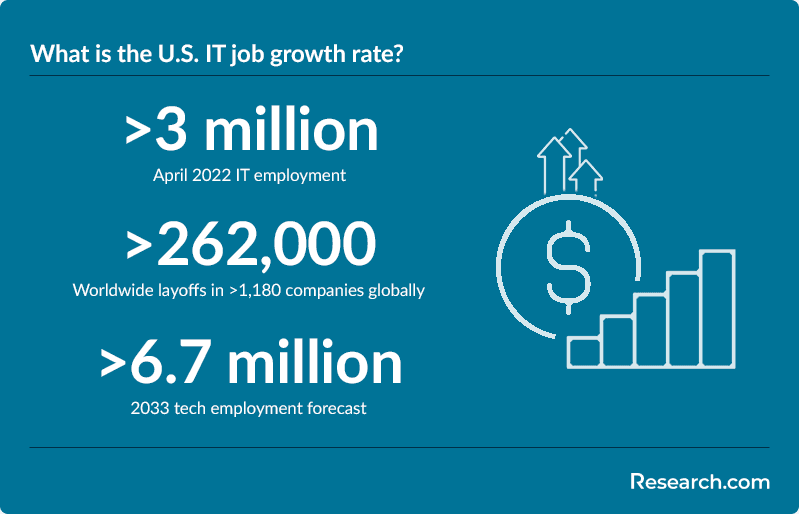
- By 2033, U.S. tech employment is forecast to exceed 6.7 million people.
- The leading tech occupation group is software developers, programmers, web developers, and QA testers, with 2,200,449 employees in 2023, according to CompTIA.
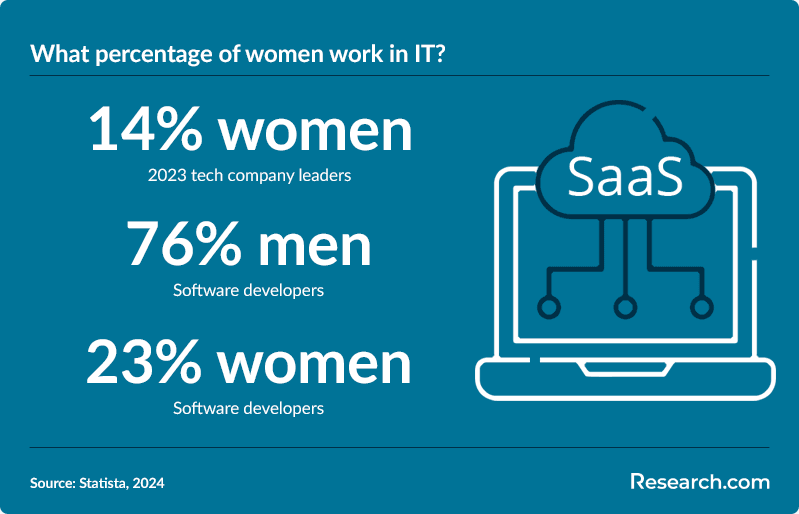
- In 2023, only 14% of tech company leaders were women, while software developers were 76% men and 23% women, highlighting continued gender imbalance in the technology workforce.
- The U.S. Bureau of Labor Statistics reported that the median salary for Information Technology occupations was $104,420 in 2023.
- Computer and information research scientists earn the highest median salary at $145,080, while computer support specialists earn a median of $60,810.
- Other IT roles with high median salaries include computer network architects ($129,840), database administrators and architects ($117,450), information security analysts ($120,360), software developers ($130,160), and computer systems analysts ($103,800).
- Web developers and digital designers have a median salary of $92,750, and network and computer systems administrators earn a median of $95,360.
- A bachelor's degree can range from $10,940 for in-state students to $28,240 for out-of-state students.
How Long Does It Take to Complete an Information Technology Degree Program?
A bachelor’s degree in information technology usually takes 4 years for a full-time student completing a standard course load. The actual timeline can be shorter or longer depending on transfer credits, enrollment intensity, accelerated options, prior learning credit, and whether the program uses semester credits or quarter credits.
| Path | Typical Time | Best For | Important Trade-Off |
| Associate degree | 2 years | Students seeking entry-level support, networking, or transfer pathways | May not qualify for roles requiring a bachelor’s degree |
| Bachelor’s degree | 4 years | Students seeking broader career options and long-term advancement | Requires more time and total tuition than shorter credentials |
| Accelerated bachelor’s pathway | Less than 4 years in some cases | Students with transfer credits, strong self-direction, or prior experience | Can be demanding for working adults |
| Certificate | Often shorter than a degree | Students building targeted skills or adding credentials | Usually narrower than a degree |
| Bootcamp | Weeks or months | Career changers seeking intensive training in one skill area | May not replace degree requirements for some employers |
CompTIA data shows that several large tech occupation groups employ substantial numbers of workers:
- Software developers, programmers, web developers, and QA testers hold the most positions, at 2,200,449.
- IT support specialists and repair technicians account for 809,967 positions.
- Cybersecurity and systems engineers account for 699,534 jobs.
- Network, cloud engineers, architects, and administrators make up 675,992 positions.
- Emerging technologies, IT project management, and other specialties employ 452,715 individuals.
- Database administrators, data scientists, analysts, and computer scientists account for 352,963 positions.
How Does an Online Information Technology Degree Compare to an On-Campus Program?
Online and on-campus IT degrees can both prepare students for technology careers, but the better option depends on your schedule, learning style, budget, need for hands-on support, and access to local employers. Online study is often better for working adults and students who need flexibility. Campus study may be better for students who want structured in-person labs, face-to-face networking, and campus-based recruiting.
| Factor | Online IT Degree | On-Campus IT Degree | Decision Tip |
| Schedule | Often more flexible, with virtual coursework and asynchronous options | Usually follows set class and lab times | Choose online if work or family obligations require flexibility. |
| Hands-on learning | May use virtual labs, simulations, remote tools, and cloud platforms | May offer in-person labs, equipment access, and direct faculty interaction | Ask how labs work before enrolling in an online program. |
| Cost | May reduce commuting, housing, and campus-based costs | May involve housing, transportation, meal, and campus fees | Compare total cost, not only tuition. |
| Networking | Relies on online forums, group projects, virtual events, and remote career services | Offers in-person clubs, events, labs, and campus recruiting | Students changing careers should pay close attention to internship access. |
| Learning style | Requires discipline, time management, and comfort with digital platforms | Provides more routine and in-person accountability | If you struggle with self-paced study, ask about tutoring and faculty access. |
| Admissions | Some programs may have flexible admissions policies | Some programs may use more traditional admissions requirements | Confirm test-score, transfer, and prerequisite policies directly with the school. |
Who Should Choose an Online IT Degree?
- Working adults who cannot attend daytime classes.
- Students who already have transfer credits and want a faster completion path.
- Learners who are comfortable using online platforms, virtual labs, and remote collaboration tools.
- Students trying to reduce housing, commuting, and relocation costs.
Who Might Prefer an On-Campus IT Program?
- Students who want in-person lab time and direct access to equipment.
- Learners who benefit from structured schedules and face-to-face support.
- Students who want campus clubs, local internships, and frequent networking events.
- Recent high school graduates seeking a traditional college experience.
What Is the Average Cost of an Information Technology Degree Program?
The cost of an IT degree depends on school type, residency status, degree level, transfer credits, fees, technology requirements, and whether you study online or on campus. College Board figures from 2022 provide useful reference points:
- An associate's degree costs $3,860 on average for two years of study.
- A bachelor's degree can range from $10,940 for in-state students to $28,240 for out-of-state students.
- Public schools are generally cheaper than private schools, and this pattern also applies to many master's and doctoral programs.
- Students should budget beyond tuition for computers, software, exam fees, books, housing, and other program-related costs.
Cost Factors Students Often Miss
| Cost Item | Why It Matters | Question to Ask |
| Transfer credit policy | Accepted credits can reduce total tuition and time to graduation. | How many credits can I transfer, and how will they apply to major requirements? |
| Technology fees | Online programs may charge platform, lab, or course technology fees. | Are there per-course or per-term technology charges? |
| Required hardware and software | IT students may need a laptop, cloud tools, coding platforms, or security software. | What are the minimum computer and software requirements? |
| Certification exam costs | Some programs prepare students for certifications but may not include exam fees. | Are certification vouchers included in tuition? |
| Residency rules | Public tuition may differ for in-state and out-of-state students. | Does the online program charge the same rate to all students? |
| Time to completion | Extra semesters increase tuition, fees, and opportunity cost. | What is the typical completion time for transfer and part-time students? |
What Financial Aid Options Are Available for IT Degree Students?
Students pursuing an information technology degree may qualify for federal aid, institutional aid, state grants, employer support, scholarships, military benefits, and work-study. Eligibility depends on the school, program accreditation, enrollment status, citizenship or eligible non-citizen status, financial need, and academic progress.
- Federal financial aid:
- Direct Subsidized Loans: Need-based federal loans where the government covers interest while eligible students are enrolled at least half-time, during grace periods, and during deferment periods.
- Direct Unsubsidized Loans: Federal loans available to undergraduate and graduate students regardless of financial need, with interest accruing from disbursement.
- Federal Pell Grant: A need-based grant for undergraduate students with exceptional financial need.
- Federal Supplemental Educational Opportunity Grant (FSEOG): A federal grant for undergraduate students with exceptional need, with priority often given to Pell Grant recipients.
- Federal Work-Study Program: Part-time work opportunities through approved employers to help students pay education expenses.
- Military Benefits: Veterans and active-duty service members may qualify for GI Bill® or other military education benefits.
- Scholarships:
- National Center for Women and Information Technology scholarships and programs
- American Association for Information Systems (AIS) Scholarships
- National Cyber Scholarship Foundation
- Scholarships listed by your chosen university
- State and local grants: Some states support students entering high-demand fields, including technology. Check your state education department and your school’s financial aid office.
- Employer tuition assistance: Some employers reimburse tuition for workers pursuing degrees that relate to their job responsibilities or future advancement.
The technology workforce still shows major gender gaps. In 2023, only 14% of tech company leaders were women, while software developers were 76% men and 23% women. Students from underrepresented groups should ask schools about scholarships, mentoring, affinity groups, and employer partnerships that support persistence in IT programs.
How to Find Online Schools That Accept FAFSA
Federal student aid can make an online IT degree more affordable, but not every online program qualifies. To use FAFSA funds, students must enroll in an eligible program at an accredited institution that participates in federal financial aid programs. Research.com’s guide to online schools that accept FAFSA can help students understand what to look for.
FAFSA Basics
- Eligibility: FAFSA is generally for U.S. citizens and eligible non-citizens pursuing postsecondary education.
- Types of aid: The FAFSA may help students qualify for grants, scholarships, work-study, and federal student loans.
- Application process: Students should gather tax returns, bank statements, and financial information before completing the FAFSA online at fafsa.ed.gov.
How to Confirm an Online IT Program Accepts FAFSA
- Check accreditation: Confirm that the institution is accredited by a recognized accrediting body.
- Contact financial aid: Ask the school’s financial aid office whether the specific online IT program is eligible for federal aid.
- Review the school code: Make sure the institution has a FAFSA school code and that your program is included in aid eligibility.
- Ask about enrollment minimums: Some aid requires half-time or full-time enrollment.
How to Maximize Aid
- Submit the FAFSA early after October 1st each year.
- Apply for IT-specific scholarships in addition to federal aid.
- Ask whether work-study jobs include technology support roles.
- Compare loan amounts carefully and borrow only what you need after grants and scholarships.
- Follow up with each school to complete verification or missing-document requests.
What Are the Prerequisites for Enrolling in an Information Technology Degree Program?
Admissions requirements vary by school and degree level. Most bachelor’s programs require a high school diploma or GED, while graduate programs may require a bachelor’s degree, prerequisite coursework, test scores, professional experience, or a technical background.
- Academic background:
- Most undergraduate IT programs require a high school diploma or GED.
- Many programs prefer a foundation in math, such as algebra, pre-calculus, or trigonometry.
- Some programs may prefer or require science or computer science coursework.
- Technical readiness:
- Students should be comfortable with computers, operating systems, software tools, and online learning platforms.
- Some programs require prior programming knowledge, while others begin with introductory coding courses.
- Testing:
- Some undergraduate programs may require SAT or ACT scores, although many schools have adopted test-optional policies.
- Graduate programs may require GRE or GMAT scores depending on the institution.
- Additional materials:
- Transfer transcripts may be needed for students with previous college credit.
- Relevant work experience may strengthen applications, especially at the graduate level.
- Some programs may ask for a portfolio of technical projects.
Before applying, verify the exact requirements on the school’s website and ask an admissions advisor how transfer credits, certifications, or military training may apply.
What Courses Are Typically in an Information Technology Degree Program?
A bachelor’s degree in information technology usually combines general education, math or quantitative reasoning, computer systems, programming, networks, databases, cybersecurity, project work, and electives. Course names vary, but the skill areas below are common.
| Course Area | What Students Learn | Why It Matters |
| Computer fundamentals | Hardware, software, operating systems, applications, and basic computing concepts | Builds the foundation for more advanced IT coursework |
| Programming and software development | Programming logic, coding structures, debugging, and application development | Supports software, automation, scripting, and technical problem solving |
| Networks and infrastructure | Network protocols, network security, troubleshooting, firewalls, and administration | Prepares students for support, systems, and network roles |
| Database management | Database design, SQL, administration, data integrity, and information management | Helps students manage and retrieve organizational data |
| Data structures and algorithms | Arrays, linked lists, stacks, queues, algorithm analysis, sorting, searching, hashing, trees, graphs, and dynamic programming | Strengthens software design and computational thinking |
| Operating systems | Windows, Linux, macOS, administration, permissions, security, and system functions | Supports technical support, systems administration, and security work |
| Web design and development | HTML, CSS, JavaScript, front-end design, back-end concepts, and web applications | Prepares students for web development and digital product roles |
| Systems analysis and design | User needs, requirements gathering, system modeling, design, and implementation planning | Connects business problems with technology solutions |
| Project management | Planning, timelines, budgets, collaboration, risk, and project methods | Useful for IT coordination and management roles; students can compare related affordable online project management degree programs |
| General education and math | Communication, discrete math, calculus, statistics, science, and humanities courses depending on the program | Builds communication, reasoning, and analytical skills |
What Types of Specializations Are Available in Information Technology Degree Programs?
Specializations help students align their degree with specific career goals. A student who wants to work in cloud architecture should not choose the same elective path as someone aiming for healthcare informatics or game development. Review each program’s concentration requirements, lab access, certification alignment, and internship opportunities before deciding.
- Cybersecurity: Focuses on protecting networks, systems, and data from attacks. Students may study cryptography, intrusion detection, ethical hacking, risk management, and security operations. Shorter options such as cyber security courses online can help students explore the field before committing to a full specialization.
- Cloud Computing: Covers cloud services, virtualization, cloud security, deployment, and platforms such as AWS, Azure, and GCP.
- Cryptocurrency/Blockchain: Introduces distributed ledgers, smart contracts, cryptography, digital currencies, and blockchain applications.
- Data Analytics: Prepares students to clean, analyze, interpret, and visualize data using statistics, data mining, and machine learning concepts.
- Digital Forensics: Teaches students how to collect, analyze, and preserve digital evidence for investigations and legal use.
- Fintech: Connects IT with banking, payments, algorithmic trading, financial data, and digital finance platforms.
- Game Development: Combines programming, design, game engines, and interactive media development.
- Healthcare Informatics: Applies IT to healthcare data, electronic health records, clinical systems, and medical information workflows. Students interested in healthcare leadership may also compare Affordable online masters in healthcare administration programs.
- Information Systems: Focuses on how organizations use technology to improve operations, processes, reporting, and decision-making.
- Mobile App Development: Covers app design, mobile operating systems, UI design, and frameworks such as React Native and Flutter.
- Network Administration: Builds skills in network setup, monitoring, troubleshooting, security, and administration.
- Other Informatics Areas: May include user experience design, web development, IT security, specialized back-end or front-end development, or industry-specific informatics.
Students planning to combine technology with management may also look at business-focused pathways, including some of the cheapest business degree online programs.
Technology hiring has gone through cycles. U.S. IT jobs grew steadily over the past decade, dipped in June 2020, rebounded above 3 million by April 2022, and reached a peak by October 2022. In 2023, layoffs affected over 262,000 employees in more than 1,180 companies globally, but long-term demand remains strong in many IT occupations. IT jobs are projected to grow much faster than average with nearly 377,500 new openings annually from 2022 to 2032. By 2033, U.S. tech employment is forecast to exceed 6.7 million people.
What Is the Return on Investment for an Information Technology Degree?
The return on investment for an IT degree depends on what you pay, how quickly you graduate, whether you borrow, what job you enter, and how your salary grows over time. A low-cost degree with strong transfer-credit acceptance and career support can produce a better outcome than a higher-priced program with limited advising or weak internship access.
How to Estimate IT Degree ROI
- Calculate total cost: Include tuition, fees, books, technology, certification exams, housing if applicable, and interest if you borrow.
- Subtract grants and scholarships: Do not evaluate sticker price alone.
- Estimate time to completion: Longer enrollment can increase tuition and delay full-time earnings.
- Review realistic entry-level roles: Compare your target job with reported salary data, but avoid assuming you will start at the median.
- Check career services: Internship placement, employer partnerships, and alumni connections can affect job search outcomes.
- Consider advanced study only when it fits your goals: Specialized graduate programs, such as the cheapest online masters in artificial intelligence, may help some students deepen technical expertise, but they add cost and time.
How Do IT Degree Programs Integrate Emerging Technologies?
Strong IT programs revise coursework as employer needs change. Many now include cloud computing, cybersecurity, data analytics, artificial intelligence, automation, virtualization, and secure systems design. The most useful programs do more than mention these topics; they give students hands-on labs, projects, industry tools, and faculty feedback.
Students interested in emerging technology should ask whether courses include current cloud platforms, AI-related assignments, cybersecurity simulations, data projects, or capstone work with real-world constraints. Those planning graduate-level specialization may later compare options such as the cheapest online masters in artificial intelligence.
Is a Management Information Systems Degree a Good Major?
A Management Information Systems degree can be a strong choice for students who want both technology and business training. MIS programs often prepare students to translate business needs into technical requirements, manage information systems, support enterprise software, and communicate between technical and nontechnical teams.
Students who enjoy programming-heavy technical work may prefer information technology, computer science, or software engineering. Students who want to work in business analysis, systems analysis, IT management, operations technology, or digital transformation may find an MIS degree especially relevant.
What Role Do Career Services and Industry Partnerships Play in IT Programs?
Career services can be the difference between completing a degree and using it effectively. In IT, employers often look for evidence of practical ability: internships, projects, GitHub work, labs, certifications, capstones, and technical interviews. Programs with strong employer relationships may give students better access to internships, mentoring, mock interviews, resume support, and networking events.
When comparing programs, ask whether career services are available to online students, not only campus students. Also review related pathways such as computer science degrees online if you want a faster or more programming-centered route.
Can Combining Information Technology With Biotechnology Boost Your Career Prospects?
IT and biotechnology increasingly overlap in areas such as genomics, laboratory data systems, machine learning, bioinformatics, and personalized medicine. Students with strong programming, database, analytics, and systems integration skills may be able to support biotech teams that rely on complex data and computational tools.
This interdisciplinary route is best for students who are comfortable combining technical coursework with science-focused learning. Those interested in this direction can explore a biotechnology master's degree online to understand how graduate training may connect technology with biological research and innovation.
How Can Integrating Healthcare Management With IT Expand Your Career Opportunities?
Healthcare organizations need professionals who understand both technology and healthcare operations. IT skills can support patient information systems, data security, telehealth platforms, electronic health records, compliance workflows, and reporting systems. Healthcare management knowledge can help technology professionals understand clinical operations, privacy requirements, and administrative decision-making.
Students interested in this field may compare health information management options, including the cheapest HIM bachelor's degree.
Do IT Degree Programs Address Ethical and Regulatory Challenges?
Modern IT work involves more than technical execution. Professionals may handle sensitive data, security incidents, surveillance concerns, algorithmic bias, privacy regulations, and industry-specific compliance requirements. Quality IT programs should include ethics, data protection, cybersecurity responsibility, legal risk, and professional conduct.
These topics matter in many roles, including cybersecurity, healthcare technology, finance, government IT, and leadership positions. Students targeting advanced roles should evaluate how thoroughly a program covers compliance and responsible technology use, especially if they are aiming for some of the highest paying information technology jobs.
Is Pursuing Bioinformatics a Valuable Complement to an IT Degree?
Bioinformatics combines computing, data analysis, and biological science. For IT students who enjoy programming and analytics but want to work in medicine, genomics, drug discovery, or research, bioinformatics can provide a specialized path beyond traditional IT support or infrastructure roles.
Students considering this interdisciplinary area can review bioinformatics master's programs online to see how graduate curricula combine computation with life science applications.
How Do You Choose the Best Information Technology Degree Program?
The best IT program is the one that fits your career goal, budget, schedule, learning style, and academic background. A program with the lowest tuition is not automatically the best choice if it lacks accreditation, limits transfer credits, or does not offer your target specialization.
Step-by-Step Program Selection Checklist
- Define your target role: Decide whether you are aiming for IT support, cybersecurity, software development, networking, cloud computing, data analytics, systems analysis, or IT management.
- Match the curriculum to that role: Review required courses, electives, labs, capstone projects, and certification alignment.
- Verify accreditation: Confirm institutional accreditation and, when relevant, programmatic accreditation such as ABET.
- Calculate total cost: Include tuition, fees, books, software, equipment, certification exams, and time to completion.
- Ask about transfer credits: Transfer-friendly policies can reduce both cost and time.
- Review online student support: Confirm access to tutoring, faculty office hours, technical help, library resources, and career services.
- Evaluate hands-on learning: Look for labs, simulations, internships, projects, cloud environments, and practical assignments.
- Check career outcomes carefully: Ask what data is available and whether it applies to online students in the IT program.
- Compare specialization depth: Students interested in security, for example, may later explore the cheapest online master's in cyber security programs, but the bachelor’s degree should still provide a strong foundation.
- Ask about advising: Strong advising can help you avoid unnecessary courses and delayed graduation.
Common Mistakes to Avoid
| Mistake | Why It Can Hurt You | Better Approach |
| Choosing only by tuition | Low tuition may be offset by fees, extra credits, weak support, or delayed graduation. | Compare total cost and time to degree. |
| Ignoring accreditation | Accreditation can affect financial aid eligibility, transfer credits, and employer recognition. | Verify accreditation before applying. |
| Assuming all online programs are flexible | Some online courses have live sessions, fixed deadlines, or required synchronous labs. | Ask about course format and weekly time expectations. |
| Overlooking hands-on labs | IT employers often value demonstrated technical ability. | Look for projects, labs, internships, and capstones. |
| Relying only on rankings | A ranked program may not match your specialization, schedule, or budget. | Use rankings as a starting point, then compare fit. |
| Assuming salary outcomes are guaranteed | Pay varies by role, location, experience, and market conditions. | Use salary data as a benchmark, not a promise. |
Students exploring different career directions can also compare other affordable programs outside IT, such as affordable medical assistant programs.
What Career Paths Are Available for Graduates of Information Technology Degree Programs?
IT graduates can pursue many roles, but not every job requires the same level of coding, math, business knowledge, or security expertise. Your career path should influence your electives, projects, internships, and certifications.
| Career Area | Common Roles | Good Fit For Students Who Like |
| Technical support and services | Help Desk Technician, IT Technician, IT Support Specialist, IT Solutions Architect | Troubleshooting, user support, documentation, customer service |
| Networking and systems | Network Administrator, Systems Administrator, Computer Network Architect | Infrastructure, connectivity, hardware, servers, networks |
| Cybersecurity | Cybersecurity Analyst, Cybersecurity Engineer, Cybersecurity Lead, Information Systems Security Officer | Risk, security tools, investigation, policy, defense |
| Software and web development | Computer Programmer, Software Developer, Web Developer | Coding, application design, testing, debugging, web tools |
| Data and analytics | Data Analyst, Business Intelligence Analyst, Data Scientist | Data cleaning, reporting, visualization, statistics, machine learning |
| Business-oriented IT | Business Analyst, IT Project Manager, Systems Analyst | Process improvement, requirements, stakeholder communication, planning |
| Cloud computing | Cloud Infrastructure Engineer, Cloud Architect | Cloud platforms, automation, scalability, infrastructure design |
| Emerging technologies | AI Engineer, Machine Learning Engineer, AI/ML Researcher, Blockchain Developer | Advanced computing, algorithms, data, distributed systems |
What Is the Job Market for Graduates With an Information Technology Degree?
The IT labor market includes both high-growth opportunities and periods of employer restructuring. Students should interpret job-market data carefully: broad demand does not guarantee a specific job, but it does show that technology skills remain relevant across many industries.
According to the U.S. Bureau of Labor Statistics, the median salary for information technology occupations was $104,420 in 2023. Salaries vary widely by role. Computer and information research scientists earn the highest median salary at $145,080, while computer support specialists earn a median of $60,810. Other reported median salaries include computer network architects ($129,840), database administrators and architects ($117,450), information security analysts ($120,360), software developers ($130,160), and computer systems analysts ($103,800). Web developers and digital designers have a median salary of $92,750, and network and computer systems administrators earn a median of $95,360.
If you are uncertain about committing to IT, compare the work itself—not only the salary—with other technical fields. For example, the radiologist technician salary of around $63,120 is slightly higher than the median salary of computer support specialists, but the training, licensing expectations, work setting, and daily responsibilities differ substantially.
How Can an Advanced Degree or Certifications Improve an IT Career?
A bachelor’s degree can prepare students for many entry-level and mid-level technology roles, but some career paths benefit from graduate study or professional certifications. The best choice depends on whether you need broad leadership preparation, deep technical specialization, or proof of skill in a specific platform.
- Advanced degrees: A master’s degree in IT, cybersecurity, data science, artificial intelligence, or a related field may help professionals move into specialized or leadership roles.
- Business-focused graduate study: Students aiming for IT leadership, product management, consulting, or technology operations may compare options such as the cheapest online MBA in information technology.
- Certifications: Vendor and professional certifications can demonstrate skill in networking, security, cloud platforms, systems administration, or project management.
- Career advancement: Additional credentials may support progression into roles such as IT manager, systems architect, network engineer, data scientist, or chief information officer, but experience and demonstrated performance remain important.
What Are the Best Degrees for High-Paying Careers in IT?
Information technology is a practical and versatile degree, but it is not the only route into high-paying technology roles. Students should choose based on the type of work they want to do, not only on average salary.
| Degree Area | Potential Strength | Possible Roles |
| Information Technology | Broad preparation in systems, networks, support, security, and applied technology | IT analyst, systems administrator, cybersecurity analyst, network administrator |
| Computer Science | Strong programming, algorithms, software, systems, and theory | Software developer, systems architect, AI engineer |
| Cybersecurity | Specialized preparation in risk, defense, security operations, and incident response | Cybersecurity consultant, security architect, penetration tester |
| Data Science | Analytics, statistics, machine learning, and data modeling | Data analyst, data engineer, data scientist |
| Software Engineering | Software design, architecture, testing, and development lifecycle | Software developer, mobile developer, enterprise application developer |
| Cloud Computing | Cloud infrastructure, platform services, automation, and scalable architecture | Cloud engineer, cloud architect, cloud consultant |
For a broader comparison of high-earning fields, review Research.com’s guide to degrees that make the most money.
Questions to Ask Before Enrolling in an Online IT Degree
- Is the institution accredited, and is the IT program separately accredited if relevant?
- What is the total cost after tuition, fees, technology requirements, and certification exams?
- How many of my previous credits will transfer into the major, not just as electives?
- Does the program offer my target specialization, such as cybersecurity, cloud computing, web development, data analytics, or IT management?
- Are labs virtual, remote, simulated, or hands-on with physical equipment?
- Can online students access internships, career coaching, resume help, and employer events?
- What certifications does the curriculum prepare students for, and are exam vouchers included?
- What is the average time to completion for part-time and transfer students?
- What support is available if I struggle with programming, math, networking, or cybersecurity courses?
- What career outcome data is available specifically for this program?
Key Insights
- The most affordable IT degree is not always the best value. Accreditation, transfer credits, technical labs, specialization options, and career services strongly affect outcomes.
- Online IT degrees can be a practical choice for working adults, but students should confirm lab access, course schedules, support services, and FAFSA eligibility before enrolling.
- A bachelor’s in information technology typically takes 4 years, but transfer credits, accelerated formats, and prior learning can shorten the timeline.
- IT salary potential varies widely. Reported BLS medians range from $60,810 for computer support specialists to $145,080 for computer and information research scientists.
- Specialization matters. Cybersecurity, cloud computing, data analytics, software development, healthcare informatics, and MIS can lead to different roles and skill requirements.
- Do not rely only on rankings or advertised tuition. Build a total-cost estimate, ask about real career support, and compare each program against your target job.
- Students planning for leadership or advanced technical roles may eventually benefit from graduate degrees, certifications, or interdisciplinary study in areas such as AI, biotechnology, healthcare information management, or bioinformatics.
References:
- Bureau of Labor Statistics. (2024). Occupational Outlook Handbook: Computer and Information Technology Occupations. Bureau of Labor Statistics.
- Bureau of Labor Statistics. (2024). Occupational Outlook Handbook: Computer Systems Analysts. Bureau of Labor Statistics.
- Bureau of Labor Statistics. (2024). Occupational Outlook Handbook: Software Developers. Bureau of Labor Statistics.
- CollegeBoard. (2022). Trends in College Pricing and Student Aid 2022. CollegeBoard.
- CompTIA. (2024). State of the Tech Workforce. CompTIA.
- DataUSA. (2024). Computer & Information Sciences. DataUSA.
- Georgetown University. (2020). The Economic Value of College Majors. Georgetown University.
- IDC. (2024). U.S. Tech Employment Forecast. IDC.
- Indeed. (2024). Salaries. Indeed.
- Payscale. (2024). Bachelor's Degree, Information Technology (IT) Degree. Payscale.
- Payscale. (2024). Information Technologist Salary. Payscale.
- Payscale. (2024). Master of Science (MS), Information Technology (IT) Degree. Payscale.
- Salary.com. (2024). Entry Level Information Technology Salaries in the United States. Salary.com.
- Salary.com. (2024). Information Tech Salaries in the United States. Salary.com.
- Salary.com. (2024). Information Technology Salaries in the United States. Salary.com.
- Statista. (2024). Employment in the IT industry - Statistics & Facts. Statista.
- U.S. Bureau of Labor Statistics. (2024). Computer and information technology occupations. U.S. Bureau of Labor Statistics.
- World Economic Forum. (2023). Jobs of Tomorrow: Mapping Opportunity in the New Economy. World Economic Forum.
Other Things You Should Know About Online Information Technology Degrees
Yes. Employers usually accept online IT degrees when the school holds regional accreditation from a U.S. Department of Education-recognized accreditor. For technical roles, many employers also value program accreditation, industry certifications such as CompTIA A+ or Network+, and completed internships or projects.
Various scholarships for online IT degrees in 2027 include merit-based, need-based, and specific IT-focused awards. Sources include government grants, private organizations, and university-specific scholarships, each with unique application criteria and deadlines.