
2027 Best Online Women's Health Nurse Practitioner Graduate Certificate Programs

Co-Founder and Chief Data Scientist
Looking to specialize in women’s health without sacrificing your current career? With nurse practitioner roles projected to be among the fastest-growing occupations, a graduate certificate in Women’s Health NP can accelerate your expertise and earning potential.
This article examines the top 10 fully online post-MSN Women’s Health Nurse Practitioner graduate certificates for 2025, comparing program reputation, on-campus counterparts, and student support services to help you choose the best fit.
What are the benefits of completing an online women's health nurse practitioner graduate certificate program?
- Earn a median annual salary of $132,050 as a certified NP specialist
- Benefit from a 40% job growth rate for NPs (2023–2033), with ~31,900 openings per year
- Pursue careers in OB/GYN clinics, women’s health centers, telehealth, academia, and research
What can I expect from an online women's health nurse practitioner graduate certificate program?
Completing a post-MSN Women’s Health NP certificate means engaging with rigorous coursework entirely online—covering advanced physiology, gynecologic health, and reproductive lifespan care—while arranging your own clinical preceptorships in local healthcare settings.
You’ll navigate interactive modules, case studies, and virtual labs, all supported by academic advisors and career services. Typical programs demand 18–24 credits, take 12–24 months, and culminate in a capstone practicum under board-certified preceptors. Expect regular faculty feedback, access to financial aid guidance, and networking opportunities with an established on-campus cohort.
Where can I work with an online women's health nurse practitioner graduate certificate program?
According to BLS May 2022 data, there were 258,230 professionally active nurse practitioners nationwide, earning a mean annual wage of $124,680. Within that group, the largest employing industries for NPs are:
- Offices of Physicians: 95,820 NPs (3.62% of all NP roles); annual mean wage $108,930
- General Medical and Surgical Hospitals: 47,420 NPs (0.85%); annual mean wage $115,790
- Outpatient Care Centers: 18,820 NPs (1.97%); annual mean wage $119,920
- Colleges, Universities, and Professional Schools: 6,710 NPs (0.22%); annual mean wage $105,310
- Offices of Other Health Practitioners: 6,210 NPs (0.65%); annual mean wage $108,660
These settings correspond closely to women’s health NP roles—especially in outpatient clinics and physician practices—where WHNPs provide specialized reproductive and gynecologic care. Notably, roughly 92% of NP jobs are in the private sector, underlining strong opportunities in non-hospital environments.
Top five employing states (May 2022) for nurse practitioners are:
- California (28,060)
- Texas (24,280)
- New York (19,570)
- Florida (16,610)
- Pennsylvania (12,120)
How much can I make with an online women's health nurse practitioner graduate certificate program?
According to the U.S. Bureau of Labor Statistics, the median annual wage for nurse practitioners—including WHNPs—was $132,050 in May 2024. Salary benchmarks from leading job sites show:
- Zippia: Average NP salary of $100,033 per year; hourly rate $48.09
- Salary.com: Average NP salary of $116,799 per year; $56/hour
- ZipRecruiter: Average NP salary of $100,033 per year
- Indeed: Average NP salary of $129,210 per year
- PayScale: Average NP salary of $110,977 per year
- Glassdoor: Average NP salary of $163,017 per year; range $131,261–$204,497
These figures reflect national averages; specialized WHNP roles often command premiums in women’s health clinics, OB/GYN practices, and telehealth services.
- Best Online Women's Health Nurse Practitioner Graduate Certificate Programs for 2027 List of Programs
- How does an online women's health nurse practitioner graduate certificate compare to an on-campus program? How does an online women's health nurse practitioner graduate certificate compare to an on-campus program?
- What is the average cost of online women's health nurse practitioner graduate certificate programs? Program Cost
- What are the financial aid options for students enrolling in an online women's health nurse practitioner graduate certificate program? Financial Aid
- What are the prerequisites for enrolling in an online women's health nurse practitioner graduate certificate program? Requirements
- What courses are typically in an online women's health nurse practitioner graduate certificate program? What courses are typically in an online women's health nurse practitioner graduate certificate program?
- What types of specializations are available in an online women's health nurse practitioner graduate certificate programs? What types of specializations are available in an online women's health nurse practitioner graduate certificate programs?
- How do you choose the best online women's health nurse practitioner graduate certificate program? How do you choose the best online women's health nurse practitioner graduate certificate program?
- What career paths are available for graduates of online women's health nurse practitioner graduate certificate programs? Career Paths
- What is the job market like for graduates of online women's health nurse practitioner graduate certificate programs? Job Outlook
- Can alternative pathways help transition non-nurses into women's health NP roles? Can alternative pathways help transition non-nurses into women's health NP roles?
- Are program accreditation and quality indicators reliable benchmarks? Are program accreditation and quality indicators reliable benchmarks?
- How do online WHNP programs secure effective clinical placements? How do online WHNP programs secure effective clinical placements?
Best Online Women's Health Nurse Practitioner Graduate Certificate Programs for 2027
An online Women’s Health Nurse Practitioner graduate certificate is designed for licensed nurses who already have graduate nursing preparation and want to add a focused advanced practice specialty in women’s, reproductive, gynecologic, and gender-related health. The decision matters because WHNP certificate programs vary widely in cost, clinical placement support, state authorization, required credits, and completion time. Choosing the wrong program can delay certification, increase debt, or create problems with clinical hours and state practice requirements.
This guide is for MSN- or DNP-prepared nurses comparing post-graduate WHNP certificate options, as well as RNs mapping a longer route toward advanced practice through an online nurse practitioner program. You will find ranked program options, cost and timeline comparisons, admissions requirements, course expectations, career outcomes, and practical questions to ask before enrolling.
Quick Answer: What Is the Best Online WHNP Graduate Certificate?
The best online WHNP graduate certificate is the one that is accredited, authorized for your state, supports local clinical placement, fits your schedule, and prepares you for women’s health nurse practitioner certification without unnecessary coursework. Many strong programs require about 18–24 credits, though requirements may be higher depending on prior graduate coursework. Most students should expect part-time study, supervised clinical hours, and careful coordination with their state board of nursing before enrolling.
How we evaluated online WHNP certificate programs
Research.com rankings are based on a structured methodology that considers institutional quality, program availability, online learning support, affordability indicators, accreditation, and student outcomes where available.
Our review draws on public and third-party education data, including the IPEDS database from the National Center for Education Statistics, Peterson’s database and its distance learning information, and the College Scorecard database. These sources help verify institutional characteristics, cost context, and education outcomes. Program-specific details should still be confirmed directly with each school because tuition, clinical policies, and state authorization can change.
The programs below were selected because they offer online or distance-based WHNP post-graduate certificate pathways through established U.S. institutions with recognized nursing education infrastructure.
Top Online Women’s Health Nurse Practitioner Graduate Certificate Programs
| Rank | School and program | Credits | Typical duration | Listed cost | Accreditation noted |
| 1 | Drexel University – Post-Master’s Certificate in Women’s Health NP | 24 quarter credits (approximately 16 semester credits) | ~2 years (part-time) | ~$1,342/credit | CCNE; MSCHE regional |
| 2 | Thomas Jefferson University – Post-Graduate Women’s Health-Gender Related Studies Nurse Practitioner | 18 credits | ~1 year (full-time) or 2 years (part-time) | ~$1,229/credit | CCNE; MSCHE |
| 3 | Carlow University – Post-Master’s Women’s Health Nurse Practitioner Certificate | 35 credits | 2 years | $918/credit | CCNE; HLC |
| 4 | Frontier Nursing University – Post-Graduate Certificate in Women’s Health Care NP | ~27 credits | ~1.5 years (five terms) | ~$700/credit | CCNE; SACSCOC |
| 5 | Georgetown University – Post-Graduate Certificate in Women’s Health Nurse Practitioner | 22 credits | ~23 months (part-time) | $2,358/credit | CCNE; MSCHE |
| 6 | Vanderbilt University – Post-Master’s Certificate in Women’s Health / Gender-Related Nurse Practitioner | 18 credits minimum | 3–5 semesters (part-time) | $2,057 per credit hour | CCNE; SACSCOC |
| 7 | University of Missouri–Kansas City – Post-Master’s Certificate in Women’s Health NP | ~18 credits | ~2 years (part-time plan of study) | ~$895/credit (out-of-state) | CCNE; HLC |
| 8 | Stony Brook University – Advanced Certificate Program: Women’s Health NP | ~18 credits | ~12 months full-time or 18+ months part-time | ~$963/credit (out-of-state; SUNY in-state lower) | CCNE; MSCHE |
| 9 | Kent State University – Post-Master’s Certificate in Women’s Health NP | ~17 credits, excluding any needed core courses | ~1 year (full-time) or 2 years (part-time) | ~$695/credit | CCNE; HLC |
| 10 | University of Colorado Anschutz Medical Campus – Post-Graduate Certificate in Women’s Health NP | ~18 credits, varying based on prior MSN coursework | 1–2 years (flexible scheduling) | ~$780/credit (in-state); ~$1,100/credit (out-of-state) | CCNE; HLC |
1. Drexel University – Post-Master’s Certificate in Women’s Health NP
Drexel University offers a post-master’s WHNP certificate through its College of Nursing and Health Professions. The program is a fit for nurses who want a structured part-time pathway from a private research university with a long history in online graduate education.
- Program cost: ~$1,342/credit
- Program duration: ~2 years (part-time)
- Total credits: 24 quarter credits (approximately 16 semester credits)
- Program/School Accreditation: CCNE; MSCHE regional
2. Thomas Jefferson University – Post-Graduate Women’s Health-Gender Related Studies Nurse Practitioner
Thomas Jefferson University provides a post-graduate certificate for nurses who already hold an MSN or DNP and want preparation in women’s health and gender-related care. Its Philadelphia healthcare setting may appeal to students who value access to a large clinical and academic health network.
- Program cost: ~$1,229/credit
- Program duration: ~1 year (full-time) or 2 years (part-time)
- Total credits: 18 credits
- Program/School Accreditation: CCNE; MSCHE
3. Carlow University – Post-Master’s Women’s Health Nurse Practitioner Certificate
Carlow University offers a post-master’s WHNP certificate for graduate-prepared nurses seeking more comprehensive specialty coursework. Because the program lists 35 credits, students should compare transfer policies carefully and ask how prior MSN coursework affects the final plan of study.
- Program cost: $918/credit
- Program duration: 2 years
- Total credits: 35 credits
- Program/School Accreditation: CCNE; HLC
4. Frontier Nursing University – Post-Graduate Certificate in Women’s Health Care NP
Frontier Nursing University is known for graduate nursing and midwifery education and offers a post-graduate WHNP certificate through a distance-based model. The program may be especially relevant for nurses looking for a women’s health pathway from an institution with a longstanding focus on community-based advanced practice education.
- Program cost: ~$700/credit
- Program duration: ~1.5 years (five terms)
- Total credits: ~27 credits
- Program/School Accreditation: CCNE; SACSCOC (Southern Association of Colleges and Schools)
5. Georgetown University – Post-Graduate Certificate in Women’s Health Nurse Practitioner
Georgetown University offers a distance-based WHNP post-graduate certificate through its nursing school. The program is a potential match for MSN- or DNP-prepared nurses who want part-time study and a curriculum shaped by ethical, evidence-based, and holistic care principles.
- Program cost: $2,358/credit
- Program duration: ~23 months (part-time)
- Total credits: 22 credits
- Program/School Accreditation: CCNE; MSCHE
6. Vanderbilt University – Post-Master’s Certificate in Women’s Health / Gender-Related Nurse Practitioner
Vanderbilt University offers a post-master’s certificate in Women’s Health / Gender-Related Nurse Practitioner preparation. Students should review its clinical expectations and delivery format closely, particularly if they plan to continue working while completing local practicum requirements.
- Program cost: $2,057 per credit hour
- Program duration: 3–5 semesters (part-time)
- Total credits: 18 credits minimum
- Program/School Accreditation: CCNE; SACSCOC
7. University of Missouri–Kansas City – Post-Master’s Certificate in Women’s Health NP
The University of Missouri–Kansas City offers an online post-master’s WHNP certificate through its School of Nursing and Health Studies. The program can be a practical option for nurses comparing public university pathways and part-time study plans.
- Program cost: ~$895/credit (out-of-state)
- Program duration: ~2 years (part-time plan of study)
- Total credits: ~18 credits
- Program/School Accreditation: CCNE; HLC
8. Stony Brook University – Advanced Certificate Program: Women’s Health NP
Stony Brook University offers an advanced certificate for nurses who already hold a graduate nursing degree. As part of the SUNY system and connected to Stony Brook Medicine, the program may appeal to students who want a public research university with academic medical center resources.
- Program cost: ~$963/credit (out-of-state; SUNY in-state lower)
- Program duration: ~12 months full-time (or 18+ months part-time)
- Total credits: ~18 credits
- Program/School Accreditation: CCNE; MSCHE
9. Kent State University – Post-Master’s Certificate in Women’s Health NP
Kent State University offers an online post-master’s WHNP certificate through its College of Nursing. Nurses who want a shorter listed credit requirement should ask whether additional core courses are required after transcript review.
- Program cost: ~$695/credit
- Program duration: ~1 year (full-time) or 2 years (part-time)
- Total credits: ~17 credits (excluding any needed core courses)
- Program/School Accreditation: CCNE; HLC
10. University of Colorado Anschutz Medical Campus – Post-Graduate Certificate in Women’s Health NP
The University of Colorado Anschutz Medical Campus offers a post-graduate WHNP certificate through an academic health center environment. Because total credits can vary based on prior MSN coursework, applicants should request an individualized transcript review before estimating cost or completion time.
- Program cost: ~$780/credit (in-state); ~$1,100/credit (out-of-state)
- Program duration: 1–2 years (flexible scheduling)
- Total credits: ~18 credits (varying based on prior MSN coursework)
- Program/School Accreditation: CCNE; HLC
How Long Does It Take to Complete an Online Women's Health Nurse Practitioner Graduate Certificate Program?
Most online WHNP graduate certificates are built for working advanced practice nurses and are commonly completed part time. Many programs list 18–24 credits, but some post-master’s Women’s Health NP certificates may require 36 credits depending on the applicant’s previous MSN coursework, population focus, and missing advanced practice core courses. A typical part-time timeline is 18–24 months, while full-time students may finish in 12–18 months when the school permits that pace.
Completion time depends less on the word “online” and more on transcript evaluation, clinical hour requirements, course sequencing, and preceptor availability. Some programs may allow transfer of up to 12 credits, which can reduce both tuition and time to completion. Students should also plan for 500+ clinical hours arranged in approved women’s health settings under qualified preceptors.
WHNP certificates are not the same as fast-track general NP pathways. Compared with some accelerated FNP programs, WHNP certificates focus more deeply on reproductive health, gynecologic care, contraception, pregnancy-related care, menopause, and preventive services for women and gender-related populations.
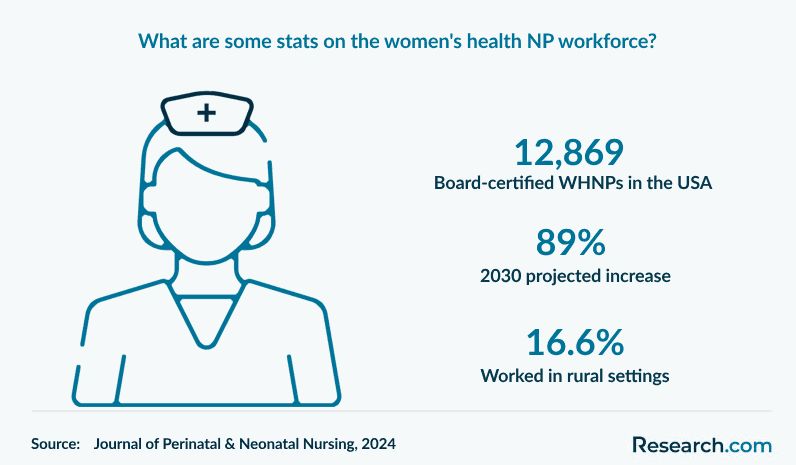
The infographic below provides workforce context, including board-certified WHNP counts, rural practice rates, and anticipated growth.
How Does an Online Women's Health Nurse Practitioner Graduate Certificate Compare to an On-Campus Program?
An accredited online WHNP certificate can meet the same educational purpose as an on-campus certificate, but the student experience is different. Online programs usually deliver lectures, discussions, assignments, and case-based work through a learning platform, while clinical hours are completed in approved healthcare settings. On-campus programs may offer more face-to-face faculty access, peer networking, and campus-based simulation resources.
| Factor | Online WHNP certificate | On-campus WHNP certificate |
| Best for | Working nurses who need location flexibility | Students who prefer regular in-person instruction |
| Course delivery | Often asynchronous, sometimes with live sessions | Scheduled classroom, lab, or seminar meetings |
| Clinical training | Completed locally when approved by the program | Often tied to campus or regional clinical networks |
| Main advantage | No relocation and easier work-school balance | More immediate in-person access to faculty and peers |
| Main risk | Clinical placement may require more student initiative | Commuting or relocation can increase time and cost |
Students coming from earlier nursing pathways, including online RN to MSN bridge programs, should confirm that their graduate coursework satisfies the certificate program’s prerequisites. Online delivery does not remove clinical requirements, state authorization rules, or national certification expectations.
What Is the Average Cost of Online Women's Health Nurse Practitioner Graduate Certificate Programs?
Online WHNP certificate tuition varies sharply by institution type, residency status, and credit requirement. The original program listings in this guide range from about ~$695/credit to $2,358/credit, with some public universities offering lower in-state rates and private universities charging higher per-credit tuition.
More broadly, tuition for an online post-MSN Women’s Health NP certificate generally falls between $400 and $1,400 per credit. With many programs requiring 18–24 credits, total tuition can range from $7,200 to $33,600 before fees, books, travel for any required intensives, background checks, immunizations, exam preparation, and clinical onboarding costs.
NCES data show average graduate tuition and fees in 2021–22 were $12,596 at public universities and $28,017 at private nonprofits. Applying those averages to an 18-credit load yields $11,336 for public institutions and $25,215 for private nonprofit institutions. Certificate-specific costs may be lower or higher, so applicants should compare the exact number of credits they will be required to complete after transcript review.
If affordability is your top concern, use budget-focused comparisons such as the most affordable online nurse practitioner programs as a starting point, but do not choose on price alone. Accreditation, clinical placement support, and state eligibility matter just as much as tuition.
The chart below compares median annual pay across APRN roles and can help frame the cost of graduate certificate training against potential career advancement.
What Financial Aid Options Are Available for Online WHNP Certificate Students?
Graduate certificate students may be eligible for several funding sources, but eligibility depends on the school, enrollment status, certificate structure, and federal aid rules. According to NCES, roughly 60% of graduate/professional certificate seekers received some form of financial aid in 2022–23. Nurses who previously used aid for pathways such as RN to BSN to MSN online programs should check remaining loan limits and employer reimbursement rules before applying.
- Federal Direct Unsubsidized Loans: Graduate students may qualify regardless of financial need, but interest accrues while enrolled.
- Direct PLUS Loans: Graduate PLUS loans may help cover remaining approved cost of attendance after other aid.
- Institutional Scholarships & Grants: Nursing schools may offer merit-based or need-based awards for graduate nursing students.
- State & Professional Association Grants: State nursing organizations and groups such as the AANP Foundation may offer targeted funding opportunities.
- GI Bill & VA Education Benefits: Eligible veterans, service members, and dependents may be able to apply benefits to approved certificate coursework.
- Employer Tuition Reimbursement: Hospitals, clinics, and health systems may reimburse part or all of tuition when the credential aligns with workforce needs.
- Federal Work-Study & Campus Employment: Some students may qualify for paid campus or university-related employment, depending on institutional participation.
Before enrolling, ask the financial aid office whether the certificate is aid-eligible, how many credits you must take each term, and whether scholarships apply to certificate students rather than degree-seeking students only.
What Are the Prerequisites for Enrolling in an Online Women's Health Nurse Practitioner Graduate Certificate Program?
WHNP graduate certificates are advanced nursing programs, not entry-level healthcare certificates. Applicants generally need graduate nursing preparation, an active license, and evidence that they have completed key advanced practice core courses. This is different from short allied health pathways such as online phlebotomy technician certificate programs, which serve a very different career purpose.
- Master of Science in Nursing (MSN): Usually from a CCNE- or ACEN-accredited institution.
- Active, unencumbered RN license: Typically required in the state where the student will complete clinical hours.
- National NP certification: Some programs expect existing certification, such as ANCC or AANP certification, in another population focus.
- Minimum GPA of 3.0: Often required across undergraduate and graduate coursework.
- Transcript evaluation: Used to verify advanced pathophysiology, pharmacology, physical assessment, and other graduate core coursework.
- Professional resume: Usually expected to document clinical nursing experience, often at least 1–2 years.
- Letters of recommendation: Commonly requested from clinical supervisors, faculty, or advanced practice colleagues.
- Statement of purpose: Used to explain why the applicant wants to specialize in women’s health.
- Background check & drug screen: Required by many universities and clinical partners before practicum placement.
The most important step is to request a formal gap analysis. This tells you whether the school will require only WHNP specialty courses or additional graduate core work.
What Courses Are Typically Included in an Online Women's Health Nurse Practitioner Graduate Certificate Program?
Online WHNP certificate curricula usually combine didactic coursework with supervised clinical practice. The goal is not just to learn women’s health theory, but to apply assessment, diagnosis, prescribing, counseling, and care coordination skills in clinical settings. Students interested in broader public health, patient education, or community programming may also want to explore what you can do with a health education degree, although that path is not a substitute for NP preparation.
- Advanced Women’s Health Assessment: Focuses on comprehensive physical, reproductive, psychosocial, and preventive assessment across the lifespan.
- Gynecologic Primary Care: Covers evaluation and management of common conditions, including infections, menstrual concerns, and menopausal symptoms.
- Reproductive Physiology & Pathophysiology: Examines hormonal function, fertility, pregnancy-related concepts, and reproductive system disorders.
- Pharmacology in Women’s Health: Addresses medication management for contraception, hormone therapy, pregnancy-related concerns, and gynecologic conditions.
- Advanced Pathophysiology of Reproductive Systems: Builds clinical reasoning around reproductive and gender-related health conditions.
- Clinical Practicum in Women’s Health: Includes 500+ supervised clinical hours in approved settings such as OB/GYN clinics, community health centers, outpatient practices, or telehealth-supported care models.
- Health Promotion & Disease Prevention: Covers screening, counseling, patient education, and prevention strategies relevant to women’s health.
The chart below compares median salaries for NPs, midwives, and nurse anesthetists to show how APRN roles differ financially and professionally.
What Specializations Are Available in Online Women's Health Nurse Practitioner Graduate Certificate Programs?
Most WHNP certificates focus on a defined population role rather than a long list of formal concentrations. However, electives, clinical sites, faculty expertise, and scholarly projects can help students build a niche within women’s health.
| Focus area | What it emphasizes | Best fit for nurses interested in |
| Advanced Reproductive Endocrinology | Infertility, hormone therapy, and PCOS-related care | Fertility clinics and endocrine-focused women’s health practices |
| Obstetric High-Risk Care | Complex pregnancies, prenatal diagnostics, and maternal–fetal coordination | OB practices, hospital-based prenatal services, and high-risk referral settings |
| Gynecologic Oncology Support | Screening, surveillance, symptom support, and survivorship care | Oncology clinics and multidisciplinary women’s cancer programs |
| Primary & Preventive Care | Well-woman exams, contraception, screenings, and health counseling | Outpatient OB/GYN, public health clinics, and community health centers |
| Adolescent & Menstrual Health | Teen reproductive education, menstrual disorders, and counseling | Adolescent clinics, school-linked health, and youth-centered care |
| Menopause & Midlife Health | Hormonal management, bone health, and cardiometabolic risk reduction | Midlife health clinics and primary gynecologic care |
Nurses still completing earlier graduate preparation may compare RN to MSN online options before pursuing a post-graduate certificate. The key is to choose a pathway that ultimately meets NP certification and state practice requirements.
The chart below shows how women’s health compares with other NP specialties and why a focused certificate can support a distinct clinical niche.
How Do You Choose the Best Online Women's Health Nurse Practitioner Graduate Certificate Program?
The best program is not automatically the cheapest, fastest, or highest-ranked option. It is the program that fits your prior coursework, your state’s rules, your clinical placement needs, and your professional goals. Use the checklist below before submitting an application.
- Confirm nursing accreditation: Look for CCNE or ACEN nursing accreditation and verify regional institutional accreditation.
- Check state authorization: Ask whether the school can enroll students in your state and approve clinical hours where you live.
- Request a gap analysis: Make the program review your transcripts before you estimate cost, duration, or required credits.
- Evaluate clinical placement support: Ask whether the school assigns sites, helps identify preceptors, or leaves placement mostly to students.
- Review certification preparation: Ask how the curriculum maps to WHNP certification eligibility and exam preparation.
- Compare online format: Determine whether courses are asynchronous, live, hybrid, or tied to required campus visits.
- Ask about faculty expertise: Look for instructors with women’s health, reproductive health, OB/GYN, or gender-related care experience.
- Calculate total cost: Include tuition, fees, travel, books, background checks, clinical compliance costs, and lost work hours.
- Review student outcomes: Ask for graduation rates, certification pass rates, and employment outcomes when available.
- Speak with current students or alumni: Their experience can reveal whether advising, clinical coordination, and faculty responsiveness match the school’s claims.
Questions to ask admissions advisors before enrolling
- Will my state board accept this program for WHNP practice preparation?
- How many credits will I personally need after transcript review?
- Who is responsible for finding clinical preceptors?
- Are there required campus visits, intensives, or synchronous class times?
- What happens if I cannot secure a clinical site by the deadline?
- Does the certificate qualify for federal financial aid?
- Can I continue working full time during clinical semesters?
- What are the program’s recent certification pass rates and graduation outcomes?
What Career Paths Are Available After an Online WHNP Graduate Certificate?
A WHNP graduate certificate can help an already graduate-prepared nurse move into a women’s health-focused advanced practice role or expand an existing NP scope. Career outcomes depend on state practice authority, certification, prior nursing background, clinical experience, and employer needs.
- Women’s Health Nurse Practitioner: Provides gynecologic, reproductive, preventive, and gender-related care in outpatient or clinical settings.
- Senior WHNP: Handles more complex cases, supports quality improvement, and mentors less experienced clinicians.
- Clinical Coordinator / Lead NP: Helps oversee workflows, protocols, clinical education, and patient-care standards.
- Program Manager: Coordinates women’s health initiatives, service lines, staffing needs, and reporting expectations.
- Director of Women’s Health: Leads strategy, compliance, clinical performance, and multidisciplinary women’s health services.
- Academic Faculty: Teaches clinical or didactic nursing courses, often alongside practice, research, or doctoral preparation.
- Chief Nursing Officer / VP of Clinical Services: Moves into senior leadership focused on policy, staffing, quality, and organizational care delivery.
Among the types of master degree in nursing that can support APRN careers, a post-MSN certificate is a targeted option for nurses who do not need a second full graduate degree but do need specialty preparation.
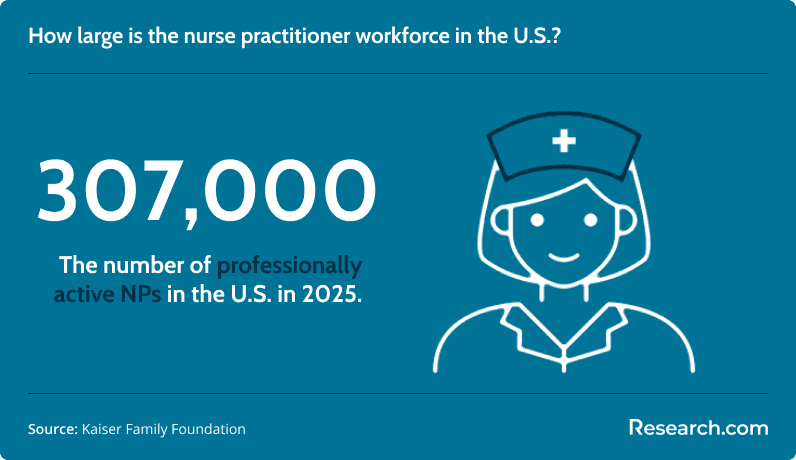
The infographic below shows the scale of the NP workforce and why advanced specialty preparation can matter for long-term progression.
What Is the Job Market Like for Online WHNP Certificate Graduates?
The job outlook for advanced practice nurses is strong. The Bureau of Labor Statistics projects 40% growth for nurse anesthetists, nurse midwives, and nurse practitioners from 2023 to 2033, with about 31,900 openings annually. WHNPs may find opportunities in OB/GYN clinics, hospitals, outpatient centers, community health organizations, telehealth-supported practices, academic settings, and underserved regions.
WHNP employment is influenced by local scope-of-practice laws, payer policies, employer demand, and the availability of women’s health services in a region. BLS data on NP practice settings can help applicants understand where nurse practitioners are employed, but salary and hiring outcomes are never guaranteed by completing a certificate alone.
Current Trends Affecting WHNP Education and Practice
- Telehealth is becoming a normal part of women’s health access: WHNP students should expect more exposure to virtual follow-ups, contraception counseling, chronic condition monitoring, and patient education.
- Clinical placement competition remains a major issue: Online students should not assume local preceptors will be easy to secure, especially in high-demand regions.
- Employers are emphasizing certification-ready preparation: A certificate should clearly align coursework and clinical hours with advanced practice role requirements.
- State rules still matter: Online education can cross state lines, but clinical approval, licensure, and practice authority are state-specific.
- Technology skills are increasingly important: WHNPs use EHR tools, patient portals, remote monitoring, and decision-support resources, but clinical judgment and patient communication remain central.
Can Alternative Pathways Help Non-Nurses Become Women’s Health NPs?
A WHNP graduate certificate is not designed for non-nurses. It is an advanced route for nurses who already hold graduate nursing credentials or meet equivalent advanced practice prerequisites. Non-nurses usually need to start with entry into professional nursing, then progress to graduate nursing education, licensure, national certification, and women’s health specialization.
For career changers, online accelerated BSN programs for non-nurses may provide an entry point into nursing education. After becoming licensed RNs and gaining appropriate experience, students can pursue graduate NP preparation and, eventually, a WHNP-focused pathway if it fits their goals.
Are Accreditation and Quality Indicators Reliable Benchmarks?
Accreditation is one of the most important screening factors, but it is not the only one. A properly accredited program helps protect your eligibility for certification, clinical placement, financial aid, and employer recognition. However, quality also depends on faculty support, clinical coordination, student outcomes, exam preparation, and transparency about state authorization.
Students comparing earlier nursing routes may review options such as the easiest RN to BSN online programs, but “easy” should never replace accredited, board-recognized, career-aligned preparation. For WHNP certificates, the safer benchmark is whether the program can document accreditation, clinical readiness, and fit with your state requirements.
How Do Online WHNP Programs Secure Effective Clinical Placements?
Online WHNP programs typically approve clinical experiences through a formal process involving site agreements, preceptor qualifications, university approval, and ongoing supervision. Some schools provide strong placement assistance, while others expect students to identify potential sites before the term begins. This is one of the biggest differences among online programs.
Ask whether the program has dedicated clinical coordinators, how early students begin placement planning, and what support is available if a preceptor cancels. Programs with compressed practicum schedules may feel similar in intensity to accelerated doctoral options such as the shortest DNP program, so working nurses should be realistic about time demands during clinical semesters.
Common Mistakes to Avoid When Choosing an Online WHNP Certificate
| Mistake | Why it matters | Better approach |
| Choosing only by tuition | A cheap program can become expensive if credits do not transfer or clinical placement delays graduation. | Compare total required credits, fees, placement support, and state approval. |
| Assuming “online” means no campus or clinical requirements | Some programs require intensives, live sessions, or strict practicum schedules. | Ask for the full program calendar before enrolling. |
| Skipping state authorization checks | A school may not be able to place students or support licensure in every state. | Verify authorization with both the school and your state board. |
| Ignoring preceptor responsibilities | Clinical placement problems can delay completion even when coursework is finished. | Ask who finds sites, who approves them, and what backup support exists. |
| Relying only on rankings | A highly ranked school may not be the best fit for your state, budget, or schedule. | Use rankings as a shortlist, then compare fit and requirements. |
| Assuming salary outcomes are guaranteed | Pay depends on region, employer, experience, certification, and scope-of-practice laws. | Review local job postings and speak with WHNPs in your market. |
Graduate Perspectives on Online Women's Health Nurse Practitioner Certificate Programs
- : "I needed a program that would let me keep working while raising three children. The online format made that possible because I could complete lectures outside my work schedule and finish clinical hours with an approved local preceptor. The strongest part was how quickly the women’s health content changed my confidence with complex gynecologic visits. — Marisol"
- : "I was worried an online certificate would feel disconnected, but the live case discussions and faculty feedback kept me engaged. The reproductive endocrinology content gave me a clearer specialty focus, and career services helped me prepare for WHNP applications after graduation. — Keon"
- : "The certificate worked because the school reviewed my MSN credits carefully and accepted six credits, which reduced my timeline by six months and saved over $5,000 in tuition. The combination of online coursework, peer forums, and local clinical practice helped me apply new skills in prenatal and menopausal care. — Avis"
References
- Bureau of Labor Statistics. Nurse Anesthetists, Nurse Midwives, and Nurse Practitioners.
- Bureau of Labor Statistics. Occupational Employment and Wages, May 2022: Nurse Practitioners.
- Bureau of Labor Statistics. Occupational Employment and Wages, May 2023: Healthcare Practitioners and Technical Occupations.
- Bureau of Labor Statistics. OES Industry Data.
- Carlow University. Post-Master’s Women’s Health Nurse Practitioner Certificate.
- Drexel University. Post-Master’s Certificate in Women’s Health Nurse Practitioner.
- Frontier Nursing University. Post-Graduate Certificate in Women’s Health Care Nurse Practitioner.
- Georgetown University. Women’s Health Nurse Practitioner Post-Graduate Certificate.
- Indeed. Nurse Practitioner Salaries.
- Kent State University. Post-Master’s Women’s Health Nurse Practitioner Certificate.
- PayScale. Nurse Practitioner (NP) Salary.
- Salary.com. Nurse Practitioner Hourly Wages Benchmark.
- Stony Brook University. Advanced Certificate Program: Women’s Health Nurse Practitioner.
- Thomas Jefferson University. Women’s Health–Gender Related Studies NP Certificate.
- University of Colorado Anschutz Medical Campus. Post-Graduate Certificate in Women’s Health Nurse Practitioner.
- University of Missouri–Kansas City. Post-MSN Certificate in Women’s Health Nurse Practitioner.
- Vanderbilt University. Post-Master’s Certificate in Women’s Health / Gender-Related Nurse Practitioner.
- ZipRecruiter. Nurse Practitioner Salary.
- Zippia. Certified Nurse Practitioner Salaries.
Key Insights
- An online WHNP graduate certificate is best suited for MSN- or DNP-prepared nurses who want focused women’s health advanced practice preparation without completing another full degree.
- Accreditation, state authorization, and clinical placement support should be checked before tuition, rankings, or speed. These factors determine whether the program can actually help you reach practice goals.
- Program length varies because schools evaluate prior graduate coursework differently. Do not rely on advertised credits alone; request a transcript review before estimating time or cost.
- Most students should expect 500+ supervised clinical hours, even in fully online programs. Online coursework does not eliminate hands-on practicum requirements.
- Costs can range widely, from lower public university rates to private university tuition above $2,000 per credit. Calculate total program cost, not just price per credit.
- The job outlook for APRNs is strong, with BLS projecting 40% growth from 2023 to 2033 for nurse anesthetists, nurse midwives, and nurse practitioners, but individual WHNP salaries and opportunities depend on location, experience, certification, employer type, and state practice rules.
- The strongest program choice is the one that aligns with your state, schedule, clinical access, prior coursework, and intended women’s health practice setting.
Other Things You Should Know About the Online Women's Health Nurse Practitioner Graduate Certificate Programs
Yes. Most programs require an active, unencumbered RN license and a master’s degree in nursing from an accredited school, usually with a minimum GPA of 3.0. Some programs also ask for APRN certification, recent clinical experience, and proof of immunizations before enrollment.
2027 Best Online Women's Health Nurse Practitioner Graduate Certificate Programs require a reliable internet connection, a computer with updated software, and specific applications like Zoom and Canvas for online learning. Check program websites for any additional software needs or technical specifications.


