2027 Best Online DNP Adult-Gerontology Primary Care NP Programs

Co-Founder and Chief Data Scientist
Standing at a career crossroads, staring at a list of DNP specializations, can be overwhelming. You know you’re ready for more responsibility and a greater impact, but the path forward is foggy. Our career planning experts, with over a decade of experience, created this guide to bring that path into focus and cut through the confusion surrounding online adult-gerontology primary care NP programs.
The Adult-Gerontology Primary Care Nurse Practitioner (AG-PCNP) role is more than an advanced degree—it’s a direct answer to a major challenge in American healthcare. While only 2.7% of registered nurses currently hold a doctorate, this path offers a rare opportunity for deep purpose and true clinical leadership by serving the needs of an entire generation.
What are the benefits of getting an online DNP adult-gerontology primary care NP degree?
- You will gain the clinical autonomy to design care plans, moving from an implementer to a true clinical leader.
- You can expect a significant increase in earning potential, with typical salaries for DNP-prepared AG-PCNPs ranging from $133,000 to $145,000.
- You have the flexibility to earn your terminal degree from a top-tier, accredited program without leaving your current job or having to relocate.
What can I expect from an online DNP adult-gerontology primary care NP program?
You can expect a rigorous curriculum built on three core pillars, all designed to shape you into a clinical leader.
First, you'll master advanced clinical management for complex adult and geriatric populations. This is where you deepen the hands-on skills needed for primary care.
Second, you'll focus on evidence-based practice, which culminates in a DNP project. This isn't a theoretical dissertation; it’s a practical project where you solve a real-world problem in a clinical setting.
Finally, you'll build expertise in systems leadership through courses in healthcare policy, finance, and quality improvement.
The best online adult-gerontology primary care NP programs ensure your clinical hours are completed in outpatient settings, directly preparing you for your future role. It’s an education that equips you not just to practice, but to lead.
Where can I work with an online DNP adult-gerontology primary care NP program?
An AG-PCNP degree prepares you to work in outpatient settings where you focus on long-term health management. You’ll find roles in community clinics, private practices, and specialty clinics focused on areas like cardiology or oncology. High-growth areas also include telehealth and home-based primary care, which are becoming more common.
It is critical to understand that this degree does not prepare you for inpatient, hospital-based acute care roles. Working in an ICU or emergency department is the domain of the Acute Care NP. This distinction is the clearest line between the two career paths.
How much can I make with an online DNP adult-gerontology primary care NP degree?
In outpatient primary care settings, you can expect to earn between $133,000 and $145,000 annually.
This figure reflects the combined value you bring to the table. It’s not just the salary lift from the DNP credential itself, but also the high market demand for the adult-gerontology primary care specialty certification.
Employers recognize this combination of advanced education and specialized skill as the new standard for clinical leadership in primary care, and the compensation reflects that value. This makes the degree a sound financial investment in your long-term earning potential.
- List of the Best Online DNP Adult-Gerontology Primary Care NP Programs for 2027 List of Programs
- How long does it take to complete an online DNP adult-gerontology primary care NP program? Completion Time
- How does an online DNP adult-gerontology primary care NP program compare to an on-campus program? How does an online DNP adult-gerontology primary care NP program compare to an on-campus program?
- What is the average cost of an online DNP adult-gerontology primary care NP program? Program Cost
- What are the financial aid options for students enrolling in an online DNP adult-gerontology primary care NP program? Financial Aid
- What are the prerequisites for enrolling in an online DNP adult-gerontology primary care NP program? What are the prerequisites for enrolling in an online DNP adult-gerontology primary care NP program?
- What courses are typically in an online DNP adult-gerontology primary care NP program? What courses are typically in an online DNP adult-gerontology primary care NP program?
- What types of specializations are available in an online DNP adult-gerontology primary care NP program? What types of specializations are available in an online DNP adult-gerontology primary care NP program?
- How to Choose the Best Online DNP Adult-Gerontology Primary Care NP Program How to Choose the Best Online DNP Adult-Gerontology Primary Care NP Program
- What career paths are available for graduates of an online DNP adult-gerontology primary care NP program? Career Paths
- What is the job market for graduates of an online DNP adult-gerontology primary care NP program? Job Market
- How Is Clinical Training Managed in Online DNP Adult-Gerontology Primary Care NP Programs? How Is Clinical Training Managed in Online DNP Adult-Gerontology Primary Care NP Programs?
- Is an Accelerated BSN a Viable Stepping Stone to a DNP? Is an Accelerated BSN a Viable Stepping Stone to a DNP?
Best Online DNP Adult-Gerontology Primary Care NP Programs for 2027
// PREVIEW //
Choosing an online Doctor of Nursing Practice adult-gerontology primary care nurse practitioner program is not just a degree decision. It affects where you can practice, how quickly you can move into advanced primary care, how much clinical support you receive, and whether you will be eligible for certification and licensure after graduation.
This guide is for registered nurses comparing online and hybrid DNP AGPCNP programs, especially BSN-prepared nurses who want a direct path to doctoral-level advanced practice. You will find ranked program options, cost and timeline comparisons, accreditation considerations, clinical placement questions, financial aid strategies, and practical guidance for deciding whether this path fits your career goals.
Quick Answer: What Should You Look for in an Online DNP AGPCNP Program?
The best online DNP adult-gerontology primary care NP program is accredited by the Commission on Collegiate Nursing Education (CCNE) or the Accreditation Commission for Education in Nursing (ACEN), prepares graduates for national AGPCNP certification, provides meaningful clinical placement support, and fits your budget, schedule, and state licensure requirements. Online delivery can work well for working nurses, but every program still requires in-person clinical training.
How We Rank Schools
Because a DNP is a major financial and professional commitment, our rankings are designed to help readers compare programs using transparent, education-focused information. Research.com draws on established data sources, including the IPEDS database, Peterson's database, the College Scorecard database, and The National Center for Education Statistics.
These sources help evaluate online DNP adult-gerontology primary care nurse practitioner programs across factors such as institutional data, program characteristics, cost, and student outcomes where available. You can review the broader Research.com ranking process on our methodology page.
// PREVIEW //
At-a-Glance Comparison of Featured Online DNP AGPCNP Programs
| School | Program Format | Program Length | Credits | Cost per Credit | Accreditation |
| Pennsylvania State University | Hybrid | 3 years | 65 | $1,037 | CCNE |
| University of Indianapolis | Online coursework with campus visits | 3 years (10 semesters) | 62 | $828 | CCNE |
| University of Pittsburgh | Hybrid | 3 years (full-time) | 79 | $1,280 (In-state); $1,595 (Out-of-state) | CCNE |
| Maryville University of Saint Louis | Online coursework with clinical placements | 3-4 years | 68-77 | $863 (MSN courses); $947 (DNP courses) | CCNE |
| University of Central Florida | Mixed-mode | 9 semesters (Full-time); 12 semesters (Part-time) | 73 | $288.16 (In-state); $1,194.04 (Out-of-state) | CCNE |
| Mercer University | Online coursework with practicum and immersion hours | 3-4 years | 73 | $1,285.50 | CCNE |
| Herzing University | Online coursework with clinical experience | 3-4 years | 68 | $770 | CCNE |
1. Pennsylvania State University – Doctor of Nursing Practice – Nurse Practitioner
Pennsylvania State University offers a DNP nurse practitioner pathway that prepares nurses to provide primary care for adults and older adults while emphasizing health promotion, disease prevention, and advanced clinical leadership. The hybrid format combines online classes with required in-person clinical experiences, making it a fit for nurses who want flexibility but can still complete hands-on requirements.
- Program Length: 3 years
- Required Credits to Graduate: 65
- Cost per Credit: $1,037
- Accreditation: Commission on Collegiate Nursing Education (CCNE)
2. University of Indianapolis – BSN-DNP Adult/Gerontological Primary Care Nurse Practitioner
The University of Indianapolis BSN-DNP Adult/Gerontological Primary Care Nurse Practitioner track is built for RNs who want to move from bedside or generalist nursing into doctoral-level primary care practice. Coursework is largely online, but students should plan for campus-based requirements that support hands-on assessment, clinical examination, and practice readiness.
- Program Length: 3 years (10 semesters)
- Required Credits to Graduate: 62
- Cost per Credit: $828
- Accreditation: Commission on Collegiate Nursing Education (CCNE)
3. University of Pittsburgh – BSN to DNP Adult-Gerontology Primary Care Nurse Practitioner
The University of Pittsburgh BSN to DNP AGPCNP program prepares nurses to serve as primary care providers for patients from adolescence through older adulthood. Its hybrid structure pairs online learning with required on-campus immersions, which may appeal to students who want a flexible program without losing structured faculty interaction and clinical preparation.
- Program Length: 3 years (full-time)
- Required Credits to Graduate: 79
- Cost per Credit: $1,280 (In-state); $1,595 (Out-of-state)
- Accreditation: Commission on Collegiate Nursing Education (CCNE)
4. Maryville University of Saint Louis – BSN to DNP Adult-Gerontology Primary Care Nurse Practitioner
Maryville University offers a BSN-DNP AGPCNP pathway that develops nurses for advanced primary care, evidence-based practice, research application, and leadership with adult populations. Students complete online coursework and required clinical placements, so applicants should confirm how clinical site approval works in their state before enrolling.
- Program Length: 3-4 years
- Required Credits to Graduate: 68-77
- Cost per Credit: $863 (MSN courses); $947 (DNP courses)
- Accreditation: Commission on Collegiate Nursing Education (CCNE)
5. University of Central Florida – DNP, Adult/Gerontology Primary Care
The University of Central Florida DNP Adult/Gerontology Primary Care program is designed for nurses preparing for high-level clinical practice, organizational leadership, and evidence-informed decision-making. The mixed-mode design includes online coursework along with required on-campus clinical labs and DNP intensives.
- Program Length: 9 semesters (Full-time); 12 semesters (Part-time)
- Required Credits to Graduate: 73
- Cost per Credit: $288.16 (In-state); $1,194.04 (Out-of-state)
- Accreditation: Commission on Collegiate Nursing Education (CCNE)
6. Mercer University – BSN to DNP, Adult-Gerontology Primary Care
Mercer University offers a BSN to DNP AGPCNP program for registered nurses who want to qualify for advanced adult-gerontology primary care practice. The curriculum combines online instruction with required practicum and immersion experiences, so prospective students should assess whether the clinical expectations match their work schedule and location.
- Program Length: 3-4 years
- Required Credits to Graduate: 73
- Cost per Credit: $1,285.50
- Accreditation: Commission on Collegiate Nursing Education (CCNE)
7. Herzing University – BSN to DNP, Adult Gerontology Primary Care
Herzing University structures its BSN to DNP Adult Gerontology Primary Care program around the latest AACN Essentials. Students complete online coursework, 540 hours of required hands-on clinical experience, and a DNP Practice Project that applies doctoral-level learning to a real practice issue.
- Program Length: 3-4 years
- Required Credits to Graduate: 68
- Cost per Credit: $770
- Accreditation: Commission on Collegiate Nursing Education (CCNE)
How Long Does It Take to Complete an Online DNP Adult-Gerontology Primary Care NP Program?
Your completion time depends mainly on your current nursing credential, enrollment pace, and clinical scheduling. A BSN-to-DNP adult-gerontology primary care NP program usually requires three to four years of full-time study. Nurses who already have an MSN may complete an MSN-to-DNP pathway in one to two years, depending on transfer credit, advanced practice preparation, and DNP project requirements.
Part-time study can make the degree more manageable for working nurses, but it also extends the timeline. Before applying, ask whether clinical hours must be completed during business hours, whether weekend or evening clinical options are possible, and how much flexibility exists during intensive or campus-based components.
| Starting Point | Typical Timeline | Best Fit | Key Planning Issue |
| BSN-prepared RN | Three to four years of full-time study | Nurses who want a direct route to doctoral-level NP preparation | Balancing graduate coursework, clinical hours, and work responsibilities |
| MSN-prepared nurse | One to two years | Nurses who already have graduate nursing preparation | Confirming which previous credits and clinical experiences will apply |
| Part-time student | Varies by program structure | Working nurses who need a slower pace | Longer completion time and possible sequencing limits |
Why Many Nurses Commit to the DNP Path
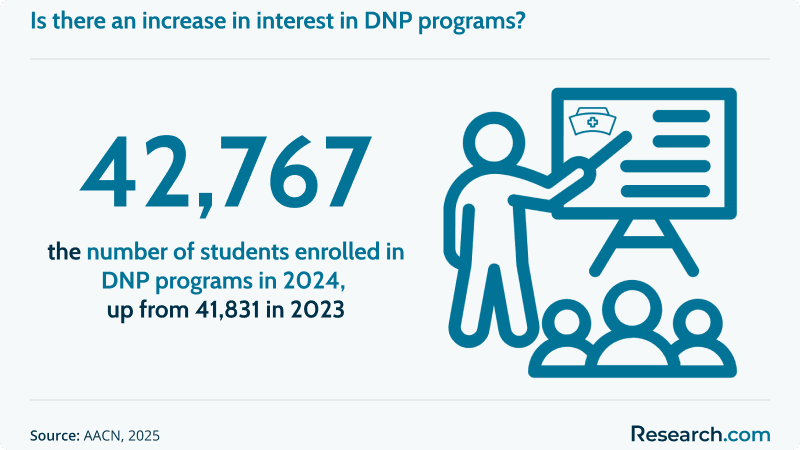
The time requirement is substantial, but many nurses pursue the DNP because it can expand their clinical authority, leadership preparation, and long-term career options. For AGPCNP students, the degree is especially relevant because adult and older adult primary care requires advanced assessment, chronic disease management, prevention, care coordination, and systems-level thinking.
Enrollment trends can also help applicants understand the broader professional movement toward doctoral nursing preparation. The data below provides additional context on how the DNP has become a more common pathway for nurses seeking advanced practice and leadership roles.
Online vs. On-Campus DNP AGPCNP Programs: What Actually Matters?
An accredited online DNP adult-gerontology primary care NP program can carry the same academic value as an accredited campus-based program. Employers, state boards, and certification bodies typically focus on accreditation, clinical preparation, licensure eligibility, and certification readiness rather than whether didactic coursework was delivered online or in person.
The stronger question is not simply “online or campus?” It is “Will this program meet the requirements for where I plan to practice?” Similar to online FNP graduate certificate programs, the legitimacy of an online AGPCNP pathway depends on institutional and nursing accreditation, approved clinical training, and alignment with certification and state requirements.
| Feature | Online or Hybrid DNP AGPCNP Program | Campus-Based DNP AGPCNP Program |
| Accreditation | Should be equivalent when accredited by recognized nursing accrediting bodies | Should be equivalent when accredited by recognized nursing accrediting bodies |
| Course Content | Typically comparable to campus programs at the same institution | Typically comparable to online programs at the same institution |
| Degree Awarded | Doctor of Nursing Practice | Doctor of Nursing Practice |
| Flexibility | Higher flexibility for coursework, though clinical hours are in person | Lower flexibility but more scheduled face-to-face interaction |
| Clinical Training | Completed in approved in-person clinical settings | Completed in approved in-person clinical settings |
The More Important Choice: Primary Care vs. Acute Care
For many nurses, the larger career-defining decision is not online versus on campus. It is whether to prepare for adult-gerontology primary care or adult-gerontology acute care. AGPCNP programs focus on outpatient, preventive, long-term, and chronic care management across adulthood and older age. Acute care pathways prepare nurses for more intensive, hospital-based, and complex episodic care settings.
If your goal is long-term patient relationships, prevention, health maintenance, chronic disease management, and community-based adult care, the AGPCNP path is likely more aligned. If your interests are ICU, inpatient specialty services, or hospital-based management of unstable patients, compare this route with fast track online MSN AGACNP programs online before committing.
What Is the Average Cost of an Online DNP Adult-Gerontology Primary Care NP Program?
Total tuition for online adult-gerontology primary care NP programs commonly falls between $50,000 and $95,000, depending on the school, credit load, tuition rate, and residency status. Published per-credit tuition in the featured programs ranges from about $800 to over $1,300, and many programs require between 60 and 80 credits.
Do not evaluate cost using tuition alone. The real price depends on fees, travel for immersions, campus visits, clinical compliance costs, books, technology, background checks, certification exam expenses, and lost income if you reduce work hours. Also compare the gross price with your net cost after scholarships, grants, loans, military benefits, and employer tuition support.
| Cost Factor | Why It Matters | Question to Ask |
| Per-credit tuition | This is the largest visible cost and varies widely by institution and residency status. | Is the listed rate locked in, or can it increase during the program? |
| Required credits | A lower per-credit price may not mean a lower total cost if the program requires more credits. | How many credits will I need after transcript review? |
| Campus visits and intensives | Travel, lodging, and time away from work can add meaningful costs. | How many in-person visits are required? |
| Clinical placement requirements | Some students may need to travel or adjust work schedules to complete approved hours. | Does the school help secure placements near my location? |
| Employer reimbursement | Workplace tuition benefits can reduce out-of-pocket costs. | Does my employer cover DNP coursework, and are there service commitments? |
How to Think About DNP Return on Investment
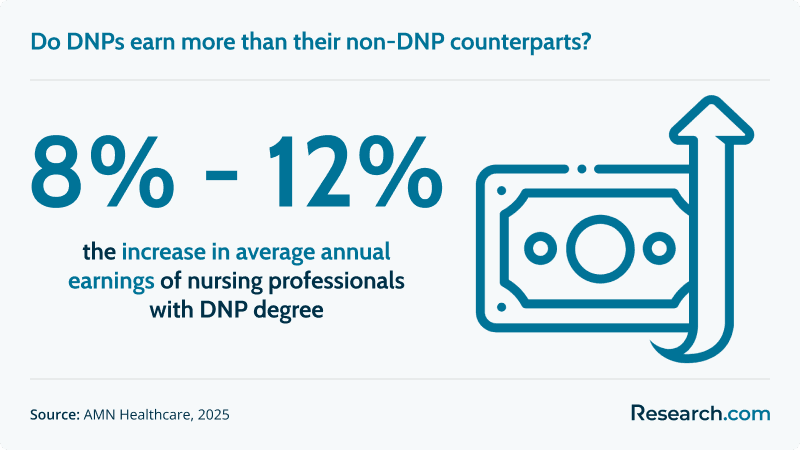
The DNP should be evaluated as a career investment, not only as an academic expense. For nurses who want broader clinical responsibility, leadership roles, or doctoral-level advanced practice preparation, the credential may support career mobility over time. However, salary outcomes are not guaranteed and vary by state, employer, specialty setting, scope of practice, and experience.
The data below provides additional context on the financial side of the DNP credential. Use it as one part of your decision, along with your projected debt, local job market, clinical interests, and the type of practice environment you want after graduation.
Financial Aid Options for Online DNP Adult-Gerontology Primary Care NP Students
DNP students often combine several funding sources rather than relying on one option. The best strategy is to compare aid early, ask your employer about tuition support before applying, and understand how much debt you may need to take on after scholarships and grants.
- Federal Student Aid: Start by completing the Free Application for Federal Student Aid (FAFSA). Graduate nursing students commonly use federal loan options such as Direct Unsubsidized Loans and Grad PLUS loans.
- Scholarships and Grants: Universities, healthcare systems, professional nursing associations, and private organizations may offer awards for graduate nursing students. Unlike loans, scholarships and grants generally do not need to be repaid.
- Employer Tuition Reimbursement: Hospitals, health systems, clinics, and long-term care organizations may help fund advanced nursing education when it supports workforce needs.
- Payment Plans: Some institutions allow students to spread tuition payments across a term, which can reduce the need for short-term borrowing.
- Service-Based Funding: Some funding programs may require a work commitment after graduation, so read the terms carefully before accepting support.
When comparing program costs, avoid assuming that all online credentials have the same price structure. A doctoral nursing program has different requirements than shorter workforce credentials, technology bootcamps, or niche training such as ISC2 CGRC training online or an online flooring installers training certification. The clinical, accreditation, and licensure components of an NP program make the cost model different.
Why Employer Reimbursement Can Be Especially Valuable
If you are already employed in healthcare, employer support may be one of the most practical ways to reduce DNP debt. Frame the conversation around organizational value: improved adult and geriatric primary care capacity, stronger chronic disease management, better care coordination, and leadership in quality improvement.
Before accepting reimbursement, ask whether you must remain with the employer for a certain period, whether part-time study is covered, whether clinical hours can be completed within the organization, and whether tuition support applies to all program fees or only course tuition.
Prerequisites for Online DNP Adult-Gerontology Primary Care NP Programs
Most online DNP AGPCNP programs require applicants to hold either a Bachelor of Science in Nursing (BSN) or a Master of Science in Nursing (MSN) from an accredited institution. Programs also typically require an active, unencumbered RN license. Some schools specify additional admission standards, such as a minimum GPA, often a 3.0 on a 4.0 scale, and one to two years of relevant clinical experience.
Admission requirements vary, so verify each school’s criteria directly. For example, prospective students can review a university’s stated expectations through resources such as the standard set of requirements published by nursing programs.
| Requirement | Why Programs Ask for It | How to Strengthen Your Application |
| BSN or MSN from an accredited institution | Shows that you have completed recognized nursing preparation. | Confirm transcript eligibility before applying. |
| Active, unencumbered RN license | Required for clinical practice and advanced nursing progression. | Resolve any licensure issues before submitting applications. |
| Minimum GPA | Helps programs assess readiness for doctoral-level coursework. | Use your statement to explain academic growth if needed. |
| Clinical experience | Advanced practice programs expect applicants to build on real patient care exposure. | Highlight adult, geriatric, primary care, chronic disease, or care coordination experience. |
| Recommendations and personal statement | Programs want evidence of judgment, professionalism, and leadership potential. | Choose recommenders who can speak to clinical reasoning and readiness for advanced practice. |
How to Build a Strong Application Narrative
Meeting minimum requirements gets your application reviewed, but competitive applicants show why they are ready for advanced primary care. Your essay, resume, and recommendations should connect your nursing background to your future role as a provider for adult and older adult patients.
Experience in care transitions, chronic disease management, population health, or interdisciplinary coordination can strengthen your application. If you are comparing related graduate pathways, accelerated online MSN in care coordination programs can also help you understand how schools frame patient management across settings.
Common Courses in an Online DNP Adult-Gerontology Primary Care NP Program
Online DNP AGPCNP curricula usually combine advanced clinical science, diagnostic reasoning, pharmacology, evidence-based practice, leadership, healthcare policy, and a doctoral practice project. The goal is to prepare graduates not only to treat individual patients but also to improve systems of care.
Coursework generally falls into three broad categories: advanced clinical practice, evidence-based practice, and systems leadership. As in other graduate disciplines, curriculum design matters; readers comparing online learning models more broadly may also find value in reviewing the structure of the best online instructional design master's programs.
| Course Area | Typical Topics | How It Applies to AGPCNP Practice |
| Advanced Clinical Practice | Advanced pathophysiology, pharmacology, health assessment, diagnostics, adult and geriatric primary care | Builds the clinical foundation for evaluating and managing adult and older adult patients. |
| Evidence-Based Practice | Research translation, quality improvement, outcomes measurement, DNP project development | Helps students apply evidence to improve patient care and clinical processes. |
| Systems Leadership | Healthcare policy, organizational leadership, finance, informatics, population health | Prepares graduates to lead practice improvements and communicate with administrative stakeholders. |
Why Systems Leadership Matters in a DNP Program
The DNP differs from a purely clinical master’s pathway because it prepares nurses to think beyond one patient encounter. Systems leadership coursework helps students understand budgets, workflow redesign, policy, informatics, quality measures, and organizational decision-making.
This leadership component can be especially important for nurses who want to influence primary care delivery, chronic disease programs, telehealth workflows, or community-based health initiatives. If you are interested in the administrative side of nursing leadership, compare AGPCNP preparation with the shortest MSN in health systems management online to see how clinical and management-focused tracks differ.
Are There Specializations Within an Online DNP Adult-Gerontology Primary Care NP Program?
In most cases, adult-gerontology primary care NP is the specialization. Students do not usually enroll in a formal “DNP AGPCNP with cardiology” or “DNP AGPCNP with nephrology” track. Instead, the program prepares graduates for broad primary care of adults and older adults across preventive care, chronic disease management, assessment, diagnosis, and long-term treatment planning.
More focused expertise typically develops after graduation through clinical experience, continuing education, fellowships, employer-based training, and specialty certifications. For example, an AGPCNP may later build a practice emphasis in diabetes management, oncology, cardiology, geriatrics, nephrology, or palliative care, depending on the clinical setting.
Post-Graduate Expertise Can Shape Your Career
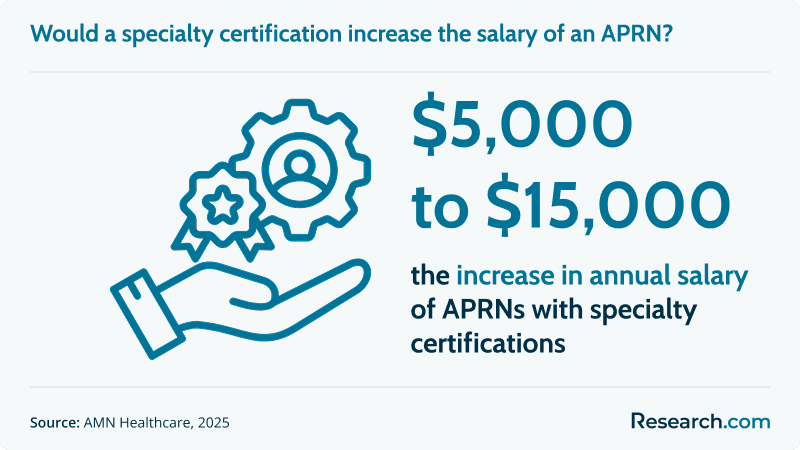
Although sub-specialty expertise may not be listed as a formal DNP concentration, it can become an important career differentiator. Additional certifications and focused clinical experience may help an NP qualify for specialized outpatient clinics, leadership assignments, or roles that require deeper knowledge of a specific adult or geriatric population.
The data below adds context on how continued professional development and specialty expertise can affect long-term career opportunities.
How to Choose the Best Online DNP Adult-Gerontology Primary Care NP Program
The best program is not always the cheapest, fastest, or most recognizable. The right program is the one that meets accreditation standards, supports your clinical training, aligns with your state’s requirements, fits your schedule, and prepares you for certification and practice in the setting you want.
- Verify accreditation first. Look for nursing accreditation from CCNE or ACEN. Without proper accreditation, certification eligibility, licensure, and employer acceptance may be affected.
- Confirm state authorization and licensure alignment. Online programs may not accept students from every state, and state NP requirements can differ.
- Ask about clinical placement support. A strong online program should explain how placements are approved, how preceptors are vetted, and what happens if a placement falls through.
- Review certification pass-rate information. Ask admissions staff for graduation rates and national certification exam pass rates when available.
- Compare total cost, not just tuition. Include fees, travel, clinical compliance costs, and lost income.
- Evaluate faculty experience. Faculty with current or recent AGPCNP practice can provide more relevant clinical guidance.
- Check technology and student support. Online DNP students need responsive advising, library access, clinical coordination, technical support, and faculty communication.
Questions to Ask Before You Enroll
| Question | Why It Matters |
| Is the program accredited by CCNE or ACEN? | Accreditation is central to program credibility and may affect certification and licensure eligibility. |
| Will this program meet NP requirements in my state? | State rules differ, and online enrollment may be restricted by location. |
| Who finds clinical placements? | Clinical placement problems can delay graduation. |
| How many campus visits, labs, or intensives are required? | Travel and time away from work can affect cost and feasibility. |
| What are the certification exam pass rates? | Pass rates can help indicate how well the curriculum prepares students. |
| Can I attend part time? | Part-time options can help working nurses manage workload. |
| What happens if I need to pause enrollment? | Leave policies and course sequencing can affect completion time. |
Common Mistakes to Avoid
- Choosing a program before checking accreditation: Accreditation should be verified before you compare price or convenience.
- Assuming online means fully remote: NP programs require in-person clinical training, and many include campus visits or intensives.
- Looking only at tuition: Fees, travel, compliance costs, and work-hour reductions can change the real cost.
- Ignoring state rules: A program may be reputable but still not appropriate for your state’s licensure requirements.
- Relying only on rankings: Rankings can narrow your list, but your final decision should reflect your clinical goals and local practice requirements.
- Underestimating clinical placement logistics: Ask detailed questions about preceptors and placement responsibility before enrolling.
How to Evaluate Program Quality Beyond Marketing Materials
Program websites often emphasize flexibility, prestige, and student support. Go deeper by asking for measurable outcomes, certification preparation details, clinical placement policies, faculty access, and examples of DNP projects. Strong programs should be willing to explain how they track student success.
This outcome-focused mindset is also central in healthcare improvement fields. If you are interested in the quality and safety side of nursing leadership, compare this pathway with fastest online MSN healthcare quality and patient safety programs.
Career Paths for Online DNP Adult-Gerontology Primary Care NP Graduates
Graduates of online DNP AGPCNP programs typically work in outpatient and primary care settings where they manage adult and older adult patients over time. The role often involves assessment, diagnosis, treatment planning, medication management, prevention, health education, chronic disease care, and coordination with physicians, specialists, pharmacists, social workers, and other clinicians.
- Primary Care Practice: Provide ongoing adult and geriatric care in physician offices, NP-led practices, or multi-provider clinics.
- Community Health Centers: Serve patients who need accessible preventive care, chronic disease support, and health education.
- Specialty Outpatient Clinics: Work in settings such as cardiology, endocrinology, oncology, nephrology, or geriatrics while applying adult primary care expertise.
- Long-Term and Home-Based Care Models: Support older adults and medically complex patients outside the hospital setting.
- Telehealth and Hybrid Care: Deliver follow-up care, chronic disease monitoring, medication management, and preventive counseling through virtual or blended care models.
- Leadership and Quality Improvement: Use DNP preparation to lead clinical workflows, patient safety initiatives, population health projects, or care model redesign.
How Work Setting Can Affect Compensation
Earnings for AGPCNP graduates vary by employer, geography, experience, scope of practice, and clinical setting. Outpatient specialty clinics, primary care organizations, community health centers, and entrepreneurial models may all compensate differently. Rather than relying on a single salary figure, compare pay by local market and work environment.
The chart below provides additional context on salary patterns by practice environment, which can help you think through the financial implications of a primary care career path.
Job Market Outlook for DNP Adult-Gerontology Primary Care NP Graduates
The job market for AGPCNP graduates is supported by long-term demand for adult and older adult primary care, ongoing physician shortages in many communities, and the growing need for clinicians who can manage chronic conditions outside hospital settings. Demand can vary by state and region, so local job postings and scope-of-practice laws should be part of your research.
Several trends are shaping the field. Telehealth is now a routine part of many primary care models. Employers increasingly expect NPs to work with electronic health records, remote monitoring tools, population health dashboards, and quality metrics. AI-enabled clinical tools may support documentation, risk identification, and workflow efficiency, but they do not replace the clinical judgment, patient communication, and licensure-based responsibilities of nurse practitioners.
Scope of Practice Is a Major Career Factor
State scope-of-practice laws affect NP autonomy, supervision or collaboration requirements, prescribing authority, and practice ownership possibilities. Before choosing a program or planning a move, review the rules in the state where you intend to practice. A DNP may strengthen your preparation, but it does not override state licensure law.
Long-Term Career Growth
The DNP can support more than an entry into advanced practice. Over time, graduates may move into clinical leadership, quality improvement, population health, faculty roles, practice ownership, or specialized outpatient care. The data below illustrates how earnings can change with professional experience and career advancement.
If you are comparing healthcare with completely different online education pathways, Research.com also maintains guides to other fields, including top online audio and music programs. Use those comparisons only if you are still deciding between healthcare and a non-nursing career direction.
How Is Clinical Training Managed in Online DNP Adult-Gerontology Primary Care NP Programs?
Online DNP AGPCNP programs deliver lectures and academic coursework remotely, but clinical training takes place in approved healthcare settings. Students usually complete supervised practice with qualified preceptors who can help them build competence in adult and older adult primary care.
Clinical management varies by school. Some programs help identify placement sites, while others require students to take the lead in finding preceptors. Schools may also use simulation, telehealth modules, skills labs, campus intensives, faculty check-ins, and standardized assessments to evaluate readiness. Before enrolling, ask exactly how clinical sites are approved, who is responsible for placement, and whether your preferred state or region is supported.
Students who are not yet licensed RNs should not start with a DNP pathway. They first need an entry route into nursing. For career changers with a non-nursing bachelor’s degree, an accelerated online BSN may provide a faster path toward RN eligibility before future graduate study.
What Graduates Say About Online DNP Adult-Gerontology Primary Care NP Programs
- Wanda: "I chose adult-gerontology primary care because my community needed more providers who understood the needs of older adults. The program helped me manage complicated conditions across multiple body systems and gave me confidence working with patients who need long-term, coordinated care."
- Amy: "Before the DNP, I understood patient care but did not always understand how decisions were made at the organizational level. Courses in policy, finance, and leadership helped me speak the same language as administrators and participate in strategy discussions with more confidence."
- Shiloh: "The DNP project felt overwhelming at first, but it became the most useful part of the program. I created a new workflow for diabetic patient management, and my preceptor’s clinic adopted it. That was the moment I saw how doctoral work could change everyday care."
// PREVIEW //
Is an Accelerated BSN a Viable Stepping Stone to a DNP?
Yes, an accelerated BSN can be a practical first step for someone who already holds a non-nursing bachelor’s degree and wants to become a registered nurse before pursuing advanced practice. It is not a shortcut directly into NP practice, but it can help career changers complete foundational nursing education and become eligible for RN licensure.
If this applies to you, compare accredited accelerated BSN options carefully. Guides such as the easiest online accelerated BSN can help you understand admissions accessibility, but you should also verify accreditation, clinical placement quality, NCLEX preparation, and whether the program supports future graduate study.
Key Insights
// PREVIEW //
- Accreditation is the first filter. Do not apply to an online DNP AGPCNP program until you verify recognized nursing accreditation and state eligibility.
- Online does not mean clinical-free. Coursework may be remote, but supervised clinical practice is completed in person.
- The primary care focus is career-defining. AGPCNP programs prepare nurses for adult and older adult outpatient care, not hospital-based acute care roles.
- Total cost matters more than tuition rate. Include fees, travel, clinical compliance costs, and reduced work hours when comparing programs.
- Clinical placement support can make or break the experience. Ask who finds preceptors, how sites are approved, and what backup support exists.
- The DNP can support leadership as well as practice. Systems leadership, policy, informatics, and quality improvement coursework prepare graduates to influence care beyond individual patient visits.
- State scope-of-practice rules matter. Your autonomy, prescribing authority, and practice options depend heavily on where you plan to work.
// PREVIEW //
References:
- American Association of Colleges of Nursing. (2025, June). DNP fact sheet. AACN.
- American Association of Critical-Care Nurses. (2024, December 30). Why would I need more than one nursing certification? AACN Blog.
- Baylor University. (2025). The demand for pediatric nurses and how a DNP/PNP can help. Baylor University Online Nursing Programs.
- Centers for Disease Control and Prevention. (2025, June 5). Data and statistics on children's mental health. CDC.
- Centers for Disease Control and Prevention. (2025, July 15). FastStats - Child health. National Center for Health Statistics.
- Centers for Disease Control and Prevention. (2025, July 15). FastStats - Older adult health. National Center for Health Statistics.
- Centers for Disease Control and Prevention. (2023). FastStats - Women’s health. National Center for Health Statistics.
- Kaplow, R., & Reed, K. D. (2021). Specialty certification: A path to improving outcomes. American Journal of Critical Care, 30(2), 156.
- KFF. (2024). U.S. women's health status data. KFF.
- National Council on Aging. (2024, June 1). Get the facts on older Americans. NCOA. AACN DNP fact sheet.
// PREVIEW //
Other Things You Should Know About Online DNP Adult-Gerontology Primary Care NP Programs
Prerequisites typically include a Bachelor of Science in Nursing (BSN), a valid Registered Nurse (RN) license, relevant clinical experience, and satisfactory GRE scores. Some programs may also require a master’s degree and specific coursework in areas such as statistics or health assessment.
State practice laws directly impact AG-PCNP job opportunities by defining the level of autonomy and scope of practice allowed in each state. In 2027, full practice states offer more independent opportunities for graduates, whereas restricted practice states may limit their ability to independently diagnose, prescribe medications, or manage treatments.
Top picks for 2027 online DNP Adult-Gerontology Primary Care NP programs include institutions like Johns Hopkins University, Duke University, and the University of Michigan. These programs are known for their rigorous curricula, experienced faculty, and commitment to preparing students for advanced practice roles in adult-gerontology primary care.