2027 Best Online Family Nurse Practitioner Graduate Certificate Programs

Co-Founder and Chief Data Scientist
Nurses aiming to advance their careers by becoming family nurse practitioners often face the challenge of finding a graduate certificate program that accommodates their demanding schedules. They question whether an online program is a worthwhile investment, given the time and financial commitment. Fortunately, online family nurse practitioner graduate certificate programs offer a flexible solution.
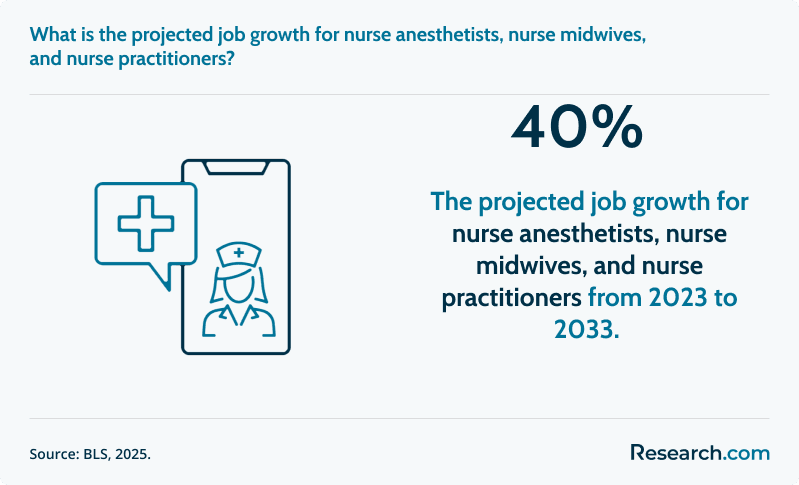
With overall employment of nurse anesthetists, nurse midwives, and nurse practitioners projected to grow 40% from 2023 to 2033, the career outlook is exceptionally strong. Our team, with over ten years of expertise in career planning, has meticulously researched and compiled this article to help students gain comprehensive insights into the best online FNP programs.
What are the benefits of getting an online family nurse practitioner graduate certificate program?
- Qualify for in-demand roles as a Family Nurse Practitioner (FNP) in primary care clinics, family medicine practices, hospitals, urgent care centers, and even telehealth—helping address the nationwide shortage of primary care providers with broad, flexible job opportunities.
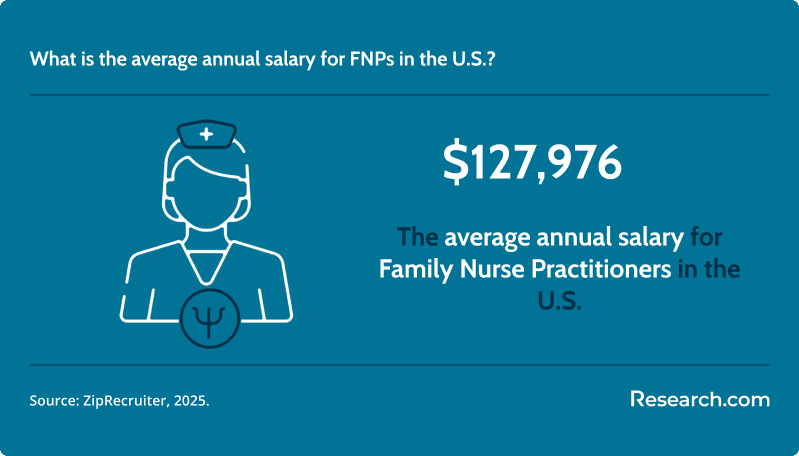
- Earn a strong median annual salary—FNPs make about $127,976 per year in the U.S., reflecting the high demand and competitive compensation in this field.
- Maintain your current job and personal commitments while advancing your career, enjoying accredited, rigorous coursework, and completing clinical requirements in your local area—perfect for working nurses and those with families.
What can I expect from an online family nurse practitioner graduate certificate program?
An online family nurse practitioner graduate certificate program features a focused curriculum blending advanced nursing courses with hands-on learning. You’ll study topics like health assessment, pharmacology, and the management of acute and chronic conditions across the lifespan.
Most online family nurse practitioner programs typically require 18 to 29 credit hours, often including a capstone project or specialty seminar and 500 to 750 internship (clinical) hours completed in your community. Tuition ranges from approximately $8,000 to $23,000, depending on the school and the number of credits required.
Most online courses are delivered asynchronously. So you can access lectures and assignments on your schedule. This flexibility enables individuals to balance work, life, and education while acquiring specialized skills in family practice nursing.
Where can I work with an online family nurse practitioner graduate certificate?
An online family nurse practitioner graduate certificate can unlock diverse career paths. Most graduates, nearly 70%, work in family practice, clinics, hospitals, or outpatient centers, but opportunities span far wider. You can excel in corporate wellness programs, telehealth, home healthcare, government agencies, nonprofits, or even run your own healthcare business.
FNPs find roles in management, clinical leadership, consulting, education, and research. Many industries, such as technology, healthcare, and education, seek FNPs for their expertise in problem-solving, communication, and critical thinking.
How much can I make with an online family nurse practitioner graduate certificate?
With an online family nurse practitioner graduate certificate, you can expect strong earning potential. The average annual salary for family nurse practitioners is $127,976 in the U.S., with entry-level salaries starting near $122,100 and experienced professionals making up to $131,400 or more.
Salaries can vary by industry and location. Practitioners working in hospitals, private practices, government, and top-paying urban areas tend to earn higher wages. Obtaining additional certifications or advanced degrees, such as a Doctor of Nursing Practice (DNP), can boost salaries by $9,000 or more annually. This flexibility and growth attract many to the profession.
- Best Online Family Nurse Practitioner Graduate Certificate Programs for 2027 List of Programs
- How long does it take to complete an online family nurse practitioner graduate certificate program? Completion Time
- How does an online family nurse practitioner graduate certificate program compare to an on-campus program? How does an online family nurse practitioner graduate certificate program compare to an on-campus program?
- What is the average cost of an online family nurse practitioner graduate certificate program? Average Cost
- What are the financial aid options for students enrolling in an online family nurse practitioner graduate certificate program? Financial Aid
- What are the prerequisites for enrolling in an online family nurse practitioner graduate certificate program? What are the prerequisites for enrolling in an online family nurse practitioner graduate certificate program?
- What courses are typically in an online family nurse practitioner graduate certificate program? What courses are typically in an online family nurse practitioner graduate certificate program?
- What types of specializations are available in an online family nurse practitioner graduate certificate program? What types of specializations are available in an online family nurse practitioner graduate certificate program?
- How to Choose the Best Online Family Nurse Practitioner Graduate Certificate Programs How to Choose the Best Online Family Nurse Practitioner Graduate Certificate Programs
- What career paths are available for graduates of an online family nurse practitioner graduate certificate program? Career Paths
- What is the job market for graduates with an online family nurse practitioner graduate certificate? Job Market
- How Can an Online FNP Certificate Propel Further Accelerated Education? How Can an Online FNP Certificate Propel Further Accelerated Education?
- Can Supplementary Online Credentials Enhance My Nursing Career? Can Supplementary Online Credentials Enhance My Nursing Career?
Best Online Family Nurse Practitioner Graduate Certificate Programs for 2027
An online family nurse practitioner graduate certificate is designed for licensed nurses who already have graduate nursing education and want to qualify for FNP certification and primary care practice. The decision is not only about finding a flexible online format. You also need to compare accreditation, clinical placement expectations, total credits, tuition, state authorization, certification eligibility, and whether the program fits your current nursing background.
This guide helps MSN- and DNP-prepared nurses compare online FNP certificate options, understand how long these programs take, estimate costs, prepare for admissions, and avoid common mistakes that can delay certification or increase out-of-pocket expenses.
Quick answer: What is the best online FNP graduate certificate?
The best online family nurse practitioner graduate certificate is the one that is accredited, meets national FNP certification requirements, supports clinical placement in your state, fits your schedule, and gives you a clear path from admission to supervised practice hours. Most online FNP certificate programs take between one to two years, although completion time varies based on prior coursework, transfer credits, clinical requirements, and whether you study full-time or part-time.
How Research.com ranks the programs
Because a post-master’s FNP certificate can require a major financial and time commitment, Research.com uses a transparent ranking process built around institutional and program-level information. Data sources include the IPEDS database, Peterson's database, the College Scorecard database, and the National Center for Education Statistics.
These sources help evaluate online family nurse practitioner graduate certificate programs using consistent education data. For a fuller explanation of the ranking process, visit Research.com’s methodology page.
Top online family nurse practitioner graduate certificate programs
| Rank | School and program | Best fit | Length | Cost | Credits | Accreditation |
| 1 | Duquesne University — Post-Master's Certificate - Online FNP | Advanced practice nurses seeking lifespan primary care training with online coursework and campus-based labs | 2.5 years | $1,840 per credit | 33 | Commission on Collegiate Nursing Education (CCNE) |
| 2 | George Washington University — Post-Master's Certificate in Family Nurse Practitioner | Master’s-prepared nurses who want hybrid FNP preparation with simulation-based skill assessment | 1.5-2 years | $1,630 per credit | 17 | CCNE |
| 3 | Maryville University — Post-Master's Family Nurse Practitioner | Nurses looking for 100% online coursework with supervised practicum experiences | 12-24 months | Total tuition range of $17,709 to $37,144 | 35 | CCNE |
| 4 | Northern Arizona University — Post-Master's Certificate in Family Nurse Practitioner | MSN-prepared nurses interested in primary care for underserved rural populations | The program is delivered over 4 semesters. | Approximately $1,053, subject to other fees. | A minimum of 38 credits. | CCNE |
| 5 | Purdue Global — Family Nurse Practitioner Certificate Program | Nurses with an accredited master’s degree in nursing who want national FNP certification preparation | As few as 1.5 years | $420 per quarter credit hour | 60 quarter credit hours | CCNE |
| 6 | Regis College — Post-Master's Certificate in Nursing | Current NPs or MSN-prepared nurses adding a nurse practitioner specialty | As few as 12 months for current NPs or 20 months for MSN-prepared nurses | $1,024.85 per credit | 19-40 credits, depending on the specialization and previous coursework | Accreditation Commission for Education in Nursing (ACEN) |
| 7 | Spring Arbor University — Post-Master's Certificate - Family Nurse Practitioner | Working nurses seeking a flexible online, faith-based FNP pathway | 14 to 24 months | $797 per credit | 23 | CCNE |
| 8 | University of Cincinnati — Post-Master's Family Nurse Practitioner Certificate | MSN or DNP-prepared nurses who want eligibility for ANCC or AANP certification exams | Varies, with completion time dependent on previous coursework. | $892 (in-state resident) or $908 (non-resident) per credit | Up to 38 credits depending on previous education and transferable courses. | CCNE |
| 9 | University of Texas at Arlington — Post-Master's Family Nurse Practitioner Certificate | MSN-prepared nurses who want an accelerated online plan based on transcript review | Determined by a gap analysis of the student's transcript | $654 per credit | Minimum of five courses (at 3 credits per course, this is a minimum of 15 credits) | CCNE |
| 10 | Wilkes University — Online Post-Master's FNP Certificate | MSN or DNP-prepared RNs looking for online coursework and clinical placement support | 1.67 years | $751 per credit | 30 credit hours | CCNE |
Program notes to review before applying
- Duquesne University: The program trains advanced practice nurses to provide family-centered primary care across the lifespan. Students complete flexible coursework, significant clinical practice, and two on-campus labs focused on hands-on skills.
- George Washington University: This post-master’s certificate blends online coursework with clinical learning and two on-campus simulation events that use standardized patients for skill development and evaluation.
- Maryville University: The curriculum emphasizes advanced pediatrics, gerontology, family health, and supervised practicum experiences in a fully online course format.
- Northern Arizona University: The hybrid program includes web-based classes, required campus experiences, and 810 hours of supervised clinical training.
- Purdue Global: The certificate focuses on diagnosing and managing health needs across the lifespan and prepares graduates for national FNP certification exams.
- Regis College: Depending on prior coursework and specialty goals, the program can prepare MSN-prepared nurses or current NPs for additional national nurse practitioner certification exams.
- Spring Arbor University: Students complete an online FNP curriculum with 250 to 625 clinical hours and preparation for national FNP certification.
- University of Cincinnati: The program is built for MSN or DNP-prepared nurses and prepares graduates for national certification exams offered by the ANCC or AANP.
- University of Texas at Arlington: UTA uses a gap analysis of the student’s transcript to determine the exact plan of study.
- Wilkes University: The program includes primary care coursework, complimentary clinical placement support, and the school reports board exam pass rates above the national average.
How long does it take to complete an online family nurse practitioner graduate certificate program?
An online FNP graduate certificate generally takes between one to two years. Your actual timeline depends on whether you enroll full-time or part-time, how many graduate nursing courses transfer, whether you have already completed advanced pharmacology, advanced assessment, and advanced pathophysiology, and how quickly you can complete clinical hours.
Full-time students may move through the certificate more quickly, while part-time students often need up to two years because they are balancing coursework, clinical placements, employment, and family responsibilities. Programs designed for working nurses often offer flexible or accelerated schedules, but clinical courses still require consistent in-person patient care hours.
Acceleration is not unique to nursing. Professionals in other education fields also compare fast online options, such as the shortest master's degree in gifted education online, when they need specialized credentials without leaving the workforce.
| Factor | How it affects completion time | What to ask the school |
| Prior graduate coursework | Completed advanced nursing courses may reduce the number of required credits. | Will the program conduct a transcript review or gap analysis before admission? |
| Clinical placement timing | Delays in finding an approved preceptor can extend the program. | Does the school provide clinical placement support in my state? |
| Enrollment status | Full-time study may shorten the timeline; part-time study is often more realistic for working nurses. | Can I switch between full-time and part-time enrollment if my schedule changes? |
| On-campus requirements | Labs, simulations, or intensives can affect travel planning and work schedules. | How many campus visits are required, and when do they occur? |
Online vs. on-campus FNP graduate certificate programs: which format is better?
Online FNP graduate certificate programs are usually better for working nurses who need scheduling flexibility, live far from campus, or want to complete didactic coursework without relocating. On-campus programs may be better for students who prefer regular face-to-face instruction, more structured clinical coordination, and immediate access to faculty and classmates.
The most important point is that “online” does not mean fully remote. Family nurse practitioner students must complete supervised clinical hours in approved healthcare settings. Some online and hybrid programs also require campus visits for labs, assessments, or simulation events.
| Feature | Online or hybrid FNP certificate | On-campus FNP certificate |
| Best for | Working nurses, rural students, and learners who need flexible coursework | Students who want in-person classes, campus resources, and structured scheduling |
| Course delivery | Online coursework, often with some synchronous sessions, labs, or campus intensives | Scheduled in-person classes and campus-based learning activities |
| Clinical hours | Completed in approved clinical sites, often near the student’s community | Completed through school-approved or school-connected clinical sites |
| Faculty access | Virtual office hours, discussion boards, email, and video meetings | In-person meetings, campus advising, and direct classroom interaction |
| Student responsibility | Requires strong self-management and careful planning for clinical placements | Offers more built-in structure but less schedule flexibility |
| Cost considerations | May reduce commuting, housing, and relocation expenses, though tuition varies by school | May involve transportation, parking, housing, and campus fees |
Online learning flexibility is also a major reason professionals choose programs outside nursing, including an instructional design masters online degree. However, FNP certificates are different because clinical practice and state authorization rules directly affect whether you can complete the program where you live.
What is the average cost of an online family nurse practitioner graduate certificate program?
The average total tuition for an online family nurse practitioner graduate certificate typically ranges from about $12,000 to $23,000. Some programs fall near the lower end, around $11,000 to $17,000, depending on credit load, tuition rate, transfer credit policies, and whether the school charges different rates by residency status.
- Per-credit tuition commonly ranges from $400 to over $900 per credit.
- FNP certificate programs often require 24 to 45 credits or more, which can significantly change the total price.
- Some master’s NP programs report annual tuition as low as $5,000 to $9,000, although certificate pricing varies by program.
- Books, clinical supplies, background checks, travel to campus intensives, certification exam fees, and clinical placement expenses may not be included in tuition.
- Public universities may charge different tuition for in-state and out-of-state students.
When comparing costs, do not rely on tuition alone. A lower per-credit rate can become less affordable if the program requires more credits, charges major fees, or provides limited clinical placement support. Cost comparisons from unrelated online fields, such as online landscaping technology, should not be used to estimate FNP expenses because nursing programs include clinical and certification-related costs.
| Cost item | Why it matters | Question to ask |
| Tuition per credit | This is the baseline cost, but it does not show the full price by itself. | What is the current per-credit tuition for the certificate? |
| Total credits | A program with fewer required credits may cost less, especially if prior coursework transfers. | How many credits will I personally need after transcript review? |
| Clinical costs | Students may pay for health screenings, insurance, travel, background checks, or site-related requirements. | Which clinical expenses are not included in tuition? |
| Campus visits | Hybrid labs or simulation events can add travel and lodging costs. | How many campus visits are required, and where are they held? |
| Certification preparation | Review materials and exam fees can increase the final cost before practice. | Does tuition include certification exam preparation resources? |
The chart below shows the average tuition per credit hour for public and private four-year institutions.
What financial aid options are available for online FNP certificate students?
Financial aid for an online family nurse practitioner graduate certificate depends on the school, program eligibility, enrollment status, and whether the certificate qualifies for federal aid. Always confirm aid eligibility with the financial aid office before applying, because not every certificate program is treated the same way.
- Federal financial aid: Accredited programs may participate in federal aid programs, including loans and grants, but eligibility depends on the specific program and student status.
- Nursing scholarships: Schools, nursing organizations, professional associations, and external scholarship providers may offer awards for nurse practitioner students.
- Employer tuition assistance: Hospitals and healthcare systems may reimburse part of tuition for nurses advancing into primary care or advanced practice roles. Some employers require a work commitment after funding is awarded.
- Veterans benefits: Some universities are approved for veterans’ education benefits, which may help eligible students reduce tuition expenses.
- Institutional aid and payment plans: Universities may offer need-based grants, scholarships, tuition installment plans, or individual financial counseling.
- Private loans: If other aid does not cover the full cost, private student loans may be available, though borrowers should compare interest rates, repayment terms, and protections carefully.
Students comparing advanced practice nursing programs may also review financing options for related paths such as online MSN AGPCNP programs, but aid eligibility can differ by degree level, certificate type, and school policy.
What are the admission requirements for an online family nurse practitioner graduate certificate?
Online FNP graduate certificate programs are built for nurses who already have advanced nursing education. Admissions requirements vary, but most schools want evidence that you are academically prepared, clinically experienced, licensed, and eligible to complete supervised practice in an approved state.
- Graduate nursing degree: Applicants usually need an MSN, DNP, or another qualifying graduate nursing degree from an accredited program.
- Active, unencumbered RN license: A current registered nurse license without restrictions is typically required. Some schools require licensure in a specific state or in the state where clinical hours will be completed.
- Advanced nursing prerequisites: Many programs expect prior completion of advanced pharmacology, advanced physical assessment, and advanced pathophysiology, often with a minimum grade such as a “B” or better.
- Statistics and research preparation: Schools may require undergraduate or graduate coursework in statistics and research or an equivalent background.
- Clinical nursing experience: Some programs prefer or require at least one year of nursing experience before entry.
- Application materials: Common requirements include a resume, letters of recommendation, a goals statement or essay, background checks, and professional documentation.
- Minimum GPA: A GPA around 3.0 to 3.2 on undergraduate and/or graduate coursework is commonly recommended.
These requirements are very different from non-healthcare certificate programs such as an online gunsmith certification. FNP programs prepare graduates for regulated advanced nursing practice, so licensure, clinical readiness, and accreditation carry much greater weight.
Meanwhile, the chart below shows the most common family nurse practitioner degrees.
What courses are usually included in an online FNP graduate certificate?
An online family nurse practitioner certificate combines advanced nursing science, primary care management, diagnostics, role development, and supervised clinical practice. Students learn to assess, diagnose, treat, educate, and manage care for patients across the lifespan.
- Advanced Pharmacology: Covers medication management, prescribing principles, drug effects, and safe pharmacologic decision-making for FNP practice.
- Advanced Health Assessment: Builds comprehensive patient assessment skills, including history-taking, physical examination, and diagnostic reasoning.
- Advanced Pathophysiology: Examines disease processes and body system changes that influence primary care diagnosis and treatment.
- Primary Care of Families: Often taught in multiple parts, these courses address acute and chronic conditions, prevention, health promotion, diagnosis, and management for individuals and families.
- FNP Practicum or Clinical Courses: Students complete supervised primary care hours in real healthcare settings, often 500-800 hours required, depending on the program and prior preparation.
- Family Nurse Practitioner Role and Issues: Introduces advanced practice responsibilities, ethics, healthcare policy, scope of practice, and professional role expectations.
- Clinical Readiness and Diagnostics: Strengthens decision-making around diagnostic tests, procedures, patient safety, and readiness for supervised clinical practice.
Some FNP coursework overlaps with knowledge used in other nursing specialties. For example, pathophysiology and pharmacology are also important in telemetry nursing. If you are comparing nursing career paths, Research.com’s guide on what a telemetry nurse does can help clarify how that role differs from advanced primary care practice.
Do online FNP certificate programs offer specializations?
Most online family nurse practitioner graduate certificates do not offer separate tracks inside the certificate. The FNP specialty is already broad by design: it prepares nurse practitioners to deliver primary care to individuals and families across the lifespan.
Even without formal sub-specializations, some programs may include electives, clinical experiences, or course emphasis areas connected to common FNP practice needs, such as:
- Women’s health and childbearing care across the lifespan
- Pediatric primary care
- Care for diverse populations
- Equity and social determinants of health
FNP graduates may later work in or collaborate with specialized clinical areas. If you are earlier in your healthcare career and considering adjacent medical support roles, you may also want to review how to become a podiatry medical assistant. That route is not a substitute for advanced practice nursing, but it can help clarify the differences between assistant-level and provider-level healthcare roles.
How to choose the best online family nurse practitioner graduate certificate program
The best FNP certificate is not always the cheapest, fastest, or highest-ranked option. The right program is the one that meets certification requirements, works in your state, fits your clinical placement reality, and supports your long-term practice goals.
1. Confirm accreditation first
Look for recognized nursing accreditation such as CCNE or ACEN. Accreditation can affect certification eligibility, employer acceptance, financial aid access, and future academic progression.
2. Verify state authorization and clinical eligibility
Before applying, ask whether the program accepts students from your state and whether clinical placements can be completed where you live. State authorization and clinical site approval rules can change, so get confirmation directly from the school.
3. Compare clinical placement support
Clinical placement is one of the biggest pressure points in online FNP education. Some schools help identify preceptors, while others expect students to take the lead. Ask what support is guaranteed, what is only advisory, and what happens if a site falls through.
4. Request a transcript review
If you already completed graduate-level advanced pharmacology, advanced assessment, or advanced pathophysiology, a transcript review may reduce your course load. Programs such as UTA use a gap analysis to determine the student’s required coursework.
5. Calculate the total cost, not only tuition
Include credit hours, fees, books, technology costs, travel to campus events, clinical compliance expenses, and certification exam preparation. A program with lower tuition can still cost more if it requires more credits or multiple in-person visits.
6. Match the program to your career goal
If your goal is independent or semi-independent primary care practice, focus on programs with strong clinical preparation and certification outcomes. If you are comparing healthcare roles more broadly, remember that an FNP’s responsibilities and compensation potential differ greatly from medical assistant roles; for context, Research.com also explains OB-GYN medical assistant salary and career paths.
| Question to ask | Why it matters |
| Is the program CCNE- or ACEN-accredited? | Accreditation can affect certification, employment, and financial aid eligibility. |
| Can I complete clinical hours in my state? | State authorization and clinical site rules can block enrollment or delay graduation. |
| Who finds the preceptor? | Clinical placement support can determine whether you finish on time. |
| How many campus visits are required? | Labs and simulations may add travel costs and scheduling challenges. |
| Will my prior graduate coursework transfer? | Transfer credit or course waivers may reduce time and cost. |
| Which certification exams will I be eligible to take? | Graduation should align with your intended national certification pathway. |
Common mistakes to avoid when choosing an online FNP certificate
- Choosing a program before checking accreditation: Accreditation should be verified before you invest time in an application.
- Assuming online means no in-person requirements: Clinical hours are required, and some programs include on-campus labs or simulations.
- Ignoring state authorization: A school may be online but still unable to enroll students or approve clinical placements in every state.
- Focusing only on per-credit tuition: Total credits, fees, travel, books, and certification-related costs can change the true price.
- Waiting too long to plan clinical placements: Preceptor availability can be competitive, especially in high-demand regions.
- Assuming salaries or job offers are guaranteed: FNP outcomes depend on location, experience, certification, employer needs, scope of practice rules, and specialty setting.
- Relying only on rankings: Rankings can help you build a shortlist, but they cannot replace program-specific questions about clinical support, licensure, and fit.
What career paths are available after an online FNP graduate certificate?
Graduates of online family nurse practitioner certificate programs typically pursue advanced practice roles centered on primary care. The certificate is commonly used by graduate-prepared nurses who want to add FNP certification eligibility and expand their scope into lifespan family care.
| Career path | Typical responsibilities | Common settings |
| Family Nurse Practitioner in Primary Care | Assessing patients, diagnosing conditions, managing acute and chronic illnesses, ordering screenings, providing wellness counseling, and supporting disease prevention | Family practices, outpatient clinics, urgent care centers, pediatric clinics, women’s health centers, community health centers, and hospitals |
| Acute Care Nurse Practitioner | Providing advanced nursing care in higher-acuity environments, depending on training, certification, and employer requirements | Hospitals and specialty clinical settings |
| Clinical Nurse Specialist | Improving patient outcomes through expert practice, consultation, education, and evidence-based care improvement | Hospitals, specialty units, healthcare systems, and clinical programs |
| Nursing Educator or Professor | Teaching nursing students or clinical staff and translating advanced nursing knowledge into education | Colleges, universities, hospitals, and clinical training programs |
| Health Services Manager or Clinical Director | Leading teams, coordinating services, shaping policy, and contributing to healthcare operations | Clinics, departments, healthcare systems, and community health organizations |
| Health Policy Consultant | Advising organizations or communities on healthcare delivery, access, quality, and policy decisions | Healthcare organizations, public agencies, consulting groups, and nonprofits |
| Telehealth Practitioner | Providing virtual primary care, follow-up visits, patient education, and access-focused services | Telehealth platforms, health systems, rural care networks, and outpatient practices |
Some FNPs also pursue additional specialty training after certification. For example, nurses interested in chronic wound management may compare advanced wound care roles and review Research.com’s guide to wound care nurse salary and career paths.
What is the job market for FNP certificate graduates?
The labor market for nurse practitioners remains strong. According to the U.S. Bureau of Labor Statistics (BLS), nurse practitioner employment is projected to grow by about 40% from 2023 to 2033, much faster than the average for all occupations. That growth represents approximately 31,900 new job openings over the period.
In 2023, nurse anesthetists, nurse midwives, and nurse practitioners held about 349,600 jobs. The employment distribution among these occupations is shown below.
Current trends affecting online FNP certificate students
- Telehealth is now part of primary care delivery: FNP programs increasingly need to prepare nurses for virtual assessment, patient education, documentation, and follow-up care.
- Clinical placement planning matters more than ever: Online students should start asking about preceptor availability before enrollment, not after they reach practicum courses.
- Employers continue to value certification readiness: Programs that clearly align coursework and clinical hours with national certification expectations can help students avoid delays after graduation.
- Technology is changing documentation and care coordination: FNPs should expect to use electronic health records, remote monitoring tools, decision-support systems, and digital communication platforms in many practice settings.
- Scope of practice remains state-specific: Certification is national, but practice authority and prescriptive rules depend on state law. Students should verify requirements in the state where they plan to practice.
Can an online FNP certificate support further accelerated education?
An online FNP certificate can strengthen your academic record and clinical preparation if you later pursue additional graduate education, leadership training, or specialized nursing credentials. For nurses planning a broader education strategy, accelerated pathways may help reduce time in school, although the right option depends on your current degree level and career target.
For comparison, students entering nursing from other backgrounds may explore accelerated BSN online programs. Those programs serve a different audience than post-master’s FNP certificates, but they show how accelerated education can help learners move into nursing or advance more efficiently.
What graduates say about online FNP certificate programs
- Sarah: "The online format let me keep working while I completed my FNP certificate. Asynchronous coursework helped me study around my shifts, and the virtual simulations made the clinical concepts feel practical. I could move forward professionally without stepping away from my current responsibilities."
- Paul: "Clinical placement was my biggest worry, but the program helped me connect with a preceptor near home. The classes tied advanced theory directly to patient care, and by the time I prepared for certification exams, I felt ready for the next role."
- Claire: "I did not expect such a strong online learning community. Faculty and classmates stayed connected through discussion boards, virtual meetings, and feedback. That support made the program feel collaborative and helped me build the confidence to practice as an FNP."
Can supplementary online credentials enhance a nursing career?
Additional credentials can be useful when they support a clear career goal. An FNP certificate is focused on advanced primary care practice, while other credentials may strengthen leadership, teaching, research, informatics, or broader nursing foundations.
For nurses still completing undergraduate progression, Research.com’s guide to the easiest online RN to BSN programs may be useful. For nurses who already hold graduate preparation, the better question is whether an additional credential will improve certification eligibility, expand practice authority, support leadership goals, or reduce barriers to employment.
Related Research.com resources
If you are comparing healthcare and online education pathways, use related guides carefully. Nursing practice programs have licensure and clinical requirements that do not apply to many other online credentials. Research.com also covers career and degree options such as online MSN AGPCNP programs, telemetry nursing careers, podiatric medical assistant pathways, OB-GYN medical assistant careers, wound care nursing careers, online instructional design master’s programs, online landscaping technology programs, and online gunsmith certification programs.
Key Insights
- An online FNP certificate is for graduate-prepared nurses, not entry-level nursing students. Most applicants need an MSN, DNP, or related graduate nursing degree plus an active, unencumbered RN license.
- Accreditation and certification eligibility should come before cost or convenience. Prioritize CCNE- or ACEN-accredited programs that align with national FNP certification requirements.
- Clinical placement is the make-or-break factor for many online students. Ask whether the school helps secure preceptors, whether placements are available in your state, and what happens if a site is not approved.
- Program length is usually between one to two years, but prior coursework can change the timeline. A transcript review or gap analysis can reduce required credits for some students.
- Total cost is more than tuition. Include fees, travel, books, clinical compliance costs, certification preparation, and potential lost work time.
- The FNP job market is strong, but outcomes are not guaranteed. BLS projects nurse practitioner employment to grow by about 40% from 2023 to 2033, but individual opportunities depend on certification, state practice rules, experience, location, and employer demand.
- The best program is the one that fits your state, schedule, finances, and career plan. Rankings can help you start, but your final decision should be based on accreditation, clinical support, total cost, and certification alignment.
References:
- Family Nurse Practitioner Salary. (2025). Ziprecruiter. Retrieved August 5, 2025, from https://www.ziprecruiter.com/Salaries/Family-Nurse-Practitioner-Salary
- Hanson, M. (2024, August 31). Cost of Online Education vs. Traditional Education [2024]: Comparison. Education Data Initiative. https://educationdata.org/cost-of-online-education-vs-traditional-education
- How to become a family nurse practitioner: What it is and career path - Zippia. (2025, January 8). https://www.zippia.com/family-nurse-practitioner-jobs
- Nurse anesthetists, nurse midwives, and nurse practitioners. (2025, April 18). U.S. Bureau of Labor Statistics. Retrieved August 5, 2025, from https://www.bls.gov/ooh/healthcare/nurse-anesthetists-nurse-midwives-and-nurse-practitioners.htm#tab-3
Other Things You Should Know About Online Family Nurse Practitioner Graduate Certificate Programs
The fastest family nurse practitioner certificate programs can be completed in as little as 12 to 15 months with full-time, intensive study, though most accelerated online options take around 15 to 18 months.
A top FNP program in 2027 excels through accreditation, comprehensive curriculum, experienced faculty, and flexible online format. It supports career advancement with strong clinical partnerships and networking opportunities, ensuring graduates are well-prepared to meet evolving healthcare demands.