2027 How to Become an Elementary School Teacher in Pennsylvania: Requirements & Certification

Co-Founder and Chief Data Scientist
Becoming an elementary school teacher in Pennsylvania means meeting state certification rules, choosing the right preparation program, completing supervised classroom practice, and planning for ongoing professional development after you are hired. The path is straightforward, but the details matter: not every education program leads to licensure, online programs must meet state requirements, and costs can vary widely by institution.
This guide is for future teachers, career changers, paraprofessionals, substitute teachers, and college students who want to teach young learners in Pennsylvania public schools. You will learn the required education, certification steps, program options, costs, timelines, job outlook, salary expectations, and common mistakes to avoid before investing time and money in a teacher preparation pathway.
Quick Answer: How do you become an elementary school teacher in Pennsylvania?
To become an elementary school teacher in Pennsylvania, you typically need to complete a bachelor’s degree with an approved teacher preparation program, finish student teaching, pass the required Pennsylvania Educator Certification Tests (PECT) or other applicable assessments, complete background clearances, and apply for certification through the Teacher Information Management System (TIMS). The most common route takes approximately four years when teacher preparation is built into a bachelor’s degree.
Key Things You Should Know About Becoming an Elementary School Teacher in Pennsylvania
- Typical timeline: The average time to complete the necessary education and obtain an elementary teaching license in Pennsylvania is approximately four years, including a bachelor’s degree in education and required student teaching experiences.
- Licensure activity: In the 2022-2023 academic year, Pennsylvania issued over 10,000 new teaching licenses, showing continued need for qualified educators across the state.
- Application and testing costs: The Pennsylvania teaching license application fee is $200. Certification tests may add $100 to $300, depending on the assessments required.
- Renewal requirement: Pennsylvania teachers must complete 180 hours of continuing education every five years to maintain licensure.
- Required testing: Candidates must pass the Pennsylvania Educator Certification Tests (PECT), which include basic skills and subject-specific assessments. Preparation can take several months depending on your background and study routine.
- Labor market context: Pennsylvania elementary school teachers are projected to see 0.7% job growth through 2032, with approximately 3,670 job openings annually and an average annual salary of $73,100.
- Education requirements for Pennsylvania elementary teachers
- Licensure application and renewal process
- Traditional vs. alternative teacher certification programs
- How long the process takes
- Whether online programs are accepted for licensure
- Online vs. on-campus elementary education programs
- Average cost of elementary education programs
- How to choose the right program
- Elementary education specializations in PennsylvaniaSpecialization planning
- Classroom management strategies
- Career paths for elementary teachers
- Other teaching opportunities in Pennsylvania
- Teacher compensation compared with social work
- Pennsylvania elementary teacher job market
- Professional development for teacher growth
- Speech and language support in elementary classrooms
- Emerging trends in elementary education
- Private school vs. public school requirements
- Most cost-effective certification path
- Elementary vs. high school teaching qualifications
- Current Pennsylvania teaching certificate requirements
- State policy, growth, and teacher retention
- Inclusive learning environmentsJob market context
- Technology in elementary classrooms
- Arts integration and classroom creativity
- Online PhD options for Pennsylvania educatorsRelated doctoral next steps
What are the educational requirements for elementary school teachers in Pennsylvania?
Pennsylvania public school teachers must meet state certification standards before they can lead an elementary classroom. For most candidates, the foundation is a bachelor’s degree connected to an approved educator preparation program.
The required preparation generally includes three parts: academic coursework, supervised field experience, and state testing. Your program should prepare you not only to teach core subjects, but also to support children’s social, emotional, literacy, and developmental needs.
- Bachelor’s degree: Most future elementary teachers complete a four-year degree in Elementary Education. Coursework commonly covers child development, literacy instruction, instructional design, assessment, classroom management, and methods for teaching math, science, social studies, and language arts.
- Approved teacher preparation: The degree should include a state-approved teacher preparation sequence. This matters because a general education degree without approved preparation may not qualify you for certification by itself.
- Student teaching: Candidates must complete supervised classroom experience. This is where you practice planning lessons, managing routines, assessing student learning, communicating with families, and responding to real classroom challenges.
- Certification exams: After or near the end of preparation, candidates must pass the required Pennsylvania Educator Certification Tests (PECT) or other applicable assessments.
- Background clearances: Pennsylvania requires child abuse history clearance, criminal background checks, and FBI fingerprinting before candidates work with students.
- Master’s degree: A master’s degree is not required for initial elementary certification, but it can support salary advancement, leadership opportunities, specialization, or transition into roles such as reading specialist, instructional coach, or administrator.
| Requirement | Why it matters | What to verify before enrolling |
| Bachelor’s degree | Provides the academic foundation for teaching young learners | Confirm that the degree is connected to elementary certification, not only general education studies |
| Approved educator preparation program | Aligns your coursework and fieldwork with Pennsylvania certification standards | Ask whether program completion makes you eligible to apply for Pennsylvania certification |
| Student teaching | Builds practical classroom skill under supervision | Check placement support, school district partnerships, and whether placements are local to you |
| Certification exams | Demonstrates readiness in pedagogy and content knowledge | Ask which exams are required and what test-prep support is available |
| Clearances | Protects student safety and is required for school-based experiences | Confirm when clearances must be completed and whether costs are included in program estimates |
As of 2023, Pennsylvania has seen a steady demand for elementary school teachers, with the Pennsylvania Department of Education reporting a projected need for over 10,000 new teachers in the coming years. That does not mean every district hires at the same pace, so candidates should compare regional demand, commute options, and district salary schedules while planning their path.
What is the licensure application and renewal process for elementary school teachers in Pennsylvania?
Licensure is the state’s formal approval to teach in Pennsylvania public schools. Completing a degree is only one part of the process; candidates must also document program completion, pass required assessments, submit clearances, and apply through the state’s online system.
The main application platform is the Teacher Information Management System (TIMS). Through TIMS, applicants submit certification materials, track status, and manage certification records. Candidates considering other education roles may also explore related graduate credentials, such as a master’s in library science online, if they want to expand into school library or information-focused positions later.
Typical Pennsylvania teacher licensure steps
- Complete an eligible bachelor’s degree and teacher preparation program. Your school must verify that you met the academic and field experience requirements.
- Pass required certification tests. For elementary candidates, this commonly includes the PECT or other required assessments tied to the certification area.
- Complete required background checks. These include child abuse history, criminal record checks, and FBI fingerprinting.
- Apply through TIMS. Submit the application, pay the required fee, and ensure your institution provides needed verification.
- Monitor your application. Processing can be delayed if documents, test scores, or institutional recommendations are missing.
- Meet renewal requirements after certification. Pennsylvania teachers must complete 180 hours of continuing education every five years.
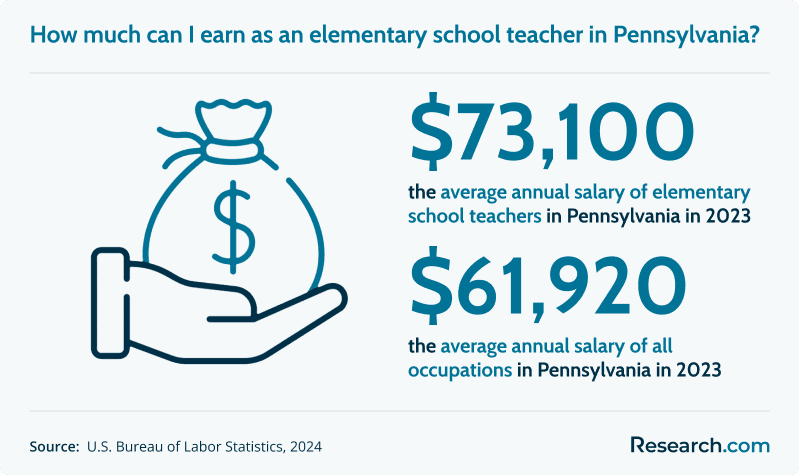
In 2023, there were more than 50,000 elementary school teachers in Pennsylvania, earning around $73,100, which is higher than the average of all occupations in the state at $61,920.
| Licensure stage | Approximate cost or requirement stated | Common issue to avoid |
| Certification application | $200 application fee | Submitting before your program has verified completion |
| Certification testing | $100 to $300 depending on required assessments | Underestimating preparation time |
| Renewal | 180 hours of continuing education every five years | Waiting until the end of the cycle to document hours |
| Background checks | Required for candidates working with children | Missing deadlines before field placements or student teaching |
What is the difference between traditional and alternative teacher certification programs in Pennsylvania?
Pennsylvania offers more than one route into teaching. The best option depends on your education history, work experience, schedule, budget, and how quickly you need to enter the classroom.
Traditional teacher preparation programs
Traditional certification programs are usually built into undergraduate education degrees. They are often the clearest route for first-time college students who know they want to become elementary teachers.
- Best for: Recent high school graduates, transfer students, and college students who want a structured education major.
- Degree format: Usually a bachelor’s degree in Elementary Education or a closely related certification track.
- Training model: Coursework, observation, field experiences, and student teaching are integrated across the program.
- Examples: Institutions such as Penn State University and Temple University offer traditional teacher certification programs.
- Main advantage: A clear, comprehensive route to initial certification.
- Potential drawback: Less efficient for someone who already has a bachelor’s degree in another field.
Alternative teacher certification programs
Alternative pathways are usually designed for people who already have a degree, are changing careers, or need a more flexible route into teaching. They can be faster, but candidates must be careful to confirm that the route leads to the certification they need.
- Best for: Career changers, degree holders, veterans, and working adults.
- Flexibility: Many options allow candidates to complete requirements while working.
- Speed: Some programs may be completed in a shorter time frame, sometimes within a year.
- Examples: Pennsylvania recognizes options such as the Pennsylvania Teacher Intern Certification Program and the Troops to Teachers initiative.
- Main advantage: A more direct path for candidates who do not need another full undergraduate degree.
- Potential drawback: Candidates may need to manage work, coursework, testing, and classroom responsibilities at the same time.
| Pathway | Best fit | Typical strength | Question to ask |
| Traditional bachelor’s program | Students starting college or changing majors early | Integrated coursework and student teaching | Does this program lead directly to Pennsylvania elementary certification? |
| Alternative certification | Adults who already hold a degree | May reduce time spent earning another degree | What teaching certificate will I be eligible for after completion? |
| Online teacher preparation | Students needing schedule flexibility | Can reduce commuting and improve access | How are field placements and student teaching arranged in Pennsylvania? |
| Post-baccalaureate program | Degree holders who need educator preparation | Focuses on certification coursework and fieldwork | How long will it take based on my prior credits? |
How long does it take to become an elementary school teacher in Pennsylvania?
The fastest realistic timeline depends on where you are starting. A first-time college student usually needs approximately four years if the bachelor’s degree includes approved teacher preparation. A person who already has a bachelor’s degree may need less time through an alternative or post-baccalaureate route, but the exact timeline depends on transcript review, required coursework, testing, and field placement availability.
- Bachelor’s degree: 4 years. A traditional undergraduate route typically takes four years and includes education coursework, general education classes, field observations, and student teaching.
- Teacher preparation: 1 year when completed after a degree. Candidates who did not complete educator preparation during their bachelor’s program may need an additional program that often includes student teaching and at least 12 weeks of supervised teaching experience.
- Licensure application: varies. Processing depends on whether your transcripts, institutional recommendation, test scores, fees, and clearances are complete.
- Exam preparation: varies. Many candidates should plan for several months of study, especially if they are balancing work or family responsibilities.
In total, the process can take approximately five to six years from the start of undergraduate education to licensure if teacher preparation is completed after the bachelor’s degree rather than inside it. Candidates interested in broader education leadership or early learning roles can also review education leadership career paths when planning long-term advancement.
Are online education programs accepted for teacher licensure in Pennsylvania?
Yes, online education programs can be accepted for Pennsylvania teacher licensure if they meet the state’s certification requirements. The key issue is not whether the coursework is online; it is whether the program is properly accredited, state-approved, and able to provide required field experiences and student teaching.
What to verify before choosing an online program
- Accreditation: Look for institutional and educator preparation accreditation from recognized bodies. Programs may reference the Council for the Accreditation of Educator Preparation (CAEP), but candidates should also verify state approval.
- Pennsylvania Department of Education approval: If you want Pennsylvania public school certification, ask the program directly whether it is approved for Pennsylvania elementary certification.
- Field placement support: Online coursework still requires classroom-based experiences. Confirm how the school arranges observations and student teaching in or near your Pennsylvania community.
- Testing alignment: The program should prepare you for the PECT or required Praxis assessments tied to your certification area.
- Clearance requirements: Ask when background checks must be completed and whether the program provides step-by-step instructions.
Online licensure pathway checklist
- Complete a bachelor’s degree in Elementary Education or a related approved certification pathway.
- Finish all required field experiences and student teaching placements.
- Pass the required Pennsylvania certification exams.
- Complete child abuse, criminal background, and FBI fingerprinting clearances.
- Submit the certification application through the Pennsylvania Department of Education’s online system.
Online programs can be a strong option for working adults, parents, rural students, and career changers. However, never assume an online education degree automatically leads to licensure. Get written confirmation from the program before enrolling.
How does an online elementary education program in Pennsylvania compare to an on-campus program?
Online and on-campus elementary education programs can both lead to certification when they meet Pennsylvania requirements. The better choice depends on your schedule, learning style, need for campus resources, and access to field placements.
| Factor | Online program | On-campus program |
| Schedule flexibility | Often better for working adults or students with family responsibilities | More structured class meeting times |
| Commuting | May reduce or eliminate travel for coursework | Requires regular campus attendance |
| Field experience | Still required; placement support varies by school | Often tied to established local school partnerships |
| Peer interaction | May rely on discussion boards, video meetings, and virtual collaboration | More face-to-face interaction with classmates and faculty |
| Technology preparation | Often develops comfort with digital teaching tools | May offer more in-person classroom modeling and campus resources |
| Licensure fit | Must be approved for Pennsylvania certification | Must also be approved for Pennsylvania certification |
Choose an online program if:
- You need to keep working while studying.
- You live far from a campus with an approved elementary education program.
- You are comfortable learning through digital platforms.
- The school can clearly explain how Pennsylvania field placements are arranged.
Choose an on-campus program if:
- You learn best through in-person discussion and immediate feedback.
- You want access to campus advising, education labs, tutoring, or student organizations.
- You prefer a set weekly schedule.
- You want local networking with faculty and nearby school districts.
What is the average cost of elementary education programs in Pennsylvania?
The cost of becoming an elementary teacher in Pennsylvania depends on the type of institution, residency status, delivery format, transfer credits, housing, books, testing, and certification fees. Tuition is only one part of the total cost, so students should compare the full price of attendance before choosing a program.
- Tuition: Undergraduate education programs may range from approximately $10,000 to $30,000 per year. Public universities often cost less for in-state students, while private colleges may charge more.
- Room and board: Students living on campus should budget around $12,000 to $15,000 annually, depending on housing and meal plan choices.
- Books and supplies: Textbooks and education materials can cost between $1,000 and $1,500 each year.
- Certification-related expenses: Testing and credentialing costs can range from $100 to $300, and the Pennsylvania teaching license application fee is $200.
| Cost category | Amount stated | How to reduce or control the cost |
| Tuition | Approximately $10,000 to $30,000 per year | Compare in-state public options, transfer credit policies, and scholarship availability |
| Room and board | Around $12,000 to $15,000 annually | Consider commuting, living off campus, or choosing online coursework when appropriate |
| Books and supplies | Between $1,000 and $1,500 each year | Use rentals, used books, library copies, and digital resources when allowed |
| Certification tests and fees | $100 to $300 for tests; $200 application fee | Budget early and use program-provided test preparation to reduce retake risk |
Future teachers should also investigate financial aid, scholarships, grants, employer tuition support, and transfer pathways. If you are still comparing education roles, Research.com’s overview of careers in education can help you understand how teaching compares with other school-based options.
How to choose the best elementary education program in Pennsylvania?
The best elementary education program is not simply the cheapest, closest, or highest-ranked option. It is the program that can get you eligible for Pennsylvania certification, prepare you for real classrooms, fit your schedule, and keep your debt manageable.
Program selection checklist
- Confirm licensure alignment: Ask whether graduates are eligible to apply for Pennsylvania elementary certification. Get the answer in writing when possible.
- Check accreditation and approval: Verify institutional accreditation and educator preparation approval. Accreditation affects quality assurance, transferability, financial aid eligibility, and employer confidence.
- Review field experience quality: Strong programs place students in classrooms early and often, not only at the end of the degree.
- Ask about student teaching placements: Find out whether the program arranges placements or expects you to locate your own.
- Compare total cost, not just tuition: Include fees, housing, transportation, books, testing, background checks, and lost work time.
- Evaluate test support: Ask about PECT preparation, pass-rate support, tutoring, and retake guidance.
- Look at advising quality: Good advising can prevent delayed graduation, missed testing deadlines, and incorrect course sequencing.
- Consider specializations: Special education, ESL, reading, STEM, and early childhood preparation may make you more versatile.
- Review graduate outcomes carefully: Ask where alumni teach, how quickly they find roles, and whether local districts recruit from the program.
Questions to ask admissions advisors before enrolling
- Is this program approved for Pennsylvania elementary teacher certification?
- Which certification exams will I need after completing the program?
- How many field experiences are required before student teaching?
- Who arranges student teaching placements?
- Can I complete placements near where I live?
- What happens if I do not pass a certification exam on the first attempt?
- How many of my prior credits will transfer?
- What is the total estimated cost through certification?
- Does the program support online, evening, or part-time students?
- What advising support is available from enrollment through licensure?
Common mistakes when choosing a teacher preparation program
| Mistake | Why it can hurt you | Better approach |
| Choosing a program without verifying Pennsylvania approval | You may finish a degree that does not lead directly to certification | Confirm licensure eligibility before applying |
| Looking only at tuition | Fees, housing, books, commuting, and testing can change the real cost | Compare total program cost through certification |
| Assuming online means fully remote | Student teaching and fieldwork still require school placements | Ask how in-person requirements are completed |
| Ignoring transfer credit rules | You may repeat courses or extend your timeline | Request a transcript evaluation early |
| Relying only on rankings | A ranked program may not be the best fit for your location, schedule, or budget | Prioritize certification alignment, placement support, cost, and outcomes |
| Assuming salary outcomes are guaranteed | Pay varies by district, education level, contract, and experience | Review district salary schedules and local hiring conditions |
What types of specializations are available within elementary education in Pennsylvania?
Specializations can help elementary teachers serve specific student populations or move into advanced instructional roles. Some specializations are built into undergraduate programs, while others may require graduate study, additional certification, or professional development.
- Special Education: Prepares teachers to support students with disabilities and diverse learning needs. Approximately 14% of students in the U.S. receive special education services, making this a high-impact area of practice.
- English as a Second Language (ESL): Helps teachers support multilingual learners and build inclusive classrooms for students developing English proficiency.
- Reading Specialist: Focuses on literacy development, reading intervention, assessment, and support for struggling readers.
- STEM Education: Emphasizes science, technology, engineering, and mathematics through inquiry, problem-solving, and hands-on learning.
- Early Childhood Education: Focuses on children from birth to age eight and the developmental foundations of early learning.
- Art or Music Education: Supports creative development and can lead to specialized roles teaching visual or performing arts.
According to the National Center for Education Statistics, approximately 1.5 million elementary school teachers were employed in the U.S. in 2020. In Pennsylvania, specialization can be especially useful for teachers who want to work in intervention, inclusion, literacy, multilingual education, or curriculum support.
Future teachers may also compare elementary education with preschool, middle school, or high school teaching. Preschool teachers lead the listed comparison with a 2.1% job growth projection from 2022 to 2032.
What are the classroom management strategies for elementary school teachers in Pennsylvania?
Elementary teachers need strong classroom management because young learners are still developing self-regulation, attention, collaboration, and problem-solving skills. Effective management is not about controlling students through punishment; it is about building predictable routines, respectful relationships, and clear learning structures.
- Teach expectations explicitly: Model what routines look and sound like, then practice them with students. Rules are more effective when children understand the reason behind them.
- Use consistent routines: Morning entry, transitions, group work, bathroom procedures, device use, and dismissal should follow predictable patterns.
- Reinforce positive behavior: Praise specific actions, such as listening respectfully, starting work quickly, helping classmates, or using materials responsibly.
- Plan active lessons: Young children need movement, discussion, manipulatives, visuals, and interaction. Engagement reduces off-task behavior.
- Redirect privately when possible: Quiet, respectful correction protects student dignity and reduces power struggles.
- Build relationships: Students respond better to teachers who know their interests, strengths, home context, and learning needs.
- Use data to spot patterns: Track when disruptions occur. Behavior during transitions, independent work, or certain subjects may signal that routines or supports need adjustment.
- Partner with families and specialists: Classroom management improves when teachers collaborate with caregivers, counselors, special educators, and administrators.
| Classroom challenge | Helpful strategy | Why it works |
| Frequent interruptions | Teach hand signals and discussion norms | Gives students a clear way to participate without disrupting instruction |
| Difficult transitions | Use visual timers, countdowns, and rehearsed routines | Reduces uncertainty and lost instructional time |
| Low engagement | Add movement, partner talk, manipulatives, or choice | Matches elementary students’ developmental needs |
| Repeated behavior issues | Identify triggers and teach replacement behaviors | Addresses the cause rather than only the symptom |
| Uneven participation | Use structured turn-taking and small groups | Creates safer opportunities for quieter students to contribute |
What career paths are available for elementary school teachers in Pennsylvania?
Many elementary teachers begin as classroom teachers, but the credential can also support several instructional and leadership pathways over time. Some roles require additional certification, graduate study, or district-level experience.
- Elementary classroom teacher: Teaches core academic and social-development skills to students in elementary grades.
- Special education teacher: Supports students with disabilities through individualized instruction, accommodations, collaboration, and progress monitoring.
- Reading specialist: Provides literacy intervention, assessment, coaching, and support for students who need targeted reading help.
- Curriculum developer: Designs, evaluates, and improves instructional materials, pacing guides, assessments, and learning resources.
- Instructional coach: Works with teachers to strengthen lesson design, classroom practice, assessment use, and student outcomes.
- Educational administrator: Moves into roles such as assistant principal or principal after additional preparation and leadership experience.
- Educational consultant: Advises schools, districts, or organizations on curriculum, instruction, professional development, or program improvement.
There are many opportunities for elementary school teachers in Pennsylvania because it is one of the most heavily populated states in the country. In 2023, there were around 50,730 elementary school teachers in service.
If you are already working and need a flexible path, options such as going back to college for a teaching degree may help you compare evening, online, or career-change pathways.
What other teaching opportunities are available in Pennsylvania?
Elementary education is only one route into the teaching profession. Pennsylvania also has pathways for preschool, middle school, high school, special education, private school, arts, and subject-specific teaching roles. If you are comparing grade levels, review the preparation and certification rules carefully because each area can require different exams, field experiences, and content knowledge.
For example, candidates interested in adolescent mathematics instruction can compare requirements in this guide to how to become a middle school math teacher in Pennsylvania. Comparing grade levels before enrolling can prevent you from choosing the wrong certification track.
How does an elementary teacher’s compensation compare to that of social workers?
Elementary teaching and social work both serve children, families, and communities, but they operate under different credentialing systems, work settings, funding models, and salary structures. Pennsylvania elementary school teachers earn an average annual salary of approximately $73,100. Social work earnings can vary widely by role, license level, employer, and service setting.
If you are comparing helping professions, look beyond salary alone. Consider daily responsibilities, emotional demands, licensure expectations, advancement opportunities, and whether you prefer classroom instruction, family services, case management, counseling-related work, or community support. For salary context in the social work field, see Research.com’s guide, How much do social workers make?.
What is the job market for elementary school teachers in Pennsylvania?
The Pennsylvania elementary teacher job market is stable but not fast-growing. That means candidates should prepare well, complete certification correctly, and be strategic about where they apply.
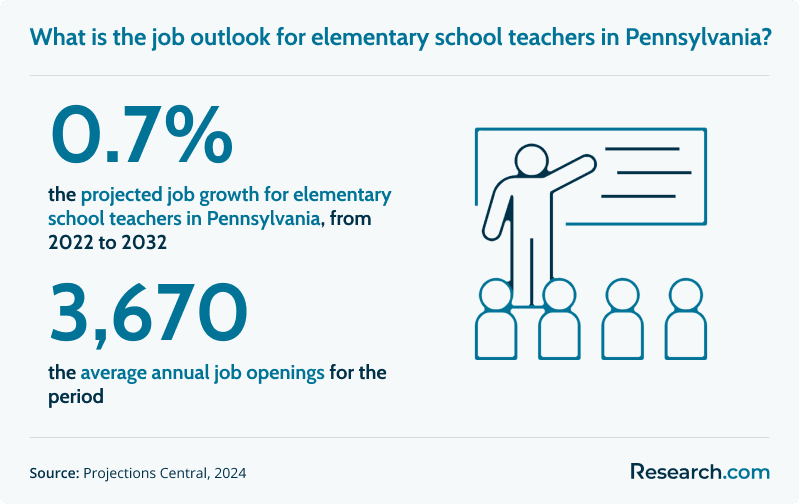
- Projected growth: Nationally, the Bureau of Labor Statistics anticipated a 4% increase in job openings for elementary education teachers from 2019 to 2029. In Pennsylvania, the long-term projection is slower, at 0.7% from 2022 to 2032.
- Annual openings: Even with modest growth, Pennsylvania is projected to have around 3,670 elementary teacher openings each year in the same period.
- Salary: The median annual salary for elementary school teachers in Pennsylvania is approximately $73,100. Pay can vary by district, experience, education level, contract, and local cost of living.
- Regional differences: Philadelphia, Pittsburgh, rural districts, and suburban systems may have different hiring patterns. Urban districts may have more vacancies, while some rural areas may have fewer applicants for certain roles.
- Competitive edge: Candidates with strong student teaching evaluations, special education or ESL preparation, literacy skills, substitute teaching experience, and strong references may be better positioned.
Teachers who want to improve their long-term options may consider graduate study, endorsements, or advanced credentials. Research.com’s guide to online master’s teaching programs can help working educators compare flexible graduate pathways.
How can ongoing professional development boost teaching excellence in Pennsylvania?
Professional development is not just a renewal requirement. It is how teachers stay effective as curriculum standards, student needs, classroom technology, literacy practices, and assessment expectations change.
Pennsylvania teachers must complete 180 hours of continuing education every five years, but the most useful professional learning is targeted. Strong options include literacy intervention training, special education strategies, trauma-informed teaching, classroom technology, multilingual learner support, assessment design, and mentoring for early-career teachers.
Some educators also broaden their subject knowledge through graduate coursework. For example, teachers who want deeper content expertise in history or social studies instruction may compare options such as the most affordable online history degree programs, while still ensuring any degree aligns with their professional goals.
How can speech and language support enhance student learning in Pennsylvania?
Speech and language support can improve reading readiness, comprehension, classroom participation, social interaction, and confidence. Elementary teachers are often the first professionals to notice patterns such as difficulty following directions, limited vocabulary, unclear speech, or challenges expressing ideas.
Teachers do not replace speech-language pathologists, but they play a crucial role in referral, classroom accommodations, communication-rich instruction, and collaboration. Strategies such as visual supports, sentence frames, explicit vocabulary instruction, partner talk, and structured oral language practice can help many students participate more fully.
Educators interested in this related field can review how to become a speech-language pathologist in Pennsylvania to understand the separate preparation and credentialing pathway.
What are the emerging trends shaping elementary education in Pennsylvania?
Several trends are influencing how Pennsylvania elementary teachers plan instruction and support students. These trends do not replace the fundamentals of teaching, but they change what strong preparation looks like.
- Blended learning: Teachers increasingly combine face-to-face instruction with digital tools for practice, feedback, assessment, and enrichment.
- Social-emotional learning: Schools continue to emphasize relationship-building, self-regulation, empathy, and student well-being.
- Culturally responsive pedagogy: Teachers are expected to build classrooms where students’ backgrounds, languages, and identities are respected and reflected.
- Data-informed instruction: Assessment data helps teachers identify learning gaps, adjust grouping, and provide targeted support.
- Inquiry-based learning: Lessons that ask students to investigate, explain, design, and solve problems can build critical thinking.
- Early learning alignment: Elementary teachers benefit from understanding preschool and early childhood development. Candidates may compare this route with how to become a preschool teacher in Pennsylvania.
How do private school teaching requirements differ from public ones in Pennsylvania?
Public school teachers in Pennsylvania must meet state certification requirements. Private schools may set their own hiring standards, which can differ by institution, religious affiliation, mission, grade level, and subject area.
Some private schools prefer or require state-certified teachers, while others may consider candidates based on degree background, classroom experience, subject expertise, professional references, and fit with the school’s educational philosophy. This flexibility can create opportunities, but it can also limit portability if you later want to move into a public school role.
If you are considering this route, review school-specific expectations and compare them with public certification standards. Research.com’s guide to how to become a private school teacher in Pennsylvania explains this pathway in more detail.
What is the most cost-effective path to teacher certification in Pennsylvania?
The most cost-effective path depends on your starting point. A first-time college student may save money by choosing an in-state public university, transferring community college credits, commuting, or selecting an approved online option. A degree holder may save time and money through an alternative or post-baccalaureate certification route instead of earning a second bachelor’s degree.
| Starting point | Potentially cost-effective route | What to watch for |
| No bachelor’s degree | Approved in-state bachelor’s program in Elementary Education | Transfer policies, student teaching placement, and total attendance cost |
| Some college credit | Transfer-friendly education program | Whether education prerequisites and fieldwork still extend the timeline |
| Bachelor’s degree in another field | Alternative or post-baccalaureate certification pathway | Transcript gaps, exam requirements, and supervised teaching obligations |
| Working adult | Approved online or hybrid program | Field placement logistics and whether the program meets Pennsylvania licensure rules |
For a deeper cost-focused comparison, review Research.com’s guide to the cheapest way to get a teaching credential in Pennsylvania.
What are the differences in teaching qualifications for elementary and high school educators in Pennsylvania?
Elementary and high school teachers need different preparation because they teach different developmental stages and content structures. Elementary teachers usually need broad instructional knowledge across multiple subjects. High school teachers generally need deeper expertise in a specific subject area.
| Category | Elementary teacher | High school teacher |
| Instructional focus | Multiple subjects, foundational skills, child development, classroom routines | Specialized subject instruction and adolescent learning needs |
| Content depth | Broad knowledge across literacy, math, science, and social studies | Advanced preparation in a specific discipline |
| Classroom structure | Often teaches the same group for much of the day | Usually teaches multiple class sections in one subject |
| Certification planning | Elementary certification pathway | Subject-specific secondary certification pathway |
For example, candidates interested in secondary mathematics should review high school math teacher qualifications in Pennsylvania before choosing coursework or certification exams.
What are the current teaching certificate requirements in Pennsylvania?
Current Pennsylvania teaching certificate requirements generally include an eligible bachelor’s degree, completion of an approved educator preparation program or equivalent route, required assessments, student teaching or supervised experience, background clearances, and application through the state certification system.
Because certification rules can change, candidates should check requirements before applying, before transferring programs, and before moving from another state. Important details may include assessment codes, acceptable preparation routes, required documents, and renewal obligations.
For a broader overview of certificate categories and requirements, review teaching certificate requirements in Pennsylvania.
How do state policies impact professional growth and retention for elementary teachers in Pennsylvania?
State policies influence how teachers are certified, evaluated, supported, renewed, and retained. Policies can affect continuing education, mentoring, induction programs, teacher shortages, funding priorities, instructional standards, and career advancement options.
For elementary teachers, the most practical takeaway is to stay informed. Monitor Pennsylvania Department of Education updates, read district communications, maintain documentation of continuing education hours, and participate in professional learning networks. Policy awareness helps teachers avoid compliance problems and identify new opportunities for leadership or specialization.
If you are still mapping your full timeline, Research.com’s guide on how long it takes to become a teacher in Pennsylvania can help you compare routes.
How Pennsylvania teachers can foster inclusive learning environments
Inclusive elementary classrooms help students feel safe, respected, and capable of learning. Inclusion is not a single strategy; it is a set of daily decisions about curriculum, language, grouping, accessibility, behavior support, family communication, and student voice.
- Differentiate instruction: Use multiple ways to teach and assess learning, including visuals, manipulatives, small groups, oral responses, written work, and project-based options.
- Use culturally responsive materials: Select books, examples, names, histories, and classroom displays that reflect students’ communities and identities.
- Collaborate with specialists: Work with special educators, counselors, ESL teachers, speech-language pathologists, and interventionists to align classroom support with student goals.
- Teach respect directly: Use social-emotional learning, class meetings, conflict-resolution routines, and anti-bullying expectations to build a safer classroom culture.
- Apply Universal Design for Learning: Offer flexible access to content, different ways to participate, and multiple ways for students to show understanding.
- Partner with families: Communicate consistently and respectfully with caregivers. Family insight can help teachers understand student strengths, needs, and context.
- Support well-being: Short reflection routines, breathing exercises, predictable transitions, and emotional vocabulary can help young learners manage stress and build self-awareness.
Candidates researching how to become a teacher in Pennsylvania should treat inclusion as a core professional skill, not an optional add-on.
Leveraging technology in elementary classrooms in Pennsylvania
Technology is now part of elementary instruction, but it works best when it supports clear learning goals. Effective teachers use digital tools to personalize practice, increase engagement, assess progress, and expand access—not to replace strong instruction.
Useful ways to apply technology
- Interactive instruction: Digital whiteboards, simulations, and educational apps can make abstract ideas more visible.
- Personalized practice: Adaptive tools can give students targeted practice based on current skill level.
- Collaboration: Platforms such as Google Workspace for Education can support shared writing, peer feedback, and group projects.
- Assessment: Digital quizzes and learning platforms can help teachers identify patterns quickly.
- Accessibility: Text-to-speech, captions, translation tools, and enlarged text can support diverse learners.
Future teachers should look for programs that include instructional technology, digital citizenship, and ethical use of student data. Online degree options, including a bachelor of education online program, may provide additional practice with digital learning environments.
How can arts integration enhance classroom creativity in Pennsylvania?
Arts integration helps elementary students learn through movement, music, visual design, drama, storytelling, and creative expression. When used well, it can strengthen engagement, memory, collaboration, vocabulary, confidence, and problem-solving.
For example, students might act out a story to improve comprehension, use rhythm to remember math facts, draw scientific observations, or create visual timelines in social studies. Arts integration can be especially powerful for students who struggle to show understanding through traditional worksheets alone.
Teachers who want to specialize further in creative instruction can explore how to become an art teacher in Pennsylvania.
What are the benefits of pursuing an online PhD in Pennsylvania?
An online PhD is not required to become or remain an elementary school teacher. It is usually a better fit for experienced educators who want to move into research, higher education, district leadership, curriculum policy, or advanced administrative roles.
For Pennsylvania teachers interested in leadership, a program such as a PhD in educational leadership online may offer a flexible way to continue working while studying advanced topics in school improvement, policy, leadership, research, and organizational change.
- Career advancement: Doctoral study can support movement into leadership roles such as principal, superintendent, district administrator, researcher, or higher education faculty, depending on credentials and experience.
- Policy and systems impact: Advanced study can prepare educators to influence curriculum, assessment, school improvement, and equity initiatives beyond one classroom.
- Professional network: Online doctoral programs often connect working educators from different districts, states, and leadership contexts.
- Flexibility: Online formats may allow teachers to continue working while completing coursework and research.
Before enrolling, compare accreditation, dissertation support, faculty expertise, total cost, completion expectations, and whether the degree aligns with your intended role. A doctoral degree can be valuable, but it is a major investment and should be tied to a clear professional goal.
Here’s what graduates have to say about becoming an elementary school teacher in Pennsylvania
- My first year teaching in Pennsylvania showed me how important mentorship is. Having experienced teachers nearby helped me turn theory into daily routines, stronger lesson plans, and better communication with families. The most rewarding part has been watching students become more confident learners. Andrea
- I chose elementary teaching because I wanted to work with children from many different backgrounds. Pennsylvania classrooms can be wonderfully diverse, and that pushed me to become more flexible, more culturally aware, and more intentional about helping every student feel included. Melissa
- What surprised me most was how connected teaching is to the local community. Field trips, guest speakers, family events, and partnerships with local organizations made lessons feel real for my students. Those moments reminded me that teaching reaches far beyond the classroom walls. Castor
Related Articles for Nearby States
- 2027 How to Become an Elementary School Teacher in New Jersey: Requirements & Certification
- 2027 How to Become an Elementary School Teacher in Delaware: Requirements & Certification
- 2027 How to Become an Elementary School Teacher in Maryland: Requirements & Certification
- 2027 How to Become an Elementary School Teacher in New York: Requirements & Certification
- 2027 How to Become an Elementary School Teacher in West Virginia: Requirements & Certification
- 2027 How to Become an Elementary School Teacher in Ohio: Requirements & Certification
- 2027 How to Become an Elementary School Teacher in Virginia: Requirements & Certification
- 2027 How to Become an Elementary School Teacher in Connecticut: Requirements & Certification
- 2027 How to Become an Elementary School Teacher in Rhode Island
- 2027 How to Become an Elementary School Teacher in Massachusetts: Requirements & Certification
Key Insights
- The standard route is clear: Complete an approved bachelor’s-level teacher preparation program, student teaching, required exams, clearances, and the TIMS application.
- Program approval matters more than format: Online programs can work, but only if they meet Pennsylvania certification requirements and provide valid field placements.
- Budget beyond tuition: Include housing, books, testing, clearances, and the $200 application fee when comparing programs.
- The job market is steady but competitive: Pennsylvania projects 0.7% growth through 2032, but approximately 3,670 openings annually still create opportunities for prepared candidates.
- Specialization can improve flexibility: Skills in special education, ESL, reading, STEM, or early childhood education can expand your usefulness to schools.
- Licensure is not the finish line: Teachers must complete 180 hours of continuing education every five years and should use professional development strategically.
- The best path depends on your starting point: First-time students may benefit from traditional bachelor’s programs, while degree holders may find alternative or post-baccalaureate certification more efficient.
References:
- education.pa.gov (n.d.). School district tuition rates. education.pa.gov
- drexel.edu (n.d.). How to become an elementary school teacher. drexel.edu
- bls.gov (17 Apr 2024). Kindergarten and elementary school teachers. bls.gov
- projectionscentral.org. (2024). Long-term occupational projections (2022-2032). projectionscentral.org
Other Things You Should Know About Becoming an Elementary School Teacher in Pennsylvania
Pennsylvania requires the Praxis exam series for elementary certification. Candidates must pass the Pennsylvania Educator Certification Tests, including the Praxis Core or accepted basic skills requirement, subject assessment, and the Elementary Education: Content Knowledge test, before the Pennsylvania Department of Education issues certification.
To become certified as an elementary school teacher in Pennsylvania, candidates must hold a bachelor's degree, complete a state-approved teacher preparation program, and pass the PECT exams. Additional requirements include meeting Pennsylvania's Act 168 and proficiency in the basic skills assessment.