2027 How to Become an Art Teacher in Pennsylvania: Requirements & Certification

Co-Founder and Chief Data Scientist
Becoming an art teacher in Pennsylvania means preparing for two connected responsibilities: meeting state educator requirements and learning how to teach creative skills in a real classroom. The path usually involves a bachelor’s degree, a teacher preparation program, student teaching, state testing, background checks, and ongoing professional development after certification. This guide is for high school students exploring education careers, college students choosing an art education program, career changers considering teaching, and current educators who want to understand Pennsylvania’s art certification pathway. You will learn what credentials are typically required, how certification works, what teaching experience matters, what salary and job market factors to consider, and how to decide whether this career path fits your goals.
Quick answer: How do you become an art teacher in Pennsylvania?
To become an art teacher in Pennsylvania, you generally need to complete a bachelor’s degree in art education or a related field, finish a state-approved teacher preparation program, complete supervised student teaching, pass required educator assessments, clear state and federal background checks, and apply for a Pennsylvania Instructional I Certificate through the Pennsylvania Department of Education. Public school teaching roles usually require state certification, while private schools may set their own hiring standards.
- As of 2023, the average salary for art teachers in Pennsylvania is approximately $60,000 per year, though pay differs by district, experience, and location.
- The employment outlook for art teachers is projected to grow at about 4% over the next decade, supported by continued interest in arts education and creative learning.
- Pennsylvania’s cost of living index is around 98, slightly below the national average of 100, which can make teacher compensation go further than in some other Northeastern states.
- Steps to become an art teacher in Pennsylvania
- Education requirements for Pennsylvania art teachers
- Certification and licensing process
- Student teaching, internships, and classroom experience
- Pennsylvania art standards and curriculum expectations
- Job market, salary expectations, and benefits
- Continuing education and professional development
- Classroom management and teaching methods for art educators
- First steps before choosing this career path
- Digital technology in Pennsylvania art education
- Using interdisciplinary learning in art classrooms
- Career growth and specialization options
- Support resources for new Pennsylvania art teachers
- Art and math collaboration ideas
- Supporting students with special needs in art class
- Networking and mentorship opportunities
- Connecting art instruction with history education
- Using early childhood education principles in art teaching
- Public vs. private school art teaching requirements
- Future prospects for art teachers in Pennsylvania
- Common challenges and practical solutions
- Combining music and visual art instruction
How can you become an art teacher in Pennsylvania?
The most direct route is to complete an approved art education program that leads to Pennsylvania teacher certification. Career changers may also look for post-baccalaureate or graduate-level certification programs, but they still need to satisfy state requirements for educator preparation, testing, student teaching, and background clearances.
| Step | What to do | Why it matters |
| 1. Confirm the grade level you want to teach | Decide whether you want to teach elementary, middle school, high school, or PK-12 art. | Art certification pathways often prepare educators for broad school settings, but your field experience should match your career goals. |
| 2. Choose an accredited program | Look for a regionally accredited institution with a state-approved teacher preparation pathway. | Public school certification depends on completing an approved preparation route. |
| 3. Build a strong art portfolio | Develop work across drawing, painting, sculpture, digital media, and other studio areas. | Your portfolio can support admissions, job applications, and classroom credibility. |
| 4. Complete student teaching | Teach under a certified mentor in a school setting. | Student teaching helps you learn lesson planning, classroom management, assessment, and school routines. |
| 5. Pass required assessments | Prepare for Pennsylvania educator exams and any required art content assessment. | Testing verifies that candidates understand both pedagogy and subject matter. |
| 6. Apply for certification | Submit your application, clearances, and fees through the Pennsylvania Department of Education process. | Certification is typically required for public school art teaching jobs. |
What are the educational requirements for becoming an art teacher in Pennsylvania?
Most aspiring Pennsylvania art teachers begin with a bachelor’s degree in art education or a closely related discipline that includes teacher preparation. A strong program should combine studio practice, art history, child development, instructional methods, classroom assessment, and supervised fieldwork.
- Bachelor’s degree: A bachelor’s degree is the standard starting point. Art education is usually the most aligned major because it blends creative training with teaching methods.
- Art and pedagogy coursework: Candidates should expect study in studio art, art history, educational psychology, curriculum design, assessment, and inclusive instruction. This mix matters because art teachers need to teach technique, interpretation, critique, creativity, and safe material use.
- Teacher preparation program: Pennsylvania public school certification generally requires completion of a state-approved educator preparation program with clinical experience.
- Accreditation: Before enrolling, confirm that the college or university is regionally accredited and that the teacher preparation pathway is recognized for Pennsylvania certification.
- Subject matter competency: Candidates must show readiness to teach art content and pedagogy, often through required certification exams such as Praxis® assessments or Pennsylvania educator assessments, depending on the current state requirement.
Students who want broader creative training may later add graduate study or related credentials. For example, affordable online MFA options can support advanced work in creative practice, writing, critique, or storytelling, although an MFA alone does not replace Pennsylvania teacher certification for public school roles.
Pennsylvania includes well-known institutions such as Temple University and Kutztown University, both of which are cited for art education preparation. When comparing programs, do not rely only on reputation. Ask whether the program leads to Pennsylvania certification, how student teaching placements are arranged, what exam pass support is available, and whether graduates commonly find positions in the grade levels you want to teach.
| Education option | Best for | Key caution |
| Bachelor’s in Art Education | First-time college students who want the most direct route into teaching art. | Confirm that the program is approved for Pennsylvania educator certification. |
| Art degree plus teacher preparation | Students who already have strong studio training but need pedagogy and certification coursework. | Additional coursework and field placements may extend the timeline. |
| Post-baccalaureate certification | Career changers or art graduates who already hold a bachelor’s degree. | Requirements vary by institution, so review transcripts early. |
| Graduate art education program | Candidates seeking advanced preparation, career mobility, or specialization. | Make sure the program’s outcome matches your goal: certification, professional growth, or advanced study. |
What is the certification and licensing process for an art teacher in Pennsylvania?
Certification is the formal process that allows qualified candidates to teach in Pennsylvania public schools. Requirements can change, so candidates should always verify current rules through the Pennsylvania Department of Education before applying or enrolling in a program.
- Earn the appropriate degree: Candidates typically need a bachelor’s degree in art education or a related field from an accredited institution.
- Complete approved educator preparation: The preparation program should include art education coursework, pedagogy, and student teaching. The original certification pathway described here includes at least 12 credits in art history and studio art.
- Pass required testing: Candidates must complete Pennsylvania’s required educator assessments. The original guidance identifies the Pennsylvania Educator Certification Tests (PECT) as part of the testing process for general and content knowledge in art education.
- Complete background checks: Candidates must submit fingerprinting and background checks through the Pennsylvania State Police, the FBI, and the Department of Human Services.
- Budget for clearance and application costs: Candidates should expect approximately $22 for the Pennsylvania State Police check, $27.50 for the FBI check, around $10 for the Department of Human Services check, and typically around $100 for the certification application fee.
- Apply for the Instructional I Certificate: Once degree, testing, fieldwork, and clearance requirements are complete, candidates apply through the Pennsylvania Department of Education’s online portal.
- Maintain certification: After earning the Instructional I Certificate, teachers must complete 24 hours of professional development every five years to keep certification active.
- Advance to Instructional II: After three years of teaching under the Instructional I Certificate, candidates may apply for the Instructional II Certificate after meeting additional professional development and experience requirements.
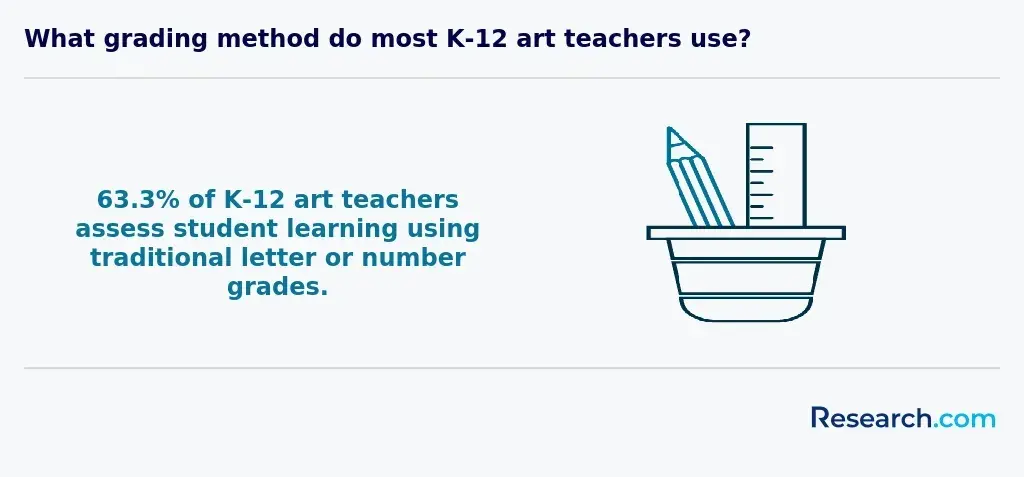
Assessment practices vary by district and teacher, but grading is still common in K-12 art classrooms. In the data shown below, 63.3% of K-12 art teachers assess students using traditional letter or number grades.
How important is teaching experience and what are the internship opportunities for art teachers in Pennsylvania?
Teaching experience is one of the most important parts of preparation because art classrooms require planning, safety awareness, supply management, behavior support, differentiated instruction, and meaningful critique. A candidate can understand color theory or sculpture technique and still struggle if they have never managed a classroom full of students using paint, clay, scissors, digital tools, or shared studio materials.
- Student teaching: Pennsylvania certification candidates typically complete a supervised student teaching experience. The original requirement described here includes a minimum of 12 weeks in a K-12 setting.
- Mentor supervision: Student teachers work with certified educators who help them plan lessons, assess work, communicate expectations, and reflect on classroom decisions.
- Field placement variety: If possible, seek experience across different grade levels and school communities. Teaching kindergarten art is very different from teaching advanced high school studio art.
- Additional experience: Volunteering at museums, community art centers, summer camps, after-school programs, and youth workshops can help candidates build confidence before certification.
- Alternative education exposure: Some candidates explore community-based or nonprofit roles before entering public school teaching. These experiences can also connect to broader education career pathways.
- Professional organizations: Groups such as the National Art Education Association (NAEA) and state-level associations can provide professional learning, networking, and classroom resources.
| Experience type | What you learn | How to use it in job applications |
| Student teaching | Lesson delivery, classroom routines, assessment, school policies, and parent communication. | Discuss specific units you taught, how you adapted instruction, and what evidence showed student growth. |
| Museum or community art program | Informal teaching, public engagement, project facilitation, and age-group flexibility. | Highlight your ability to teach outside traditional classroom formats. |
| Summer camp or workshop leadership | Short-format lesson planning, behavior support, and hands-on project management. | Show that you can manage materials, time, and student energy in active settings. |
| After-school art club | Student motivation, portfolio development, and project-based learning. | Use examples of student exhibitions, collaborative projects, or creative outcomes. |
The broader art economy also affects how students understand creative careers. The global art market moved from $64.4 billion in 2019 to $50.3 billion in 2020, then rose to $65.9 billion in 2021 and $67.8 billion in 2022. In 2023, it decreased to $65 billion, a 4% decline from the prior year while remaining above pre-pandemic levels. This pattern shows why art teachers often need to help students connect creativity with resilience, changing markets, and multiple career possibilities.
What are the standards and curriculum requirements for teaching art in Pennsylvania?
Pennsylvania arts education is guided by state academic expectations that include dance, music, theater, and visual arts. For visual art teachers, the practical task is to translate standards into age-appropriate lessons that build technique, creative expression, critique skills, cultural understanding, and safe studio habits.
- Certification alignment: Pennsylvania art teachers are expected to hold appropriate certification for public school roles, which requires a degree pathway, testing, and student teaching.
- State standards: Pennsylvania’s academic guidelines identify what students should learn across grade levels. Local school districts then develop curriculum that aligns with those standards.
- Core curriculum areas: Visual arts instruction often includes media exploration, art history, design principles, personal expression, critique, and cultural context.
- Responsible material use: Art teachers must teach students how to handle tools, supplies, digital equipment, and studio spaces safely and respectfully.
- Assessment: Teachers should evaluate process as well as product. Strong rubrics can measure creativity, technique, effort, reflection, craftsmanship, and alignment with project goals.
- Local flexibility: Districts may differ in course offerings, available materials, scheduling, and staffing. A strong teacher learns to meet standards even when resources are limited.
| Curriculum focus | Classroom example | Decision point for teachers |
| Art production | Students create drawings, paintings, sculptures, digital images, or mixed-media work. | Choose media that fit student age, safety needs, time, budget, and learning goals. |
| Art history and culture | Students examine artists, movements, communities, and visual traditions. | Avoid treating art history as a list of names; connect it to meaning, identity, and context. |
| Critique and reflection | Students discuss choices, revise work, and explain artistic intent. | Use structured critique so feedback stays specific, respectful, and useful. |
| Design and visual literacy | Students analyze composition, symbolism, color, balance, and audience. | Connect visual literacy to media, technology, advertising, and everyday communication. |
Teachers who want to move into department leadership or curriculum design may eventually consider advanced study in administration, supervision, or organizational learning. Programs such as online PhD programs in leadership may be relevant for educators focused on broader leadership roles rather than initial teacher certification.
What is the job market like and what are the salary expectations for art teachers in Pennsylvania?
The Pennsylvania art teacher job market is generally tied to school district budgets, retirements, enrollment, arts programming priorities, and regional hiring needs. Public school openings can be competitive in some areas, while other districts may have a stronger need for certified candidates who can teach across multiple grade levels or integrate digital media.
- Average salary: The average salary for Pennsylvania art teachers is approximately $60,000 per year.
- Location differences: Art teachers in urban areas such as Philadelphia or Pittsburgh may earn upwards of $65,000, while teachers in rural districts may see salaries closer to $55,000.
- Benefits: Compensation often includes more than base pay. Health insurance, retirement plans, paid time off, and professional development support can substantially affect overall value.
- Hiring settings: Art teachers may work in public schools, private schools, charter schools, community programs, museums, nonprofit organizations, or after-school enrichment programs.
| Factor | How it can affect pay or opportunity | Question to ask before accepting a job |
| District location | Urban, suburban, and rural salaries may differ, as can cost of living and commute time. | How does the salary compare with housing, transportation, and local expenses? |
| Years of experience | District salary schedules often reward experience and education level. | Where would my previous experience place me on the salary scale? |
| Degree level | Advanced education may support higher placement or future advancement, depending on district policy. | Does the district compensate for graduate credits or a master’s degree? |
| Program strength | Schools with established arts programs may offer better materials, facilities, and support. | What is the annual art budget, and how are supplies purchased? |
| Workload | Some art teachers serve multiple buildings, grade levels, or very large student loads. | How many students, preps, classrooms, and buildings are assigned to this position? |
Arts and design careers outside K-12 teaching show wide salary differences. Special Effects Artists and Animators have a median salary of $106,500, Fashion Designers earn $99,060, Industrial Designers earn $79,290, Interior Designers earn $76,250, Set and Exhibit Designers earn $62,510, and Graphic Designers earn $58,910. These figures show why some students and teachers explore digital art, animation, and design alongside traditional studio practice. Interest in online graphic design degree programs is one example of how creative training can connect to multiple career directions.
Is becoming an art teacher in Pennsylvania worth it?
Becoming an art teacher in Pennsylvania can be worth it for people who want a stable education career, enjoy working with young people, and are willing to manage the realities of school-based teaching. The work can be deeply meaningful, but it is not only about making art. It also involves documentation, grading, classroom management, meetings, safety procedures, accommodations, and adapting instruction for students with different skill levels.
| This path may fit you if... | You may want another route if... |
| You enjoy teaching process, not just finished artwork. | You want to focus exclusively on your own studio practice. |
| You can manage active, materials-heavy classrooms. | You dislike routines, cleanup systems, and supply logistics. |
| You are comfortable working with children or teenagers every day. | You prefer adult learners, freelance work, or independent creative production. |
| You value school benefits and a public-service career. | You need a faster entry into the workforce without certification requirements. |
| You are willing to keep learning new media, technology, and teaching methods. | You do not want ongoing professional development or state compliance obligations. |
What professional development and continuing education opportunities are available for art teachers in Pennsylvania?
Professional development helps art teachers stay current with instructional methods, digital tools, inclusive teaching practices, assessment strategies, and state expectations. It also supports certification maintenance and career advancement.
- Continuing education expectations: To maintain Level II certification, art teachers are required to complete 180 hours of professional development through options such as college courses, workshops, conferences, or approved learning activities.
- State and professional associations: The Pennsylvania Art Education Association (PAEA) offers workshops, conferences, and professional connections for art educators.
- PAFA offerings: The Pennsylvania Academy of the Fine Arts provides continuing education options for different experience levels, including courses that may be available in person or online.
- In-service training: Schools and museums may host workshops on topics such as standards alignment, art and science integration, assessment, technology, and classroom practice.
- Annual conferences: Conferences can help teachers exchange lesson ideas, learn new techniques, and build relationships with educators outside their district.
- Local universities and colleges: Continuing education through higher education institutions can support skill development, salary advancement, or future leadership goals.
Choose professional development strategically. A workshop on watercolor technique may strengthen your studio teaching, while a course on trauma-informed instruction, special education, or digital design may solve urgent classroom challenges. The best professional learning connects directly to what your students need and what your district expects.
What are effective classroom management strategies and teaching methods for art teachers in Pennsylvania?
Art classroom management is different from management in many academic classrooms because students often use shared tools, messy materials, water, clay, scissors, paint, cameras, tablets, or other supplies. A successful art teacher plans both the lesson and the movement of people and materials.
- Use clear routines: Teach students how to enter, collect supplies, store work, clean tools, and transition between activities. Do not assume they know how a studio classroom functions.
- Label and organize supplies: Labeled bins, drying racks, supply stations, and cleanup roles reduce confusion and wasted time.
- Design engaging lessons: Students are more likely to stay focused when projects include choice, challenge, cultural relevance, and visible progress.
- Teach expectations before materials come out: Explain safety rules, noise levels, cleanup procedures, and consequences before students begin working.
- Use positive reinforcement: Recognize students who use tools responsibly, help peers, revise thoughtfully, or stay engaged through mistakes.
- Differentiate instruction: Offer multiple entry points through visual examples, demonstrations, written steps, peer support, adaptive tools, and flexible project choices.
- Build critique skills: Teach students how to give feedback that is specific, respectful, and connected to the project criteria.
- Assign classroom jobs: Rotating roles such as supply manager, table captain, sink monitor, or cleanup checker can build responsibility.
- Plan for early finishers: Have reflection prompts, sketchbook extensions, revision options, or artist research tasks ready.
- Document student growth: Portfolios, process photos, written reflections, and rubrics can make learning visible beyond the final product.
Art teachers who manage classroom libraries, visual resources, artist books, or digital archives may also benefit from information-management skills. Educators interested in that area can explore online MLIS programs, especially if they are considering future work in school libraries, museums, or educational resource management.
What are the first steps to take when considering a career as an art teacher in Pennsylvania?
Start by learning the broader teacher certification process in the state, then narrow your research to art education. A general guide on how to become a teacher in Pennsylvania can help you understand certification language, educator preparation, background checks, testing, and professional development before you evaluate specific art programs.
- Review Pennsylvania Department of Education certification guidance for art.
- List colleges or post-baccalaureate programs that lead to Pennsylvania certification.
- Ask each program how student teaching placements are assigned.
- Compare total cost, not just tuition.
- Begin building a portfolio that shows range, originality, and technical growth.
- Observe or volunteer in schools, youth art programs, museums, or camps.
- Talk with working art teachers about workload, budgets, and classroom realities.
How is digital technology reshaping art education in Pennsylvania?
Digital tools are changing what art teachers teach and how students create. Pennsylvania art classrooms may now include digital drawing, photography, animation, design software, virtual galleries, online critique, and multimedia projects. Teachers who can connect traditional studio skills with digital production are better positioned to prepare students for contemporary creative work.
The shift is not only technical. Digital art also raises questions about authorship, image editing, copyright, media literacy, accessibility, and responsible technology use. Educators developing broader teaching strategies may find useful parallels in resources such as how to become an english teacher in Pennsylvania, particularly when teaching interpretation, communication, and critique.
How can interdisciplinary education enhance art teaching practices in Pennsylvania?
Interdisciplinary teaching helps students see art as part of science, history, literacy, math, technology, and human development. For younger learners, early childhood principles can help art teachers design lessons around sensory exploration, play, language development, fine motor skills, and social interaction. Teachers who want deeper preparation in developmental practice may compare options such as an online early childhood education degree.
| Discipline connection | Art classroom example | Student benefit |
| Science | Study natural forms, color mixing, light, shadow, or environmental design. | Students connect observation with experimentation. |
| Math | Use symmetry, proportion, tessellation, scale, or geometric abstraction. | Students see math as visual and practical. |
| English language arts | Create visual narratives, artist statements, or illustrated responses to literature. | Students strengthen interpretation and communication. |
| History | Analyze artwork from specific periods, cultures, or social movements. | Students understand how images reflect time, place, and power. |
| Technology | Use digital illustration, animation, photography, or online portfolio tools. | Students build modern creative and media skills. |
What are the career advancement opportunities and specializations for art teachers in Pennsylvania?
Art teachers can remain classroom educators for their entire careers, but they can also move into specialized, leadership, or adjacent roles. Advancement usually depends on experience, additional credentials, graduate education, district needs, and demonstrated leadership.
- Art therapy-informed practice: Some educators pursue additional training to better understand how creative expression supports emotional growth. Formal art therapy roles usually require specialized graduate preparation beyond standard teaching certification.
- Digital art and design: Teachers with digital media expertise can lead courses in animation, design, photography, or multimedia production.
- Curriculum development: Experienced teachers may write district curriculum, align standards, develop assessment tools, or mentor other educators.
- Department leadership: Art teachers may become department chairs, fine arts coordinators, or curriculum leaders.
- Administration: Additional credentials such as Principal Certification or an Art Education Supervisor endorsement can support transitions into school leadership.
- Policy and advocacy: Teachers may join committees, professional associations, or advocacy groups that influence arts education decisions.
Before pursuing a specialization, ask whether it improves your classroom practice, increases your earning potential, supports leadership goals, or opens a role you actually want. Additional credentials can be valuable, but only when they align with a clear career plan.
What resources and support are available for new art teachers in Pennsylvania?
New art teachers should not try to build every lesson, rubric, display system, and supply procedure alone. Pennsylvania educators can draw on state agencies, professional associations, district mentors, colleges, museums, and online communities.
- Pennsylvania Art Education Association: PAEA provides professional development, networking, conferences, and connections with experienced art educators.
- Pennsylvania Department of Education: The state education website offers certification information, standards, policy guidance, and related educator resources.
- District mentorship programs: Many districts pair new teachers with experienced educators during induction or early-career support.
- PAEA conferences and workshops: These events can help new teachers find practical strategies for classroom management, assessment, technology, and curriculum planning.
- Online lesson platforms: Teachers Pay Teachers, Artsonia, and similar resources can provide ideas, but teachers should adapt materials to state standards and student needs.
- Online educator communities: Social media groups and forums can offer quick advice, but verify recommendations before using them for policy, assessment, or safety decisions.
- National Art Education Association: NAEA offers webinars, publications, advocacy resources, and national professional connections.
- Local colleges and universities: Continuing education programs can help teachers strengthen studio skills, pedagogy, technology integration, or leadership preparation.
How can art and math educators collaborate to enhance interdisciplinary learning in Pennsylvania?
Art and math teachers can work together on projects that make abstract ideas visible. Examples include geometric murals, tessellation studies, perspective drawing, scale models, pattern design, symmetry projects, data visualization, and architecture-inspired units. These collaborations can help students understand that creativity and analytical reasoning are not separate skills.
Teachers interested in cross-disciplinary planning may also review how to become a middle school math teacher in Pennsylvania to better understand how math educators approach standards, sequencing, and classroom practice.
How can art teachers effectively support students with special needs in Pennsylvania?
Inclusive art teaching begins with flexible design. Students may need adapted tools, alternative materials, modified timelines, visual directions, sensory supports, peer assistance, or different ways to demonstrate learning. The goal is not to lower expectations automatically, but to remove barriers so students can participate meaningfully.
- Use visual schedules, step-by-step examples, and demonstrations.
- Offer adaptive grips, larger tools, textured materials, or digital alternatives when appropriate.
- Provide choices in media, scale, or final format.
- Coordinate with special education teachers, occupational therapists, aides, and families.
- Review IEP or 504 accommodations before planning major projects.
- Assess growth, effort, problem-solving, and communication as well as finished artwork.
Art teachers who want deeper expertise in inclusive instruction can explore pathways related to special education teacher certification in Pennsylvania.
What are the networking and mentorship opportunities for art teachers in Pennsylvania?
Mentorship can shorten the learning curve for new art teachers. A strong mentor can help with pacing, supply ordering, classroom routines, grading, parent communication, exhibitions, and professional expectations that are rarely obvious before the first year of teaching.
- District induction: Many school districts provide structured support for new teachers, including meetings with mentors or instructional coaches.
- PAEA events: State conferences and workshops can connect teachers across districts and grade levels.
- NAEA membership: National membership can broaden access to professional learning and art education research.
- University networks: Teacher preparation programs often maintain alumni networks and placement relationships.
- Peer observation: Observing other art teachers can reveal practical solutions for studio setup, transitions, and critique routines.
Teachers who work with young learners may also benefit from studying general elementary teaching structures. A guide on how to become an elementary school teacher in Pennsylvania can help art educators understand foundational classroom practices beyond the art room.
Can integrating history education enrich art teaching practices in Pennsylvania?
History gives artwork context. Instead of treating art as isolated objects, teachers can help students investigate how images respond to migration, war, technology, religion, labor, identity, protest, patronage, and cultural exchange. Historical framing also helps students compare perspectives and understand why visual symbols carry different meanings across time and place.
Useful classroom approaches include curated mini-exhibitions, artist research projects, visual timelines, primary-source analysis, and studio projects inspired by historical techniques or themes. Educators who want to deepen this connection can review how to become a history teacher in Pennsylvania for insight into history pedagogy and standards-based planning.
How can early childhood education principles enhance art teaching practices in Pennsylvania?
For younger students, art instruction should support exploration, motor development, language, social interaction, and confidence. Early childhood principles remind art teachers that process often matters more than a polished final product. Young children learn by touching, sorting, naming, building, tearing, mixing, noticing, and trying again.
- Use short demonstrations and repeat key routines.
- Choose safe, age-appropriate materials.
- Build lessons around sensory exploration and play.
- Connect artmaking with storytelling, movement, and conversation.
- Allow variation rather than requiring every project to look identical.
Teachers working with early grades can also review how to become a kindergarten teacher in Pennsylvania to understand developmental expectations and classroom structures for young learners.
How do requirements differ between public and private art teaching roles in Pennsylvania?
Public and private schools may evaluate art teacher candidates differently. Public school teaching roles generally require Pennsylvania certification, while private schools can set institution-specific hiring standards. However, private schools may still prefer certified teachers, especially for credibility, parent confidence, accreditation expectations, or alignment with college-preparatory goals.
| Category | Public school art teacher | Private school art teacher |
| Certification | Usually requires Pennsylvania teacher certification. | May not always require state certification, depending on the school. |
| Hiring priorities | Certification, student teaching, standards alignment, classroom readiness. | Artistic expertise, teaching ability, portfolio, school mission fit, and sometimes certification. |
| Curriculum | Aligned with state standards and district requirements. | May have more flexibility, though expectations vary by institution. |
| Compensation | Often tied to district salary schedules and negotiated benefits. | Varies by school and may differ from public district pay structures. |
| Best next step | Confirm certification pathway with the Pennsylvania Department of Education. | Review each school’s job postings and speak with current faculty when possible. |
For candidates exploring nonpublic school pathways, how to become a private school teacher in Pennsylvania can help clarify how expectations may differ from public certification routes.
What is the job outlook and future prospects for art teachers in Pennsylvania?
The future for Pennsylvania art teachers is shaped by school funding, retirements, district priorities, teacher supply, and the role of creativity in modern education. The original outlook cited here projects about 4% growth over the next decade. Candidates who can teach traditional studio art while also integrating digital media, STEAM projects, inclusive practices, and interdisciplinary learning may be more competitive.
Some educators also explore adjacent education careers if they want to stay in schools but shift responsibilities. For example, learning how to become a librarian in Pennsylvania may be useful for teachers interested in media literacy, research support, school libraries, or instructional resources.
What challenges do art teachers face and how can they overcome them?
Art teaching can be rewarding, but candidates should understand the pressure points before entering the field. Many challenges are manageable with planning, advocacy, and professional support.
| Common challenge | Why it happens | Better strategy |
| Limited supply budgets | Art materials can be expensive and are often shared across many students. | Plan reusable centers, seek donations within policy, use low-cost media strategically, and document supply needs clearly. |
| Large class sizes | Art may serve many grade levels and students on rotating schedules. | Use routines, table roles, visual directions, and predictable cleanup systems. |
| Misunderstanding of art’s academic value | Some stakeholders may view art as enrichment rather than standards-based learning. | Share student learning evidence, connect projects to standards, and display process as well as final work. |
| Assessment difficulties | Creativity can be hard to grade fairly without clear criteria. | Use rubrics that include process, craftsmanship, reflection, technique, and growth. |
| Digital tool gaps | Technology access and teacher training vary by school. | Start with accessible tools, build small digital units, and pursue targeted professional development. |
| Student differences | Students enter with varied confidence, ability, language backgrounds, and support needs. | Differentiate materials, instructions, pacing, and ways students can show understanding. |
Teachers who want additional insight into child development, classroom sustainability, and education career options may also review the career path in early childhood education.
Can integrating music education enhance art teaching practices in Pennsylvania?
Music and visual art can work together naturally through rhythm, mood, pattern, movement, cultural study, performance design, album art, animation, stage sets, and multimedia installations. Collaboration with music teachers can help students understand how different art forms communicate emotion, identity, and structure.
Art educators interested in this type of collaboration can explore how to become a music teacher in Pennsylvania to better understand music educator preparation and possible interdisciplinary planning opportunities.
Common mistakes to avoid when preparing to become an art teacher in Pennsylvania
- Choosing a program before checking certification alignment: A strong art program is not automatically a teacher certification program. Confirm the pathway before enrolling.
- Looking only at tuition: Include fees, supplies, transportation to field placements, testing costs, background checks, and lost income if student teaching is full time.
- Assuming private and public school requirements are the same: Public school roles usually require state certification; private schools may use different criteria.
- Underestimating classroom management: Art teaching requires systems for movement, materials, cleanup, and safety.
- Ignoring digital media: Students increasingly need visual literacy and digital production skills alongside traditional studio techniques.
- Waiting too long to build a portfolio: A portfolio can support admissions, student teaching, and job interviews.
- Assuming salary outcomes are guaranteed: Pay depends on district, experience, education level, location, and contract structure.
- Skipping professional networks: Mentors and associations can help with job leads, lesson planning, advocacy, and early-career survival.
Questions to ask before choosing an art education program in Pennsylvania
- Is the program regionally accredited?
- Does the program lead to Pennsylvania art teacher certification?
- What grade levels will I be prepared to teach?
- How are student teaching placements selected?
- What support is available for certification exams?
- What are the total costs, including supplies, fees, testing, and clearances?
- Can transfer credits apply if I already completed art coursework?
- How much classroom field experience happens before student teaching?
- Do graduates find jobs in Pennsylvania schools?
- Does the curriculum include digital art, inclusive teaching, classroom management, and standards-based assessment?
Key Insights
- The standard public school route in Pennsylvania includes a bachelor’s degree, state-approved teacher preparation, student teaching, required testing, background checks, and application for the Instructional I Certificate.
- As of 2023, Pennsylvania has approximately 1,200 art teachers employed in K-12 public schools, showing that art education remains an established teaching field in the state.
- The median or average annual wage cited for Pennsylvania art teachers is around $60,000, with examples ranging from about $55,000 in some rural districts to upwards of $65,000 in urban areas such as Philadelphia or Pittsburgh.
- Certification costs are not limited to tuition. Candidates should also plan for background checks of approximately $22, $27.50, and around $10, plus an application fee that is typically around $100.
- Student teaching matters because art classrooms require more than content knowledge; teachers must manage supplies, safety, pacing, critique, behavior, and differentiated instruction.
- Advanced education is common in the field. In 2023, 85% of art teachers in Pennsylvania were reported to hold a master’s degree or higher.
- Traditional grading remains widely used in art education, with 63.3% of K-12 art teachers using letter or number grades.
- Long-term career growth is possible through digital art, curriculum leadership, department roles, supervision, administration, advocacy, and interdisciplinary teaching.
- The strongest candidates combine studio skill, teaching ability, inclusive practice, digital literacy, and evidence that they can help students think creatively and critically.
Related Articles for Nearby States
- 2027 How to Become an Art Teacher in New Jersey: Requirements & Certification
- 2027 How to Become an Art Teacher in Delaware: Requirements & Certification
- 2027 How to Become an Art Teacher in Maryland: Requirements & Certification
- 2027 How to Become an Art Teacher in New York: Requirements & Certification
- 2027 How to Become an Art Teacher in West Virginia: Requirements & Certification
- 2027 How to Become an Art Teacher in Ohio: Requirements & Certification
- 2027 How to Become an Art Teacher in Virginia: Requirements & Certification
- 2027 How to Become an Art Teacher in Connecticut: Requirements & Certification
- 2027 How to Become an Art Teacher in Rhode Island: Requirements & Certification
- 2027 How to Become an Art Teacher in Massachusetts: Requirements & Certification
References:
- Art Teacher Education. (2014, September 19). Pennsylvania art teacher certification and job requirements. Art Teacher Education.
- Easton Area High School. (2024). SECTION THREE. Easton Area High School.
- Pennsylvania Academy of the Fine Arts. (2019, July 3). Continuing education. Pennsylvania Academy of the Fine Arts.
- Pennsylvania Art Education Association. (2024). The Pennsylvania Art Education Association. Pennsylvania Art Education Association.
- Pennsylvania Music Educators Association. (2016, February 17). Pennsylvania arts education. Pennsylvania Music Educators Association.
- Pennsylvania Department of Education. (2023, January 17). CSPG 31 - Art. Pennsylvania Department of Education.
- Rosemont College. (2024). Art education certification (PK-12). Rosemont College.
- Kutztown University. (2024). Art education (Post-Baccalaureate certification). Kutztown University.
- Temple University. (2024). Teaching art education certificate (Graduate). Temple University.
Other Things You Should Know About Becoming an Art Teacher in Pennsylvania
No. Pennsylvania public art teacher certification is issued by the Pennsylvania Department of Education, not by private schools. To qualify, you need a state-approved preparation program, the required art/content coursework, student teaching, and passing scores on the required Praxis tests.
To become an art teacher in Pennsylvania, you need to complete a bachelor's degree with a state-approved teacher preparation program. This includes coursework in art education, classroom management, and instructional strategies, typically accompanied by a student teaching experience.
The Pennsylvania Department of Education oversees art teacher certification. They set the requirements and processes for becoming a certified art teacher, including coursework, exams, and application submissions. Aspiring teachers should refer to their resources for the latest guidelines and updates.