2027 What is Early Childhood Education? Salary & Career Paths

Co-Founder and Chief Data Scientist
Choosing an early childhood education (ECE) degree is a practical career decision: it affects where you can work, what age groups you can teach, whether you qualify for licensure, and how much flexibility you have to move into leadership, special education, child development, or administration later. For 2027, the field is being shaped by stronger expectations for qualified educators, wider use of classroom technology, more attention to children’s mental health, and continued demand for professionals who understand how young children learn.
This guide explains what early childhood education programs cover, how long they take, which careers they can lead to, what salaries may look like, and how to compare programs before enrolling. It is written for future preschool teachers, childcare professionals, teacher aides, career changers, and current educators who want to strengthen their credentials or move into leadership.
Quick answer: Is an early childhood education degree worth considering?
An early childhood education degree can be a strong fit if you want to work with children from birth through the early elementary years and you are prepared for a career centered on child development, family communication, classroom routines, and hands-on learning. It can support entry into roles such as preschool teacher, childcare provider, teacher’s aide, kindergarten teacher, special education teacher, or early childhood program director, depending on the degree level, state requirements, and additional credentials you complete.
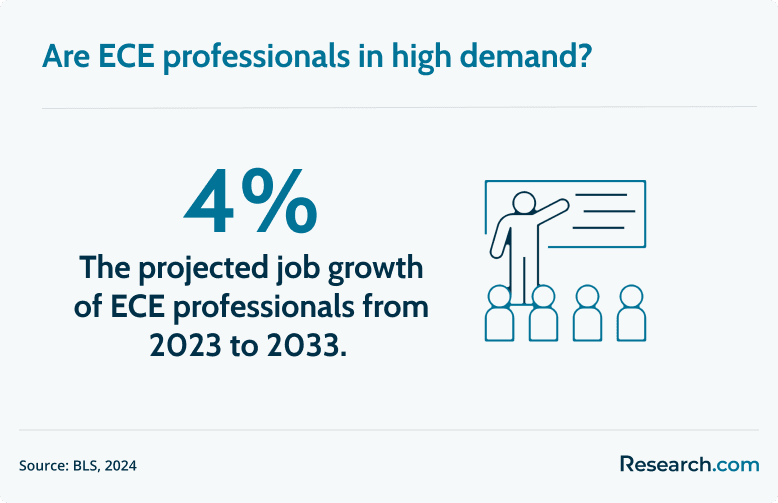
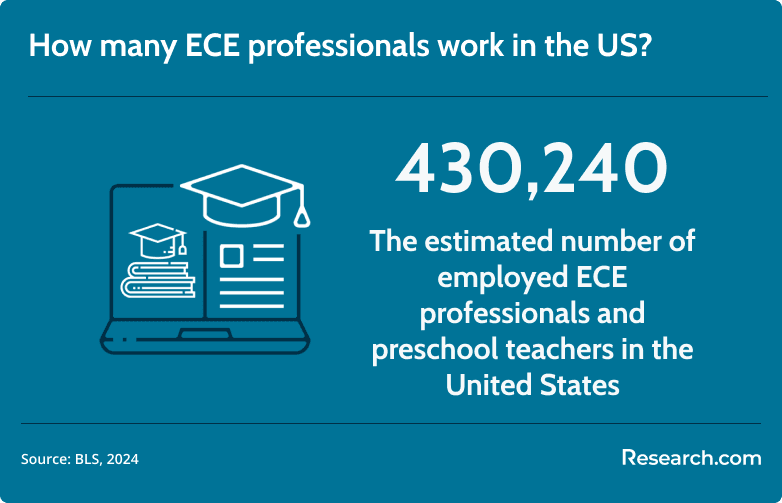
The field has a broad employment base. The national estimate for employment among preschool teachers and ECE professionals is 430,240 (BLS, 2024), and demand for preschool teachers and ECE professionals is projected to grow by 4% from 2023 to 2033. However, salary outcomes vary significantly by role, location, employer type, credentials, and experience, so students should compare program cost against realistic career goals before enrolling.
What are the benefits of getting a degree in early childhood education?
- It prepares you for a wide range of child-focused settings. Graduates may work in childcare centers, preschools, early learning programs, elementary schools, family support organizations, and administrative roles.
- It aligns with a large workforce need. The national estimate for employment among preschool teachers and ECE professionals is 430,240 (BLS, 2024).
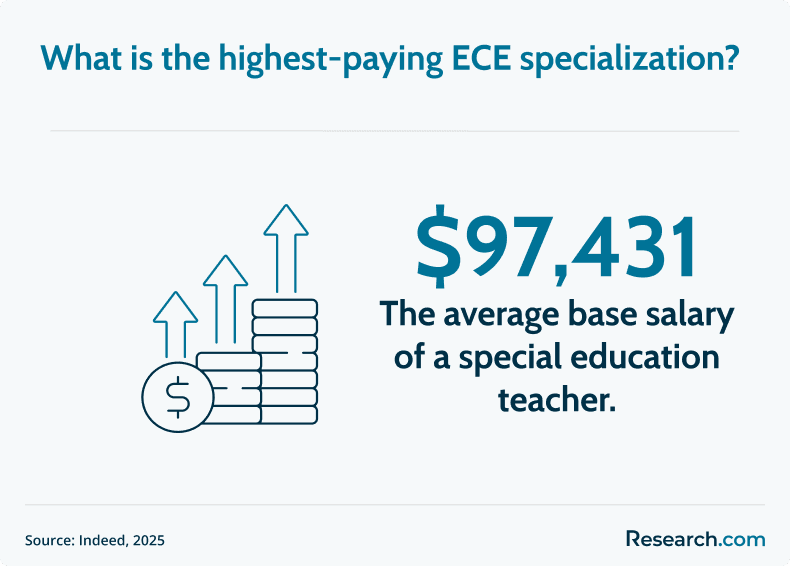
- It can support advancement when paired with experience and credentials. Annual salaries for early childhood education professionals can go as high as $97,431 (Indeed, 2025), particularly in roles requiring specialized training, advanced credentials, or leadership responsibilities.
- How long does an early childhood education program take?
- What skills do early childhood education students build?
- Which courses are common in ECE programs?
- What specializations can ECE students choose?
- What careers can you pursue with an early childhood education background?
- How much do early childhood education professionals earn?
- How is early childhood education different from other education degrees?
- Can an accelerated EdD help experienced ECE professionals move faster?
- What is the ROI of an early childhood education degree?
- Which credentials matter in early childhood education?
- What ECE trends should students and educators watch?
- How should you choose an early childhood education program?
- How do accreditation and professional development affect ECE career growth?
- Can interdisciplinary studies strengthen an ECE career?
- How can educators move into ECE leadership roles?
- What networking and mentorship strategies help ECE professionals advance?
- How can interdisciplinary expertise improve career resilience? Mentorship strategies Leadership transition Program selection
How long does it take to complete an early childhood education program for 2027?
The time required depends on the credential, enrollment pace, transfer credits, and whether the program includes fieldwork or licensure preparation. A full-time early childhood education degree may be completed in 2 years or 4 semesters. Students who continue into a master’s program often need about 3 to 4 years, depending on whether they study part time or full time. Completing both a bachelor’s and master’s pathway can take 4 to 6 years.
Duration of Early Childhood Education Programs
| Degree Level | Typical Duration | Best Fit |
| Bachelor's Degree | 2 years (4 semesters) | Students seeking preparation for classroom, childcare, or early learning roles |
| Master's Degree | 3-4 years (part-time or full-time) | Educators aiming for advanced practice, specialization, or leadership |
| Bachelor’s + Master’s Combined | 4-6 years | Students planning a longer pathway toward advanced credentials or higher-level roles |
Source: Ivy Tech Community College, n.d.
Before choosing a program based only on length, confirm whether it includes practicum hours, student teaching, or state-approved teacher preparation. A shorter program may be convenient, but it may not meet the requirements for every teaching role or every state.
What essential skills can students learn in early childhood education programs?
Early childhood education programs are designed to connect child development theory with real classroom practice. Strong programs teach students how to support children’s learning, observe developmental progress, build safe routines, communicate with families, and adapt instruction for children with different needs.
| Skill Area | What It Means in Practice | Why It Matters |
| Child development knowledge | Understanding how young children grow cognitively, socially, emotionally, physically, and linguistically | Helps educators choose activities that match a child’s developmental stage |
| Classroom management | Creating routines, transitions, expectations, and positive behavior supports | Young children need structure, safety, and consistency to learn well |
| Curriculum planning | Designing lessons that support early literacy, numeracy, play, creativity, and social skills | Thoughtful planning prevents activities from becoming disconnected or developmentally inappropriate |
| Special education awareness | Recognizing diverse learning needs and using inclusive strategies | Educators often work with children who need individualized support or early intervention |
| Communication | Explaining progress, concerns, routines, and expectations to families and colleagues | Family partnership is central in early childhood learning environments |
| Observation and assessment | Documenting behavior, milestones, participation, and skill development | Observation helps educators adjust instruction and identify concerns early |
- Child development knowledge: Students learn how early cognitive, emotional, social, language, and physical growth affect teaching decisions. This helps educators choose lessons and routines that are appropriate for each age group.
- Classroom management: ECE students practice ways to build calm, predictable, and engaging learning spaces. These skills are useful for future preschool, elementary, and secondary educators because clear expectations and supportive routines are essential at every level.
- Curriculum planning: Students learn how to create activities tied to developmental milestones and early learning standards. Good planning makes lessons more purposeful and helps children build foundational skills through play, conversation, movement, and exploration.
- Special education strategies: Educators need to notice when children may require additional support and know how to adapt activities for different abilities. Students who want deeper preparation can explore options such as the most affordable online master’s programs in special education.
- Creativity and adaptability: Young children do not all respond to the same activity in the same way. ECE programs help future educators use stories, music, sensory play, art, movement, and flexible grouping to keep children engaged.
- Speech and language development: Students study ways to encourage listening, vocabulary, conversation, and early communication. Those interested in helping children with speech and language delays may later consider online speech pathology programs.
- Observation and assessment skills: ECE students learn to watch, document, and interpret children’s progress without relying only on formal testing. These skills help educators respond earlier when a child needs additional support.
What courses are typically in an early childhood education program?
Most early childhood education programs combine child development, teaching methods, family engagement, assessment, and supervised field experience. The exact course titles vary by school, but the strongest programs usually include both theory and direct practice with young children.
- Child Development: This course examines how young children grow socially, emotionally, cognitively, and physically. It is also relevant beyond teacher preparation; for example, students exploring career options with an MFT degree may study child development to better understand family systems and early behavior.
- Classroom Management and Guidance of Young Children: Students learn how to create positive routines, prevent behavior problems, guide conflict resolution, and support self-regulation.
- Creative and Affective Experience for Young Children: This class focuses on art, music, imaginative play, movement, and emotional expression as tools for early learning.
- Math Content and Processes: Students study how to introduce basic math ideas through counting, sorting, patterns, measurement, shapes, and hands-on activities.
- Play Development and Assessment: This course explains how play supports learning and how educators can observe play to understand developmental progress.
- Young Children with Special Needs: Students learn inclusive practices for supporting children with disabilities, developmental delays, or other learning differences.
When comparing programs, look beyond course names. Ask whether courses include lesson planning, observation assignments, family communication practice, and supervised work in real early childhood settings.
What types of specializations are available in early childhood education programs?
Early childhood education covers many types of work, so specialization can help you align your studies with the children, settings, and responsibilities you prefer. Since demand for ECE professionals and preschool teachers is projected to grow by 4% from 2023 to 2033, selecting a focused pathway can help you prepare for roles that match your strengths rather than taking a general program without a clear plan.
| Specialization | Focus | Good Fit For |
| Special Education | Inclusive teaching, developmental delays, individualized support, and intervention strategies | Students who want to work with children with disabilities or diverse learning needs |
| Infant and Toddler Care | Development from birth to age three, caregiving routines, early attachment, and health-related practices | Students interested in childcare centers, early intervention, or infant-toddler programs |
| Early Literacy Development | Language, phonological awareness, storytelling, reading readiness, and early writing | Students who want to strengthen children’s communication and pre-reading skills |
| STEM Education in Early Childhood | Hands-on science, technology, engineering, and math activities for young learners | Educators who enjoy inquiry-based lessons, exploration, building, and problem solving |
| Curriculum and Instruction Design | Lesson development, standards alignment, learning materials, and instructional planning | Students who may later become curriculum specialists or program leaders |
| Child Psychology and Development | Children’s emotional, cognitive, behavioral, and social growth | Students considering advanced study such as a master’s in child development or psychology |
| Administration and Leadership | Program management, staff supervision, compliance, family partnerships, and operations | Experienced educators who want director, coordinator, or policy-related roles |
- Special Education: This specialization prepares educators to adapt instruction and support children with disabilities or developmental delays.
- Infant and Toddler Care: Students focus on the earliest stage of development, including caregiving, safety, early learning, and responsive relationships.
- Early Literacy Development: This path emphasizes communication, vocabulary, reading readiness, storytelling, and early writing skills.
- STEM Education in Early Childhood: Students learn how to introduce science, technology, engineering, and math through play, discovery, building, and experimentation.
- Curriculum and Instruction Design: This specialization is useful for educators who want to design learning materials, align lessons with standards, or support other teachers.
- Child Psychology and Development: Students take a deeper look at how children think, feel, behave, and form relationships. This can support later graduate study in child development or psychology.
- Administration and Leadership in Early Childhood Education: This option helps educators prepare for director, coordinator, policy, or school leadership responsibilities.
What career paths are available for graduates of early childhood education programs?
An early childhood education background can lead to classroom, childcare, support, counseling, consulting, and leadership roles. Across the country, an estimated 430,240 preschool teachers and ECE professionals are employed in work that supports young children (BLS, 2024). Students comparing careers working with children should pay close attention to the degree level, licensure rules, and experience required for each role.
| Career Path | Typical Responsibilities | Important Consideration |
| Teacher’s Aide | Assists lead teachers with lessons, supervision, materials, and classroom routines | Often a practical entry point for gaining classroom experience |
| Childcare Provider | Supports children’s safety, daily routines, play, learning, and social development | Requirements may vary by employer and state rules |
| Kindergarten Teacher | Teaches early academic, social, and classroom-readiness skills | Public school roles generally require state teaching certification |
| Preschool Teacher | Plans activities for children typically aged three to five, including early literacy, numeracy, play, and social development | Credential requirements vary by setting |
| Special Education Teacher | Works with children who need individualized strategies, supports, or accommodations | Usually requires specialized preparation or certification |
| School Counselor | Supports students’ emotional, academic, and social needs | Typically requires graduate-level preparation and state-specific credentials |
| Education Consultant | Advises schools, families, or organizations on early learning, curriculum, and program quality | Experience and specialized expertise are important for credibility |
| Principal or Education Director | Oversees programs, staff, operations, compliance, and instructional quality | Leadership experience and advanced education may be expected |
| Child Psychologist | Assesses and supports children’s cognitive, behavioral, and emotional development | Requires further psychology training; ECE can provide a useful foundation for child psychology careers |
- Teacher’s Aide: Helps teachers prepare activities, supervise children, organize materials, and maintain classroom routines.
- Childcare Provider: Works in daycare, family childcare, or private childcare settings to provide safe, nurturing, and developmentally appropriate care.
- Kindergarten Teacher: Introduces structured early academics while helping children build confidence, social skills, and classroom habits.
- Preschool Teacher: Plans play-based and structured learning for children typically aged three to five.
- Special Education Teacher: Supports children with disabilities or developmental challenges through individualized strategies.
- School Counselor: Helps children with emotional, academic, and social concerns, often in school-based settings.
- Education Consultant: Provides guidance on curriculum, early learning standards, program improvement, or family education.
- Principal or Education Director: Manages staff, budgets, compliance, program quality, and school or center operations.
- Child Psychologist: Uses specialized training to evaluate and support children’s emotional, cognitive, and behavioral development. Early childhood education can be a helpful starting point because it builds knowledge of learning behavior and early development.
How much do early childhood education professionals typically earn?
Early childhood education salaries differ by job title, state, employer type, years of experience, credentials, and whether the role is classroom-based or administrative. Entry-level childcare and assistant roles may pay less than licensed teaching, special education, or director positions. According to salary data cited in the original article, most professionals in the field earn between $45,000 and $53,000 per year.
Additional credentials can influence opportunities, especially in special education, administration, curriculum development, or public school teaching. Experienced educators who want a more advanced role may consider pathways such as an education specialist degree if it aligns with their state requirements and career goals.
| Salary Factor | How It Affects Earnings | What to Check Before Enrolling |
| Location | Pay can vary because of state funding, cost of living, and demand | Compare salaries in the state or district where you plan to work |
| Role | Assistant, childcare, teaching, special education, and director roles may pay differently | Match your program to the specific role you want |
| Credential level | Certificates, bachelor’s degrees, master’s degrees, and licensure can affect eligibility | Confirm which credentials employers in your area require |
| Employer type | Public schools, private centers, nonprofits, and childcare providers may use different pay structures | Review job postings before choosing a specialization |
| Experience | Leadership and specialized responsibilities may increase earning potential | Ask programs how they support practicum, student teaching, and career placement |
Location is one of the most important variables in the United States because funding models, demand, and living costs differ across states. The top paying states shown in the chart below include the District of Columbia at $61,980, Colorado at $50,410, and California at $50,150:
What are the key differences between early childhood education and other education degrees?
The choice between early childhood education and another teaching degree should start with the age group you want to teach. Students comparing early childhood education and elementary education degree programs should also look at curriculum focus, teaching methods, field experience, and licensure requirements.
| Category | Early Childhood Education | Other Education Degrees |
| Age range | Usually focuses on children from birth to around age 8, including infancy through third grade | Often focuses on elementary, middle school, high school, or postsecondary learners |
| Main emphasis | Child development, early learning, social-emotional growth, family engagement, and play-based instruction | Subject-area instruction, pedagogy, assessment, and classroom management for older learners |
| Teaching style | Hands-on, play-based, sensory, inquiry-driven, and highly individualized | Often more structured and subject-specific, with greater emphasis on formal academic content |
| Coursework | Early literacy, early math, child psychology, observation, assessment, and family partnerships | Subject methods, curriculum design, assessment, and teaching strategies for older grades |
| Certification | May require ECE certification, Child Development Associate, Certified Childcare Professional, National Administrator Credential, or state teaching certification depending on the role | May require state-specific teaching licenses such as the Initial or Professional Teaching Certificate (New York), Florida Professional Educator Certificate (Florida), or Professional Educator License (Illinois) |
1. Age Group Focus
- ECE Degrees: These programs typically prepare students to work with children from birth to around age 8, including infancy, preschool, kindergarten, and the early elementary grades.
- Other Education Degrees: These usually prepare teachers for older students, such as elementary grades K-5/6, middle school, high school, or higher education.
2. Developmental Emphasis
- ECE: The curriculum gives strong attention to early brain development, social-emotional growth, language, play, and foundational learning.
- Other Degrees: Programs for older learners usually place more weight on academic content, subject-specific methods, and formal assessment.
3. Teaching Methods
- ECE: Educators often use play, movement, stories, sensory activities, conversation, and individualized support.
- Other Degrees: Teaching may be more structured around academic standards, subject pacing, testing, and classroom discipline.
4. Curriculum Content
- ECE: Courses commonly include early literacy, early numeracy, child psychology, observation, family engagement, and inclusive practice.
- Other Degrees: Coursework is usually organized by grade level or subject area, such as mathematics, science, English, social studies, or the arts.
5. Licensing & Certification
- ECE: Entry requirements may include ECE certification, Child Development Associate, Certified Childcare Professional, National Administrator Credential, or state teaching certification.
- Other Degrees: Public school teaching usually requires a state-specific license, with examples including the Initial or Professional Teaching Certificate (New York), Florida Professional Educator Certificate (Florida), and Professional Educator License (Illinois).
Can an accelerated EdD program fast-track your career in early childhood education?
An accelerated EdD may be useful for experienced early childhood educators who already have classroom or program leadership experience and want to move into higher-level roles more quickly. These programs are usually designed for professionals interested in leadership, applied research, policy, organizational change, curriculum improvement, or program administration.
Before choosing this route, be realistic about your goals. An EdD is not usually the first step for someone entering early childhood education. It makes more sense for educators who want to lead programs, influence systems, teach at advanced levels, or solve organizational problems in education settings. Compare course structure, dissertation or capstone expectations, faculty expertise, scheduling format, and whether the program’s outcomes match your leadership plans. If speed and flexibility are priorities, review accelerated online EdD programs carefully before committing.
What is the return on investment for an early childhood education degree?
The ROI of an early childhood education degree depends on the total cost of attendance, financial aid, transfer credits, time out of the workforce, required certifications, and the type of role you plan to pursue. Because salaries can vary widely, students should avoid assuming that any ECE degree will automatically lead to the highest-paying jobs.
A practical ROI review should compare three things: what the program costs, what jobs it qualifies you for, and whether those jobs meet your income and lifestyle goals. Lower-cost online options may reduce debt if they are accredited, meet state requirements, and include the field experience you need. Students comparing affordability can start with Research.com’s guide to the most affordable online education degrees.
| ROI Question | Why It Matters | What to Look For |
| Will this program meet my state’s requirements? | A degree that does not meet certification or licensure rules may limit job options | State-approved teacher preparation, practicum, and licensing alignment |
| How much will I actually pay? | Published tuition may not include fees, books, background checks, exams, or fieldwork costs | Total cost, grants, scholarships, employer support, and transfer credits |
| What roles do graduates enter? | Career outcomes should match your expectations | Job placement support, alumni roles, employer partnerships, and practicum sites |
| Can I work while enrolled? | Flexible scheduling may reduce income disruption | Online, hybrid, evening, part-time, and competency-based options |
| Does the degree support advancement? | Some roles require additional credentials or graduate study | Pathways to licensure, special education, administration, or advanced degrees |
What are the credentials for a career in early childhood education?
Credentials matter because they can determine which roles you qualify for, whether you can work in public schools, and how employers evaluate your preparation. Requirements differ by state and employer, so students should verify the exact rules for their target role before enrolling in a certificate or degree program.
- Child Development Associate (CDA): This widely recognized credential involves coursework, practical experience, and an exam that demonstrates core early childhood education competencies.
- Certified Childcare Professional (CCP): Offered by the National Early Childhood Program Accreditation (NECPA), this credential is intended for childcare professionals with hands-on experience who want formal professional recognition.
- National Administrator Credential (NAC): This credential is designed for early childhood directors and administrators and focuses on leadership, management, and program operations.
- First Aid and CPR Certification: Many childcare and early learning settings expect staff to be prepared to respond to emergencies and maintain safe environments.
- Special Needs or Inclusive Education Certification: Credentials such as the Certified Autism Specialist (CAS) can help educators develop targeted skills for working with children with diverse learning needs.
- State Teaching Certification: Public school teaching roles typically require state certification, which may involve completing an approved degree program, teacher preparation, and state exams.
- ECE Certificate/Bachelor’s Degree Diploma: Colleges and universities may offer certificates, diplomas, or degrees that cover child development, curriculum planning, and classroom management.
- Master’s Degree Diploma: Educators pursuing leadership, faculty head, education director, or advanced instructional roles may continue into graduate study, including specialized areas such as online master’s programs in math education or developmental psychology.
What are crucial early childhood education trends that you should know about?
Early childhood education is changing as programs respond to technology, child mental health concerns, inclusion, play-based learning, and sustainability. Students should understand these trends because they influence coursework, classroom expectations, and the skills employers may value.
- Technology Integration in the Classroom: Age-appropriate apps, smartboards, and educational games can support engagement and reinforce concepts when used thoughtfully. The University of Wisconsin-Madison created the Technology Integration as a Spectrum (TIS) to support and refine the nuanced use of digital tools in classrooms (Georgie State News Hub, 2025). Future educators should learn when technology improves learning and when hands-on interaction is more appropriate.
- Play-Based Learning: Research indicates that play-based learning supports collaboration and social skills. In strong ECE classrooms, play is not treated as a break from learning; it is a major way children practice language, problem solving, self-regulation, and peer interaction.
- Child’s Mental Health: At least 55% of adults in the United States display great concern over the younger generation’s mental health (Statista, 2025). Early childhood programs are responding with social-emotional learning, predictable routines, mindfulness activities, and strategies that help children identify and manage feelings.
- Inclusive Education Practices: More programs are emphasizing classrooms that serve children with different abilities, cultures, languages, and learning needs. Universal Design for Learning (UDL), individualized supports, and culturally responsive practices can help educators create more accessible learning environments.
- Environmental Sustainability: Some early childhood programs are using outdoor learning, recycling, nature-based exploration, and eco-friendly routines to help children build early awareness of the environment.
How to choose the best early childhood education program?
The best early childhood education program is not simply the cheapest, fastest, or highest ranked. It is the program that fits your career goal, meets state or employer requirements, provides supervised experience with children, and does not create more debt than your likely career path can support. Just as students researching flight nurse career requirements must understand the required training and credentials, future educators need to verify exactly what their intended roles demand.
| Selection Factor | What to Ask | Why It Matters |
| Accreditation | Is the program accredited by a recognized body such as CAEP or NAEYC? | Accreditation can affect quality assurance, transferability, employer trust, and access to aid |
| State alignment | Does the program meet requirements in the state where I want to work? | Licensure and certification rules are state-specific |
| Field experience | Does the program include student teaching, practicum, internships, or classroom observation? | Hands-on experience is essential in early childhood settings |
| Curriculum | Does it cover child development, assessment, family engagement, inclusion, and classroom management? | A narrow curriculum may leave gaps in practical preparation |
| Specializations | Can I focus on special education, literacy, infant-toddler care, STEM, or leadership? | Specialization can help align the degree with specific career goals |
| Cost | What is the full cost after aid, fees, and required materials? | ROI depends on total cost, not tuition alone |
| Format | Is the program online, hybrid, or campus-based, and how are field hours completed? | Online flexibility is valuable, but fieldwork still needs to be arranged |
| Career support | Does the school provide advising, placement support, and employer connections? | Career services can help students move from coursework into employment |
- Accreditation and Reputation: Check whether the program is accredited by recognized organizations such as the Council for the Accreditation of Educator Preparation (CAEP) or the National Association for the Education of Young Children (NAEYC).
- Curriculum: Review whether the program covers child development, teaching methods, family engagement, classroom management, special needs, and assessment.
- Specializations: Consider whether a focus area supports your career plan. Some students may pursue special education because it can lead to roles paying up to $97,431 annually (Indeed, 2025).
- Delivery Format: Decide whether online, hybrid, or in-person learning fits your schedule. Online programs may help working adults, while campus programs may provide more direct in-person support.
- Practical Experience and Internships: Prioritize programs with student teaching, practicum, internships, or supervised classroom experience.
- Tuition and Financial Aid: Compare the full cost of attendance and review scholarships, grants, employer tuition support, and state incentives where available.
- Career Support and Job Placement Rates: Ask how the program helps students find practicum placements, prepare resumes, meet certification requirements, and connect with employers.
Common mistakes to avoid when choosing an ECE program
| Mistake | Why It Can Hurt You | Better Approach |
| Choosing only by tuition | A low-cost program may not include required fieldwork or licensure preparation | Compare total cost, accreditation, outcomes, and state alignment |
| Ignoring accreditation | Unrecognized programs may create problems with transfer credits, aid, or employer acceptance | Verify accreditation before applying |
| Assuming online means fully remote | ECE programs often require in-person practicum or student teaching | Ask where and how field hours are completed |
| Overlooking state requirements | Licensure rules can vary by state | Check your state education agency or ask the program directly |
| Relying only on rankings | Rankings may not reflect your career goal, schedule, or state certification needs | Use rankings as one tool, not the whole decision |
| Assuming salary outcomes are guaranteed | Pay depends on role, location, employer, experience, and credentials | Review local job postings and salary data before enrolling |
How do accreditation standards and continuous professional development influence career growth in early childhood education?
Accreditation helps students identify programs that have been reviewed against recognized academic and professional standards. It can also influence eligibility for federal aid, transfer credit decisions, employer confidence, and whether a program aligns with certification or licensure pathways. For ECE students, accreditation is especially important because working with young children requires both academic preparation and practical competence.
Career growth also depends on continuous professional development. Workshops, specialized certificates, advanced courses, and employer-sponsored training can help educators stay current in areas such as child assessment, inclusion, family engagement, classroom technology, communication, and curriculum design. Educators who want to strengthen complementary communication skills may also review options such as affordable online English degree programs, depending on their long-term goals.
Can an interdisciplinary studies online degree enhance my early childhood education career?
An interdisciplinary studies degree can be useful when an educator wants to combine early childhood knowledge with another field, such as communication, psychology, family studies, literacy, administration, or technology. This approach may help professionals design more flexible curricula, solve classroom challenges from multiple angles, and prepare for roles that require collaboration across teams.
For educators who already have ECE experience, an online interdisciplinary studies degree may be most valuable when it is intentionally planned around a career goal. It should not be chosen as a vague general degree; it should add a clear skill set that supports teaching, leadership, family engagement, or program development.
Here’s What Graduates Have to Say About Their Early Childhood Education Degree
- My early childhood education program helped me understand how to build learning spaces where young children feel safe, curious, and ready to participate. Courses in development, classroom guidance, and inclusive teaching gave me tools I use every day. – Emily
- The degree helped me turn a desire to work with children into a real profession. Learning how children develop, communicate, and express creativity made me more confident in supporting their growth. – Adrian
- The most important lesson I took from my program is that early learning experiences matter. The supervised practice and research-based teaching strategies helped me become more patient, prepared, and effective with young learners. – Sophie
How can I effectively transition into leadership roles in early childhood education?
Moving from classroom work into leadership requires more than strong teaching. Directors, coordinators, and administrators must understand staff supervision, budgeting, compliance, curriculum quality, family communication, conflict resolution, and program improvement. The transition is usually strongest when educators combine classroom credibility with formal leadership preparation.
A practical pathway is to document your classroom results, volunteer for committee or mentoring responsibilities, pursue supervisor training, and seek mentorship from experienced directors. Advanced study can also help if it matches your goals. Some educators explore organizational leadership PhD programs when they want deeper preparation in research, management, and systems-level leadership.
What networking and mentorship strategies can accelerate my career advancement?
Networking in early childhood education is not just about finding jobs. It helps educators learn how other programs solve staffing challenges, support families, meet accreditation expectations, integrate new teaching practices, and develop leadership pipelines. Mentorship can also help newer professionals avoid common mistakes, prepare for credential requirements, and decide whether graduate study is necessary.
Useful strategies include joining professional associations, attending early childhood conferences, asking supervisors for structured feedback, connecting with alumni, participating in local education events, and building relationships with practicum supervisors. Educators considering doctoral-level preparation can also compare affordable online EdD programs, which may provide peer networks as well as academic training.
How can interdisciplinary expertise boost career resilience in early childhood education?
Early childhood educators often work across learning, health, family engagement, disability support, literacy, technology, and community services. Interdisciplinary expertise can make a professional more adaptable because it broadens how they solve problems and collaborate with other specialists.
For example, skills in information organization, digital resources, literacy support, and community programming can strengthen curriculum development and family engagement. Educators interested in related paths may also examine library science careers to understand how resource management and learning support can connect with early childhood education.
Key Insights
- An early childhood education degree is best for students who want to work with children from birth through the early elementary years and are interested in developmentally appropriate, play-based, and family-centered learning.
- A full-time early childhood education degree can be completed in 2 years or 4 semesters, while a master’s program may take 3-4 years and a combined bachelor’s plus master’s pathway may take 4-6 years.
- The estimated employment for preschool teachers and early childhood education professionals is 430,240, and demand for preschool teachers is projected to grow by 4% from 2023 to 2033.
- Salary outcomes vary. Most professionals in the field earn between $45,000 and $53,000 per year, while some higher-level or specialized roles, such as special education teachers, earn an average of $97,431 annually.
- Location matters. The top paying states listed are the District of Columbia at $61,980, Colorado at $50,410, and California at $50,150.
- Before enrolling, verify accreditation, fieldwork requirements, state certification alignment, total cost, transfer credit policy, and career support services.
- Do not choose an ECE program based only on speed, tuition, or rankings. The right program should qualify you for the role you actually want and fit the state where you plan to work.
- Specializations such as special education, infant and toddler care, early literacy, STEM, curriculum design, child development, and administration can help align the degree with long-term career goals.
References:
- Data USA. (n.d.). Early childhood education & teaching. DataUsa.io. Retrieved March 14, 2025.
- Georgia State University. (2025). Research snapshot: Integrating technology in early childhood classrooms. News.gsu.edu. Retrieved 14 March 2025.
- Indeed. (n.d.). Special education teacher salary in United States. Indeed.com. Retrieved 14 March 2025.
- Ivy Tech Community College. (n.d.). Education – early childhood. IvyTech.edu. Retrieved 14 March 2025.
- Statista. (2023). U.S. adults' concern about children's mental health and social media usage. Statista.com. Retrieved 14 March 2025.
- US Bureau of Labor Statistics. (2023). Postsecondary teachers (Occupational Employment and Wage Statistics). Bls.gov. Retrieved 14 March 2025.
- US Bureau of Labor Statistics. (2024). Kindergarten and elementary school teachers (Occupational Outlook Handbook). Bls.gov. Retrieved 14 March 2025.
- US Bureau of Labor Statistics. (2024). Preschool teachers (Occupational Outlook Handbook). Bls.gov. Retrieved 14 March 2025.
Other Things You Should Know About Early Childhood Education Jobs and Careers
In 2027, the demand for early childhood educators has increased due to a growing emphasis on the importance of early childhood development. This demand is fueled by numerous initiatives and investments in early education aimed at improving long-term societal outcomes.
The best degree for early childhood education depends on an individual's career goals. An associate degree in early childhood education is ideal for entry-level positions, such as preschool assistant or childcare provider. A bachelor’s degree is typically required for most teaching positions in preschools and early learning centers, providing a strong foundation in child development, curriculum planning, and classroom management. For those seeking leadership roles, curriculum development positions, or specialized teaching opportunities, a master’s degree can open doors to higher-paying jobs such as education consultant or preschool director. Meanwhile, a doctoral degree (Ph.D. or Ed.D.) is best suited for professionals interested in research, policy development, or university-level teaching.
The demand for early childhood educators in the 2027 job market remains strong due to increased emphasis on early childhood learning and government incentives. Job growth for preschool teachers is expected to grow by 7%, with urban areas showing particularly high demand for qualified professionals.