2027 Early Childhood Education vs. Elementary Education Degree Programs: Explaining the Difference

Co-Founder and Chief Data Scientist
Choosing between an early childhood education degree and an elementary education degree is really a choice about the learners you want to serve, the settings where you want to work, and the salary and licensure path that makes sense for your goals. Early childhood education usually prepares you to support children from birth to age eight in preschools, childcare centers, Head Start programs, and early intervention environments. Elementary education generally prepares you to teach kindergarten through sixth grade in public or private schools.
This guide compares the two degree paths side by side so you can understand the major differences in coursework, cost, online study options, career outcomes, salaries, job outlook, and long-term advancement. It is written for future teachers, working childcare professionals, paraprofessionals, career changers, and students deciding which education major offers the best fit.
Quick answer: early childhood education vs. elementary education degree
An early childhood education degree is usually the better fit if you want to work with infants, toddlers, preschoolers, or young children in early learning environments. An elementary education degree is usually the better fit if you want to become a licensed K-6 classroom teacher and teach multiple academic subjects in a school setting.
- Early childhood education can lead to work in preschools, daycare centers, early intervention programs, Head Start programs, and nonprofit child development organizations.
- Early childhood education teachers earn a median salary of $37,130, while elementary school teachers earn $70,740.
- Both degree paths may be available online, which can help working adults complete coursework while keeping a job.
Early childhood education vs. elementary education: what is the difference?
The biggest difference is the age group. Early childhood education focuses on birth through age eight, with heavy emphasis on developmental milestones, play-based learning, family engagement, early literacy, social-emotional growth, and safe learning environments. Elementary education focuses on kindergarten through sixth grade and prepares teachers to deliver structured instruction in reading, writing, math, science, social studies, and classroom routines.
Both degrees cover educational psychology, child development, curriculum design, assessment, classroom management, and supervised teaching practice. However, the classroom expectations are different. Early childhood educators often work with smaller children who are still developing language, self-regulation, and motor skills. Elementary educators typically manage a full classroom, teach academic standards, evaluate student progress, and prepare learners for later grades.
| Comparison point | Early childhood education | Elementary education |
| Typical age range | Birth to age eight | Kindergarten through sixth grade |
| Common work settings | Preschools, daycare centers, Head Start programs, early intervention programs, nonprofit organizations | Public and private elementary schools |
| Instructional focus | Developmental learning, play-based instruction, social-emotional skills, early literacy, family support | Core academic subjects, classroom instruction, student assessment, grade-level standards |
| Best for students who | Want to work with very young children and support early development | Want to teach K-6 students in a school classroom |
| Median salary listed in this guide | $37,130 | $70,740 |
Where can you work with an early childhood education vs. elementary education degree?
Early childhood education graduates usually work in settings built around early learning, childcare, and developmental support. These roles may involve teaching, supervising children, communicating with families, preparing age-appropriate activities, or helping children with developmental delays.
- Common industries: Preschools, daycare centers, early intervention programs, Head Start programs, non-profit organizations.
- Top states: California, New York, District of Columbia.
Elementary education graduates usually work in school-based settings. Their work centers on planning lessons, teaching multiple subjects, managing a classroom, assessing student learning, and communicating with parents or guardians.
- Common industries: Public and private elementary schools.
- Top states: Texas, Florida, New York.
How much can you make with an early childhood education vs. elementary education degree?
Salary is one of the clearest differences between these two degree paths. According to the Bureau of Labor Statistics, graduates working in early childhood education roles earn a median salary of $37,130 per year. Elementary school teachers earn a median salary of $70,740 annually.
That gap does not mean elementary education is automatically the better choice for every student. Early childhood education may be a stronger fit if you are committed to working with infants, toddlers, preschoolers, or early intervention populations. Still, students should be realistic about pay, especially if they plan to borrow money for school.
Early childhood educators may earn more in higher-paying employers such as colleges and universities or in high-cost states such as New York or California. For elementary educators, the top-paying states listed are:
- California: $93,880
- New York: $94,600
The top-paying industry listed is:
- Colleges, universities, and professional schools: $70,790
| Degree path | Typical career direction | Median salary listed | Salary consideration |
| Early childhood education | Preschool, childcare, early learning, early intervention | $37,130 | Lower median pay, but strong fit for students committed to early development work |
| Elementary education | K-6 classroom teaching | $70,740 | Higher listed median salary, but licensure and school hiring requirements matter |
- Top early childhood education and elementary education degrees for 2027
- How long does it take to finish an early childhood education or elementary education degree?
- How do online and campus-based education degrees compare?
- What does an early childhood education or elementary education degree cost?
- What financial aid options are available for education majors?
- What are the admission requirements for these degree programs?
- What courses will you take in early childhood education or elementary education?
- What specializations are available in these education programs?
- Can accelerated graduate programs help educators advance faster?
- What is the return on investment for early childhood and elementary education degrees?
- How should you choose the right education degree program?
- What careers can you pursue after earning these degrees?
- What is the job market for early childhood and elementary education graduates?
- Can leadership training improve long-term education career growth?
- Can interdisciplinary specialization support advancement in education?
- What should you look for in affordable online EdD programs?
- How can technology improve teaching and learning outcomes?
- How can mentorship and networking help educators build stronger careers?
Top early childhood education and elementary education degrees for 2027
How we evaluate schools
Research.com builds school and program lists using a structured methodology that considers institutional data, program information, and outcomes-related indicators. For education programs, students should use rankings as a starting point rather than the only deciding factor. Accreditation, licensure alignment, student teaching placements, tuition, transfer credit policies, and local employer relationships can matter just as much as national reputation.
Institutional data may be reviewed through the IPEDS database from the National Center for Education Statistics, which provides information on U.S. colleges and universities. Program and distance-learning details may also be informed by Peterson's database, including the Distance Learning Licensed Data Set. Cost and outcome context can be checked through the College Scorecard database.
Top early childhood education programs
1. Vanderbilt University
Vanderbilt University offers an Early Childhood Education program designed for students who want preparation in child development, early learning environments, and work with young children in diverse educational settings. The program combines academic study with practical preparation for early childhood roles.
- Tuition: $25,606 (net price)
- Total Credits to Graduate: 120 credits
- Accreditation: Southern Association of Colleges and Schools Commission on Colleges (SACSCOC)
2. University of Virginia
The University of Virginia provides an Early Childhood Education program that blends foundational education coursework with applied experience in learning environments for young children. Students study how children develop and how teachers can support early growth through effective instruction.
- Tuition: $19,469 (net price)
- Total Credits to Graduate: 120 credits
- Accreditation: Council for the Accreditation of Educator Preparation (CAEP).
3. Ball State University
Ball State University offers Early Childhood Education study options with flexibility for students considering on-campus or online learning. The curriculum prepares graduates for early learning settings such as preschool, childcare, and primary education, with options connected to early intervention and applied behavior analysis.
- Tuition: In-state: $8,688, Out-of-state: $26,696 (undergraduate)
- Total Credits to Graduate: 90 credits for the degree
- Accreditation: Accredited by the National Association for the Education of Young Children (NAEYC) and the CAEP
4. Bay Path University
Bay Path University offers an online Bachelor’s program in Early Childhood Education with a licensure-focused pathway. The program is built for students who want to strengthen teaching skills and prepare for the demands of early childhood classrooms.
- Tuition: $35,781 (in-state/out-of-state)
- Total Credits to Graduate: Approximately 120 credits
- Accreditation: NAEYC accredited; New England Commission of Higher Education (NECHE)
5. University of Washington
The University of Washington offers Early Childhood Education options that combine educational theory with practical experience. With campus and online formats, the program may appeal to students who want to work with varied communities in urban and rural education settings.
- Tuition: In-state: $12,643, Out-of-state: $39,687
- Total Credits to Graduate: 120 credits
- Accreditation: CAEP; Washington State Professional Educator Standards Board (PESB)
Top elementary education programs
1. University of Northern Iowa
The University of Northern Iowa offers a Bachelor’s in Elementary Education that combines academic preparation with classroom-based experience. The program is designed for students preparing to teach elementary-aged learners and includes flexible campus and online options for students who need scheduling support.
- Tuition: In-State: $8,396, Out-of-State: $19,940
- Total Credits to Graduate: 120 credits
- Accreditation: Higher Learning Commission (HLC)
2. University of South Carolina-Columbia
The University of South Carolina-Columbia offers a Bachelor’s in Elementary Education for students preparing to teach grades K-6. The program combines coursework with fieldwork, including a semester-long internship, and offers online and on-campus study options.
- Tuition: In-State: $12,288, Out-of-State: $34,534
- Total Credits to Graduate: 120 credits
- Accreditation: SACSCOC; CAEP
3. University of North Carolina at Charlotte
The University of North Carolina at Charlotte offers a Bachelor’s in Elementary Education with preparation for North Carolina licensure. The curriculum balances theory, methods, and practice so students can prepare for teaching in diverse elementary classrooms.
- Tuition: In-State: $3,812, Out-of-State: $18,474
- Total Credits to Graduate: 120 credits
- Accreditation: Accredited by CAEP; the National Council for Accreditation of Teacher Education (NCATE).
4. Kansas State University
Kansas State University offers a Bachelor’s in Elementary Education for students planning to become elementary classroom teachers. The program combines online and in-person learning experiences and prepares students for instructional work across different school settings.
- Tuition: In-State: $9,964, Out-of-State: $26,838
- Total Credits to Graduate: 120 credits
- Accreditation: CAEP; Kansas Department of Education (KSDE)
5. Oklahoma State University
Oklahoma State University offers an Elementary Education program that prepares students to teach K-6 learners. Students can choose campus or online options and may complete local student-teaching placements as part of their preparation.
- Tuition: In-State: $5,417, Out-of-State: $20,937
- Total Credits to Graduate: 120 credits
- Accreditation: CAEP
How long does it take to finish an early childhood education or elementary education degree?
Most bachelor’s programs in early childhood education and elementary education take around 4 years of full-time study. Many programs require 120 credits to graduate, though requirements can vary by institution, licensure track, transfer credits, and student teaching requirements.
- Vanderbilt University lists a 120-credit Early Childhood Education program.
- University of Northern Iowa lists a 120-credit Elementary Education program.
Online and hybrid programs may help students continue working while they study, but they do not always shorten the licensure process. Future teachers should ask whether fieldwork, practicum hours, and student teaching can be completed near where they live. Students comparing budget-friendly pathways can also review options such as the cheapest online elementary education degree.
| Program feature | What to check before enrolling |
| Credit requirement | Confirm whether the program requires 120 credits or a different total. |
| Student teaching | Ask where placements are available and whether they meet state licensure rules. |
| Transfer credits | Find out how previous college credits apply to education major requirements. |
| Part-time pacing | Ask how long completion usually takes for working students. |
How do online and campus-based education degrees compare?
Online education degrees can be a practical choice for working adults, parents, paraprofessionals, and students who do not live near a campus. They often allow students to complete lectures and assignments with more scheduling flexibility. Campus-based programs may offer more face-to-face interaction, easier access to faculty, peer collaboration, and structured classroom experiences.
The key issue is not whether the program is online or on campus. The more important question is whether the program is accredited, whether it leads to the licensure you need, and whether it can arrange supervised fieldwork in approved settings. This is true across education-related programs, including adjacent options such as an online physical education bachelor degree.
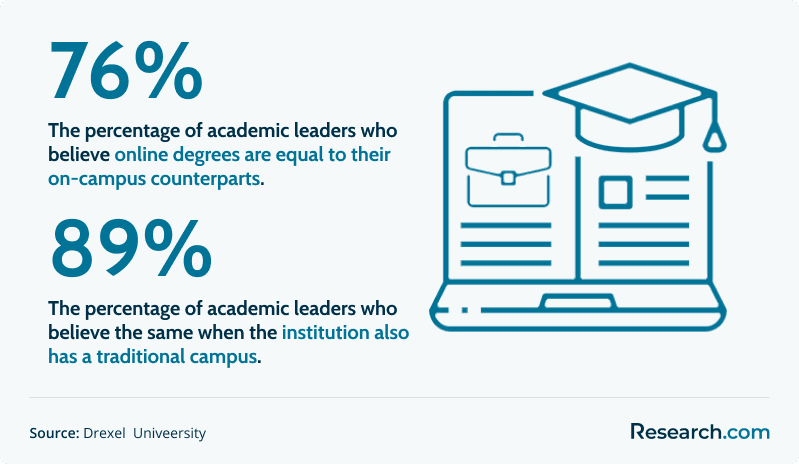
According to Drexel University Online, 76% of academic leaders believe online degrees are as valid as on-campus degrees, and that figure rises to 89% when the online degree is awarded by a college that also has a traditional campus. For teacher preparation, institutional reputation matters, but licensure alignment and local placement quality matter too.
| Format | Best fit | Potential drawback |
| Online | Working students, caregivers, rural students, and students who need schedule flexibility | Field placements may require extra planning, and students need strong time management |
| On campus | Students who want in-person advising, campus resources, and regular classroom interaction | Less flexible for students with full-time work or family responsibilities |
| Hybrid | Students who want online coursework with some face-to-face training | Travel may still be required for specific sessions or field experiences |
What does an early childhood education or elementary education degree cost?
The average tuition listed for an Early Childhood Education program is around $25,226 for undergraduate programs and $19,395 for graduate programs. For Elementary Education, the average tuition listed is about $27,256 for undergraduates and $19,796 for graduate programs.
Individual schools can differ widely. Vanderbilt University lists Early Childhood Education tuition at $25,606, while the University of Northern Iowa lists Elementary Education in-state tuition at $8,396.
Tuition is only one part of the total cost. Students should also estimate fees, books, technology expenses, transportation, housing, background checks, licensure exam fees, and unpaid student-teaching time. Online programs may reduce commuting or relocation costs, but they are not automatically cheaper. If cost is a deciding factor, compare tuition, transfer policies, and aid carefully when reviewing elementary education degree cost options.
| Cost category | Why it matters |
| Tuition | This is the largest visible expense, but it does not show the full cost of attendance. |
| Fees and materials | Education majors may need books, classroom supplies, software, background checks, and testing fees. |
| Field placement costs | Travel, schedule changes, or reduced work hours during student teaching can affect affordability. |
| Transfer credit policy | A generous transfer policy can reduce both time and total cost. |
| Licensure alignment | A cheaper program can become expensive if it does not meet the requirements for your state. |
What financial aid options are available for education majors?
Students in early childhood education and elementary education programs may qualify for several forms of aid, including grants, scholarships, work-study, and loans. According to NCES data, 85.6% of full-time, first-time students receive some form of financial aid.
- Federal grants: Need-based aid that generally does not have to be repaid.
- Scholarships: Awards from colleges, school districts, foundations, professional associations, or government programs that may be based on merit, need, service commitment, or field of study.
- Work-study: Part-time employment that helps students earn money for college expenses, sometimes in education-related settings.
- Student loans: Federal or private borrowing that can help cover remaining costs but must be repaid with interest.
Financial aid rules are not unique to education programs. Students in other human-service fields, including those exploring careers with a marriage and family therapy degree, may also compare scholarships, federal grants, loan repayment options, and service-based aid. For future teachers, the most important step is to compare net cost, not just advertised tuition.
What are the admission requirements for these degree programs?
Most early childhood education and elementary education bachelor’s programs require a high school diploma or GED. Selective programs may also review GPA, prerequisite coursework, essays, recommendations, or prior experience with children. Because both fields involve working with minors, background checks or fingerprinting are commonly required before fieldwork or student teaching.
Students considering early childhood programs should first understand what is early childhood education and how its focus on young children differs from elementary classroom teaching.
Common early childhood education requirements
- High school diploma or GED.
- Some programs may require a minimum GPA, often around 2.5-3.0.
- Background check or fingerprinting because students work with young children.
Common elementary education requirements
- High school diploma or GED.
- Minimum GPA of 2.5-3.0, sometimes with expectations in subjects such as math and English.
- Possible introductory education coursework or a personal statement.
- Criminal background check because students complete fieldwork with children.
Admission to the college is not always the same as admission to the teacher preparation program. Some schools require students to complete foundational courses, maintain a minimum GPA, or pass screening requirements before entering upper-division education coursework.
What courses will you take in early childhood education or elementary education?
Both degree paths include education theory, teaching methods, assessment, classroom management, and supervised practice. The difference is how those topics are applied. Early childhood coursework is designed around developmental stages and early learning. Elementary education coursework is more closely tied to grade-level subject instruction and school-based teaching standards.
Typical early childhood education courses
- Child Development: Examines cognitive, social, emotional, and physical development from birth to age eight.
- Curriculum Planning for Young Children: Covers how to build developmentally appropriate lessons and activities for early learners.
- Health and Safety in Early Childhood Settings: Teaches safety practices, nutrition basics, supervision, and health guidelines for young children.
Typical elementary education courses
- Foundations of Elementary Education: Introduces teaching theories, school systems, and instructional principles for elementary grades.
- Literacy Instruction: Focuses on teaching reading, writing, and language arts to elementary students.
- Math Methods for Elementary Teachers: Prepares future teachers to explain mathematical concepts to young learners.
Education coursework can also support future graduate study. Students planning for leadership, research, or higher education roles may eventually ask what can I do with a PhD in education, especially if they want to move beyond classroom teaching into administration, policy, scholarship, or faculty work.
What specializations are available in these education programs?
Specializations help students tailor their degree toward specific learners, instructional needs, or career goals. The right specialization can improve preparation for certain roles, but students should confirm whether it affects licensure, endorsements, or employment options in their state. Educators who already hold a master’s degree may also explore what is an education specialist degree if they want advanced preparation beyond the master’s level without immediately pursuing a doctorate.
| Degree path | Possible specialization | What it prepares you to focus on |
| Early childhood education | Special Education | Supporting young children with disabilities or developmental delays |
| Early childhood education | Infant and Toddler Care | Working with children from birth to three years old |
| Early childhood education | Bilingual/ESL Education | Teaching young learners whose first language is not English |
| Elementary education | STEM Education | Teaching science, technology, engineering, and math concepts to elementary students |
| Elementary education | Reading and Literacy | Strengthening reading and writing instruction at the elementary level |
| Elementary education | Inclusive Education | Serving diverse classrooms, including students with special needs |
Can accelerated graduate programs help educators advance faster?
Accelerated advanced degree programs can be useful for educators who already know they want to move into leadership, curriculum design, administration, or specialized instructional roles. These programs may reduce the time between classroom experience and advanced credentials, especially when offered in flexible online formats such as 1 year EdD programs online.
Speed should not be the only reason to choose a graduate program. Before enrolling, compare accreditation, faculty expertise, dissertation or capstone expectations, scheduling demands, support services, and whether the degree aligns with your state, district, or employer requirements.
What is the return on investment for early childhood and elementary education degrees?
Return on investment depends on how much you pay, how much you borrow, how quickly you graduate, the salary range for your intended role, and whether the degree leads to the credential you need. Because the listed median salary for early childhood education is $37,130 and the listed median salary for elementary school teachers is $70,740, students should compare likely earnings against total program cost before committing.
Students should also look beyond tuition. The true cost includes time out of the workforce, student teaching requirements, loan interest, licensure exams, and relocation or commuting expenses. Reviewing resources on how much is a bachelor's degree in education can help students think about net price, debt, and long-term affordability.
| ROI question | Why it matters |
| Will this program qualify me for the job I want? | A degree that does not meet licensure or employer requirements may not deliver the expected career value. |
| What is the total cost after grants and scholarships? | Net cost is more useful than sticker price. |
| Can I transfer credits? | Accepted credits can reduce both completion time and tuition. |
| What salary is realistic in my state or district? | National median salaries may not reflect local pay scales. |
| Will I need graduate school later? | Some advancement paths require additional credentials, which affects long-term cost. |
How should you choose the right education degree program?
The best program is the one that fits your target age group, meets your state’s licensure requirements, provides strong field placements, and costs an amount you can reasonably manage. Choosing an education degree deserves the same practical review students would apply to any professional pathway, whether they are comparing teaching programs or researching a different field such as how to become a flight nurse.
- Choose the age group first: Select early childhood education if you want to support infants, toddlers, preschoolers, or young children. Select elementary education if you want a K-6 classroom teaching role.
- Check accreditation: Look for recognized institutional accreditation and programmatic approval where relevant, including NAEYC or CAEP when applicable.
- Verify licensure alignment: Ask whether the program meets teacher certification requirements in the state where you plan to work.
- Review field experience: Find out when classroom observations, practicums, and student teaching begin and where they take place.
- Compare total cost: Look at tuition, fees, net price, aid, books, testing, and student teaching expenses.
- Ask about online support: If studying online, confirm advising, placement coordination, tutoring, technology access, and faculty availability.
- Evaluate career outcomes: Ask where graduates work and whether the school has relationships with districts, childcare centers, or early learning organizations.
Common mistakes to avoid
- Choosing only by tuition: A low-cost program is not a good deal if credits do not transfer, support is weak, or licensure requirements are not met.
- Assuming online programs are easier: Online teacher preparation still requires discipline, fieldwork, and supervised practice.
- Ignoring state requirements: Teacher licensure rules vary, so confirm requirements before enrolling.
- Relying only on rankings: Rankings can help you build a shortlist, but they cannot replace accreditation, cost, and placement checks.
- Assuming salary is guaranteed: Pay depends on role, employer, state, experience, credentials, and local salary schedules.
What careers can you pursue after earning these degrees?
Both degrees can lead to direct work with children, but the job titles and settings differ. Early childhood education graduates are more likely to work in preschool, childcare, and early intervention settings. Elementary education graduates are more likely to become K-6 classroom teachers in public or private schools.
Early childhood education career options
- Preschool Teacher: Helps young children build early language, social, motor, and school-readiness skills. Median salary: $37,130.
- Childcare Center Director: Oversees childcare or preschool operations, including staff, schedules, safety procedures, and family communication. Median salary: $47,130.
Elementary education career options
- Elementary School Teacher: Teaches kindergarten through sixth grade students in subjects such as math, reading, writing, science, and social studies. Median salary: $70,740.
- School Administrator: Manages school operations, supports teachers, and helps ensure compliance with education policies. Median salary: $98,490.
Educators who want senior leadership, district-level work, higher education, or specialized roles may later consider graduate or doctoral study. Students researching advancement often ask what can I do with a doctorate in education, since doctoral credentials may support movement into administration, research, policy, or executive education roles.
What is the job market for early childhood and elementary education graduates?
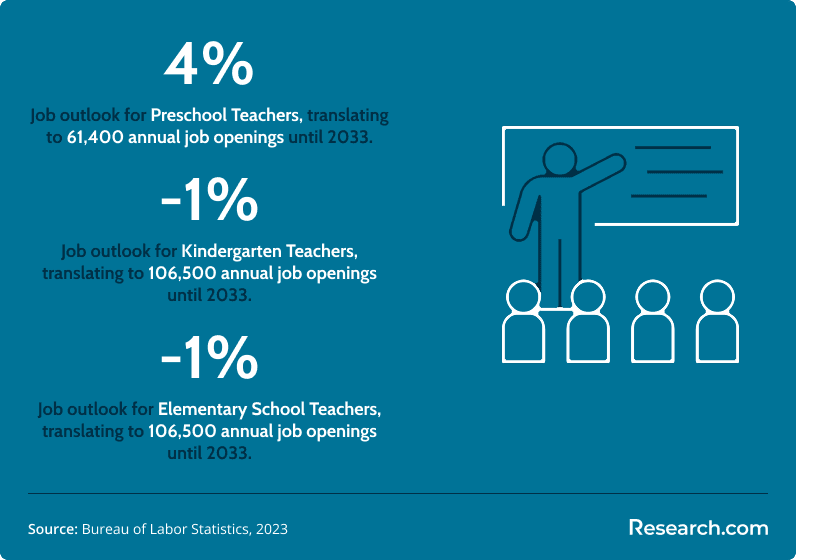
The job market differs by role. According to the U.S. Bureau of Labor Statistics, employment for preschool teachers is projected to grow by 4% from 2023 to 2033, which matches the average growth rate for all occupations. Employment for kindergarten and elementary school teachers is projected to decline by 1% during the same period.
Even with the projected decline for kindergarten and elementary teachers, openings are still expected because workers retire, change careers, or leave the occupation. The BLS projects 106,500 openings annually for kindergarten and elementary teachers and about 61,400 openings each year for preschool teachers.
Students interested in education-adjacent careers may also explore school support fields. For example, those asking Are educational psychologists in demand may be considering roles focused on learning, assessment, emotional development, and student support beyond classroom teaching.
| Career area | Projected employment change | Annual openings listed | What this means for students |
| Preschool teachers | 4% from 2023 to 2033 | 61,400 openings each year | Demand remains connected to early learning, childcare, and replacement needs. |
| Kindergarten and elementary school teachers | 1% decline from 2023 to 2033 | 106,500 openings annually | Openings continue, but competition and hiring conditions may vary by state, district, and subject need. |
What graduates say about early childhood education and elementary education degrees
- My early childhood education program helped me understand how much the earliest years shape learning. I use what I learned about child psychology and development every day when I support children’s growth, communication, and confidence. Emberly
- My elementary education degree gave me the classroom practice I needed before becoming a teacher. Student teaching helped me learn how to manage a room, plan lessons, and adapt instruction for different learners. Soren
- Earning my early childhood education degree online made it possible to keep working while finishing school. The flexible format helped me build new teaching skills while continuing to apply them in my job. Lucinda
Can leadership training improve long-term education career growth?
Leadership training can help experienced educators move beyond classroom instruction into roles involving school improvement, staff development, policy implementation, strategic planning, or organizational management. A leadership-focused graduate pathway, such as a doctor of organizational leadership, may be relevant for educators who want to lead teams, manage programs, or influence education systems.
Before choosing an advanced leadership program, educators should check whether the curriculum matches their career goal. Some programs emphasize school administration, while others focus on organizational change, higher education, nonprofit leadership, or executive management.
Can interdisciplinary specialization support advancement in education?
Interdisciplinary study can help educators expand their expertise beyond a single classroom role. For example, advanced work in literacy, communication, humanities, special education, technology, or curriculum design can strengthen instructional practice and open doors to specialized teaching or leadership responsibilities. Educators interested in stronger language and curriculum skills may compare options such as affordable online English master's degrees.
What should you look for in affordable online EdD programs?
Online EdD programs should be evaluated on more than price. Important factors include accreditation, faculty qualifications, curriculum depth, student support, research or capstone expectations, scheduling flexibility, and whether the program serves your career goal. Cost still matters, especially for educators balancing graduate tuition against public-sector salary scales. Students comparing doctoral options can review cheap EdD programs while also checking academic quality and employer recognition.
How can technology improve teaching and learning outcomes?
Technology is changing how educators plan lessons, assess student progress, communicate with families, and support differentiated instruction. In early childhood settings, technology should be used carefully and developmentally appropriately. In elementary classrooms, digital tools can support reading practice, math activities, collaboration, accessibility, and formative assessment.
Educators who understand information systems, digital learning resources, and media literacy may be better prepared to help students navigate modern learning environments. Related fields can also be useful; for example, students exploring what can you do with a degree in library science may find connections to instructional resources, school libraries, research skills, and digital access.
How can mentorship and networking help educators build stronger careers?
Mentorship helps new educators learn classroom management, lesson planning, parent communication, and school culture from experienced professionals. Networking can also lead to student teaching placements, job referrals, professional development, and leadership opportunities. These relationships are especially important in education because hiring and advancement often depend on local schools, districts, childcare organizations, and professional communities.
Educators with broader interests may also benefit from cross-disciplinary learning. An interdisciplinary studies online degree program can support students who want to connect education with fields such as communication, psychology, technology, social services, or community leadership.
Questions to ask before choosing a program
- Does this program prepare me for early childhood roles, elementary licensure, or both?
- Is the program accredited by a recognized institutional accreditor?
- Does the program meet teacher licensure requirements in the state where I plan to work?
- Where will I complete observations, practicums, and student teaching?
- What is the total cost after scholarships, grants, fees, and required materials?
- How many transfer credits will the school accept?
- Are online students supported with placement coordination and advising?
- What percentage of graduates work in teaching or education-related roles?
- Will I need a graduate degree for the position I ultimately want?
Key Insights
- Early childhood education is best for students who want to work with children from birth to age eight in preschools, childcare centers, Head Start programs, early intervention programs, or nonprofit child development settings.
- Elementary education is the stronger match for students who want to teach kindergarten through sixth grade in public or private schools.
- The salary difference is substantial in the figures listed here: preschool teachers earn a median salary of $37,130 per year, while elementary teachers earn a median salary of $70,740 annually.
- Preschool teacher employment is projected to grow by 4% from 2023 to 2033, while employment for kindergarten and elementary teachers is projected to decline by 1% from 2023 to 2033.
- Openings still exist in both fields: about 61,400 openings for preschool teachers are expected each year, and approximately 106,500 openings annually are projected for kindergarten and elementary teachers.
- Online programs can be worthwhile, but only if they are accredited, aligned with licensure requirements, and able to support field placements where you live.
- Do not choose a program based on tuition alone. Accreditation, licensure fit, transfer credit, student teaching access, financial aid, and local hiring conditions all affect the real value of the degree.
References:
- Bureau of Labor Statistics. Kindergarten and Elementary School Teachers.
- Bureau of Labor Statistics. High School Teachers.
- Bureau of Labor Statistics. Preschool Teachers.
- Bureau of Labor Statistics. Other Kindergarten Teachers.
- Bureau of Labor Statistics. Other Preschool Teachers.
- Bureau of Labor Statistics. Other Elementary School Teachers.
- College Tuition Compare. Early Childhood Education and Teaching.
- College Tuition Compare. Elementary Education and Teaching.
- Drexel University Online. Online Degree vs. Traditional Degree.
- Education Data. Average Cost of College.
- National Center for Education Statistics. IPEDS Trend Generator.
Other Things You Should Know About Early Childhood Education vs. Elementary Education Degrees
In 2027, certification for early childhood education often involves credentials focused on child development and preschool pedagogy. Elementary education certification, however, typically demands proficiency in a range of subjects and teaching methods for grades K-6. Both require passing state-specific exams and student-teaching experience.
In 2027, Early Childhood Education programs focus on skills like foundational pedagogy, behavior management, and developmental psychology for young children. Elementary Education programs emphasize subject-specific teaching strategies, classroom management, and methods for evaluating student progress across various subjects. Both pathways prepare educators for age-appropriate instruction but with tailored skill sets.
Yes, but most states require a separate elementary teaching license. Candidates usually need a bachelor’s degree, a state-approved preparation program, passing scores on Praxis or state exams, and supervised student teaching. Some states also require extra content coursework in reading, math, and science.