2027 Best Accelerated Online Bachelor's in Early Childhood Education

Co-Founder and Chief Data Scientist
Choosing an accelerated online bachelor’s in early childhood education is usually about more than finishing college faster. It is a decision about whether you want to qualify for early learning roles, meet teacher certification requirements, move into a higher-responsibility childcare position, or build a foundation for graduate study while continuing to work or care for family.
This guide explains what accelerated online early childhood education programs include, how they compare with campus programs, what they may cost, how fieldwork and licensure work, and which career paths may follow. It also highlights programs designed for faster completion and gives you practical criteria for deciding whether a fast online format is the right fit.
Quick answer: Is an accelerated online bachelor’s in early childhood education worth it?
An accelerated online bachelor’s in early childhood education can be worth it if you already have transfer credits, work experience with children, or a clear goal such as becoming a preschool teacher, kindergarten teacher, childcare center leader, or early learning specialist. The online format can reduce scheduling barriers, while accelerated terms may shorten the time to graduation. However, students seeking public school teaching roles must confirm that the program meets their state’s licensure rules before enrolling.
What are the benefits of getting an online bachelor’s in early childhood education?
- The demand for early childhood educators is projected to grow 4% over the next decade, reflecting continued investment in preschool programs and child development services (BLS, 2025).
- With an average annual salary of $35,364, graduates can count on steady income and job opportunities in schools, daycare centers, and community programs (ZipRecruiter, n.d.)
- Accelerated online bachelor’s programs can make degree completion more realistic for working adults because coursework is often designed around flexible scheduling, shorter terms, transfer credits, and local field placements.
What can I expect from an online bachelor’s in early childhood education?
An online bachelor’s in early childhood education covers how young children develop, learn language, build social-emotional skills, and respond to structured play, routines, family support, and inclusive teaching strategies. In a quality program, the online format should not eliminate practical preparation. Instead, it should combine digital coursework with supervised fieldwork, observation, lesson planning, and assessment practice.
Most online early childhood education programs include the following components:
- Child development coursework: Students study cognitive, physical, emotional, language, and social development from infancy through the early elementary years.
- Lesson planning and curriculum design: Programs teach students how to create age-appropriate activities in literacy, math, science, art, movement, and social learning.
- Classroom management preparation: Online modules, case studies, recorded classroom examples, and discussion boards help students practice positive guidance and behavior support strategies.
- Family and community engagement: Students learn how to communicate with parents, caregivers, support agencies, and community partners in ways that strengthen child outcomes.
- Fieldwork or practicum experiences: Many online programs require students to complete supervised placements in approved local preschools, childcare centers, public schools, or early learning agencies.
- Licensure or certification preparation: Programs that lead to teaching credentials typically align coursework, assessments, and student teaching with state requirements.
| Program feature | Why it matters | What to verify before enrolling |
| Accelerated terms | Shorter sessions may help students complete credits faster. | Ask whether the pace is manageable for working adults and whether courses are offered year-round. |
| Field placement support | Early childhood education requires practical experience with children. | Confirm whether the school helps arrange local placements or expects students to find their own sites. |
| Licensure alignment | Public school pre-K and kindergarten roles may require state certification. | Check whether the program meets certification rules in the state where you plan to teach. |
| Transfer credit policy | Prior college credits can significantly shorten completion time. | Request an official transfer evaluation before committing to a program. |
Where can I work with an online bachelor’s in early childhood education?
An online bachelor’s in early childhood education can lead to work in schools, childcare organizations, nonprofit programs, family support services, and early learning administration. The exact roles available depend on your state, employer requirements, licensure status, and whether your program is certification-track or non-certification-track.
Common work settings include:
- Preschools and childcare centers: Graduates may teach or lead classrooms serving children ages 3 to 5 in licensed early learning environments.
- Public and private elementary schools: Students in licensure-aligned programs may pursue pre-K, kindergarten, or early elementary teaching roles.
- Child development centers: Graduates may help create play-based learning experiences in community, employer-sponsored, or nonprofit care settings.
- Nonprofit and advocacy organizations: Early childhood training can support roles connected to program development, family outreach, policy, and education access.
- Educational support positions: Depending on credentials and experience, graduates may qualify for work as instructional aides, early intervention support staff, curriculum assistants, or program coordinators.
How much can I earn with an online bachelor’s in early childhood education?
Pay in early childhood education varies widely by job title, employer, state, local funding, teaching license status, and years of experience. A bachelor’s degree may help graduates qualify for roles with more responsibility than positions requiring only a high school diploma or associate degree, but salary outcomes are never guaranteed.
Reported earnings in the field include:
- Top Earners – $47,000 per year: Professionals in this range often have more experience, stronger credentials, leadership duties, or employment in higher-paying districts or private programs.
- 75th Percentile – $39,500 per year: Educators at this level may have classroom experience and work in public schools, established childcare organizations, or specialized early learning programs.
- Average Salary – $35,364 per year: This figure represents typical reported earnings for early childhood education teachers nationwide, including entry-level and bachelor’s-prepared workers.
- 25th Percentile – $29,500 per year: Early-career professionals, workers in lower-cost regions, or employees at smaller organizations may fall in this range while gaining experience.
| Salary factor | How it can affect earnings |
| Teaching license | Licensed public school roles may have different pay structures than private childcare positions. |
| Location | Compensation often differs by state, district, funding source, and cost of living. |
| Employer type | Public schools, Head Start programs, nonprofits, private centers, and corporate childcare providers may pay differently. |
| Experience and leadership duties | Lead teacher, director, curriculum, and coordinator roles may offer higher pay than assistant-level positions. |
- Best universities for online bachelor’s in early childhood education programs for 2027
- How long does an accelerated online bachelor’s in early childhood education take?
- Online vs. on-campus early childhood education bachelor’s programs
- How to finish faster if your program is not formally accelerated
- Financial aid options for online early childhood education students
- Admission requirements for an online bachelor’s in early childhood education
- Common courses in an online early childhood education bachelor’s program
- Why accreditation and quality assurance matter
- Can this degree support educational leadership goals?
- How online programs use technical support and digital learning tools
- Specializations in online early childhood education bachelor’s programs
- How to choose the right online early childhood education bachelor’s program
- Career paths for early childhood education graduates
- Job outlook for graduates with an online bachelor’s in early childhood education
- Advanced degree options after an online bachelor’s in early childhood education
Best universities for online bachelor’s in early childhood education programs for 2027
The programs below are useful starting points for students comparing accelerated or flexible online early childhood education pathways. If you are still exploring related education specialties, you may also want to compare this route with an accelerated master's degree in gifted education online, especially if your long-term goal involves advanced teaching or specialized learner support.
How do we rank schools?
A bachelor’s degree is a major financial and professional decision, so the ranking process should be transparent. Research.com evaluates programs using education data, institutional information, and program-level factors that matter to online students, including cost, speed, accreditation, and student support.
Sources used in the analysis include the IPEDS database, Peterson’s database and its Distance Learning Licensed Data Set, the College Scorecard database, and the National Center for Education Statistics.
The goal is not to rank schools by name recognition alone. The list is designed to help students compare programs based on practical criteria such as completion time, affordability, institutional recognition, and support for online learners. Details about the ranking process are available on Research.com’s methodology page.
1. Eastern University
Eastern University offers an online BS in Early Childhood Education for students preparing to work as teachers and early learning practitioners. The curriculum focuses on communication, analytical thinking, culturally and linguistically responsive teaching, and age-appropriate technology use with children.
- Program Length: 2 years minimum
- Tracks/concentrations: Early childhood education, child and adolescent development
- Estimated Cost: $2,500-$7,500 annually
- Accreditation: Middle States Commission on Higher Education (MSCHE)
2. Walden University
Walden University provides a BS in Early Childhood Studies through its Competency-Based Tempo Learning format. Instead of moving through a fixed sequence of courses, students demonstrate mastery of defined competencies tied to practical early childhood education skills.
- Program Length: 15 months
- Tracks/concentrations: Early childhood education and development
- Estimated Cost: $8,000
- Accreditation: Higher Learning Commission (HLC)
3. University of Rhode Island
The University of Rhode Island offers a fully online Early Childhood Care and Education program built for childcare professionals and elementary educators who want to advance. Graduates are eligible for a Pre K–2 teaching certificate, which may support career movement into early education teaching roles.
- Program Length: 7 weeks
- Tracks/concentrations: Early childhood care and education
- Estimated Cost: $841
- Accreditation: New England Commission of Higher Education (NECHE)
4. Rasmussen University
Rasmussen University offers a BS in Early Childhood Education with two focused options. The ECE Leadership specialization adds administration and management preparation, while the Child Development specialization emphasizes early intervention and collaboration with families and caregivers.
- Program Length: 18 months
- Tracks/concentrations: Child development and ECE leadership specialization
- Estimated Cost: $16,000
- Accreditation: Higher Learning Commission (HLC)
5. Pacific Oaks College
Pacific Oaks College offers an online B.A. in Early Childhood Education centered on inquiry, reflection, teamwork, and problem-solving. Students examine the factors that influence child development and learning while building practical skills for supporting young children.
- Program Length: 2 years
- Tracks/concentrations: STEAM and trauma specialization
- Estimated Cost: $712
- Accreditation: ASC Senior College and University Commission (WSCUC)
6. Indiana Wesleyan University
Indiana Wesleyan University offers an online B.S. in Early Childhood Education that prepares students to support developmentally appropriate learning. Coursework addresses advocacy for young children, research-based learning environments, and multiple approaches to assessment.
- Program Length: 30 months
- Tracks/concentrations: Early childhood education
- Estimated Cost: $7,695
- Accreditation: Higher Learning Commission (HLC)
7. Vermont State University
Vermont State University offers a BS in Early Childhood Education covering child development, classroom management, teaching methods, ethics, inclusion, and critical theory. The program also includes a 13-week student teaching placement with mentor teacher support.
- Program Length: 20 months (5 semesters)
- Tracks/concentrations: Early childhood education
- Estimated Cost: $16,056
- Accreditation: New England Commission of Higher Education (NECHE)
8. California Baptist University
California Baptist University offers an online Bachelor of Arts in Early Childhood Studies focused on supporting young children across early developmental stages. The program is taught from a Christ-centered perspective and addresses cognitive, social, emotional, perceptual-motor, and spiritual growth.
- Program Length: 16 months
- Tracks/concentrations: Early childhood education
- Estimated Cost: $24,960
- Accreditation: Western Association of Schools and Colleges Senior College and University Commission (WSCUC)
9. Texas Tech University
Texas Tech University offers an online Bachelor of Applied Arts and Sciences (AAS) in Early Childhood Education for students planning careers as ECE professionals. The program is non-certification and is designed for work supporting young children outside traditional classroom teaching roles.
- Program Length: 2 years minimum
- Tracks/concentrations: Early childhood education (non-certificate)
- Estimated Cost: $49,800
- Accreditation: Southern Association of Colleges and Schools Commission on Colleges (SACSCOC)
10. Illinois State University
Illinois State University offers an online BS in Early Childhood Education that prepares students for a professional educator license to teach children from birth through age 7 (up to grade 2). The program prepares graduates for public pre-K, K–2 classrooms, childcare, special education preschool, and parent-infant education settings.
- Program Length: Less than 2 years
- Tracks/concentrations: Early childhood education
- Estimated Cost: $24,132
- Accreditation: Higher Learning Commission (HLC)
How long does an accelerated online bachelor’s in early childhood education take?
Completion time depends on transfer credits, course load, term length, fieldwork scheduling, and whether the program is built for degree completion or first-time college students. Accelerated online programs may move quickly, but they still require consistent weekly study time and careful planning around practicum or student teaching requirements.
Like fast track cybersecurity online training programs, accelerated early childhood education programs compress learning into a more intensive schedule. The difference is that education degrees often include supervised practice with children, so speed must be balanced with placement availability and licensure timelines.
According to Ivy Tech Community College (n.d.), common timelines include:
- Accelerated Programs: These can be completed in as little as 7 weeks to 16 months, making them best suited for students with transfer credits, prior experience, or the ability to handle an intensive pace.
- Traditional Full-Time Programs: A standard online bachelor’s degree can typically be earned in 2 years, or 4 semesters, when pursued without breaks.
- Graduate Study Timeline: A master’s degree after the bachelor’s usually adds 3 to 4 years, depending on the program structure and enrollment pace.
- Combined Pathway: Completing both a bachelor’s and a master’s in early childhood education can take anywhere from 4 to 6 years in total.
If your long-term interest includes child development, mental health, and one-on-one support, this bachelor’s degree may also be an early step toward exploring how to become a child counselor.
Online vs. on-campus early childhood education bachelor’s programs
Online and campus-based early childhood education programs can cover the same academic foundation: child development, inclusive instruction, family engagement, assessment, and curriculum planning. The main differences are schedule, delivery format, fieldwork logistics, and how students interact with faculty and classmates.
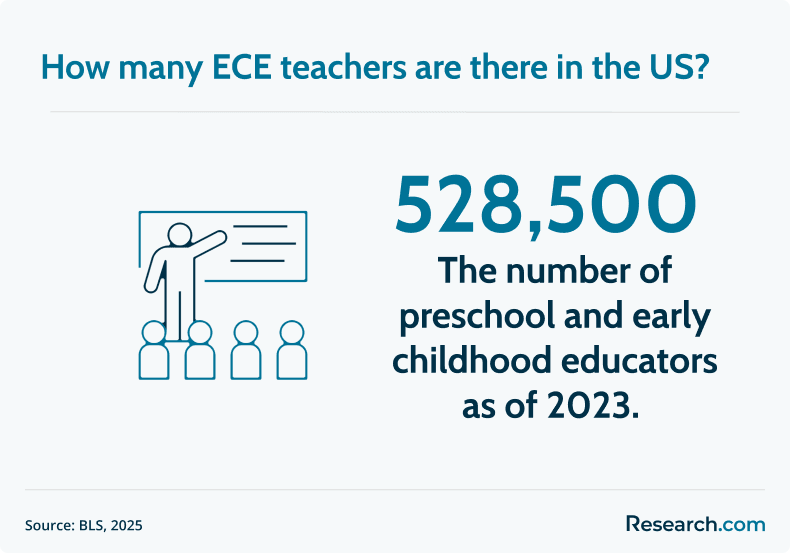
With more than 528,500 early childhood education teachers currently in the field, flexible preparation pathways can help working adults and career changers enter or advance in the profession. Similar to fast track online data analytics bootcamps, accelerated online degrees may suit students who want a concentrated path, but early childhood education still requires practice-based preparation.
| Factor | Accelerated online program | On-campus program |
| Schedule | Often includes asynchronous coursework and shorter terms. | Typically follows fixed class meeting times and campus schedules. |
| Fieldwork | Usually completed at approved local sites if the program requires practicum or student teaching. | Often arranged through school or district partners near campus. |
| Class interaction | Uses discussion boards, video meetings, group projects, and digital feedback. | Relies more heavily on in-person seminars, classroom activities, and campus events. |
| Best fit | Working adults, transfer students, childcare employees, and students far from campus. | Students who prefer face-to-face learning and immediate campus access. |
| Licensure preparation | Can prepare for licensure if approved for your state and role. | Can prepare for licensure if approved for your state and role. |
If your goal is state certification, compare program approval carefully. Research.com’s guide to teacher certification in early childhood can help you understand why program format alone does not determine licensure eligibility.
How to finish faster if your program is not formally accelerated
Not every student can enroll in a formal fast-track program. Some schools offer only standard timelines, and some students need a slower pace because of work, caregiving, or fieldwork requirements. Even so, there are ways to reduce time to completion without sacrificing academic quality.
Students in fast track online data science bootcamps often use structured planning and prior skill recognition to move efficiently. Early childhood education students can apply the same principle by maximizing eligible credits and avoiding preventable delays.
- Request a transfer credit review early: Prior coursework in child development, psychology, education, English, or general education may reduce the number of credits you need to complete.
- Ask about prior learning assessment: Some schools award credit for documented professional experience, exams, portfolios, or employer verification.
- Take a full course load when realistic: Enrolling in the maximum allowed credits can shorten your timeline, but only if you can maintain grades and meet fieldwork expectations.
- Use summer and winter terms: Year-round enrollment can help you complete general education and major requirements more quickly.
- Map fieldwork requirements in advance: Practicum and student teaching are often sequential, so missing one deadline can delay graduation.
- Choose electives strategically: Courses in child psychology, family engagement, classroom technology, or special education can support both degree requirements and career goals.
Students interested in child and family support outside the classroom may also consider social services. Research.com’s guide to becoming a child and family social worker explains another path for helping children and families.
Financial aid options for online early childhood education students
Online bachelor’s students may qualify for many of the same financial aid options as campus students, provided the institution and program meet eligibility rules. Because accelerated programs can have different billing models, students should compare total cost, fees, transfer credit savings, and financial aid availability before choosing a school.
Students researching online credentials in other fields, including fast track online ethical hacking dual certification programs, face the same basic financial aid question: What is the true out-of-pocket cost after grants, scholarships, employer support, and transfer credits?
- TEACH Grant Program: This federal grant supports students who plan to teach in high-need fields and complete a required service commitment in low-income areas.
- Early Childhood Educators Scholarship Program (Massachusetts): This scholarship supports employed early childhood educators in Massachusetts pursuing degrees, covering a portion of tuition costs while requiring continued work in the field.
- Bright Futures Scholarship (Florida): This state-funded, merit-based award helps eligible Florida high school graduates pay for approved in-state institutions, covering 75-100% of the tuition costs.
- Early Childhood Education Scholarship Fund (Colorado): Applicants must be enrolled in an Early Childhood Education program at the University of Colorado, demonstrate financial need through FAFSA, and submit a one-page essay outlining their goals.
- NAEYC Lasting Legacy Scholarships: These scholarships from the National Association for the Education of Young Children support future ECE leaders and advocates.
If cost is your main concern, compare tuition alongside completion time and transfer policies. Research.com’s guide to affordable early childhood development degree online programs can help you broaden your search.
Admission requirements for an online bachelor’s in early childhood education
Admission standards vary by school, but online early childhood education programs commonly ask applicants to show academic readiness and, in some cases, suitability for fieldwork with children. Licensure-track programs may have additional checks before students enter clinical or student teaching experiences.
- High School Diploma or GED: Most bachelor’s programs require proof that applicants completed secondary education.
- Minimum GPA: Some schools require a GPA between 2.0 and 2.5 for high school or prior college coursework.
- Official Transcripts: Applicants usually must submit records from all high schools, colleges, and universities previously attended.
- General Education Courses: Transfer applicants may need completed coursework in English, Math, Psychology, or other foundational subjects.
- Application and Essay: Some programs ask for a personal statement explaining your interest in early childhood education and career goals.
- Background Check or Experience with Children: Programs involving practicum, student teaching, or licensure may require background screening or documentation of experience with children.
If you plan to teach in public kindergarten, admissions requirements are only the first step. Review state expectations using Research.com’s guide to kindergarten teacher requirements.
Common courses in an online early childhood education bachelor’s program
Early childhood education coursework blends developmental science, teaching methods, observation, assessment, and family partnership. Accelerated programs often organize these subjects into shorter modules, but students still need to master both theory and classroom application.
As with accelerated online bachelor's in mathematics programs, the goal is to make complex material manageable without removing essential content.
- Child Development: Examines physical, cognitive, emotional, language, and social growth from birth through age eight.
- Language and Literacy in Early Childhood: Covers early communication, emergent reading, vocabulary growth, and literacy-supportive classroom practices.
- Curriculum and Instruction for Young Children: Teaches students to plan, teach, and evaluate age-appropriate activities in multiple learning areas.
- Classroom Management and Guidance: Focuses on positive behavior support, routines, social-emotional learning, and safe learning environments.
- Inclusive and Special Education Practices: Prepares students to adapt instruction for children with diverse abilities and developmental needs.
- Family and Community Engagement: Explores how educators partner with families, caregivers, and community resources to support children.
- Early Childhood Assessment: Introduces observation, documentation, screening, and evaluation methods used in early learning settings.
- Ethics and Professionalism in Early Education: Addresses professional responsibilities, ethical judgment, mandated expectations, and educator conduct.
Coursework should translate into daily classroom skills. The chart below highlights eight in-demand skills for early childhood teachers:
Why accreditation and quality assurance matter
Accreditation is one of the most important checks in choosing an online early childhood education degree. Institutional accreditation affects credit transfer, financial aid eligibility, employer confidence, and admission to graduate programs. For teacher preparation, students should also verify whether the program meets state licensure or certification expectations for the role they want.
Quality assurance also includes how often the curriculum is reviewed, whether field placements are supervised, how faculty support online students, and whether academic advising understands state teaching requirements. Students considering long-term leadership or doctoral study may later compare options such as accelerated EdD programs, where accredited prior coursework can matter.
| Accreditation question | Why to ask it |
| Is the institution accredited? | Institutional accreditation can affect financial aid, transfer credits, and graduate school options. |
| Is the teacher preparation pathway approved in my state? | Licensure requirements are state-specific and may not transfer automatically across states. |
| Does the program include supervised fieldwork? | Hands-on experience is essential for building classroom readiness. |
| Will the degree qualify me for my target job? | Some programs are non-certification and may not lead to public school teaching eligibility. |
Can this degree support educational leadership goals?
A bachelor’s in early childhood education can be a first step toward leadership, but most administrative, policy, supervisory, and higher-level curriculum roles require experience and sometimes graduate education. Graduates may move into lead teacher, curriculum coordinator, program coordinator, instructional supervisor, or childcare center director roles depending on employer requirements and state regulations.
Students who want to manage programs, influence policy, or lead education systems may later consider graduate study, including cheap educational leadership online doctoral programs. The strongest pathway is usually a combination of classroom experience, leadership responsibilities, continuing education, and credentials aligned with the setting where you want to work.
How online programs use technical support and digital learning tools
Online early childhood education programs typically use learning management systems for lectures, readings, assignments, peer discussion, video feedback, and instructor communication. Strong programs also provide digital libraries, academic tutoring, online advising, virtual orientation, and technical support for login, software, and connectivity issues.
For working adults, technology support is not a minor detail. A program may be academically strong, but weak online support can make it harder to complete assignments, attend live sessions, upload fieldwork documentation, or collaborate with classmates. Programs in other disciplines, such as accelerated online philosophy degree programs, also depend on reliable digital learning systems, but early childhood education students should pay special attention to tools used for observation, assessment, lesson planning, and practicum documentation.
Specializations in online early childhood education bachelor’s programs
Specializations let students tailor their degree toward classroom teaching, leadership, infant and toddler care, special education, literacy, family engagement, or trauma-informed practice. The best choice depends on the children you want to serve and the setting where you hope to work.
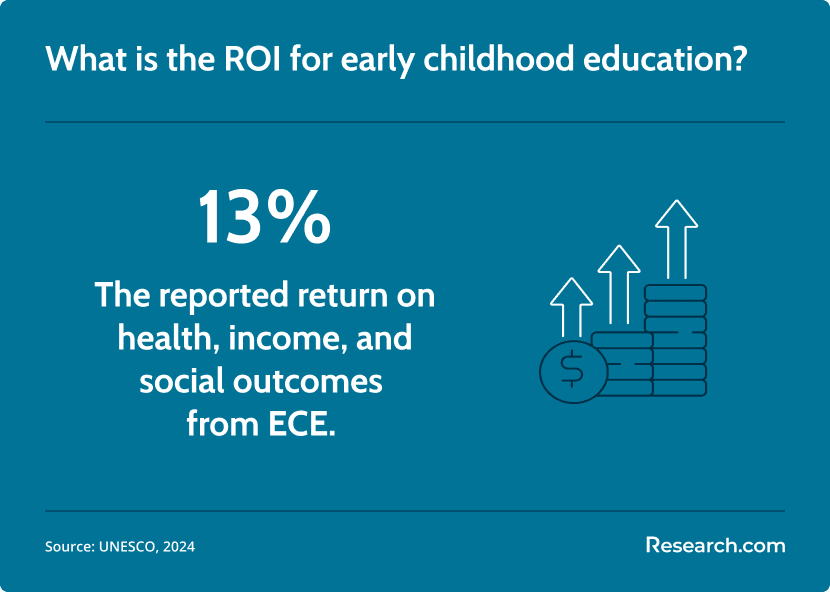
Research highlighted by UNESCO notes that early childhood care and education delivers a 13% return through improved health and wellbeing. A specialization can help students focus their preparation on the part of early learning where they want to have the greatest effect.
- Early Childhood Special Education: Focuses on supporting children with disabilities, developmental delays, and individualized education needs.
- Child Development: Emphasizes growth from infancy through age eight and can support roles in advocacy, programming, and child-focused services.
- Administration and Leadership: Prepares students for program coordination, staff supervision, budgeting, policy, and early childhood center management.
- Infant and Toddler Care: Covers development from birth to age three, including attachment, sensory learning, routines, and early intervention.
- Language and Literacy: Builds expertise in early communication, emergent reading, vocabulary development, and culturally responsive literacy teaching.
- Family and Community Engagement: Trains students to partner with caregivers, agencies, and community organizations.
- Trauma-Informed Education: Helps future educators recognize and respond to trauma-related needs in safe, supportive early learning environments.
How to choose the right online early childhood education bachelor’s program
The best program is not always the fastest or cheapest. It is the program that fits your state requirements, budget, schedule, prior credits, career target, and learning style. Before applying, compare programs using objective criteria instead of relying only on rankings or advertising claims.
- Confirm institutional accreditation: Accreditation affects financial aid, credit transfer, and future graduate study.
- Check educator preparation approval: If you want public school licensure, verify state approval rather than assuming an education degree automatically qualifies you.
- Review child development coverage: A strong curriculum should address development from birth through age eight, including cognitive, social, emotional, language, and physical growth.
- Evaluate flexibility: Asynchronous courses can be helpful for childcare workers, parents, and students with irregular schedules.
- Ask about field placements: Online students need a clear plan for practicum, observation, or student teaching if the program requires it.
- Look for early education career services: Advising should connect students with roles in preschools, Head Start, public schools, nonprofits, and childcare organizations.
- Understand the course structure: Accelerated programs often use 5–8 week terms, which can speed completion but also increase weekly workload.
- Get a transfer estimate: Some programs accept up to 90 transfer credits, which can make a major difference in time and cost.
- Compare licensure preparation: If a program claims to prepare teachers, ask which state requirements are embedded in the curriculum.
Students comparing education specialties may also examine standards used in related graduate programs, such as an accelerated master's in educational counseling online, to understand how accreditation, clinical preparation, and career alignment shape program quality.
Common mistakes to avoid when choosing a program
| Mistake | Better approach |
| Choosing only the fastest program | Make sure the pace still allows you to complete fieldwork, maintain grades, and meet licensure rules. |
| Assuming online means no practicum | Ask whether supervised field experience is required and how placements are approved. |
| Looking only at tuition | Compare fees, books, technology costs, transfer credits, and total time to degree. |
| Ignoring state certification rules | Contact your state education agency or program advisor before enrolling in a licensure-track degree. |
| Relying only on rankings | Use rankings as a starting point, then compare curriculum, accreditation, outcomes, and support services. |
Career paths for early childhood education graduates
An online bachelor’s in early childhood education can prepare graduates for teaching, support, leadership, curriculum, and family engagement roles. Some jobs require state licensure, while others depend more on degree level, experience, employer expectations, and specialization.
- Preschool Teacher: Plans learning activities and supports early literacy, social development, and school readiness for children ages 3–5. Research.com’s guide explains what you need to become a preschool teacher.
- ECE Lead Teacher: Leads daily classroom routines, supports assistant teachers, communicates with families, and helps align instruction with developmental milestones.
- Early Childhood Education Specialist: Works with schools, agencies, or nonprofits to evaluate programs, support teachers, and strengthen early learning quality.
- Childcare Center Director: Oversees staffing, budgets, compliance, operations, family communication, and program quality.
- Home Visitor or Family Support Specialist: Provides families with guidance on child development, parenting strategies, early intervention, and community resources.
- Curriculum Developer for Early Learning: Creates lesson plans, instructional materials, and developmentally appropriate activities for preschool, Head Start, publishing, or early learning programs.
The chart below highlights some of the highest paying early childhood teacher jobs projected this year:
Job outlook for graduates with an online bachelor’s in early childhood education
The labor market for early childhood educators remains steady, with demand shaped by preschool enrollment, childcare needs, public investment, staff turnover, and state-level pre-K expansion. A bachelor’s degree can broaden options, but employment outcomes depend on licensure, location, experience, and the type of employer.
- Projected Job Growth: Employment of preschool teachers and early childhood educators is expected to grow 4% from 2023 to 2033, which is about as fast as the average for all occupations.
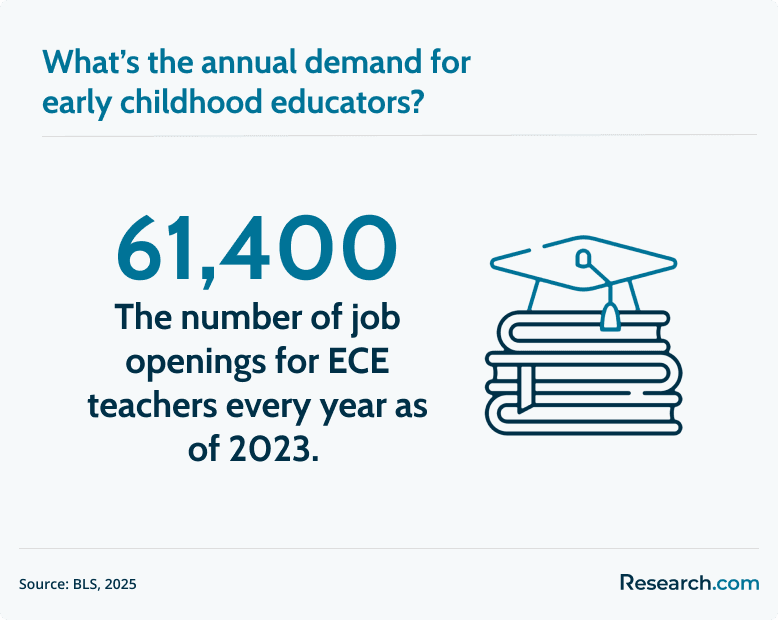
- Annual Job Openings: An estimated 61,400 openings for preschool teachers are projected each year, due largely to workforce turnover and retirement.
- Growing Importance: Early education continues to be recognized as important to children’s intellectual, language, and social development.
- Workforce Replacement: Many openings are expected to result from current teachers leaving the occupation or retiring.
- Policy-Driven Expansion: Wider access to pre-K and early intervention services in many states can support ongoing demand across public and private settings.
- Versatility of Roles: Graduates may pursue preschool teaching, specialist, coordinator, director, and family support roles, and some later branch into related graduate pathways such as accelerated master's degree in marriage and family counseling online programs.
Advanced degree options after an online bachelor’s in early childhood education
An online bachelor’s in early childhood education can support several graduate pathways. The right next degree depends on whether you want to teach at a higher level, specialize in child development, enter administration, support children with communication needs, move into counseling-related work, or influence education policy.
For example, graduates interested in language development and communication support may compare online masters speech pathology programs. Others may pursue graduate education in early childhood leadership, special education, curriculum and instruction, educational counseling, school administration, or child and family services. Before enrolling, check accreditation, clinical or fieldwork requirements, state licensure rules, and whether the program’s outcomes match your target role.
Questions to ask before applying to an accelerated online early childhood education program
- Is this program certification-track or non-certification-track?
- Will it meet licensure requirements in the state where I plan to teach?
- How many of my previous credits will transfer?
- Does the school help arrange local practicum or student teaching placements?
- What is the total estimated cost after fees, books, and technology expenses?
- How many hours per week should I expect to study in accelerated courses?
- Are classes asynchronous, synchronous, or a mix of both?
- What support is available for online students during evenings or weekends?
- What jobs have recent graduates pursued?
- If I move to another state, how will that affect certification eligibility?
References:
- California Baptist University. (n.d.). Online Bachelor of Arts in Early Childhood Studies. Calbaptist.edu. Retrieved 1 July 2025.
- Eastern University. (n.d.). BS in Early Childhood Education (Online). Eastern.edu. Retrieved 1 July 2025.
- Graduate Program. (n.d.). TEACH Grant: What You Need to Know. Graduateprogram.org. Retrieved 1 July 2025.
- Ivy Tech Community College. (n.d.). Education – Early Childhood. Ivytech.edu. Retrieved 1 July 2025.
- Massachusetts Department of Higher Education. (n.d.). Early Childhood Educators Scholarship Program. Mass.edu. Retrieved 1 July 2025.
- Rasmussen University. (n.d.). Early Childhood Education – Bachelor’s Degree. Rasmussen.edu. Retrieved 1 July 2025.
- Texas Tech University. (n.d.). Early Childhood BAAS Online. Depts.ttu.edu. Retrieved 1 July 2025.
- UNESCO. (n.d.). Investing in early childhood care and education yields lifelong benefits. Unesco.org. Retrieved 1 July 2025.
- University of Central Florida. (n.d.). Florida Bright Futures Scholarships. Ucf.edu. Retrieved 1 July 2025.
- University of Rhode Island. (n.d.). Early Childhood Education (Online). Web.uri.edu. Retrieved 1 July 2025.
- US Bureau of Labor Statistics. (n.d.). Preschool Teachers. Bls.gov. Retrieved 1 July 2025.
- US Department of Education. (n.d.). Child Care Access Means Parents in School Program. Ed.gov. Retrieved 1 July 2025.
- Vermont State University. (n.d.). Early Childhood Education Online Completion (BS). Vermontstate.edu. Retrieved 1 July 2025.
- Walden University. (n.d.). BS in Early Childhood Studies – Tempo Learning. Waldenu.edu. Retrieved 1 July 2025.
- ZipRecruiter. (n.d.). Early Childhood Education Teacher Salary. Ziprecruiter.com. Retrieved 1 July 2025.
- ZipRecruiter. (n.d.). Highest Paying Early Childhood Teacher Jobs. Ziprecruiter.com. Retrieved 1 July 2025.
- Zippia. (n.d.). Early Childhood Teacher Skills. Zippia.com. Retrieved 1 July 2025.
Key Insights
- An accelerated online bachelor’s in early childhood education is best for students who need flexibility, already have credits or experience, and want to move toward teaching, childcare leadership, curriculum, or family support roles.
- Program speed should never be the only deciding factor. Accreditation, state licensure alignment, field placement support, and transfer credit policies are just as important.
- Some online programs lead to teacher certification, while others are non-certification degrees. This distinction matters most for students who want public pre-K, kindergarten, or early elementary teaching roles.
- Reported earnings vary by role, region, employer, and credentials, with an average annual salary of $35,364 and top earners at $47,000 per year according to the cited salary data.
- Employment of preschool teachers and early childhood educators is expected to grow 4% from 2023 to 2033, with 61,400 projected openings each year.
- The smartest next step is to request transfer evaluations, confirm licensure eligibility in your state, compare total program cost, and ask how online fieldwork is arranged before applying.
Other Things You Need to Know About Online Bachelor’s in Early Childhood Education
Applicants typically need a high school diploma or GED, and may need to meet a minimum GPA requirement. Some programs might require prerequisite coursework in education or related fields. Check specific program details for any additional criteria for 2027.
Yes. Many accelerated online programs accept up to 90 transfer credits, and some also credit prior learning or professional experience. Schools usually require official transcripts and a minimum transfer GPA, often 2.0 to 2.5, before they apply those credits toward the degree.