
2027 Fastest Online Data Science Bootcamps

Co-Founder and Chief Data Scientist
Choosing a fast online data science bootcamp is a high-stakes decision. The appeal is clear: data science roles are projected to grow by 36% in the next decade, and the median annual salary for data scientists is $112,590. But the market is crowded with short programs, self-paced tracks, university-affiliated certificates, and career-change bootcamps that all claim to be the quickest route into tech.
The real question is not simply, “Which bootcamp is fastest?” It is, “Which program can help me build credible data skills, complete employer-ready projects, and move toward the right role without wasting time or money?” A 12-week program may be the best choice for someone with strong math and coding experience, while a six- or ten-month option may be more realistic for a working adult changing careers.
This guide explains what fast online data science bootcamps teach, how long they take, what they cost, how to compare online and on-site formats, what employers look for, and how to evaluate whether a program is worth it for your goals. You will also find a list of seven fast online data science bootcamps for 2027, plus practical questions to ask before enrolling.
Quick Answer: Are Fast Online Data Science Bootcamps Worth It?
A fast online data science bootcamp can be worth it if you already have the discipline to learn intensively, can commit enough weekly study time, and choose a program that helps you produce strong portfolio projects. Bootcamps are usually best for learners who want practical training in Python, SQL, statistics, machine learning, and data visualization without spending several years in a degree program.
However, a bootcamp is not a guaranteed shortcut to a job. Employers will want proof that you can clean messy data, explain your analysis, build models responsibly, and communicate results clearly. Your portfolio, interview preparation, and prior work experience often matter as much as the bootcamp certificate itself.
What are the benefits of attending a fast online data science bootcamp?
- Faster skill development: Bootcamps compress job-focused training into a short period, helping learners move quickly from foundational tools to applied projects.
- Preparation for data roles: Graduates may pursue positions such as Data Analyst, Junior Data Scientist, or Machine Learning Engineer, depending on their background and portfolio quality.
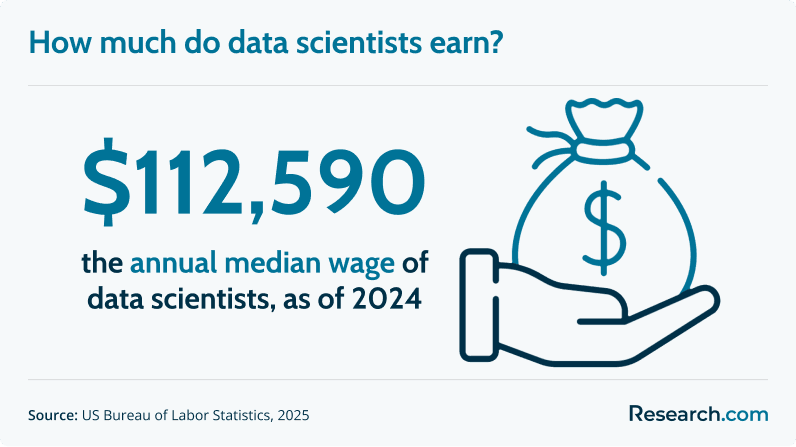
- Strong earning potential: Data scientists earn a median annual salary of $112,590, according to the US Bureau of Labor Statistics.
- Remote learning practice: Online programs often use tools such as Git, Slack, Zoom, and shared coding environments, which mirror common workflows in distributed tech teams.
- Industry flexibility: Data skills are used in finance, healthcare, retail, technology, insurance, information services, and many other sectors.
What can I expect from a fast online data science bootcamp?
A fast online data science bootcamp is usually intensive, skills-based, and project-driven. Instead of spending years on broad theory, students focus on the tools and workflows used in entry-level data roles: Python, SQL, statistics, data cleaning, exploratory analysis, visualization, and machine learning.
The strongest programs do more than teach syntax. They require students to work through realistic datasets, explain technical results to nontechnical audiences, and build a portfolio that can be reviewed by hiring managers. Many programs culminate in a capstone project, which should demonstrate a complete data science workflow from problem definition to data preparation, modeling, evaluation, and presentation.
You should also expect a demanding schedule. Even part-time programs may require sustained weekly work outside class sessions. Fast does not mean easy; it means the curriculum is compressed. Students who succeed usually prepare before enrollment, keep a consistent study routine, ask for feedback early, and use career services before the final week of the program.
| Bootcamp Component | What It Usually Includes | Why It Matters |
| Technical foundations | Python, SQL, statistics, command line, Git | These are the baseline tools needed for most junior data roles. |
| Data preparation | Cleaning, joining, transforming, and validating datasets | Employers value candidates who can work with imperfect real-world data. |
| Machine learning | Regression, classification, clustering, model evaluation | These topics support predictive analysis and data science roles. |
| Visualization and communication | Charts, dashboards, presentations, stakeholder storytelling | Data work only creates value when others can understand and use it. |
| Portfolio projects | Usually 2-3 substantial projects or a capstone | Projects provide tangible evidence of your abilities during the job search. |
| Career support | Resume help, interview practice, portfolio review, job search coaching | Career services can shorten the transition from training to employment. |
Where can I work with a fast online data science bootcamp?
Fast online data science bootcamps can prepare graduates for data-focused work in many industries. The Professional, Scientific, and Technical Services sector is a major employer, especially for roles connected to technology consulting, analytics, and software-driven companies. Finance and insurance, information services, healthcare, retail, and e-commerce also rely heavily on data professionals.
Your previous experience can make you more competitive. A bootcamp graduate with healthcare experience may be more credible for health analytics roles than someone with technical training alone. A retail manager who learns SQL, Python, and visualization may be well positioned for e-commerce analytics or customer behavior analysis. Domain knowledge helps you ask better questions, interpret results more accurately, and communicate with business teams.
| Prior Background | Data Science Direction to Consider | Possible Role |
| Finance or accounting | Risk analysis, forecasting, fraud detection, reporting automation | Financial Data Analyst |
| Healthcare | Patient outcomes, operations analytics, health informatics | Health Informatics Analyst |
| Retail or marketing | Customer segmentation, churn modeling, pricing, campaign analysis | Marketing Analyst or E-commerce Analyst |
| Operations or logistics | Process optimization, demand planning, supply chain analytics | Operations Data Analyst |
| Software or IT | Machine learning engineering, data pipelines, model deployment | Machine Learning Engineer or Data Engineer |
How much can I make after a fast online data science bootcamp?
The median annual salary for data scientists is $112,590, according to the US Bureau of Labor Statistics. That figure can make bootcamps look attractive, but individual outcomes vary. Salary depends on location, industry, prior experience, technical depth, portfolio strength, interview performance, and whether the role is closer to analytics, data science, machine learning, or data engineering.
Graduates with previous quantitative, technical, or industry-specific experience may have an easier time positioning themselves for higher-responsibility roles. Career changers without prior technical experience often need to start with analyst or junior data roles, then build toward more advanced titles over time.
- 7 Fastest Online Data Science Bootcamps for 2027
- How long does it take to complete a fast online data science bootcamp?
- How does a fast online data science bootcamp compare to an on-site bootcamp?
- What is the average cost of a fast online data science bootcamp?
- What are the financial aid options for students enrolling in a fast online data science bootcamp?
- What are the prerequisites for enrolling in a fast online data science bootcamp?
- What courses are typically in a fast online data science bootcamp?
- What types of specializations are available in the fastest online data science bootcamp?
- Are fast online data science bootcamps accredited and industry-recognized?
- What steps can I take to ensure long-term success after my bootcamp?
- Can a fast online data science bootcamp lead to advanced education opportunities?
- What challenges might you face after a fast online data science bootcamp?
- How to choose the best fast online data science bootcamp?
- What career paths are available for graduates of a fast online data science bootcamp?
- What is the job market for graduates with a fast online data science bootcamp?
List of 7 Fastest Online Data Science Bootcamps for 2027
How do we rank schools?
Our ranking process uses multiple trusted data sources to evaluate institutions and programs. We reviewed the IPEDS database for institutional information such as enrollment, accreditation, and program offerings. We also used the Peterson’s database, including its Distance Learning Licensed Data Set, to examine online learning availability and delivery formats.
To assess cost, completion, and post-completion outcome data where available, we referenced the College Scorecard. Additional information was checked through the National Center for Education Statistics. For a broader explanation of our evaluation standards, see our full methodology.
1. TripleTen - Data Science Bootcamp
TripleTen offers a Data Science Bootcamp for learners who want to move into tech, including those without extensive prior experience. The program emphasizes applied training through projects and case studies. Students work with Python, SQL, machine learning, and data analysis while developing portfolio materials that can support a job search.
- Program Length: 10 months (part-time)
- Required Hours: 20-25 hours per week
- Total Tuition: $9,700
- Accreditation: Accredited by the Accrediting Council for Continuing Education & Training (ACCET)
2. BrainStation - Data Science Bootcamp
BrainStation provides an online Data Science Bootcamp built around intensive, project-based learning. The curriculum introduces learners to Python, SQL, machine learning, and applied data methods. Students complete portfolio projects, including a final capstone, to demonstrate their ability to solve practical data problems.
- Program Length: 12 weeks (full-time) or 32 weeks (part-time)
- Tracks: Full-Time; Part-Time
- Total Tuition: $16,750
- Accreditation: Licensed by the appropriate state or provincial regulatory bodies (e.g., Licensed by the New York State Education Department)
3. NYC Data Science Academy - Data Science with Machine Learning
NYC Data Science Academy offers a Data Science with Machine Learning bootcamp suited to learners with strong quantitative preparation, including those from STEM backgrounds. The program connects academic concepts to industry applications and includes both Python and R, along with machine learning, deep learning, and big data technologies.
- Program Length: 12 weeks (full-time) or 24 weeks (part-time)
- Tracks: Python; R
- Total Tuition: $17,600
- Accreditation: Licensed by the New York State Education Department
4. Springboard - Data Science Bootcamp
Springboard offers a career-oriented Data Science Bootcamp that includes mentor support and a job guarantee. The program covers the data science workflow from data wrangling and analysis to machine learning and communication. Students complete multiple real-world projects and receive 1-on-1 guidance from a personal mentor.
- Program Length: 6 months (approximately 15-20 hours/week)
- Required Projects: 14 real-world projects
- Total Tuition: $9,900
- Accreditation: Not applicable (non-degree program)
5. General Assembly - Data Science Bootcamp & Certification
General Assembly delivers a Data Science Bootcamp & Certification program for career changers and professionals who want practical data skills. Students study Python, machine learning, and statistical modeling, then apply those skills to real-world assignments and a capstone project designed for a professional portfolio.
- Program Length: 12 weeks (full-time) or 24 weeks (part-time)
- Formats: Full-Time Immersive; Part-Time Flex
- Total Tuition: $16,450
- Accreditation: Licensed by state education agencies in various locations (e.g., BPPE in California)
6. Data Science Dojo - Data Science Bootcamp Online
Data Science Dojo offers an online Data Science Bootcamp for professionals who want practical skills they can apply quickly. The program introduces major areas of the data science ecosystem, including data engineering, machine learning, visualization, and IoT analytics.
- Program Length: 16 weeks (part-time)
- Required Hours: 15-20 hours per week
- Total Tuition: $4,000
- Accreditation: Not applicable (non-degree program)
7. DataCamp - Associate Data Scientist in Python
DataCamp provides an Associate Data Scientist in Python track for beginners who want a structured, self-paced introduction to data science. Learners complete interactive courses and projects covering Python, pandas, visualization, and introductory machine learning.
- Program Length: Self-paced (approximately 88 hours)
- Required Courses: 22
- Cost: Subscription-based (e.g., Premium plan at ~$25/month)
- Accreditation: Not applicable (non-degree program)
| Program | Best Fit | Time Commitment | Tuition or Cost |
| TripleTen | Part-time career changers who want a longer runway | 10 months; 20-25 hours per week | $9,700 |
| BrainStation | Learners choosing between full-time and part-time study | 12 weeks full-time or 32 weeks part-time | $16,750 |
| NYC Data Science Academy | Students with strong quantitative or STEM preparation | 12 weeks full-time or 24 weeks part-time | $17,600 |
| Springboard | Students seeking mentor support and many projects | 6 months; approximately 15-20 hours/week | $9,900 |
| General Assembly | Career changers wanting an immersive or flexible format | 12 weeks full-time or 24 weeks part-time | $16,450 |
| Data Science Dojo | Professionals seeking a shorter part-time applied program | 16 weeks; 15-20 hours per week | $4,000 |
| DataCamp | Self-paced beginners building fundamentals | Self-paced; approximately 88 hours | Subscription-based (e.g., Premium plan at ~$25/month) |
How long does it take to complete a fast online data science bootcamp?
Most accelerated data science bootcamps take between three and nine months to complete. The shortest options are often full-time and intensive, while longer programs are typically part-time and designed for working adults. A self-paced track may be completed quickly by a motivated learner, but it can also stretch longer if there is no fixed schedule.
Speed should not be the only deciding factor. A very short program may be effective if you already know programming, statistics, and basic analytics. If you are starting from scratch, a slightly longer bootcamp may lead to better projects, stronger understanding, and a more credible job search.
The more useful metric is not time-to-graduation; it is time-to-employment. A 12-week program with weak portfolio support may leave you job searching for months, while a longer program with better mentoring, interview preparation, and project feedback may create a clearer route into the market.
Bootcamps can be a strong option for targeted tech training, similar to how fast online CompTIA Network+ training bootcamps help learners build focused networking skills quickly. If you need a deeper quantitative foundation, however, a degree path may be more appropriate than a short bootcamp.
The chart below provides context for why data skills remain in demand: as internet use grows, organizations collect more data and need professionals who can interpret it responsibly.
How does a fast online data science bootcamp compare to an on-site bootcamp?
Online and on-site data science bootcamps can both teach the same core skills, but the learning experience differs. Online bootcamps prioritize flexibility and remote collaboration. On-site bootcamps may provide more face-to-face interaction, a fixed routine, and local networking opportunities.
The best format depends on your schedule, learning preferences, location, and accountability needs. Online learning can be especially practical for students balancing work, caregiving, or geographic limitations. Similar flexibility is one reason some learners choose options such as online CompTIA Security+ training bootcamps when preparing for cybersecurity certifications.
| Factor | Online Bootcamp | On-Site Bootcamp |
| Flexibility | Can often be completed from anywhere and may offer part-time schedules | Requires attendance at a physical location on a set schedule |
| Cost considerations | May reduce commuting, housing, and relocation expenses | May involve travel, parking, or temporary relocation costs |
| Networking | Depends on virtual events, peer groups, mentor access, and alumni communities | May provide more spontaneous in-person networking |
| Workplace preparation | Builds comfort with remote tools such as Git, Zoom, and team chat platforms | May better suit learners who prefer in-person collaboration |
| Accountability | Requires strong self-management, especially in asynchronous programs | Fixed attendance can provide more external structure |
Neither format is automatically better. Choose online if you need flexibility and are comfortable learning remotely. Choose on-site if you learn best through in-person interaction and can commit to the location and schedule.
What is the average cost of a fast online data science bootcamp?
Many top-tier fast online data science bootcamps charge tuition in the $10,000 to $20,000 range. Some shorter or self-paced options cost less, while intensive career-change programs with coaching, mentoring, and job support may cost more.
Cost should be evaluated alongside program quality. A lower price is not always better if the curriculum is thin, projects are generic, or career support is limited. A higher-cost program also is not automatically superior. The key is to compare what you are actually receiving: instruction, feedback, mentor access, portfolio development, job search support, and employer connections.
Because data scientists earn a median annual salary of $112,590, some students view bootcamp tuition as a career investment. That can be reasonable, but you should still calculate your risk carefully. Consider how much income you may lose while studying, whether you need financing, how long repayment may take, and whether the program prepares you for the specific roles you want. This kind of return-on-investment thinking is also useful when comparing other career-focused credentials, such as evaluating an MBA in finance and its career outlook.
| Cost Factor | What to Check Before Enrolling |
| Tuition | Confirm the total program price, not just the deposit or monthly payment. |
| Financing terms | Review interest, fees, repayment timing, and what happens if you do not get a job quickly. |
| Time away from work | Estimate lost income if you choose a full-time program. |
| Software and equipment | Ask whether you need a specific laptop, paid tools, cloud credits, or textbooks. |
| Career support | Compare coaching, mock interviews, portfolio reviews, and alumni access. |
| Refund policy | Read withdrawal deadlines and refund rules before signing an enrollment agreement. |
What are the financial aid options for students enrolling in a fast online data science bootcamp?
Bootcamp funding varies widely, so students should ask each provider exactly which payment options are available and what obligations come with them. Some programs offer scholarships or installment plans; others work with private lenders or employer sponsorship arrangements. Similar funding structures may also appear in adjacent tech training programs, including some fast online cybersecurity bootcamps.
- Free Application for Federal Student Aid (FAFSA): Federal student aid may be available only in specific cases, such as when a bootcamp is connected to an eligible accredited institution. Always verify eligibility directly.
- Income Share Agreements (ISAs): Some bootcamps allow students to pay a percentage of future income after employment. Read the repayment cap, income threshold, term length, and job-definition rules carefully.
- Scholarships: Programs may offer merit-based awards or scholarships for underrepresented groups in tech, women, veterans, or career changers.
- Private loans and lending partners: Bootcamp lenders may offer education loans, but students should compare interest rates, fees, grace periods, and total repayment cost.
- Employer sponsorship: If data skills would benefit your current employer, ask whether professional development funds can cover part or all of the tuition.
- GI Bill®: Some bootcamps are approved for eligible military education benefits through the GI Bill®.
Questions to ask before using bootcamp financing
- What is the total amount I will repay, including fees and interest?
- When does repayment begin?
- What happens if I withdraw, pause, or do not complete the program?
- Is the job guarantee conditional on location, job search activity, salary threshold, or application volume?
- Can I repay early without penalty?
What are the prerequisites for enrolling in a fast online data science bootcamp?
Prerequisites depend on the bootcamp. Some beginner-friendly programs start with programming basics, while more advanced data science bootcamps expect incoming students to understand coding, math, and analytical thinking before the first day. The faster the program, the more important preparation becomes.
Technical skills you may need before starting
- Basic Python knowledge: Many programs expect familiarity with variables, loops, functions, data structures, and notebooks. If you are new to coding, review Python getting-started resources before applying.
- SQL basics: Since data often lives in databases, knowing how to query, filter, join, and aggregate tables is useful.
- Statistics fundamentals: You should be comfortable with descriptive statistics, probability, distributions, hypothesis testing, and correlation.
- Math readiness: Linear algebra and related quantitative concepts are especially helpful for understanding machine learning models.
Nontechnical strengths that matter
- Problem framing: Data scientists must turn messy business questions into answerable analytical problems.
- Communication: Employers need people who can explain results to product managers, executives, clinicians, marketers, or clients.
- Persistence: Debugging code and cleaning data can be slow, frustrating work. Resilience is essential.
- Domain knowledge: Experience in healthcare, finance, education, logistics, military, public service, or retail can help you stand out when paired with data skills. For example, people researching what you can do with a military science degree may find that strategic planning and operational analysis transfer well into data-focused roles.
| If You Are... | Best Preparation Before Applying |
| A complete beginner | Start with Python basics, spreadsheets, introductory statistics, and simple data projects. |
| A career changer with business experience | Learn SQL and Python, then connect projects to your existing industry knowledge. |
| A STEM graduate | Strengthen coding fluency and focus on portfolio-ready applied projects. |
| A software developer | Review statistics, machine learning concepts, and data visualization. |
What courses are typically in a fast online data science bootcamp?
Most fast online data science bootcamps follow a practical sequence: programming tools first, data analysis next, then machine learning and final projects. The pace can be similar to other accelerated technical training, such as fast online ethical hacking dual certification bootcamps, where students move quickly from foundations to applied scenarios.
- Python programming: Students learn syntax, functions, packages, notebooks, and libraries commonly used in data work.
- SQL and databases: Courses teach students to retrieve, join, filter, and summarize data from relational databases.
- Statistics and probability: Students build the conceptual foundation needed to interpret patterns, test assumptions, and evaluate models.
- Data wrangling: Learners clean missing values, standardize formats, merge datasets, and prepare data for analysis.
- Exploratory data analysis: Students identify trends, outliers, relationships, and limitations in datasets.
- Data visualization: Training may include charts, dashboards, and tools such as Matplotlib or Tableau.
- Machine learning: Students study supervised and unsupervised learning, model selection, validation, and performance metrics.
- Capstone or portfolio projects: Final work should show the full process from question to insight or prediction.
Why data cleaning deserves serious attention
Many beginners imagine data science as mostly model building. In practice, much of the work involves preparing data before any modeling happens. A bootcamp that rushes through cleaning, validation, and documentation may leave students underprepared for real workplace expectations.
Why communication is part of the curriculum
Technical accuracy is not enough. Data professionals must turn analysis into decisions. Visualization and storytelling help translate complex findings into evidence that stakeholders can act on. The communication challenge is not unlike visual composition in creative fields; learners comparing programs such as a low-cost online digital photography degree can see the parallel between technical skill and clear presentation.
What types of specializations are available in the fastest online data science bootcamp?
Some bootcamps focus on general data science, while others offer advanced modules or electives in specialized areas. Specialization can help you target specific roles, but it should come after you understand the fundamentals. Learners comparing niche skill paths may also review related accelerated technology options, such as fast-track online technical training programs, to understand how focused credentials differ by field.
- Machine Learning Operations (MLOps): Focuses on deploying, monitoring, and maintaining machine learning models in production environments.
- Deep Learning: Covers neural networks and advanced AI applications such as image recognition, advanced forecasting, and other complex modeling tasks.
- Natural Language Processing (NLP): Teaches methods for analyzing and generating human language, including applications such as chatbots, sentiment analysis, and translation tools.
- Business Intelligence (BI): Emphasizes dashboards, reporting, SQL, and decision support using historical business data.
- Data Engineering: Focuses on pipelines, databases, and infrastructure that make analytics and machine learning possible.
- Big Data Technologies: Introduces tools such as Apache Spark and Hadoop for working with large and complex datasets.
| Specialization | Best For | Common Career Direction |
| MLOps | Learners interested in production systems and reliability | MLOps Engineer |
| Deep Learning | Students drawn to advanced AI and neural networks | AI Specialist or Deep Learning Engineer |
| NLP | People interested in language data and conversational systems | NLP Engineer |
| Business Intelligence | Professionals who want to support business decisions with dashboards and reporting | BI Analyst |
| Data Engineering | Learners who like databases, pipelines, and backend data systems | Data Engineer |
| Big Data Technologies | Students targeting large-scale data environments | Big Data Engineer |
Specialization can improve focus, but it can also narrow your job search too early. If you are new to the field, build a broad foundation first, then use projects and electives to test which area fits your strengths.
Are fast online data science bootcamps accredited and industry-recognized?
Bootcamp credibility is more complicated than college accreditation. Some bootcamps are accredited by continuing education bodies or licensed by state education agencies. Others are non-degree programs with no traditional accreditation. That does not automatically make them low quality, but it does mean you need to verify their legitimacy in other ways.
Ask whether the program is licensed where it operates, whether it is connected to an accredited college or university, whether employers have hired recent graduates, and whether outcome claims are documented. Industry recognition may come from employer partnerships, alumni results, instructor experience, curriculum relevance, or respected certifications, not only from accreditation.
This evaluation is similar to comparing other applied online programs, such as an online game development degree program, where students should look beyond marketing language and examine curriculum, project quality, faculty experience, and graduate outcomes.
| Credibility Check | What to Ask |
| Accreditation or licensing | Is the provider accredited, state licensed, university affiliated, or clearly identified as a non-degree program? |
| Outcome transparency | Are job placement, salary, and completion claims explained with methodology? |
| Employer relevance | Do projects and tools match current job descriptions for your target roles? |
| Instructor qualifications | Do instructors have current or recent professional data experience? |
| Student protections | Are refund policies, financing terms, and job guarantees written clearly? |
What steps can I take to ensure long-term success after my bootcamp?
Graduation is not the end of your training. Data science changes quickly, and successful graduates keep learning after the bootcamp. Build a habit of reading documentation, improving old projects, practicing technical interviews, joining professional communities, and following responsible AI and explainable AI discussions.
Long-term growth may also involve additional education. Some professionals later pursue graduate study to deepen expertise or move into interdisciplinary areas. For example, someone combining data science with life sciences might explore options such as the most affordable online master's degrees in biotechnology.
- Refine your portfolio: Improve project documentation, add clear explanations, and include business context.
- Practice interviews weekly: Prepare for Python, SQL, statistics, machine learning, case interviews, and behavioral questions.
- Network with purpose: Contact alumni, attend industry events, and join data communities relevant to your target sector.
- Keep learning tools: Stay current with libraries, visualization platforms, cloud tools, and model deployment practices.
- Track job search metrics: Record applications, referrals, interviews, rejections, and feedback so you can adjust your strategy.
Can a fast online data science bootcamp lead to advanced education opportunities?
A fast online data science bootcamp can support future academic goals, especially if it helps you build projects, clarify your interests, and strengthen technical confidence. However, a bootcamp is usually not a substitute for degree prerequisites. Graduate programs may still require transcripts, specific math or computing coursework, standardized materials, or professional experience.
Bootcamp experience may be useful when applying to programs that value applied technical skill and leadership potential. For instance, a professional who wants to combine data, engineering, and management may later compare options such as the fastest online master's in engineering management programs.
If advanced education is part of your plan, contact admissions offices before enrolling in a bootcamp. Ask whether noncredit bootcamp work can strengthen an application, whether it can count toward prerequisites, and what additional coursework may be needed.
What challenges might you face after a fast online data science bootcamp?
Bootcamp graduates often face a competitive job market, especially for junior data scientist roles. Many employers want evidence of strong fundamentals, not just completion of a short program. You may need to apply broadly, consider analyst roles as a stepping stone, and continue improving your portfolio after graduation.
Another challenge is the gap between classroom projects and enterprise data work. Bootcamp datasets are often cleaner and smaller than workplace data. Real organizations may involve legacy systems, unclear requirements, privacy constraints, stakeholder disagreement, and models that must be monitored after deployment.
Some graduates eventually pursue deeper academic training in AI or related fields. Learners considering that route may compare options such as the most affordable online artificial intelligence degree programs to determine whether a degree better supports their long-term plans.
| Common Challenge | Better Strategy |
| Expecting the certificate to secure interviews | Build a polished GitHub portfolio with clear project writeups and measurable results. |
| Applying only to data scientist titles | Include Data Analyst, BI Analyst, Product Analyst, and Junior Data Scientist roles when appropriate. |
| Using generic capstone projects | Create projects connected to your industry background or a real business question. |
| Ignoring communication skills | Practice explaining technical findings to nontechnical audiences. |
| Stopping learning after graduation | Keep improving SQL, statistics, machine learning, and deployment skills. |
How to choose the best fast online data science bootcamp?
The best fast online data science bootcamp is the one that fits your career target, current skill level, schedule, budget, and preferred learning style. Rankings can help you create a shortlist, but they should not replace your own due diligence. The same principle applies when comparing other accelerated programs, such as the fastest online public safety degree programs: fit matters more than speed alone.
Step-by-step bootcamp selection process
- Define your target role: Decide whether you want data analytics, business intelligence, junior data science, machine learning, or data engineering.
- Audit your current skills: Be honest about your Python, SQL, statistics, math, and self-study readiness.
- Compare curriculum depth: Look for data cleaning, statistics, machine learning, visualization, and capstone requirements.
- Review project quality: Ask to see examples of student projects and determine whether projects are original or template-based.
- Evaluate career services: Confirm whether the program offers 1-on-1 coaching, mock interviews, resume support, portfolio reviews, and alumni access.
- Check credibility: Verify accreditation, licensing, employer partnerships, student reviews, and outcome reporting.
- Calculate total cost: Include tuition, financing, equipment, lost income, and repayment obligations.
- Talk to alumni: Ask recent graduates what worked, what did not, and how long their job search took.
Data science vs. data analytics: choose the right focus
One of the most important decisions is whether you want data analytics or data science. Data analytics often focuses on explaining what happened using dashboards, SQL, reporting, and business metrics. Data science usually goes further into prediction, statistics, machine learning, and modeling. Many career changers begin in analytics and later move into data science after gaining experience.
| Goal | Program Features to Prioritize |
| Become a Data Analyst | SQL, dashboards, statistics, spreadsheets, visualization, business communication |
| Become a Junior Data Scientist | Python, statistics, machine learning, portfolio projects, model evaluation |
| Move into Machine Learning | Advanced modeling, deep learning, MLOps, deployment, strong math preparation |
| Become a Data Engineer | Databases, pipelines, cloud tools, big data technologies, software engineering fundamentals |
| Upskill in your current industry | Flexible schedule, applied projects tied to your field, employer sponsorship options |
Common mistakes to avoid when choosing a bootcamp
- Choosing only by speed: The shortest program may not give you enough practice or career support.
- Focusing only on tuition: A cheaper program can become costly if it lacks feedback, mentoring, or credible projects.
- Assuming job guarantees are simple: Read all conditions, including location, application requirements, salary thresholds, and eligible roles.
- Ignoring prerequisites: Entering an advanced bootcamp without Python or statistics preparation can make the pace overwhelming.
- Relying only on rankings: Use rankings as a starting point, then verify fit through curriculum review, alumni conversations, and outcome data.
- Overlooking accreditation or licensing: Confirm whether the program is accredited, state licensed, university affiliated, or clearly non-degree.
What career paths are available for graduates of a fast online data science bootcamp?
A data science bootcamp can lead to several career directions, but your path will depend on your prior experience, technical strength, project portfolio, and job market strategy. Like graduates of fast online ethical hacking dual certification bootcamps, data science bootcamp graduates often need to translate specialized training into a role that matches employer needs.
The Data Analyst or BI Analyst path
This is a common entry point for career changers. These roles focus on SQL, dashboards, reporting, metrics, visualization, and business communication. They can be a practical route into data work before moving toward more advanced modeling responsibilities.
The Junior Data Scientist path
Junior data scientists typically work with Python, statistics, machine learning, and experimentation. A strong portfolio is essential because employers need evidence that you can apply models appropriately and explain their limitations.
The Machine Learning Engineer path
This path is more technical and often requires stronger software engineering skills. Machine learning engineers help build, deploy, and maintain models in production environments. Bootcamp graduates with programming or IT backgrounds may be better positioned for this direction.
The Industry Specialist path
Some graduates combine data skills with prior domain expertise. A nurse may move toward healthcare analytics. A marketer may specialize in customer segmentation. A finance professional may focus on risk modeling or forecasting. This route can be powerful because employers value people who understand both data and the business context.
The Interdisciplinary Problem-Solver path
Data science can support work in climate, sustainability, public policy, education, and social impact. Learners interested in environmental applications may also explore broader academic routes such as the most affordable online master's in sustainability programs.
| Career Path | Core Skills | Portfolio Project Idea |
| Data Analyst | SQL, visualization, dashboards, statistics | Interactive dashboard analyzing sales or operations trends |
| Junior Data Scientist | Python, machine learning, model evaluation | Predictive model with clear explanation of assumptions and limitations |
| Machine Learning Engineer | Python, software engineering, model deployment | Deployed model with monitoring or API documentation |
| BI Analyst | Reporting, SQL, stakeholder communication | Executive dashboard tied to business KPIs |
| Data Engineer | Databases, pipelines, cloud or big data tools | Data pipeline that cleans, stores, and prepares raw data for analysis |
What is the job market for graduates with a fast online data science bootcamp?
The job market for data professionals remains strong, but it is also competitive. The US Bureau of Labor Statistics projects employment for data scientists to grow by 36% between 2023 and 2033, much faster than the average for all occupations. That growth is driven by organizations collecting large volumes of data and needing people who can convert it into useful decisions.
Bootcamps can help learners move quickly into the field, much like the fastest online data analytics degree programs support students preparing for data-centered roles. Still, bootcamp graduates should not assume demand alone will make the job search easy. Employers evaluate practical ability, communication, and problem-solving evidence.
Your portfolio is often your strongest credential. A GitHub profile with two or three well-documented projects can show employers how you frame a problem, prepare data, choose methods, evaluate results, and explain findings. For career changers, that portfolio helps replace missing direct experience. For technical professionals, it shows how existing skills now apply to data science.
Analytical backgrounds can also help. Learners from quantitative disciplines, including those comparing affordable online physics degree programs, may already have mathematical reasoning and problem-solving habits that transfer well into data roles.
Current trends also affect hiring expectations. Employers increasingly care about responsible AI, explainable AI, data privacy, model monitoring, and whether candidates understand the limits of automated systems. As more teams use AI tools, data professionals who can validate outputs, detect bias, document assumptions, and communicate uncertainty will remain valuable.
Here’s What Graduates Have to Say About Their Fast Online Data Science Bootcamp
-
: "
"Before I enrolled, I could not clearly explain the difference between analytics and data science. The early coursework helped me realize I wanted to build predictive models rather than focus mainly on reporting. That clarity shaped the projects I chose for my portfolio." - Terrence
"
-
: "
"The tuition was a major decision for my family, so I paid close attention to career support. The most useful help came from portfolio reviews, mock interviews, and salary negotiation practice. Three months after finishing, I accepted an offer that made the investment feel justified." - Louie
"
-
: "
"The certificate mattered less than the capstone. I built a customer churn prediction project and documented every step. Interviewers kept coming back to that project because it showed how I approached a real business problem." - Annalise
"
Key Insights
- Fast is not always better: A shorter bootcamp only makes sense if it gives you enough practice, feedback, and portfolio development to compete for jobs.
- The field has strong demand: Data scientist employment is projected to grow by 36% between 2023 and 2033, according to the US Bureau of Labor Statistics.
- Earning potential is significant but not guaranteed: Data scientists have a median annual salary of $112,590, but individual salaries depend on role, industry, location, experience, and technical depth.
- Your portfolio is the main proof of skill: Employers often care more about two or three well-documented projects than the certificate itself.
- Online bootcamps work best for disciplined learners: Flexibility is valuable, but remote study requires consistent time management and self-direction.
- Career goals should guide program choice: Data analytics, data science, machine learning, BI, and data engineering require overlapping but different skill sets.
- Check credibility before paying: Verify accreditation or licensing status, outcome claims, refund terms, financing conditions, and career service quality.
- Long-term success requires continued learning: Responsible AI, explainable AI, data privacy, MLOps, and evolving employer expectations make ongoing skill development essential.
References:
- IBM. (n.d.). Data science. IBM
- Kemp, S. (2024, January 24). Digital 2024: Global overview report. DataReportal.
- Lawrence University. (n.d.). Statistics & data science. Lawrence University
- Ritchie, H., et al. (2023, November). Share of individuals using the internet. Our World in Data.
- US Bureau of Labor Statistics. (2024, April 17). Data scientists. Occupational Outlook Handbook. BLS.gov.
- Zippia. (2024, May 10). Data scientist demographics and statistics in the US. Zippia
Other Things You Should Know About the Fastest Online Data Science Bootcamps
In 2027, bootcamps like Springboard and Le Wagon offer rapid courses lasting 12 to 24 weeks. These programs blend intensive learning with practical projects to prepare students for immediate job placement in data science and analytics roles.
To enroll in a 2027 online data science bootcamp, applicants typically need a foundational understanding of statistics and programming. A bachelor's degree in a related field and some experience with data analysis tools may also be required. Bootcamps often assess candidates through assessments or prerequisite courses to ensure readiness.
The fastest online data science bootcamps in 2027 typically offer programs that can be completed in as little as 12 to 16 weeks. These accelerated formats are designed for individuals looking to rapidly gain the skills necessary for entry-level data science positions.





