
2027 Fastest Online Master’s Degree in Sports Analytics Programs

Co-Founder and Chief Data Scientist
Choosing an online master’s in sports analytics is really a speed-versus-fit decision. You may want the fastest possible path into sports data work, but the shortest program is not always the best choice if it lacks the right analytics depth, industry projects, accreditation, or schedule flexibility. This guide is designed for working professionals, recent graduates, coaches, analysts, and sports management students who want to compare accelerated online options without overlooking quality.
Below, you will find the fastest online master’s degree programs in sports analytics for 2027, along with practical guidance on admissions requirements, program length, cost, financial aid, accreditation, curriculum, career paths, salary expectations, and common mistakes to avoid before enrolling.
Quick answer: What is the fastest online master’s in sports analytics?
The fastest online master’s in sports analytics programs can be completed in about 12 months, depending on course load, start dates, transfer policies, and whether the program uses accelerated terms. Among the options listed here, University of Mississippi offers a fully online M.S. in Sports Analytics that can be completed in 12 months through 8-week courses. Lasell University and Northeastern University also offer accelerated online pathways with completion timelines as short as 12 months for some students.
| Fastest option to consider | Typical completion time stated | Best fit |
| University of Mississippi | 1 year | Students who want a focused, fully online M.S. in Sports Analytics with 8-week accelerated courses |
| Lasell University | 12-24 months | Students who want sport management coursework with a sport analytics concentration |
| Northeastern University | 12-18 months | Students who want sports leadership training with an analytics concentration |
Why earn an online master’s in sports analytics?
A master’s in sports analytics teaches students how to use data to evaluate players, improve performance, support coaching decisions, understand fan behavior, and guide business strategy in sports organizations. The online format can make this degree more accessible for people who cannot leave a job, relocate, or attend classes on a fixed campus schedule.
The main value of the degree is not the title alone. It is the combination of analytics training, applied sports projects, portfolio development, and exposure to tools used in performance, operations, business intelligence, and sports technology roles.
Benefits of an online master’s in sports analytics
- Career-focused technical training: Programs commonly cover statistics, data analysis, modeling, visualization, database work, and performance evaluation.
- Flexible scheduling: Online coursework can be easier to manage for students who work full time, coach, travel, or have family responsibilities.
- Applied learning: Strong programs use sports data sets, case studies, dashboards, and capstone projects instead of relying only on theory.
- Faster completion options: Accelerated formats may allow students to finish in as little as one year, although the pace can be demanding.
- Transferable analytics skills: Graduates can use their training in sports, business analytics, technology, media, fitness, betting, or consulting roles.
What can I expect from an online master's in sports analytics program?
An online master’s in sports analytics typically combines quantitative coursework with sports-specific applications. Students learn how to interpret data, build models, evaluate performance, communicate insights, and apply analytics to real decisions made by teams, leagues, athletic departments, sports businesses, and media organizations.
Most programs include a mix of technical, business, and applied sports courses. The strongest options usually include hands-on assignments that help students build a portfolio they can show employers.
| Program component | What it usually includes | Why it matters |
| Core analytics coursework | Statistics, data analysis, predictive modeling, visualization, and interpretation | Builds the technical foundation needed for analyst roles |
| Sports applications | Performance analysis, player evaluation, strategy, fan behavior, and operations | Connects data skills to real sports industry problems |
| Tools and software | Databases, dashboards, visualization platforms, and analytics software | Helps students develop practical, employer-relevant skills |
| Applied projects | Case studies, group work, capstones, or research projects using sports data | Creates evidence of skill for job applications and interviews |
| Online learning experience | Virtual discussions, asynchronous lessons, live sessions, and remote collaboration | Allows students to study without relocating or pausing work |
Where can I work with an online master's in sports analytics degree?
Graduates can pursue roles in professional sports, college athletics, sports technology, media, consulting, fitness, fantasy sports, betting, and related analytics-heavy industries. The degree is most useful for students who want to turn data into decisions, whether those decisions involve player development, roster construction, coaching strategy, ticket sales, audience engagement, or business operations.
- Professional teams and leagues: Analysts may support player evaluation, scouting, strategy, performance monitoring, and operational decisions in organizations connected to leagues such as the NBA, NFL, MLB, or international sports bodies.
- Collegiate athletic departments: Data can support recruiting, athlete development, training evaluation, game preparation, and department-level planning.
- Sports technology and analytics firms: Graduates may work for companies that build software, consulting services, tracking systems, dashboards, or data products for teams and leagues.
- Broadcasting and sports media companies: Analytics can strengthen commentary, storytelling, visualizations, rankings, projections, and fan engagement.
- Fitness and performance organizations: Analysts can help interpret athlete testing, wearable data, training loads, and conditioning outcomes.
- Sports betting and fantasy sports companies: Predictive modeling, probability, and statistical analysis are central to many product, risk, and content roles.
- Consulting and market research firms: Sports organizations, sponsors, and brands use data to understand markets, fans, revenue opportunities, and competitive positioning.
Because the curriculum often overlaps with business analytics and data science, graduates may also compete for analytics roles outside sports, especially if they build strong portfolios and technical skills.
How much can I make with an online master's in sports analytics degree?
Sports analytics salaries vary widely by role, employer, technical skill level, location, and prior experience. The degree can help students qualify for specialized roles, but it does not guarantee a specific salary. Portfolio quality, internships, networking, and the ability to communicate data-driven recommendations often matter as much as the credential.
Typical reported salary ranges include $60,000 to $100,000 per year for sports data analysts and related roles. Senior or specialized positions, including data scientist and performance director roles, may earn upwards of $120,000 or more annually. Roles connected to major leagues, high-profile teams, sports betting, and technology firms may pay more, while some sports roles can pay less than similar analytics jobs in other industries.
| Career stage or role type | Salary range stated | Important context |
| Entry-level analyst | $60K–$70K | Often requires a strong portfolio, internships, projects, or prior sports experience |
| Mid-level analyst | $80K–$95K | Usually involves more independent modeling, reporting, and stakeholder communication |
| Senior/lead roles | $100K–$150K+ | May require advanced technical skills, leadership ability, and deep industry knowledge |
| Senior leadership | up to $200K–$250K+ | Typically tied to director, executive, or highly specialized responsibilities |
- Fastest Online Master’s Degree Programs in Sports Analytics for 2027
- Admissions Requirements for an Online Master’s in Sports Analytics
- How Long an Online Master’s in Sports Analytics Takes
- Average Cost of an Online Master’s in Sports Analytics
- Financial Aid Options for Sports Analytics Master’s Students
- Common Courses in an Online Sports Analytics Master’s Program
- How to Choose the Best Fast Online Sports Analytics Master’s Program
- Accreditation for Online Sports Analytics Degrees
- Complementary Accelerated Degrees and Career Flexibility
- Challenges of Accelerated Online Sports Analytics Programs
- Traditional vs. Online Master’s in Sports Analytics
- Career Paths for Sports Analytics Master’s Graduates
- Job Outlook for Online Master’s in Sports Analytics Graduates
- Key Insights
Fastest Online Master’s Degree Programs in Sports Analytics for 2027
This ranking is based on research and data analysis using sources such as the IPEDS database, Peterson's database, including the Distance Learning Licensed Data Set, the College Scorecard database, and the National Center for Education Statistics.
Because a graduate degree is a significant financial and time commitment, the ranking focuses on transparent program information that can help students compare speed, cost, credits, delivery format, and accreditation. Research.com’s broader ranking process includes programs across undergraduate and graduate levels. For more details, review our methodology.
| Rank | School | Program | Program length | Credits | Cost information stated |
| 1 | University of Mississippi | M.S. in Sports Analytics | 1 year | 30 | $14,532 |
| 2 | Lasell University | Master of Science in Sport Management - Sport Analytics | 12-24 months | 36 | $675 per credit |
| 3 | Linfield University | M.S. in Sports Science & Analytics | 16 months | 33-35 | $790 per semester credit |
| 4 | American University | M.S. in Sports Analytics & Management | 20 months | 30 | $2,000 per credit |
| 5 | Northeastern University | M.S. in Sports Leadership with sports analytics concentration | 12-18 months | 45 | $41,355 |
1. University of Mississippi
University of Mississippi offers a fully online M.S. in Sports Analytics that can be completed in 12 months. The program uses 8-week accelerated courses and supports faster progression through multiple start dates and rolling admissions five times per year.
The curriculum is built around measurement, evaluation, applied statistics, database management, visualization, and data interpretation. Students can select one of two emphasis areas: Sport Performance or Sport Business. This makes the program useful for students who know whether they want to focus more on athlete and team performance or the business side of sports organizations.
- Location: Oxford, MS
- Program Length: 1 year
- Credits Required: 30
- Program Cost: $14,532
- Accreditation: Southern Association of Colleges and Schools Commission on Colleges (SACSCOC)
2. Lasell University
Lasell University offers a 100% online Master of Science in Sport Management - Sport Analytics. Students complete 24 credits of foundational coursework that connects sport management topics with analytics concepts, followed by 9 credit hours of concentration courses and a 3-credit capstone.
The concentration emphasizes data analytics principles such as predictive analytics, data visualization, machine learning, and artificial intelligence. The program is designed for accelerated completion through 8-week sessions and rolling admissions. Students can begin in September, October, January, March, May, or July.
- Location: Newton, MA
- Program Length: 12-24 months
- Credits Required: 36
- Cost Per Credit: $675
- Accreditation: The New England Commission of Higher Education (NECHE)
3. Linfield University
Linfield University offers an online M.S. in Sports Science & Analytics with a science-based curriculum. The program includes topics such as experimental design, biomechanics, physiology, data analysis, behavioral foundations of movement control and motor skill learning, cardiorespiratory and bioenergetic systems, movement integration, and assessment.
This option may fit students whose interests lean toward sports science, athletic performance, exercise physiology, and movement analysis. The program uses a hybrid format and can be finished in as less as 16 months.
- Location: McMinnville, OR
- Program Length: 16 months
- Credits Required: 33-35
- Cost: $790 per semester credit
- Accreditation: Northwest Commission on Colleges and Universities
4. American University
American University offers a fully online M.S. in Sports Analytics & Management. The program combines analytics and management, helping students evaluate how emerging technologies affect sports organizations and society.
Students who take two courses per semester can complete the degree in 20 months. This program may be a strong fit for students who want analytics training but also expect to work in management, operations, strategy, or leadership roles in sports organizations.
- Location: Washington, DC
- Program Length: 20 months
- Credits Required: 30
- Cost Per Credit: $2,000
- Accreditation: Middle States Commission on Higher Education
5. Northeastern University
Northeastern University offers a 100% online M.S. in Sports Leadership with four concentrations, including sports analytics. The 45-credit structure gives students a broader leadership foundation while allowing those in the analytics concentration to take up to six data analytics courses.
This program may be best for students who want to combine sports analytics with leadership, administration, team management, or strategic decision-making rather than pursuing a narrowly technical analytics degree.
- Location: Boston, MA
- Program Length: 12-18 months
- Credits Required: 45
- Program Cost: $41,355
- Accreditation: Commission on Sport Management Accreditation (COSMA)
Admissions Requirements for an Online Master’s in Sports Analytics
Admissions requirements vary by university, but most online sports analytics master’s programs expect applicants to show both graduate-level readiness and some preparation for quantitative work. A sports background can help, but it is usually not enough by itself. Applicants should be ready to demonstrate analytical ability, academic preparation, or relevant professional experience.
| Requirement | What schools may look for | How to prepare |
| Bachelor’s degree | A completed degree from an accredited institution | If you are still finishing your undergraduate studies, accelerated options such as the fastest online bachelor's degree in sports management programs may help you reach graduate eligibility sooner. |
| Minimum GPA | Many programs use a minimum undergraduate GPA, often around 2.5 to 3.0 | Check whether the school allows conditional admission, professional experience, or supplemental coursework if your GPA is lower. |
| Quantitative background | Prior coursework or experience in statistics, mathematics, programming, analytics, business, or computer science | Consider bridge courses if you lack statistics, coding, or database experience. |
| Professional experience | Some programs recommend experience in sports, coaching, analytics, business, or technology | Use your resume and statement of purpose to connect your background to sports analytics goals. |
| Standardized tests | GRE requirements vary, and some online programs waive them | Confirm whether waivers are available for applicants with strong academic or professional records. |
Sports statistical analyst roles can overlap with broader careers in business analytics, especially when graduates have strong skills in modeling, visualization, and decision support.
The chart below shows the educational attainment of sports statisticians.
How Long Does It Take to Earn an Online Master’s in Sports Analytics?
Most online master’s in sports analytics programs are designed for completion in 18 to 24 months, depending on whether the student enrolls full time or part time. Accelerated programs may shorten that timeline to 12 to 15 months, but they usually require a heavier workload and less downtime between courses.
Fast-track graduate study can be appealing if you want to move into the job market quickly. The trade-off is intensity. Similar to the fastest online bachelor's degree in supply chain management, an accelerated sports analytics program is best for students who can stay organized, meet frequent deadlines, and commit consistent weekly study time.
| Enrollment pace | Typical timeline stated | Best for |
| Accelerated | 12 to 15 months | Students who can handle compressed terms and a demanding schedule |
| Standard full-time or flexible pace | 18 to 24 months | Students who want steady progress without the most intensive course load |
| Part-time | around two to three years | Working professionals, parents, coaches, and students with major outside commitments |
Average Cost of an Online Master’s in Sports Analytics
Tuition for an online master’s in sports analytics can vary substantially by institution, credit requirement, and whether the school is public or private. The stated average range is $15,000 to $35,000 for the full degree. Some private or top-tier universities may cost upwards of $40,000 to $50,000, while some more affordable options may be under $20,000.
Do not compare programs by tuition alone. Ask about technology fees, course materials, software access, graduation fees, residency costs for hybrid programs, and whether the tuition rate is locked. Online students may avoid commuting, relocation, and housing costs, but fees and required tools can still affect the total price.
Students prioritizing cost can also compare the most affordable online master's programs in analytics.
Financial Aid Options for Online Sports Analytics Master’s Students
Students in online graduate programs may have several ways to reduce upfront costs. The right funding strategy depends on eligibility, employer benefits, school policies, and whether the program is offered by an accredited institution.
- Federal financial aid: Eligible U.S. students can complete the Free Application for Federal Student Aid, commonly known as the FAFSA, to determine loan and aid options.
- University scholarships and grants: Some schools offer merit awards, need-based support, graduate scholarships, tuition discounts, or online student funding.
- Private scholarships: External organizations, sports associations, analytics groups, and foundations may fund students preparing for sports analytics careers.
- Employer tuition assistance: Working professionals should ask whether their employer offers tuition reimbursement or professional development funding.
- Payment plans: Monthly or term-based payment options can help students spread costs instead of paying all tuition upfront.
These funding routes are also common in other accelerated graduate options, including an accelerated MBA in non-profit management online, where students may need to balance speed, cost, and leadership goals.
If you are comparing sports-related graduate paths beyond analytics, it may help to understand the difference between sports administration and sports management. Research.com’s guide to sport administration vs sport management explains how those fields differ.
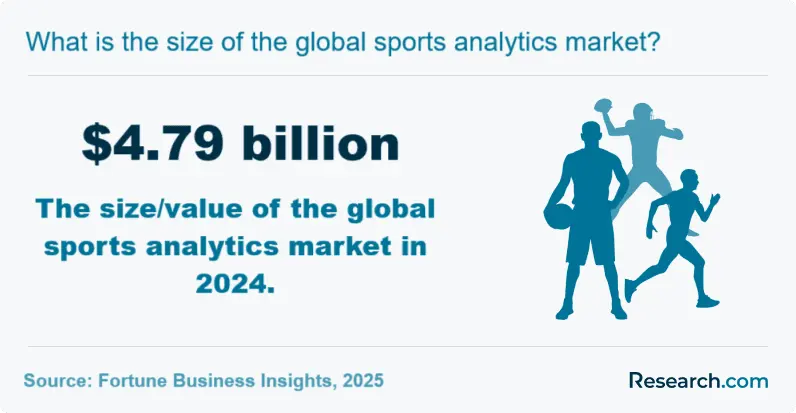
The image below shows the value of the global sports analytics market as of 2024.
Common Courses in an Online Master’s in Sports Analytics Program
Coursework usually blends statistics, data tools, sports performance, business applications, and applied research. The exact course names differ by school, but the goal is typically the same: prepare students to collect data, analyze it correctly, explain what it means, and recommend action.
| Course area | What students learn | Career relevance |
| Introduction to Sports Analytics | How data is used across professional, collegiate, and amateur sports | Gives students a shared foundation in sports analytics use cases |
| Statistical Methods and Data Analysis | How to collect, clean, analyze, and interpret data | Supports most analyst, reporting, and research roles |
| Predictive Modeling in Sports | How to forecast outcomes, player performance, and other measurable results | Useful for performance analysis, betting, scouting, and strategy roles |
| Data Visualization and Reporting | How to present insights through dashboards, charts, and reports | Helps analysts communicate clearly with coaches, executives, and nontechnical audiences |
| Performance Analysis and Player Evaluation | How to assess athletes using data-driven tools and performance indicators | Applies directly to team, training, and player development roles |
| Sports Technology and Data Tools | How to work with databases, software, tracking systems, and analytics platforms | Supports roles in sports tech, operations, and performance departments |
| Ethics and Data Privacy in Sports Analytics | How to handle athlete and organizational data responsibly | Important as wearable technology and sensitive performance data become more common |
| Capstone Project or Applied Research | How to solve a real or simulated sports analytics problem | Can become a portfolio piece for job applications |
If you decide you want a broader business analytics focus instead of a sports-specific degree, compare programs such as an affordable online MBA in data analytics.
How to Choose the Best and Fastest Online Master’s in Sports Analytics Program
The best accelerated program is not simply the shortest one. A strong choice should match your career goal, technical background, budget, learning style, and preferred area of sports analytics. As with the fastest online master's degree in management information systems, the goal is to move quickly without sacrificing the depth employers expect.
- Confirm accreditation first. Make sure the institution is accredited by a recognized accrediting body before comparing speed or cost.
- Match the curriculum to your target role. Performance analysts need different coursework than fan analytics, business intelligence, or sports betting analysts.
- Review the technical depth. Look for statistics, modeling, visualization, databases, and applied projects, not just general sports management courses.
- Check the schedule format. Ask whether classes are asynchronous, synchronous, cohort-based, self-paced, part-time, or full-time.
- Ask about portfolio-building work. Capstones, applied research, and real sports data projects can matter more in hiring than course titles.
- Compare total cost, not only tuition. Include fees, software, books, residency expenses, and whether financial aid is available.
- Look for career support and industry access. Faculty experience, alumni networks, employer relationships, internships, and career coaching can affect outcomes.
Students interested in the business side of competitive gaming may also explore a fast-track online esports business degree to understand how analytics, audience engagement, and digital competition intersect.
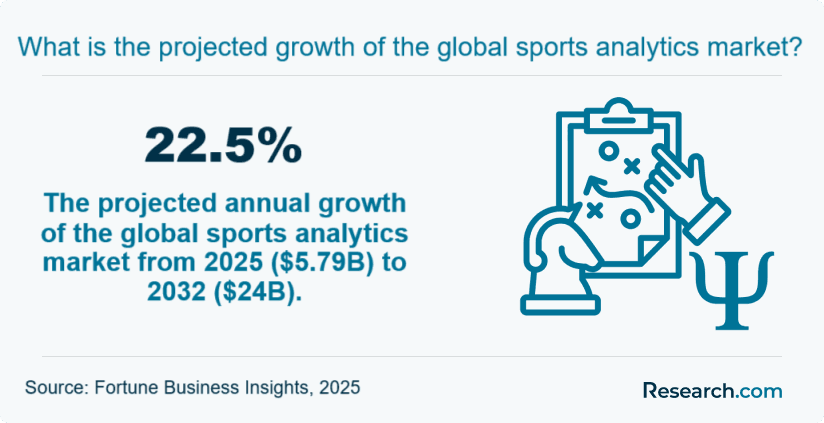
The image below shows that the global sports analytics market is projected to grow from a value of $5.79 billion in 2025 to $24 billion in 2032.
Is the Online Master’s in Sports Analytics Degree Accredited?
Accreditation is one of the first things to verify before enrolling. Institutional accreditation means the school has been reviewed for academic quality, faculty qualifications, student services, and administrative standards. It can also affect eligibility for federal financial aid, credit transfer, employer recognition, and future doctoral study.
Some sports-related programs may also hold specialized accreditation, such as sport management accreditation. However, not every strong analytics program will have the same programmatic accreditor, so students should evaluate both institutional accreditation and program quality. If you are comparing graduate business options by cost and credibility, Research.com’s guide to the cheapest MBA online may also be useful.
How Can Complementary Accelerated Degrees Broaden Career Opportunities?
A sports analytics master’s can be powerful on its own, but some students benefit from combining it with related credentials in business, technology, management, networking, or operations. The right complementary degree or certificate depends on the career path you want.
| If your goal is... | Consider adding skills in... | Why it helps |
| Sports leadership or executive roles | Management, finance, strategy, or MBA coursework | Analytics leaders must often explain data in business terms |
| Sports technology roles | Networking, databases, cloud tools, or cybersecurity | Teams and firms need people who understand the technical infrastructure behind data systems |
| Operations or facilities-related roles | Project management and operational planning | Analytics is increasingly used to improve scheduling, staffing, venue decisions, and logistics |
| Cross-industry flexibility | Business analytics, information systems, or data science | Transferable technical skills can help if sports roles are highly competitive |
For example, a 2 year construction management degree shows how accelerated study in another field can build managerial and technical perspective. The value comes from strategic fit, not from collecting unrelated credentials.
What Are the Common Challenges of Fast-Paced Online Master’s in Sports Analytics Programs?
Accelerated online programs can save time, but they are not easier. Students should understand the trade-offs before choosing the quickest option.
- Compressed workload: Short terms can mean frequent assignments, faster exams, overlapping projects, and less time to recover between courses.
- Limited spontaneous interaction: Online students may need to be intentional about joining discussions, contacting faculty, and building professional relationships.
- Technology dependence: Reliable internet, strong computer skills, and comfort with online platforms are essential.
- Variable student support: Career coaching, tutoring, library support, and advising can differ widely by school.
- Unclear career alignment: Some programs use the word analytics but may be more focused on management. Review syllabi before applying.
- Higher burnout risk: Students working full time should be realistic about weekly study demands before choosing a 12-month path.
Students who want broader leadership and strategy training may also compare the best online MBA programs alongside sports analytics options.
Traditional vs. Online Master’s in Sports Analytics
Traditional and online sports analytics master’s programs can cover similar academic content, but the learning experience differs. The better format depends on your schedule, learning preferences, need for campus access, and desire for in-person networking. Students comparing accelerated education options in other fields, such as the shortest online education specialist programs, should use the same logic: speed is valuable only when the delivery model fits your life.
| Factor | Online program | Traditional campus program |
| Class format | Virtual coursework, often with asynchronous or flexible components | In-person classes with scheduled campus attendance |
| Flexibility | Usually better for working professionals, parents, coaches, and students outside the school’s region | Usually better for students who can commit to a fixed location and schedule |
| Networking | Requires deliberate use of online discussions, faculty contact, alumni groups, and virtual events | Offers more informal in-person networking and campus involvement |
| Program duration | May offer accelerated tracks as short as 12 to 15 months | May offer full-time, part-time, or cohort formats, depending on the school |
| Cost considerations | May reduce commuting, relocation, and housing costs | May include campus-based costs, but can provide direct access to facilities and local networks |
If you are highly self-directed and need flexibility, online learning may be the better fit. If you learn best through in-person collaboration and want campus immersion, a traditional program may be worth the added logistical commitment.
Career Paths for Graduates With an Online Master’s in Sports Analytics
A sports analytics master’s can lead to technical, operational, performance, business, and consulting roles. The best career path depends on whether you want to work close to athletes and coaches, inside a team’s business office, at a sports technology company, or in a data-focused role that happens to serve the sports industry.
| Career path | What the role does | Skills to emphasize |
| Sports Data Analyst | Collects and interprets data to support team, coaching, player, or organizational decisions | Statistics, visualization, reporting, sports knowledge |
| Performance Analyst | Uses data to evaluate athlete development, training effectiveness, workload, and injury risk | Performance metrics, sports science, wearable data, communication with coaches |
| Sports Operations Analyst | Improves logistics, scheduling, staffing, resources, and team operations using data | Operations analysis, dashboards, process improvement |
| Business Intelligence Analyst | Analyzes fan behavior, revenue, marketing, ticketing, sponsorship, and business trends | Business analytics, SQL, dashboards, stakeholder communication |
| Data Scientist | Builds advanced models for performance, strategy, prediction, and decision-making | Machine learning, statistical modeling, programming, data engineering basics |
| Sports Technology Specialist | Works with software, tracking systems, wearables, and performance platforms | Technical troubleshooting, analytics tools, systems knowledge |
| Sports Betting or Fantasy Sports Analyst | Uses models and probability to support betting products, fantasy platforms, or content | Predictive analytics, probability, modeling, domain expertise |
| Consultant or Advisor | Provides data-backed recommendations to teams, brands, sponsors, or sports organizations | Client communication, research, analytics, business strategy |
Students who want stronger technology infrastructure skills can consider additional training, such as the shortest CCNA online training course, especially if they want to work with networks, data systems, or security in sports organizations.
If your main interest is sports management rather than analytics, compare online sports management degree programs before committing to a more data-heavy path.
The chart below shows the distribution of sports statisticians according to the industries where they work.
Job Outlook for Online Master’s in Sports Analytics Graduates
The outlook for sports analytics is positive, but the field is also competitive. Sports organizations are using more data in performance, fan engagement, media, betting, operations, and business strategy. At the same time, many sports analytics jobs receive large applicant pools, and some teams have small analytics departments.
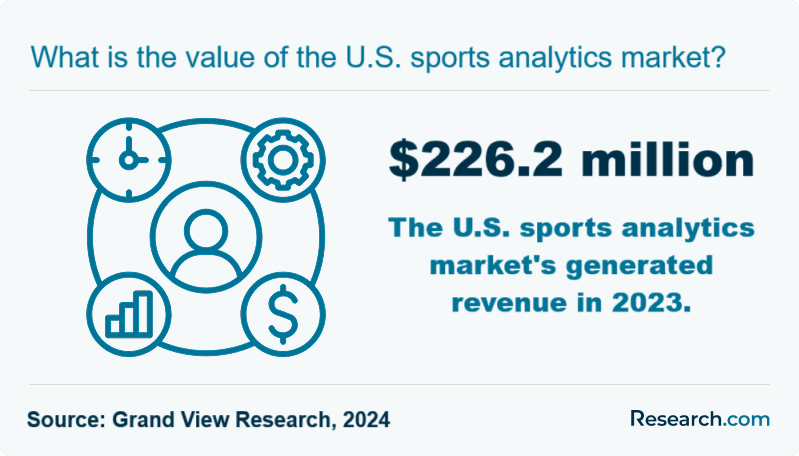
The global sports analytics market reached $4.79 billion in 2024 and is projected to grow from from USD 5.79 billion in 2025 to $24.03 billion by 2032, with an annual growth rate (CAGR) of 22.5%.
Reported sports analytics salary ranges include:
- Entry‑level analyst: $60K–$70K
- Mid‑level analyst: $80K–$95K
- Senior/lead roles: $100K–$150K+
- Senior leadership, including Director and Executive roles: up to $200K–$250K+
Sports data scientists average around $96K, while analysts across sectors earn $63K–$77K. However, sports-specific roles can sometimes pay less than comparable data science jobs outside sports. Graduates improve their odds by building a portfolio, completing applied projects, learning industry tools, networking consistently, and showing that they understand both analytics and the sports context.
Professionals who want to combine analytics with executive preparation may also compare accelerated online MBA sports management programs, which can be completed in as little as 12–18 months and may support advancement into leadership roles in sports organizations, agencies, and analytics firms.
If you are comparing other sports careers, Research.com’s guide to the sports psychologist job outlook can help you evaluate a different path in the sports industry.
Common Mistakes to Avoid When Choosing a Fast Online Sports Analytics Master’s
| Mistake | Why it can hurt you | Better approach |
| Choosing only the shortest program | A fast program may not have enough technical depth or applied work for your target role | Compare speed alongside curriculum, projects, faculty, and outcomes |
| Ignoring accreditation | Accreditation can affect financial aid, transfer credit, employer acceptance, and future study | Verify institutional accreditation before applying |
| Looking only at tuition | Fees, software, course materials, and hybrid requirements can change the real cost | Ask for the total estimated cost of attendance |
| Assuming all analytics programs are technical | Some programs are more focused on sports management than statistics or modeling | Review course descriptions and ask for sample syllabi |
| Skipping portfolio development | Employers often want proof that you can apply analytics to sports problems | Choose programs with capstones, applied projects, and real data assignments |
| Underestimating the workload | Accelerated terms can be difficult for students working full time | Ask current students or advisors about weekly time expectations |
| Relying only on rankings | A highly ranked program may not match your schedule, goals, or budget | Use rankings as a starting point, then evaluate fit |
Questions to Ask Before Enrolling
- Is the institution accredited by a recognized accrediting body?
- Can the degree be completed fully online, or are campus visits required?
- What is the fastest realistic completion timeline for a working student?
- How many courses must I take at once to finish in 12 to 15 months?
- Does the curriculum include statistics, modeling, programming, databases, and visualization?
- Will I graduate with a capstone project or portfolio-ready work?
- What software, tools, or programming languages are used in the program?
- Are internships, industry projects, or employer partnerships available?
- What is the total cost, including fees and technology expenses?
- What career services are available to online graduate students?
Current Trends Affecting Sports Analytics Degrees
Sports analytics programs are evolving because employers increasingly expect graduates to understand both data and the sports environment where that data will be used. AI, machine learning, wearable technology, and video-analysis tools are becoming more common in performance tracking, injury prediction, scouting, and tactical analysis. These tools do not replace the need for human judgment; they increase the need for analysts who can ask the right questions, validate data quality, and explain findings clearly.
The sports analytics market data cited above also points to growing investment in this field. Still, job seekers should be realistic. Sports remains a competitive industry, and many entry-level openings attract applicants with statistics, computer science, business analytics, coaching, or sports management backgrounds. A master’s degree can help, but hands-on experience and a strong portfolio are often essential.
References
- Fortune Business Insights. Sports Analytics Market Size, Share & Industry Analysis. fortunebusinessinsights.com.
- Sporting Reports. Sports Analytics Salary Elevates Earning Potential. sportingreports.com.
- The University of Kansas. Sports Analytics Jobs: How to Start Your Career. KU.
- Yellowbrick. Discover Lucrative Sports Data Scientist Jobs: A Comprehensive Overview. yellowbrick.co.
- Zippia. What is a Sports Statistician and How to Become One. zippia.com.
Key Insights
- The fastest online master’s in sports analytics programs can be completed in about 12 months, but accelerated pacing requires strong time management and consistent weekly effort.
- University of Mississippi, Lasell University, and Northeastern University offer some of the shortest stated completion timelines among the programs listed.
- Accreditation, curriculum quality, applied projects, and career support are more important than speed alone.
- Sports analytics careers can include performance analysis, data science, business intelligence, operations, sports betting, fantasy sports, consulting, and sports technology roles.
- Reported salary ranges are broad, from entry-level analyst ranges of $60K–$70K to senior leadership ranges of up to $200K–$250K+, but outcomes depend heavily on role, employer, skills, and experience.
- The global sports analytics market reached $4.79 billion in 2024 and is projected to grow from from USD 5.79 billion in 2025 to $24.03 billion by 2032, with a CAGR of 22.5%.
- Before enrolling, ask whether the program will help you build a portfolio with real sports data. In a competitive field, evidence of applied skill can matter as much as the degree itself.
Other Things You Should Know About the Fastest Online Master's in Sports Analytics Programs
Most accelerated online sports analytics master’s programs require a capstone that uses real team or league data to solve a performance, scouting, or business problem. It is often completed in the final term and may be worth 3 to 6 credits, with faculty or industry review before graduation.
The average course load for 2027 fast online master's programs in sports analytics typically ranges from 9 to 12 credit hours per semester. This accelerated pace requires a balanced time commitment to manage the intensive learning schedule effectively.


