
2027 Best Online Doctorate in Data Science Programs

Co-Founder and Chief Data Scientist
The market projects around 23,400 new data science leadership roles each year, yet many experienced professionals feel they’ve hit a ceiling, unable to make the leap into true strategic impact. You have the experience, but you need a definitive way to formalize your expertise and open the right doors.
Making that high-stakes decision is the hard part. The career planning experts who created this guide have over a decade of experience helping professionals choose the right online doctorate in data science. We’ve built this framework not just to list schools, but to help you find the one program that aligns perfectly with your goals.
What are the benefits of getting an online doctorate in data science program?
- You will qualify for top-tier leadership roles where you can drive innovation and strategy for major corporations or research institutions.
- The degree unlocks the highest salary potential in the field, where top earners with a doctorate can make up to $266,000 annually.
- An online doctorate in data science offers the flexibility to earn a terminal degree from a top university without having to pause your career or relocate.
What can I expect from an online doctorate in data science program?
You can expect a program that demands a significant multi-year commitment, centered on a major independent research project. This is the core of any doctoral study, whether it culminates in a traditional dissertation or an applied capstone project.
The curriculum is designed to provide rigorous academic training while also supporting professional application. Students engage in advanced coursework, research design, and methodological study, all of which prepare them to produce original scholarship or applied solutions that address complex challenges in the field of data science.
Where can I work with an online doctorate in data science program?
A doctorate in data science opens doors to leadership roles across the most influential sectors of the economy. Graduates are highly sought after in environments where deep expertise is needed to solve complex, large-scale problems.
- Technology Sector: Top tech companies like Google, Amazon, and Microsoft are major employers, with over 18% of data scientists working in the tech industry.
- Fortune 500 Companies: Large enterprises across retail, automotive, and manufacturing hire doctoral graduates to lead their in-house strategic analytics and R&D teams.
- Finance and Insurance: This sector is a major destination, employing nearly 17% of all data scientists to develop sophisticated models for risk management and investment strategies.
- Consulting Firms: Elite consulting firms hire graduates to advise C-suite clients on data-driven business transformation and corporate strategy.
- Public Sector and Research: Government agencies and national labs employ experts for critical work in areas like defense, intelligence, and public health policy.
How much can I make with an online doctorate in data science program?
While the average salary for a data scientist is around $165,018, several factors determine your specific earning potential. A doctorate gives you access to the highest end of this spectrum.
- Educational Attainment: A Ph.D. is the key that unlocks the highest salary tier, with top earners in the field reaching up to $266,000.
- Years of Experience: Your prior professional experience is highly valued and directly impacts your starting salary after graduation.
- Industry: Sectors like finance and technology typically offer higher compensation than academia or the public sector.
- Specialized Skills: Expertise in high-demand areas like artificial intelligence or cybersecurity can command a significant salary premium.
- Geographic Location: Salaries vary based on the cost of living and demand in major metropolitan tech hubs.
- List of the Best Online Doctorate in Data Science Programs for 2027 List of Programs
- How long does it take to complete an online doctorate in data science program? Completion Time
- How does an online doctorate in data science program compare to an on-campus program? How does an online doctorate in data science program compare to an on-campus program?
- What is the average cost of an online doctorate in data science program? Program Cost
- What are the financial aid options for students enrolling in an online doctorate in data science program? Financial Aid
- What are the prerequisites for enrolling in an online doctorate in data science program? What are the prerequisites for enrolling in an online doctorate in data science program?
- What courses are typically in an online doctorate in data science program? What courses are typically in an online doctorate in data science program?
- What types of specializations are available in an online doctorate in data science program? Specializations
- How to Choose the Best Online Doctorate in Data Science Program How to Choose the Best Online Doctorate in Data Science Program
- What career paths are available for graduates of an online doctorate in data science program? Career Paths
- What is the job market for graduates of an online doctorate in data science program? Job Market
Best Online Doctorate in Data Science Programs for 2027: A Practical Guide for Applicants
An online doctorate in data science is designed for experienced professionals who want to move from applying models and managing analytics projects into advanced research, senior technical leadership, university teaching, or executive-level data strategy. The decision is significant: doctoral study requires years of sustained research, careful funding planning, and a strong match between your goals and a program’s faculty expertise.
This guide explains how to compare online doctorate in data science programs, what they cost, how long they take, what admissions committees look for, and which career paths may follow. It also highlights common mistakes applicants make, including choosing a program without checking accreditation, underestimating the dissertation stage, or focusing on tuition without considering total value.
Quick answer: Is an online doctorate in data science worth it?
An online doctorate in data science can be worth it if you already have strong quantitative preparation and want to qualify for research, academic, senior consulting, AI leadership, or high-level data strategy roles. It is usually not the fastest route into data science; students who want entry-level technical employment may be better served by a master’s degree, graduate certificate, or bootcamp. The best program is the one that matches your research interests, career direction, budget, schedule, and accreditation needs.
| Best fit | Consider another path if |
| You want to lead original research, publish, teach, or direct enterprise data strategy. | You mainly need practical coding, dashboarding, or machine learning implementation skills. |
| You can commit several years to coursework, exams, and dissertation research. | You need a short credential to change jobs quickly. |
| Your career goals require doctoral-level credibility or research training. | A master’s degree already meets your target employer’s requirements. |
| You have a clear research area and can identify faculty whose work aligns with it. | You are unsure what problem you want to study or what specialization fits your career. |
How Research.com evaluates programs
Because doctoral tuition can be a major financial commitment, program comparisons should rely on clear and verifiable information. Research.com uses data sources such as the IPEDS database, Peterson's database, the College Scorecard database, and The National Center for Education Statistics to support program evaluation.
These sources help provide context on institutional characteristics, costs, outcomes, and other school-level indicators. For a fuller explanation of how programs are assessed, visit Research.com’s methodology page.
Online doctorate in data science programs at a glance
| School | Program | Length | Credits | Listed cost | Accreditation listed |
| National University | Doctor of Philosophy in Data Science (PhD-DS) | 40 to 49 months | 60 quarter credits | $1,153.58 per quarter credit | Western Association of Schools and Colleges Senior College and University Commission (WSCUC) |
| Capitol Technology University | Doctor of Philosophy (PhD) in Business Analytics and Data Science | 3 to 4 years | 66 credits | $975.00 per credit | Middle States Commission on Higher Education (MSCHE) |
| Eastern University | PhD in Applied Data Science | ~ 2 years | 30 credits | $450.00 per credit | Middle States Commission on Higher Education (MSCHE) |
| Arizona State University | Data Science, Analytics and Engineering, PhD | 48 to 72 months | 84 credits | $605.00 per credit | Higher Learning Commission (HLC) |
| Harrisburg University of Science and Technology | Doctoral Degree Data Sciences Ph.D. | 3 to 5 years | 36 credits | $955.00 per credit | Middle States Commission on Higher Education (MSCHE) |
| East Bridge University | Applied Doctorate in Data Science | ~ 36 months | 180 credits | $3,000.00 total tuition | Education Quality Accreditation Commission (EQAC) |
| University of North Texas | Information Science Ph.D. With a Concentration in Data Science | ~ 3 to 4 years | 72 credits | $227.79 per credit | Southern Association of Colleges and Schools Commission on Colleges (SACSCOC) |
| Florida Atlantic University | Professional PhD Degree Program in Computer Science: Data Science and Analytics (DSA) Concentration | ~ 3 years | 42 credits | $800.00 per credit | Accreditation Board for Engineering and Technology (ABET) |
1. National University - Doctor of Philosophy in Data Science (PhD-DS)
National University offers a doctoral program that combines advanced theory with applied data science practice. Its curriculum is built around areas such as data mining, machine learning, and artificial intelligence, while also connecting analytical work to industry frameworks such as CRISP-DM.
- Program Length: 40 to 49 months
- Required Quarter Credits to Graduate: 60
- Cost per Quarter Credit: $1,153.58
- Accreditation: Western Association of Schools and Colleges Senior College and University Commission (WSCUC)
2. Capitol Technology University - Doctor of Philosophy (PhD) in Business Analytics and Data Science
Capitol Technology University structures its program for experienced professionals who want to move into high-level analytics, business intelligence, or data-informed leadership roles. The low-residency model is intended to support working students while emphasizing applied research, advanced technical judgment, and decision-making in public and private organizations.
- Program Length: 3 to 4 years
- Required Credits to Graduate: 66
- Cost per Credit: $975.00
- Accreditation: Middle States Commission on Higher Education (MSCHE)
3. Eastern University - PhD in Applied Data Science
Eastern University focuses its PhD in Applied Data Science on interdisciplinary research, applied problem-solving, and socially responsible analytics. Students develop advanced statistical, computational, and ethical research skills while preparing to contribute original scholarship to the field.
- Program Length: ~ 2 years
- Required Credits to Graduate: 30
- Cost per Credit: $450.00
- Accreditation: Middle States Commission on Higher Education (MSCHE)
4. Arizona State University - Data Science, Analytics and Engineering, PhD
Arizona State University offers a research-oriented doctorate with specialization options in data engineering or data analytics. The program includes advanced work in data processing, security, statistical learning, and dissertation research that is expected to add new knowledge to the discipline.
- Program Length: 48 to 72 months
- Required Credits to Graduate: 84
- Cost per Credit: $605.00
- Accreditation: Higher Learning Commission (HLC)
5. Harrisburg University of Science and Technology - Doctoral Degree Data Sciences Ph.D.
Harrisburg University organizes its Data Sciences Ph.D. around broad methodological training followed by focused dissertation research. The program is intended for students who want a strong scientific foundation across data science approaches before narrowing into an original research topic.
- Program Length: 3 to 5 years
- Required Credits to Graduate: 36
- Cost per Credit: $955.00
- Accreditation: Middle States Commission on Higher Education (MSCHE)
6. East Bridge University - Applied Doctorate in Data Science
East Bridge University offers an Applied Doctorate in Data Science that emphasizes the use of advanced data methods to address professional and industry problems. Because accreditation recognition can vary by employer, country, and credential evaluator, applicants should confirm whether the listed accreditation meets their career, academic, or immigration-related goals before enrolling.
- Program Length: ~ 36 months
- Required Credits to Graduate: 180
- Total Tuition: $3,000.00
- Accreditation: Education Quality Accreditation Commission (EQAC)
7. University of North Texas - Information Science Ph.D. With a Concentration in Data Science
The University of North Texas offers a data science concentration within an Information Science Ph.D. The program draws from information technology, decision sciences, and computer science to help students study how large-scale data can be organized, analyzed, and converted into usable insight.
- Program Length: ~ 3 to 4 years
- Required Credits to Graduate: 72
- Cost per Credit: $227.79
- Accreditation: Southern Association of Colleges and Schools Commission on Colleges (SACSCOC)
8. Florida Atlantic University - Professional PhD Degree Program in Computer Science: Data Science and Analytics (DSA) Concentration
Florida Atlantic University designs its professional PhD option for working professionals who need flexible evening, weekend, and online formats. The Data Science and Analytics concentration combines advanced computing preparation with doctoral research in a specialized data science area.
- Program Length: ~ 3 years
- Required Credits to Graduate: 42
- Cost per Credit: $800.00
- Accreditation: Accreditation Board for Engineering and Technology (ABET)
How Long Does an Online Doctorate in Data Science Take?
Most online doctorate in data science programs take three to five years, although the exact timeline depends on enrollment intensity, transfer credit policies, residency requirements, research progress, and dissertation expectations. Programs built for full-time students may move faster, while part-time formats often give working professionals more flexibility at the cost of a longer completion window.
The dissertation or applied doctoral research project is usually the biggest timing variable. Coursework follows a schedule, but original research requires topic approval, literature review, methodology development, data work, faculty feedback, revisions, and a final defense. Students who do not plan this stage carefully may complete coursework but stall before finishing the dissertation.
If you are not yet ready for doctoral-level research, a graduate program such as one of the best online master's degree database management options can help build the technical and analytical base needed for future doctoral work.
The chart below shows that 13% of data scientists who hold a doctorate have completed this demanding path, underscoring the level of persistence required to reach the highest academic credential in the field.
Online vs. On-Campus Doctorate in Data Science: Which Format Fits Your Goals?
An online doctorate from a properly accredited university can carry the same academic credential as an on-campus doctorate, but the learning experience is different. The better choice depends on how you work, how much structure you need, whether you can relocate, and what type of research community helps you stay productive.
| Factor | Online doctorate | On-campus doctorate |
| Schedule | Often better for employed professionals who need to study around work and family responsibilities. | Often better for students who can make doctoral study their main daily commitment. |
| Networking | Usually built through virtual seminars, research groups, cohort projects, and planned faculty meetings. | Often happens through labs, department events, office visits, and informal campus interactions. |
| Research access | Works best when projects can be completed remotely with digital tools, online datasets, or employer-supported research. | May be stronger for students who need physical labs, specialized equipment, or frequent face-to-face collaboration. |
| Cost considerations | May reduce relocation and commuting costs, though tuition and fees still vary widely. | May involve relocation, campus fees, commuting, and possible changes to employment. |
| Best for | Working professionals, managers, consultants, and students who need geographic flexibility. | Students seeking a traditional academic environment with daily access to campus resources. |
When an online doctorate makes sense
Online doctoral study is usually the stronger fit if you need to continue working, cannot relocate, or want to research a problem connected to your current industry. The trade-off is that you must be disciplined about communication, research milestones, and time management. If your main goal is faster skill development rather than doctoral research, a fast track master's in data science online may be more practical.
When an on-campus doctorate may be better
An on-campus program may be preferable if you want daily faculty access, a research assistantship tied to a lab, frequent academic events, or a stronger separation between home and study. This route can also be useful for students targeting traditional academic careers where in-person research communities and teaching opportunities are especially important.
How Much Does an Online Doctorate in Data Science Cost?
The average total tuition for an online doctorate in data science is approximately $35,000, but actual costs vary substantially by school, credit requirements, public or private status, residency rules, and fees. Applicants should calculate the full cost of attendance rather than comparing tuition alone.
Budget planning should include technology fees, online platform charges, books or software, possible travel for residencies, dissertation continuation fees, and the opportunity cost of time spent studying. A low advertised tuition can be appealing, but unusually inexpensive programs deserve extra scrutiny for accreditation, faculty qualifications, student support, and employer recognition.
Career return should also be evaluated carefully. Data science appears among the highest paid doctorate degrees, but individual salaries depend on role, employer, location, experience, industry, and leadership scope. No program can guarantee a specific compensation outcome.
| Cost factor | Why it matters | Question to ask |
| Tuition structure | Quarter-credit, semester-credit, and total-program pricing can make programs difficult to compare. | What is the estimated total tuition from enrollment through graduation? |
| Residency requirements | Short campus visits may add travel, lodging, and time-away-from-work expenses. | Are any in-person sessions required, and what do students typically spend on them? |
| Dissertation fees | Students who need extra time may continue paying registration or research fees. | What fees apply after coursework is complete? |
| Employer support | Tuition assistance can reduce out-of-pocket cost significantly. | Will my employer reimburse doctoral coursework, and are there service commitments? |
| Financial aid eligibility | Accreditation and enrollment status may affect aid options. | Does the program qualify for the funding sources I plan to use? |
Financial Aid Options for Online Doctorate in Data Science Students
With the average graduate student debt reaching over $240,000 for a doctorate, funding should be part of your program-selection process from the beginning. Start by comparing total program cost, then look for ways to reduce borrowing before committing.
- Federal Student Loans: Completing the Free Application for Federal Student Aid (FAFSA) is the standard first step for students who want to be considered for federal options such as Direct Unsubsidized Loans and Grad PLUS Loans.
- Private and Institutional Scholarships: Universities may offer doctoral scholarships, and external organizations sometimes fund students based on research area, academic merit, or professional background.
- Employer Tuition Assistance: Many professionals pursue this degree while employed, so employer reimbursement can be one of the most valuable funding sources if your company supports graduate study.
- Research Assistantships: Some online doctoral students may be able to assist faculty with funded research, which can provide compensation or tuition support depending on the institution.
- Teaching Assistantships: Teaching-related roles may help offset expenses while also building experience for students interested in academic careers.
Admissions Requirements for an Online Doctorate in Data Science
Doctoral admissions committees are not only checking whether you can complete difficult coursework. They are also evaluating whether you are ready to conduct independent research, work with faculty, and contribute to a defined area of data science.
- Master's Degree: Most applicants are expected to have a master’s degree in a quantitative discipline such as computer science, statistics, mathematics, engineering, or a closely related field.
- Relevant Work Experience: Professional experience using analytics, machine learning, statistics, or data systems can strengthen an application, especially for applied or professional doctorate formats.
- Statement of Purpose: This essay should explain your research interests, career goals, preparation, and reasons for choosing the specific program and faculty.
- Letters of Recommendation: Strong recommendations should come from people who can evaluate your technical ability, research potential, leadership, and readiness for doctoral-level work.
- GRE/GMAT Scores: Some universities still ask for standardized test results, while others waive them, so applicants should verify each school’s current policy.
Applicants from fields such as physics, mathematics, engineering, and other quantitative disciplines may be competitive even if their background is not labeled “data science.” If you need additional computing preparation before doctoral study, one of the shortest online bachelor's programs in computer science may help address foundational gaps.
| Applicant profile | Likely strength | Possible gap to address |
| Experienced data scientist | Applied modeling, programming, and business problem-solving | Research design, theory, and dissertation focus |
| Software engineer | Systems, coding, data pipelines, and technical implementation | Statistics, causal inference, and research methods |
| Statistician or mathematician | Quantitative theory and modeling depth | Large-scale computing, machine learning systems, or production workflows |
| Analytics manager | Leadership, strategy, stakeholder communication, and applied decision-making | Advanced technical currency and original research framing |
Common Courses in an Online Doctorate in Data Science
Doctoral coursework in data science goes beyond learning tools. The goal is to prepare students to evaluate existing research, design rigorous studies, build or improve methods, and defend original contributions to the field.
- Advanced Machine Learning Theory: Students examine the statistical and mathematical foundations of algorithms rather than only using prebuilt software libraries.
- Advanced Statistical Modeling: Topics may include Bayesian inference, causal modeling, experimental design, and other high-level approaches to uncertainty and evidence.
- Research Methodologies: These courses teach students how to form researchable questions, review scholarship, select methods, analyze evidence, and design defensible studies.
- Data Ethics and Governance: Doctoral students study privacy, fairness, accountability, bias, transparency, and the broader social consequences of large-scale analytics and AI.
- Dissertation/Research Seminars: Seminar courses help students refine topics, receive critique, prepare proposals, and move steadily toward dissertation completion.
Some professionals combine doctoral study with shorter skills-focused options when they need to update a toolset quickly. For example, the fastest online data science bootcamps can be useful for targeted practice in a programming language, platform, or applied workflow.
Data Science Doctorate Specializations to Consider
Your specialization shapes your dissertation, faculty advisor match, publication opportunities, and post-graduation career positioning. Choose it based on the problems you want to solve, not only on what sounds marketable.
| Specialization | Good fit for | Decision point |
| Cybersecurity Analytics | Professionals interested in threat detection, anomaly analysis, risk modeling, and secure data systems. | Decide whether you need industry certifications in addition to doctoral research training. |
| Artificial Intelligence and Machine Learning | Students who want to study deep learning, natural language processing, computer vision, or advanced predictive systems. | Look closely at faculty research depth and computing resources. |
| Business Analytics and Intelligence | Managers, consultants, and strategists who want to use analytics for executive decision-making. | Make sure the program supports applied research tied to organizational problems. |
| AI Ethics and Governance | Students focused on responsible AI, policy, fairness, accountability, and risk management. | Check whether the curriculum includes ethics, law, governance, and technical evaluation methods. |
| Health Informatics | Professionals interested in healthcare data, patient outcomes, hospital operations, and biomedical research. | Confirm whether the program provides healthcare context as well as technical training. |
- Cybersecurity Analytics: This track applies advanced analytics and machine learning to security threats, vulnerabilities, and critical infrastructure protection. Students considering this direction may also compare how much are cyber security certifications to decide whether credentials such as CISSP, CEH, or Security+ fit their career plans.
- Artificial Intelligence and Machine Learning: This broad specialization covers areas such as deep learning, natural language processing, computer vision, and algorithmic innovation.
- Business Analytics and Intelligence: This path suits professionals who want to connect data science with strategy, finance, operations, and senior organizational decision-making.
- AI Ethics and Governance: As AI adoption grows, organizations need experts who can create responsible frameworks for privacy, fairness, accountability, and risk control.
- Health Informatics: This specialization applies analytics and AI to healthcare delivery, hospital operations, patient outcomes, and biomedical discovery. Students sometimes ask whether is health information technology a difficult degree because it combines healthcare knowledge with technical work, but many programs introduce the material in stages for working professionals.
Specialization choices can influence future opportunities and compensation. The chart below shows how particular skills may affect salary. Professionals interested in cybersecurity often add practical training, such as CyberOps training bootcamps online, to complement doctoral-level study.
How to Choose the Best Online Doctorate in Data Science Program
Rankings can help you build a shortlist, but they should not make the decision for you. At the doctoral level, the most important questions are whether the program supports your research interests, whether you can realistically finish, and whether the credential will be recognized by your target employers or academic institutions.
Step-by-step selection process
- Define your end goal. Decide whether you want a university faculty role, corporate research role, senior analytics leadership position, consulting path, or specialized AI/data science role.
- Identify your research area. Write down the problems, datasets, industries, or methods you want to study before reviewing programs.
- Match with faculty. Look for faculty members publishing in areas close to your interests, then evaluate whether they advise online doctoral students.
- Verify accreditation. Confirm institutional accreditation and, when relevant, programmatic accreditation or employer recognition.
- Compare total cost. Include tuition, fees, residencies, software, books, travel, and potential dissertation continuation charges.
- Ask about dissertation support. Strong advising, milestone tracking, research seminars, and feedback systems can make a major difference in completion.
- Review flexibility carefully. Check synchronous meeting times, residency dates, workload expectations, and whether part-time enrollment is allowed.
- Speak with current students or alumni. Ask about faculty access, workload, research support, and career outcomes rather than relying only on marketing material.
Questions to ask before enrolling
| Question | Why it matters |
| Which faculty members could supervise my intended research topic? | A poor advisor match can delay or derail dissertation progress. |
| How are online doctoral students supported during the dissertation phase? | The dissertation is often where timelines expand. |
| What percentage of students complete the program, and how long do they usually take? | Completion patterns reveal whether the program structure is realistic. |
| Are residencies required? | Travel can affect cost, work scheduling, and family planning. |
| What funding is available specifically for online doctoral students? | Some aid opportunities are limited by program format or enrollment status. |
| Where are graduates employed? | Outcomes should align with your target career path. |
Common mistakes to avoid
- Choosing by tuition alone: Low cost does not guarantee quality, support, recognition, or completion value.
- Ignoring accreditation: Accreditation affects aid eligibility, credit transfer, employer acceptance, and academic credibility.
- Assuming online means easier: Online doctoral work still requires advanced research, writing, independent study, and sustained faculty engagement.
- Applying without a research fit: A strong GPA or résumé cannot replace alignment with faculty expertise.
- Underestimating the dissertation: Coursework is only part of the program; the research phase often determines the true timeline.
- Relying only on rankings: A highly ranked program may still be wrong for your schedule, budget, specialization, or advisor needs.
Career Paths for Online Doctorate in Data Science Graduates
A doctorate in data science can prepare graduates for senior roles that require advanced technical knowledge, research ability, leadership, and strategic judgment. The degree is most useful for positions where you are expected to design new approaches, lead teams, guide organizational data policy, or produce original scholarship.
| Career path | Core responsibility | Median salary listed |
| Chief Data Scientist | Sets data science strategy and leads teams, research priorities, and enterprise analytics direction. | $195,000 per year. |
| Director of AI/Machine Learning | Oversees AI and machine learning initiatives from research through deployment. | $210,000 per year. |
| Principal Research Scientist | Leads advanced research projects in corporate labs, research institutions, or technical organizations. | $185,000 per year. |
| Senior Data Science Consultant | Advises organizations on complex analytics, AI, and data strategy problems. | $170,000 per year. |
| University Professor | Teaches, publishes research, mentors students, and contributes to academic service. | $145,000 per year. |
1. Chief Data Scientist
A chief data scientist shapes an organization’s data science roadmap, builds high-performing technical teams, evaluates research priorities, and connects analytics initiatives to measurable business or mission outcomes.
Median salary: $195,000 per year.
2. Director of AI/Machine Learning
This leadership role manages the design, development, deployment, and governance of artificial intelligence and machine learning systems. It requires both technical depth and the ability to identify where AI can create practical value.
Median salary: $210,000 per year.
3. Principal Research Scientist
Principal research scientists lead complex, long-term research efforts in corporate R&D, government, or research institutions. Their work may involve developing new methods, publishing findings, or creating proprietary technology.
Median salary: $185,000 per year.
4. Senior Data Science Consultant
Senior consultants help executives solve difficult analytics and AI problems. Success in this role depends on technical credibility, business judgment, and the ability to explain advanced methods clearly to nontechnical decision-makers.
Median salary: $170,000 per year.
5. University Professor
A Ph.D. is commonly required for tenure-track academic roles. Professors conduct and publish research, teach courses, advise students, seek funding, and contribute to their departments and professional fields.
Median salary: $145,000 per year.
The chart below highlights industries where data science leadership roles appear. Even after earning a doctorate, many professionals keep updating their skills through shorter credentials such as an accelerated data analytics graduate certificate online.
Job Market Outlook for Doctorate in Data Science Graduates
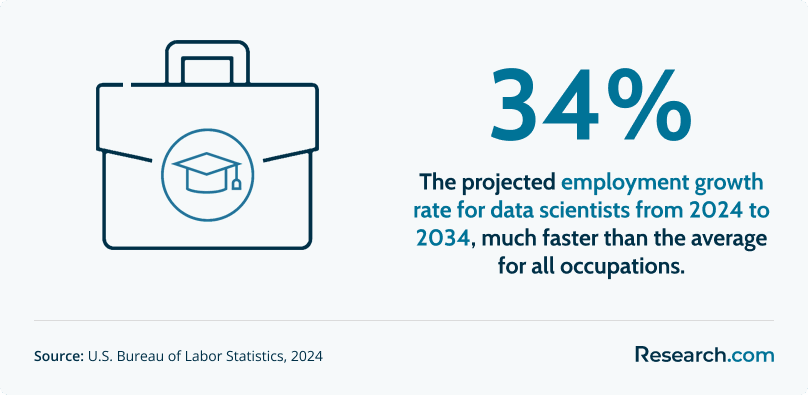
The labor market for data scientists remains strong. The U.S. Bureau of Labor Statistics projects that employment for data scientists will grow by 34% over the next decade, much faster than the average for all occupations.
For doctoral graduates, the strongest opportunities are often in roles that combine analytics leadership, research design, AI strategy, governance, and cross-functional influence. Employers increasingly need professionals who can ask the right research questions, evaluate model risk, communicate uncertainty, and translate technical findings into organizational action.
AI is also changing what employers expect. Routine modeling and reporting tasks are becoming more automated, which makes doctoral-level skills in research judgment, causal reasoning, ethics, governance, and advanced methodology more valuable. A doctorate does not replace the need for practical experience, but it can strengthen a candidate’s profile for roles where original thinking and technical leadership matter.
What Graduates Say About Online Doctorate in Data Science Programs
- Chloe: "I came from experimental physics and was unsure whether my background would translate into data science research. My advisor helped me turn that quantitative training into an advantage. The dissertation was the most difficult academic project I have completed, but it helped me earn the credibility to lead our R&D work and publish results."
- Jaysen: "Before the doctorate, I had years of management experience but was still focused on execution. The program changed how I approached strategy, risk, and the business value of data. After finishing, I moved into a director role and began leading the initiatives I had previously supported from the sidelines."
- Olivia: "With a demanding job and two young children, relocating for a doctorate was not realistic. The online format made it possible, although it still required late nights, weekend research blocks, and a lot of discipline. I was able to keep working while finishing a goal I had postponed for years."
Key Insights
- An online doctorate in data science is best for advanced goals, not entry-level training. It is most useful for research, AI leadership, senior analytics strategy, consulting, or academic careers.
- Program fit matters more than rankings alone. Faculty alignment, dissertation support, accreditation, research focus, and schedule flexibility should drive your decision.
- Most programs require a multi-year commitment. Many online doctorates take three to five years, and the dissertation stage is often the biggest source of delay.
- Costs vary widely. The average total tuition for an online doctorate in data science is approximately $35,000, but applicants should compare full costs, including fees, residencies, and dissertation continuation expenses.
- Accreditation should be verified before enrollment. Make sure the institution’s accreditation is recognized by financial aid providers, employers, licensing or credential evaluators, and academic institutions relevant to your goals.
- Career outcomes depend on more than the degree. Experience, specialization, industry, leadership ability, and technical currency all affect advancement and salary.
- The job outlook is favorable, but expectations are rising. With data scientist employment projected to grow by 34% over the next decade, doctoral graduates who combine research depth with practical leadership and AI governance skills may be especially well positioned.
References:
- Bureau of Labor Statistics. (2023). Occupational employment and wages: Data scientists. Retrieved from BLS.
- Coursera. (2024). Data scientist salary: Your 2024 guide. Retrieved from Coursera.
- Education Data Initiative. (2023). Average graduate student loan debt. Retrieved from EducationData.
- National Center for Science and Engineering Statistics. (2024). Doctorate recipients from U.S. universities: 2022. Retrieved from NCSES.
- PayScale. (2024). Data scientist salary. Retrieved from PayScale.
- Stitch Data. (2024). The state of data science. Retrieved from Stitch Data.
- World Population Review. (2024). PhD percentage by country. Retrieved from World Population Review.
- ZipRecruiter. (2024). Data scientist PhD salary. Retrieved from ZipRecruiter.
- Zippia. (2024). Data scientist demographics. Retrieved from Zippia.
- Zippia. (2024). Data scientist education. Retrieved from Zippia. Additional source record: Zippia education data.
Other Things You Should Know About Online Doctorate in Data Science Programs
Most 2027 online doctorate in data science programs require a dissertation or applied doctoral project based on original research. Typical milestones include a proposal, committee approval, defense, and final submission. Many programs expect the work to be completed over 1 to 3 years within a 3- to 5-year degree plan.
In 2027, most online doctorate in data science programs require students to have at least one peer-reviewed publication before graduation. This involves conducting original research, often under faculty supervision, and adhering to specific academic journal standards set by the program.
The average duration to complete a 2027 online doctorate in data science program is typically 3 to 5 years. This varies based on factors such as the student's enrollment status, pace, and selected program structure, which can be part-time or full-time.


