
2027 Fastest Online Master’s in Artificial Intelligence Programs

Co-Founder and Chief Data Scientist
Choosing a fast online master’s in artificial intelligence is not just about finding the shortest program. The real question is whether the degree can help you build advanced AI skills quickly without sacrificing academic quality, project experience, employer recognition, or long-term career value. This matters because AI-related job postings are projected to grow by 21% between 2024 and 2034, and employers increasingly expect candidates to understand machine learning, data systems, ethical AI, and real-world model deployment.
This guide is designed for working professionals, technical graduates, career changers with strong quantitative backgrounds, and students comparing accelerated online AI master’s programs. You will learn how fast these programs can be completed, what they cost, what admissions requirements to expect, how online and campus formats differ, which specializations are available, and how to evaluate whether a program is worth the investment.
Quick Answer: Is a Fast Online Master’s in Artificial Intelligence Worth Considering?
A fast online master’s in artificial intelligence can be a strong option if you already have programming, math, or technical experience and want graduate-level AI training without leaving your job. Many programs take 12 to 24 months, require about 30 to 36 credits, and include courses in machine learning, deep learning, natural language processing, computer vision, ethics, and applied capstone work. The best choice is usually not the shortest program, but the one that combines speed, accreditation, hands-on projects, relevant electives, and credible career support.
What are the main advantages of earning an online master’s in artificial intelligence?
- An online AI master’s degree can prepare graduates for advanced work in machine learning engineering, AI development, data analytics, model evaluation, and AI-driven product development across several industries.
- Professionals with a master’s in artificial intelligence earn an average annual salary of approximately $102,848, although actual pay depends heavily on role, employer, location, technical depth, and prior experience.
- Online delivery gives students more control over when and where they study, which can make graduate education more realistic for professionals managing full-time work, family responsibilities, or relocation constraints.
What should students expect from a fast-track online AI master’s program?
A fast-track online master’s in artificial intelligence is usually built around a compressed graduate curriculum that covers machine learning, data science, programming for AI, deep learning, responsible AI, and applied model development. Many programs also require a capstone, thesis, or portfolio project so students can demonstrate that they can use AI methods to solve practical problems rather than only explain theory.
Students should expect a rigorous pace. Accelerated terms may require weekly coding assignments, model-building labs, technical papers, group projects, and cloud-based experimentation. Some programs include internship opportunities or industry-sponsored projects, while others rely on virtual labs, simulated datasets, and faculty-guided capstones.
Tuition commonly ranges from $27,000 to $45,000, depending on the school, number of credits, and tuition rate. Many online AI master’s programs use asynchronous coursework, but students should still confirm whether exams, live sessions, capstone meetings, or group work require attendance at specific times.
Where can graduates work after completing an online master’s in artificial intelligence?
An online master’s in artificial intelligence can lead to roles that involve building, evaluating, deploying, or managing AI systems. Graduates often work with machine learning models, natural language tools, computer vision systems, predictive analytics platforms, decision-support applications, or AI governance processes.
Common employment settings include the following:
- Professional Services (20%): Consulting firms and advisory organizations hire AI graduates to help clients evaluate AI use cases, improve operations, automate workflows, and design analytics strategies.
- Technology (20%): Software companies, platform providers, AI labs, and automation firms employ graduates in areas such as model development, AI infrastructure, robotics, and product innovation.
- Education (15%): Universities, research centers, and education technology organizations use AI expertise for research, curriculum design, learning analytics, and instructional tools.
- Government (10%): Public agencies need AI professionals for cybersecurity, defense analytics, fraud detection, public service optimization, and policy-related data analysis.
- Start-ups (10%): Early-stage companies often need AI talent to prototype products, automate business processes, test models, and turn data into marketable tools.
- Fortune 500 Companies (10%): Large organizations hire AI specialists for enterprise analytics, digital transformation, customer intelligence, supply chain optimization, and internal AI governance.
How much can someone earn with a master’s in artificial intelligence?
A master’s in artificial intelligence may support access to higher-paying technical roles, but salary outcomes are never guaranteed. Pay varies by job title, technical specialization, years of experience, region, industry, employer size, and whether the role involves research, engineering, leadership, or product ownership.
- Average Salary: Professionals with a master’s in artificial intelligence earn an average annual salary of approximately $102,848, or about $49.47 per hour.
- Location: AI engineers in San Francisco can earn around $164,499 annually, while those in Columbus, OH, earn approximately $103,974 on average.
- Experience Levels: Professionals with less than one year of experience earn about $103,140 annually, while those with more than 15 years of experience can earn up to $185,709 per year.
- Industry Variations: AI engineers in technology earn an average of $135,000 per year, while professionals in finance and healthcare can earn up to $162,000 annually.
- Advanced Degrees and Specializations: Professionals with advanced skills in machine learning, natural language processing, robotics, or similar areas may earn over $150,000 annually in some roles.
- Fastest Online Master’s in Artificial Intelligence Programs for 2027
- How long does an online master’s in artificial intelligence take?
- Online vs. on-campus AI master’s programs: which format fits best?
- How much does an online master’s in artificial intelligence cost?
- What financial aid can AI master’s students use?
- What admissions prerequisites do online AI master’s programs require?
- What courses are included in an online AI master’s curriculum?
- Which AI specializations are available?
- How to choose the best online master’s in artificial intelligence program
- What is the return on investment for an online master’s in artificial intelligence?
- How do accreditation and quality benchmarks affect online AI master’s programs?
- What careers can graduates pursue after an AI master’s program?
- What is the job market for AI master’s graduates?
- How does an online AI master’s compare with an accelerated CS degree? Common mistakes to avoid before enrolling
Fastest Online Master’s in Artificial Intelligence Programs for 2027
The programs below are designed for students who want graduate AI training in an online or flexible format. Use the list as a starting point, then compare each school’s curriculum, capstone requirements, admissions expectations, tuition, and support services. A fast AI degree should be evaluated differently from unrelated accelerated options such as fast-track special education master’s programs online, because AI programs require substantial technical preparation and hands-on computing work.
How are these programs ranked?
Research.com builds rankings using a data-focused process intended to make program comparisons clearer for prospective students. Sources include the IPEDS database, Peterson’s database, the College Scorecard database, and The National Center for Education Statistics.
These sources help identify online AI master’s programs using verified institutional and program-level information. Readers who want to understand the ranking process in more detail can review Research.com’s methodology page.
1. University of Washington – Seattle Campus
The University of Washington - Seattle Campus offers a master of science in artificial intelligence and machine learning for engineering through a stackable certificate structure. Students can complete the program online or in a hybrid format, with coursework focused on applied AI and machine learning in engineering contexts. The curriculum includes domain electives and a two-quarter applied capstone intended to help students connect AI methods with engineering analytics and systems work.
- Program Length: 24-36 months
- Cost: $1,200 per credit hour
- Total Credits: 36
- Accreditation: Northwest Commission on Colleges and Universities (NWCCU)
2. Johns Hopkins University
Johns Hopkins University provides a fully online, part-time master of science in artificial intelligence for engineers and technical professionals. The 10-course program combines theoretical foundations with applied study in machine learning, natural language processing, image processing, robotics, and related AI areas. Graduates may use the degree to pursue roles such as AI engineer, data scientist, NLP specialist, or systems architect.
- Program Length: 24-36 months
- Cost: $1,756 per credit hour
- Total Credits: 30
- Accreditation: Middle States Commission on Higher Education (MSCHE)
3. Rochester Institute of Technology
The online master of science in artificial intelligence at Rochester Institute of Technology is designed to build interdisciplinary AI knowledge for students from varied academic backgrounds. Coursework covers AI theory, ethics, machine learning, research methods, and electives, ending with a capstone or optional thesis. The program can support preparation for AI-focused roles in technology, healthcare, engineering, and related fields.
- Program Length: 24 months
- Cost: $2,257 per credit hour
- Total Credits: 30
- Accreditation: Middle States Commission on Higher Education (MSCHE)
4. New Jersey Institute of Technology
The New Jersey Institute of Technology offers an online master of science in artificial intelligence through the Ying Wu College of Computing. Students study AI model design, deployment, scalable software architecture, APIs, and tools such as TensorFlow and PyTorch. The program uses asynchronous and self-paced coursework and offers either a project-based capstone or thesis path, with emphasis on programming, ethics, and engineering implementation.
- Program Length: 12-24 months
- Cost: $1,143 per credit hour
- Total Credits: 30
- Accreditation: Middle States Commission on Higher Education (MSCHE)
5. Purdue University
Purdue University offers a fully online master of science in artificial intelligence with pathways focused on technical development or policy and leadership. The program uses asynchronous coursework and includes applied projects, AI ethics, governance, machine learning, and a capstone. It can prepare students for roles such as machine learning engineer, AI specialist, or policy analyst.
- Program Length: 18 months
- Cost: $933.33 per credit hour
- Total Credits: 30
- Accreditation: Higher Learning Commission (HCL)
6. University of San Diego
The University of San Diego offers a fully asynchronous online master of science in applied artificial intelligence. The curriculum includes machine learning, computer vision, natural language processing, IoT, ethical decision-making, privacy, and socially responsible AI. Students complete a capstone with guidance from industry and faculty mentors, preparing for work as AI engineers, machine learning analysts, and applied data scientists.
- Program Length: 20 months
- Cost: $965 per credit hour
- Total Credits: 30
- Accreditation: WASC Senior College and University Commission (WSCUC)
7. University of Michigan – Dearborn
The University of Michigan–Dearborn offers an online master of science in artificial intelligence with foundational study and concentration options. Coursework includes computational learning, algorithms, software engineering, and AI systems. Students may choose a coursework-only route, a project option, or a two-semester thesis, depending on their academic and career goals.
- Program Length: 18–24 months
- Cost: $620 per credit hour
- Total Credits: 30
- Accreditation: Higher Learning Commission (HLC)
8. Dakota State University
The online master of science in artificial intelligence at Dakota State University emphasizes applied AI, analytics, and real-world problem solving. Students complete case-based learning activities, industry-connected projects, and customizable concentration work. The program can support careers such as data scientist, AI engineer, or analytics specialist.
- Program Length: 12–18 months
- Cost: $770 per credit hour
- Total Credits: 30
- Accreditation: Higher Learning Commission (HLC)
9. Mayville State University
Mayville State University offers an online master of science in artificial intelligence centered on applied AI and machine learning. The curriculum includes AI ethics, Python programming, machine learning, natural language processing, robotics, computer vision, and faculty-supervised projects. Students complete a capstone and earn two embedded graduate certificates, including fundamentals and advanced AI.
- Program Length: 24 months
- Cost: $875 per credit hour
- Total Credits: 33 credits
- Accreditation: Higher Learning Commission (HLC)
10. Seattle University
Seattle University offers an asynchronous online master of science in artificial intelligence focused on machine learning, big data, AI programming, and responsible AI. The program ends with a capstone that requires students to integrate technical concepts into a real-world AI solution. Graduates may pursue roles such as AI architect, machine learning engineer, or AI policy analyst in technology, healthcare, finance, civic, and other sectors.
- Program Length: 24 months
- Cost: $1,011 per credit hour
- Total Credits: 49
- Accreditation: Northwest Commission on Colleges and Universities (NWCCU)
How long does it take to complete an online master’s in artificial intelligence?
Most online master’s in artificial intelligence programs take 18 to 24 months, although some accelerated options can be completed in 12 to 18 months and some part-time routes take 24 to 36 months. Many programs require 30 to 36 credit hours, but the timeline depends on course load, term length, transfer credit policies, prerequisite requirements, capstone structure, and whether students enroll year-round.
Compared with unrelated accelerated graduate options such as fast-track MFT online master's programs, AI programs may be harder to compress if they include advanced programming, mathematical modeling, or a major technical project. Students working full time should look closely at weekly time expectations before choosing the fastest available plan.
| Enrollment Pattern | Typical Completion Time | Best For |
| Accelerated full-time | 12–18 months | Students with strong technical preparation who can handle a heavy workload |
| Standard full-time | 18 to 24 months | Students who want speed but still need time for projects and career planning |
| Part-time | 24 to 36 months | Working professionals who need a manageable course load |
How does an online AI master’s program compare to an on-campus program?
The better format depends on how you learn, how much flexibility you need, and whether you value campus-based labs and networking more than schedule control. Online AI programs often work well for employed students who can complete virtual labs, collaborate remotely, and manage independent technical work. Campus programs may be better for students who want in-person research access, structured schedules, and face-to-face interaction with faculty and peers.
Online AI programs should not be evaluated the same way as accelerated undergraduate options such as fast-track early childhood education bachelor's degree online programs. AI master’s students must confirm that the online format provides enough access to computing resources, faculty feedback, technical support, and project-based learning.
| Aspect | Online AI Master’s Program | On-Campus AI Master’s Program |
| Delivery Format | Remote learning, often asynchronous or scheduled for working students | In-person classes that usually follow fixed meeting times |
| Hands-on Projects | Virtual labs, cloud platforms, remote collaboration, and online capstones | Campus labs, physical research facilities, and in-person project teams |
| Cost Structure | May reduce housing, commuting, and some campus-related costs | May include relocation, housing, transportation, and campus fees |
| Career Services | Virtual advising, online job boards, remote workshops, and digital networking | Campus recruiting, local employer events, in-person career fairs, and alumni activities |
| Technology Requirements | Reliable internet, webcam, capable computer, and access to required software or cloud tools | Campus systems are often available, though students still need basic technology access |
| Flexibility | Usually stronger for students balancing work, travel, or family obligations | Better for students who prefer a structured academic environment |
What is the average cost of an online master’s in artificial intelligence?
Online master’s in artificial intelligence programs commonly cost $900 to $1,200 per credit hour, with total tuition generally ranging from $27,000 to $45,000. Since most programs require 30 to 36 credits, even small differences in per-credit tuition can significantly change the total price. Some programs also require technology fees, course materials, cloud computing access, proctored exams, or graduation fees.
Cost should be compared against value, not viewed in isolation. A lower-cost program may be a strong choice if it is accredited, technically rigorous, and offers meaningful project work. A higher-cost program may be easier to justify if it has strong faculty expertise, industry connections, career support, and a curriculum aligned with your target role. Students focused on price should compare the most affordable online artificial intelligence degree programs while still checking quality indicators.
| Cost Factor | Why It Matters | Question to Ask |
| Credits required | More credits usually mean higher total tuition | How many credits are required to graduate? |
| Per-credit tuition | This is the main driver of total program cost | Is tuition the same for online, in-state, and out-of-state students? |
| Fees and materials | Technology, proctoring, and software costs can add up | What mandatory fees are not included in advertised tuition? |
| Time to completion | Longer programs may increase opportunity costs | Can I finish faster without overloading my schedule? |
| Employer support | Tuition reimbursement can reduce out-of-pocket cost | Does my employer cover graduate AI coursework? |
What are the financial aid options for students enrolling in an AI master’s program?
Graduate AI students may qualify for several types of funding, but availability depends on the school, enrollment status, citizenship or residency status, employer benefits, and program structure. Some funding options resemble those used by students in other flexible graduate programs, including fast-track master's in teacher leadership online programs, but technical fields may also offer industry-sponsored support.
- Federal Direct Unsubsidized Loans: Eligible graduate students can borrow up to $20,500 annually, with interest beginning immediately. Students must complete the FAFSA to be considered.
- Graduate PLUS Loans: These credit-based federal loans can cover remaining education costs after other aid is applied. More than 22% of master’s degree recipients rely on Grad PLUS loans.
- Federal Work-Study: Some students qualify for part-time paid work through their institution, including positions that may be related to research, data, or academic support.
- Institutional Scholarships and Assistantships: Universities may offer scholarships, tuition reductions, assistantships, stipends, or merit-based awards, although online students should verify eligibility.
- External Fellowships and Grants: National fellowships, including NSF and Soros opportunities, may provide funding packages that include tuition support and living stipends.
- Private and Industry-Sponsored Scholarships: Technology companies, nonprofits, professional associations, and workforce initiatives may fund AI students, especially high-achieving students or students from underrepresented groups.
What are the prerequisites for enrolling in an online AI master’s program?
Online AI master’s programs usually expect applicants to show readiness for graduate-level computing, math, and data work. Requirements differ by school, but applicants should assume that admissions committees will look for both academic preparation and evidence of technical ability.
- Bachelor’s Degree in a Related Field: Many programs prefer a background in computer science, engineering, mathematics, data science, statistics, or another technical discipline. Students still building a technical foundation may compare the most affordable online applied sciences degree programs with concentrations related to artificial intelligence or data science.
- Programming Experience: Applicants are often expected to know Python, Java, C++, or similar languages because AI coursework requires coding, debugging, model implementation, and algorithmic thinking.
- GPA Requirements: Many programs set a minimum undergraduate GPA, often around 3.0 on a 4.0 scale, as one indicator of graduate readiness.
- Foundational Coursework: Common prerequisites include linear algebra, calculus, statistics, data structures, algorithms, and sometimes probability or discrete mathematics.
- Supporting Application Materials: Applicants typically submit a resume, recommendations, transcripts, and a statement of purpose explaining their AI interests, career goals, and technical background.
- English Proficiency: Applicants whose first language is not English may need TOEFL or IELTS scores to demonstrate that they can complete advanced technical coursework in English.
What courses are typically included in an online AI master’s program?
Most online AI master’s programs combine graduate computer science foundations with applied AI development. The curriculum is usually more technical than broader professional degrees, even if the program is accelerated like a fast track master's in legal studies online. Students should expect coding-intensive work, mathematical reasoning, experimentation, and written analysis of model performance and ethical risks.
- Machine Learning: Covers supervised, unsupervised, and reinforcement learning methods, with emphasis on using statistical models to identify patterns and improve predictions.
- Deep Learning: Examines neural network architectures, including convolutional and recurrent models used for images, language, speech, and sequential data.
- Natural Language Processing: Teaches methods for processing, interpreting, and generating human language through tokenization, parsing, embeddings, and semantic analysis.
- Computer Vision: Focuses on extracting meaning from images and video through object detection, classification, segmentation, and visual recognition methods.
- AI Ethics and Policy: Explores bias, fairness, accountability, privacy, transparency, explainability, and the broader social effects of AI systems.
- Data Science and Analytics: Builds skills in data preparation, statistical analysis, visualization, and large-scale dataset management. Students who need a lower-cost skill-building option before graduate study can compare the cheapest online data science bootcamps.
- AI Capstone Project: Requires students to solve a realistic AI problem by applying technical, analytical, and ethical concepts from the program.
What types of specializations are available in artificial intelligence programs?
AI specializations help students align graduate coursework with a target industry or technical function. As with a fast track public policy degree online, specialization choices matter because they shape the kinds of problems students learn to solve and the roles they can credibly pursue after graduation.
- Robotics: Connects AI with sensors, hardware, control systems, and autonomous movement for machines that interact with physical environments.
- Human-Centered AI: Focuses on AI systems designed around transparency, usability, human decision-making, and responsible collaboration between people and machines.
- Autonomous Systems: Covers AI methods used in self-driving vehicles, drones, intelligent agents, and systems that operate with limited human supervision.
- AI for Healthcare: Applies AI to diagnostics, medical imaging, clinical decision support, personalized medicine, and health data analysis. This path may connect with a career in health science, especially in health informatics, biomedical analytics, and AI-supported public health.
- AI in Business Analytics: Uses AI for forecasting, customer segmentation, risk analysis, market prediction, and decision-making in corporate settings.
- Edge AI: Studies how to deploy AI models on devices such as phones, sensors, and embedded systems where speed, latency, and computing limits matter.
- Computational Neuroscience: Examines brain-inspired computing, neural modeling, and cognition-related approaches that can inform machine intelligence.
How to Choose the Best Online Master’s in Artificial Intelligence Program
The best online AI master’s program is the one that matches your background, schedule, target role, and budget while giving you credible technical training. Do not choose only by speed. A compressed program can be valuable, as seen in other flexible options such as fast track master's in teacher leadership online programs, but AI students also need enough time to build models, complete projects, and develop a portfolio employers can evaluate.
- Confirm Accreditation: Choose a program offered by a regionally accredited institution so the degree is more likely to be recognized by employers, graduate schools, and financial aid agencies.
- Review the Technical Depth: Look beyond course titles. Check whether the curriculum includes coding, statistics, cloud tools, model evaluation, ethics, and a meaningful capstone.
- Compare Delivery Format: Decide whether asynchronous, live online, hybrid, or cohort-based study fits your work schedule and learning style.
- Check Admissions Fit: Review required programming, math, GPA, test scores, recommendations, and prerequisite coursework before applying.
- Calculate the Full Cost: Compare tuition, required credits, fees, software costs, financial aid, scholarships, and employer tuition support.
- Evaluate Career Support: Look for resume help, portfolio guidance, employer partnerships, alumni access, internship support, and AI-specific career coaching.
- Study Outcomes Carefully: Ask for graduation rates, job placement information, alumni roles, capstone examples, and student satisfaction data when available.
What is the return on investment for an online master’s in artificial intelligence?
The return on investment for an online master’s in artificial intelligence depends on more than the average salary after graduation. Students should compare tuition, fees, time away from work, debt, employer tuition assistance, prior experience, and the likelihood that the degree will help them qualify for a stronger role. A program with a lower price may produce excellent value if it leads to practical skills and portfolio-ready work, while a more expensive program may be worthwhile if it provides stronger faculty access, industry projects, and alumni networks.
Students comparing AI with related technical fields may also review the cheapest online software engineering degree options to understand how AI-focused training differs from broader software engineering preparation. For ROI, the key is to estimate how long it may take for salary growth, promotion potential, or career transition benefits to outweigh the cost of attendance.
How can AI revolutionize health informatics?
AI is reshaping health informatics by helping organizations interpret complex clinical data, identify patterns, improve workflow efficiency, and support more informed decision-making. In graduate study, this area often combines predictive modeling, data governance, systems integration, privacy awareness, and healthcare analytics. Students interested in applying AI methods to medical data, clinical operations, or digital health systems may compare AI-focused pathways with the fastest health informatics masters online.
How do accreditation and quality benchmarks impact online AI master’s programs?
Accreditation is one of the first quality checks students should make before enrolling. A program offered by an accredited institution is more likely to meet recognized academic standards and may be more widely accepted by employers, licensing-related bodies where relevant, and other universities. Accreditation does not guarantee a job or salary outcome, but it helps reduce the risk of paying for a credential with limited recognition.
Quality benchmarks also include faculty expertise, curriculum currency, computing resources, capstone rigor, student support, employer engagement, and transparency about outcomes. Students comparing AI programs with related professional fields, such as a healthcare administration online degree, should remember that AI programs need stronger evidence of technical infrastructure, project-based learning, and up-to-date tools.
What career paths are available for graduates of an AI master’s program?
Graduates of AI master’s programs can pursue technical, analytical, product, and architecture roles in sectors such as healthcare, finance, manufacturing, robotics, education, government, and technology. Unlike a fast track exercise science degree online, which prepares students for health and fitness-related pathways, an AI master’s is usually built for roles that require programming, data modeling, system design, and applied analytics.
1. Machine Learning Engineer
A machine learning engineer builds systems that learn from data and improve performance over time. Work often includes preparing datasets, training models, testing accuracy, tuning performance, and deploying models into production systems. This role typically requires strong programming, statistics, and experience with tools such as Scikit-learn or TensorFlow.
Median salary: $128,769
2. AI Engineer
An AI engineer designs and implements intelligent applications using methods such as neural networks, natural language processing, and machine learning. The role often involves integrating models into software products, managing training data, improving model performance, and collaborating with software, data, and product teams.
Median salary: $101,752
3. AI Architect
An AI architect plans large-scale AI systems for organizations. Responsibilities may include choosing tools, designing frameworks, setting technical standards, guiding implementation teams, and making sure AI systems align with business objectives, security needs, and long-term technology strategy.
Median salary: $128,756
4. Computer Vision Engineer
A computer vision engineer develops systems that analyze images, videos, or other visual data. Common projects include object detection, facial recognition, medical imaging analysis, quality inspection, and visual classification. Strong math, deep learning, and pattern recognition skills are important. Students interested in data organization, metadata, or information retrieval may also explore a library science degree online as a related information-focused pathway.
Median salary: $121,515
5. AI Product Manager
An AI product manager guides the strategy, development, and launch of AI-enabled products. The role requires balancing technical feasibility, business goals, user needs, model limitations, risk, and ethical concerns. Strong communication, analytical thinking, domain knowledge, and cross-functional leadership are essential.
Median salary: $182,525
What is the job market for graduates with a master’s in artificial intelligence?
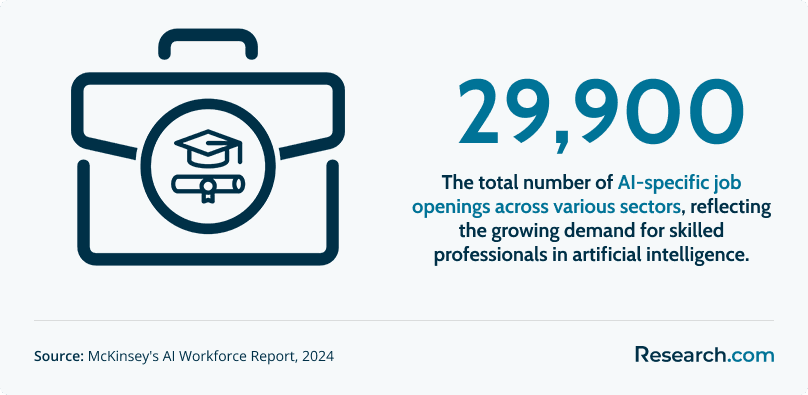
The labor market for AI-trained professionals continues to expand, although demand differs by role, region, and employer. AI-related job postings rose by 21% between 2024 to 2034, and approximately 29,900 AI-specific job openings were reported. Common high-demand titles include machine learning engineer, data scientist, AI engineer, NLP specialist, and computer vision engineer.
The broader AI market is also growing quickly. In 2024, the global artificial intelligence market is valued at approximately USD 279 billion, with projections estimating growth to USD 1,811 billion by 2030. This represents a compound annual growth rate of 35.9% from 2025 onward. Growth in healthcare, finance, manufacturing, cybersecurity, customer operations, and enterprise automation continues to influence employer demand for AI skills.
How does an online AI master’s program compare with an accelerated CS degree?
An online master’s in artificial intelligence is narrower and more advanced than an accelerated CS degree. AI master’s programs usually focus on machine learning, deep learning, NLP, computer vision, AI ethics, data systems, and applied model development. Accelerated computer science degrees cover a wider set of computing foundations, such as programming, databases, operating systems, networks, algorithms, and software development.
| Option | Best For | Main Trade-Off |
| Online master’s in artificial intelligence | Students with technical preparation who want specialized AI roles | More focused, but may be less useful for broad entry-level computing preparation |
| Accelerated computer science degree | Students who need broad CS foundations quickly | Broader coverage, but less depth in advanced AI topics |
What graduates say about fast online master’s in artificial intelligence programs
-
: "
The accelerated online AI master’s helped me build current technical skills without stepping away from work. The pace was demanding, but the flexibility made it possible to study while continuing my career. The projects also gave me stronger examples to discuss in technical interviews. — Elijah
"
-
: "
The program strengthened my understanding of machine learning and data analysis in a focused period of time. Online coursework gave me access to instructors and applied projects while allowing me to keep my professional schedule. I left with more confidence in my ability to work through complex AI problems. — James
"
-
: "
Earning the degree online helped me move toward a specialized AI role faster than I expected. The workload was intense, but applying concepts immediately made the learning practical. I valued the mix of academic rigor and remote access. — Merly
"
Common mistakes to avoid before enrolling
- Choosing only the fastest program: A short timeline is valuable only if the program still provides technical depth, faculty support, and meaningful project work.
- Ignoring accreditation: Always confirm institutional accreditation before applying, especially if you plan to use federal aid or want broad employer recognition.
- Comparing only tuition: Calculate the full cost, including credits, fees, software, cloud tools, textbooks, and time away from paid work.
- Underestimating prerequisites: AI graduate courses can be difficult without programming, statistics, linear algebra, and data structures.
- Assuming online means self-paced: Some online programs require synchronous meetings, group work, fixed deadlines, or scheduled exams.
- Overlooking portfolio value: Employers often want proof that you can build, evaluate, and explain AI systems, not just a completed degree.
- Expecting salary guarantees: A master’s degree may improve opportunities, but salary depends on skills, experience, location, industry, and job performance.
Key Insights
- A fast online master’s in artificial intelligence can be worthwhile for technically prepared students who want focused AI training in 12 to 24 months.
- Most AI master’s programs require 30 to 36 credit hours, and total tuition typically ranges from $27,000 to $45,000, depending on school and format.
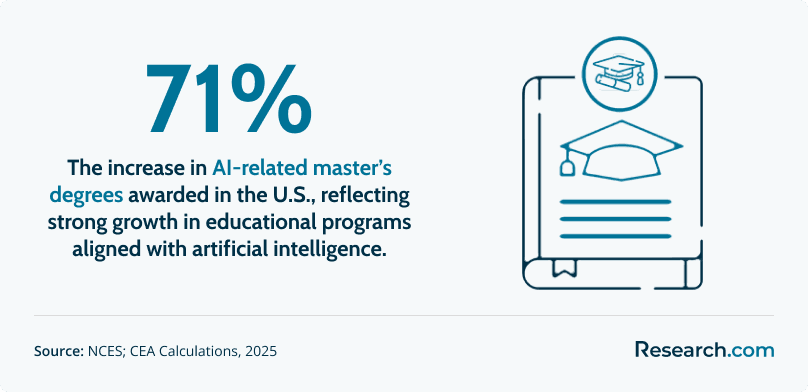
- AI-related master’s degrees awarded in the U.S. have increased by 71%, showing strong growth in AI-focused graduate education.
- AI job postings are projected to grow by 38% from 2024 to 2034, with 29,900 AI-specific job openings currently reported.
- The global AI market is valued at $279 billion in 2024 and is projected to reach $1.8 trillion by 2030, growing at a 35.9% CAGR.
- Engineering accounts for 41.9% of AI-relevant degrees, making it the academic discipline with the highest percentage of AI-related degrees.
- The best program is not automatically the shortest or cheapest. Prioritize accreditation, technical rigor, capstone quality, specialization fit, career support, and total cost.
References:
- Artificial Intelligence Learning. (n.d.). Best online masters degree programs in AI. Retrieved from Artificial Intelligence Learning.
- Business Insider. (2025, February). AI education courses increasingly popular in non-STEM fields. Retrieved from Business Insider.
- Glassdoor. (n.d.). AI product manager salary. Retrieved from Glassdoor.
- Lifewire. (n.d.). Best free AI courses. Retrieved from Lifewire.
- PhD Services. (n.d.). AI capstone project with deep learning. Retrieved from PhD Services.
- ProjectPro. (n.d.). Artificial intelligence project ideas. Retrieved from ProjectPro.
- Simplilearn. (n.d.). AI project ideas. Retrieved from Simplilearn.
- ZipRecruiter. (n.d.-a). AI architect salary. Retrieved from ZipRecruiter.
- ZipRecruiter. (n.d.-b). AI engineer salary. Retrieved from ZipRecruiter.
- ZipRecruiter. (n.d.-c). Computer vision engineer salary. Retrieved from ZipRecruiter.
- ZipRecruiter. (n.d.-d). Machine learning engineer salary. Retrieved from ZipRecruiter.
Other Things You Should Know About Online Master’s in Artificial Intelligence Programs
Most accelerated online AI master’s programs require a capstone project, not a thesis. A thesis is more common in research-focused degrees, while applied programs usually end with a project built from 30 to 36 credit hours and finished in about 12 to 18 months.
The fastest online Master's in AI programs in 2027 typically require a bachelor's degree, a strong academic record, letters of recommendation, a statement of purpose, and sometimes GRE scores. Some programs may have prerequisites in programming or mathematics.
The curriculum typically includes foundational AI courses, machine learning, data analysis, and neural networks. Some programs offer specializations in areas like natural language processing or robotics. The entire program may require completing around 30-36 credit hours to graduate.


