2027 Fastest Online Artificial Intelligence Degree Programs

Co-Founder and Chief Data Scientist
Choosing a fast online artificial intelligence degree is a timing decision as much as an education decision. AI tools are now part of software development, analytics, healthcare operations, finance, marketing, cybersecurity, and business automation, so students want programs that build usable technical skills without requiring four years away from work.
The challenge is that “fast” can mean several different things: shorter terms, generous transfer credit, year-round enrollment, self-paced coursework, or an associate degree that leads quickly into entry-level tech roles. This guide explains how accelerated online AI degrees work, what they cost, which programs to compare, and how to choose an option that is quick without sacrificing accreditation, career support, or practical training.
Government data shows that nearly 72% of jobs highly exposed to AI now require a postsecondary degree to qualify. For students entering tech, changing careers, or upgrading existing IT skills, an online artificial intelligence degree can be one way to build a credential, portfolio, and technical foundation for AI-related work.
Quick Answer: What Is the Fastest Way to Earn an Online Artificial Intelligence Degree?
The fastest online artificial intelligence degree is usually an accelerated associate or bachelor’s program that accepts transfer credits and offers short terms throughout the year. An associate degree may be completed in as little as 16 months, while some bachelor’s programs can be completed in 2.5 years, depending on transfer credits, course load, and program structure.
Students who already have college credits, technical certificates, military training, or professional experience may finish faster if the school awards credit for prior learning. However, the quickest program is not always the best value. You should confirm accreditation, total cost, required courses, project work, student support, and whether the curriculum includes current AI tools before enrolling.
What are the benefits of getting the fastest online artificial intelligence degree?
- Faster entry into AI-related roles: A short-format AI degree can help you prepare for early-career jobs in machine learning support, data analysis, automation, software development, and business intelligence.
- Portfolio-focused technical training: Strong programs require coding assignments, model-building exercises, analytics projects, and capstones that can be shown to employers.
- Access to high-paying technology pathways: AI graduates may start in junior technical roles and later move into advanced positions where salaries can average over $150,000 a year, depending on experience, location, industry, and specialization.
What can I expect from the fastest online artificial intelligence degree programs?
The fastest online artificial intelligence degree programs are designed to compress the path to graduation while still covering the core areas employers expect: programming, data handling, algorithms, machine learning, statistics, ethics, and applied AI development. A good accelerated program should not simply move faster; it should organize courses so students build skills in a logical sequence.
At the associate level, students usually complete around 60 credits. These programs are often best for learners who want a shorter credential, plan to transfer later, or want entry-level technical preparation. Common subjects include:
- Introduction to AI concepts and use cases
- Python programming for data and automation
- Data structures and basic algorithm design
- Mathematics for computing and analytics
- Technology ethics, privacy, and responsible AI use
At the bachelor’s level, students typically complete about 120 credits. These programs go deeper into theory, software development, data science, and system design. Coursework often includes:
- Machine learning model development
- Natural language processing (NLP)
- Robotics or autonomous systems
- Neural networks and deep learning
- AI application development, capstones, or applied projects
Accelerated online programs may use 5-week, 8-week, 10-week, or year-round terms so students can complete more courses in less calendar time. Many also include virtual labs, coding platforms, cloud-based tools, team projects, and optional internships. These experiences matter because AI hiring often depends on what you can build, explain, test, and improve—not only the degree title.
| Degree level | Typical credits | Best for | Common AI preparation |
| Associate degree | Around 60 credits | Students seeking a shorter credential, transfer pathway, or entry-level tech foundation | Python, introductory AI, data basics, computing math, ethics |
| Bachelor’s degree | About 120 credits | Students who want broader career options, deeper technical preparation, or graduate school readiness | Machine learning, NLP, neural networks, software development, AI capstone work |
| Bachelor’s completion pathway | Varies by transfer credit | Students with prior college credits who want the fastest route to a four-year credential | Upper-division AI, data science, cloud tools, applied development projects |
For tuition, many regionally accredited schools charge between $250 and $500 per credit hour. Community colleges may cost less, especially for in-state students. Some universities also offer flat online tuition, locked tuition rates, or discounts for military students, transfer students, or employees of partner organizations.
Where can I work with an online artificial intelligence degree?
An AI degree can lead to work beyond traditional technology companies. Organizations in healthcare, finance, insurance, manufacturing, logistics, media, retail, education, and government now use AI for forecasting, automation, fraud detection, language processing, decision support, image analysis, and workflow improvement.
Depending on the degree level, portfolio, experience, and technical depth, graduates may qualify for roles such as:
- AI or machine learning technician
- Data analyst or junior data scientist
- Software developer with an AI focus
- Business intelligence associate
- Robotics or automation support technician
- AI support specialist in cloud services
Common employment settings include:
- Software, cloud computing, and technology firms
- Banks, fintech companies, and insurance organizations
- Hospitals, healthcare systems, and biotech labs
- Marketing, media, and content technology companies
- Government agencies and public service organizations
Recent research indicates that white-collar, high-paying jobs are highly exposed to generative AI because many of these roles involve writing, analysis, coding, design, and decision support. That does not mean every job will disappear. It does mean employers increasingly need workers who can use AI tools responsibly, evaluate outputs, manage data quality, and understand where human judgment is still required.
How much can I make with the fastest online artificial intelligence degree?
According to new data from 2025, computer and information technology jobs now have a median annual salary of about $106,000. This category includes many roles connected to AI pathways, including data analysts, software developers, machine learning technicians, and related technical positions.
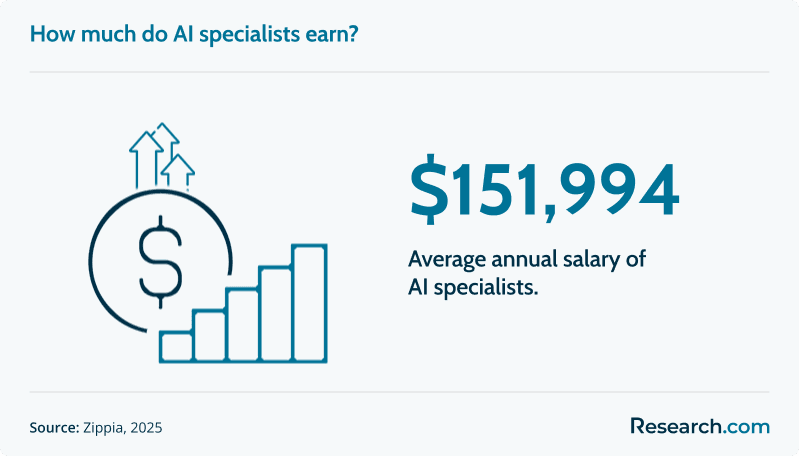
Higher earnings are more likely for workers who combine an AI degree with strong programming ability, analytics experience, industry knowledge, and a portfolio of completed projects. Zippia reports that artificial intelligence specialists now earn an average annual salary of nearly $152,000. These positions often involve model development, large language models, algorithm training, AI product design, or advanced data systems.
Your actual salary will depend on several factors:
- The specific job title and level of responsibility
- Your experience with Python, machine learning, cloud tools, and data systems
- Location, employer size, and industry
- Certifications, internships, prior IT experience, and portfolio quality
- Whether the role is entry-level, mid-level, senior, or research-oriented
A fast AI degree can shorten the time to a credential, but it does not guarantee a specific salary. The strongest return usually comes from pairing the degree with applied projects, internships, open-source work, technical certifications, and measurable experience solving real problems.
- Fastest Online Artificial Intelligence Degree Programs for 2027
- How long does the fastest online artificial intelligence degree take?
- Online vs. on-campus AI degrees: which format is better?
- How much does an online artificial intelligence degree cost?
- Financial aid options for online AI degree students
- Admissions requirements for online artificial intelligence programs
- Common courses in an online artificial intelligence degree
- AI degree specializations to compare
- Practical learning and industry collaboration in online AI programs
- Return on investment for an online artificial intelligence degree
- How interdisciplinary AI programs support leadership skills
- How AI programs keep up with industry change
- How to choose the best and fastest online artificial intelligence degree
- Career paths for online artificial intelligence degree graduates
- Job market outlook for accelerated AI degree graduatesQuestions to ask before enrolling
List of the Fastest Online Artificial Intelligence Degree Programs for 2027
How do we rank schools?
Because an AI degree can require a major financial and time commitment, our rankings are built to help students compare programs using credible education data rather than marketing claims. Research.com reviews information from sources such as the IPEDS database, College Scorecard, Peterson’s, and the National Center for Education Statistics.
These sources help us evaluate online artificial intelligence degree programs using consistent data points. For more detail on ranking criteria and data use, visit Research.com’s methodology page.
1. Texas Tech University
Texas Tech University offers an online Human-Centered Artificial Intelligence degree focused on building AI systems that are useful, ethical, and designed around people. Students study data science, user experience, responsible technology, and applied AI design for settings such as technology, healthcare, media, and digital services.
- Required Credits to Graduate: 120
- Program Length: 2–4 years
- Cost: $415–$500 per credit hour
- Accreditation: Southern Association of Colleges and Schools Commission on Colleges (SACSCOC)
2. Atlantic International University
Atlantic International University offers an associate program in Artificial Intelligence with a highly individualized structure. Students work with academic advisors to shape a curriculum that reflects their goals while exploring applied AI tools, ethical issues, creativity, and independent learning.
- Required Credits to Graduate: 60
- Program Length: Varies (self-paced)
- Cost: $7,300 total (Plan 1)
- Accreditation: Accreditation Service for International Schools, Colleges, and Universities (ASIC)
3. Central Piedmont Community College
Central Piedmont Community College provides an associate degree in Artificial Intelligence Technology that emphasizes hands-on preparation in machine learning, natural language processing, generative AI, and applied IT. Students may benefit from flexible substitutions, credit for industry certification, and training connected to current technology needs.
- Required Credits to Graduate: 68–70
- Program Length: Varies
- Cost: $76 (in-state) / $268 (out-of-state) per credit hour
- Accreditation: Southern Association of Colleges and Schools Commission on Colleges (SACSCOC)
4. ECPI University
ECPI University offers a bachelor’s path in AI/Machine Learning and Data Analytics that combines software development, analytics, and intelligent systems. The program is built for students who want a faster schedule and project-based experience using data and AI tools to address business and technology problems.
- Required Credits to Graduate: 121
- Program Length: 2.5 years
- Cost: $8,712 per semester
- Accreditation: Southern Association of Colleges and Schools Commission on Colleges (SACSCOC)
5. Arkansas State University
Arkansas State University offers a bachelor’s in Digital Technology & Design with an AI and Machine Learning focus. Students study computational intelligence, cloud-based tools, machine learning applications, and digital design skills that can support AI-driven product and technology work.
- Required Credits to Graduate: 120
- Program Length: Varies (transfer up to 90 credits)
- Cost: $282 per credit hour
- Accreditation: Higher Learning Commission (HLC)
6. Indiana University
Indiana University offers an online B.A. in Artificial Intelligence that introduces students to machine learning, robotics, cognitive computing, automation, and bot development. The program can serve both new college students and working adults seeking structured AI training.
- Required Credits to Graduate: 120
- Program Length: Varies
- Cost: $317.26 (in-state) / $412.44 (out-of-state) per credit hour
- Accreditation: Higher Learning Commission (HLC)
7. Colorado State University
Colorado State University offers an online B.S. in Computer Science with a concentration in Artificial Intelligence and Machine Learning. Students build a computer science base while adding AI-focused electives in areas such as data science, software development, and cybersecurity.
- Required Credits to Graduate: 120
- Program Length: Varies
- Cost: $490 per credit hour (flat rate)
- Accreditation: Higher Learning Commission (HLC)
8. Dakota State University
Dakota State University offers a B.S. in Artificial Intelligence that blends computer science, machine learning, human cognition, and AI ethics. Students learn to build algorithmic systems, evaluate social impact, and apply AI concepts to software and real-world problems.
- Required Credits to Graduate: 120
- Program Length: Varies (Fall, Spring, and Summer start dates)
- Cost: $8,956.50 per semester (estimated)
- Accreditation: Higher Learning Commission (HLC)
9. Full Sail University
Full Sail University offers an AI-focused Computer Science program that allows students to complete both associate and bachelor’s coursework. The curriculum covers deep learning, natural language processing, human-AI interaction, and project-based development for students interested in building AI applications from concept to deployment.
- Required Credits to Graduate: 120
- Program Length: 2–3 years
- Cost: $66,500 total
- Accreditation: Accrediting Commission of Career Schools and Colleges (ACCSC)
10. Strayer University
Strayer University offers an online B.S. in Information Technology with an Artificial Intelligence concentration. Students study Python, prompt design, AI problem solving, and practical development skills through a guided online format with 11-week courses.
- Required Credits to Graduate: 40 courses
- Program Length: Varies (courses are 11 weeks long)
- Cost: $1,525 per course
- Accreditation: Middle States Commission on Higher Education (MSCHE)
How long does it take to complete the fastest online artificial intelligence degree?
The fastest online artificial intelligence degree can take as little as 16 months for an associate degree or 2.5 years for a bachelor’s degree. Your timeline depends on course format, transfer credits, start dates, whether you study year-round, and how many classes you can handle at once.
Accelerated programs often use shorter terms so students complete more courses per year. To finish quickly, you usually need to avoid long breaks, register early, meet prerequisites on time, and choose a program with a predictable course rotation. If you are comparing related technical credentials, the shortest online data analytics programs may also be worth reviewing because data analytics and AI coursework often overlap.
Typical completion timelines include:
- Associate degree: Most programs require around 60 credits. Students taking year-round courses in 8-week or 10-week terms may finish in 16–18 months.
- Bachelor’s degree: Most programs require 120 credits. Accelerated formats with 5–8 week terms and multiple start dates may take 2.5 to 3 years.
- Transfer-heavy bachelor’s plan: Some schools accept up to 90 credits toward a bachelor’s degree. Students who transfer the maximum may finish in 1 to 1.5 years.
| Speed factor | How it can shorten the degree | What to check before enrolling |
| Transfer credits | Reduces the number of courses you must complete at the new school | Maximum transfer limit, minimum residency credits, and whether technical credits expire |
| Accelerated terms | Allows more course starts each year | Workload per term and whether key AI courses are offered frequently |
| Year-round enrollment | Uses summer and winter terms to maintain progress | Availability of required classes outside fall and spring |
| Credit for prior learning | May award credit for certifications, military training, or professional experience | Documentation rules, fees, and which credits apply to major requirements |
The chart below lists the most common educational levels of AI specialists, as published by Zippia in 2025.
How does an online artificial intelligence degree program compare to an on-campus program?
An online artificial intelligence degree can cover the same academic content as an on-campus program, but the learning experience is different. Online programs are usually better for working adults, transfer students, military learners, caregivers, and students who need schedule flexibility. Campus programs may be better for students who want in-person labs, face-to-face networking, and a more traditional college environment.
| Comparison point | Online AI degree | On-campus AI degree |
| Schedule | Often flexible, asynchronous, accelerated, or available year-round | Usually follows a fixed semester or quarter calendar |
| Course content | Typically includes programming, machine learning, data, ethics, and projects | Often includes the same core subjects with in-person sessions |
| Interaction | Uses discussion boards, video meetings, email, chat, and virtual office hours | Offers in-person class discussion, campus events, and physical office hours |
| Hands-on learning | May use cloud labs, coding platforms, simulations, and remote projects | May include physical labs, research groups, and campus equipment |
| Best fit | Students who need flexibility and can manage independent study | Students who learn best with structure and direct in-person access |
Employers generally care most about whether you can demonstrate relevant skills: coding, data analysis, model evaluation, problem solving, teamwork, and communication. A well-designed online program can help you build those skills, especially if it includes substantial project work.
Career outcomes depend more on your competence and experience than on whether you studied remotely or in person. For example, the average data scientist salary is well over six figures, and professionals can reach data-focused roles through either online or campus-based education.
What is the average cost of an online artificial intelligence degree?
The average cost of an online artificial intelligence degree ranges from $8,000 to $66,000, depending on degree level, school type, residency status, transfer credits, and program length. Associate degrees at public or community colleges are usually less expensive than bachelor’s degrees at private or specialized institutions.
- Associate degrees in AI typically cost between $8,000 and $20,000 in total, especially at public or community colleges.
- Bachelor’s degrees commonly fall between $30,000 and $66,000, depending on school, pace, and transfer credit.
- Per-credit tuition can range from around $76 to over $500, depending on institution and residency status.
Do not compare programs by tuition alone. The true cost includes required fees, textbooks or digital materials, technology fees, proctoring fees, software subscriptions, exam costs, and the number of credits you must still complete. A program with a higher per-credit rate may be cheaper overall if it accepts more transfer credits or lets you finish faster.
Students often evaluate AI programs the same way they compare the most affordable online master’s in education technology: by calculating total tuition, required fees, time to completion, and likely career value rather than looking only at the advertised per-credit price.
| Cost factor | Why it matters | Question to ask |
| Transfer credit policy | More accepted credits can sharply reduce total tuition | How many credits can I transfer, and will they apply to major requirements? |
| Online fees | Technology and course fees can raise the actual price | What is the full cost per term after all fees? |
| Course availability | Delayed courses can extend enrollment and increase costs | Are required AI courses offered every term? |
| Flat-rate tuition | May benefit students taking heavier course loads | Is tuition charged by credit, course, semester, or program? |
What are the financial aid options for students enrolling in an online artificial intelligence degree program?
Online artificial intelligence degree students may qualify for many of the same funding sources as campus-based students if they attend an eligible accredited institution. Financial aid availability depends on the school, program level, enrollment status, and the student’s personal eligibility. Students comparing other accelerated technology pathways, including accelerated CompTIA Cloud+ certification training online, should also verify whether the institution and program meet aid requirements.
- Federal Student Aid (FAFSA): The Free Application for Federal Student Aid is used to determine eligibility for federal grants, federal student loans, and work-study through the U.S. Department of Education.
- State Grants and Aid: Some states fund grants, scholarships, or tuition assistance for residents enrolled in approved online programs.
- Institutional Scholarships: Colleges may offer merit-based, need-based, transfer, military, or online student scholarships. Some may also provide awards for technology or AI-focused students.
- Private Scholarships: Programs and organizations such as the AI4ALL College Pathways Program, Google’s Women Techmakers Scholarship, and Udacity Scholarships support learners in technology and AI fields.
- Employer Tuition Assistance: Working students should ask whether their employer offers reimbursement, tuition discounts, or professional development funding.
- Military and Veteran Benefits: Eligible students may use GI Bill® benefits and other military education benefits for qualifying online degrees.
How to reduce the cost of an online AI degree
- Complete the FAFSA early and renew it each year.
- Ask for an official transfer credit evaluation before committing.
- Compare total program cost, not only per-credit tuition.
- Look for schools that accept certification, military, or prior learning credit.
- Apply for scholarships from the school, state, professional groups, and technology organizations.
- Avoid repeating general education courses that may transfer from a prior college.
What are the prerequisites for enrolling in an online artificial intelligence degree program?
Admissions requirements for online artificial intelligence programs vary by degree level and institution. Most associate and bachelor’s programs are designed for students who are still developing their technical foundation, so you usually do not need to be an experienced programmer before applying.
For associate degree programs, common requirements include:
- A high school diploma or GED
- Basic computer literacy
- No required coding or advanced math background, although prior exposure can help
For bachelor’s degree programs, schools may ask for:
- A high school diploma or GED
- A minimum GPA, often around 2.0–2.5
- SAT or ACT scores, although many schools make them optional or waive them
- Basic algebra and comfort using computers
- A personal statement or prior math, science, or computing coursework in some cases
Transfer applicants should request a credit review before enrolling. General education courses such as English, math, and science often transfer, but technical credits may be evaluated more carefully. If you want another accelerated technology option, the fastest online bachelor's in software engineering may be useful to compare with AI-focused programs.
Students without coding experience can still begin many AI degrees, but they should be ready for math, programming practice, and independent troubleshooting. A short introductory Python course before enrollment can make the first term less stressful.
The chart below illustrates the occupations with the most AI exposure by their entry-level education, as published by the U.S. Department of Labor.
What courses are typically in an online artificial intelligence degree program?
An online artificial intelligence degree combines computer science, data analysis, mathematics, machine learning, and responsible technology coursework. The best programs build from fundamentals to applied AI projects so students can understand not only how to use AI tools, but also how those tools work and where they can fail. Students considering adjacent fields may also compare an accelerated cybersecurity bachelor's degree online, since AI and cybersecurity increasingly overlap in automation, threat detection, and data protection.
- Introduction to Artificial Intelligence: Covers AI history, core concepts, search methods, reasoning systems, and current applications.
- Machine Learning: Teaches how models learn from data and how to evaluate predictions, classifications, and recommendations.
- Python Programming: Builds coding skills using a language widely used in AI, automation, analytics, and machine learning.
- Data Structures and Algorithms: Explains how data is organized, processed, searched, and optimized in software systems.
- Neural Networks and Deep Learning: Introduces layered models used in advanced pattern recognition, language tools, and computer vision.
- Natural Language Processing (NLP): Focuses on AI systems that process, classify, summarize, translate, or generate human language.
- Ethics in AI: Examines bias, privacy, transparency, accountability, fairness, and responsible deployment.
- Computer Vision: Covers image and video analysis used in healthcare, robotics, retail, manufacturing, and security.
These courses can support entry-level employment and prepare students for graduate study. Some AI graduates later move into management, education, or training roles; students interested in leadership-oriented education pathways may also review the cheapest online EdS programs in leadership.
What types of specializations are available in an online artificial intelligence degree program?
AI specializations let students focus their projects and electives around a specific technical or industry area. Choosing a specialization should depend on your target job, preferred work style, math comfort, and industry interests.
| Specialization | What you study | Good fit for students who want to |
| Machine Learning | Model training, prediction, classification, evaluation, and automation | Build systems that learn from data and improve decision-making |
| Natural Language Processing (NLP) | Text analytics, language generation, chatbots, translation, and voice tools | Work on conversational AI, search, assistants, or language products |
| Computer Vision | Image recognition, video analytics, object detection, and visual data processing | Apply AI in healthcare imaging, robotics, retail, manufacturing, or security |
| Robotics and Autonomous Systems | Sensors, control systems, navigation, automation, and intelligent machines | Work with drones, self-driving systems, smart devices, or industrial automation |
| AI in Healthcare | Clinical data, predictive health tools, patient monitoring, and decision support | Connect AI with healthcare analytics and informatics; related roles may offer a competitive health informatics salary |
| Ethical AI and Policy | Bias, governance, regulation, accountability, risk management, and social impact | Help organizations deploy AI responsibly and evaluate legal or ethical risk |
How Do Online Artificial Intelligence Degree Programs Enhance Practical Learning and Industry Collaboration?
Strong online AI programs use applied assignments to help students move beyond theory. Practical learning may include coding labs, dataset analysis, model-building projects, virtual collaboration, cloud-based tools, and capstone projects designed around realistic business or technical problems. Some programs also invite industry professionals to review projects, advise on curriculum, or support internship and networking opportunities.
Project-based learning is especially important in AI because employers often want proof that graduates can clean data, select models, test performance, explain limitations, and communicate findings to nontechnical stakeholders. Students who want a broader creative-technical path may also compare AI programs with an online game developer degree, where programming, simulation, graphics, and intelligent systems can intersect.
What is the Return on Investment of an Online Artificial Intelligence Degree?
The return on investment of an online artificial intelligence degree depends on total cost, time to completion, transfer credits, career services, portfolio strength, and the graduate’s ability to move into better-paying technical work. A faster program can improve ROI if it reduces tuition and helps you enter the job market sooner. It can hurt ROI if the program is expensive, poorly supported, weakly accredited, or light on practical AI experience.
Before enrolling, compare tuition, fees, expected remaining credits, graduation timeline, employment support, and career outcomes. Ask whether the school publishes job placement data, internship access, alumni outcomes, and examples of capstone projects. Students evaluating graduate-level technical paths can also compare financial considerations with related fields such as the most affordable biotechnology master's programs online.
| ROI question | Why it matters |
| How many credits will I actually need to complete? | Transfer policies can change total cost and graduation speed more than the advertised tuition rate. |
| Will I graduate with a portfolio? | AI employers often want examples of code, models, analysis, and project documentation. |
| Does the program teach current tools? | Courses should include relevant programming, machine learning, data, cloud, and responsible AI practices. |
| What career support is available? | Resume help, interview preparation, internships, and employer connections can affect job search success. |
How do interdisciplinary components in online AI programs foster leadership potential?
AI projects rarely succeed through technical skill alone. Graduates also need communication, product thinking, ethics, project management, and business judgment. Interdisciplinary online AI programs may combine computer science with psychology, design, statistics, management, healthcare, policy, or cybersecurity to help students understand how AI affects people and organizations.
This broader preparation can support leadership roles because AI teams must translate business goals into technical requirements, explain model limitations, manage risk, and work across departments. Students who want to combine technical expertise with management training may find related guidance in the fastest online engineering management masters.
How do online artificial intelligence degree programs keep pace with evolving industry trends?
AI changes quickly, so programs need regular curriculum review, updated tools, and faculty engagement with current industry practice. Strong programs refresh assignments, integrate emerging AI applications, use relevant programming libraries, and address issues such as generative AI, model bias, data governance, privacy, cybersecurity, and human oversight.
Prospective students should ask when AI courses were last revised, which tools are used in labs, whether faculty have applied AI experience, and whether the program includes current topics such as large language models, responsible AI, and automation workflows. Students comparing lower-cost AI options may also review the cheapest online masters in artificial intelligence.
How to choose the best and fastest online artificial intelligence degree program?
To choose the best and fastest online artificial intelligence degree, look for a program that balances speed, accreditation, technical depth, affordability, and career preparation. A short program is only valuable if it helps you graduate with credible training and marketable skills. The same principle applies when comparing other accelerated credentials, such as the fastest online special education graduate certificate programs: speed should support your goal, not replace quality.
- Confirm accreditation: Check whether the institution is accredited by a recognized agency such as the Higher Learning Commission (HLC) or another appropriate accreditor. Accreditation can affect financial aid eligibility, credit transfer, and employer recognition.
- Review the accelerated structure: Look for short terms, multiple start dates, year-round enrollment, and a clear schedule of required AI courses.
- Evaluate transfer credit rules: Ask for a written transfer evaluation before enrolling, especially if you already have college credits.
- Check curriculum relevance: Strong programs should include Python, machine learning, data structures, statistics, AI ethics, and applied projects. Tools such as TensorFlow and natural language processing may also be included.
- Look for career services: Resume support, portfolio guidance, interview preparation, internships, and job search coaching can help after graduation.
- Assess faculty and industry ties: Instructors with practical AI, software, analytics, or research experience can strengthen the learning experience.
- Compare total value: Calculate full tuition, fees, time to degree, financial aid, and likely career relevance before choosing the fastest option.
Common mistakes to avoid when choosing an online AI degree
| Mistake | Why it can hurt you | Better approach |
| Choosing only the shortest program | A very fast format may lack depth, support, or enough project work. | Compare speed with curriculum quality, accreditation, and career preparation. |
| Ignoring accreditation | Unrecognized accreditation can affect aid, transfer credit, and employer perception. | Verify the accreditor through official school and agency sources. |
| Looking only at per-credit tuition | Fees, transfer limits, and extra terms can change the real cost. | Ask for a full program cost estimate based on your transfer credits. |
| Assuming online means easier | Accelerated AI courses can be intense and require steady coding practice. | Plan weekly study time and prepare with basic Python and algebra if needed. |
| Skipping portfolio development | A degree alone may not demonstrate practical AI ability. | Save projects, document code, and build a portfolio throughout the program. |
What career paths are available for graduates of an online artificial intelligence degree program?
Graduates of online artificial intelligence degree programs can pursue technical, analytical, and product-focused roles in industries that use data and automation. Entry-level opportunities depend on the degree level, projects, internships, prior experience, and the graduate’s ability to demonstrate relevant tools. Students who want to pair AI knowledge with cloud skills may also compare the fastest online Microsoft Azure dual certification bootcamps.
- Machine Learning Engineer: Builds, trains, tests, and improves models that identify patterns or make predictions.
- Data Scientist: Uses data, statistics, and AI tools to support business decisions and product development.
- AI Software Developer: Codes intelligent features for applications, automation systems, games, robotics, or digital products.
- Computer Vision Specialist: Works with image and video data for uses such as autonomous vehicles, security, healthcare, manufacturing, and retail.
- Natural Language Processing (NLP) Engineer: Develops tools that process, classify, summarize, or generate human language.
- AI Research Assistant: Supports academic, government, or corporate teams testing new models, methods, and AI applications.
- AI Project Manager: Coordinates teams developing AI products while managing timelines, communication, ethics, and user needs.
Long-term advancement may lead to senior engineering, data science, AI product, architecture, or technology leadership positions. Professionals targeting executive technology roles can use CTO salary expectations to understand how compensation can change at higher leadership levels.
The chart below illustrates the most common industries for AI specialists, as reported by Zippiain 2025.
What is the job market for graduates of the fastest artificial intelligence degree programs?
The job market for graduates of the fastest online artificial intelligence degree programs is shaped by a broad shift toward automation, analytics, generative AI, and AI-assisted decision-making. Employers need workers who can build tools, manage data, improve software, evaluate model performance, and use AI safely in real business settings. Students considering nontechnical accelerated credentials, such as the fastest online graduate certificate programs in early childhood education, should use a similar lens: demand is strongest when the credential matches a clear workforce need.
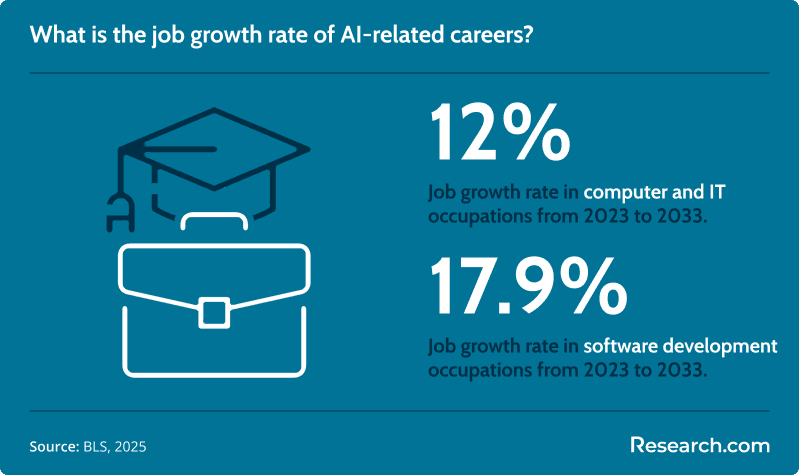
- Software developers are projected by the U.S. Bureau of Labor Statistics (BLS) to see nearly 18% job growth from 2023 to 2033. AI-related software work includes building applications, integrating machine learning features, improving data quality, and maintaining automated systems.
- Database administrators and architects are expected to see job growth ranging from 8% to nearly 11% by 2033. These roles matter because AI systems depend on reliable, secure, well-structured data environments.
- Engineering roles use AI for simulation, diagnostics, design optimization, and automation. Aerospace and electrical engineering fields are experiencing job growth of between 6% and 9%, which is faster than the average.
AI is not simply replacing workers; in many organizations, it is changing how work gets done. Graduates who know how to use AI tools, interpret results, manage limitations, and collaborate with business teams may be better positioned than those who only understand traditional workflows. Students seeking advanced technical leadership may later compare the shortest online cybersecurity master's degree programs, especially as AI and security continue to overlap.
Questions to Ask Before Enrolling in a Fast Online AI Degree
- Is the institution accredited, and is the accreditor recognized by appropriate education authorities?
- How many credits will I need after transfer evaluation?
- Are AI major courses available every term, or could course sequencing delay graduation?
- Does the program include Python, machine learning, data structures, statistics, AI ethics, and capstone work?
- Will I graduate with portfolio-ready projects?
- What career services are available to online students?
- Are tutoring, technical support, and faculty office hours available during accelerated terms?
- What is the total cost after tuition, fees, software, materials, and any proctoring charges?
- Does the program teach current AI tools and address responsible AI use?
- What jobs have recent graduates pursued, and does the school provide outcome data?
Here’s What Graduates Have to Say About Their Online Artificial Intelligence Degree Programs
-
: "
I wanted a degree I could complete quickly, but I did not want a shortcut that felt shallow. The accelerated schedule kept me moving, and the projects helped me prove that I could actually build useful AI tools. After a little over two years, I moved from part-time cashier work into a full-time AI support analyst role. – Henry
"
-
: "
I was nervous about balancing work and school, but the shorter terms helped me stay organized. The first semester was intense, especially Python and machine learning, but the assignments felt directly connected to real work. I now take on contract projects connected to healthcare AI. – Noah
"
-
: "
I had already spent time in college and did not want another long traditional program. The faster format helped me finish sooner, build a portfolio, and get a junior AI developer job while some of my friends were still working through longer programs. – Lucas
"
Key Insights
- The fastest online artificial intelligence degree programs may be completed in as little as 16 months for an associate degree or 2.5 years for a bachelor’s degree, especially when students use transfer credits and accelerated terms.
- Most bachelor’s-level AI programs require 120 credits, while associate programs commonly require 60–70 credits.
- The average cost of an online artificial intelligence degree ranges from $8,000 to $66,000, with per-credit prices varying widely by school, residency, and degree level.
- Technology roles connected to AI can pay well, but salaries are not guaranteed. Computer and information technology jobs have a median annual salary of about $106,000, while AI specialists average up to $151,994 annually.
- Speed should not be the only deciding factor. The best fast AI program is accredited, transfer-friendly, project-based, current with industry tools, and supported by strong advising and career services.
- The job outlook is strongest for graduates who can show practical ability in programming, data analysis, machine learning, cloud tools, and responsible AI use. Software developers are projected to experience 17.9% growth from 2023 to 2033.
References:
- Bureau of Labor Statistics (BLS). (2025a). AI impacts in BLS employment projections. The Economics Daily. BLS.
- Bureau of Labor Statistics (BLS). (2025b). Computer and Information Technology Occupations. Occupational Outlook Handbook. BLS.
- Department of Labor (DOL). (2023). Artificial Intelligence and the U.S. Workforce. Trendlines. DOL.
- Felten, E. W., Raj, M., & Seamans, R. (2023). Occupational heterogeneity in exposure to generative AI. SSRN.
- Wynne, M. A. & Derr, L. (2025). Will AI replace your job? Perhaps not in the next decade. Dallas Fed Economics. Federal Reserve Bank of Dallas.
- Zippia. (2025). Artificial Intelligence Specialist demographics and statistics in the US. Zippia.
Other Things You Should Know About the Fastest Online Artificial Intelligence Degree Programs
It should be regionally accredited by a U.S. institutional accreditor recognized by the Council for Higher Education Accreditation or the U.S. Department of Education. For AI-focused computing degrees, programmatic accreditation is less common, but AACSB, ABET, or similar reviews can strengthen the credential.
In 2027, prominent institutions offering the fastest online AI degree programs include Arizona State University and University of Florida. These programs focus on accelerated learning, typically allowing students to complete degrees in under two years through an intensive and structured curriculum.
Prerequisites include a high school diploma or equivalent, basic proficiency in programming languages, and foundational knowledge of mathematics. Some programs may also require prior coursework in computer science or related fields to enroll in the fastest online AI degree programs in 2027.