
2027 Fastest Online Bachelor's Programs in Cybersecurity

Co-Founder and Chief Data Scientist
Choosing an online bachelor’s degree in cybersecurity is usually a decision about speed, cost, credibility, and career readiness. The field matters because organizations keep moving more operations, customer data, payment systems, health records, and infrastructure into digital environments. At the same time, breaches remain expensive: IBM reports that the average cost of a data breach is $4.9 million, the highest in history.
This guide is for students, career changers, working IT professionals, military learners, and transfer students who want a faster route to a cybersecurity bachelor’s degree without giving up accreditation or practical training. You will learn how accelerated online programs work, what they cost, what jobs they can lead to, how online study compares with campus learning, and how to evaluate whether a cybersecurity degree is worth the investment.
Quick answer: What are the benefits of an online bachelor’s degree in cybersecurity?
- The degree can prepare graduates for roles such as information security analyst, IT auditor, network security administrator, incident responder, SOC analyst, and cybersecurity specialist.
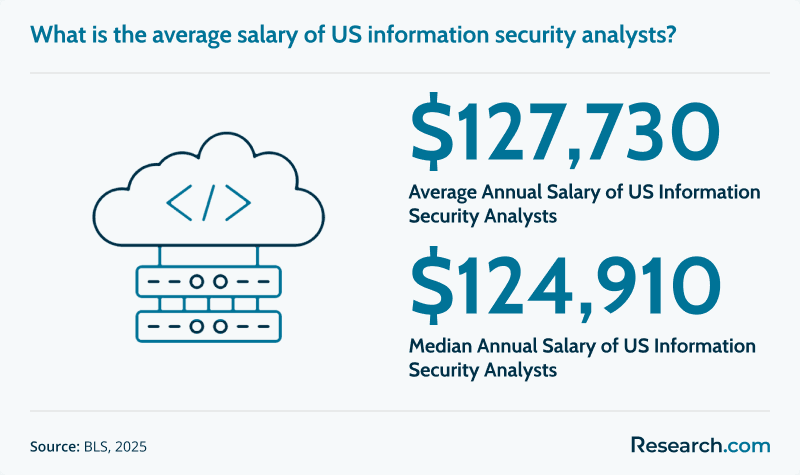
- Information security analysts earn an average annual salary of $127,730, while the median annual salary is $124,910.
- Online programs are often easier to fit around work and family obligations because many use asynchronous classes, virtual labs, transfer credits, and accelerated terms.
- Students who already have college credits, IT certifications, military training, or professional experience may be able to shorten the time to graduation.
- The best programs combine accredited coursework with hands-on labs, security tools, capstone projects, internships, or certification preparation.
What can I expect from an online bachelor's degree in cybersecurity?
An online bachelor’s degree in cybersecurity teaches students how to protect networks, applications, data, cloud systems, and organizational technology from unauthorized access, disruption, fraud, and misuse. Most programs combine computer science or information technology fundamentals with specialized security coursework.
Students commonly study network defense, ethical hacking, cryptography, digital forensics, secure systems administration, cyber law, governance, and risk management. Because cybersecurity is a practical field, stronger online programs include virtual labs, simulations, remote security environments, case studies, and projects that ask students to detect vulnerabilities, investigate incidents, or design security controls.
The online format usually works best for self-directed learners. Students may watch lectures, complete assignments, participate in discussion boards, join live sessions, and access cloud-based labs from home. Many schools also offer part-time enrollment, accelerated 8-week courses, transfer credit reviews, and credit for prior learning.
By graduation, students should be able to analyze threats, communicate risk, document incidents, secure systems, and apply ethical and legal standards. A degree alone does not guarantee a job, but it can provide the academic foundation employers often expect for analyst, administrator, auditor, and technical support roles in cybersecurity.
Where can I work with an online bachelor's degree in cybersecurity?
Cybersecurity graduates can work anywhere organizations rely on connected systems, sensitive data, regulated information, or digital services. The degree is not limited to technology companies. Employers in finance, healthcare, defense, education, retail, consulting, telecommunications, and government all need workers who can reduce cyber risk and respond to incidents.
| Work setting | How cybersecurity graduates may contribute |
| Government and defense | Protect public systems, support threat response, assist cyber investigations, and help secure national, state, or local infrastructure. |
| Private corporations | Monitor networks, safeguard customer records, manage access controls, support compliance, and reduce exposure to attacks. |
| Healthcare organizations | Help secure electronic health records, medical systems, and patient data while supporting privacy and security requirements such as HIPAA. |
| Schools and universities | Defend student information systems, research data, learning platforms, email systems, and campus networks. |
| Consulting firms | Assess client security programs, conduct audits, test vulnerabilities, recommend controls, and support incident response planning. |
| Startups and small businesses | Build practical security processes, choose tools, manage secure configurations, and help growing organizations avoid preventable risks. |
How much can I make with an online bachelor's degree in cybersecurity?
Many graduates target information security analyst roles after completing an online cybersecurity bachelor’s degree. According to the United States Bureau of Labor Statistics (BLS), information security analysts earn an average annual salary of $127,730 and a median annual salary of $124,910, compared with the national average of $49,500.
Reported annual salaries for information security analysts typically range from $69,660 to $186,420. Entry-level professionals, smaller employers, and lower-cost labor markets often fall near the lower end. Analysts with stronger experience, specialized skills, leadership responsibilities, or roles in larger organizations may earn above the median.
Salary should be treated as a planning benchmark, not a promise. Your earnings will depend on location, employer size, prior IT experience, certifications, clearance eligibility, technical portfolio, and the specific role you pursue.
- Fastest Online Bachelor's Programs in Cybersecurity for 2027
- How long does it take to complete an online bachelor's degree in cybersecurity?
- How does an online bachelor's degree in cybersecurity compare to an on-campus program?
- What is the average cost of an online bachelor's degree in cybersecurity?
- What are the financial aid options for students enrolling in an online bachelor's degree in cybersecurity?
- What are the prerequisites for enrolling in an online bachelor's degree in cybersecurity?
- What courses are typically in an online bachelor's degree in cybersecurity?
- What types of specializations are available in online bachelor's degrees in cybersecurity?
- How do online cybersecurity degrees differ from other online tech degrees?
- Is an online bachelor's degree in cybersecurity worth the investment?
- How can you evaluate the credibility and industry alignment of an online cybersecurity program?
- How to choose the best online bachelor's degree in cybersecurity?
- What career paths are available for graduates of online bachelor's degrees in cybersecurity?
- What is the job market for graduates with an online bachelor's degree in cybersecurity?
Fastest Online Bachelor's Programs in Cybersecurity for 2027
How do we rank schools?
Accelerated cybersecurity degrees can reduce time to completion, but they still require a meaningful financial and time commitment. A fast program is only useful if it is credible, affordable enough for your situation, and aligned with the jobs you want after graduation.
To build this ranking, the research team reviewed transparent education data from sources such as the IPEDS database, College Scorecard, Peterson's database, and the National Center for Education Statistics. You can review the broader ranking process on our methodology page.
Fastest online cybersecurity bachelor’s programs at a glance
| School | Program length | Credits required | Cost information | Accreditation |
| Norwich University | 18 months | 120 | $375 per credit | New England Commission of Higher Education |
| Old Dominion University | 1 to 3.5 years | 120 | $268 in-state, $444 out-of-state per credit | Southern Association of Colleges and Schools Commission on Colleges |
| Liberty University | 3.5 years | 121 | $390 full-time, $455 part-time, $250 military per credit | Southern Association of Colleges and Schools Commission on Colleges |
| Southern New Hampshire University | 2 to 3 years | 120 | $330 full-time and part-time, $231 military | New England Commission of Higher Education |
| Grand Canyon University | 3 years | 120 | $485 per credit | Computing Accreditation Commission of ABET |
| Mercy College | 4 years full-time, 5 years dual degree | 120 | $300 per credit | Middle States Commission on Higher Education |
| Franklin University | 2 to 4 years | 124 | $398 per credit | Higher Learning Commission |
| Purdue Global | 4 years | 120 | $371 per credit | Computing Accreditation Commission of ABET |
| Maryville University | 3.5 years | 120 | $622 per credit | Higher Learning Commission |
| Lewis University | 4 years, 5 years bachelor’s-to-master’s option | 128 | $625 per credit | Higher Learning Commission |
1. Norwich University Bachelor of Science in Cybersecurity
Norwich University offers an online Bachelor of Science in Cybersecurity built for students who already have substantial transfer credit. Learners with at least 90 transfer credits may be able to finish in 18 months, making this one of the faster completion options for qualified students.
The program starts with core preparation in networking, programming, Linux and server administration, cybercrime, and information assurance. Students then complete a capstone and may shape the degree through concentrations in Computer Forensics and Vulnerability Management (CFVM) or Information Warfare and Security Management (IWSM). The ability to switch concentration paths mid-program gives students some flexibility if their career interests change.
- Program Length: 18 months
- Concentrations:
- Computer Forensics and Vulnerability Management
- Information Warfare and Security Management
- Required Credits to Graduate: 120
- Cost per Credit: $375
- Accreditation: New England Commission of Higher Education
2. Old Dominion University Cybersecurity Online Program
Old Dominion University provides an online Bachelor of Science in Cybersecurity for both first-time and transfer students. Students with prior college work can transfer up to 30 credits and may complete the degree in as little as one year, while students completing the full 120-credit pathway can expect about 3.5 years.
The curriculum draws from criminal justice, computer science, engineering, and philosophy, which can be useful for students who want a broader view of cybersecurity’s technical, legal, and ethical dimensions. Students also complete a 150-hour cybersecurity internship and a 3-credit interdisciplinary portfolio project that can help demonstrate applied skills to employers.
- Program Length: 1 to 3.5 years
- Required Credits to Graduate: 120
- Cost per Credit: $268 (in-state), $444 (out-of-state)
- Accreditation: Southern Association of Colleges and Schools Commission on Colleges
3. Liberty University Computer Science Cyber Security Bachelor’s Degree
Liberty University offers a fully online Bachelor of Science in Computer Science Cybersecurity. The program uses accelerated 8-week courses and allows students to transfer in up to 75% of the 121-credit requirement, which can make it a practical option for learners with significant prior coursework.
Students study programming, network security, cryptography, and software development, with optional internships and electives available for additional customization. The program is accredited by SACSCOC and is recognized as a Center of Academic Excellence by the NSA and DHS.
- Program Length: 3.5 years
- Required Credits to Graduate: 121
- Cost per Credit: $390 (full-time), $455 (part-time), $250 (military)
- Accreditation: Southern Association of Colleges and Schools Commission on Colleges
4. Southern New Hampshire University Cybersecurity Degree Online
Southern New Hampshire University offers an online Bachelor of Science in Cybersecurity focused on protecting systems, evaluating risk, and responding to threats from both defensive and adversarial perspectives.
The degree emphasizes security principles, risk management, legal and ethical decision-making, and communication. Students may follow the general cybersecurity path or choose a concentration in Data Analytics or Project Management. Courses are delivered 100% online in 8-week terms, and students may transfer up to 90 credits.
- Program Length: 2 to 3 years
- Concentrations:
- Data Analytics Fundamentals
- Project Management Fundamentals
- Required Credits to Graduate: 120
- Total Cost: $330 (full-time and part-time), $231 (military)
- Accreditation: New England Commission of Higher Education
5. Grand Canyon University Bachelor of Science in Cybersecurity Degree
Grand Canyon University offers a Bachelor of Science in Cybersecurity online and on campus. The program is designed around applied learning, ethical practice, and technical problem-solving in areas such as cyber law, ethical hacking, forensic investigation, and secure systems design.
Students complete 120 credits, including general education and major coursework. The university allows up to 90 transfer credits, which may shorten completion time for eligible students. Online tuition is $485 per credit.
- Program Length: 3 years
- Required Credits to Graduate: 120
- Cost per Credit: $485
- Accreditation: Computing Accreditation Commission of ABET
6. Mercy College Bachelor of Science in Cybersecurity
Mercy College offers a 120-credit Bachelor of Science in Cybersecurity online and at campuses in the Bronx, Manhattan, and Westchester. The program prepares students to manage security software, support cybersecurity policy, help with disaster recovery planning, and conduct compliance audits.
The curriculum includes 60 general education credits, 39 cybersecurity core credits, 9 major elective credits, and 12 open elective credits. Students who want graduate-level preparation may consider the 5-year dual degree option, which leads to both a bachelor’s and master’s in cybersecurity.
- Program Length: 4 years (full-time), 5 years (dual degree)
- Required Credits to Graduate: 120
- Cost per Credit: $300
- Accreditation: Middle States Commission on Higher Education
7. Franklin University B.S. Cybersecurity
Franklin University offers an online B.S. Cybersecurity program for students who want a flexible, transfer-oriented route into security roles. The 124-credit curriculum is aligned with NSA standards and uses simulations and industry-informed instruction to connect theory with practical work.
Coursework covers risk management, network security, disaster recovery, compliance, and related security topics. Students may also pursue a pathway that combines bachelor’s and master’s study.
- Program Length: 2 to 4 years
- Required Credits to Graduate: 124
- Cost per Credit: $398
- Accreditation: Higher Learning Commission
8. Purdue Global Online Bachelor's Degree in Cybersecurity
Purdue Global offers an online Bachelor of Science in Cybersecurity requiring 180-quarter-credit, equivalent to 120 semester credits. The program includes 34 courses in topics such as ethical hacking, digital forensics, network security, and Python programming.
Students can select from 10 career-focused concentrations, including CISSP preparation, cloud computing, data management, game development, programming and analytics, several software development language tracks, and supply chain management and logistics.
- Program Length: 4 years
- Concentrations:
- CISSP Certification Preparation
- Cloud Computing
- Data Management
- Game Development
- Programming and Analytics
- Software Development Using C#
- Software Development Using Java
- Software Development Using Python
- Software Development Using Web Languages
- Supply Chain Management and Logistics
- Required Credits to Graduate: 120
- Cost per Credit: $371
- Accreditation: Computing Accreditation Commission of ABET
9. Maryville University Bachelor's in Cyber Security
Maryville University offers a Bachelor of Science in Cyber Security designed for students aiming to work in business, government, and technology environments. The program is designated as a Center of Academic Excellence in Cyber Defense and uses project-based learning through its Cybersecurity Center of Excellence, where students provide cybersecurity services to nonprofits.
Students choose one of three tracks: offensive, defensive, or general. The curriculum blends technical preparation with business context, which may appeal to students who want both hands-on skills and an understanding of organizational risk.
- Program Length: 3.5 years
- Concentrations:
- Offensive Track
- Defensive Track
- General Track
- Required Credits to Graduate: 120
- Cost per Credit: $622
- Accreditation: Higher Learning Commission
10. Lewis University Cybersecurity, B.S.
Lewis University offers a Bachelor of Science in Cybersecurity grounded in computer science. Students learn how data is processed, stored, transmitted, and protected, which can help them understand both attacker methods and defensive controls.
Coursework includes cryptography, secure coding, ethical hacking, IT law, and digital forensics. The program may fit students who want a technically rigorous cybersecurity education and may later consider the 5-year bachelor’s-to-master’s pathway.
- Program Length: 4 years, 5 years (Bachelor's to Master's in Cybersecurity)
- Required Credits to Graduate: 128
- Cost per Credit: $625
- Accreditation: Higher Learning Commission
How long does it take to complete an online bachelor's degree in cybersecurity?
Most full-time students need about four years to complete an online bachelor’s degree in cybersecurity because many programs require around 120 credit hours. The actual timeline depends on transfer credits, course load, term structure, prior learning credit, and whether the student enrolls full time or part time.
Accelerated programs can shorten the timeline through condensed terms, year-round enrollment, generous transfer policies, or credit-by-examination options. Students with substantial previous college credit may finish much faster than first-time students. Learners who want an even shorter skills-focused route into technology may also compare degree programs with the shortest online software engineering bootcamp, although bootcamps and bachelor’s degrees serve different credential purposes.
Part-time students often need five to six years because they take fewer credits each term. This can be a better fit for working adults, parents, military learners, or students who need to spread tuition costs across a longer period.
| Student situation | Likely timeline | Best fit |
| First-time full-time student | About four years | Students who can carry a standard full-time course load |
| Transfer student with many completed credits | Potentially less than four years | Learners who previously attended college or completed approved credits |
| Accelerated online student | Varies by transfer credit and course load | Highly organized students who can handle faster terms |
| Part-time student | Often five to six years | Working adults and students balancing school with major responsibilities |
College Board data shown below indicates that 75.16% of information security analysts in the United States hold a bachelor's degree, 12.87% hold an associate degree, 7.16% completed a certificate program, 2.8% earned a master's or professional degree, and 2.01% have some college experience.
How does an online bachelor's degree in cybersecurity compare to an on-campus program?
Online and on-campus cybersecurity bachelor’s programs usually pursue the same academic goal: preparing students to secure systems, evaluate threats, manage risk, and respond to incidents. The major differences are delivery format, flexibility, networking style, cost structure, and access to physical campus resources.
Students comparing cybersecurity with other emerging technology fields may also review the fastest online artificial intelligence degree programs, especially if they are interested in machine learning, automation, and AI security.
| Factor | Online cybersecurity degree | On-campus cybersecurity degree |
| Schedule | Often asynchronous or hybrid, with more control over when coursework is completed. | Typically follows fixed class times and in-person attendance requirements. |
| Learning environment | Uses learning platforms, video lectures, discussion boards, virtual labs, and remote collaboration tools. | Uses classrooms, campus labs, study groups, and face-to-face instructor interaction. |
| Hands-on training | May rely on cloud-based labs, simulations, and remote security environments. | May offer direct access to physical labs, equipment, research spaces, and campus IT facilities. |
| Networking | Networking happens through online groups, webinars, virtual projects, faculty office hours, alumni platforms, and remote career events. | Networking may happen through clubs, campus events, faculty relationships, internships, and local employer connections. |
| Cost and access | Can reduce commuting, relocation, housing, and meal plan costs; useful for students who cannot move. | May cost more when housing and campus fees are included, but provides a traditional college experience. |
| Best for | Working adults, transfer students, military learners, parents, and self-motivated students. | Students who want daily structure, in-person labs, campus life, and local networking. |
What is the average cost of an online bachelor's degree in cybersecurity?
The average total cost of an online bachelor’s degree in cybersecurity typically ranges from $30,000 to $60,000. Costs vary by school type, residency status, transfer credits, fees, technology requirements, and whether the institution charges per credit or uses another tuition model.
Public universities often offer lower online tuition for in-state students, with common rates between $250 and $400 per credit hour. For a 120-credit degree, that usually places tuition between $30,000 and $48,000.
Out-of-state online students at public universities may pay more, often between $350 and $600 per credit hour. That can bring total tuition to about $42,000 to $72,000, although some schools use flat online tuition rates regardless of residency. Students who want a broader computing foundation may also compare cybersecurity programs with a fast-track online computer science bachelor's degree.
Private universities frequently charge higher rates, commonly $500 to $800 per credit hour. A full online cybersecurity bachelor’s degree at a private institution can cost $50,000 to $96,000. Some private programs may offset higher tuition with smaller classes, stronger advising, specialized tracks, or generous transfer policies, but students should verify the actual value before enrolling.
Students should also plan for technology fees, textbooks, software licenses, and other required materials, which can add $1,000 to $2,500 over the degree. Certification preparation or exam costs may add another $300 to $1,000.
| Cost category | Typical amount stated | What to check before enrolling |
| Public in-state tuition | $250 to $400 per credit hour; about $30,000 to $48,000 for 120 credits | Whether online students qualify for in-state rates |
| Public out-of-state tuition | $350 to $600 per credit hour; about $42,000 to $72,000 | Whether the school offers flat-rate online tuition |
| Private university tuition | $500 to $800 per credit hour; about $50,000 to $96,000 | Scholarships, institutional aid, and transfer credit limits |
| Books, technology, and software | $1,000 to $2,500 | Required devices, lab platforms, security tools, and licensing fees |
| Certification-related expenses | $300 to $1,000 | Whether exam preparation or vouchers are included in tuition |
High salary potential can strengthen the case for a cybersecurity degree, but ROI depends on keeping debt manageable. The industries with the highest average annual salaries for information security analysts are computer and peripheral equipment manufacturing ($184,190); web search portals and other information services ($182,660); and media streaming distribution services, social networks, and other media networks and content providers ($152,500).
What are the financial aid options for students enrolling in an online bachelor's degree in cybersecurity?
Online cybersecurity students may qualify for many of the same aid options as campus students, provided they enroll in an eligible accredited institution and meet aid requirements. Students comparing technology and quantitative degrees can also review funding considerations for the fastest online bachelor's in mathematics degree programs.
- Federal financial aid: Eligible students can complete the FAFSA (Free Application for Federal Student Aid) to apply for federal grants, loans, and work-study consideration.
- Scholarships: Some universities, professional organizations, employers, and industry groups offer scholarships for cybersecurity, IT, STEM, military, or underrepresented students.
- Institutional aid and grants: Schools may offer need-based or merit-based aid to online learners, but availability varies by institution and program.
- Tuition payment plans: Some colleges allow students to divide tuition into scheduled payments instead of paying the full balance at once.
- Employer tuition assistance: Working students in IT, technology, operations, compliance, or government roles may be able to use employer reimbursement benefits.
- Military and veteran benefits: Military-affiliated learners should ask about tuition discounts, credit for training, and benefit eligibility.
- Transfer credits and credit for certifications: Prior college courses, approved professional certifications, or documented training may reduce the number of credits required, lowering total cost.
What are the prerequisites for enrolling in an online bachelor's degree in cybersecurity?
Admission requirements vary by school, but most online cybersecurity bachelor’s programs expect applicants to show readiness for college-level work. Transfer applicants may also need to meet minimum credit or GPA requirements. Students who plan to continue beyond the bachelor’s level can compare future options such as an accelerated cybersecurity master's degree online.
- High school diploma or equivalent: First-time applicants generally need a high school diploma or GED from an accepted institution.
- Official transcripts: Schools usually require high school transcripts and transcripts from every college previously attended.
- Minimum GPA: Many programs set a minimum cumulative GPA, commonly between 2.0 and 2.5 on a 4.0 scale. More selective programs may expect stronger academic records.
- Standardized test scores: Some schools may request SAT or ACT scores, but many online programs use test-optional admissions.
- Math and computer readiness: Students may need basic algebra, computing, and technology skills. Some programs use placement tests or introductory courses to close gaps.
- English proficiency: International students whose first language is not English may need TOEFL or IELTS scores.
- Personal essay or statement of purpose: Some programs ask applicants to explain their interest in cybersecurity, academic background, and career goals.
What courses are typically in an online bachelor's degree in cybersecurity?
Cybersecurity bachelor’s programs usually include general education, computing foundations, security core courses, electives, and a capstone or internship. A strong curriculum should move students from basic computer systems knowledge into applied security practice.
Some students pair degree coursework with certification preparation. For example, the fastest online CompTIA Security+ training bootcamps may help learners review foundational security concepts and strengthen job readiness, depending on their prior experience.
| Course area | What students usually learn |
| Introduction to cybersecurity | Core security concepts, major threat types, basic controls, and the role of cybersecurity in organizations. |
| Networking fundamentals | Protocols, routing, IP addressing, network architecture, and secure data transmission. |
| Operating systems and administration | Windows and Linux configuration, permissions, system hardening, and administrative controls. |
| Ethical hacking and penetration testing | How to identify vulnerabilities through authorized testing while following legal and ethical boundaries. |
| Cybersecurity risk management | How to assess, prioritize, reduce, and communicate security risk in business and government settings. |
| Cryptography | Encryption methods, key management, and secure communication principles. |
| Digital forensics | Evidence collection, deleted data recovery, breach investigation, and forensic analysis methods. |
| Cyber law and policy | Privacy, compliance, intellectual property, security governance, and legal responsibilities. |
| Security architecture and design | How to design secure systems using hardware, software, procedures, and policy controls. |
| Incident response and disaster recovery | How to prepare for attacks, contain incidents, restore systems, and maintain business continuity. |
| Cloud computing security | Identity management, encryption, access control, and risk considerations for cloud environments. |
| Capstone or internship | Applied experience through a final project, employer-based learning, simulation, or portfolio assignment. |
Cybersecurity coursework should also reflect current industry shifts. The World Economic Forum reports that AI and machine learning are the leading technologies expected to significantly affect cybersecurity in the next 12 months, cited by 66% of organizations, followed by IT and OT security convergence (13%) and cloud technologies (11%).
Students who want deeper AI knowledge may consider the cheapest online artificial intelligence degree programs as a complementary path, particularly if they are interested in defending against AI-enabled attacks or securing machine learning systems.
What types of specializations are available in online bachelor's degrees in cybersecurity?
Some online cybersecurity bachelor’s programs let students choose a specialization, concentration, or track. This can help align the degree with a specific career direction, such as penetration testing, forensics, cloud security, risk management, or compliance. Cybersecurity students should choose specializations for career fit, not simply because a track sounds advanced. In unrelated fields, learners may use targeted graduate study such as the fastest online master's in adult education programs to deepen expertise; cybersecurity concentrations serve a similar purpose within this technical field.
| Specialization | Best for students interested in | Common skill focus |
| Network Security | Protecting enterprise networks and infrastructure | Firewalls, traffic monitoring, intrusion detection, access controls, and secure configuration |
| Digital Forensics | Investigating breaches and cybercrimes | Evidence handling, forensic tools, data recovery, investigation methods, and documentation |
| Ethical Hacking and Penetration Testing | Finding vulnerabilities before attackers exploit them | Vulnerability scanning, exploitation methods, reporting, social engineering awareness, and legal testing rules |
| Information Assurance and Risk Management | Governance, compliance, and security leadership | Risk assessment, policy development, security frameworks, audits, and controls |
| Cloud Security | Protecting cloud platforms and virtual systems | Identity and access management, encryption, cloud compliance, and secure architecture |
| Cybercrime and Law Enforcement | Cyber investigations and criminal justice applications | Cyber law, investigative processes, evidence procedures, and coordination with law enforcement |
| Malware Analysis and Reverse Engineering | Threat intelligence and advanced incident response | Malware behavior, reverse engineering, code analysis, and defensive countermeasures |
| Healthcare Security | Protecting health systems and patient data | HIPAA-related security, electronic health record protection, medical device risk, and privacy controls |
If your interest is in physical safety roles rather than digital defense, a security guard career guide may be more relevant than a cybersecurity degree.
How do online cybersecurity degrees differ from other online tech degrees?
Cybersecurity degrees focus on protecting systems and data from misuse, attack, disruption, and unauthorized access. Students study threats, controls, risk, law, forensics, network defense, and incident response. Other tech degrees may emphasize building software, managing databases, designing games, analyzing data, or developing AI systems.
For example, online game development degree programs typically prioritize interactive design, programming for games, user experience, graphics, and production workflows. Cybersecurity programs, by contrast, train students to secure environments, investigate incidents, test vulnerabilities, and support compliance.
| Degree type | Main focus | When it may be the better fit |
| Cybersecurity | Defense, threat analysis, risk management, compliance, incident response, and secure systems | You want to protect systems, investigate attacks, or work in security operations. |
| Computer science | Programming, algorithms, software engineering, systems, and computing theory | You want a broad technical foundation for software, systems, or graduate study. |
| Artificial intelligence | Machine learning, automation, data models, and AI applications | You want to build or manage intelligent systems and understand AI-driven tools. |
| Game development | Game design, interactive media, software development, and creative production | You want to create games, simulations, or interactive experiences. |
Is an online bachelor's degree in cybersecurity worth the investment?
An online bachelor’s degree in cybersecurity can be worth it if the program is accredited, the total cost is manageable, the curriculum includes hands-on training, and the degree supports your target role. The strongest value often goes to students who use transfer credits, employer tuition assistance, scholarships, or military benefits to reduce out-of-pocket costs.
The case for the degree is strengthened by salary and labor market data, but students should avoid assuming every graduate will immediately earn a high salary. Career outcomes depend on experience, technical ability, certifications, portfolio work, location, networking, and interview performance.
Cybersecurity is also not the only field with online degree options. Students comparing long-term ROI across unrelated industries may look at programs such as the most affordable masters in biotechnology online, but the better comparison is usually between cybersecurity, computer science, IT, cloud computing, data analytics, and AI programs.
Who should consider an online cybersecurity bachelor’s degree?
- Students who want a structured path into information security, network defense, risk, compliance, or cyber operations.
- Working adults who need an online format but still want a recognized bachelor’s credential.
- Transfer students who can shorten completion time and reduce cost.
- IT professionals who need a bachelor’s degree for promotion, government roles, or long-term advancement.
- Learners willing to practice technical skills outside required coursework through labs, projects, certifications, and internships.
Who may want a different path?
- Students who want the shortest possible route to a specific entry-level IT job and do not need a bachelor’s degree yet.
- Learners who dislike technical troubleshooting, documentation, policy, or continuous learning.
- Students whose main interest is software development, game design, mathematics, biotechnology, or business management rather than security.
- Applicants considering expensive programs without a clear plan to limit debt or improve career outcomes.
How can you evaluate the credibility and industry alignment of an online cybersecurity program?
A credible online cybersecurity program should have recognized accreditation, current technical coursework, meaningful hands-on learning, qualified faculty, and evidence that the curriculum reflects employer needs. Accreditation matters because it affects transfer credit, graduate school eligibility, employer trust, and federal financial aid access.
Industry alignment matters because cybersecurity changes quickly. A program should teach durable fundamentals while also exposing students to current tools, cloud security, threat intelligence, incident response, automation, and governance. Students interested in technical leadership may also compare cybersecurity pathways with the fastest online master's degree in engineering management, especially if they eventually want to manage security or technology teams.
| What to evaluate | Why it matters | Questions to ask |
| Institutional accreditation | Supports academic legitimacy, credit transfer, financial aid eligibility, and employer recognition. | Is the college accredited by a recognized accrediting body? |
| Programmatic recognition | ABET accreditation or NSA Centers of Academic Excellence recognition may signal stronger alignment with computing or cyber defense standards. | Does the cybersecurity program hold ABET accreditation or NSA-related recognition? |
| Hands-on learning | Employers often value demonstrated technical ability, not just completed coursework. | Are there virtual labs, simulations, capstones, competitions, internships, or portfolio projects? |
| Faculty background | Instructors with academic and professional security experience can connect theory to practice. | Do faculty have cybersecurity, IT, compliance, or research experience? |
| Curriculum currency | Outdated technical courses can leave graduates underprepared. | How often is the curriculum reviewed or updated? |
| Career support | Internships, resume support, employer connections, and alumni networks can improve job search readiness. | Does the school provide cybersecurity-specific career services? |
| Transfer and prior learning policies | Generous but clear credit policies can reduce cost and speed completion. | How many credits can transfer, and are certifications eligible for credit? |
How to choose the best online bachelor's degree in cybersecurity?
The best online cybersecurity bachelor’s degree is not automatically the fastest or cheapest option. It is the program that fits your starting point, budget, schedule, learning style, and career target while maintaining credible accreditation and practical training.
- Confirm accreditation first. Verify institutional accreditation and, when relevant, programmatic accreditation or recognition such as ABET or the National Security Agency’s Centers of Academic Excellence in Cybersecurity.
- Map the curriculum to your target job. If you want security operations, look for network defense and incident response. If you want forensics, look for investigation and evidence courses. If you want leadership later, consider programs that support the education path toward information security manager requirements.
- Prioritize hands-on work. Look for virtual labs, real-world simulations, capstone projects, internships, competitions, and portfolio assignments.
- Calculate total cost, not just tuition. Include fees, books, software, devices, certification exams, transfer credit limits, and the cost of taking longer than planned.
- Ask about transfer credits. Students with prior college coursework should request an official transfer evaluation before committing.
- Review student support. Strong online programs provide advising, tutoring, technology support, faculty access, career coaching, and cybersecurity job-search resources.
- Compare outcomes carefully. Graduation rates, job placement support, alumni outcomes, and internship access can help you judge whether the program delivers practical value.
Location can also affect salary opportunities. The US states with the highest average yearly salaries for information security analysts are Washington ($148,090), Iowa ($143,960), New York ($140,770), and California ($140,730). In some markets, information security analyst wages may compare favorably with a cloud architect salary, though the roles require different skill sets.
Common mistakes to avoid when choosing an online cybersecurity degree
| Mistake | Why it can hurt you | Better approach |
| Choosing only the fastest program | A short timeline may not help if the program lacks rigor, support, or employer recognition. | Balance speed with accreditation, labs, faculty quality, and career services. |
| Ignoring accreditation | Unaccredited programs can limit financial aid, transfer options, graduate study, and employer trust. | Verify accreditation through official school and accreditor sources before applying. |
| Comparing only tuition | Fees, books, software, equipment, and certification costs can change the real price. | Ask for a full cost estimate from admission through graduation. |
| Assuming online means easier | Cybersecurity coursework can be technical and time-intensive, especially in accelerated terms. | Review weekly workload expectations and plan study time before enrolling. |
| Overlooking hands-on learning | Employers often expect evidence that you can use tools and solve practical problems. | Choose programs with labs, simulations, projects, internships, or portfolio work. |
| Assuming salary outcomes are guaranteed | Published salary data does not ensure any individual graduate will earn a specific wage. | Build experience, pursue relevant certifications, network, and apply strategically. |
What career paths are available for graduates of online bachelor's degrees in cybersecurity?
Graduates can pursue entry-level and mid-level cybersecurity roles depending on their experience, technical skills, certifications, and portfolio. Some roles are highly technical, while others focus more on risk, audits, policy, or compliance.
| Career path | Typical responsibilities | Helpful preparation |
| Information Security Analyst | Monitor networks, detect threats, investigate incidents, recommend controls, and help protect organizational data. | Security fundamentals, incident response, network defense, and possibly affordable online CompTIA A bootcamps for foundational IT skills. |
| Cybersecurity Specialist | Implement security tools, manage access, support encryption, configure defenses, and help secure infrastructure. | Hands-on labs, systems administration, scripting, and security tool experience. |
| Network Security Administrator | Secure networks, manage hardware and software, update protocols, monitor traffic, and maintain network integrity. | Networking fundamentals and guidance on how to become a network administrator. |
| Security Operations Center (SOC) Analyst | Use monitoring tools to identify, triage, escalate, and respond to security events in real time. | Log analysis, SIEM tools, alert triage, incident response, and communication skills. |
| Penetration Tester or Ethical Hacker | Conduct authorized testing to identify vulnerabilities and report remediation recommendations. | Ethical hacking labs, scripting, networking, vulnerability testing, and strong documentation. |
| Digital Forensics Analyst | Recover and analyze digital evidence, investigate cyber incidents, and document findings. | Forensics coursework, evidence handling, investigation methods, and legal awareness. |
| IT Auditor | Evaluate information systems, review controls, identify risk, and assess compliance with internal and external standards. | Risk management, governance, compliance, documentation, and audit frameworks. |
| Compliance Analyst | Help organizations follow cybersecurity and privacy requirements such as GDPR, HIPAA, or PCI-DSS. | Cyber law, policy, risk management, communication, and reporting skills. |
| Cloud Security Associate | Secure cloud-based systems, manage identity controls, protect data, and support cloud compliance. | Cloud platforms, identity and access management, encryption, and secure architecture. |
| Cybercrime Investigator | Analyze online criminal activity, trace digital evidence, and support investigations involving fraud, identity theft, or hacking. | Cyber law, digital forensics, investigative methods, and collaboration skills. |
What is the job market for graduates with an online bachelor's degree in cybersecurity?
The job market for cybersecurity graduates is strong, especially for students who pair their degree with practical experience, projects, internships, certifications, or prior IT work. Information security analyst is the most common benchmark occupation for cybersecurity bachelor’s graduates. Students researching online education more broadly may compare this outlook with unrelated fields, such as the fastest online bachelor's in history degree programs, but cybersecurity has a distinct labor market driven by digital risk and security needs.
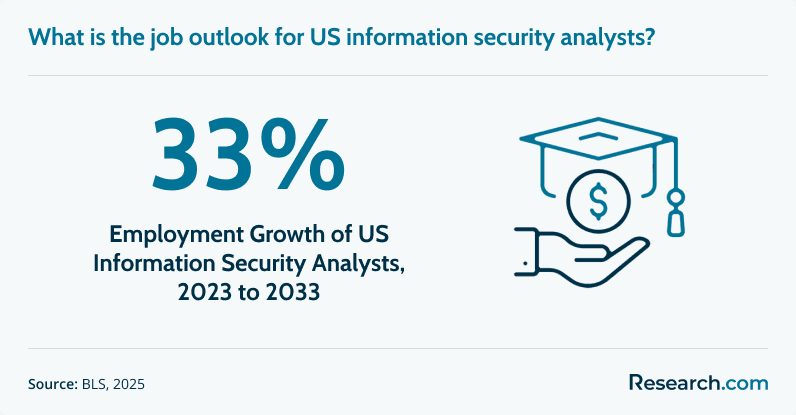
According to BLS data, employment of information security analysts from 2023 to 2033 is projected to grow by 33%, much faster than the national average of 4%. The occupation is expected to increase from 180,700 workers in 2023 to about 239,800 by 2033.
During that same period, BLS projects approximately 17,300 openings for information security analysts each year. There are currently over 6,000 openings for the role in the country, and demand is likely to remain significant if organizations continue expanding digital systems and security operations.
The industries employing the most information security analysts are computer systems design and related services (40,290), company management (16,510), and credit intermediation and related activities (12,600).
The US states with the highest employment levels are Virginia (18,460), California (16,510), and Texas (14,870).
Practical steps before you apply
- Define your target role. Decide whether you are aiming for SOC analyst, security analyst, network security, forensics, audit, compliance, cloud security, or penetration testing.
- List your existing credits and credentials. Gather transcripts, military training records, and IT certifications before requesting transfer evaluations.
- Verify accreditation. Confirm institutional accreditation and check whether the cybersecurity program has ABET accreditation or NSA-related recognition if that matters for your goals.
- Ask for a total cost estimate. Include tuition, fees, software, books, equipment, and certification expenses.
- Review the lab experience. Ask what tools, platforms, simulations, and projects are included, not just what topics are listed in the catalog.
- Compare completion timelines honestly. Accelerated terms can save time, but only if you can handle the workload.
- Plan for career development early. Build a portfolio, seek internships, join cybersecurity communities, practice in labs, and prepare for interviews before your final term.
Key Insights
- An online bachelor’s degree in cybersecurity is most valuable when it combines accreditation, applied labs, relevant coursework, career support, and a cost you can manage.
- Fast programs are usually fastest for transfer students. If you are starting with no credits, expect a timeline closer to the traditional four-year path unless you take heavier course loads.
- Information security analysts earn an average annual salary of $127,730 and a median annual salary of $124,910, but individual salaries depend on experience, location, employer, and technical skill.
- The average total cost of an online cybersecurity bachelor’s degree typically ranges from $30,000 to $60,000, with higher totals possible at some public out-of-state or private institutions.
- BLS projects information security analyst employment to grow 33% from 2023 to 2033, rising from 180,700 workers in 2023 to about 239,800 by 2033.
- Cybersecurity students should pay close attention to AI, cloud security, and IT/OT convergence because these trends are changing how organizations manage cyber risk.
- Do not choose a program based only on rankings, speed, or tuition. Ask about accreditation, transfer credit, hands-on labs, curriculum updates, certification preparation, and job-search support.
References:
- BLS (2025, April 3). 15-1212 Information Security Analysts. BLS
- BLS (2025, June 22). Industry: Cross-industry, Private, Federal, State, and Local Government Period: May 2024. BLS
- BLS (2025, April 18). Information Security Analysts. BLS
- College Board. Information Security Analysts. College Board
- IBM (2024). Cost of a Data Breach Report 2024. IBM
- World Economic Forum (2025, January 13). Global Cybersecurity Outlook 2025. World Economic Forum
Other Things You Should Know About Online Bachelor's Degrees in Cybersecurity
Many fast online cybersecurity bachelor’s programs award transfer credit for certifications such as CompTIA A+, Network+, Security+, Cisco CCNA, and AWS or Microsoft cloud certificates. Schools set the rule, and some cap exam-based credit at 25% of the degree, or about 30 credits in a 120-credit program.
The prerequisites typically include a high school diploma or equivalent, basic computer literacy, and sometimes prior coursework in math or programming. Some programs may require a minimum GPA or standardized test scores for admission in 2027.


