2027 What Can You Do With a Master’s in Cybersecurity?

Co-Founder and Chief Data Scientist
A Master’s in Cybersecurity is usually considered by people who already work in technology, risk, compliance, intelligence, or security and want to move into higher-responsibility cyber roles. The decision is not simply whether cybersecurity is “in demand.” The real question is whether the degree will help you qualify for the specific jobs, salary range, leadership track, or technical specialization you want.
This guide explains what a Master’s in Cybersecurity covers, who it is best suited for, how much it can cost, whether online programs are respected, and what career outcomes graduates can realistically compare. It also walks through admissions requirements, financing options, concentrations, common mistakes, and how to evaluate whether the degree is worth the investment for your situation.
Quick answer: What are the benefits of getting a Master’s in Cybersecurity?
- A master’s degree can help graduates compete for specialized roles in cybersecurity, information assurance, network security, cyber risk, security management, and incident response across technology, government, finance, healthcare, manufacturing, and utilities.
- Reported salaries for the roles covered in this guide range from $77,752 to $111,707 per year, with several senior or specialized positions exceeding $100,000 annually.
- Online programs can be a practical option for working professionals because they often allow students to continue earning income while completing technical coursework, virtual labs, and security projects.
- What is a Master’s in Cybersecurity?
- What are the admission requirements for a Master’s in Cybersecurity?
- How much does a Master’s in Cybersecurity cost?
- Do employers respect an online Master’s in Cybersecurity?
- Best careers for Master’s in Cybersecurity graduates
- How much can you earn with a Master’s in Cybersecurity?
- Which industries hire cybersecurity master’s graduates?
- How can you pay for a Master’s in Cybersecurity?
- How does cybersecurity compare with related IT degrees?
- What should you look for in an online cybersecurity program?
- Which cybersecurity concentrations are most useful?
- How are emerging technologies changing cybersecurity education?
- What challenges should students expect?
- How does cybersecurity affordability compare with engineering programs?
- How is AI changing cybersecurity programs?
- How does cybersecurity training support healthcare data protection?
- Which states are strongest for cybersecurity graduates?
- What is the job outlook for Master’s in Cybersecurity graduates?
- Is a Master’s in Cybersecurity worth it?
What is a Master’s in Cybersecurity?
A Master’s in Cybersecurity is a graduate degree focused on protecting digital systems, networks, applications, cloud environments, and sensitive data from unauthorized access, disruption, fraud, and misuse. Unlike a general IT degree, it usually emphasizes security architecture, cyber defense, risk management, cryptography, ethical hacking, digital forensics, compliance, governance, and incident response.
The degree is designed for students who want to move beyond basic technical support or entry-level IT work into roles that require deeper judgment. Graduates are often expected to identify vulnerabilities, evaluate threats, design controls, communicate risk to leadership, and respond when systems are attacked or compromised.
Cybersecurity also overlaps with data science because modern security teams rely heavily on analytics, anomaly detection, fraud monitoring, and automated threat intelligence. Students interested in the analytical side of cyber defense may benefit from understanding the skills covered in a data scientist education, especially if they want to work with security data, behavioral analytics, or predictive detection tools.
Cybersecurity is not only a technical field. It also involves law, policy, privacy, ethics, and regulatory compliance. Students who want to work in cyber governance, privacy operations, or compliance-heavy industries may find that the topics covered in the best online master’s in legal studies degree programs connect closely with cybersecurity responsibilities such as privacy law, data protection, and organizational risk management.
| Cybersecurity master’s focus area | What students learn | Why it matters in the workplace |
| Network and systems security | How to secure infrastructure, endpoints, servers, and network traffic | Organizations need secure systems that can withstand attacks and operational failures. |
| Risk management and governance | How to assess threats, prioritize controls, and report risk to decision-makers | Security leaders must connect technical risks to business consequences. |
| Incident response | How to detect, contain, investigate, and recover from cyber incidents | Fast response reduces damage when breaches, ransomware, or intrusions occur. |
| Cryptography and data protection | How encryption, identity controls, and secure protocols protect sensitive information | Data protection is essential in finance, healthcare, government, and technology. |
| Digital forensics | How to collect evidence, analyze attacks, and document security events | Forensic skills support investigations, legal processes, and post-incident improvement. |
What are the admission requirements for a Master’s in Cybersecurity?
Admission requirements vary by university, but most programs look for evidence that applicants can handle graduate-level technical work. Some programs are built for students with computer science or IT backgrounds, while others provide bridge courses for applicants coming from business, criminal justice, military, intelligence, or engineering fields.
Common admissions requirements include:
- Bachelor’s degree: Many programs prefer applicants with an undergraduate degree in cybersecurity, computer science, information technology, engineering, or a related field. Students who completed an accelerated bachelor's degree in computer science may already have exposure to programming, algorithms, operating systems, and technical problem-solving.
- Minimum GPA: Programs often expect a GPA of about 3.0 on a 4.0 scale, though the exact requirement can differ by institution.
- Professional experience: Some schools value or require work experience in IT, networking, cybersecurity, military operations, intelligence, or related technical roles.
- Letters of recommendation: Applicants may need academic or professional references who can speak to their technical ability, work ethic, leadership potential, or readiness for graduate study.
- Standardized test scores: Some programs request GRE scores, while others waive them for applicants with strong academic records or relevant professional experience.
- Statement of purpose: A strong essay should explain why the applicant wants the degree, which cybersecurity problems they want to work on, and how the program supports their career goals.
Applicants with leadership or sustainability interests may also compare cyber-focused graduate study with business-oriented pathways. For example, students asking what can I do with an online MBA in sustainability may find that secure infrastructure, digital risk, and responsible technology management increasingly overlap with sustainability and corporate governance priorities.
Who is a strong candidate for this degree?
- IT professionals who want to move into security analysis, cloud security, security engineering, or cyber management.
- Military, law enforcement, or intelligence professionals seeking technical cyber credentials.
- Compliance, audit, or risk professionals who want deeper knowledge of cyber controls and data protection.
- Computer science graduates who want to specialize in defensive security, secure systems, or threat analysis.
- Working professionals who need a structured pathway into advanced cybersecurity roles.
Who may need preparation before applying?
- Applicants with limited programming, networking, or operating systems experience may need prerequisite coursework.
- Students who dislike hands-on technical problem-solving may struggle in lab-heavy programs.
- Career changers should confirm whether the program offers foundational courses rather than assuming the curriculum starts from the basics.
How much does a Master’s in Cybersecurity cost?
The total cost of a Master’s in Cybersecurity can vary widely. The programs cited in this guide range from approximately $20,944 to $89,430. American National University lists tuition for a Master’s degree in Cybersecurity at $20,944, including fees such as application, course technology, graduation, textbooks, and lab equipment.
At the higher end, New York University lists the Master of Science in Cybersecurity Risk and Strategy program at $89,430, including registration and service fees, course materials, and official events, but not hotel and travel expenses.
Other examples show why students should compare total program cost rather than tuition alone. The University of Nevada, Reno lists tuition of $26,790 for its online cybersecurity master’s, while the Asian Institute of Management lists $22,500, depending on track and available financing. These examples illustrate the range students may encounter when evaluating overall security degree cost.
| Institution or program example | Stated cost | Important cost note |
| American National University Master’s degree in Cybersecurity | $20,944 | Cost is described as including items such as fees, textbooks, and lab equipment. |
| Asian Institute of Management cybersecurity program | $22,500 | Cost depends on track and financing options. |
| University of Nevada, Reno online cybersecurity master’s | $26,790 | Students should confirm tuition, fees, and aid eligibility directly with the university. |
| New York University MS in Cybersecurity Risk and Strategy | $89,430 | Includes registration and service fees, course materials, and official events, but excludes hotel and travel expenses. |
Cost should be evaluated alongside accreditation, curriculum fit, hands-on learning, employer reputation, and expected career path. Students should also be careful not to confuse accreditation types across fields. For example, CACREP accreditation standards are relevant to counseling programs, not cybersecurity program quality. Cybersecurity students should instead confirm institutional accreditation and review whether the program’s computing, security, or engineering credentials align with their goals.
Students often ask whether online degrees are respected. In cybersecurity, employers are generally more likely to value an accredited online degree when it comes from a reputable institution and is supported by strong technical training, labs, projects, and relevant certifications or work experience.
Do employers respect an online Master’s in Cybersecurity?
Employers can recognize an online Master’s in Cybersecurity as credible when the program is properly accredited, academically rigorous, and offered by an institution with a strong reputation. The delivery format matters less than whether students can demonstrate real cybersecurity skills, complete hands-on work, and explain technical concepts clearly in interviews.
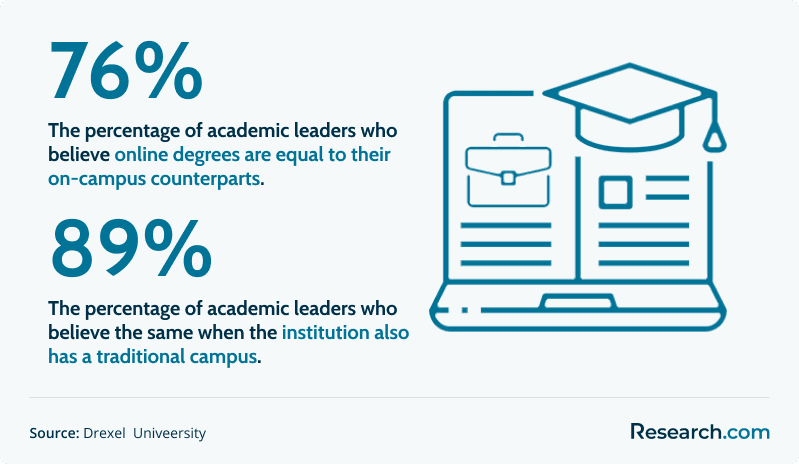
Drexel University notes that the first criterion is accreditation, particularly regional accreditation, when employers evaluate online degrees. Drexel also reports that 76% of academic leaders believe online degrees are equal to traditional ones, and that figure rises to 89% when the online degree comes from an institution that also has a physical campus.
This is especially relevant for students considering an online master's in computer science without a CS undergrad or a cybersecurity program designed for career changers. Choosing an accredited school with transparent curriculum requirements, technical labs, faculty expertise, and recognizable institutional credibility can improve how the degree is perceived.
| What employers may evaluate | Why it matters | What to check before enrolling |
| Accreditation | It helps confirm that the school meets recognized academic standards. | Verify institutional accreditation through official school and accreditor information. |
| Hands-on technical work | Cybersecurity hiring often depends on applied skills, not only coursework. | Look for virtual labs, simulations, capstones, cloud security work, or incident response projects. |
| Program reputation | A known institution may reduce concerns about online delivery. | Review faculty backgrounds, employer partnerships, alumni outcomes, and student support. |
| Curriculum relevance | Cybersecurity tools and threats change quickly. | Check for coverage of cloud, identity, AI-related security, forensics, risk, and secure systems. |
| Career support | Graduate degrees are often pursued for advancement or career transition. | Ask about career coaching, resume support, employer connections, and internship or project options. |
Best careers for Master’s in Cybersecurity graduates
A Master’s in Cybersecurity can support several career paths, from hands-on engineering to intelligence, governance, consulting, and management. The best role depends on your background. A network administrator may move toward security engineering, while a compliance professional may be better positioned for information assurance or cyber risk. A military or intelligence professional may find watch officer or intelligence analyst roles more aligned with prior experience.
| Role | Typical responsibilities | Average annual salary | Minimum education required | Growth rate |
| Watch Officer | Monitors security activity, follows established protocols, escalates incidents, and supports operational readiness in high-security environments. | $89,161 | Bachelor's degree in any field or a high school diploma with five years of experience | 3% |
| Cyber Security Analyst | Reviews threats, monitors systems, investigates suspicious activity, and recommends controls to reduce cyber risk. | $88,422 | Bachelor’s degree in cybersecurity, information technology, or related fields | 32% |
| Securities Analyst | Evaluates financial securities such as stocks and bonds and develops investment recommendations using financial and market analysis. | $84,334 | Bachelor’s degree in finance, economics, or related fields | 32% |
| Information Assurance Engineer | Designs and maintains safeguards that protect information systems, reduce vulnerabilities, and support security compliance. | $89,291 | Bachelor’s degree in computer science, cybersecurity, or related field | 32% |
| Securities Consultant | Advises organizations or clients on investment opportunities, financial strategies, and securities-related decisions. | $92,092 | Bachelor’s degree in finance, economics, or related fields | 32% |
| Intelligence Analyst | Collects, evaluates, and interprets information to support national security, corporate security, or risk-related decisions. | $77,752 | Bachelor's degree in fields like criminal justice, cybersecurity, or international relations | 3% |
| Information Assurance Officer | Oversees data protection practices, information security governance, and secure handling of organizational information. | $105,312 | Bachelor's degree in information technology, cybersecurity, or a related field | 32% |
| Senior Network Engineer | Designs, secures, maintains, and scales network infrastructure that supports business operations. | $111,707 | Bachelor’s degree in information technology, computer science, or related fields | 5% |
| Security Manager | Leads security operations, manages teams, develops security policies, and coordinates responses to threats or incidents. | $111,171 | Bachelor’s degree in security studies, criminal justice, or related fields | 6% |
| Security Engineer | Builds and implements technical defenses to protect systems, applications, networks, and infrastructure from attacks. | $104,524 | Bachelor’s degree in cybersecurity, information technology, or related fields | 32% |
How to choose the right cybersecurity career path
- Choose security engineering if you enjoy building, configuring, testing, and improving technical defenses.
- Choose cyber analysis if you prefer monitoring threats, investigating alerts, and translating data into action.
- Choose information assurance if you are interested in governance, compliance, risk controls, and secure operations.
- Choose management if you already have technical or security experience and want to lead teams, budgets, policies, and incident planning.
- Choose intelligence-oriented roles if your strengths include research, pattern recognition, geopolitical awareness, and briefing decision-makers.
How much can you earn with a Master’s in Cybersecurity?
The roles discussed in this guide report annual salaries ranging from $77,752 to $111,707. Actual earnings can vary by job title, location, employer, clearance requirements, technical specialization, management responsibility, and prior experience. A master’s degree may help qualify a candidate for advanced roles, but it does not guarantee a specific salary.
Senior Network Engineers, Security Managers, Information Assurance Officers, and Security Engineers are among the roles listed above that exceed $100,000 annually. These jobs typically require a mix of technical depth, operational judgment, and the ability to protect systems that are important to an organization’s continuity and reputation.
Some professionals compare cybersecurity graduate study with business technology degrees. An MBA in Information Technology salary pathway may appeal to students who want to combine technology strategy, management, finance, and organizational leadership rather than pursue a heavily technical security curriculum.
The chart below summarizes the salary range across the cybersecurity-related occupations discussed in this guide.
Which industries hire cybersecurity master’s graduates?
Cybersecurity graduates are needed wherever organizations store data, operate networks, handle payments, manage regulated information, or depend on digital infrastructure. The strongest fit often depends on whether a graduate wants a technical, compliance, intelligence, engineering, or management role.
- Technology: Technology companies need security engineers, information assurance engineers, cloud security specialists, and product security professionals to defend platforms, applications, infrastructure, and customer data.
- Government: Federal, defense, intelligence, and public-sector organizations employ cybersecurity professionals for national security, critical systems protection, compliance, and secure operations.
- Finance: Banks, investment firms, insurance companies, and payment platforms rely on cybersecurity teams to protect financial data, transaction systems, fraud detection processes, and customer trust.
- Healthcare: Healthcare organizations need security professionals to protect patient records, connected medical devices, telemedicine systems, and regulated health information.
- Manufacturing and utilities: Industrial environments and infrastructure operators need cybersecurity expertise to secure operational technology, production systems, utilities, and supply chains.
| Industry | Why cybersecurity matters | Roles that may fit |
| Technology | Companies must protect platforms, cloud systems, applications, and user data. | Security Engineer, Information Assurance Engineer, Senior Network Engineer |
| Government | Agencies handle sensitive information, national defense, and critical operations. | Watch Officer, Intelligence Analyst, Information Assurance Officer |
| Finance | Financial institutions face fraud, data theft, regulatory pressure, and payment security risks. | Cyber Security Analyst, Securities Analyst, Securities Consultant |
| Healthcare | Patient data, medical devices, and electronic records require strong privacy and security controls. | Security Manager, Information Assurance Officer, Cyber Security Analyst |
| Manufacturing and utilities | Operational technology and infrastructure systems are increasingly connected and exposed to cyber risk. | Security Engineer, Senior Network Engineer, Information Assurance Engineer |
The chart below shows where Cyber Security Analyst roles are especially common across industries, with technology standing out as a major employment area.
How can you pay for a Master’s in Cybersecurity?
Students should evaluate financing before enrolling, not after receiving the first bill. A lower-cost program is not always the best value, and a high-cost program is not automatically a poor choice. The right decision depends on total cost, time to completion, employer recognition, available aid, and whether the curriculum supports the roles you want.
- Scholarships and institutional grants: Ask each school whether it offers awards for cybersecurity students, working professionals, veterans, women in technology, public-sector employees, or students with strong academic records.
- Federal and private loans: Compare borrowing terms carefully and avoid assuming a future salary will make any debt level manageable.
- Employer tuition reimbursement: Many working professionals should ask whether their employer supports graduate education tied to cybersecurity, IT, compliance, or risk management.
- State-specific grants: Some students may qualify for location-based financial aid, workforce development funding, or public-sector education support.
- Accelerated or flexible options: Some accelerated online cybersecurity degree programs may reduce opportunity cost by shortening the timeline or allowing students to keep working while studying.
Questions to ask financial aid offices
- What is the total program cost, including fees, books, software, labs, and graduation charges?
- Is tuition charged per credit, per term, or as a flat program fee?
- Can transfer credits, prior graduate credits, or professional training reduce the cost?
- Are online students eligible for the same aid as campus students?
- Does the program require travel, residencies, certification exam fees, or specialized equipment?
How does a Master’s in Cybersecurity compare to related IT degrees?
A Master’s in Cybersecurity is more specialized than many broader technology degrees. It is generally the better fit for students who want to work directly with threat detection, digital defense, cyber risk, compliance, security engineering, or incident response. A broader computing degree may be better for students who want flexibility across software engineering, systems design, artificial intelligence, databases, or general technology leadership.
For example, an online MS computer science can provide a wider technical foundation in programming, algorithms, systems architecture, and computing theory. That can complement cybersecurity, but it may not provide the same depth in cyber operations, governance, forensics, or security policy unless the student chooses security electives.
| Degree option | Best for students who want to... | Potential limitation |
| Master’s in Cybersecurity | Specialize in security operations, defense, cyber risk, incident response, or information assurance | May be narrower than a general computer science degree if you want broad software or research roles. |
| Master’s in Computer Science | Build broad technical depth in computing, software, algorithms, and systems | May require extra security electives or certifications for cyber-specific roles. |
| MBA in Information Technology | Lead technology strategy, budgets, teams, and business transformation | May not provide the technical depth needed for hands-on security engineering roles. |
| Master’s in Information Technology | Develop applied IT management, systems, infrastructure, and enterprise technology skills | Cybersecurity coverage may be less advanced unless the program offers a security concentration. |
What should you look for in an online cybersecurity program?
A strong online cybersecurity program should be more than a set of recorded lectures. Cybersecurity is an applied field, so students need opportunities to practice technical skills, analyze realistic scenarios, and produce work that can be discussed with employers.
When comparing programs, review accreditation, curriculum depth, faculty expertise, virtual lab access, career services, cost transparency, and whether the school supports working adults. Students comparing affordability may also review a cyber security program online resource to identify lower-cost options that still align with their academic and career goals.
| Program feature | Why it matters | Red flag to avoid |
| Institutional accreditation | Supports degree credibility and financial aid eligibility. | The school is vague about accreditation or uses unclear claims. |
| Hands-on labs | Students need practical experience with security tools, networks, systems, and scenarios. | The curriculum is mostly theory with little applied technical work. |
| Current curriculum | Security threats, tools, cloud systems, and AI-related risks change quickly. | Course descriptions appear outdated or overly generic. |
| Clear admissions fit | Students need to know whether the program assumes prior technical knowledge. | The school does not explain prerequisites or support for career changers. |
| Transparent pricing | Total cost affects return on investment and borrowing decisions. | Fees, materials, labs, or travel requirements are hard to find. |
| Career support | Career changers and advancement-focused students need help translating coursework into job opportunities. | No evidence of advising, portfolio support, employer engagement, or alumni outcomes. |
Which cybersecurity concentrations are most useful?
Concentrations can make a Master’s in Cybersecurity more valuable when they match the student’s target role. A student interested in compliance should not choose the same specialization as someone aiming for penetration testing, secure software engineering, or cloud security architecture.
Common concentration areas include network defense, digital forensics, risk management, secure software development, information assurance, and incident response. Some programs also align coursework with industry certifications or require simulations that test decision-making under pressure. Students comparing broader technology pathways can also review online technology degree programs to see whether an IT-focused curriculum may be a better fit.
| Concentration | Best fit | Skills emphasized |
| Network defense | Students interested in infrastructure, monitoring, and defensive operations | Firewalls, intrusion detection, network hardening, traffic analysis |
| Digital forensics | Students interested in investigations, evidence handling, and breach analysis | Forensic tools, evidence preservation, incident reconstruction, reporting |
| Risk management | Students moving toward governance, compliance, audit, or security leadership | Risk assessment, policy, controls, regulatory alignment, executive communication |
| Secure software development | Students with programming backgrounds who want to build safer applications | Secure coding, application testing, vulnerability management, software assurance |
| Incident response | Students who want to detect, contain, and recover from cyber events | Threat analysis, response planning, containment, recovery, post-incident review |
How are emerging technologies changing cybersecurity education?
Cybersecurity programs are adapting because the systems students must protect are changing. Cloud platforms, artificial intelligence, machine learning, IoT, blockchain, connected devices, and automated security tools have expanded the knowledge expected of advanced cybersecurity professionals.
Modern programs increasingly use simulations, virtual labs, threat modeling exercises, and interdisciplinary projects so students can practice securing complex systems rather than simply memorizing definitions. Some programs also encourage creative technical thinking that overlaps with fields such as software design, simulation, and interactive systems. Students interested in digital design and immersive technology can compare related pathways such as an online college for game design, though game development and cybersecurity have different career outcomes.
Current trends affecting cybersecurity students
- AI-supported security work: Security teams increasingly use automation and analytics to triage alerts, identify patterns, and support faster response.
- Cloud security expectations: Employers often need professionals who understand identity, access, configuration, and shared responsibility in cloud environments.
- IoT and operational technology exposure: Connected devices and industrial systems create security challenges beyond traditional office networks.
- Regulatory and privacy pressure: Organizations need security professionals who can connect technical controls with legal and compliance obligations.
- Skills-based hiring: Degrees can help, but employers still look for evidence of hands-on ability, projects, certifications, and clear communication.
What challenges should students expect in a Master’s in Cybersecurity?
A Master’s in Cybersecurity can be demanding because the field combines technical depth, constant change, time-sensitive decision-making, and high-stakes problem-solving. Students should expect challenging work in cryptography, networking, systems security, incident response, and security governance.
Working adults may also need to manage weekly labs, group projects, reading, and technical assignments around job and family responsibilities. Cost is another challenge, which is why comparing cybersecurity programs with other technical graduate degrees can be useful. For example, reviewing the cheapest online master's electrical engineering options can help students understand how pricing varies across technology and engineering fields.
| Common challenge | Why it happens | How to prepare |
| Steep technical learning curve | Graduate cybersecurity programs may assume knowledge of networks, systems, and programming. | Review prerequisites and complete foundational courses before the first term if needed. |
| Rapidly changing tools and threats | Security practices evolve as attackers, platforms, and defenses change. | Build a habit of reading security advisories, threat reports, and technical documentation. |
| Time pressure | Labs, projects, and readings can be difficult to balance with full-time work. | Choose a realistic course load and ask whether part-time study is available. |
| Cost management | Tuition, fees, software, and time away from work can affect affordability. | Compare total cost, employer reimbursement, scholarships, and transfer policies. |
| Translating coursework into jobs | A degree alone may not prove hands-on ability to employers. | Build a project portfolio, document labs, and align electives with target roles. |
How does cybersecurity affordability compare with engineering programs?
Online cybersecurity master’s programs can be competitively priced compared with other technical graduate programs, but affordability depends on the institution, fee structure, program length, residency requirements, and financial aid. Students should compare total cost and expected career value rather than choosing solely by sticker price.
Cybersecurity and engineering programs may also differ in equipment, lab delivery, software access, and course sequencing. Students comparing cost across technical fields can review the most affordable online colleges for engineering to understand how engineering tuition options compare with cybersecurity programs.
How to evaluate affordability realistically
- Calculate the full cost of attendance, not only tuition.
- Check whether books, cybersecurity labs, software, certification preparation, or residency travel are included.
- Ask whether the program allows part-time enrollment without increasing overall cost.
- Compare salary outcomes by role, not by degree title alone.
- Consider opportunity cost if you must reduce work hours to study.
How is AI changing cybersecurity programs?
Artificial intelligence is becoming more prominent in cybersecurity education because security teams use AI-supported tools to analyze large datasets, detect anomalies, prioritize alerts, and support faster investigation. Master’s programs increasingly expose students to machine learning concepts, automated response, predictive analytics, and the risks created by AI-enabled attacks.
Students should not assume that an AI module alone makes a program cutting edge. A useful cybersecurity curriculum should explain both how AI can strengthen defense and how attackers may misuse automation, synthetic content, or model-driven techniques. Students who want deeper AI preparation can compare cybersecurity coursework with an online degree in AI to decide whether their main goal is cyber defense or artificial intelligence specialization.
How does cybersecurity training support healthcare data protection?
Healthcare cybersecurity requires special attention because organizations must protect patient records, clinical systems, connected devices, telemedicine platforms, and sensitive operational data. A Master’s in Cybersecurity can prepare graduates to apply risk assessment, encryption, identity management, access controls, monitoring, and incident response practices in healthcare settings.
Healthcare security also requires collaboration with clinical, privacy, compliance, and informatics teams. Students interested in the healthcare side of digital systems may find that online health informatics programs offer useful context on electronic health records, healthcare data workflows, and technology used in patient care.
Which states are strongest for cybersecurity graduates?
Cybersecurity roles exist nationwide, but some states stand out because of their concentration of federal agencies, defense contractors, technology employers, financial institutions, and critical infrastructure. The strongest state for an individual graduate depends on target role, clearance eligibility, remote work options, industry preference, and cost of living.
- Virginia: Virginia offers strong opportunities near Washington, D.C., especially for Security Engineers and Information Assurance Officers working with federal agencies, defense organizations, and military-related employers.
- District of Columbia: D.C. is closely tied to national security and federal operations, making it especially relevant for Watch Officers, Intelligence Analysts, and professionals supporting government missions.
- Maryland: Maryland benefits from its proximity to federal cybersecurity and defense activity, creating opportunities for Security Managers, Information Assurance Engineers, and related roles.
- California: California’s technology sector supports demand for Security Engineers and Senior Network Engineers who help protect digital products, infrastructure, and innovation-driven companies.
- Texas: Texas has growing technology markets in cities such as Austin and Dallas, creating opportunities for cybersecurity professionals across technology, business, and infrastructure employers.
Students should compare job availability with living costs, commuting expectations, remote work policies, and whether a role requires security clearance or sector-specific experience.
What is the job outlook for Master’s in Cybersecurity graduates?
The job outlook for many cybersecurity-related roles is strong because organizations continue to depend on secure systems, protected data, and resilient digital operations. In the roles covered in this guide, Cyber Security Analysts, Information Assurance Engineers, Information Assurance Officers, and Security Engineers have a projected job growth rate of 32% from 2018 to 2028.
Other roles show slower but still meaningful demand. Intelligence Analysts and Watch Officers have projected growth of 3% over the same period, while Senior Network Engineers are listed at 5% and Security Managers at 6%. These differences show why students should research the specific occupation they want rather than relying on broad statements about cybersecurity demand.
The chart below compares growth rates across the listed cybersecurity-related roles, from steadier occupations such as Intelligence Analyst and Watch Officer to faster-growing roles in security engineering, cyber analysis, and information assurance.
Is a Master’s in Cybersecurity worth it?
A Master’s in Cybersecurity can be worth it if it helps you qualify for the roles you actually want and if the total cost fits your financial situation. Tuition in the examples covered here ranges from $20,944 to $89,430, while listed salaries range from $77,752 to $111,707 per year. That creates a potentially strong return, but only when the degree is matched to realistic career goals, prior experience, location, and employer expectations.
Cost of living also matters. Numbeo lists average monthly costs for a single person without rent in the U.S. at around $1,164.6. A salary above $100,000 may go further in some regions than others, and students should account for rent, transportation, taxes, loan payments, and family obligations when evaluating affordability.
Compared with many computer science career paths, cybersecurity can offer strong advancement potential for professionals who combine technical skill, practical experience, and sound judgment. However, a graduate degree is not a shortcut around hands-on ability. Employers may still expect technical projects, certifications, security tools experience, communication skills, and evidence that you can solve real problems.
| A Master’s in Cybersecurity may be worth it if... | It may not be the best choice if... |
| You already work in IT, networking, risk, intelligence, or compliance and need a graduate credential to advance. | You have no technical background and the program offers little foundational support. |
| You want roles such as Security Engineer, Information Assurance Officer, Cyber Security Analyst, or Security Manager. | You mainly want general software engineering or data science roles without a security focus. |
| Your employer offers tuition reimbursement or the program cost is manageable without excessive debt. | You would need to borrow heavily without a clear target role or salary plan. |
| The curriculum includes labs, projects, current tools, and relevant concentrations. | The program is mostly theoretical and does not help you demonstrate applied skills. |
| You need flexibility and can succeed in an online or part-time format. | You need extensive in-person support and the program does not provide strong advising or technical help. |
Common mistakes to avoid before enrolling
- Choosing based only on tuition: A cheaper program may cost more in the long run if it lacks hands-on labs, career support, or employer recognition.
- Ignoring accreditation: Always verify that the institution is properly accredited before committing time and money.
- Assuming an online degree is automatically accepted: Employer perception depends on school reputation, accreditation, curriculum quality, and your ability to demonstrate skills.
- Overlooking prerequisites: Students without networking, programming, or systems knowledge should confirm whether bridge courses are available.
- Relying only on rankings: Rankings can be useful, but the best program is the one that fits your goals, budget, schedule, and technical level.
- Expecting salary guarantees: Salaries depend on role, location, experience, industry, clearance requirements, and interview performance.

What graduates say about earning a Master’s in Cybersecurity
- My cybersecurity master’s helped me move from theory into practical security work. The projects were built around real-world problems, and that gave me more confidence when I started applying for roles in finance and technology. Elena
- Studying online made the degree possible while I kept working. I could apply concepts from class directly to my job, which made the coursework feel immediately useful instead of separate from my career. Marcus
- The technical training mattered, but the collaborative projects were just as important. Working with classmates on complex security problems helped me build the communication and leadership skills I needed for the next stage of my career. Priya
Key Insights
- A Master’s in Cybersecurity is best for students who want advanced technical, risk, governance, intelligence, or leadership roles tied directly to cyber defense.
- The degree can support roles such as Cyber Security Analyst, Security Engineer, Information Assurance Officer, Senior Network Engineer, Security Manager, Watch Officer, and Intelligence Analyst.
- Reported salaries in this guide range from $77,752 to $111,707, with several roles exceeding $100,000 annually, but salary outcomes are not guaranteed.
- Program costs vary significantly, from $20,944 to $89,430 in the examples cited, so students should compare total cost, aid, employer reimbursement, and likely career benefit.
- Accredited online cybersecurity master’s programs can be respected by employers, especially when they include rigorous coursework, practical labs, and recognized institutional credibility.
- Students should choose concentrations based on target roles: network defense, digital forensics, risk management, secure software development, or incident response.
- AI, cloud systems, IoT, and regulatory pressure are reshaping cybersecurity education, making applied, current, and interdisciplinary training more important.
- The degree is most worthwhile when it matches your background, budget, preferred industry, and specific career goals rather than a general belief that cybersecurity is a high-demand field.
References:
- American National University. Master of Science in Cybersecurity.
- Asian Institute of Management. Cybersecurity Fees and Financing.
- Drexel University. Online Degree vs. Traditional Degree: Which is Right for You?
- New York University. Cybersecurity Strategy Masters Program Fee.
- Numbeo. Cost of Living in United States.
- University of Nevada, Reno. Online MS in Cybersecurity Tuition.
- Zippia. Cyber Security Analyst Jobs.
- Zippia. Information Assurance Engineer Jobs.
- Zippia. Information Assurance Officer Jobs.
- Zippia. Intelligence Analyst Jobs.
- Zippia. Securities Analyst Jobs.
- Zippia. Securities Consultant Jobs.
- Zippia. Security Engineer Jobs.
- Zippia. Security Manager Jobs.
- Zippia. Senior Network Engineer Jobs.
- Zippia. Watch Officer Jobs.
Other Things You Should Know About Master’s in Cybersecurity
In 2027, professionals with a Master’s in Cybersecurity can pursue roles such as Security Architect, Cybersecurity Analyst, Chief Information Security Officer (CISO), and Penetration Tester, among others. These roles are critical as organizations increasingly prioritize security to combat sophisticated cyber threats.
To enroll in a Master’s in Cybersecurity program in 2027, candidates typically need a bachelor's degree in a related field such as computer science. Some programs may also require relevant work experience or proficiency in specific programming languages like Python or Java.
Many employers list Security+ for entry-level roles and CISSP for senior roles, but neither is always mandatory. Security+ is an entry-level certification from CompTIA, while CISSP requires five years of paid work experience in at least two CISSP domains, according to (ISC)².