2027 Best Online Master’s In Legal Studies Degree Programs

Co-Founder and Chief Data Scientist
An online master’s in legal studies is built for professionals who need legal knowledge at work but do not plan to become attorneys. It can help people in compliance, healthcare, finance, government, human resources, contracts, risk management, and corporate operations understand laws, regulations, policies, and legal risk more confidently. The key decision is whether the degree will improve your career path enough to justify the tuition, time, and opportunity cost.
This guide explains what an online master’s in legal studies covers, how long it takes, what it costs, which programs stand out, and what careers it may support. It also explains when this degree makes sense, when a different credential may be better, and how to compare programs without relying only on rankings or marketing language.
Quick Answer: Is an Online Master’s in Legal Studies Worth It?
An online master’s in legal studies can be worth it if your current or target role requires legal literacy but not a law license. It is especially relevant for professionals who work with contracts, compliance programs, regulatory reporting, employment policies, healthcare rules, financial services requirements, privacy issues, or public policy. According to Data USA, graduates in legal studies earn a median salary of $86,930 per year.
However, this degree is not a substitute for a JD. It does not qualify graduates to practice law, represent clients in court, or sit for the bar exam. Students who want to become licensed attorneys should pursue law school instead.
What are the main benefits of earning an online master’s in legal studies?
- Career relevance across regulated industries: The degree can support roles in compliance, regulatory affairs, contract administration, legal operations, policy analysis, and legal consulting.
- Stronger legal decision-making: Students learn how laws, regulations, contracts, and institutional policies affect business and organizational risk.
- Flexible study format: Online programs are often designed for working adults who need to complete coursework around employment, family, or military responsibilities.
- Potential salary upside: Data USA reports a median salary of $86,930 per year for legal studies graduates, although outcomes vary by role, industry, location, and experience.
What can I expect from an online master’s in legal studies?
An online master’s in legal studies, often called an MLS, MSL, or Master of Legal Studies, teaches non-lawyers how to interpret legal rules and apply them in professional settings. The curriculum usually emphasizes legal research, legal writing, ethics, contracts, regulatory compliance, administrative law, risk management, and industry-specific legal issues.
Most programs are designed for adults already working in fields where legal knowledge matters. Coursework may be asynchronous, live online, or a blend of both. Some programs include capstone projects, applied research papers, compliance simulations, case studies, or policy analysis assignments instead of traditional internships.
The degree is best understood as a legal literacy credential for professionals, not a law practice credential. Graduates typically use it to improve their ability to work with attorneys, manage legal risk, interpret regulations, strengthen compliance systems, or move into legal-adjacent leadership roles.
| Feature | What it usually means for students | Why it matters |
| Degree purpose | Advanced legal education for non-lawyers | Useful for legal-adjacent roles, but not for becoming an attorney |
| Common format | Online, asynchronous, live online, or hybrid online delivery | Allows many working professionals to keep their jobs while studying |
| Typical credits | Often around 30 Credits in many listed programs | Credit load affects cost, time to completion, and weekly workload |
| Common assignments | Legal memos, case analysis, policy reviews, compliance plans, research projects | Builds practical skills for workplace legal and regulatory decisions |
| Licensure outcome | Does not lead to attorney licensure | Students who want to practice law should compare JD programs instead |
Where can I work with a master’s in legal studies?
Graduates can work wherever organizations need employees who understand legal obligations but are not serving as attorneys. Common settings include corporations, hospitals, health systems, banks, insurance companies, universities, government agencies, nonprofit organizations, consulting firms, and law firms.
In corporate settings, MLS graduates may support compliance programs, contract workflows, governance processes, employee relations, or risk controls. In healthcare and finance, they may help organizations respond to complex regulations. In government or public policy roles, the degree may support policy analysis, regulatory review, administrative processes, or enforcement-related work.
| Industry or setting | How legal studies knowledge may be used | Examples of related roles |
| Corporate business | Contracts, compliance, governance, internal policies, risk management | Compliance manager, contracts manager, legal operations specialist |
| Healthcare | Patient rights, privacy, regulatory compliance, institutional risk | Healthcare compliance specialist, policy analyst, risk coordinator |
| Finance and insurance | Regulatory reporting, underwriting rules, consumer protection, audit readiness | Underwriter, compliance analyst, risk management specialist |
| Human resources | Employment law, workplace investigations, discrimination policies, labor relations | Human resources manager, employee relations specialist |
| Government and public policy | Administrative rules, enforcement processes, policy interpretation | Policy analyst, regulatory affairs specialist, program administrator |
| Law firms and legal departments | Research support, case organization, legal project coordination | Paralegal, legal assistant, case manager, legal project coordinator |
How much can I make with a master’s in legal studies?
Pay depends heavily on occupation, employer, geography, industry, and prior experience. According to Data USA, the median annual salary for graduates in this field is $86,930. The original salary data also notes that compliance managers, one of the common roles for legal studies graduates, can earn over $100,000 per year, while legal assistants and consultants typically range from $60,000 to $80,000 annually.
Higher compensation is more likely when legal studies training is paired with industry experience, management responsibility, technical knowledge, or specialized regulatory expertise. Healthcare, finance, insurance, privacy, and corporate compliance roles may be especially sensitive to legal and regulatory complexity, but no degree guarantees a specific salary.
- Best online master’s in legal studies programs for 2027
- How long does an online master’s in legal studies take?
- Online vs. on-campus master’s in legal studies
- Average cost of an online master’s in legal studies
- Financial aid options for legal studies students
- Admissions requirements and prerequisites
- Common courses in an online master’s in legal studies
- Specializations in online legal studies programs
- Do employers respect online legal studies degrees?
- Why accreditation and institutional quality matter
- Challenges of earning this degree online
- Certifications that can strengthen a legal career
- Criminology opportunities connected to legal studies
- Criminal justice programs that may complement legal studies
- Return on investment for an online legal studies master’s
- Forensic science and related career connections
- Federal law enforcement and legal studies
- Trends shaping online legal studies
- How to choose the best online master’s in legal studies
- Career paths for online legal studies graduates
- Job market for graduates with an online master’s in legal studies
Best Online Master’s In Legal Studies Degree Programs for 2027
How do we rank schools?
Choosing a graduate program requires more than comparing tuition or brand recognition. Research.com’s ranking is developed to help students evaluate programs using transparent, data-informed criteria. You can review the full process in our methodology section.
The evaluation draws from established education data sources, including the IPEDS database, Peterson’s database and its Distance Learning Licensed Data Set, the College Scorecard database, and the National Center for Education Statistics.
Program comparison table
| Rank | School | Program length | Tracks or concentrations | Cost per credit | Credits | Accreditation |
| 1 | Northeastern University | Two years | General Legal Studies | $1,132 | 30 Credits | New England Commission of Higher Education |
| 2 | Drexel University | Two years | Corporate Compliance, Healthcare Law, Intellectual Property | $1,079 | 30 Credits | Middle States Commission on Higher Education (MSCHE) |
| 3 | University of Oklahoma-Norman Campus | One year and a half | General Legal Studies, Compliance | $567 (in state) | 30 Credits | Higher Learning Commission (HLC) |
| 4 | University of Illinois Springfield | Two years | General Legal Studies | $366 | 30 Credits | HLC |
| 5 | Seton Hall University | Two years | Financial Services Compliance, Health Law, General Legal Studies | $1,430 | 31 Credits | MSCHE |
| 6 | Trinity International University | Two years | General Legal Studies | $750 | 30 Credits | HLC |
| 7 | Pennsylvania Western University | One year and a half | General Legal Studies | $516 | 30 Credits | MSCHE |
| 8 | Nova Southeastern University | Two years | General Legal Studies, Healthcare Compliance, Business Law | $800 | 30 Credits | Southern Association of Colleges and Schools Commission on Colleges (SACSCOC) |
| 9 | Albany Law School | One year | Legal Studies with an emphasis on Corporate Law and Regulatory Compliance | $650 | 30 Credits | MSCHE |
| 10 | Samford University | Two years | General Legal Studies with options in Compliance and Corporate Law | $700 | 34 Credits | SACSCOC |
1. Northeastern University
Northeastern University’s online Master’s in Legal Studies is designed for professionals who want practical legal training without taking the traditional law school route. Since its inception in 2010, the program has served learners in corporate, government, and nonprofit environments. Its online format combines asynchronous lectures with interactive live sessions, giving students both flexibility and structured engagement.
- Program Length: Two years
- Tracks/concentrations: General Legal Studies
- Cost per Credit: $1,132
- Required Credits to Graduate: 30 Credits
- Accreditation: New England Commission of Higher Education
2. Drexel University
Drexel University’s online Master’s in Legal Studies, launched in 2011, is structured for professionals in business, healthcare, government, and related fields. The curriculum blends legal theory with workplace application, helping students analyze regulations, contracts, compliance issues, and legal risks in professional settings.
- Program Length: Two years
- Tracks/concentrations: Corporate Compliance, Healthcare Law, Intellectual Property
- Cost per Credit: $1,079
- Required Credits to Graduate: 30 Credits
- Accreditation: Middle States Commission on Higher Education (MSCHE)
3. University of Oklahoma-Norman Campus
The University of Oklahoma-Norman Campus offers an online Master’s in Legal Studies that may appeal to students seeking a lower-cost public university option, especially in-state residents. Established in 2013, the program emphasizes legal concepts used in compliance, regulatory affairs, public administration, and private-sector operations.
- Program Length: One year and a half
- Tracks/concentrations: General Legal Studies, Compliance
- Cost per Credit: $567 (in state)
- Required Credits to Graduate: 30 Credits
- Accreditation: Higher Learning Commission (HLC)
4. University of Illinois Springfield
The University of Illinois Springfield’s online Master’s in Legal Studies, launched in 2012, provides broad legal training for working professionals who need to understand law in business, government, nonprofit, or policy environments. Its lower listed cost per credit makes it a program worth comparing carefully for affordability.
- Program Length: Two years
- Tracks/concentrations: General Legal Studies
- Cost per Credit: $366
- Required Credits to Graduate: 30 Credits
- Accreditation: HLC
5. Seton Hall University
Seton Hall University’s online Master’s in Legal Studies has served legal and compliance professionals since 2014. The program is built for students who want deeper legal training in areas such as health law, financial services compliance, and general legal studies while remaining in the workforce.
- Program Length: Two years
- Tracks/concentrations: Financial Services Compliance, Health Law, General Legal Studies
- Cost per Credit: $1,430
- Required Credits to Graduate: 31 Credits
- Accreditation: MSCHE
6. Trinity International University
Trinity International University’s online Master’s in Legal Studies, established in 2015, offers legal education for professionals across religious, nonprofit, and corporate settings. The program focuses on legal principles, policy issues, compliance responsibilities, and applied decision-making.
- Program Length: Two years
- Tracks/concentrations: General Legal Studies
- Cost per Credit: $750
- Required Credits to Graduate: 30 Credits
- Accreditation: HLC
7. Pennsylvania Western University
Pennsylvania Western University’s online Master’s in Legal Studies, established in 2013, is intended for working adults in public and private organizations who need legal knowledge for compliance, regulatory, and administrative responsibilities. Its format combines online coursework with instructor-led discussion.
- Program Length: One year and a half
- Tracks/concentrations: General Legal Studies
- Cost per Credit: $516
- Required Credits to Graduate: 30 Credits
- Accreditation: MSCHE
8. Nova Southeastern University
Nova Southeastern University’s online Master’s in Legal Studies, launched in 2014, is designed for professionals in healthcare, business, public administration, and related fields. The curriculum combines legal theory with applied legal analysis, regulatory concepts, and policy-focused coursework.
- Program Length: Two years
- Tracks/concentrations: General Legal Studies, Healthcare Compliance, Business Law
- Cost per Credit: $800
- Required Credits to Graduate: 30 Credits
- Accreditation: Southern Association of Colleges and Schools Commission on Colleges (SACSCOC)
9. Albany Law School
Albany Law School’s online Master’s in Legal Studies, started in 2013, is aimed at professionals in government, healthcare, corporate, and regulatory environments. Students study legal reasoning, case analysis, compliance, and legal frameworks that inform organizational decisions.
- Program Length: One year
- Tracks/concentrations: Legal Studies with an emphasis on Corporate Law and Regulatory Compliance
- Cost per Credit: $650
- Required Credits to Graduate: 30 Credits
- Accreditation: MSCHE
10. Samford University
Samford University’s online Master’s in Legal Studies, introduced in 2016, supports professionals who need advanced legal training for work in finance, healthcare, government, compliance, and corporate law-related settings. Its curriculum includes legal theory, applied case studies, and regulatory problem-solving.
- Program Length: Two years
- Tracks/concentrations: General Legal Studies with options in Compliance and Corporate Law
- Cost per Credit: $700
- Required Credits to Graduate: 34 Credits
- Accreditation: SACSCOC
How long does it take to complete an online master’s in legal studies?
Most online master’s in legal studies programs take about two years for part-time students. Full-time students often finish in 12 to 18 months, and some accelerated formats allow completion in as little as one year. Students comparing condensed options can also review Research.com’s guide to the fastest master's degrees.
The right pace depends on your job schedule, family obligations, financial situation, and tolerance for intensive reading and writing. Legal studies courses often require careful analysis, substantial writing, and close reading of statutes, cases, regulations, and policy documents. A one-year program can be efficient, but it may be difficult for students working full time unless they have strong time management and employer support.
| Enrollment pace | Typical timeline | Best for | Trade-off |
| Accelerated | As little as one year | Students who can handle a heavy workload and want to finish quickly | Less scheduling flexibility and more weekly study time |
| Full time | 12 to 18 months | Students who can prioritize graduate school alongside limited work obligations | Faster completion but a more demanding academic schedule |
| Part time | Around two years | Working professionals balancing school with employment or family | Longer timeline, but often more manageable |
Students exploring other professional fields should pay attention to field-specific accreditation. For example, counseling and psychology-related programs may require CACREP accreditation depending on career goals and state requirements.
How does an online master’s in legal studies compare to an on-campus program?
Online and campus-based master’s in legal studies programs can cover similar academic content, but the experience is different. Online programs usually provide more scheduling flexibility, while campus programs may offer more frequent face-to-face interaction and local networking.
| Factor | Online master’s in legal studies | On-campus master’s in legal studies |
| Flexibility | Often better for working professionals because coursework can be completed remotely | Usually requires commuting and attendance at set class times |
| Networking | Depends on virtual events, live sessions, discussion boards, and alumni access | May provide easier access to in-person faculty, peers, and local employers |
| Learning style | Works best for self-directed students comfortable with digital platforms | Works well for students who prefer structured classroom interaction |
| Cost considerations | May reduce commuting, relocation, and housing expenses; some online programs may have lower tuition and fewer associated costs | May involve additional transportation, campus fees, parking, or housing costs |
| Access to programs | Allows students to enroll without relocating | Limited by geography unless the student can move |
Students who want a flexible legal education at a lower price point can compare an online legal studies degree against local campus options. Those considering a different student-support career path may also explore the best online school counseling master’s programs.
What is the average cost of an online master’s in legal studies?
The cost varies widely by institution type, residency policy, number of credits, and whether the school charges online students in-state or out-of-state tuition. According to Data USA, median tuition is $8,685 for in-state public institutions and $53,070 for out-of-state private universities. Based on this data, the estimated median tuition for out-of-state public schools is around $22,000, while in-state private institutions likely cost approximately $40,000.
Because tuition structures differ, students should calculate total program cost rather than comparing only cost per credit. Required fees, technology charges, textbooks, graduation fees, residency requirements, and lost work hours can change the real price. For cost-focused options, compare the cheapest master of legal studies online programs.
| Cost category | What to check before enrolling |
| Tuition | Cost per credit, total required credits, and whether online students receive in-state rates |
| Fees | Technology fees, student service fees, graduation fees, and online course fees |
| Books and materials | Legal texts, research platform access, casebooks, and digital materials |
| Residency or travel | Any required campus visits, intensives, orientations, or proctored exams |
| Time cost | Reduced work hours, unpaid study time, or delayed promotions while enrolled |
Students interested in technology-related compliance may also compare legal studies with cybersecurity pathways, including Research.com’s guide to what jobs can you get with an associate’s in cybersecurity. For a different regulated professional field, our article asking is online nursing legit explains why accreditation and licensure alignment matter in online healthcare education.
What are the financial aid options for students enrolling in an online master’s in legal studies?
Online graduate students may qualify for several types of aid, but availability depends on the institution, enrollment status, citizenship or residency status, employer policies, and individual eligibility. Start by asking the school’s financial aid office for the full cost of attendance and aid options specific to online graduate students.
- Federal financial aid: Eligible students can submit the FAFSA to be considered for federal student aid.
- Scholarships and grants: Some universities, law schools, professional associations, and private organizations offer merit-based or need-based funding.
- Employer tuition assistance: Employers in compliance-heavy industries may help pay for legal studies coursework if it supports your current role.
- Payment plans: Many universities allow students to spread tuition payments across the term.
- Military benefits: Active-duty service members and veterans may be eligible for education benefits or tuition assistance.
If you are comparing related public safety or legal-adjacent programs, Research.com’s guide to the cheapest criminal justice degree online can help you evaluate cost across nearby fields.
What are the prerequisites for enrolling in an online master’s in legal studies?
Admissions requirements vary, but most online master’s in legal studies programs are intended for applicants who already hold a bachelor’s degree. A pre-law major is usually not required. Schools often value professional experience in compliance, business, healthcare, government, finance, human resources, law firms, or regulated industries.
- Bachelor's degree: Applicants generally need a bachelor’s degree from an accredited institution.
- Minimum GPA: Many programs list a minimum GPA, often around 2.5 to 3.0.
- Letters of recommendation: Some schools request academic or professional references.
- Personal statement: Applicants may need to explain their goals, relevant experience, and reasons for pursuing legal studies.
- Work experience: Not always required, but experience in legal, compliance, policy, administrative, or regulatory work can strengthen an application.
Applicants who want broad access and flexible requirements can compare admissions policies across easy master's degrees, but they should still verify accreditation, curriculum quality, and employer relevance.
What courses are typically in an online master’s in legal studies?
Coursework usually teaches students how to identify legal issues, read legal authorities, communicate legal analysis, and apply legal frameworks in organizations. The best curriculum for you depends on your target field: healthcare, finance, technology, HR, government, contracts, intellectual property, or general compliance.
- Legal Research and Writing: Trains students to find legal sources, interpret authority, write clearly, and prepare professional legal documents.
- Constitutional Law: Introduces constitutional interpretation, civil liberties, government powers, and the legal structure of public authority.
- Business and Corporate Law: Covers business entities, contracts, governance issues, regulatory obligations, and legal risk in organizations.
- Employment and Labor Law: Examines workplace rights, discrimination rules, employee relations, and employer responsibilities.
- Regulatory Compliance: Focuses on compliance programs, federal and state rules, monitoring systems, audits, and industry-specific obligations.
- Ethics and Professional Responsibility: Explores ethical decision-making, organizational responsibility, conflicts of interest, and compliance culture.
What types of specializations are available in online master’s in legal studies?
Specializations help students connect legal training to a specific industry or function. Choosing the right concentration can make the degree more useful because employers often hire for specialized knowledge, not just general legal awareness.
| Specialization | Best fit for students interested in | Common topics |
| Healthcare Law | Hospitals, insurers, health systems, patient services, healthcare compliance | Patient rights, medical malpractice, privacy, healthcare regulation |
| Compliance and Risk Management | Corporate compliance, audits, financial services, internal controls | Regulatory obligations, risk assessment, compliance programs |
| Intellectual Property Law | Technology, media, creative industries, innovation-focused organizations | Copyright, trademark, patent concepts, protection of creative work and inventions |
| Environmental Law | Public agencies, sustainability, regulated industries, nonprofit advocacy | Climate policy, conservation, environmental regulation |
| Criminal Justice | Justice systems, public policy, corrections, enforcement-related organizations | Criminal law, corrections policy, justice system operations |
Do employers value online master’s in legal studies degrees?
Employers may value an online master’s in legal studies when the program is accredited, academically rigorous, and relevant to the job. The online format itself is usually less important than whether the school is credible, the curriculum fits the role, and the graduate can apply legal knowledge to real workplace problems.
For legal-adjacent positions, hiring managers often care about evidence of practical skill: writing ability, regulatory knowledge, contract experience, compliance judgment, data privacy awareness, project management, and communication with legal counsel. A degree can strengthen a resume, but it should be paired with relevant experience and measurable accomplishments.
Students who are comparing legal pathways but are not ready for a JD may also review Research.com’s guide to the easiest law degree to get to understand how legal education options differ.
How do accreditation and institutional quality impact your online legal studies experience?
Accreditation affects transferability, financial aid eligibility, employer recognition, and the baseline credibility of a graduate degree. Before enrolling, confirm that the institution is accredited by a recognized accrediting agency and that the school clearly publishes tuition, credits, faculty qualifications, and student support services.
Institutional quality also shows up in the curriculum. Strong programs update courses to reflect current compliance issues, privacy concerns, legal technology, healthcare rules, financial services regulation, and workplace law. They also provide access to faculty, research tools, career support, alumni networks, and applied learning opportunities.
Students considering legal support roles can also compare graduate legal studies programs with ABA paralegal programs, especially if they want a more practice-support-oriented credential.
What challenges might you encounter with an online master’s in legal studies?
Online graduate study can be convenient, but it is not automatically easier. Legal studies programs require sustained reading, precise writing, and careful analysis. Students who fall behind may struggle because legal concepts often build on earlier assignments and discussions.
| Challenge | Why it matters | How to reduce the risk |
| Limited structure | Asynchronous courses require self-management | Block recurring study time before the term starts |
| Heavy reading and writing | Legal coursework can be dense and time-consuming | Ask programs for sample syllabi and weekly workload estimates |
| Virtual networking | Online students may need to be more intentional about building contacts | Attend live sessions, office hours, alumni events, and professional association meetings |
| Technology requirements | Unreliable internet or weak digital tools can disrupt learning | Confirm platform requirements, tech support hours, and proctoring rules |
| Career transition support | A degree alone may not be enough to change fields | Choose programs with career coaching, employer connections, and applied projects |
Students comparing remote legal education at different credential levels may also look at paralegal online programs to understand whether a degree, certificate, or master’s credential best fits their goals.
What additional certifications can enhance your legal career?
Certifications can make an MLS more targeted. They are especially useful when they verify skills tied to a specific job function, such as compliance, contracts, privacy, legal operations, project management, or paralegal work. The right credential depends on your desired role and industry.
For example, a student who wants legal support work may compare paralegal certificate programs, while someone moving toward compliance may prioritize regulatory or industry-specific compliance training. Certifications are most valuable when they align with job postings you are actively targeting.
Can an online master’s in legal studies pave the way for criminology career opportunities?
An online master’s in legal studies can support criminology-related work when the role involves legal analysis, policy evaluation, regulatory frameworks, institutional compliance, or justice system reform. It may be useful for professionals who want to understand how laws shape enforcement, corrections, administrative procedures, and public policy.
It is not, however, a substitute for all criminology, law enforcement, or forensic training. Students should compare job requirements carefully before assuming the MLS is enough. Research.com’s guide to criminology career opportunities can help clarify related roles and pathways.
Could complementary criminal justice programs enhance my legal studies career?
Criminal justice training can complement legal studies for students interested in courts, corrections, policy, public safety administration, or enforcement-related compliance. Combining the two fields may be useful for roles that require both legal interpretation and knowledge of justice system operations.
Students who want a broader foundation in the justice system may compare the best online criminal justice degree programs with graduate legal studies options. The better choice depends on whether your target roles emphasize legal analysis, operations, investigations, corrections, policy, or management.
What is the return on investment for an online master’s in legal studies?
ROI depends on total cost, your current salary, your target role, employer tuition support, time to completion, and whether the degree helps you qualify for higher-level responsibilities. The degree may be financially stronger for professionals already working in a regulated field because they can apply the coursework immediately and may not need to restart at entry level.
Before enrolling, compare tuition with realistic salary expectations for your job market. Do not rely only on national averages. Look at job postings in your region, speak with hiring managers, ask alumni about outcomes, and check whether your employer rewards graduate credentials.
| ROI question | Why it matters |
| Will this degree help me move into a specific role? | A clear job target makes it easier to choose courses, specializations, and internships or projects. |
| Can I use employer tuition assistance? | Employer support can significantly reduce out-of-pocket cost. |
| Does the program align with my industry? | Healthcare, finance, HR, government, and technology compliance roles may require different legal knowledge. |
| How much debt will I need? | Borrowing changes the payoff timeline and should be compared with expected income gains. |
| Can I keep working while enrolled? | Maintaining income can improve overall ROI compared with leaving the workforce. |
Students considering investigative or science-adjacent legal roles may also compare interdisciplinary options such as a forensic degree online.
Can an online master’s in legal studies lead to opportunities in forensic science and related fields?
Legal studies can be relevant to forensic-adjacent work when jobs involve evidence rules, compliance audits, digital evidence policies, privacy, investigative procedures, or regulatory oversight. However, forensic science roles often require scientific, laboratory, technical, or investigative training that a legal studies degree alone may not provide.
If your goal involves forensic analysis, crime labs, digital forensics, or evidence processing, compare MLS coursework with science and technical requirements. Research.com’s guide to the top forensic science colleges in the US can help you understand more specialized forensic pathways.
Can a Master’s in Legal Studies Support Federal Law Enforcement Roles?
A master’s in legal studies may support federal law enforcement-related careers when the position values legal interpretation, policy analysis, regulatory knowledge, ethics, administrative processes, or compliance expertise. It can be helpful for professionals seeking roles that intersect with law, procedure, investigations, and institutional oversight.
That said, federal law enforcement jobs often have specific citizenship, fitness, background, age, experience, training, and agency requirements. Anyone targeting a particular agency should read the exact qualifications first. For example, Research.com’s guide to the requirements to be an ICE agent explains how role-specific criteria can shape career planning.
How are emerging industry trends shaping online legal studies?
Online legal studies programs are responding to changes in legal technology, data privacy, compliance expectations, remote work, digital records, and AI-supported research tools. These trends do not eliminate the need for legal judgment; they increase the need for professionals who can understand how technology, policy, and regulation intersect.
Students should look for courses or electives covering legal technology, cybersecurity and privacy, digital evidence, compliance analytics, healthcare regulation, financial services regulation, employment law, and risk governance. Complementary credentials from the top online paralegal certificate programs may also help students build more job-specific skills in legal support or legal operations.
How do you choose the best online master’s in legal studies?
The best online master’s in legal studies is the one that matches your career goal, budget, schedule, and learning style. A highly ranked program is not automatically the right fit if it lacks your specialization, costs more than you can justify, or provides limited career support in your target field.
- Define your target role first. Decide whether you want compliance, contracts, HR, healthcare law, financial services, legal operations, policy, or another pathway.
- Verify accreditation. Confirm institutional accreditation and check whether the school is recognized by employers in your field.
- Compare curriculum depth. Review required courses, electives, capstone options, legal research training, and specialization choices.
- Calculate the full cost. Include tuition, fees, books, technology, travel, and any lost income.
- Ask about career support. Look for career coaching, alumni access, employer connections, resume help, and networking events.
- Check format and workload. Confirm whether classes are asynchronous, live, or mixed, and ask how many hours students typically study each week.
- Consider pace. If you want to finish quickly, compare one year online master's programs, but make sure the workload is realistic.
Common mistakes to avoid when choosing a program
| Mistake | Why it can hurt you | Better approach |
| Choosing based only on tuition | The cheapest program may not offer the specialization or support you need | Compare total value, not just price |
| Ignoring accreditation | Unrecognized credentials can affect aid eligibility and employer trust | Verify institutional accreditation before applying |
| Assuming the MLS lets you practice law | The degree does not qualify graduates to become licensed attorneys | Choose a JD if your goal is to practice law |
| Picking a general program for a specialized career | Employers may prefer targeted knowledge in healthcare, finance, privacy, or compliance | Select a concentration aligned with job postings |
| Overlooking career services | Online students may need intentional networking and job-search support | Ask about alumni outcomes, coaching, and employer connections |
What career paths are available for graduates of online master’s in legal studies?
Graduates may pursue legal-adjacent roles in compliance, contracts, business operations, human resources, risk, policy, and legal support. Some positions are available with a bachelor’s degree, but a master’s may help candidates compete for senior responsibilities, especially when paired with relevant experience.
| Career path | How the degree may help |
| Compliance Manager | Supports knowledge of laws, regulations, internal controls, audits, and organizational compliance programs. |
| Contracts Manager | Builds understanding of contract language, negotiation issues, legal risk, and document management. |
| Human Resources Manager | Strengthens knowledge of employment law, workplace policy, labor relations, and discrimination rules. |
| Underwriter | Can help with regulatory awareness, risk evaluation, documentation, and compliance expectations. |
| Senior Business Intelligence Analyst | May support analysis of regulatory data, compliance reporting, and legal-risk-informed decision-making. |
| Arbitrator, Mediator, and Conciliator | Provides legal context for dispute resolution, negotiation, and conflict management. |
| Paralegal and Legal Assistant | Can improve legal research, writing, case organization, and attorney support skills, though some roles may prefer paralegal-specific training. |
What is the job market for graduates with an online master’s in legal studies?
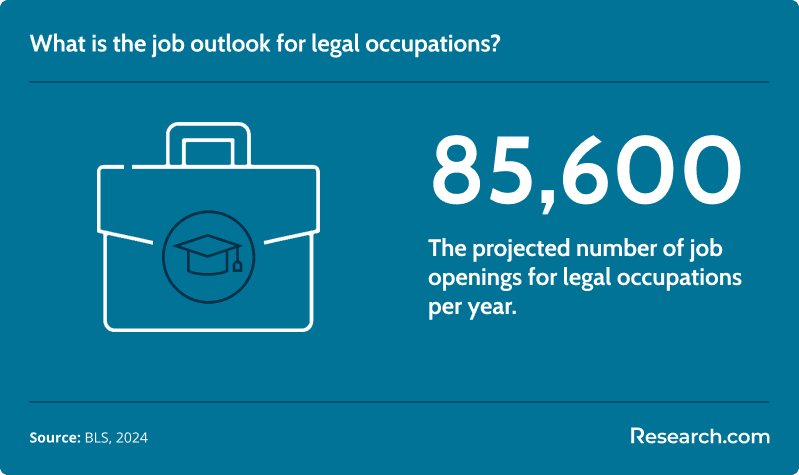
According to the US Bureau of Labor Statistics (BLS), legal occupations are projected to grow at an average rate from 2023 to 2033. The BLS also reports that approximately 85,600 new job openings are expected annually because of industry growth and workforce replacement.
For MLS graduates, the strongest opportunities are often outside traditional attorney roles. Compliance, risk management, healthcare administration, financial services, contracts, data privacy, employment policy, and legal operations can all reward professionals who understand legal rules and can apply them in organizational settings.
Advanced education may improve competitiveness for some senior roles, but employers still evaluate experience, industry knowledge, communication skills, technical tools, and measurable results. Students should review job postings before enrolling to confirm that a master’s in legal studies appears in preferred or relevant qualifications for their target positions.
Here’s What Graduates Have to Say About Their Online Master’s In Legal Studies
-
: "
Studying online gave me the room to continue working and stay present for my family while earning my Master’s in Legal Studies. Being able to complete coursework from wherever I was made the degree possible, and the legal knowledge changed the way I approached my career. Stephanie
"
-
: "
The online format connected me with professionals from many backgrounds, which made class discussions more practical and relevant. I was able to take ideas from the program and apply them directly at work. Felix
"
-
: "
My online Master’s in Legal Studies strengthened my understanding of legal issues and forced me to become more disciplined with my time. The flexibility helped me stay enrolled while managing work and personal responsibilities. Nadine
"
Key Insights
- An online master’s in legal studies is best for professionals who need legal knowledge for work but do not plan to become licensed attorneys.
- The degree can support careers in compliance, contracts, HR, healthcare regulation, financial services, policy, legal operations, and legal support.
- Most programs take about two years part time, while full-time and accelerated options may take 12 to 18 months or as little as one year.
- According to Data USA, median tuition is $8,685 for in-state public institutions and $53,070 for out-of-state private universities; students should calculate total cost before enrolling.
- Data USA reports a median salary of $86,930 per year for legal studies graduates, but salary outcomes depend on role, industry, location, and experience.
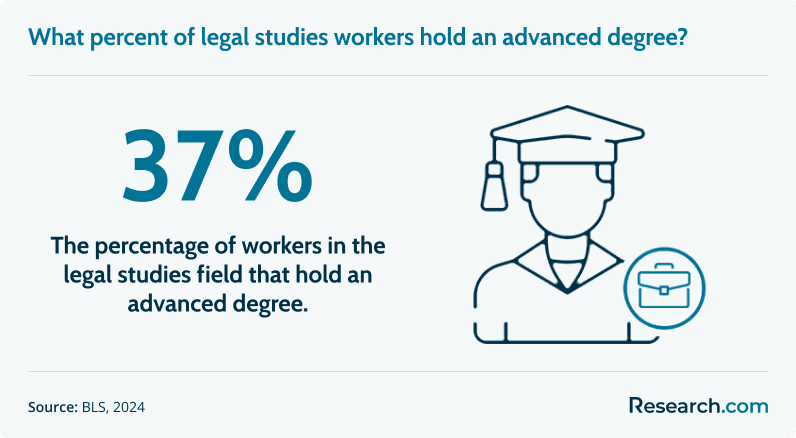
- 37% of legal studies workers hold an advanced degree, showing that graduate education is common in this field but not the only factor employers consider.
- Graduates with a master's in legal studies often earn significantly higher salaries compared to those with a bachelor’s, such as $114,719 vs. $103,344 for Compliance Managers.
- The BLS projects legal occupations to grow at an average rate from 2023 to 2033, with approximately 85,600 openings expected annually.
- Accreditation, curriculum fit, specialization, career support, and employer relevance matter more than online format alone.
- The biggest mistake is assuming the MLS is a shortcut to becoming a lawyer. It is a legal knowledge degree for non-lawyers, not a bar-qualifying law degree.
References:
- BLS. (2024, August 29). Field of degree: Law and legal studies. BLS.
- BLS. (2024, August 29). Legal occupations. BLS.
- BLS. (2024, August 29). Paralegals and legal assistants. BLS.
- BLS. (2024, December 16). Arbitrators, mediators, and conciliators. BLS.
- Data USA. (2023). International Law & Legal Studies. datausa.io.
- Zippia. (2025, January 8). Compliance Manager Demographics and Statistics [2025]: Number of compliance managers in the US. Zippia.
- Zippia. (2025, January 8). Contracts Manager Demographics and Statistics [2025]: Number of contracts managers in the US. Zippia.
- Zippia. (2025, January 8). Human Resources Manager Demographics and Statistics [2025]: Number of human resources managers in the US. Zippia.
- Zippia. (2025, January 8). Senior Business Intelligence Analyst Demographics and Statistics [2025]: Number of senior business intelligence analysts in the US. Zippia.
- Zippia. (2025, January 8). Underwriter Demographics and Statistics [2025]: Number of underwriters in the US. Zippia.
Other Things You Should Know About the Best Online Master’s In Legal Studies Degree Programs
Most online Master’s in Legal Studies programs require 30 to 36 credit hours and can be finished in 12 to 24 months. Some schools allow part-time enrollment, and many programs do not require the LSAT or GRE, which makes the degree accessible to working professionals.
Graduates of online Master’s in Legal Studies programs in 2027 can pursue careers in compliance, human resources, contract management, or legal consultancy. They often work in corporate, government, or non-profit sectors, leveraging their expertise in legal principles to support organizational operations.
Prerequisites typically include a bachelor’s degree in a related field, a minimum GPA, and sometimes professional experience. Some programs may require standardized test scores. Specific requirements vary by institution, so verify with the program you are interested in for precise details.