
2027 Most Affordable Online Master’s in Business Law

Co-Founder and Chief Data Scientist
Choosing an affordable online master’s in business law is not just a tuition comparison. The right program depends on whether you want legal knowledge for a business role, a compliance career, contract work, entrepreneurship, risk management, or a future path toward legal practice. It also matters whether the degree is an MLS, MJ, MSL, LLM, or JD because these credentials serve different professional goals.
This guide is for working professionals, managers, compliance specialists, HR leaders, entrepreneurs, and career changers who want graduate-level legal training without automatically pursuing a license to practice law. You will learn how online business law master’s programs work, what they cost, how to compare formats and credentials, what career paths they can support, and which questions to ask before enrolling.
Quick answer: Is an online master’s in business law worth considering?
An online master’s in business law can be a strong fit if you need legal fluency for business decisions but do not plan to become a practicing attorney. These programs typically help professionals understand contracts, compliance, corporate governance, risk, regulation, employment law, intellectual property, and legal operations. They are most useful when the curriculum matches your target industry and the total cost fits your expected career benefit.
The degree is not the same as a JD and usually does not qualify graduates to sit for a bar exam. If your goal is to practice law, you should compare JD options instead. If your goal is to work more effectively with legal teams, manage regulatory risk, lead compliance programs, or make better business decisions, an MLS, MJ, or MSL in business law may be more appropriate.
What are the main benefits of earning an online master’s in business law?
- Career mobility in regulated fields: The credential can strengthen your qualifications for roles in compliance, contracts, legal operations, corporate governance, risk management, human resources, finance, healthcare, technology, and consulting.
- Potential salary improvement: Graduates may move into roles with greater responsibility. Reported salaries often range from $80,000 to $150,000+ annually in the United States, depending on role, industry, location, prior experience, and employer size.
- Flexible graduate study: Online delivery can make it possible to keep working while completing coursework, especially when programs offer asynchronous classes or part-time pacing.
- Better collaboration with attorneys: Business professionals who understand legal terminology, risk analysis, and regulatory frameworks can communicate more effectively with in-house counsel and outside firms.
- Practical value for entrepreneurs: Founders and small-business leaders can use business law training to understand contracts, entity formation, intellectual property, employment obligations, and compliance issues.
What should you expect from an online master’s in business law program?
Most online business law master’s programs are designed for professionals who need legal knowledge in business settings, not for students seeking bar eligibility. Coursework usually combines legal foundations with practical applications in corporate, regulatory, and commercial contexts.
- Business-focused legal coursework: Common topics include contract law, business organizations, intellectual property, employment law, corporate compliance, ethics, negotiation, regulatory systems, and risk management.
- Online course delivery: Programs may use asynchronous modules, live virtual sessions, discussion boards, recorded lectures, case studies, legal research assignments, and group projects.
- Applied problem solving: Many assignments ask students to analyze business scenarios, identify legal risk, interpret regulations, review contracts, or recommend policy changes.
- Stronger analytical judgment: Students learn to separate business risk from legal risk, assess uncertainty, and explain complex rules to non-lawyer stakeholders.
- Digital legal resources: Online students often receive access to law libraries, research databases, writing support, academic advising, and faculty office hours.
| Program feature | What it means for students | Why it matters when comparing schools |
| Asynchronous coursework | You complete weekly work on your own schedule. | Best for working professionals with changing hours. |
| Live online classes | You attend scheduled virtual sessions. | Better for discussion and networking, but less flexible. |
| Business law concentration | The curriculum directly covers corporate, contract, compliance, or commercial law. | More relevant than a general legal studies program if your goal is a business-facing role. |
| Capstone or applied project | You complete a practical legal or compliance project. | Useful for building work samples and demonstrating job-ready skills. |
| Career services for online students | Remote learners can access advising, job boards, resume help, or networking events. | Important because some online programs offer less career support than campus programs. |
Where can graduates work with an online master’s in business law?
Business law graduates often work in roles that sit between legal departments, business units, compliance teams, and executive leadership. The degree is especially relevant in organizations where contracts, regulation, privacy, employment rules, financial controls, or corporate governance shape daily decisions.
- Corporate legal departments: Graduates may support contract review, compliance tracking, legal operations, vendor management, policy development, or risk reporting.
- Consulting firms: Professionals may advise clients on regulatory obligations, internal controls, governance, ethics, and operational risk.
- Financial institutions: Banks, investment firms, insurers, and fintech companies need employees who understand compliance, risk, contracts, and financial regulation.
- Government agencies: Regulatory agencies and public-sector offices may need staff who can interpret rules, monitor compliance, or support policy implementation.
- Startups and entrepreneurial ventures: Founders and operators can use legal knowledge to structure agreements, protect intellectual property, and reduce preventable legal exposure.
- Nonprofit organizations: Nonprofits often need guidance on governance, grants, contracts, employment rules, privacy, and regulatory reporting.
How much can you make with an online master’s in business law?
Compensation depends heavily on your existing experience, industry, job title, employer, and location. Entry-level or mid-career roles in compliance, contract administration, or business analysis might typically range from $70,000 to $100,000 annually. With more experience, professionals who move into senior legal counsel, corporate compliance officer, or legal affairs manager roles can often earn $100,000 to $150,000+, while highly specialized or executive positions may exceed $150,000.
Salary figures for lawyers should be interpreted carefully. Many lawyer roles require a JD, bar admission, and licensure, while most online MLS, MJ, and MSL business law programs are intended for non-lawyer professionals. Use attorney salary data as labor-market context, not as a guaranteed outcome for a non-JD master’s graduate.
- Affordable online business law master’s programs for 2027
- JD vs. LLM vs. MLS vs. MJ vs. MS in law: which credential fits your goal?
- How to choose the right online master’s in business law
- Admissions requirements and application steps
- Skills developed in a strong business law master’s program
- Career options after an online master’s in business law
- Program costs and financing options
- Salary expectations after a business law master’s
- Online vs. in-person business law master’s programs
- Accreditation, faculty quality, and program value
- Is an online master’s in business law cost-effective?
- How business law training supports entrepreneurship
- How complementary programs can expand career options
- Subspecialties and career tracks
- Job market outlook for graduates
- Industry trends shaping business law careers
Most Affordable Online Master's in Business Law Programs for 2027
This list uses data from trusted education sources, including the Integrated Postsecondary Education Data System (IPEDS), Peterson's, College Scorecard, and the National Center for Education Statistics.
These sources support a more consistent review of online business law master’s programs, including cost, structure, and institutional quality. Research.com’s broader ranking approach is explained on the methodology page. Students should still verify tuition, fees, credit requirements, and concentration availability directly with each law school before applying.
| School | Relevant online credential | Credits or units | Published tuition information | Best fit |
| Boston University School of Law | MLS with Business Law concentration | 30 credits | $2,321 per credit; approximately $69,630 for 30 credits | Professionals seeking a broad legal studies degree with business law focus |
| Loyola University Chicago School of Law | MJ in Business and Compliance Law | Typically 30 credits | About $1,560 per credit; $46,800 for a typical 30-credit MJ | Compliance-focused professionals in regulated organizations |
| Pepperdine University School of Law | Online MLS | 26 units | $2,570 per unit | Students who want an accelerated or flexible MLS with elective options |
| Seton Hall University School of Law | Online MLS | 31 credits | $1,480 per credit | Students interested in compliance, privacy, cyber, sports, gaming, or healthcare-related law |
| Texas A&M School of Law | Online MLS in Business Law & Compliance | 30 credits | Approximate total program tuition of $35,008 | Business professionals, managers, and entrepreneurs seeking a focused business law and compliance path |
| Thomas Jefferson School of Law | Online MSL options | 24 units | $1,260 per unit | Professionals in taxation, financial services, wealth management, financial compliance, or risk management |
| Tulane University Law School | Online MJ options | 30 credits | $1,300 per credit | Students whose business goals connect to labor, employment, energy, or environmental law |
| Widener University Delaware Law School | Online MJ in Corporate & Business Law | 30 credits | $1,950 per credit | Non-lawyer professionals seeking a direct corporate and business law curriculum |
1. Boston University School of Law
Boston University offers an online Master of Legal Studies with a Business Law concentration for professionals who need legal fluency but are not pursuing attorney licensure. The program introduces core legal concepts and then connects them to business, corporate, and financial settings.
Students can use the curriculum to improve legal issue spotting, communicate more effectively with counsel, and make more informed decisions in business environments where contracts, regulation, and governance matter.
- Program length: Typically 18-24 months part-time.
- Tracks or concentrations: Business Law, Health Law, Human Resources Law, Intellectual Property Law, and Public Law and Policy.
- Tuition cost: $2,321 per credit. For a 30-credit MLS program, the total tuition is approximately $69,630.
- Required credits to graduate: 30 credits.
- Accreditation: American Bar Association (ABA).
2. Loyola University Chicago School of Law
Loyola University Chicago offers online Master of Jurisprudence programs for professionals outside traditional legal practice. For business-focused students, the MJ in Business and Compliance Law emphasizes how laws, regulations, internal policies, and ethical obligations shape organizational decisions.
The program is particularly relevant for students who want to work in compliance, governance, or regulatory roles across industries where legal risk is part of daily operations.
- Program length: Varies, typically 1-2 years.
- Tracks or concentrations: Online MJ in Business and Compliance Law. Other MJ concentrations include Children's Law and Policy, Health Law, Global Competition, and Rule of Law for Development.
- Tuition cost: For the MJ programs, the per-credit-hour rate is in the range of $1,560 per credit. A typical 30-credit MJ would be $46,800.
- Required credits to graduate: Typically 30 credits for MJ programs.
- Accreditation: American Bar Association (ABA).
3. Pepperdine University School of Law
Pepperdine University offers an online Master of Legal Studies for non-lawyers who want to add legal knowledge to their existing careers. While the program includes concentrations in Dispute Resolution and Human Resources, students can also use the general track to build a broader business law foundation.
The curriculum covers legal concepts and procedures, with elective opportunities in areas such as Intellectual Property, Business Organizations, and Employment Law. This makes the program useful for professionals who need legal insight without becoming practicing attorneys.
- Program length: Can be completed in as few as 12 months (accelerated) or 16-28 months.
- Tracks or concentrations: Online MLS (General, Dispute Resolution, Human Resources, Litigation).
- Tuition cost: For the Online Master of Legal Studies (MLS), the per-unit tuition rate is $2,570.
- Required credits to graduate: 26 units for MLS.
- Accreditation: American Bar Association (ABA).
4. Seton Hall University School of Law
Seton Hall University offers an Online Master of Legal Studies degree for non-lawyers. The curriculum includes legal foundations and allows students to choose concentrations that connect closely to business, regulation, privacy, healthcare, and compliance.
This option may fit professionals who need to interpret legal requirements, evaluate business risk, and support decision-making in corporate compliance, privacy, cybersecurity, medical device, pharmaceutical, gaming, sports, or risk-related roles.
- Program length: Can be completed in two years part-time.
- Tracks or concentrations: Online MLS, with concentrations such as Corporate Compliance, Gaming Regulation and Compliance, Pharmaceutical and Medical Device Law & Compliance, Privacy Law and Cyber Security, and Sports Law and Compliance.
- Tuition cost: For the Online Master of Legal Studies (MLS), tuition is $1,480 per credit.
- Required credits to graduate: 31 credits for MLS.
- Accreditation: American Bar Association (ABA).
5. Texas A&M School of Law
Texas A&M School of Law offers an Online Master of Legal Studies with an emphasis in Business Law & Compliance. The program is built for new and experienced business professionals, managers, and entrepreneurs who want legal knowledge tied directly to business operations.
Students study areas such as contracting, employment, risk assessment, business formation, buying and selling businesses, and regulatory issues that affect organizations. The program can support roles that require negotiation, compliance judgment, and business strategy.
- Program length: Estimated 1-2 Years (30 Credit Hours).
- Tracks or concentrations: Online MLS in Business Law & Compliance.
- Tuition cost: Approximate total program tuition for the Online MLS in Business Law & Compliance is $35,008.
- Required credits to graduate: 30 credits.
- Accreditation: American Bar Association (ABA).
6. Thomas Jefferson School of Law
Thomas Jefferson School of Law offers online Master of Science of Law programs for professionals who are not attorneys. Although these programs are not labeled strictly as business law, concentrations such as Financial Services and Wealth Management and Financial Compliance and Risk Management are closely connected to business, finance, and regulation.
The programs emphasize applied legal knowledge, especially for professionals who need to identify compliance problems, design compliance systems, prevent risk, and advise leaders in financial or business settings.
- Program length: Typically 1 year (full-time) for MSL.
- Tracks or concentrations: Online MSL in Taxation, Financial Services and Wealth Management, Financial Compliance and Risk Management.
- Tuition cost: $1,260 per unit for their online graduate programs (MSL).
- Required credits to graduate: 24 units.
- Accreditation: Committee of Bar Examiners of the State Bar of California and WASC.
7. Tulane University Law School
Tulane University Law School offers several online Master of Jurisprudence degrees for non-lawyer professionals. While the school does not list a direct “Business Law” MJ in this set, options in Labor and Employment Law, Energy Law, and Environmental Law can be highly relevant for organizations with complex regulatory and operational obligations.
These programs can help students understand the legal frameworks that govern specific industries, communicate more effectively with legal professionals, and improve performance in compliance-heavy business roles.
- Program length: Varies.
- Tracks or concentrations: Online MJ in Labor and Employment Law, Online MJ in Energy Law, Online MJ in Environmental Law.
- Tuition cost: $1,300 per credit for their online MJ programs.
- Required credits to graduate: 30 credits.
- Accreditation: American Bar Association (ABA).
8. Widener University Delaware Law School
Widener University Delaware Law School offers an Online Master of Jurisprudence in Corporate & Business Law for non-lawyer professionals. The program focuses on the legal framework that shapes business, nonprofit, and government operations.
Students receive graduate-level training in legal analysis, compliance, ethics, regulation, and business law. The program may be especially useful for professionals working in enterprise risk management, corporate administration, governance, or regulatory compliance.
- Program length: Varies, typically 1-2 years.
- Tracks or concentrations: Online MJ in Corporate & Business Law.
- Tuition cost: $1,950 per credit.
- Required credits to graduate: 30 credits for MJ.
- Accreditation: American Bar Association (ABA).
What are the differences among JD, LLM, MLS, MJ, and MS degrees in the field of Law?
The most important decision is whether you need a degree that leads to legal practice or a degree that adds legal knowledge to a non-lawyer career. A JD is the traditional pathway for future attorneys. MLS, MJ, and many MSL programs are typically designed for professionals who need legal understanding but do not intend to practice law.
| Degree | Primary audience | Typical purpose | Does it usually prepare you to practice law? |
| Juris Doctor (JD) | Students who want to become lawyers | Foundational professional law degree and common route to bar eligibility | Yes, when combined with bar exam and jurisdiction requirements |
| Master of Laws (LLM) | Attorneys or graduates with a JD or equivalent foreign law degree | Advanced specialization in a legal field | Usually for those already trained in law; bar eligibility varies |
| Master of Legal Studies (MLS) | Non-lawyer professionals | Legal knowledge for business, compliance, HR, healthcare, technology, or policy roles | No |
| Master of Jurisprudence (MJ) | Non-lawyer professionals | Applied understanding of law in a specific professional context | No |
| Master of Science (MS) in Law or MSL | Professionals in business, finance, technical, scientific, or regulated fields | Legal and regulatory training tied to a specialized industry | No, in most cases |
If you are at the beginning of a legal support career rather than comparing master’s programs, Research.com’s guide to paralegal certification requirements may be a better starting point.
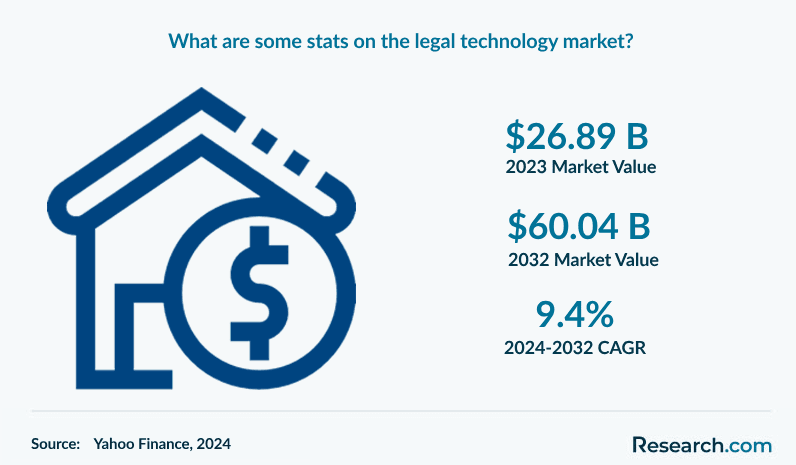
The legal technology sector is also changing how legal and compliance work is performed. The legal technology market was valued at $26.89 billion in 2023 and is projected to reach $60.04 billion by 2032, reflecting a compound annual growth rate (CAGR) of 9.4% from 2024 to 2032.
That growth reflects expanding use of artificial intelligence, cloud platforms, automated contract tools, and legal workflow systems. Students comparing legal credentials should consider whether a program teaches technology-aware legal problem solving, not just traditional doctrine.
Online legal education is part of a larger shift in professional education. Students who are comparing flexible online programs across fields may also review Research.com’s guides to an affordable online animation degree or other online degree formats, but legal programs require special attention to credential type, accreditation, and whether the degree supports licensure.
How do I choose the best online Master's in Business Law program for my specific needs and career goals?
The best online master’s in business law is the one that matches your target role, industry, learning schedule, and budget. Do not choose solely by school name or advertised tuition. A lower-cost program may be a poor fit if it lacks the concentration, faculty access, or career support you need.
- Start with your career goal: Decide whether you want to work in compliance, contracts, risk management, HR, privacy, financial regulation, healthcare, entrepreneurship, legal operations, or corporate governance.
- Match the credential to your objective: Choose a JD if you want to become an attorney. Consider an MLS, MJ, or MSL if you are a non-lawyer who needs legal knowledge for business work.
- Check accreditation and institutional recognition: Give priority to reputable law schools and regionally accredited institutions. If you are comparing related legal support pathways, this guide to ABA approved online paralegal programs can help explain why approval and accreditation matter.
- Read the course list carefully: Look for classes in contracts, compliance, business organizations, employment law, intellectual property, privacy, negotiations, and regulatory systems.
- Review faculty backgrounds: Faculty with legal practice, compliance, corporate, judicial, regulatory, or industry experience can add practical context to online learning.
- Compare online format and pacing: Determine whether the program is asynchronous, synchronous, hybrid, full-time, part-time, accelerated, or cohort-based.
- Ask about online student support: Career advising, writing help, access to legal databases, tech support, and networking opportunities can affect the real value of the program.
- Calculate total cost: Include tuition, fees, books, technology charges, travel for any residencies, loan interest, and the opportunity cost of study time.
| If your goal is... | Look for programs with... | Avoid programs that... |
| Compliance leadership | Compliance, regulatory affairs, ethics, investigations, and risk coursework | Offer only general legal theory with little applied compliance content |
| Contract management | Contract drafting, negotiation, procurement, vendor management, and commercial law | Do not include practical contract analysis assignments |
| HR or employment work | Employment law, labor relations, workplace investigations, and policy development | Focus mainly on corporate finance or unrelated legal electives |
| Entrepreneurship | Business formation, intellectual property, contracts, privacy, employment, and risk | Provide little flexibility to tailor electives to startup needs |
| Privacy or cybersecurity compliance | Data privacy, cyber risk, information governance, and regulatory compliance | Do not address modern data protection or technology issues |
What are the prerequisites and application process for online Master's in Business Law programs?
Admissions requirements vary by institution, but online MLS, MJ, and MSL programs generally look for applicants who can handle graduate-level legal reading and writing. Most programs are designed for working professionals, so professional experience can strengthen an application even when it is not mandatory.
As with structured professional pathways such as affordable RN to BSN to MSN online programs, applicants should review every admissions requirement before applying. A business law master’s may ask for a bachelor’s degree, transcripts, resume, recommendations, and a statement of purpose, while some programs may prefer relevant work experience.
- Bachelor’s degree: Most programs require a bachelor’s degree from an accredited institution and may review undergraduate GPA.
- Professional experience: Some programs value or require experience in business, finance, compliance, human resources, healthcare, technology, government, or a related field.
- Letters of recommendation: Applicants typically submit two to three recommendations from supervisors, professors, or professional contacts who can assess readiness for graduate study.
- Statement of purpose: This essay should explain why you want legal training, how the program fits your career plan, and what professional problems you hope to solve.
- Resume or CV: Schools use this to evaluate work history, leadership, industry experience, and transferable skills.
- Official transcripts: Applicants usually submit transcripts from all prior colleges and graduate institutions.
- Standardized tests: Unlike JD programs, most online MLS, MJ, and MSL programs do not require the LSAT (Law School Admission Test). Some may waive GRE or GMAT requirements, especially for experienced applicants.
- Application fee: A non-refundable fee is common.
- Interview: Some programs include an interview to assess fit, goals, communication skills, or professional readiness.
Business law is not usually a low-effort academic path. If you are comparing business disciplines by workload, Research.com’s guide to the easiest business majors can provide context, but graduate legal study typically requires substantial reading, careful writing, and disciplined analysis.
What essential skills will I learn in a top online Master's in Business Law program?
A strong online master’s in business law should help students apply legal rules to business problems. The goal is not memorization alone; it is practical judgment in situations involving risk, contracts, governance, regulation, and ethics.
- Legal research and interpretation: Students learn to locate, read, and apply statutes, regulations, cases, agency guidance, and contractual language.
- Risk identification: Graduates become better at spotting legal, operational, reputational, and compliance risks before they become costly problems.
- Contract review and negotiation: Programs often teach students to understand contract structure, key clauses, obligations, remedies, negotiation points, and business consequences.
- Regulatory compliance: Students examine how organizations comply with laws, policies, reporting duties, ethics rules, and industry-specific standards.
- Business communication: Graduates practice translating complex legal ideas into clear guidance for managers, executives, clients, vendors, and cross-functional teams.
- Ethical reasoning: Coursework helps students evaluate conflicts of interest, corporate responsibility, governance failures, and professional obligations.
- Strategic business judgment: Students learn how legal constraints interact with finance, operations, human resources, technology, and growth strategy.
- Process and policy design: Many business law roles require building procedures, checklists, controls, and training systems that reduce legal exposure.
Students who want a shorter and more entry-level legal credential may compare these skills with those covered in the cheapest paralegal certificate options, though a graduate business law program generally serves a different career purpose.
What are some career prospects after completing an online Master's in Business Law program?
Graduates often pursue roles that require legal awareness but not necessarily a law license. These positions are common in corporations, financial institutions, healthcare systems, technology companies, nonprofits, government agencies, and consulting firms.
- Compliance officer or manager: Monitors legal and regulatory obligations, builds compliance programs, supports audits, and trains employees.
- Contract administrator or contract manager: Oversees contract review, negotiation workflows, approvals, renewals, vendor obligations, and performance tracking.
- Regulatory affairs specialist: Tracks changes in laws and regulations, communicates requirements to business teams, and supports compliance planning.
- Risk management analyst: Identifies business, legal, operational, and financial risks and recommends controls to reduce exposure.
- HR manager with legal emphasis: Applies employment law knowledge to workplace policies, investigations, benefits, discipline, and employee relations.
- Business development manager with legal knowledge: Uses legal awareness to structure partnerships, commercial agreements, and market-entry strategies.
- Compliance or governance consultant: Advises organizations on policies, controls, ethics programs, investigations, or regulatory strategy.
- Legal operations professional: Improves processes, technology, budgeting, vendor management, and workflow within legal departments.
- Government relations specialist: Interprets legislative and regulatory developments and communicates organizational positions to public-sector stakeholders.
Business law graduates gain portable skills that can apply across sectors. In that sense, the flexibility is similar to other broad online degree paths, such as affordable online geography degree programs, where graduates may apply analytical training in government, technology, consulting, and business environments.
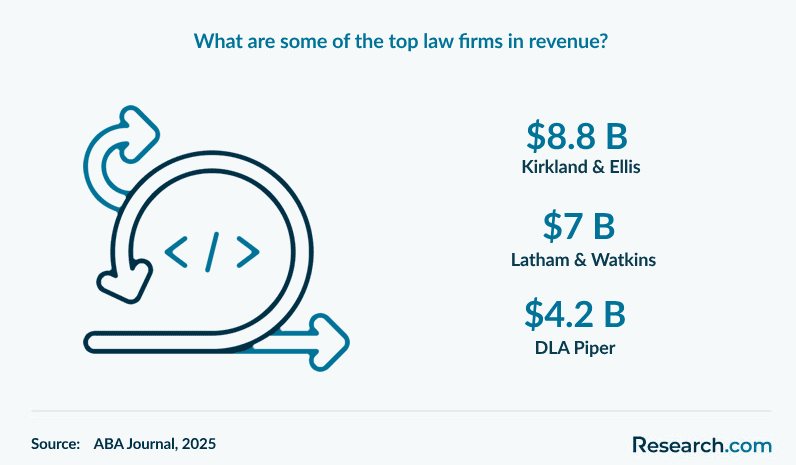
Large law firms also provide context for the scale of the legal services market. According to recent reports from the 2025 Am Law 100 rankings, which reflect financial performance in 2024, Kirkland & Ellis led with $8.8 billion in gross revenue, an approximate 22% increase from its 2023 figures. Latham & Watkins reported $7 billion in revenue, a 23% rise from the previous year.
DLA Piper reported $4.2 billion in gross revenue, nearly an 11% increase from 2023. Skadden, Arps, Slate, Meagher & Flom reached $3.6 billion, about 12% growth. Gibson, Dunn & Crutcher recorded $3.5 billion, nearly 16% above its 2023 performance. These figures show the continued strength of major global law firms, although most online business law master’s graduates will pursue business, compliance, or legal operations roles rather than traditional attorney positions.
How much do online Master's in Business Law programs cost, and what financing options are available?
Online master’s in business law programs vary widely in price because schools use different credit requirements, per-credit tuition rates, fees, and pacing options. Published tuition is only one part of the real cost. Students should request a full cost breakdown before enrolling.
- Tuition range: Online Master's in Business Law programs generally range from $30,000 to over $70,000 for the entire program, with per-credit costs typically between $1,000 and $2,600.
- Additional fees: Technology fees, student service fees, administrative charges, course materials, graduation fees, and residency costs can increase the total cost.
- Federal student aid: Students in eligible accredited programs may use federal student loans after completing the FAFSA.
- Institutional scholarships or grants: Some law schools offer merit-based or need-based aid for graduate students.
- Employer tuition reimbursement: Working professionals should ask whether their employer will fund part of the degree if it connects to compliance, risk, HR, legal operations, or management duties.
- Private student loans: These may help cover remaining costs, but borrowers should compare interest rates, repayment terms, and total repayment amounts carefully.
- Payment plans: Installment plans may help students spread tuition payments across a term.
- Veterans benefits: Eligible students may be able to use GI Bill benefits or other military education assistance.
| Cost question to ask | Why it matters |
| Is tuition charged per credit, per unit, per term, or for the full program? | Pricing models differ, and the cheapest advertised number may not reflect total cost. |
| Are online students charged technology or distance-learning fees? | These fees can add to the final bill even when students never visit campus. |
| Are books, databases, or course materials included? | Legal materials can be expensive if not bundled into tuition. |
| Can I transfer credits? | Transfer policies can reduce time and cost, but many graduate law programs limit transfer credit. |
| What happens financially if I pause or withdraw? | Refund schedules and leave policies affect financial risk. |
| Does the program qualify for employer reimbursement? | Employer funding can substantially improve affordability. |
How much can you earn after obtaining an online Master's in Business Law qualification?
An online master’s in business law can improve earning potential when it helps a professional move into a more specialized, regulated, or leadership-oriented role. However, salaries are not guaranteed and depend on the role, employer, location, industry, experience, and whether the position requires attorney licensure.
- Entry to mid-level roles: Professionals in compliance, contract management, or regulatory affairs often see starting salaries ranging from $60,000 to $90,000 annually.
- Experienced professionals: With several years of relevant experience, roles such as senior compliance manager, risk director, or corporate governance specialist can reach $90,000 to $150,000+ per year.
- Specialized industries: Finance, pharmaceuticals, technology, cybersecurity, and healthcare may offer higher compensation for experienced professionals with legal and regulatory expertise, sometimes exceeding $150,000 in leadership roles.
- Prior experience matters: Professionals who already have a strong business background may use the degree to qualify for promotions or strategic lateral moves.
- Location affects pay: Major legal and corporate markets such as New York, Washington D.C., and California often offer higher pay than smaller markets, though cost of living should also be considered.
According to Payscale.com data from 2025, the national average salary for an attorney/lawyer is $101,483. For law firm attorneys nationally, the average is $117,937.
Corporate attorneys nationally average $129,437, associate attorneys nationally average $87,163, and Assistant United States Attorneys nationally average $131,195.
Regional Payscale.com data from 2025 shows lawyers in Washington averaging $113,969, lawyers in the District of Columbia averaging $113,711, lawyers in New York averaging $110,089, lawyers in Massachusetts averaging $109,896, and lawyers in Alaska averaging $108,369.
These figures show that role specialization and geography influence compensation. They should not be read as automatic outcomes for MLS, MJ, or MSL graduates, especially because attorney roles typically involve different educational and licensing requirements.
A business law master’s is most likely to pay off when it helps you qualify for a clearly defined advancement path, such as compliance leadership, contract management, legal operations, regulatory affairs, or a specialized industry role. The degree alone is rarely enough; it works best when paired with relevant experience and targeted skills.
What are the key benefits and drawbacks of online versus in-person Master's in Business Law programs?
Online and campus-based business law programs can both be valuable, but they serve different students. Online programs prioritize flexibility and access. In-person programs may offer stronger informal networking and a more immersive academic environment.
| Factor | Online program | In-person program |
| Schedule flexibility | Often better for working professionals, especially with asynchronous courses | Less flexible because classes and activities occur at fixed times and locations |
| Geographic access | Allows students to enroll without relocating | Usually requires commuting or moving near campus |
| Networking | Depends heavily on virtual events, cohorts, discussion boards, and alumni access | Often easier through campus events, study groups, and face-to-face interaction |
| Cost considerations | May reduce commuting, housing, and relocation expenses | May involve additional living, parking, transportation, and campus costs |
| Learning style | Requires self-discipline, time management, and comfort with technology | Provides more immediate classroom interaction and campus structure |
| Career support | Quality varies; students should confirm support for online learners | Campus students may have easier access to career centers and live events |
Online education can be useful for students balancing school with work or family obligations. Research.com covers flexible online training in many fields, including affordable online cosmetology programs, but legal education requires extra scrutiny because credential type, accreditation, and licensure implications matter more than format alone.
How do accreditation and faculty quality influence program value?
Accreditation and institutional credibility affect employer confidence, credit transfer, financial aid eligibility, and academic quality. For legal education, students should understand the difference between an ABA-approved law school, regional institutional accreditation, and specialized approval that may apply to specific programs or jurisdictions.
Faculty quality also matters. In business law, the most useful instructors often combine academic expertise with practical experience in corporate law, compliance, litigation, government regulation, privacy, labor, tax, finance, or legal operations. When reviewing faculty, look for practice experience, publications, professional leadership, and current engagement with the field.
Students weighing business law against broader management education may also compare legal training with options such as the cheapest online MBA, especially if their primary goal is general leadership rather than legal or regulatory expertise.
Is the Online Master's in Business Law a Cost-Effective Investment?
The degree is cost-effective only when its benefits are tied to a realistic career plan. A program that costs less but does not align with your role may have weak value. A higher-priced program may still be worthwhile if it provides the exact specialization, faculty access, employer recognition, and career support needed for advancement.
To evaluate ROI, compare total program cost against likely career outcomes. Include tuition, fees, materials, interest on loans, time away from work, and the possibility that the degree may support promotions rather than immediate job changes. Students considering executive-level business education may also compare the analysis with best value executive MBA online programs.
How Can an Online Master's in Business Law Complement Entrepreneurial Ventures?
Entrepreneurs benefit from understanding legal risk before it becomes expensive. A business law master’s can help founders evaluate entity formation, contracts, intellectual property, employment obligations, vendor agreements, privacy practices, licensing, and regulatory compliance.
The degree does not replace an attorney, but it can help entrepreneurs ask better questions, negotiate more effectively, recognize legal red flags, and coordinate more efficiently with counsel. Founders comparing business education paths can also review Research.com’s guide to entrepreneurship degree salary outcomes for broader career context.
How Can Interdisciplinary Education Elevate a Business Law Career?
Business law becomes more valuable when paired with complementary expertise. Professionals in finance, cybersecurity, healthcare, HR, data privacy, energy, or operations can use legal training to become stronger risk and strategy leaders.
For example, a compliance professional who understands finance may be better prepared for financial regulation, audit controls, and enterprise risk. Students who want to strengthen the finance side of their profile can compare options such as accelerated finance degree programs online.
What subspecialties and career paths are available for online Master's in Business Law graduates?
Business law is broad, so choosing a subspecialty can make the degree more marketable. The best concentration depends on your target industry and the type of problems you want to solve.
- Corporate compliance: Corporate compliance focuses on internal policies, external laws, ethics, anti-money laundering rules, data privacy, reporting, and organizational controls.
- Contract management: This path centers on drafting, reviewing, negotiating, tracking, and enforcing business agreements with customers, vendors, partners, and employees.
- Intellectual property management: Professionals work with patents, trademarks, copyrights, licensing, trade secrets, brand protection, and commercialization strategy.
- Employment law and HR compliance: This specialty covers workplace policies, labor rules, discrimination, investigations, leave, discipline, and employee relations.
- Healthcare law and compliance: Graduates may support hospitals, insurers, pharmaceutical companies, medical device companies, or healthcare vendors.
- Financial services regulation: This track fits banking, securities, insurance, investment, fintech, risk, and financial compliance careers.
- Environmental law and sustainability: Professionals focus on environmental regulation, energy issues, reporting, sustainability commitments, and operational compliance.
- Cybersecurity and data privacy law: This area addresses privacy regulations, data breaches, cyber governance, vendor risk, and information management. Students interested in the technical side may compare online cybersecurity degrees.
- Commercial real estate law: This specialty covers leases, development, zoning, financing, property management, and business transactions involving real estate.
What is the job market like for online Master's in Business Law graduates?
The job market is strongest for graduates who connect legal knowledge to specific business needs. Employers in regulated industries continue to need professionals who understand compliance, risk, contracts, privacy, governance, and policy implementation. However, job outcomes vary based on experience, location, industry, and whether a role requires attorney licensure.
- Compliance demand remains important: Finance, healthcare, technology, energy, education, and government-facing industries need professionals who can understand and apply regulatory requirements.
- Risk management is expanding: Organizations increasingly need employees who can anticipate legal and operational problems rather than simply respond after issues arise.
- Specialized sectors offer targeted opportunities: Pharmaceutical, cybersecurity, environmental, energy, and financial services roles often require deeper regulatory knowledge.
- Skills apply across sectors: Graduates can work in corporations, nonprofits, consulting firms, government agencies, startups, and professional services organizations.
- Non-lawyer legal roles are common: Many employers value legal fluency in roles that do not require bar admission, particularly in compliance, contracts, privacy, and legal operations.
- Experience still matters: A master’s degree can strengthen a resume, but employers often prefer candidates who can show practical experience, industry knowledge, and communication skills.
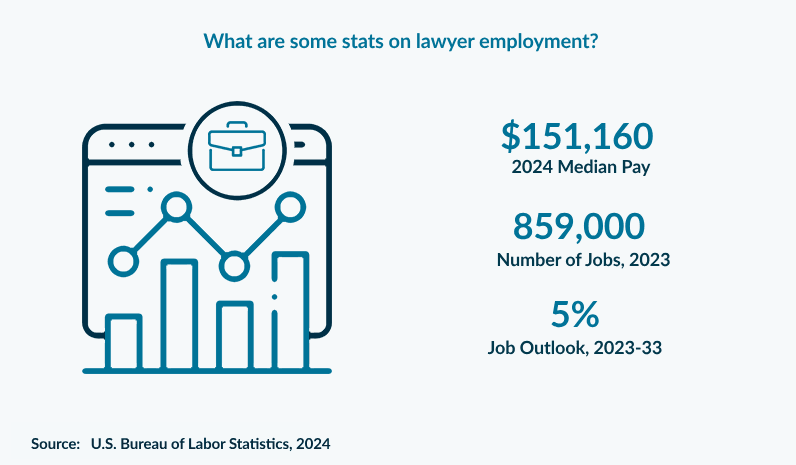
For the broader legal profession, BLS data reported that lawyers earned median annual pay of $151,160, or $72.67 per hour, in 2024. Entry-level lawyer positions typically require a doctoral or professional degree, with no prior work experience or on-the-job training required.
In 2023, there were approximately 859,000 lawyer jobs. Employment is projected to grow by 5% from 2023 to 2033, adding 44,200 new jobs. BLS describes this growth rate as as fast as average.
These lawyer statistics provide useful context for the legal field, but online business law master’s graduates should focus on job titles that match their credential. For non-JD graduates, the strongest opportunities are often in compliance, governance, contracts, privacy, regulatory affairs, HR, risk, and legal operations.
What are the current industry trends and future outlook for online Master's in Business Law graduates?
Business law careers are being reshaped by regulation, technology, data, globalization, and organizational risk. Graduates who understand both legal frameworks and business operations are positioned to support decision-making in increasingly complex environments.
- More complex regulation: Organizations need professionals who can interpret changing rules and build compliance systems across departments.
- Data privacy and cybersecurity pressure: Privacy laws, breach response, vendor risk, and cyber governance are creating demand for legal and compliance knowledge.
- ESG and governance expectations: Environmental, social, and governance issues continue to influence reporting, supply chains, ethics, and corporate accountability.
- Global business operations: Cross-border work requires awareness of international contracts, trade issues, privacy regimes, and jurisdictional differences.
- AI and legal technology adoption: Legal teams are using technology for research, contract management, drafting, workflow automation, and data analysis.
- Greater focus on ethical leadership: Companies increasingly need leaders who can connect legal compliance with responsible business conduct.
- Proactive risk management: Employers value professionals who can prevent problems through policies, training, audits, and internal controls.
- Interdisciplinary roles: The strongest candidates often bridge law, business, technology, finance, operations, and communications.
When legal professionals evaluated generative AI tools, key adoption drivers included compatibility with existing trusted software (43%), vendor understanding of legal workflows (33%), and preference for legal-specific tools rather than general consumer platforms (29%). Ethical considerations (26%) and firm-specific requirements (23%) also influenced adoption, according to the American Bar Association in 2025.
AI is being used beyond traditional legal tasks. Reported uses include drafting correspondence by 54% of legal professionals, analyzing firm data by 14%, and interest in using AI for financial data insights by 47%.
Individual use of generative AI is growing, but firm-wide adoption remains cautious. The pace of adoption depends on firm size, ethical obligations, workflow integration, data security, and whether tools fit legal-specific needs. Business law students should expect technology literacy to become increasingly important in compliance, contracts, privacy, and legal operations work.
Common mistakes to avoid when choosing an online master’s in business law
- Assuming every legal master’s leads to becoming a lawyer: MLS, MJ, and many MSL programs are generally not bar-qualifying degrees.
- Comparing only tuition: Fees, credit requirements, books, technology charges, and loan interest affect the true cost.
- Ignoring concentration fit: A general legal studies program may not prepare you well for privacy, compliance, contracts, healthcare, finance, or HR roles.
- Overvaluing rankings: Rankings can be useful, but course content, faculty access, accreditation, cost, and career support matter more for individual fit.
- Failing to check online student services: Some programs provide robust remote support, while others offer limited advising or networking for online learners.
- Assuming salary outcomes are guaranteed: A degree can support advancement, but pay depends on job market conditions, experience, location, employer, and performance.
- Not asking about licensure limitations: If you want to practice law, confirm whether the program supports bar eligibility in your jurisdiction.
Questions to ask before enrolling
- Is this degree designed for lawyers, non-lawyers, or both?
- Does the program qualify graduates for any licensure or bar-related pathway?
- What is the full cost, including tuition, fees, books, and technology charges?
- How many credits or units are required to graduate?
- Can I study part-time while working full-time?
- Are classes asynchronous, live, or a mix of both?
- Which courses directly support my target role?
- What career services are available to online students?
- Who teaches the courses, and what practical experience do they have?
- Where do graduates work after completing the program?
- Does my employer offer tuition reimbursement for this credential?
- Can I speak with current students or alumni before applying?
References:
- American Bar Association. (2025, March 3). ABA releases its newest survey on legal tech trends. American Bar Association.
- American Bar Association. (2025, May 6). The Legal Industry Report 2025. Law Technology Today. American Bar Association.
- PayScale. (2025, January 26). Associate Attorney Salary in 2025. PayScale.
- PayScale. (2025, February 28). Corporate Attorney Salary in 2025. PayScale.
- PayScale. (2025, April 22). Attorney / Lawyer Salary in 2025. PayScale.
- PayScale. (2025). Attorney / Lawyer, (Law Firm) Salary in 2025. PayScale.
- U.S. Bureau of Labor Statistics. (2024, April 17). Lawyers. Occupational Outlook Handbook. U.S. Bureau of Labor Statistics.
- U.S. Department of Justice. (2025, May 1). Administratively Determined Pay Plan Charts. U.S. Department of Justice.
- Yahoo Finance. (2024, June 20). Legal technology market to reach USD 46.77 billion by 2030: Grand View Research, Inc. Yahoo Finance.
- Weiss, D. C. (2025, April 16). This law firm is ranked No. 1 after posting $8.8B in gross revenue; which other firms are 'category leaders'? ABA Journal.
- ZipRecruiter. (2025, January 1). What Is the Average Lawyer Salary by State in 2025? ZipRecruiter.
Key Insights
- Choose the right credential first: A JD is the usual path for aspiring attorneys, while MLS, MJ, and MSL programs are typically better for non-lawyer professionals who need legal knowledge for business roles.
- Affordability requires total-cost analysis: Compare tuition, fees, credit requirements, books, technology charges, loan costs, and employer reimbursement before deciding.
- Career fit matters more than the program title: A business law concentration is most valuable when it matches a target role such as compliance, contracts, privacy, HR, finance, legal operations, or regulatory affairs.
- Salary outcomes vary widely: Reported salary ranges can be strong, but pay depends on prior experience, industry, geography, employer, and whether the role requires attorney licensure.
- Online learning is best for disciplined working professionals: Flexibility is a major advantage, but students must confirm that online learners receive strong advising, networking, database access, and career support.
- Technology literacy is becoming essential: AI, contract automation, data privacy, cybersecurity, and legal workflow tools are reshaping business law, compliance, and legal operations work.
- The best program is the one that answers your next career move: Before enrolling, identify the job you want, the skills you lack, the credential employers value, and the maximum cost that still makes sense for your goals.
Other Things You Should Know About Online Master's in Business Law Programs
Yes, many affordable online Master’s in Business Law programs offer part-time enrollment. This option typically requires students to complete around 6-9 credit hours per semester, extending the program duration but providing flexibility for working professionals. Check each program's specific enrollment guidelines.
Admission requirements typically include a bachelor’s degree, a minimum GPA of 3.0, and possibly GRE or GMAT scores. Some programs may also require professional experience or letters of recommendation to qualify for the most affordable online Master’s in Business Law programs in 2027.
Many programs require a capstone instead of a thesis, and some make it a 3- to 6-credit final project. A thesis is less common in professional business law master’s programs. Requirement details are set by the university and often appear in the program handbook.


