2027 Most Affordable Online Animation Degree Programs

Co-Founder and Chief Data Scientist
Choosing an affordable online animation degree is not only a tuition decision. It is a career decision, a portfolio decision, and a time-management decision. If you want to become an animator, motion graphics artist, visual effects artist, game artist, or multimedia designer but cannot relocate or pause your job, an online program can make formal training more accessible.
Online learning is no longer a fringe option. In 2022, over half of college students—53.3%—were enrolled in distance education. For animation students, the bigger question is not whether online study exists, but whether a specific program teaches the right software, provides useful feedback, supports portfolio development, and fits your budget. This guide explains what affordable online animation degrees cost, what you can study, how to compare programs, and what to check before enrolling.
Quick Answer: Are affordable online animation degrees worth considering?
Yes, an affordable online animation degree can be a practical option if the school is properly accredited, the curriculum includes hands-on production work, and the program helps you build a strong portfolio or demo reel. Employers in animation and digital media often evaluate candidates by their technical skills, creative judgment, software fluency, and finished work samples—not only by where they studied.
Tuition for affordable online animation degrees generally ranges from $129 to $545 per credit, depending on the institution and residency status. Some programs cost more, especially when they include equipment, fees, or specialized production resources. Before choosing a program, compare total cost, transfer credit policies, software requirements, faculty feedback, career services, and portfolio outcomes.
Why earn an online animation degree?
- An online animation degree can prepare students for roles such as animator, special effects artist, video game designer, motion graphics designer, multimedia artist, storyboard artist, and visual effects artist.
- The median annual salary for animators and multimedia artists is around $78,000, although pay varies by role, location, industry, portfolio strength, and experience level.
- Online study can make animation training more accessible for students who need to keep working, avoid relocation, or study around family and personal responsibilities.
What can I expect from an online animation degree?
An online animation degree typically combines art fundamentals, digital production, visual storytelling, and technical software training. Students usually study drawing, design, 2D animation, 3D modeling, character development, storyboarding, lighting, composition, and digital editing. Many programs also require a capstone, portfolio, or demo reel so students graduate with work samples they can show to employers or clients.
Some programs include internship options, production-based courses, or simulated studio assignments. These experiences matter because animation hiring is heavily portfolio-driven. A low-cost program is only valuable if it helps you produce polished, original work and receive meaningful feedback from instructors.
Online delivery often includes recorded lectures, digital critiques, interactive assignments, virtual labs, discussion boards, and scheduled live sessions. The best programs combine flexibility with structure: students can work on their own schedule, but still meet project deadlines and receive regular critique.
| What to evaluate | Why it matters | What to look for |
| Portfolio or demo reel requirement | Employers usually want proof of skill, not just a transcript. | Capstone projects, reel development courses, critique sessions, and final portfolio reviews. |
| Software access | Animation tools can add to the real cost of the degree. | Programs that clearly explain required software, hardware, lab access, or included technology packages. |
| Faculty feedback | Animation improves through revision and critique. | Regular instructor comments, peer review, live critiques, or recorded feedback. |
| Career support | Creative careers often require networking, internships, and strong application materials. | Portfolio advising, internship guidance, resume help, career coaching, and employer connections. |
Where can I work with an online animation degree?
Graduates with animation training can work in entertainment, advertising, game development, education, corporate media, technology, nonprofit communications, government media teams, and freelance production. The degree can support creative roles, technical roles, and hybrid positions that blend visual design with digital storytelling.
Common career paths include character animator, 3D modeler, visual effects artist, storyboard artist, motion graphics designer, video game artist, multimedia specialist, compositor, and digital content creator. With experience, professionals may move into animation direction, production management, art direction, technical consulting, or independent studio work.
The most useful skills are practical and visible: storyboarding, timing, rigging, 3D modeling, scene layout, visual effects, motion design, composition, communication, and problem-solving. Because the field is project-based, students should graduate with finished work that demonstrates both creative decision-making and technical execution.
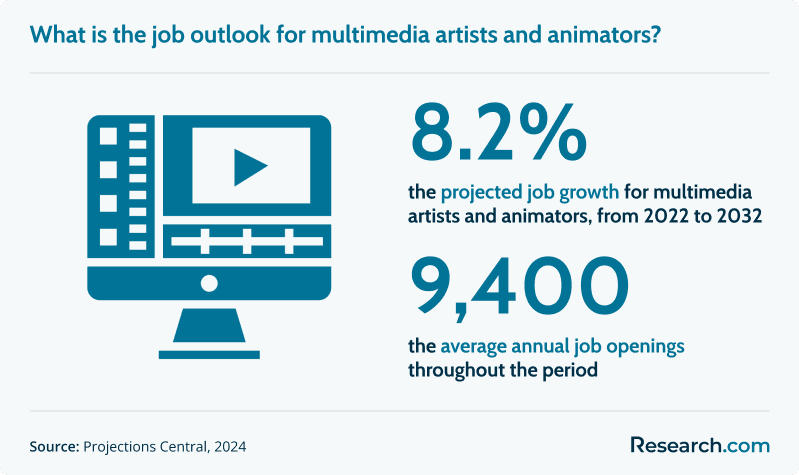
According to the U.S. Bureau of Labor Statistics, employment of multimedia artists and animators is projected to grow 4% from 2023 to 2033, with about 6,700 job openings each year. That points to steady demand, but not guaranteed employment. Graduates still need a competitive portfolio, strong software skills, and the ability to revise work based on feedback.
How much can I make with an online animation degree?
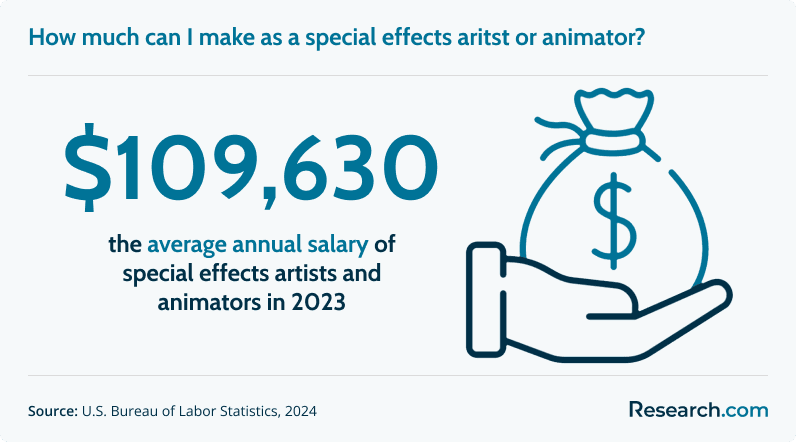
The average salary for professionals with an animation degree is around $78,000 per year, according to the U.S. Bureau of Labor Statistics. Actual earnings depend on the type of work, employer, geographic market, experience, specialization, and portfolio quality.
Entry-level animators typically start near $50,000 annually. Senior professionals, specialists, and experienced artists in higher-paying fields can exceed $100,000. Film, gaming, advertising, and visual effects roles may pay more than some education or nonprofit positions, but those sectors can also be competitive and project-driven.
Additional credentials can help in specific situations. A Master of Fine Arts (MFA) in Animation or Digital Arts may be useful for teaching, leadership, or advanced studio work. Software certifications such as Autodesk Certified Professional can also strengthen a resume when they match the tools employers use.
Still, a credential alone is not enough. In animation, your earning potential is closely tied to the quality of your reel, your ability to work in a production pipeline, and your capacity to deliver polished work on deadline.
- Most Affordable Online Animation Degree Programs for 2027
- How much does an online animation degree really cost?
- What types of online animation degrees can I choose from?
- Are affordable online animation programs accredited and respected?
- How flexible are affordable online animation degrees?
- What will I learn in an online animation degree program?
- How can creative writing skills enhance my animation career?
- What are the job prospects after finishing an affordable online animation degree?
- How do affordable online animation degrees integrate interdisciplinary skills?
- Can I transfer into an affordable online animation degree program?
- How do I choose the right online animation program for my budget and goals?
- Do affordable online animation degrees offer comprehensive student support and career services?
- Are affordable online animation degrees competitive with higher-priced programs?
- What are the next steps to enroll in an affordable online animation degree?
Most Affordable Online Animation Degree Programs for 2027
How do we rank the programs?
Because tuition is a major factor for online students, affordability should be evaluated with reliable education data and transparent criteria. This ranking uses established sources including the IPEDS database, Peterson's database, the College Scorecard database, and The National Center for Education Statistics.
These sources help compare degree programs using consistent institutional and program-level information. To learn more about how Research.com evaluates schools and programs, review the methodology page.
1. University of Hawaiʻi at Mānoa - Bachelor of Arts in Cinematic Arts
The Bachelor of Arts in Cinematic Arts at the University of Hawaiʻi at Mānoa is available fully online and includes three official tracks: Cinematic Arts, Animation, and Digital Cinema. Students in the Animation track study traditional, experimental, and computer-based techniques while working within a program that emphasizes Pacific/Asia-centered storytelling. The degree is a strong fit for students who want animation training connected to film language, visual culture, drawing, 3D work, and production practice.
- Cost per credit: $480 (resident) / $1,398 (non‑resident)
- Total cost of program: Approximately $57,600 (resident, 120 credits) or $167,760 (non‑resident)
- Accreditation: Regionally accredited by WASC (WSCUC) as part of UH Mānoa
2. University of Florida – Bachelor of Arts in Digital Arts and Sciences
The Bachelor of Arts in Digital Arts and Sciences at the University of Florida is a fully online program that combines art, communication, and technology. Through the Digital Worlds Institute, students can explore animation, game design, and experience production through project-based coursework and electives. This program may suit students who want animation skills within a broader digital media, interactive design, and creative technology environment.
- Cost per credit: $129.18 (resident) / $552.62 (non‑resident), including required UF Online fees
- Total cost of program: Approximately $15,500 (residents) or $66,300 (non‑residents) for 120 credits (estimate)
- Accreditation: Regionally accredited by the Southern Association of Colleges and Schools (SACS), through UF
3. Southern New Hampshire University – Bachelor of Arts in Graphic Design and Media Arts (3D Modeling & Animation Concentration)
Southern New Hampshire University offers a fully online Bachelor of Arts in Graphic Design and Media Arts with a 3D Modeling & Animation concentration. Students work with tools such as Maya, Mudbox, and Adobe Creative Suite while developing applied projects and portfolio pieces. This option is especially relevant for students who want animation training connected to graphic design, digital media, and visual communication.
- Cost per credit: $330
- Total cost of program: Approximately $39,600 for 120 credits
- Accreditation: Regionally accredited by the New England Commission of Higher Education (NECHE)
4. Rasmussen University – Bachelor of Arts in Graphic Design with Animation & Motion Graphics Specialization
Rasmussen University offers a fully online Bachelor of Arts in Graphic Design with a specialization in Animation & Motion Graphics. Coursework includes 3D animation, motion graphics, interactive design, and advanced typography. Students use Adobe Creative Cloud and other industry-standard tools to build portfolio-ready work. The self-paced FlexChoice option may appeal to students who want more control over pacing or who are trying to accelerate completion.
- Cost per credit: $360
- Total cost of program: Approximately $43,200 for 120 credits
- Accreditation: Institutionally accredited by the Higher Learning Commission (HLC)
5. Rocky Mountain College of Art and Design – Bachelor of Fine Arts in Animation
Rocky Mountain College of Art and Design provides a fully online Bachelor of Fine Arts in Animation. The curriculum covers classical animation, digital animation, storyboarding, character design, 2D production, and 3D production with tools such as Adobe Animate and Autodesk Maya. A project-based structure and professional demo reel make this program a fit for students who want focused animation training for film, games, or visual effects.
- Cost per credit: $545
- Total cost of program: Approximately $65,400 for 120 credits
- Accreditation: Regionally accredited by the Higher Learning Commission (HLC)
6. Full Sail University – Bachelor of Science in Computer Animation
The Bachelor of Science in Computer Animation at Full Sail is offered online and on campus. The online format follows an accelerated 29-month schedule and covers the production pipeline from storyboarding and modeling to character animation, compositing, and motion capture. Students use industry-standard software and receive the Project LaunchBox™ technology package. Portfolio and demo reel courses help students prepare work samples for animation and visual effects roles.
- Cost per credit: $746
- Total cost of program: Approximately $66,500 (includes tuition, equipment, fees, and LaunchBox™)
- Accreditation: Accredited by the Accrediting Commission of Career Schools & Colleges (ACCSC)
7. Academy of Art University – Bachelor of Fine Arts in Animation & Visual Effects
Academy of Art University offers a fully online Bachelor of Fine Arts in Animation & Visual Effects. Students can specialize in areas such as 2D animation, 3D modeling, visual effects, stop-motion, storyboarding, dynamics, rigging, look development, and production management. Virtual Remote Lab access and studio-style feedback support hands-on production, while project-based coursework leads to a professional demo reel.
- Cost per credit: $1,239 (domestic); $1,463 (international)
- Total cost of program: Approximately $59,340 (domestic, 48 units)
- Accreditation: Regionally accredited by WASC Senior College and University Commission (WSCUC)
8. National University – Bachelor of Arts in Digital Media Design (Animation Emphasis)
National University offers a fully online Bachelor of Arts in Digital Media Design with an animation emphasis. Students study motion graphics, 2D animation, 3D animation, and interactive media while developing technical skills in Adobe Creative Suite and animation software. The degree is designed for students who want portfolio projects connected to digital content, multimedia production, and visual communication.
- Cost per credit: $371
- Total cost of program: Approximately $44,520 for 120 credits
- Accreditation: Regionally accredited by WASC Senior College and University Commission (WSCUC)
9. University of Advancing Technology – Bachelor of Arts in Game Art & Animation
The Universtiy of Advancing Technology offers a fully online Bachelor of Arts in Game Art & Animation. Coursework focuses on character modeling, environment art, 3D animation, rigging, and digital storytelling. Students create interactive game assets and animated reels using Unity and Maya, making the program especially relevant for learners targeting game art and animation roles.
- Cost per credit: $530
- Total cost of program: Approximately $63,600 for 120 credits
- Accreditation: Regionally accredited by the Higher Learning Commission (HLC)
10. Liberty University – Bachelor of Science in Digital Media (Animation Focus)
Liberty University offers a fully online Bachelor of Science in Digital Media with an animation focus. Students take courses in motion graphics, 2D and 3D design, and visual storytelling while gaining experience with Adobe After Effects and Cinema 4D. Portfolio-building assignments and a capstone project give students structured opportunities to produce finished creative work.
- Cost per credit: $390
- Total cost of program: Approximately $46,800 for 120 credits
- Accreditation: Regionally accredited by Southern Association of Colleges and Schools Commission on Colleges (SACSCOC)
How much does an online animation degree really cost?
An online animation degree usually costs between $10,000 and $60,000 in total, but the real price can be higher or lower depending on the school, credit requirements, residency status, fees, equipment, and software.
Public universities may be less expensive for in-state students, while some online programs use one tuition rate for all distance learners. Private institutions can cost more, though they may offer accelerated formats, specialized software access, or bundled technology resources. The only way to compare programs fairly is to calculate the full cost of attendance, not just the advertised cost per credit.
Animation students should also budget for technology-related expenses. Depending on the program, you may need a capable computer, drawing tablet, external storage, software subscriptions, course materials, production fees, or access to tools such as Adobe Creative Cloud.
| Cost item | Why it affects your budget | Question to ask the school |
| Tuition per credit | This is the main cost, but it does not show the full financial commitment. | Is the tuition different for residents and non-residents? |
| Program length | A 120-credit bachelor’s degree costs more than a shorter certificate, even if the per-credit rate is low. | How many credits are required to graduate? |
| Fees | Online, technology, student service, and course fees can increase the final bill. | Are all required fees included in the published estimate? |
| Software and hardware | Animation production may require paid software, strong hardware, or special equipment. | Are software licenses, labs, or equipment included in tuition? |
| Transfer credits | Accepted credits can reduce both time and cost. | How many previous credits can be applied to the degree? |
| Financial aid | Grants, scholarships, and federal aid can reduce out-of-pocket costs. | Is the program eligible for federal financial aid? |
Financial aid, scholarships, grants, employer tuition benefits, and transfer credits can lower the amount you actually pay. Many online students also continue working while enrolled, which can help reduce borrowing.
The smartest approach is to request a written cost breakdown from every school you are considering. Compare tuition, mandatory fees, required materials, technology costs, and estimated time to completion. As with affordable electrician programs online, the cheapest advertised option is not always the best value unless it also provides credible training and clear career preparation.
What types of online animation degrees can I choose from?
Students can pursue online animation training through certificates, associate degrees, bachelor’s degrees, and graduate study. Similar to skill-focused programs such as affordable baking and pastry arts online programs, the best choice depends on your experience level, career goal, budget, and timeline.
| Credential | Typical length | Best for | Limitations |
| Certificate program | 6–12 months | Students who want targeted training in motion graphics, character design, 3D modeling, or a specific tool. | May not meet degree requirements for roles that prefer a bachelor’s degree. |
| Associate degree | 2 years | Beginners seeking a lower-cost foundation or a transfer pathway into a bachelor’s program. | May provide less advanced portfolio development than a full bachelor’s degree. |
| Bachelor’s degree | 4 years | Students pursuing full-time animation, game art, visual effects, multimedia, or digital media careers. | Requires more time and a larger financial investment. |
| MFA or graduate study | Varies by program | Artists seeking advanced specialization, teaching options, leadership roles, or deeper studio practice. | Usually not necessary for every entry-level animation job. |
Bachelor’s degrees are common for students who want broad preparation for professional animation work. They may be offered as a BA, BFA, or BS. A BA may combine animation with liberal arts or media studies. A BFA usually emphasizes studio practice and portfolio development. A BS may lean more toward technology, production systems, or digital media tools.
If cost is a major concern, public colleges may be worth reviewing first. Their tuition is usually just 25.4% of what private nonprofit schools charge. Students interested in animation for interactive entertainment may also want to compare programs listed among the best online game design schools.
Are affordable online animation programs accredited and respected?
Many affordable online animation programs are accredited and can be respected by employers, but students should verify accreditation before applying. Accreditation confirms that a school has been reviewed by a recognized accrediting body and meets defined academic standards. It can also affect eligibility for federal financial aid, credit transfer, and graduate school admission.
Online degrees in many fields, including programs such as an affordable geography degree online, are now common in the job market. Over 70% of employers have hired candidates with online degrees in the past year. A 2024 NACE survey also found that 87.4% of employers hiring new grads considered applicants with online degrees.
For animation specifically, employers often care most about whether you can do the work. Accreditation matters, but your portfolio, demo reel, software fluency, collaboration skills, and production experience will usually carry significant weight.
Digital fields often reward demonstrable skills. The same is true in related technical careers such as GIS, where students may ask, How do you become a GIS specialist? The key lesson is similar: choose a credible program, master the tools, and build evidence of your abilities.
How to verify accreditation before enrolling
- Check the school’s accreditation page and identify the accrediting agency.
- Confirm the accreditor is recognized by the appropriate education authorities.
- Ask whether the online program is covered under the institution’s accreditation.
- Verify whether the program qualifies for federal financial aid, if you plan to use aid.
- Ask how credits transfer if you later switch schools or pursue graduate study.
How flexible are affordable online animation degrees?
Affordable online animation degrees are often designed for students who need scheduling flexibility, but flexibility varies by school. Some programs are mostly asynchronous, meaning students can watch lectures and complete assignments on their own schedule. Others require live critiques, scheduled meetings, or weekly production deadlines.
Students may be able to study full-time or part-time. Full-time enrollment can shorten the time to graduation, while part-time study may be better for working adults or students with caregiving responsibilities. Many online programs also offer multiple start dates each year.
On average, online students spend 15 to 20 hours per week on coursework. A common planning guideline is 2 to 3 hours of study time per credit hour. For a 3-credit course, that can mean up to 9 hours per week for that class alone. Animation courses may also require additional time for rendering, revision, critique responses, and portfolio polishing.
| Format | Works well if you... | May be difficult if you... |
| Asynchronous courses | Need to study at night, on weekends, or around work shifts. | Need frequent live accountability or real-time instruction. |
| Synchronous sessions | Want live critique, direct interaction, and a classroom rhythm. | Have an unpredictable schedule or live in a conflicting time zone. |
| Full-time enrollment | Want to finish faster and can handle a heavier workload. | Are working long hours or have limited weekly study time. |
| Part-time enrollment | Need a slower pace and more flexibility. | Want the shortest possible path to graduation. |
What will I learn in an online animation degree program?
An online animation degree teaches students how to create visual stories using art, design, motion, and digital production tools. The curriculum usually blends foundational art skills with technical software training and production workflow.
Common course topics include:
- 2D and 3D animation
- Drawing, digital illustration, and design fundamentals
- Storyboarding, visual development, and character design
- Motion graphics, compositing, and visual effects
- Modeling, rigging, lighting, texturing, and rendering
- Animation software such as Maya, Blender, or Adobe After Effects
- Sound design, scene composition, editing, and production planning
Many programs require a portfolio, capstone, or demo reel. This is one of the most important parts of the degree because it translates coursework into evidence of employable skill. Students interested in games may also find animation useful when exploring how to become a video game designer.
By graduation, students should understand the animation process from concept to finished scene. Strong programs help students develop both creative judgment and production discipline: planning shots, revising work, using feedback, managing files, and completing projects on schedule.
How can creative writing skills enhance my animation career?
Animation is visual, but strong storytelling often determines whether a project feels memorable. Creative writing skills can help animators develop better characters, clearer scripts, stronger scenes, and more emotionally effective story arcs. This is especially useful for storyboard artists, directors, independent animators, game narrative artists, and creators who want to pitch original concepts.
Writing also improves collaboration. Animators who understand dialogue, pacing, character motivation, and plot structure can communicate more effectively with writers, directors, designers, and producers. Students who want to deepen narrative craft can compare animation training with broader creative pathways such as MFA in creative writing jobs.
What are the job prospects after finishing an affordable online animation degree?
Animation graduates can pursue work in studios, advertising agencies, game companies, streaming and media production, corporate communications, education, technology, and freelance services. Unlike some fields where the degree title is the main credential, animation hiring often depends heavily on a portfolio, demo reel, production experience, and software fluency.
Career outcomes can vary widely, much like they do across other online graduate and professional programs such as a cheapest business law master's degree online. Students should judge a program by whether it supports the specific career path they want, not simply by whether it is affordable.
Job growth is steady
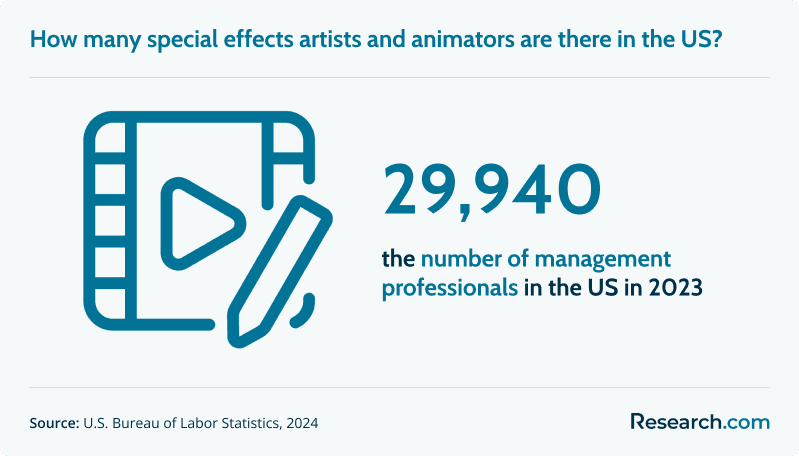
According to the Bureau of Labor Statistics, employment for special effects artists and animators is expected to grow 4 percent from 2023 to 2033. This is about as fast as the average for all occupations. Demand is connected to film, television, advertising, video games, and digital media production.
Job openings are consistent
Each year, around 6,700 job openings for animators and special effects artists are projected. Many openings are expected to come from workers changing occupations, leaving the labor force, or retiring, which creates recurring opportunities for new entrants.
Career paths are diverse
Animation graduates may work as animators, modelers, storyboard artists, motion designers, visual effects artists, game artists, multimedia specialists, or digital content creators. With additional experience, some move into art direction, production supervision, content strategy, teaching, or independent creative business ownership. Students interested in education-related options can also explore How do I get a teaching credential as part of long-term career planning.
Current trends affecting animation careers
Animation work is being shaped by real-time production tools, game engines, remote collaboration, virtual production, artificial intelligence tools, and growing demand for visual content across platforms. These trends do not eliminate the need for artists, but they do raise expectations. Graduates may need to show adaptability, ethical judgment, software versatility, and the ability to combine creative taste with efficient workflows.
How do affordable online animation degrees integrate interdisciplinary skills?
Many affordable online animation degrees now combine animation with related fields such as game design, user experience, digital illustration, interactive media, graphic design, writing, marketing, and visual communication. This interdisciplinary approach can make graduates more flexible because employers often need creators who understand more than one part of the production process.
For example, an animator who understands user-centered design may be better prepared to create interface motion, interactive experiences, educational media, or game assets. Students who want to build those complementary skills can compare animation programs with online UX design programs.
| Interdisciplinary skill | How it helps animators | Relevant career use |
| UX design | Improves motion decisions in apps, games, websites, and interactive products. | UI motion designer, interactive media designer, product animation specialist. |
| Creative writing | Strengthens character arcs, scripts, pacing, and story structure. | Storyboard artist, animation director, independent creator. |
| Game design | Connects animation to player movement, feedback, and real-time interaction. | Game animator, character artist, environment artist. |
| Graphic design | Builds stronger layout, typography, branding, and visual hierarchy skills. | Motion graphics designer, multimedia designer, advertising animator. |
Can I transfer into an affordable online animation degree program?
Yes, many affordable online animation degree programs accept transfer students. Transfer policies differ by institution, so students should ask for a transcript evaluation before committing to a school.
General education courses are often easier to transfer than specialized animation or studio courses. Art, design, digital media, and software courses may transfer if the content and learning outcomes closely match the new program’s requirements. Some schools also limit the age of technical courses because software and production workflows change over time.
On average, students lose 43% of their credits when transferring. That means a transfer decision can affect both time to graduation and total cost. A school with a lower tuition rate may not be the cheaper option if it accepts fewer of your previous credits.
Before applying, ask an admissions advisor or transfer specialist to review your transcripts. Also ask whether portfolio review, prior learning assessment, or articulation agreements could help you keep more credits.
How do I choose the right online animation program for my budget and goals?
To choose the right online animation program, compare cost, accreditation, curriculum, flexibility, portfolio development, software requirements, transfer policies, and career support. The best program is not always the lowest-cost program. It is the one that gives you credible training, manageable debt, and a realistic path toward the type of animation work you want.
Step 1: Set a realistic total budget
Start with tuition, then add fees, software, equipment, books, and any required technology. Public schools may cost less, but private schools may offer features that matter to certain students, such as accelerated schedules or bundled resources. If you want to reduce upfront expenses while comparing schools, consider whether any online colleges with no application fee fit your goals.
Step 2: Match the curriculum to your target role
If you want to work in games, look for game art, rigging, Unity, Maya, environment design, and interactive media. If you want visual effects, prioritize compositing, simulation, lighting, rendering, and production workflow. If you want motion graphics, look for typography, branding, After Effects, editing, and design foundations.
Step 3: Review portfolio support
Ask whether the program includes demo reel development, portfolio critiques, capstone projects, internship guidance, or instructor feedback from working professionals. A degree without strong portfolio support may not provide enough career value.
Step 4: Test the schedule against your real life
Do not assume “online” means easy or self-paced. Animation projects take time. Review weekly workload expectations, live session requirements, deadlines, and part-time options before enrolling.
Step 5: Ask the right questions before applying
| Question | Why it matters |
| Is the institution accredited, and does accreditation cover the online program? | This affects financial aid, credibility, credit transfer, and graduate study options. |
| What software and hardware are required? | These costs can significantly change the real price of attendance. |
| How many transfer credits will be accepted? | Transfer credit can reduce both tuition and time to completion. |
| Will I graduate with a portfolio or demo reel? | Finished work samples are essential for animation job searches. |
| Are critiques live, recorded, written, or peer-based? | Feedback quality can affect how quickly your work improves. |
| What career services are available to online students? | Remote students should have access to advising, portfolio help, and job-search support. |
Common mistakes to avoid
- Choosing only by tuition: A low price is not enough if the program lacks portfolio development, software access, or useful feedback.
- Ignoring accreditation: Unaccredited or poorly recognized programs can create problems with aid, transfer, and employer trust.
- Assuming all credits will transfer: Transfer losses can increase your total cost and delay graduation.
- Underestimating workload: Animation courses often require long production hours beyond lectures and readings.
- Skipping the portfolio review: Always look for student work, demo reel expectations, and opportunities for critique.
- Relying only on rankings: Rankings are useful starting points, but your goals, budget, schedule, and specialization matter more.
Do affordable online animation degrees offer comprehensive student support and career services?
Many affordable online animation programs provide academic advising, technical support, tutoring, career counseling, portfolio feedback, and internship guidance. However, the level of support varies, so students should confirm what is available specifically to online learners.
Useful support services for animation students include virtual office hours, software troubleshooting, portfolio reviews, production critiques, resume and reel guidance, alumni networking, and employer events. Creative programs in other fields, such as the cheapest online creative writing degree, can also differ widely in the strength of their advising and career services, so it is worth comparing support structures before enrolling.
Are affordable online animation degrees competitive with higher-priced programs?
Affordable online animation degrees can compete with higher-priced programs when they provide accredited instruction, current software training, rigorous projects, strong critique, and portfolio development. Price alone does not determine quality. Some lower-cost programs offer excellent value, while some expensive programs may not fit a student’s career goals or budget.
The main comparison should be outcomes and fit. Ask whether students graduate with polished reels, whether instructors have relevant experience, whether the curriculum reflects current production workflows, and whether online students receive the same level of support as campus students. For students who later want advanced studio or teaching credentials, cheap online MFA programs may offer another route for specialization.
What are the next steps to enroll in an affordable online animation degree?
Once you have a short list of programs, move from browsing to verification. Contact schools, request detailed cost information, compare transfer evaluations, and review curriculum requirements before submitting applications.
- Compare the programs in this guide: Review tuition, total cost, accreditation, format, specialization options, and portfolio requirements.
- Confirm accreditation and aid eligibility: Make sure the school is properly accredited and ask whether the online program qualifies for federal financial aid.
- Request a full cost estimate: Ask for tuition, fees, software, equipment, and any required technology costs in writing.
- Prepare application materials: Gather transcripts, test scores if required, recommendation letters, and a portfolio if the school requests one.
- Ask for transfer review: If you have prior college credit, request a transcript evaluation before committing.
- Submit applications: Complete each application and send all required materials. Application processing usually takes between 3 and 8 weeks but can vary by school.
- Apply for financial aid: Submit the FAFSA and search for scholarships, grants, and employer tuition assistance.
- Accept admission and register: Follow the school’s enrollment steps, pay any required deposit, meet with an advisor, and select your first courses.
Key Insights
- Affordable online animation degrees can be worthwhile when they are accredited, portfolio-focused, and aligned with your target role.
- Tuition for affordable online animation degrees generally ranges from $129 to $545 per credit, but software, equipment, fees, and transfer credit policies can change the true cost.
- A bachelor’s degree is the most common route for students seeking full-time animation, game art, visual effects, or multimedia careers, while certificates and associate degrees may suit shorter-term or lower-cost goals.
- Employers often care most about your portfolio, demo reel, software skills, and ability to complete production-quality work.
- Employment for special effects artists and animators is projected to grow 4% from 2023 to 2033, with about 6,700 job openings each year, but competition means students should build strong work samples while enrolled.
- Before enrolling, verify accreditation, compare total cost, ask about transfer credits, review student work, and confirm that online students receive meaningful critique and career support.
References:
- EducationData.org. (n.d.). Private vs. public college tuition. https://educationdata.org/private-vs-public-college-tuition
- National Center for Education Statistics. (n.d.). Fast facts: Transfer and mobility. https://nces.ed.gov/fastfacts/display.asp?id=80
- National University. (2023). Demand for university credit transfer on the rise. https://www.nu.edu/blog/demand-for-university-credit-transfer-on-the-rise/
- Texas Woman’s University. (n.d.). Graduate admissions. https://twu.edu/admissions/graduate-admissions/
- University of Illinois Chicago. (n.d.). Are online degrees respected by employers? https://onlineprograms.uic.edu/news-stories/are-online-degrees-respected-by-employers/
- University of Wisconsin Extension. (n.d.). Online learning time management calculator. https://uwex.wisconsin.edu/online-learning/time-management-calculator/
- UPCEA. (n.d.). What do students want from their online programs? https://upcea.edu/what-do-students-want-from-their-online-programs/
- U.S. Bureau of Labor Statistics. (n.d.). Multimedia artists and animators. https://www.bls.gov/ooh/arts-and-design/multimedia-artists-and-animators.htm
Other Things You Should Know About Affordable Online Animation Degree Programs
They should hold regional accreditation from a recognized agency, and the animation program should be reviewed by the school’s institutional accreditors. In the United States, check the Council for Higher Education Accreditation or the U.S. Department of Education database before enrolling.
In 2027, students seeking affordable online animation degrees can access federal student aid, scholarships specific to animation fields, and work-study programs. Additionally, some schools offer tuition installment plans to help manage education costs effectively.