2027 Best Fashion Design Schools and Programs

Co-Founder and Chief Data Scientist
Choosing a fashion design school is not just about finding a creative program with attractive course titles. The right choice affects how quickly you build a portfolio, what technical tools you learn, whether you qualify for internships, how much debt you take on, and which fashion career paths are realistic after graduation. Some students need a short certificate to learn sewing, patternmaking, and digital design quickly; others need a bachelor’s degree with deeper studio training, business coursework, and industry access.
This guide to 2027's best fashion design schools and programs is designed for students comparing certificates, vocational programs, bachelor’s degrees, online options, and accelerated pathways. It explains what fashion design programs teach, how much they cost, what admissions requirements to expect, which careers graduates pursue, and how to evaluate return on investment before enrolling.
Quick Answer: What is the best fashion design program for you?
The best fashion design program is the one that matches your career goal, budget, portfolio level, and preferred learning format. A certificate or vocational program can make sense if you want targeted technical training in areas such as garment construction, patternmaking, and fashion illustration. A bachelor’s degree is usually a better fit if you want broader design training, internship access, business coursework, and more time to develop a professional portfolio.
| Student Goal | Best-Fit Program Type | What to Check Before Enrolling |
| Enter the field quickly with practical sewing and design skills | Vocational certificate or fashion design certificate | Hands-on studio hours, portfolio support, total cost, and employer connections |
| Build a deeper design foundation and qualify for more competitive roles | B.A., B.F.A., or B.S. in Fashion Design | Accreditation, internship access, curriculum depth, faculty experience, and graduate outcomes |
| Study while working or living away from a fashion hub | Online or hybrid fashion design program | Technology platform, remote critique format, access to equipment, and portfolio development |
| Move into merchandising, buying, branding, or fashion business | Fashion design degree with business or merchandising coursework | Courses in forecasting, buying, product development, marketing, and retail strategy |
What are the benefits of getting a fashion design program?
- A fashion design program can prepare students for roles such as fashion designer, textile designer, assistant designer, patternmaker, apparel merchandiser, and fashion stylist.
- According to the U.S. Bureau of Labor Statistics, the median salary for fashion designers is around $79,290 per year.
- Students develop a portfolio, learn technical design processes, practice garment construction, and gain exposure to the business side of the fashion industry.
What can I expect from a fashion design program?
A fashion design program combines creative training with technical production skills. Students typically study fashion illustration, textiles, apparel construction, patternmaking, draping, design software, and fashion history. Strong programs also teach how to research trends, develop a concept, choose materials, produce samples, revise designs, and present finished work in a portfolio.
Many programs include studio courses, critique sessions, internships, capstone projects, or fashion shows. These experiences matter because fashion hiring often depends on a candidate’s portfolio, construction skills, ability to respond to feedback, and understanding of how garments move from idea to finished product.
Programs vary widely in cost and structure. The Otis College of Art and Design vocational degree's total costs is about $9,560. University of North Texas BFA Degree program for Fashion Design tuition ranges per semester from $7,028.68 (in-state) to $13,178.68 (out-of-state).
Where can I work with a fashion design program?
Fashion design graduates work across apparel companies, wholesalers, retailers, design services, entertainment, product development, merchandising, styling, and entrepreneurship. According to the U.S. Bureau of Labor Statistics (BLS), as of May 2024, approximately 25,700 fashion designers are employed in the United States. The industries with the highest levels of employment for fashion designers include:
- Apparel, Piece Goods, and Notions Merchant Wholesalers: Employs about 7,870 fashion designers, accounting for approximately 47.01% of the total employment in this occupation.
- Company Management: Employs around 3,720 fashion designers, representing about 22.22% of the profession's workforce.
- Clothing & Accessories Retailers: Employs approximately 2,480 fashion designers, making up about 14.81% of the total employment in this field.
- Apparel Manufacturing: Employs about 1,750 fashion designers, constituting roughly 10.45% of the occupation's workforce.
- Design Services: Employs around 920 fashion designers, about 5.5% of the workforce.
How much can I make with a fashion design program?
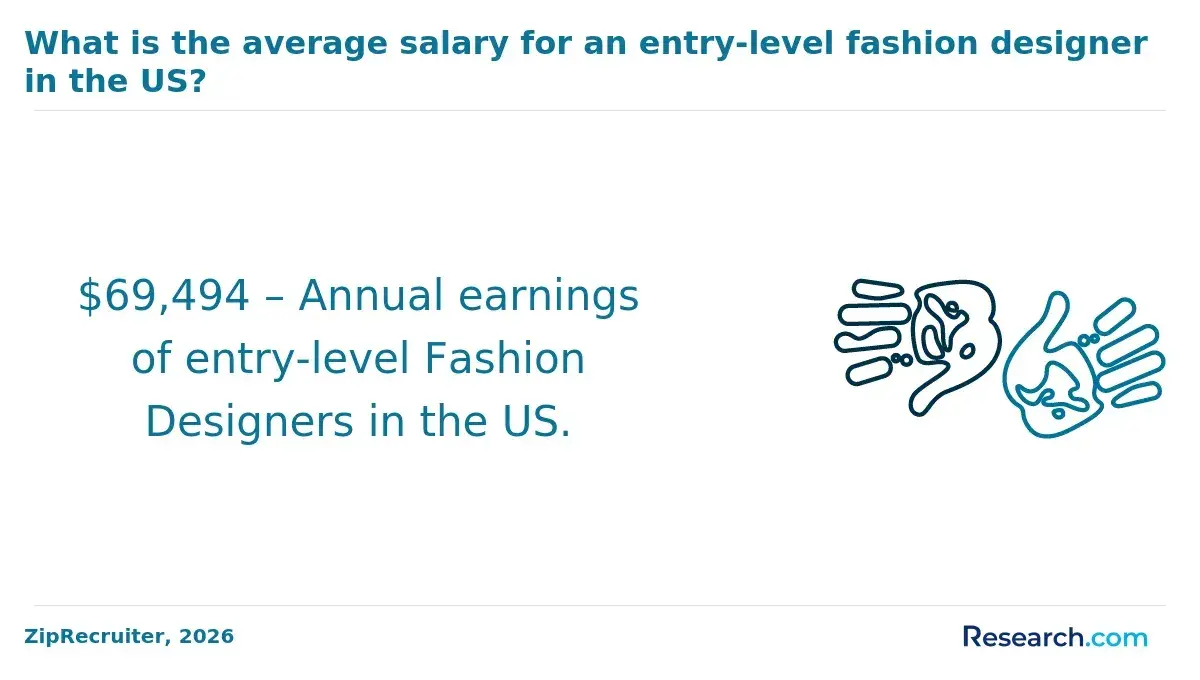
Fashion design salaries depend on experience, employer type, location, portfolio quality, and the specific role. According to the U.S. Bureau of Labor Statistics (BLS), the median annual wage for fashion designers was $80,690 in May 2024.
- Motion Picture and Video Industries: $98,740
- Apparel, Piece Goods, and Notions Merchant Wholesalers: $77,700
- Entry-level Designers: $37,090
- Professionals with Over 20 years of Experience: $160,850
Location can strongly affect earnings because fashion jobs tend to cluster around major design, retail, manufacturing, and media markets. Major fashion hubs like New York and California often offer higher salaries due to the concentration of fashion companies, although competition and living costs can also be higher.
- Best Fashion Design Degree and Certificate Programs for 2027
- How long does a fashion design program take?
- How much does a fashion design program cost?
- What financial aid is available for fashion design students?
- What are the admissions requirements for fashion design programs?
- What classes do fashion design students take?
- What fashion design specializations can students choose?
- Should you consider an online fashion design program?
- How should students evaluate fashion design degree ROI?
- Are online fashion design programs a strong alternative?
- Can accelerated and alternative programs work for fashion design?
- Who should choose an accelerated online fashion design degree?
- How to choose the right fashion design school
- How are fashion programs responding to digital and global trends?
- What careers can fashion design graduates pursue?
- What is the job market for fashion design graduates?
- Can extra certifications improve a fashion career?
List of the Best Degree in Fashion Design Programs for 2027
How do we rank schools?
Because fashion school can require a major financial commitment, Research.com evaluates programs using data sources that help students compare institutions more clearly. Our ranking process draws from the IPEDS database, Peterson's database, the College Scorecard database, and The National Center for Education Statistics. These sources support program comparisons across institutional quality, cost, student outcomes, and other available indicators. Readers can review the full approach on Research.com's methodology page.
1. Istituto Marangoni Miami (Vocational Certificate)
The Istituto Marangoni Miami Vocational Fashion Design program is built for students who want an intensive introduction to fashion creation. Coursework emphasizes sketching, fabric selection, design development, and garment construction, giving students a practical foundation for entry-level fashion work. The program is especially relevant for learners who want focused training rather than a four-year degree.
- Program Length: 1 year
- Required Credits to Graduate: Contact the institution for information
- Cost: $41,700 (Total Cost of Attendance) + Total Cost of Living Expenses Per Semester $11,600 (On Campus) / $11,031 (Online)
- Accreditation: Accredited by the Accrediting Council for Independent Colleges and Schools (ACICS)
2. Ursuline College (B.A. Degree)
The Bachelor of Arts in Fashion Design at Ursuline College combines design creativity with construction and industry knowledge. Students study areas such as patternmaking, garment construction, and fashion illustration while building experience through applied projects and internships. The program also incorporates sustainability and ethical design concepts, which can help students understand modern consumer and industry expectations.
- Required Credits to Graduate: 120
- Cost: $39,240
- Accreditation: Higher Learning Commission (HLC)
3. Otis College of Art and Design (Vocational Certificate)
The Fashion Design Certificate at Otis College of Art and Design focuses on hands-on skill development in construction, patternmaking, illustration, and design process. Students who want structured technical training without committing to a full bachelor’s degree may find this format useful for portfolio building and entry-level preparation.
- Program Length: 1.5 to 2+ Years
- Total Number of Courses: 18
- Cost: $9,560 (Total Estimated Cost)
- Accreditation: WASC Senior College and University Commission (WSCUC)
4. Mount Mary University (B.A. Degree)
The Bachelor of Arts in Fashion Design at Mount Mary University gives students a studio-based education in design, patternmaking, and garment construction. The program’s internships, fashion shows, and project-based learning opportunities can help students turn classroom concepts into portfolio-ready work.
- Required Credits to Graduate: 75
- Cost: $30,550 (Average undergrad tuition)
- Accreditation: Higher Learning Commission (HLC)
5. Parsons School of Design – The New School (Vocational Certificate)
The Fashion Design Certificate at Parsons School of Design is intended for students seeking foundational training in fashion sketching, draping, patternmaking, and garment construction. Students complete hands-on assignments that support portfolio development and introduce the technical expectations of the fashion field.
- Program Length: 18 months (On average)
- Required Courses to Graduate: 6
- Cost: $7,840 ((Whole certification program. Subject to change)
- Accreditation: Middle States Commission on Higher Education (MSCHE)
6. University of North Texas - UNT (B.F.A. Degree)
The Bachelor of Fine Arts in Fashion Design at the University of North Texas is a full undergraduate pathway for students who want advanced design training. The curriculum includes apparel design, patternmaking, garment construction, sustainability, internships, and fashion shows, giving students opportunities to combine creative work with industry-facing experience.
- Required Credits to Graduate: 120
- Cost: $7,028.68 per semester (in-state), $13,178.68 per semester (out-of-state)
- Accreditation: Southern Association of Colleges and Schools Commission on Colleges (SACSCOC)
7. Massachusetts College of Art and Design - MassArt (Vocational Certificate)
The Fashion Design Certificate at Massachusetts College of Art and Design provides part-time technical training in construction, pattern drafting, and fashion illustration. The program may appeal to students who want a structured creative credential while balancing other responsibilities.
- Program Length: 2 years + 1 Summer (Part-Time)
- Required Credits to Graduate: Contact the institution for information
- Cost: $16,262 (Whole certification program)
- Accreditation: New England Commission of Higher Education (NECHE)
8. Thomas Jefferson University (B.S. Degree)
The Bachelor of Science in Fashion Design at Thomas Jefferson University combines design, textiles, garment construction, sustainability, and innovation. Students gain exposure to industry collaborations, internships, and showcases, which can be valuable for building professional connections and a stronger portfolio.
- Required Credits to Graduate: 125-127
- Cost: $48,022 per year + $1,228 (General fee)
- Accreditation: Middle States Commission on Higher Education (MSCHE)
9. University of Nevada, Las Vegas - UNLV (Vocational Certificate)
The Fashion Design Certificate at the University of Nevada, Las Vegas introduces students to fashion illustration, garment construction, and pattern making. Its shorter structure may work well for students looking for foundational skills and portfolio development without a longer degree commitment.
- Program Length: 12 - 18 months
- Required Courses to Graduate: 9
- Cost: $4,333 (Whole certification program)
- Accreditation: Northwest Commission on Colleges and Universities (NWCCU)
10. University of Cincinnati (B.S. Degree)
The Bachelor of Science in Fashion Design at the University of Cincinnati prepares students through coursework in apparel construction, textiles, trend forecasting, and design development. Co-op experiences, industry partnerships, and international study opportunities can help students connect academic work to professional practice.
- Required Credits to Graduate: 122
- Cost: $14,655 per semester
- Accreditation: Higher Learning Commission (HLC)
How long does it take to complete a fashion design program?
Completion time depends on the credential, course load, school calendar, transfer credits, and whether the student studies full time or part time. A short certificate may focus on core technical skills, while a bachelor’s degree gives students more time to build a portfolio, complete internships, and study design theory and fashion business.
| Program Type | Typical Length | Best For |
| Certificate Programs | One to two years | Students seeking focused skill development for entry-level work or portfolio building |
| Bachelor’s Degrees | Generally four years | Students who want comprehensive training in design, textiles, studio practice, and industry preparation |
| Accelerated Programs | Varies by school and prior credit | Students with previous coursework or experience who can handle a faster pace |
| Part-Time Programs | A two-year full-time program may take three to four years part-time | Working students or learners with family, financial, or scheduling obligations |
Certificate vs. bachelor’s degree timeline
Certificate programs are usually shorter and concentrate on practical areas such as fashion drawing, garment construction, patternmaking, and digital tools. Bachelor’s programs usually require more general education, studio sequencing, critiques, internships, and portfolio development. Students comparing broader undergraduate options can review Research.com's guide to a bachelor degree in fashion.
Accelerated and flexible formats
Some schools offer compressed or flexible pathways. For example, the Fashion Institute of Technology (FIT) provides a one-year Associate in Applied Science (AAS) degree for students with prior college credits. Online programs may also allow students to move at a different pace, though learners should confirm how critiques, studio work, and garment production are handled remotely.
What is the average cost of a fashion design program?
Fashion design program costs vary by credential, institution type, location, residency status, course materials, and whether the school requires studio supplies or specialized software. Certificate programs at community colleges are often the most affordable, with tuition ranging from $4,300 to $41,700. Bachelor's degrees exhibit the widest range: public institutions may charge approximately $14,000 to $20,000 annually for in-state students, while private schools can range from $30,000 to $48,000 annually.
Tuition is only one part of the total cost. Students should also budget for fabric, sewing tools, pattern paper, mannequins, software, printing, portfolio materials, transportation to internships, and possible studio or technology fees. Online programs can reduce commuting or housing expenses, but students may still need equipment and supplies at home.
| Cost Category | Why It Matters | Question to Ask |
| Tuition and required fees | This is the largest advertised cost, but it may not include supplies or living expenses. | Is the quoted price per course, semester, year, or full program? |
| Materials and studio supplies | Fashion students often spend regularly on fabric, notions, tools, and presentation materials. | Does the school publish an estimated annual supply budget? |
| Software and technology | Digital design, CAD, and portfolio work may require specific programs or hardware. | Are software licenses included in tuition or purchased separately? |
| Internship and travel expenses | Industry access can improve career preparation but may add transportation or relocation costs. | Are internships paid, local, remote, or arranged independently? |
Students comparing fashion design with very different career paths should evaluate training cost and entry requirements carefully. For example, someone researching how to become an ICE agent would face a very different education, hiring, and federal training process than someone entering fashion.
What are the financial aid options for students enrolling in a fashion design program?
Fashion design students may be able to use scholarships, grants, loans, work-study programs, institutional aid, and outside awards. Aid availability depends on the school, credential type, enrollment status, accreditation, and whether the program participates in federal financial aid programs.
Federal financial aid
Students should start by completing the Free Application for Federal Student Aid (FAFSA) if the school and program are eligible. Federal aid may include:
- Pell Grants – Need-based grants that do not require repayment.
- Federal Supplemental Educational Opportunity Grants (FSEOG) – Additional grant funding for students with exceptional financial need.
- Stafford Student Loans – Federal student loans with structured repayment options.
- Parent PLUS Loans – Federal loans available to parents of dependent students.
- Work-Study Programs – Part-time employment that helps students earn money while enrolled.
Students considering online or hybrid study should verify whether their school participates in federal aid programs. Research.com also provides information on FAFSA-approved online schools for students comparing distance learning options.
Scholarships for fashion design students
Fashion students should look for scholarships from their college, local arts organizations, fashion foundations, professional associations, and national competitions. Examples include:
- Fashion Scholarship Fund – This organization provides scholarship opportunities for students preparing for fashion careers.
- Council of Fashion Designers of America (CFDA) Scholarships – Supports undergraduate juniors and first-year graduate students in American fashion programs.
What are the prerequisites for enrolling in a fashion design program?
Admissions requirements vary, but most fashion design schools review academic preparation, creative potential, and readiness for studio-based work. Competitive programs may place significant weight on the applicant’s portfolio because it shows how the student thinks visually and develops design ideas.
Common academic requirements
- High school diploma or equivalent – Most undergraduate and certificate programs require proof of secondary education.
- Official transcripts – Schools may review grades, completed coursework, and academic progress.
- Standardized test scores (SAT/ACT) – Some institutions request scores, while others use test-optional policies.
Portfolio requirements
A fashion portfolio may include original sketches, mood boards, photographs of completed garments, textile experiments, digital artwork, design statements, or written explanations of the applicant’s creative process. A strong portfolio does not need to look like a professional designer’s collection, but it should show originality, effort, observation, and willingness to revise work.
- Sketches and visual concepts that show design thinking
- Completed fashion or art projects photographed clearly
- Short written explanations that connect inspiration, materials, and design choices
High school courses in art, textiles, sewing, digital media, business, and writing can all help. Students interested in fashion branding, social media, or e-commerce may also compare fashion study with digital marketing programs online.
What courses are typically in a fashion design program?
Fashion design curricula usually blend studio work, design theory, garment production, digital tools, business concepts, and portfolio development. The strongest programs help students understand not only how to create a garment, but also how to research a customer, choose materials, manage production constraints, and communicate a design clearly.
Core fashion design courses
- Fashion Drawing – Builds illustration, figure drawing, and visual communication skills.
- Apparel Construction – Teaches sewing methods, garment assembly, fit, and finishing techniques.
- Contemporary Fashion Designers – Examines influential designers and how their work shapes fashion culture and industry practice.
Business and marketing courses
- Product Development – Covers the process of moving from concept to market-ready fashion product.
- Fashion Buying and Planning – Introduces retail assortment planning, inventory decisions, and consumer demand.
- Fashion Forecasting – Teaches students to analyze trends, market signals, and customer behavior.
Students who want to manage teams, budgets, timelines, or product launches may also benefit from business coursework. Some compare fashion business preparation with a cheap project management degree online when evaluating leadership-focused education paths.
Specialized and technical courses
- Textiles – Explores fabric properties, performance, sourcing, and appropriate use.
- Pattern-Making – Teaches how flat patterns are drafted and adjusted for garment production.
- Digital Design – Introduces computer-aided design tools used in fashion illustration, technical flats, and product development.
Hands-on learning and electives
- Studio Classes – Give students supervised time to practice construction, critique, and iteration.
- Internships – Offer exposure to real fashion workplaces, professional expectations, and networking.
- Elective Courses – Allow students to explore topics such as sustainable fashion, costume design, merchandising, or digital fashion.
What types of specializations are available in a fashion design program?
Specializations help students focus their portfolio and career preparation. The right concentration depends on the type of work a student wants to do after graduation, the employers they hope to target, and the skills they most want to develop.
Haute Couture and Luxury Fashion
This specialization emphasizes custom garments, refined construction, high-end materials, and detailed handwork for exclusive clients or luxury brands.
Ready-to-Wear (Prêt-à-Porter)
Ready-to-wear focuses on garments designed for standard sizing, repeat production, and broader retail markets.
Sustainable and Ethical Fashion
This area studies lower-waste design, material choices, responsible sourcing, and labor-conscious production practices.
Fashion Technology and Innovation
Students interested in fashion technology explore digital tools, 3D printing, wearable tech, smart fabrics, and virtual design environments. Learners focused on visual storytelling, branding, and multimedia presentation may also explore graphics design master's degree careers that intersect with fashion marketing and creative direction.
Fashion Business and Merchandising
This path connects design with buying, planning, product development, forecasting, and retail strategy. It can be a strong fit for students who enjoy both creativity and commercial decision-making.
Athletic Wear
Athletic wear specialists design performance-focused apparel that balances movement, durability, comfort, and style.
| Specialization | Best For Students Who Like | Possible Career Direction |
| Luxury Fashion | Detailed construction, craftsmanship, and custom design | Luxury houses, couture studios, bridal, eveningwear |
| Ready-to-Wear | Designing for real customers, fit systems, and retail production | Apparel brands, product development, mass-market design |
| Sustainable Fashion | Materials, ethics, waste reduction, and responsible sourcing | Sustainability-focused brands, consulting, product development |
| Fashion Technology | Digital tools, innovation, and virtual design | Digital fashion, CAD design, wearable technology |
| Fashion Business | Buying, planning, trend analysis, and brand strategy | Merchandising, buying, forecasting, retail planning |
Is an Online Fashion Design Program Worth Considering?
An online fashion design program can be worth considering if it offers credible instruction, strong critique systems, portfolio development, and clear support for hands-on assignments. Online learning is most practical for students who are self-directed, have access to materials and equipment, and can document their work well through photos, video, and digital presentations.
However, fashion is a tactile field. Before choosing an online program, confirm how the school handles sewing instruction, fit evaluation, garment critique, software access, internships, and networking. Students comparing flexible education routes may also review Research.com's guide to the fastest degree to get online, but speed should not replace portfolio quality or accreditation.
What is the return on investment for a fashion design degree?
Return on investment depends on total cost, debt, scholarship aid, time to completion, internship access, portfolio strength, location, and realistic salary expectations. A low-cost program with strong technical training may offer better value than a more expensive program if it produces a competitive portfolio and helps students gain industry experience. A higher-cost program may be justified when it provides exceptional mentorship, facilities, employer access, and career placement support.
Students should compare tuition, materials, fees, and living expenses against likely earnings and career options. Salary data, local job markets, internship quality, alumni outcomes, and employer relationships all matter. Using financial aid, scholarships, grants, and eligible programs at FAFSA-approved online schools may reduce up-front costs and improve the value of the degree.
Are Online Fashion Design Programs an Effective Alternative?
Online fashion design programs can be an effective alternative when they are accredited, technically well-supported, and designed around real creative production rather than passive lectures. Students should look for live or detailed critiques, access to digital design tools, clear supply lists, portfolio reviews, internship guidance, and faculty with relevant industry experience.
Online study is less effective for students who need constant in-person studio feedback, access to industrial equipment, or a highly collaborative campus environment. If you are comparing online degree difficulty and structure across multiple majors, Research.com's guide to What is the easiest degree to get online? can provide a broader view of online learning expectations.
Are Accelerated and Alternative Programs a Viable Option for Fashion Designers?
Accelerated, competency-based, and non-traditional fashion programs can work for students who already have some creative experience, can manage a heavy workload, and need targeted skills quickly. These programs may be useful for career changers, entrepreneurs, or students adding fashion training to another background.
The trade-off is pace. Shorter programs may leave less time for experimentation, critique, internships, and portfolio refinement. Before enrolling, check faculty credentials, studio expectations, employer relationships, accreditation, and whether the credential is respected by the type of employer you want. Students researching highly compressed programs in other fields may compare expectations with a degree in 6 months online.
Is an Accelerated Online Fashion Design Degree Right for You?
An accelerated online fashion design degree may be a good fit if you are disciplined, comfortable with digital tools, able to source your own materials, and ready to complete demanding studio work on a compressed schedule. It may not be the best fit if you are a beginner who needs extensive in-person help with sewing, fit, draping, or construction fundamentals.
Students should ask whether the accelerated format includes portfolio reviews, instructor feedback, internship support, and credible assessment of hands-on projects. If you are comparing faster bachelor’s pathways in multiple fields, Research.com's resource on accelerated bachelor's degree online accredited programs can help you understand what to evaluate.
How to Choose the Best Fashion Design Program
The best fashion design school is not automatically the most famous or expensive option. It is the program that helps you build the right skills, portfolio, network, and career direction at a cost you can manage. Use the steps below before applying or committing a deposit.
- Verify accreditation – Confirm that the institution is accredited and that credits are more likely to transfer if you continue your education later.
- Study the curriculum – Look for courses in drawing, construction, patternmaking, textiles, digital design, fashion history, business, and portfolio development.
- Review faculty backgrounds – Faculty with industry experience can provide practical insight, but also check whether they are available for mentoring and critique.
- Examine studio and technology resources – Ask about sewing labs, dress forms, software, equipment access, and open studio hours.
- Compare internship and industry access – Programs with employer connections, fashion shows, and real projects may offer stronger career preparation.
- Evaluate location carefully – A fashion hub may offer more networking and internship opportunities, but costs can be higher.
- Calculate total cost – Include tuition, fees, supplies, housing, travel, software, and potential lost income if studying full time.
- Ask about graduate outcomes – Request information on job placement, internship partners, alumni roles, and portfolio review opportunities.
| Common Mistake | Why It Can Hurt You | Better Approach |
| Choosing only by school reputation | A famous name does not guarantee the right fit, affordability, or career support. | Compare curriculum, portfolio outcomes, costs, and internship access. |
| Ignoring accreditation | Credits may not transfer, and aid eligibility may be limited. | Confirm institutional accreditation before enrolling. |
| Looking only at tuition | Fashion supplies, software, fees, and living expenses can change the real cost. | Build a full cost estimate before deciding. |
| Assuming online programs are easier | Remote studio work requires discipline, documentation, and self-management. | Ask how critiques, construction assignments, and portfolio reviews work online. |
| Waiting too long to build a portfolio | Employers and transfer programs often want evidence of skill, process, and creativity. | Save and document strong work from the first term. |
Students in any career field benefit from understanding the full training pathway before committing. For example, those comparing fashion with law enforcement may research FBI agent education requirements, while fashion students should focus on portfolio expectations, studio training, and internship access.
Are Fashion Design Programs Adapting to Digital and Global Trends?
Fashion education is increasingly shaped by digital design tools, online retail, global supply chains, sustainability concerns, and faster consumer trend cycles. Strong programs are responding by teaching software-based design, virtual presentation, market research, sustainability concepts, and cross-disciplinary collaboration.
Students should look for evidence that a program teaches current tools and industry practices rather than relying only on traditional studio methods. Ask whether students use digital pattern tools, CAD, trend analysis, virtual portfolios, e-commerce concepts, and sustainability frameworks. Learners who later want advanced study in a flexible format may also compare options such as a 1 year masters degree.
What career paths are available for graduates of a fashion design program?
Fashion design graduates can pursue creative, technical, business, retail, entertainment, and entrepreneurial roles. The right path depends on portfolio strengths, internships, specialization, location, and willingness to start in assistant or entry-level roles.
Fashion industry careers
Design-focused roles require creativity, technical construction knowledge, trend awareness, and the ability to revise work based on feedback. Similar to how evidence technician qualifications define preparation for forensic support work, fashion employers often look for specific proof of skill through samples, portfolios, and hands-on experience.
- Fashion Designer – Develops clothing, accessories, footwear, or collections for brands or clients.
- Assistant Designer – Helps senior designers with sketches, research, materials, fittings, and prototypes.
- Patternmaker – Creates and adjusts templates used to produce garments.
- Textile Designer – Designs fabric patterns and surface treatments for apparel or home goods.
- Fashion Stylist – Selects and coordinates looks for clients, brands, editorial shoots, media, or events.
Business and retail careers
Not every fashion graduate becomes a designer. Many work in roles that connect design, customers, inventory, marketing, and sales. Understanding training expectations before entering a profession is important in any field, just as future educators review ESL teacher education requirements before pursuing classroom roles.
- Retail Buyer – Chooses products for stores based on trends, sales data, and customer demand.
- Merchandiser – Plans product presentation, assortment, inventory, and sales strategy.
- Fashion Marketing & PR – Promotes brands through campaigns, social media, events, and public relations.
- Visual Merchandiser – Designs store displays and product layouts that support brand identity and sales.
Specialized and emerging fields
- Trend Forecaster – Studies market behavior, culture, and data to anticipate style directions.
- Digital Fashion Designer – Creates virtual garments for gaming, social media, digital platforms, and immersive environments.
- Costume Designer – Designs clothing for film, television, theater, performance, or entertainment productions.
Entrepreneurial opportunities
Some graduates launch independent clothing lines, provide freelance design services, sell custom garments, or build e-commerce brands. Entrepreneurship can offer creative control, but it also requires pricing, sourcing, marketing, production planning, and customer service skills. Students interested in practical hands-on work with lower barriers in related areas may also explore easy trades to learn that pay well, including sewing, tailoring, alterations, and merchandising-related work.
What is the job market for graduates with a fashion design program?
The job market for fashion design graduates is competitive. Employment is projected to grow 2% from 2024 to 2034, slower than the average for all occupations. Approximately 2,300 job openings for fashion designers are anticipated annually over the next decade, primarily due to workforce turnover.
Because traditional fashion designer roles are limited and competitive, students should build adaptable skills. Opportunities may also exist in product development, technical design, styling, merchandising, trend forecasting, sustainability consulting, digital fashion, costume design, and fashion marketing.
Geography matters. For instance, New York City employs around 129,000 individuals in fashion-related industries. Students who cannot relocate should investigate local employers, remote fashion business roles, freelance options, and online retail opportunities.
To compete, graduates need more than a credential. They should develop a polished portfolio, complete internships when possible, learn relevant software, document finished garments professionally, attend industry events, and keep improving their technical skills after graduation.
Can Supplementary Certifications Boost Your Fashion Career?
Supplementary certifications can strengthen a fashion career when they add skills employers actually need. Useful areas may include digital merchandising, CAD tools, sustainable design, product development, retail analytics, technical design, or specialized fabrication methods. A certification is most valuable when it produces portfolio work, software proficiency, or a measurable skill rather than just a line on a resume.
Professionals comparing practical credentials in different fields may also review Research.com's guide to the best course for high paying job, but fashion students should prioritize certificates that complement their portfolio and target role.
What Graduates Say About Fashion Design Programs
-
: "
Elise credits her vocational fashion design training with helping her learn patternmaking, garment construction, and digital design skills that supported the launch of a small clothing brand selling online and through local boutiques.
"
-
: "
Cassie says her bachelor’s degree helped her secure internships with major brands and later move into a junior designer role. She found that the combination of coursework, portfolio development, and hands-on experience made her more visible to employers.
"
-
: "
Isa describes undergraduate fashion study as useful because it connected creative design with merchandising, marketing, and retail strategy. That mix helped her move into a role linking designers and retailers.
"
Questions to Ask Before Choosing a Fashion Design School
- Is the institution accredited, and will credits transfer if I continue my education?
- What percentage of the program is hands-on studio work?
- How often do students receive critique from faculty or industry professionals?
- What software, sewing equipment, and studio facilities are available?
- Does the program require an internship, capstone, fashion show, or portfolio review?
- What are the full costs beyond tuition, including materials, tools, software, and fees?
- Where do recent graduates work, and what kinds of roles do they get first?
- Does the program align with my preferred specialization, such as sustainable fashion, technical design, merchandising, or digital fashion?
Key Insights
- Fashion design certificates can be completed in one to two years, while bachelor’s degrees generally require four years of study.
- Program cost varies sharply: certificates range from $4,300 to $41,700, while bachelor’s degrees range from $14,000 to $48,000 per year depending on institution type and residency.
- The job market is competitive, with fashion designer employment projected to grow 2% from 2024 to 2034 and about 2,300 openings expected annually due largely to workforce turnover.
- Portfolio quality, internships, technical construction skills, and digital design ability often matter as much as the credential itself.
- New York City remains a major fashion employment hub, with approximately 129,000 individuals working in fashion-related industries.
- The mean annual wage for fashion designers is $80,690 as of May 2024, but actual salaries vary by role, experience, location, employer, and industry segment.
- The best program is not always the most expensive or prestigious one. Choose the school that offers the right mix of accreditation, studio training, portfolio support, industry access, affordability, and specialization fit.
References:
- Arts and design occupations. (2024, August 29). Bureau of Labor Statistics. https://www.bls.gov/ooh/arts-and-design/
- Median weekly earnings of full‐time wage and salary workers by detailed occupation and sex. (2025, January 29). Bureau of Labor Statistics. https://www.bls.gov/cps/cpsaat39.htm
- Here’s how much you’ll pay to attend Fashion Institute of Technology. (2025, January 13). Fashion Institute of Technology. https://www.usnews.com/best-colleges/fashion-institute-of-technology-2866/paying
- Fashion designers. (2024, August 29). Bureau of Labor Statistics. https://www.bls.gov/ooh/arts-and-design/fashion-designers.htm
- Department of Defense. (n.d.-a). Fashion Designers | My future. My Future. https://myfuture.com/occupations-industries/occupations/fashion-designers
- Occupational Employment and Wage Statistics. Bureau of Labor Statistics. https://www.bls.gov/oes/2023/may/oes271022.htm
- Site built by: Salary.com. (n.d.-b). Salaries for Fashion Designer I with a Master’s Degree or MBA | Salary.com. https://www1.salary.com/Salaries-for-Fashion-Designer-I-with-a-Masters-Degree-or-MBA
- Fashionista salary reporting. https://fashionista.com/2023/04/fashion-jobs-average-salary-2022
- Average fashion designer salary information. https://tukatech.com/average-fashion-designer-salary-us
- Fashion designer salary overview. https://medium.com/%40adrianlungu06/breaking-down-the-numbers-understanding-the-average-fashion-designer-salary-7ae9b42587ad
- Academy of Art University online education. https://www.academyart.edu/online-education/online-degrees/
- Financial aid. (n.d.). https://www.fitnyc.edu/admissions/costs/financial-aid/index.php
- Named Scholarships — Fashion Scholarship Fund. (n.d.). Fashion Scholarship Fund. https://www.fashionscholarshipfund.org/named-scholarships-and-funds-2025
- CFDA. (n.d.). https://cfda.com/education/cfdascholarshipfund
- Scholarships.com. (n.d.). Fashion Scholarships. https://www.scholarships.com/financial-aid/college-scholarships/scholarships-by-major/fashion-scholarships
- Fashion Design AAS. (n.d.). https://www.fitnyc.edu/admissions/undergraduate-applicants/apply/portfolio/fashion-design-aas.php
- Fashion Business Management. (n.d.). https://www.fitnyc.edu/academics/academic-divisions/business-and-technology/fbm/index.php
- Trivedi, S. (n.d.). Fashion Design Specializations: Education. Vocal. https://vocal.media/education/fashion-design-specializations
- Fashion - Fashion Design - Degrees and Certificates - Pasadena City College. (n.d.). https://pasadena.edu/academics/degrees-and-certificates/certificates-of-achievement/fashion-design.php
- Indeed Editorial Team. (2025, March 26). What is a Specialization in Fashion Designing? (Types and Careers): Career Guide. Indeed. https://www.indeed.com/career-advice/career-development/specialization-in-fashion-designing
- What can I do with a fashion degree? | Prospects.ac.uk. (n.d.). Prospects. https://www.prospects.ac.uk/careers-advice/what-can-i-do-with-my-degree/fashion
- Webb, B., & Shoaib, M. (2024, October 7). How can fashion design graduates get a job? Vogue Business. https://www.voguebusiness.com/story/fashion/how-can-fashion-design-graduates-get-a-job-debunking-the-dream-survey
- Global fashion industry statistics. (n.d.). FashionUnited. https://fashionunited.com/statistics/global-fashion-industry-statistics/usa
- Top fashion capitals of the world. (n.d.). https://www.amordesign.org/blog/top-fashion-capitals-of-the-world
- Azri, D. (2025, March 26). 5 fashion jobs that pay well for fashion enthusiast. Study International. https://studyinternational.com/news/fashion-jobs-that-pay-well/
- ZipRecruiter. (n.d.). 16 of the Best Types of Fashion Jobs in 2025. https://www.ziprecruiter.com/g/Most-Popular-Job-Types-Of-Fashion-Jobs
- Birt, J. (2024, April 19). Career Guide: 15 Highest-Paying Fashion Jobs. Indeed. https://www.indeed.com/career-advice/finding-a-job/highest-paying-fashion-jobs
Other Things You Should Know About Degree in Fashion Design Programs
Top fashion design schools in 2027 offer state-of-the-art facilities, including 3D design labs, textile innovation centers, and digital prototyping studios. These resources provide students with practical, hands-on experience in the latest fashion technologies and techniques.
Yes. Most fashion design programs ask applicants to submit a portfolio with 8 to 15 pieces showing drawing ability, creativity, and design development. Many schools also require a statement of purpose, transcripts, and sometimes a sketchbook or digital work sample.