2027 Best Online Art Design Degree Programs

Co-Founder and Chief Data Scientist
Choosing an online art and design degree is not just about finding a creative major. It is a decision about cost, portfolio quality, software training, faculty feedback, career support, and whether the program can help you compete for design work after graduation. The right program can help you build a professional body of work while studying around a job, family responsibilities, or freelance projects. The wrong one can leave you with debt, weak portfolio samples, or credits that do not transfer.
This guide is for students comparing online art design degree programs, career changers moving into creative work, and working adults who need a flexible path into graphic design, digital arts, UX/UI, animation, illustration, or related fields. You will learn what online programs usually include, how much they may cost, how long they take, what careers they can support, and how to evaluate quality before enrolling.
Quick Answer: Is an Online Art Design Degree Worth It?
An online art design degree can be worth it if the program is accredited, teaches current digital tools, includes substantial portfolio development, and matches the type of creative work you want to pursue. According to 2024 BLS data, the median annual wage for art and design professionals is around $51,660, while experienced graduates in specialized or leadership roles can earn substantially more, with top art design graduates making up to $106,500 annually. The degree is most valuable when paired with internships, freelance projects, strong faculty critique, and a polished portfolio.
What are the benefits of getting an online art design degree?
- Career flexibility: Graduates can pursue work in advertising, technology, entertainment, publishing, education, and digital media, including roles such as graphic designer, UX/UI designer, illustrator, animator, or art director.
- Industry-relevant digital training: Many online programs use design platforms, collaboration tools, and portfolio workflows that mirror remote and hybrid creative workplaces.
- Potential for competitive earnings: With experience, specialization, and a strong portfolio, art and design graduates may progress from entry-level salaries into roles earning between $51,660 and over $100,000 annually.
What can I expect from online art design degree programs?
Online art design degree programs combine creative practice, visual theory, software training, critique, and portfolio development. Students commonly study graphic design, digital illustration, web design, art history, branding, typography, animation, and visual communication. Instead of only reading about design, you will usually complete projects such as logos, digital illustrations, campaign materials, website layouts, motion graphics, brand systems, and final portfolio pieces.
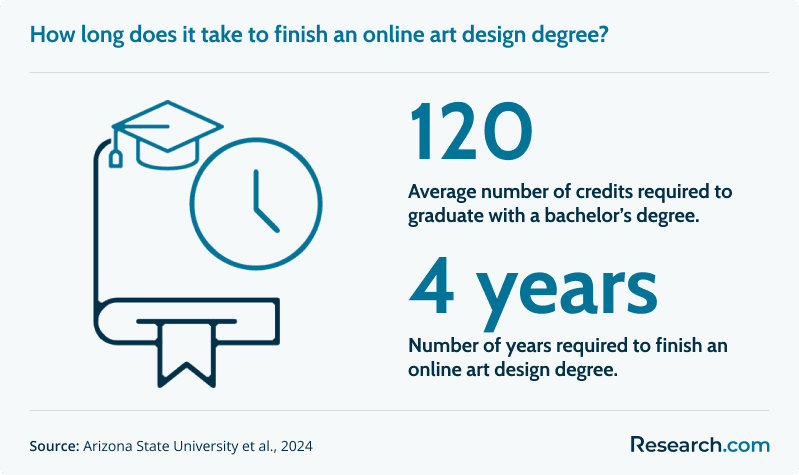
Most bachelor’s programs require around 120 credit hours. Tuition for online art design degrees commonly ranges from $400 to $1,200 per credit hour, although individual schools may charge below or above that range. Many students complete a bachelor’s degree in three to four years, while transfer credits, part-time enrollment, accelerated terms, and course availability can change the timeline.
| Program Feature | What It Means for Students | Why It Matters |
| Portfolio-based coursework | You complete visual projects throughout the program. | Employers often evaluate designers by work samples, not the degree alone. |
| Software and technology training | Programs may use tools for illustration, layout, web, animation, or UX work. | Current technical skills can make the transition into freelance or entry-level work easier. |
| Faculty critique | Instructors and peers review your creative work. | Regular feedback helps improve concept, execution, and presentation quality. |
| Flexible course delivery | Courses may be asynchronous, synchronous, or a mix of both. | Format affects how well the program fits your work schedule and learning style. |
| Capstone or final portfolio | Many programs end with a major project or portfolio review. | A strong capstone can become part of your job-search materials. |
Where can I work with an online art design degree?
An online art design degree can lead to creative work across advertising, entertainment, publishing, technology, education, media, and freelance markets. Graduates often work on visual assets that help organizations communicate clearly, sell products, improve digital experiences, or tell stories through images and interactive media.
In advertising, designers may create campaign visuals, brand identities, websites, social media graphics, and marketing collateral. In publishing, they may work on covers, page layouts, magazine design, or digital editions. In technology, UX and UI designers help shape websites, apps, software interfaces, and digital products. Entertainment and gaming employers may hire graduates for animation, concept art, visual development, and multimedia production.
Data published by the BLS in 2024 identified the following industries as having the highest employment levels for art design graduates:
- Motion Picture and Video Industries (164,500 jobs)
- Advertising, Public Relations, and Related Services (122,440)
- Colleges, Universities, and Professional Schools (103,840)
- Newspaper, Periodical, Book, and Directory Publishers (84,820)
- Media Streaming Distribution Services, Social Networks, and Other Media Networks and Content Providers (77,270)
How much can I make with an online art design degree?
Earnings vary by role, location, experience, industry, portfolio quality, and whether you work as an employee, contractor, or freelancer. According to 2024 BLS data, the median annual wage for art and design professionals is around $51,660. Entry-level roles such as junior graphic designer or web designer often begin at around $35,000 to $45,000 annually.
After gaining experience, designers may move into mid-level positions such as senior graphic designer or UX/UI designer, where salaries often range from $60,000 to $80,000 annually. Leadership and specialized roles, including art director and creative director, can reach $90,000 to over $100,000 per year. Top earners in high-demand areas such as technology, animation, and advanced digital design can surpass $106,500 annually.
| Career Stage | Common Roles | Salary Information Stated in This Guide |
| Entry level | Junior graphic designer, web designer, production designer | Around $35,000 to $45,000 annually |
| Mid level | Senior graphic designer, UX/UI designer, multimedia designer | Usually between $60,000 and $80,000 annually |
| Leadership or specialized | Art director, creative director, specialized digital designer | $90,000 to over $100,000 per year |
| Top earners | Experienced professionals in high-demand fields | Can surpass $106,500 annually |
- Best Online Art Design Degree Programs for 2027
- Program Length: How Long Online Art Design Degrees Take
- Online vs. On-Campus Art Design Programs
- Average Cost of Online Art Design Programs
- Financial Aid for Online Art Design Students
- Admissions Requirements and Prerequisites
- Common Courses in Online Art Design Programs
- Popular Art Design Specializations
- How to Choose the Right Online Art Design Degree
- Career Paths for Online Art Design Graduates
- Job Market for Art Design Degree Graduates
- Why Accreditation Matters
- Advanced Study After an Online Art Design Degree
- Affordable Online Graphic Design Degree Options
- Real-World Experience in Online Art Design Programs
- Further Academic Advancement Options
- Faculty Expertise and Program Quality
- Career Support and Networking
- Challenges for Online Art Design Students
- Cross-Disciplinary Skills in Art Design
- Evaluating Return on Investment
- Questions to Ask Before Enrolling
- Support for Nontraditional Students
- Teaching Careers After an Art Design Degree
- Entrepreneurship and Freelance Design
- Research and Technical Skill Integration
- Building a Strong Portfolio
- Preparation for Academic Research
- Connecting Creative Arts with Other Fields
- Emerging Trends in Online Art Design Education
List of the Best Online Art Design Degree Programs for 2027
How do we rank our schools?
Research.com rankings are built to help readers compare programs with greater transparency before making a financial commitment. Our ranking process uses established education data sources, including the IPEDS database, Peterson's database, the College Scorecard, and the National Center for Education Statistics. These sources help evaluate online art design degree programs using comparable institutional and program information. You can review the full ranking approach on the Research.com methodology page.
1. Arizona State University
Arizona State University offers an online Bachelor of Arts in Art with an Art Studies focus. The program is designed for students who want broad creative training rather than a narrowly technical design track. Coursework emphasizes original artmaking, creative reasoning, ethical judgment, visual storytelling, and the professional presentation of artistic work. Students may explore areas such as graphic design, merchandising, and visual communication while building a foundation in studio practice and art theory.
- Required Credits to Graduate: 120 credits
- Tracks/Concentrations: Art Studies
- Cost: $7,495 per year for residents, $14,957 for non-residents
- Accreditation: Higher Learning Commission (HLC)
2. Lindenwood University
Lindenwood University’s online BA or BFA in Art and Design gives students a choice between broader liberal arts study and deeper creative specialization. The curriculum combines design foundations with advanced practice in areas such as photography, video, web design, studio art, and digital production. The BA may suit students who want flexibility across creative fields, while the BFA is generally better aligned with intensive studio preparation or graduate study.
- Required Credits to Graduate: 90 to 111 credits
- Tracks/Concentrations: Digital Art, Graphic Design, Photography, Studio Art, K-12 Education Certification
- Cost: $495 per credit
- Accreditation: HLC
3. University of Montana
The online BA in Art from the University of Montana is structured for students who want a flexible visual arts education that can apply to fine art, applied art, media production, or interactive design. Students can choose online courses aligned with interests such as painting, animation, graphic design, media arts, or game design. Foundational coursework, focused electives, and a capstone experience help students connect creative practice with personal career goals.
- Required Credits to Graduate: 120 credits
- Tracks/Concentrations: Studio Art, Media Arts, Game Design and Interactive Media
- Cost: $6,920 per year for 12 credits for residents, $21,070 for non-residents
- Accreditation: Northwest Commission on Colleges and Universities (NWCCU)
4. University of Arizona
The online BA in Design Arts & Practices from the University of Arizona blends design history, design theory, and applied creative problem-solving. Students work through project-based courses that connect visual communication, computational thinking, data analysis, and creative production. The program is well suited for learners who want to use design methods to address complex visual, spatial, screen-based, and object-centered challenges.
- Required Credits to Graduate: 120 credits
- Tracks/Concentrations: Object Design, Print, Screen, Spatial Design
- Cost: $525 per credit hour
- Accreditation: WASC Senior College & University Commission (WSCUC)
5. University of Florida
The online BA in Digital Arts and Sciences from the University of Florida Online focuses on the connection between art, communication, and technology. Students study digital production, animation, game design, and related media skills through project-based learning. The program is designed for students interested in entertainment, interactive media, technology, and digital storytelling.
- Required Credits to Graduate: 120 credits
- Tracks/Concentrations: N/A
- Cost: $129.18 per credit hour for residents, $552.62 for non-residents
- Accreditation: Southern Association of Colleges and Schools Commission on Colleges (SACSCOC)
6. Rocky Mountain College of Art and Design
Rocky Mountain College of Art and Design offers an online BFA in Illustrative Design that combines illustration, drawing, digital design, and applied visual communication. Students build technical skills with Adobe software while developing an individual creative voice. The program’s small-class environment and project-based curriculum may appeal to students interested in graphic design, illustration, visual storytelling, and related studio careers.
- Required Credits to Graduate: 123 credits
- Tracks/Concentrations: Illustrative Design, Animation, Art Education, Fashion Design, Fine Arts, Game Art, Graphic Design, Illustration, Interior Design, Photography
- Cost: $740 per credit hour
- Accreditation: HLC
7. Academy of Art University
The BFA in Visual Development from the Academy of Art University prepares students to design characters, environments, visual worlds, and narrative concepts. Coursework includes figure modeling, scene development, visual storytelling, traditional media, digital tools, and advanced design techniques. Students work toward a professional portfolio and build collaboration, presentation, and production skills for art and design roles.
- Required Credits to Graduate: 120 credits
- Tracks/Concentrations: Visual Development, Acting, Advertising, Animation & Visual Effects, Architecture, Art Education, Art History, Communications & Media Technologies, Fashion, Fine Art, Game Development, Graphic Design, Illustration, Industrial Design, Interaction & UI/UX Design, Interior Architecture & Design, Jewelry & Metal Arts, Landscape Architecture, Motion Pictures & Television, Music Production & Sound Design for Visual Media, Photography, Writing for Film, Television & Digital
- Cost: $1,239 per unit for domestic students, $1,463 for international students
- Accreditation: WSCUC
8. DeVry University
DeVry University’s online bachelor’s degree with a Graphic and Multimedia Design specialization focuses on visual design for digital and multimedia environments. Students study web design, animation, software tools, and media production skills. The curriculum also includes preparation connected to Adobe certification, which may be useful for students who want to demonstrate software competency alongside a degree.
- Required Credits to Graduate: 122 credits
- Tracks/Concentrations: N/A
- Cost: $514 per credit hour
- Accreditation: HLC
9. Southern New Hampshire University
Southern New Hampshire University’s online BA in Graphic Design and Media Arts trains students to create design work across print, digital, web, and video formats. Coursework emphasizes design technologies, concept development, media analysis, and portfolio building. This program may fit students interested in agency work, in-house design teams, design studios, or independent creative work.
- Required Credits to Graduate: 120 credits
- Tracks/Concentrations: User Experience Design, Web Design
- Cost: $330 per credit hour
- Accreditation: New England Commission of Higher Education (NECHE)
10. Liberty University
Liberty University’s online BFA in Graphic Design emphasizes practical training in visual communication. Students study digital design, color theory, user experience, art history, and industry-standard software such as Adobe Creative Suite. Peer and instructor feedback help students refine creative work and prepare portfolio materials for graphic design roles.
- Required Credits to Graduate: 120 credits
- Tracks/Concentrations: N/A
- Cost: $390 per credit hour
- Accreditation: SACSCOC
What Graduates Say About Studying Art Design Online
-
: "
"My online art design program let me keep working while I developed a portfolio and received detailed instructor feedback. Studying from home made the degree realistic for my schedule." – Emma
"
-
: "
"The online format connected me with classmates and instructors from different places, which made critiques more useful. The assignments were practical and helped me understand how design projects work beyond the classroom." – Monica
"
-
: "
"Being able to complete coursework around other responsibilities helped me stay enrolled. The project-based classes and individual support made the experience feel career-focused." – Leonard
"
Key Findings
- Most online art design degree programs take 3-4 years to finish, although some schools offer accelerated formats.
- Tuition for online art design programs typically ranges from $15,000 to $50,000 per year, depending on the institution and student residency status.
- Graduates with an art design degree can expect an average starting salary of $50,710 per year, with higher potential earnings in specialized or senior roles.
- Employment in arts and design occupations is projected to grow about as fast as the average, with 87,900 job openings annually between 2023 and 2033.
- Most bachelor’s programs require around 120 credits, though transfer credit policies can shorten or extend the path to graduation.
How long does it take to complete an online art design program?
An online art design program can take 2 to 4 years, depending on degree level, transfer credits, enrollment pace, and program structure. An associate degree usually takes about two years. A bachelor’s degree typically takes four years for full-time students. Some accelerated options can be completed in as little as 18 months, much like fast completion models found in fields such as the cheapest RN to BSN online programs, but compressed timelines require a heavier workload.
Part-time bachelor’s students may need five to six years to graduate. Online programs often offer multiple start dates and flexible scheduling, but flexibility does not mean the work is easier. Studio projects, revisions, critiques, and portfolio development can take significant time each week.
| Enrollment Path | Typical Timeframe | Best For |
| Associate degree | About two years | Students seeking a shorter entry point into creative study |
| Bachelor’s degree, full time | Usually four years | Students who can carry a standard course load |
| Accelerated program | As little as 18 months | Students with transfer credits or the ability to manage intensive study |
| Bachelor’s degree, part time | Five to six years | Working adults and students with major outside responsibilities |
How does an online art design program compare to an on-campus program?
Online and on-campus art design programs can teach similar design principles, but the learning experience differs. Online programs usually offer more scheduling flexibility, while campus programs may provide easier access to physical studios, equipment, and in-person critiques. The better option depends on how you learn, what tools your specialization requires, and how much structure you need.
| Factor | Online Art Design Program | On-Campus Art Design Program |
| Schedule | Often more flexible, especially with asynchronous courses | Usually follows fixed class meeting times |
| Resources | May include digital libraries, software access, virtual critique spaces, and online studios; students can also compare the best online art programs for resource quality | May provide physical studios, labs, equipment, and face-to-face access to faculty |
| Cost | Can reduce commuting, housing, and some campus-related expenses | May involve higher living and transportation costs |
| Networking | Relies on discussion boards, group projects, virtual events, and online communities | Offers more spontaneous in-person networking and studio collaboration |
| Hands-on work | Strong for digital design, UX, illustration, web, and multimedia projects | May be better for programs requiring specialized physical equipment or studio access |
| Student discipline | Requires strong time management and self-direction | Provides more external structure through scheduled classes and campus routines |
What is the average cost of online art design programs?
The cost of an online art design degree depends on the school, program length, tuition model, residency status, and whether the institution is public or private. In general, total tuition can range from $15,000 to $50,000 for the entire program. Public institutions often fall between $15,000 and $30,000, while private institutions may charge up to $50,000 or more.
Tuition is only one part of the budget. Students in online art college programs may also need software subscriptions, art supplies, drawing tablets, camera equipment, external storage, or computer upgrades. These added expenses can total around $500 to $2,000, although some schools provide free, discounted, or institution-licensed design tools.
| Cost Category | What to Check Before Enrolling |
| Tuition | Ask whether tuition is charged per credit, per term, or per year. |
| Fees | Review technology, online learning, graduation, and portfolio review fees. |
| Software | Find out whether design software is included or must be purchased separately. |
| Hardware | Confirm computer, tablet, camera, and storage requirements. |
| Transfer credits | Ask how previous coursework may reduce total cost and time. |
| Financial aid | Verify whether the school participates in federal aid and scholarship programs. |
The chart below lists the most common degrees for artists and designers in 2024, as reported by Zippia.
What are the financial aid options for students enrolling in an online art design program?
Online art design students may qualify for several types of financial aid, similar to students researching career-focused online programs such as AI certification online options. Eligibility depends on the school, accreditation status, enrollment level, citizenship or residency status, and financial need.
- Federal Student Aid (FAFSA): Completing the Free Application for Federal Student Aid can help eligible students access federal grants, loans, and work-study opportunities.
- Grants: Grants generally do not need to be repaid. Examples include the Pell Grant for eligible low-income students and certain state-based grants.
- Scholarships: Schools and outside organizations may offer awards for art and design students. Examples include the National Art Honor Society Scholarship and the Adobe Design Achievement Awards.
- Work-study programs: Some students qualify for part-time jobs that help offset education expenses. Available roles may be administrative or related to creative work.
- Private loans: Bank or credit union loans can fill funding gaps, but they may carry higher interest rates and fewer borrower protections than federal loans.
How to reduce the cost of an online art design degree
Start by confirming that the school is eligible for federal financial aid, then compare net price rather than advertised tuition alone. Ask about transfer credits, portfolio-based credit, military benefits, employer tuition assistance, and software discounts. Students exploring aid-eligible online study can also review FAFSA-approved online certificate programs when comparing shorter credentials or stackable pathways.
What are the prerequisites for enrolling in an online art design degree program?
Admissions requirements vary by school, but most online art design programs require proof of prior education and may request creative work samples. A portfolio is common because it helps admissions teams evaluate visual thinking, technical skill, and creative potential.
- High school diploma or GED: Most undergraduate programs require a high school diploma or an equivalent credential.
- Portfolio submission: Many programs ask applicants to submit samples of drawings, digital work, design projects, photography, or other creative pieces.
- Basic computer skills: Online students need to navigate learning platforms and may need familiarity with tools such as Adobe Creative Suite.
- Letters of recommendation: Some schools request recommendations from teachers, mentors, or supervisors who can speak to your discipline and creative ability.
- Personal statement or essay: Applicants may need to explain their artistic interests, career goals, and reasons for choosing the program.
- Standardized test scores: Some programs may request SAT or ACT scores, although many online art design programs do not require them.
What courses are typically in online art design programs?
Online art design curricula usually begin with foundations and then move into specialized studio, digital, and portfolio courses. A strong program should help you understand both why design choices work and how to produce professional-quality creative assets.
- Introduction to Art and Design: Students learn composition, color theory, visual hierarchy, form, and core design principles.
- Digital Illustration: This course teaches digital drawing and image-making through software such as Adobe Illustrator and Photoshop.
- Graphic Design Fundamentals: Students study typography, layout, branding, identity systems, and design for print and digital media.
- Web Design: Coursework introduces responsive design, basic coding concepts, UX principles, and visual design for websites.
- 3D Modeling and Animation: Students explore 3D forms, movement, digital environments, and animation techniques used in games, film, and virtual media. This can be useful for readers exploring how to become a game developer.
- Art History: Students examine major movements, cultural contexts, and visual traditions that inform contemporary design. Those interested in teaching art history or visual arts may also compare the cheapest online education degree.
- Portfolio Development: Students revise, select, and present their strongest work for internships, freelance clients, graduate school, or employment.
What types of specializations are available in an online art design program?
Specializations help students align coursework with a specific creative market. Choosing the right concentration matters because a portfolio for UX design looks different from one for illustration, animation, or photography.
- Graphic Design: Focuses on branding, advertising, typography, layout, and visual communication for print and digital platforms.
- Web Design: Covers website layout, responsive design, user experience, interface design, and web-based tools.
- Animation: Teaches 2D and 3D animation, motion graphics, character movement, and visual storytelling for film, games, and digital content.
- Illustration: Develops drawing, concept art, editorial illustration, children’s media, advertising visuals, and digital illustration techniques.
- User Experience (UX) Design: Combines design, research, psychology, prototyping, and usability to improve digital products.
- Photography: Emphasizes digital image capture, editing, visual storytelling, and commercial or artistic presentation.
The chart below lists the top-paying arts and design careers, according to data published by the BLS in 2024.
How to choose the best online art design degree program?
The best online art design degree is the one that fits your career goal, budget, schedule, portfolio needs, and learning style. Do not choose only by school name or tuition. Compare what you will actually produce, who will critique your work, what technology you will use, and how graduates are supported after completion.
- Accreditation: Confirm that the institution is accredited by a recognized organization, such as the Higher Learning Commission or another appropriate accreditor.
- Specialization fit: Choose a program that matches your target field, whether that is graphic design, UX, animation, web design, photography, or illustration.
- Curriculum quality: Review course descriptions for foundational design, advanced studio work, software training, critique, and portfolio development.
- Faculty expertise: Look for instructors with relevant academic credentials, professional creative experience, or current industry practice.
- Flexibility: Decide whether you need asynchronous classes, live critiques, part-time study, or accelerated terms.
- Total cost and aid: Compare tuition, fees, supplies, software, transfer credit rules, and financial aid options.
- Student support: Prioritize programs with advising, technical help, tutoring, career services, portfolio reviews, and internship guidance.
Common mistakes to avoid when choosing a program
| Mistake | Why It Can Hurt You | Better Approach |
| Choosing the cheapest program without checking accreditation | Credits may not transfer, and aid eligibility may be limited. | Verify institutional accreditation before applying. |
| Ignoring portfolio outcomes | A degree without strong work samples may not impress employers. | Ask to see student portfolio examples or capstone expectations. |
| Assuming all online formats are the same | Some students need live critique, while others need asynchronous flexibility. | Match delivery format to your schedule and learning habits. |
| Forgetting software and equipment costs | Technology expenses can change the real price of attendance. | Request a full technology and supply list before enrolling. |
| Relying only on rankings | A highly ranked program may not offer your preferred specialization. | Use rankings as one factor, then compare curriculum and outcomes. |
What career paths are available for graduates of an online art design program?
Online art design graduates can pursue careers in visual communication, digital media, user experience, entertainment, publishing, advertising, and freelance design. The strongest candidates usually combine a degree with a focused portfolio, software skills, and practical project experience.
- Graphic Designer: Creates visuals for advertising, branding, packaging, publications, websites, and social media. Designers who want to strengthen messaging and client communication may later consider a cheap online master's in communication.
- Web Designer: Designs websites that are visually clear, functional, and user-friendly, often using HTML, CSS, and design platforms.
- Animator: Develops motion, characters, scenes, and visual sequences for film, television, games, advertising, and online media.
- UI/UX Designer: Designs interfaces and user journeys for apps, websites, software, and digital products.
- Art Director: Guides the visual direction of campaigns, publications, films, products, or brand systems.
- Illustrator: Produces custom artwork for books, magazines, advertising, products, digital content, and editorial projects.
- Multimedia Artist: Works across video, audio, graphics, animation, interactivity, and digital production.
What is the job market for graduates with an online art design degree?
The art and design job market is competitive but active. According to 2024 BLS data, employment in arts and design jobs is expected to grow at about the same pace as other occupations from 2023 to 2033. The field is projected to have about 87,900 job openings each year during that period.
Demand is shaped by digital marketing, e-commerce, app and website design, branding, entertainment content, social media, and remote creative production. Employers increasingly need designers who can combine visual judgment with digital tools, usability awareness, and collaboration skills. Students interested in the technical side of product design may also compare creative design careers with paths such as a cheap online engineering degree focused on software-related work.
Because many creative jobs are portfolio-driven, students should not assume that earning the degree alone guarantees employment. Internships, freelance assignments, networking, online portfolio sites, client-style projects, and strong references can improve job prospects. Remote work has also expanded the geographic reach of some creative roles, although it has also increased competition.
Accreditation and Its Importance in Online Art Design Programs
Accreditation is one of the first quality checks students should complete before applying to an online art design degree. It indicates that an institution or program has been reviewed against recognized academic standards. Accreditation can affect financial aid, transfer credits, graduate school admission, and employer confidence.
- Employability: Some employers place more trust in degrees from accredited institutions because the school has met external quality standards.
- Transferability: Credits from accredited schools are more likely to be considered by other institutions, although transfer is never automatic.
- Financial Aid: Federal financial aid generally requires enrollment at an eligible accredited institution.
- Academic recognition: Accreditation can matter if you plan to pursue graduate study, certification, or teaching-related credentials.
Before committing to a program, verify accreditation directly through the school and the accreditor. You can also explore accredited online colleges to understand how accreditation status fits into broader online education decisions.
Should I Pursue Advanced Studies After My Online Art Design Degree?
Advanced study can make sense if you want to teach, move into leadership, specialize in UX research or digital media, build a stronger academic portfolio, or qualify for roles that prefer graduate-level training. It may not be necessary if your goal is freelance design, entry-level studio work, or a portfolio-driven role where experience matters more than another credential. Students seeking a faster graduate option can compare one year master programs while weighing cost, workload, and career value.
What Are the Most Affordable Online Graphic Design Degrees?
Affordability should be evaluated by total cost, not tuition alone. Look at fees, supplies, software, credit transfer policies, and how long the program will take. Students focused specifically on graphic design can compare the cheapest online graphic design degree options to find accredited programs that align with their budget and portfolio goals.
How Do Online Art Design Programs Provide Real-World Experience?
Strong online art design programs use project-based assignments, client-style briefs, group critiques, internships, mentorship, and portfolio reviews to simulate professional creative work. Students may complete branding systems, app mockups, animation sequences, editorial layouts, or campaign assets. Those interested in motion media can also explore what it takes to build a career in animation.
Are There Pathways for Further Academic Advancement After an Online Art Design Degree?
An online art design degree can support future graduate study, academic research, teaching preparation, or specialized professional credentials. Students interested in research-heavy or academic careers should choose undergraduate programs that include writing, theory, critique, research methods, and substantial portfolio documentation. Those considering long-term academic advancement may compare options such as cheap online PhD programs.
How Does Faculty Expertise Influence Online Art Design Degrees?
Faculty quality can strongly affect an art design student’s growth because critique, mentorship, and project feedback shape portfolio quality. Instructors with current design, studio, UX, animation, or creative leadership experience can help students understand professional standards and avoid outdated practices. Faculty backgrounds also matter for students comparing creative career routes, including those asking what can you do with a masters in creative writing and how different creative disciplines overlap.
Do Online Art Design Programs Offer Robust Career Support and Networking Opportunities?
Many online art design programs provide career support, but the quality varies. Look for portfolio reviews, resume help, internship guidance, virtual job fairs, alumni networks, mentorship, freelance business support, and employer connections. Students comparing career-focused credentials can also review related guidance on the best degrees online.
What Challenges Might Online Art Design Students Encounter?
Online art design students often struggle with time management, isolation, technology requirements, and the absence of a physical studio environment. Creative assignments may require multiple revisions, which can be difficult for students who underestimate weekly workload. Those seeking a faster academic route should plan carefully and may find it useful to compare models such as the fastest way to get an associate's degree.
How Can an Online Art Design Degree Expand Cross-Disciplinary Expertise?
Design increasingly overlaps with technology, communication, education, information organization, business, and user research. Online art design students can strengthen career options by learning adjacent skills such as content strategy, accessibility, data visualization, digital marketing, and user-centered research. Related fields, including information organization discussed in Is library science a good career?, can inform UX, interface design, and digital content systems.
How Do You Evaluate the Return on Investment of an Online Art Design Degree?
To evaluate ROI, compare the total program cost with likely career benefits, portfolio outcomes, graduation timeline, and debt level. Review accreditation, tuition, transfer credit options, internship access, alumni outcomes, faculty expertise, and whether the degree directly supports your target role. Students comparing design-specific programs can review online graphic arts programs as part of their research.
What Key Questions Should You Ask When Evaluating Online Art Design Programs?
- Is the institution accredited, and by which accreditor?
- What portfolio pieces will I complete before graduation?
- Does the curriculum match my target career, such as UX, graphic design, animation, or illustration?
- Are courses asynchronous, live, or blended?
- What software, hardware, and supplies are required?
- How much will the full degree cost after transfer credits and aid?
- What internship, freelance, or client-style project opportunities are available?
- Who teaches the courses, and what industry experience do they have?
- What career services are available to online students?
- Can the degree support graduate study, including options such as the easiest masters to get?
How Can Online Art Design Programs Accommodate Nontraditional Students?
Online art design programs can work well for adult learners, working professionals, parents, career changers, veterans, and older students because many offer asynchronous classes, modular terms, remote advising, and part-time enrollment. Students should still confirm weekly workload expectations and technical requirements before enrolling. Older learners exploring flexible study can also compare online classes for seniors.
Could an Online Art Design Degree Lead to a Teaching Career?
An online art design degree can support a teaching pathway, but requirements depend on the teaching level and location. K-12 teaching generally requires specific educator preparation and certification, while college teaching may require graduate credentials. Students interested in combining art and education should ask schools about certification pathways and may review guidance on how fast can you get a teaching degree online.
Can an Online Art Design Degree Empower Entrepreneurial Success?
An online art design degree can support freelance or entrepreneurial work if it includes branding, client communication, pricing, digital marketing, portfolio development, and business fundamentals. Creative entrepreneurs need more than technical design ability; they also need project management, contracts, client acquisition, and financial planning skills. Students comparing long-term career value across majors can also review the top 10 best majors for the future.
How Do Online Art Design Programs Integrate Interdisciplinary Research and Technical Skills?
Some online art design programs combine creative production with research, digital tools, information design, data-informed decision-making, and technical analysis. This can be especially useful for UX, digital media, interaction design, and visual communication roles. Students who want stronger research and information-management skills may also compare cheap MLIS online degrees.
How Can Online Art Design Programs Help You Build a Standout Portfolio?
A strong portfolio is built through repeated practice, critique, revision, and careful curation. Online programs can help by assigning real-world projects, requiring iterative feedback, offering portfolio review courses, and teaching students how to present work for specific roles. Students who want a lower-cost academic starting point before a bachelor’s degree may compare the cheapest associate degree options.
Can an Online Art Design Degree Prepare You for Advanced Academic Research?
Students interested in research-focused careers should look for programs that include art theory, visual culture, research writing, critique, design methods, and capstone documentation. A practice-based art design degree can become a foundation for graduate or doctoral study when paired with strong academic writing and research preparation. Students evaluating accelerated doctoral options may review 1 year online PhD programs.
Can an Online Art Design Degree Bridge Creative Arts with Other Disciplines?
Online art design programs can connect creative practice with education, business, psychology, technology, communication, and social sciences. For example, a designer interested in children’s media, educational games, or visual learning tools may benefit from combining design training with child development knowledge. Students considering that route can compare a master degree in child development.
Emerging Trends in Online Art Design Education
Online art design education is changing as creative work becomes more digital, collaborative, and technology-driven. Students should look for programs that teach durable design principles while also addressing newer tools and employer expectations.
Artificial Intelligence and Machine Learning in Design
AI-driven design tools are influencing ideation, image generation, layout exploration, workflow automation, and content production. Students should learn how to use these tools responsibly while still developing original thinking, visual judgment, and ethical awareness.
Immersive Technologies
Virtual Reality (VR) and Augmented Reality (AR) are becoming more relevant in gaming, experiential marketing, product visualization, and interactive storytelling. Programs that include immersive design can help students understand spatial interfaces and experience-based media.
Sustainability in Design Practices
Design programs increasingly address environmental responsibility, ethical production, material choices, and sustainable digital practices. Students interested in branding, product design, or media production should understand how design decisions can affect social and environmental outcomes.
Accelerated Learning Opportunities
Some schools offer condensed formats for students who want to change careers or complete a degree more quickly. These options can resemble 2-year accelerated bachelor degrees online, but students should compare workload, transfer credit rules, and portfolio depth before choosing speed over fit.
Global Collaboration and Networking
Online programs can connect students with peers, faculty, and creative professionals outside their local area. Group critiques, virtual studios, online exhibitions, and international projects can broaden a student’s design perspective and professional network.
Key Insights
- An online art design degree is most valuable when it produces a strong portfolio, not just a transcript.
- Accreditation should be verified before enrollment because it can affect aid eligibility, transfer credits, and graduate study options.
- Most bachelor’s programs require around 120 credits and commonly take three to four years, though transfer credits and accelerated formats can change the timeline.
- Costs vary widely, so students should compare tuition, fees, software, hardware, supplies, and time to completion.
- Career outcomes depend heavily on specialization, portfolio quality, experience, and industry; salaries can range from entry-level pay to over $100,000 in advanced or specialized roles.
- Online learning can be a strong fit for self-directed students, working adults, and digital design fields, but it requires discipline and proactive networking.
- Before choosing a program, ask whether the curriculum, faculty, career services, and portfolio requirements align with the job you actually want.
References:
- Bureau of Economic Analysis (BEA). (2024). Arts and Cultural Production Satellite Account, U.S. and States, 2022. News Release. BEA.
- Bureau of Labor Statistics (BLS). (2024a). 27-0000 Arts, Design, Entertainment, Sports, and Media Occupations (Major Group). Occupational Employment and Wages, May 2023. BLS.
- Bureau of Labor Statistics (BLS). (2024b). Arts and Design Occupations. Occupational Outlook Handbook. BLS.
- Kakar, A. (2024). Art Industry Trends 2024. Artsy.
- Zippia. (2024). Artist Education Requirements. Zippia.
Other Things You Should Know About Online Art Design Degree Programs
Students in 2027's top online art design degree programs should master software like Adobe Creative Suite and AutoCAD. Familiarity with digital illustration, 3D modeling, and UX/UI design tools is also crucial, as these are integral to modern art and design disciplines.
Many online art design programs require a digital portfolio, and some also ask for an in-person or live virtual review before admission. Typical portfolios include 10 to 20 works that show drawing, composition, and technical range, reviewed by the department’s admissions committee.