2027 Best Careers to Pursue With a Creative Writing Master’s Degree

Co-Founder and Chief Data Scientist
A master’s in creative writing can sharpen your craft, expand your professional network, and help you qualify for writing-adjacent roles in publishing, education, media, marketing, and communications. But it is not a guaranteed path to a high-paying writing career. The real value depends on the job you pursue, the program you choose, your portfolio, your location, and whether you build marketable skills beyond literary writing.
This guide is for prospective MFA and MA students, current graduate students, and writers deciding whether an advanced creative writing degree can support their career goals. You will learn which creative writing master’s degree careers are most practical, what salaries look like, how AI is changing the field, what employers expect, how to evaluate program quality and cost, and which mistakes to avoid before investing in graduate school.
Quick answer: What can you do with a master’s in creative writing?
With a master’s in creative writing, you can pursue roles such as editor, author, journalist, copywriter, grant writer, communications specialist, social media manager, postsecondary teacher, creative writing professor, or librarian with additional library science preparation. The degree is most useful when paired with a strong portfolio, professional experience, publishing credits, internships, or complementary skills in digital media, teaching, marketing, research, or communications.
The return on investment varies. NACE data shows that class of 2024 graduates with master’s degrees earned starting salaries more than 31% higher than bachelor’s degree holders, but creative writing outcomes are highly career-specific. Freelance and literary careers can be unpredictable, while editing, communications, grant writing, teaching, and content strategy may offer more structured employment paths.
Key facts about creative writing master’s degree careers for 2027
- 9% of creative writers in the United States hold a master’s degree, making it a less common but potentially distinguishing credential.
- 66% of writers and authors are self-employed, so many graduates need business, networking, pitching, and client-management skills.
- Employment for writers and authors is projected to grow by 4% from 2024 to 2034.
- Master’s graduates in creative writing may earn more than bachelor’s-only graduates, but salary depends heavily on whether they work in publishing, academia, corporate communications, freelance writing, nonprofit work, or media.
- Many creative writing master’s programs are available online, part time, or in flexible formats, which can help working adults continue earning while studying.
- Best creative writing master’s degree careers for 2027
- Typical salaries for creative writing master’s degree careers
- Skills gained in a master’s in creative writing program
- How creative writing training supports non-writing careers
- Admission requirements for strong creative writing graduate programs
- Creative writing master’s specializations
- AI in modern creative writing education
- Accelerated creative writing master’s programs
- Cost of a creative writing master’s degree
- Internships for creative writing graduate students
- How to choose the right creative writing career path
- Financial aid for creative writing master’s students
- Supplementary online education for career growth
- Emerging trends shaping creative writing careers
- Employer expectations for creative writing graduates
- Supplementary academic credentials for career growth
- Quality standards for a valuable creative writing master’s degree
- Advanced qualifications that may strengthen your career
- Challenges creative writing graduates should plan for
- Future outlook for creative writing master’s degree careers
- Career advancement strategies for creative writing graduates
- Common mistakes to avoid when choosing a program or career
What are the best creative writing master's degree careers for 2027?
The strongest career path after a creative writing master’s degree is the one that fits both your creative goals and your income needs. Some graduates use the degree to publish fiction, poetry, essays, or scripts. Others apply their writing ability in communications, editing, teaching, journalism, nonprofit fundraising, or digital content roles.
The table below compares common career options, using the salary figures provided in the original sources for this guide. These numbers should be treated as reference points, not guarantees, because compensation can vary by employer, city, experience, portfolio strength, and full-time versus freelance status.
| Career | Salary figure | Best fit for graduates who want | How the creative writing master’s helps |
| Editor | $75,020 per year | Publishing, media, academic, nonprofit, or corporate content work | Develops revision judgment, line-editing discipline, narrative structure awareness, and the ability to give useful feedback. |
| Postsecondary Teacher | $84,380 per year | Teaching writing, literature, composition, or creative workshops | Builds teaching credibility, literary knowledge, workshop experience, and advanced writing expertise. |
| Journalist | $57,500 per year | Reporting, narrative nonfiction, digital journalism, or feature writing | Strengthens storytelling, voice, research habits, audience engagement, and long-form writing skills. |
| Communications Specialist | $122,761 per year | Organizational messaging, brand voice, public communication, and content strategy | Improves persuasive writing, audience adaptation, storytelling, and message clarity across platforms. |
| Author | $73,690 per year | Books, essays, short stories, poetry, scripts, or independent publishing | Provides structured writing time, critique, mentorship, revision practice, and literary community. |
| Copywriter | $77,000 per year | Advertising, web copy, brand campaigns, email marketing, or product storytelling | Helps writers create concise, vivid, persuasive language for commercial audiences. |
| Professor of Creative Writing | $123,000 per year | University teaching, scholarship, mentorship, and program leadership | Supports advanced craft expertise, literary analysis, workshop leadership, and academic credibility. |
| Librarian | $64,370 per year | Community literacy, reader services, programming, archives, or research support | Enhances reader advisory work, writing programming, communication, and literary engagement; a library science degree is typically required. |
| Grant Writer | $61,000 per year | Nonprofit, education, arts, healthcare, or research funding work | Builds persuasive storytelling, clarity, project framing, and concise explanation of complex ideas. |
| Social Media Manager | $61,000 per year | Digital content, audience engagement, brand storytelling, and remote-friendly work | Supports voice development, short-form storytelling, content planning, and audience-centered messaging. |
1. Editor
Median Salary: $75,020 per year
Editors improve written work so it is accurate, coherent, polished, and appropriate for its audience. A creative writing master’s degree can be especially useful for developmental editing, literary editing, manuscript evaluation, magazine work, and content editing because graduate workshops train writers to diagnose structure, pacing, tone, and style.
2. Postsecondary Teacher
Median Salary: $84,380 per year
Postsecondary teachers design courses, lead discussions, evaluate student writing, and help learners develop stronger communication skills. A master’s in creative writing may qualify graduates for some college-level teaching roles, particularly in composition or creative writing, although hiring standards differ by institution and many tenure-track roles require a doctoral degree or significant publication record.
3. Journalist
Median Salary: $57,500 per year
Journalists gather information, interview sources, verify facts, and create stories for digital, print, broadcast, or multimedia platforms. Creative writing training can strengthen narrative journalism and feature writing, but graduates also need reporting ethics, fact-checking discipline, deadline speed, and familiarity with digital publishing tools.
4. Communications Specialist
Median Salary: $122,761 per year
Communications specialists create and manage messages for organizations, including press releases, executive statements, internal announcements, social posts, website content, and campaign materials. Students considering this path may compare creative writing with a traditional or online master’s in communication. Creative writing can be a strong alternative when the role demands narrative skill, voice development, and persuasive storytelling.
This career should not be treated as an automatically easy route simply because some students search for whether a communications degree easy path exists. Communications roles often require strategic judgment, stakeholder awareness, fast editing, and the ability to write clearly under pressure.
5. Author
Median Salary: $73,690 per year
Authors produce novels, short fiction, essays, poetry, memoirs, scripts, or other original works. An on-campus or online master creative writing program can help writers refine manuscripts, receive critique, learn publishing norms, and build relationships with faculty, peers, visiting writers, editors, and agents. The degree can support the writing life, but publication and income are never guaranteed.
6. Copywriter
Median Salary: $77,000 per year
Copywriters write persuasive material for websites, ads, product pages, email campaigns, landing pages, brand guides, and social media. Creative writing graduates can succeed in this field when they combine strong language skills with marketing fundamentals, audience research, search intent, conversion writing, and the ability to revise based on performance data.
7. Professor of Creative Writing
Median Salary: $123,000 per year
Creative writing professors teach workshops and literature courses, mentor emerging writers, contribute to academic communities, and often maintain a publication record. A master’s degree can be a starting point, but competitive university positions may require extensive publications, teaching experience, and sometimes additional graduate study.
8. Librarian
Median Salary: $64,370 per year
Librarians help users access information, manage collections, support research, and lead community programs. A creative writing background can be useful for reader advisory services, writing workshops, author events, literacy initiatives, and public programming. However, many librarian roles typically require a master’s degree in library science or a related credential.
9. Grant Writer
Median Salary: $61,000 per year
Grant writers prepare funding proposals for nonprofits, schools, arts organizations, research projects, and community programs. Creative writing graduates can be effective grant writers because they know how to create compelling narratives, but they also need budgeting awareness, compliance skills, evidence-based writing, and the ability to follow funder requirements closely.
10. Social Media Manager
Median Salary: $61,000 per year
Social media managers plan, write, schedule, and evaluate content across digital platforms. Creative writing graduates can bring a strong sense of voice, timing, humor, storytelling, and audience engagement to the role. This path can also support flexible or remote work, which is one reason creative writing may appear in discussions of the best degrees for wfh jobs.
What is the typical salary for creative writing master's degree careers?
Creative writing master’s degree salaries vary widely because graduates enter very different labor markets. A full-time communications specialist, an adjunct writing instructor, a freelance essayist, a nonprofit grant writer, and a published novelist may all have the same degree but very different income patterns.
In recent data published by Payscale, MFA Creative Writing degree holders report an average annual salary of approximately $64,000. That figure is useful as a broad benchmark, but it should not be used as a promise of what any one graduate will earn.
Pay can also differ by gender and location. Men with an MFA in Creative Writing earn, on average, 7% more than women with the same degree. Larger metro areas may have more opportunities in publishing, media, higher education, communications, and corporate content, but they may also involve higher living costs and stronger competition.
| Factor | Why it affects salary | What to evaluate before choosing a path |
| Employment type | Freelance, contract, adjunct, salaried, and tenure-track roles have very different income stability. | Decide whether you need predictable pay, benefits, flexibility, or independent creative control. |
| Industry | Corporate communications and marketing may pay differently from literary publishing, journalism, nonprofits, or academia. | Compare the industries that value your writing strengths and offer realistic openings. |
| Portfolio | Employers and clients often judge writing ability through samples more than degree title alone. | Build samples for the specific role you want, such as grants, articles, scripts, campaigns, or edited manuscripts. |
| Location | Publishing, media, and higher education roles can be geographically concentrated, while remote work varies by employer. | Assess whether you are willing to relocate or compete nationally for remote positions. |
| Specialized skills | SEO, analytics, teaching, editing, fundraising, digital tools, and content strategy can improve employability. | Use electives, internships, certificates, and projects to add practical skills to your literary training. |
What skills do students gain in a master’s in creative writing program?
A master’s-level creative writing program, whether campus-based or an online degree in creative writing, develops more than literary technique. Strong programs teach students how to draft, revise, critique, research, collaborate, meet deadlines, and present work professionally. These skills are useful in creative careers and in writing-heavy business, nonprofit, education, and media roles.
| Skill | What students practice | Career value |
| Advanced writing craft | Voice, character, imagery, scene structure, dialogue, genre conventions, and literary technique. | Supports careers in authorship, publishing, screenwriting, content creation, and editorial work. |
| Critical reading | Close analysis of published texts, peer drafts, structure, tone, theme, and stylistic choices. | Helps graduates become stronger editors, reviewers, teachers, and content strategists. |
| Revision and editing | Reworking drafts for clarity, pacing, coherence, precision, and audience impact. | Essential for editing, copywriting, communications, grant writing, and manuscript development. |
| Research | Using evidence, interviews, archives, observation, and factual detail to support creative work. | Important in journalism, creative nonfiction, grant writing, historical writing, and education. |
| Workshop collaboration | Giving, receiving, and applying critique in a respectful and useful way. | Prepares graduates for editorial teams, classrooms, agencies, and client-facing writing roles. |
| Professional communication | Pitching work, writing query letters, presenting projects, networking, and explaining creative choices. | Supports publishing submissions, freelance business development, teaching, and communications work. |
| Creative resilience | Handling critique, rejection, long revision cycles, and uncertain outcomes. | Useful in competitive fields where persistence and adaptability matter. |
| Time management | Completing manuscripts, reading assignments, workshop responses, and deadlines consistently. | Helps writers succeed in freelance, editorial, academic, and corporate environments. |
How can a creative writing degree help in non-writing careers?
A creative writing master’s degree can support careers that are not labeled “writer” because many jobs require clear communication, audience awareness, persuasion, narrative thinking, and precise editing. This matters because only around 10% of writers and authors are employed in professional settings, while many creative writing graduates use their skills in broader roles.
- Marketing Specialist: Creative writing graduates can shape campaign concepts, write persuasive messaging, develop brand stories, and create content that connects with a specific audience.
- Human Resources Specialist: HR teams need clear policies, training materials, employee communications, and engagement content. Graduates who want to move further into organizational leadership may pair writing ability with an online human resources masters degree or similar preparation.
- Public Relations Manager: PR work depends on message framing, audience trust, media materials, crisis communication, and storytelling. Creative writing graduates can be strong candidates when they also understand media relations and organizational strategy.
The main takeaway: the degree becomes more flexible when you translate “creative writing” into employer language such as communication strategy, editing, audience engagement, research, persuasion, and project-based writing.
What are the admission requirements for top creative writing programs?
Selective creative writing graduate programs usually evaluate both academic readiness and creative promise. These programs should not be assumed to be among the easiest online master's degrees; the strongest applications often require a polished writing sample, clear artistic goals, and evidence that the applicant can handle intensive critique and revision.
| Requirement | What it usually shows | How to strengthen it |
| Bachelor’s degree | Academic preparation for graduate-level study. | Applicants often come from English, literature, writing, journalism, or related fields, but many programs consider other majors. |
| Writing portfolio | Creative ability, voice, genre fit, revision skill, and potential. | Submit your best polished work in the genre requested by the program, not simply your newest work. |
| Statement of purpose | Goals, fit with the program, artistic direction, and seriousness of intent. | Name your interests clearly and explain why the faculty, format, and curriculum support your goals. |
| Letters of recommendation | Writing ability, work ethic, academic readiness, and openness to critique. | Choose recommenders who know your writing and can speak specifically about your growth. |
| Transcripts | Past academic performance and completion of degree requirements. | Address academic weaknesses briefly if needed, but keep the focus on readiness and progress. |
| Standardized test scores | Additional academic evidence when required. | Confirm whether GRE scores are optional, required, or not considered because policies vary. |
| Interview | Program fit, communication style, and commitment to the writing process. | Be ready to discuss your work, influences, goals, and how you respond to critique. |
| Application fee | Administrative completion of the application. | Ask about fee waivers if cost is a barrier. |
Are there specializations within creative writing master’s programs?
Yes. Many creative writing master’s programs allow students to concentrate in a genre or professional area. Specialization matters because your workshop community, faculty mentors, thesis project, internship choices, and portfolio should align with the career you want after graduation. Students comparing creative writing with other options often search for easy majors in college, but specialization in creative writing is less about ease and more about fit, discipline, and long-term use of the credential.
| Specialization | What students focus on | Potential career uses |
| Fiction | Short stories, novels, novellas, character, plot, point of view, and narrative structure. | Authorship, editing, teaching, publishing, and narrative content work. |
| Poetry | Form, image, rhythm, sound, compression, experimentation, and voice. | Literary publishing, teaching, arts programming, editing, and performance. |
| Creative nonfiction | Memoir, essays, literary journalism, research-based narrative, and factual storytelling. | Journalism, publishing, essay writing, podcast scripting, and content development. |
| Screenwriting | Scripts, dialogue, scene design, visual storytelling, pacing, and industry formatting. | Film, television, streaming content, video production, and game narrative support. |
| Playwriting | Dramatic structure, dialogue, staging, character conflict, and workshop production. | Theater, education, performance writing, dramaturgy, and arts organizations. |
| Speculative fiction | Science fiction, fantasy, horror, world-building, genre conventions, and imagined systems. | Genre publishing, editing, game writing, screenwriting, and fan-facing media. |
| Children’s and young adult literature | Age-appropriate voice, pacing, character development, audience awareness, and publishing categories. | Children’s books, YA fiction, educational publishing, libraries, and literacy programs. |
| Hybrid or experimental writing | Cross-genre work, formal innovation, multimedia texts, and unconventional structures. | Literary arts, interdisciplinary projects, digital storytelling, and experimental publishing. |
Creative writing can also complement research-based fields. For example, writers with historical knowledge may find that narrative craft supports some of the best careers to pursue with an history master’s degree, especially in historical fiction, public history, museum interpretation, documentary scripting, or educational content.
What role does AI play in modern creative writing education?
AI now affects how students brainstorm, revise, edit, research, and test language. In creative writing programs, AI tools may help with grammar review, idea generation, outline comparison, or alternative phrasing. Used carefully, they can support experimentation and help students notice technical issues. Used carelessly, they can flatten voice, weaken originality, and create academic integrity problems.
Academic misuse is already a documented concern. According to Turnitin, approximately 11% of over 200 million papers reviewed with its AI writing detection tool contained at least 20% AI-generated content. For creative writing students, this raises a direct question: are you using AI to support your own craft, or are you allowing it to replace the hard work that develops voice, judgment, and style?
| AI use | Reasonable academic use | Risk to avoid |
| Brainstorming | Generating prompts, angles, or structural possibilities before drafting. | Letting generic suggestions replace your own artistic choices. |
| Editing | Checking grammar, clarity, repetition, or sentence-level alternatives. | Accepting edits that erase voice, rhythm, dialect, or intentional style. |
| Research support | Using AI to form questions or identify topics for verification. | Relying on unverified AI output as fact. |
| Workshop preparation | Reflecting on revision goals before peer critique. | Submitting AI-generated work as original writing when prohibited. |
Students should ask each program for its AI policy, including what is allowed in drafting, editing, thesis work, portfolio submissions, and workshop assignments. Clear expectations protect both academic integrity and the writer’s long-term development.
Are accelerated master’s programs in creative writing effective?
Accelerated creative writing master’s programs can work well for disciplined students who already have strong writing habits, a clear genre focus, and enough weekly time for intensive reading, drafting, and revision. They may reduce time away from the workforce and help students move more quickly into teaching, editing, publishing, or communications opportunities.
The trade-off is pace. A shorter program may leave less time for exploration, deep revision, internships, teaching practice, or community building. Before choosing an accelerated format, compare curriculum depth, faculty access, workshop size, thesis expectations, alumni outcomes, and networking opportunities. Students seeking a faster route can review 1 year master's programs online, but should still prioritize quality and fit over speed alone.
How much does a creative writing master’s degree typically cost?
The typical cost of a creative writing master’s degree averages around $71,140, compared with the general master’s program average of $62,820. Because that is a substantial investment, students should evaluate the full cost of attendance rather than tuition alone.
A cheap online creative writing degree may reduce expenses by eliminating relocation, commuting, and some campus-based costs. However, affordability should not be the only factor. A low-cost program is only a good value if it offers qualified faculty, meaningful workshops, strong student support, relevant electives, and a format that helps you finish.
| Cost factor | Why it matters | Question to ask |
| Tuition and fees | This is the largest direct expense and varies by institution and residency status. | What is the total program cost through graduation, not just cost per credit? |
| Program format | Online, low-residency, campus, full-time, and part-time programs create different costs. | Will I need to travel, relocate, attend residencies, or reduce work hours? |
| Time to completion | Longer enrollment can increase fees and opportunity costs. | How long do students like me typically take to finish? |
| Assistantships | Teaching or graduate assistantships may offset cost and add experience. | How many students receive assistantships, and what do they cover? |
| Career support | Internships, portfolio help, and alumni networks can affect post-graduation value. | What concrete career services are available to creative writing students? |
How can internships benefit creative writing students?
Internships help creative writing students convert workshop skills into professional experience. They can also reveal which writing environments feel sustainable: a publishing house, literary magazine, newsroom, nonprofit, marketing agency, university press, arts organization, or digital media team.
For many roles, experience matters as much as the degree. A student interested in editing needs edited samples. A grant writer needs proposal experience. A screenwriter benefits from production exposure. A communications candidate needs campaign, web, social, or press materials. Internships help students build those samples while learning deadlines, collaboration, and workplace expectations.
| Internship setting | What students may do | Career advantage |
| Publishing or literary magazine | Read submissions, assist with editing, write reader reports, support production. | Builds editorial judgment and publishing familiarity. |
| Nonprofit organization | Draft grant narratives, donor stories, newsletters, and campaign materials. | Supports grant writing, communications, and development roles. |
| Media outlet | Report stories, write features, fact-check, edit digital content. | Strengthens journalism, research, and deadline writing skills. |
| Marketing or communications team | Create web copy, social posts, scripts, brand messaging, or content calendars. | Connects creative writing to business writing and content strategy. |
| Arts or education organization | Support workshops, events, literacy programs, and educational materials. | Prepares graduates for teaching, community arts, and program roles. |
What are the key factors to consider when choosing a creative writing master's degree career?
Choosing a creative writing career should be a practical decision as well as a creative one. The best option is not necessarily the most prestigious or romantic-sounding path; it is the path that matches your strengths, preferred work style, financial needs, and tolerance for uncertainty.
- Writing interests: Decide whether you want to spend most of your time on fiction, poetry, nonfiction, scripts, journalism, copy, grants, teaching materials, or organizational communication.
- Income stability: Freelance and literary paths can offer independence but may involve irregular income. Salaried communications, editing, education, and marketing roles may provide more predictability.
- Portfolio fit: Build samples that match the job you want. A poetry thesis will not automatically qualify you for grant writing unless you also show proposal or nonprofit communication samples.
- Work environment: Consider whether you prefer remote work, classrooms, agencies, publishing teams, nonprofits, newsrooms, or independent creative work.
- Geographic flexibility: Some opportunities are concentrated in specific markets, while digital and remote roles may broaden your options.
- Program specialization: Your track should support your intended career. Screenwriting, creative nonfiction, fiction, poetry, and children’s literature lead to different portfolios and networks.
- Networking potential: Faculty, classmates, visiting writers, alumni, conferences, and internship supervisors can be important sources of referrals and opportunities.
- Long-term advancement: Think beyond the first job. Editors may move into acquisitions or content leadership; copywriters may become creative directors; instructors may pursue more advanced credentials.
- Creative control: Some roles allow personal expression, while others require writing in a brand, institutional, or client voice.
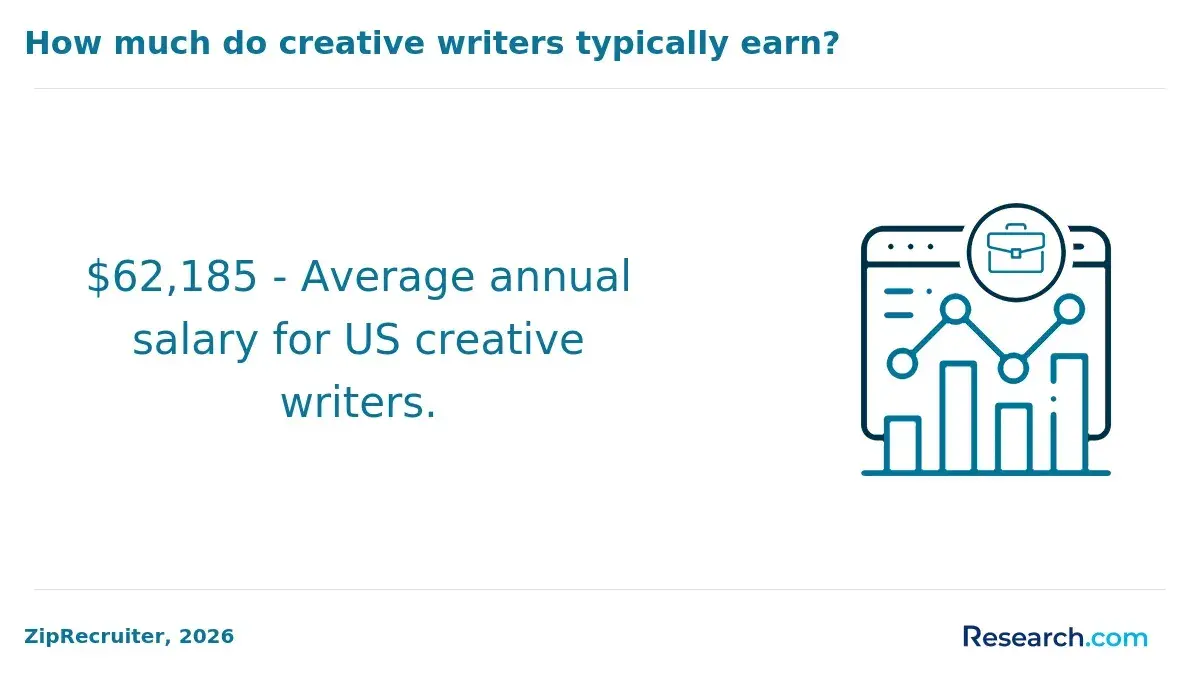
- Salary potential: According to Zippia, a creative writer can make around $73,095 per year on average, but pay varies widely by field and location.
What financial aid opportunities are available for creative writing master's degree students?
Financial aid can make a creative writing master’s degree more realistic, but students should compare aid carefully. A generous scholarship at a high-cost program may still leave more debt than a lower-cost public or online option. Your goal should be to reduce borrowing while preserving program quality.
- Scholarships and fellowships: These may be awarded for writing talent, academic merit, financial need, identity-based eligibility, genre focus, or artistic promise.
- Graduate assistantships: Some programs offer teaching, editorial, administrative, or research assistantships that may include compensation or tuition support.
- Grants: Grants may come from institutions, arts organizations, public agencies, or private foundations.
- Federal financial aid: Eligible students can explore federal aid options through accredited institutions. Students seeking flexible programs may compare online accredited colleges that accept financial aid.
- Employer support: Communications, education, nonprofit, or corporate employees may be able to use tuition benefits if the degree supports their role.
- Part-time enrollment: Studying part time may help students keep working and reduce the need for loans, though it can extend the time to completion.
How can supplementary online education enhance career prospects?
Creative writing graduates often become more employable when they add targeted online training in practical areas such as digital marketing, SEO, instructional design, editing, analytics, project management, fundraising, multimedia production, or communications technology. These skills help translate literary talent into employer-ready capabilities.
Adult learners who want to broaden their options without committing immediately to another full graduate program can explore online degree programs for adults and related flexible learning pathways. The best supplementary education is specific: choose a course or credential because it supports a defined career move, not because it looks broadly useful.
What emerging trends are shaping creative writing master's degree careers?
Creative writing careers are being reshaped by digital publishing, remote collaboration, AI tools, multimedia storytelling, creator platforms, brand storytelling, and the demand for clear communication across organizations. Graduates who understand both craft and digital distribution may have more options than writers who prepare only for traditional literary publishing.
- Digital-first publishing: Writers increasingly create for websites, newsletters, online magazines, podcasts, video scripts, interactive formats, and social platforms.
- Hybrid creative-commercial roles: Employers often seek writers who can combine voice and storytelling with brand strategy, audience research, and measurable content goals.
- Remote and freelance work: Because 66% of writers and authors are self-employed, graduates should understand contracts, rates, pitching, taxes, client communication, and portfolio marketing.
- AI-assisted workflows: Writers may be expected to use editing, research, or productivity tools responsibly while maintaining originality and ethical standards.
- Interdisciplinary media careers: Creative nonfiction, journalism, and digital storytelling increasingly overlap. Students comparing media paths may find it useful to ask is journalism a good major and how journalism training differs from creative writing.
What do employers expect from creative writing graduates?
Employers usually do not hire creative writing graduates for the degree title alone. They look for evidence that the candidate can write for a real audience, meet deadlines, revise quickly, accept feedback, collaborate with subject-matter experts, and adapt tone to the organization’s goals.
| Employer expectation | How to demonstrate it |
| Strong writing samples | Create a portfolio with samples tailored to the role, such as articles, edited pages, grant narratives, campaign copy, scripts, or teaching materials. |
| Audience awareness | Explain who each piece was written for and why you made specific tone and structure choices. |
| Revision ability | Show before-and-after examples or discuss how feedback improved a project. |
| Digital competence | List relevant tools, platforms, content management systems, analytics exposure, or multimedia experience. |
| Collaboration | Highlight workshops, internships, editorial teams, client projects, teaching, or cross-functional work. |
| Professional focus | Connect your creative background to the employer’s actual needs, not just your personal passion for writing. |
Students still comparing academic fields can use a broader college majors list and careers resource to see how writing-intensive majors compare with business, education, media, and technology-oriented options.
How can supplementary academic credentials enhance creative writing career growth?
Supplementary credentials can help creative writing graduates compete for roles that require more than literary skill. A short credential in digital marketing may help a copywriter. Coursework in nonprofit management may help a grant writer. Training in instructional design may help a writing teacher or curriculum developer. A publishing certificate may help an editor.
Some graduates may also pursue lower-cost credentials to add breadth without taking on another expensive degree. For example, a cheap associate degree online may make sense for students who want structured study in a complementary field, provided the credential supports a realistic career goal.
What quality standards ensure a valuable creative writing master's degree?
A creative writing master’s degree is valuable only if the program provides serious craft development, credible instruction, useful feedback, and career-relevant opportunities. Do not choose a program based only on reputation, speed, convenience, or a beautiful course catalog.
| Quality standard | What to check | Why it matters |
| Institutional accreditation | Confirm the school is properly accredited. | Accreditation can affect financial aid, transferability, employer recognition, and future study. |
| Faculty fit | Review faculty publications, genres, teaching areas, and mentorship availability. | Your strongest growth often comes from mentors who understand your genre and goals. |
| Workshop structure | Ask about class size, feedback expectations, workshop frequency, and revision requirements. | Graduate writing education depends heavily on the quality of critique and revision. |
| Career support | Ask about internships, teaching opportunities, alumni networks, visiting writers, and portfolio advising. | Career outcomes depend on experience and connections as well as coursework. |
| Completion flexibility | Compare online, campus, low-residency, full-time, and part-time formats. | The best program is one you can afford, attend consistently, and complete. |
If you are comparing graduate options across fields, resources on the easiest masters degrees online can provide context, but ease should not be your primary standard. For creative writing, the better question is whether the program will produce stronger work, a better portfolio, and clearer career options.
What additional advanced qualifications can further boost your creative writing career?
Additional advanced qualifications may help if they directly support your career objective. A teaching-focused graduate certificate can help aspiring instructors. A publishing or editing certificate can help editorial candidates. A doctoral pathway may be relevant for some academic careers, research-intensive roles, or leadership positions in higher education.
Some students researching advanced study also compare accelerated doctoral options such as 1 year online doctoral programs. Before pursuing any doctoral or advanced credential, ask whether it is required, preferred, or simply optional for your target role. More education is not automatically better if it increases debt without improving employability.
What are the challenges facing creative writing master's degree graduates?
Creative writing graduates face several practical challenges: competitive literary markets, limited full-time academic openings, freelance income instability, changing publishing models, and employer expectations for digital skills. These challenges do not make the degree useless, but they do mean students should plan early and build flexible career options.
| Challenge | Why it matters | Better strategy |
| Income uncertainty | Freelance and literary work may not provide steady pay. | Develop a mix of creative, commercial, teaching, editing, or grant-writing income streams. |
| Competitive publishing market | Publication depends on quality, timing, fit, persistence, and market conditions. | Build a submission plan, seek feedback, and learn publishing norms early. |
| Limited academic roles | Teaching jobs can be competitive, especially for full-time or tenure-track positions. | Gain teaching experience, publish, develop pedagogy skills, and understand hiring requirements. |
| Technology shifts | AI and digital platforms are changing writing workflows and employer expectations. | Learn ethical AI use, content tools, digital publishing, and multimedia basics. |
| Degree-to-career translation | Employers may not immediately understand how literary training applies to business needs. | Describe your skills in terms of audience, clarity, strategy, editing, research, and outcomes. |
Some graduates increase resilience by adding practical credentials or exploring alternative programs, including degrees you can get online that pay well, when their long-term goals require stronger technical, business, education, or healthcare-related skills.
What is the future outlook for creative writing master's degree careers?
The outlook for creative writing master’s degree careers is mixed but not bleak. Employment for writers and authors is expected to grow by 4% from 2024 to 2034, and writing remains essential in education, media, publishing, nonprofit work, marketing, and organizational communication. However, the strongest opportunities may go to graduates who combine strong writing with digital fluency, professional experience, and a clear niche.
Future-oriented writers should prepare for careers that blend traditional craft with new formats: digital essays, branded storytelling, long-form content, scripts, interactive media, newsletters, podcasts, social campaigns, and educational content. Some professionals also pursue complementary credentials, including options such as the fastest online associate's degree, when they need practical training in a second field.
What are the most effective career advancement strategies for creative writing master's degree graduates?
Advancement usually comes from visible work, strong relationships, strategic specialization, and continuous improvement. The degree can help open doors, but career growth depends on how you use it after graduation.
- Build a role-specific portfolio. Create separate sample sets for editing, grant writing, copywriting, teaching, journalism, or creative publication instead of relying on one general portfolio.
- Publish or present consistently. Submit work, pitch essays, participate in readings, present at conferences, or contribute to relevant professional communities.
- Gain applied experience. Internships, assistantships, freelance projects, tutoring, editorial work, and volunteer grant writing can convert academic skills into evidence.
- Find mentors. Faculty, editors, senior writers, nonprofit leaders, alumni, and conference contacts can help you understand expectations and avoid avoidable mistakes.
- Learn adjacent skills. SEO, analytics, social media strategy, pedagogy, design basics, fundraising, and content management can make a writer more employable.
- Network with purpose. Join writing organizations, attend literary events, participate in workshops, and stay connected with alumni and faculty.
- Evaluate further education carefully. A credential such as a cheapest doctorate degree online may be worthwhile for certain academic goals, but it should be weighed against cost, time, and actual hiring requirements.
Common mistakes to avoid when choosing a creative writing master’s program or career
The biggest mistake is treating a creative writing master’s degree as a single-purpose credential. It can support several careers, but only if students make intentional choices about program fit, portfolio development, cost, and professional experience.
| Mistake | Why it can hurt you | Better approach |
| Choosing a program without checking accreditation | Accreditation can affect financial aid, transfer options, employer recognition, and future study. | Verify institutional accreditation before applying or enrolling. |
| Focusing only on tuition | A cheaper program may still be a poor value if it lacks mentoring, workshops, career support, or completion flexibility. | Compare total cost, aid, assistantships, faculty access, outcomes, and student support. |
| Assuming the degree guarantees publication | Publishing success depends on craft, revision, persistence, market fit, and professional strategy. | Use the program to build a manuscript, receive critique, understand publishing, and create a submission plan. |
| Ignoring employable writing skills | Literary skill alone may not be enough for communications, content, grant, or marketing roles. | Add samples and training in editing, digital tools, SEO, fundraising, teaching, or media production. |
| Relying only on rankings | A highly ranked program may not fit your genre, schedule, budget, or career goal. | Compare faculty fit, workshop model, funding, format, internships, and alumni paths. |
| Assuming all online programs are equal | Online programs differ in interaction, feedback quality, residency requirements, and support. | Ask how workshops operate, how often students meet faculty, and what career services online students receive. |
| Waiting until graduation to think about work | Building a portfolio, network, and experience takes time. | Start internships, submissions, freelance projects, teaching experience, or editorial work during the program. |
Key Insights
- A master’s in creative writing is most valuable when it produces stronger writing, a sharper portfolio, professional experience, and a clearer career direction—not simply another credential.
- Career outcomes differ sharply. Communications, editing, grant writing, teaching, and copywriting may offer more structured employment paths, while authorship and freelance work often require entrepreneurial planning.
- Salary data should be interpreted cautiously. MFA Creative Writing degree holders report an average annual salary of approximately $64,000, but earnings vary by role, location, employer type, gender, experience, and portfolio strength.
- Cost matters. With a typical creative writing master’s degree cost around $71,140, students should compare total price, aid, assistantships, format, and likely career use before enrolling.
- AI is now part of the writing landscape. Graduates should learn to use AI ethically for support while protecting originality, voice, research accuracy, and academic integrity.
- The best program is not always the fastest, cheapest, or most famous. The strongest choice is the one that fits your genre, budget, schedule, faculty needs, and target career.
- Students should begin career preparation early by completing internships, building tailored writing samples, publishing or pitching work, networking, and learning adjacent skills such as digital publishing, content strategy, grant writing, or teaching.
What do graduates say about their creative writing master's degree careers?
- My graduate program helped me become a more deliberate storyteller and gave me the confidence to complete and publish my first novel. The workshop model pushed me to revise deeply, and the writing community became one of the most valuable parts of the experience. Emma
- The degree gave me access to teaching opportunities and introduced me to writers whose feedback changed the way I approach my work. I learned how to treat writing as both an art and a profession without losing my own voice. Earl
- Graduate study expanded the way I think about craft and gave me practical tools for working through creative blocks. Faculty mentorship helped me turn early ideas into polished projects, which made the program personally and professionally meaningful. Leonne
References:
- College Board. (n.d.). Poets, lyricists and creative writers. BigFuture | College Board.
- Glassdoor. (2024, June 6). How much does a copywriter make? Glassdoor.com.
- Glassdoor. (2024, June 6). How much does a grant writer make? Glassdoor.com.
- Glassdoor. (2024, June 6). How much does a professor in creative writing make? Glassdoor.com.
- NACE. (2024). First destinations for the college class of 2024. National Association of Colleges and Employers.
- Salary.com. (2025, January 1). Communications specialist salary. Salary.com.
- U.S BLS. (2025, August 28). Occupational Outlook Handbook: Librarians and library media specialists. U.S. Bureau of Labor Statistics.
- U.S. BLS. (2024, April 3). 27-3041 Editors. U.S. Bureau of Labor Statistics.
- U.S. BLS. (2025, August 28). Occupational Outlook Handbook: News analysts, reporters, and journalists. U.S. Bureau of Labor Statistics.
- U.S. BLS. (2025, August 28). Occupational Outlook Handbook: Postsecondary teachers. U.S. Bureau of Labor Statistics.
- U.S. BLS. (2025, August 28). Occupational outlook handbook: Writers and authors. U.S. Bureau of Labor Statistics.
- U.S. BLS. (2025, August 28). Writers and authors: Work environment. U.S. Bureau of Labor Statistics.
- Zippia. (2025, January 8). Creative writer demographics and statistics in the US. Zippia.com.
Other Things You Should Know About Creative Writing Master's Degree Careers
Yes. Most programs require a writing sample of 10 to 30 pages, often in poetry, fiction, or nonfiction. Applicants usually also submit a statement of purpose and two letters of recommendation, and some schools ask for a 2.75 to 3.0 undergraduate GPA.
In 2027, in-demand industries for those with a Creative Writing Master’s Degree include digital content creation, marketing, entertainment, advertising, and publishing. As storytelling becomes essential across digital platforms, skills in creative writing can be pivotal in these sectors.