2027 Best Online Master’s in Creative Writing Degree Programs

Co-Founder and Chief Data Scientist
An online master's in creative writing is for writers who want structured feedback, advanced craft training, and a stronger professional portfolio without relocating or pausing work. The decision is not simply whether you enjoy writing. It is whether graduate study will help you produce better work, build useful industry connections, qualify for teaching or editorial roles, and justify the cost and time commitment.
This guide explains how online creative writing master's programs are structured, what they cost, how long they take, which careers they can support, and how to compare programs before applying. It is designed for prospective MFA, MA, and professional writing students who want a practical, decision-focused view of the degree.
Quick Answer: Is an Online Master's in Creative Writing Worth Considering?
An online master's in creative writing can be worth considering if you want intensive writing workshops, faculty mentorship, a thesis or publishable manuscript, and flexibility to study from home. It is most useful for students who already write consistently and want to improve their craft, move into writing-adjacent careers, teach in some settings, or build a professional portfolio. It may not be the best investment if you expect the degree alone to guarantee publication, literary representation, or a high salary.
What are the benefits of getting an online master's in creative writing degree?
- Career flexibility: Graduates can apply advanced writing and editing skills in publishing, content strategy, advertising, communications, media, education, and freelance work. Common roles include author, content writer, editor, copywriter, screenwriter, and technical writer.
- Earning potential varies by role: Writers and authors earn a median annual salary of around $72,270 in 2025, while writers in specialized areas such as the information industry have a median salary of approximately $73,070 per year. Content strategists and marketing writers may earn more depending on experience, portfolio quality, and industry.
- Flexible learning format: Many online master’s in creative writing programs combine synchronous and asynchronous coursework. Students may complete readings and assignments on their own schedule while joining live workshops, video discussions, or faculty conferences.
What can I expect from an online master's in creative writing degree?
An online master's in creative writing usually combines craft study, literature analysis, genre workshops, peer critique, and a culminating thesis or capstone. The degree is less about passive reading and more about producing, revising, and defending creative work under faculty and peer review.
| Program Feature | What It Usually Means for Students |
| Curriculum | Students typically take core courses in narrative craft, literary analysis, character development, revision, and workshop practice, along with electives in genres such as fiction, nonfiction, poetry, screenwriting, or digital storytelling. |
| Tuition Costs | Total tuition for an online master's in creative writing degree commonly ranges from $10,000 to $35,000. Public universities may cost less for in-state students, while private institutions may have higher tuition but more institutional aid options. |
| Program Length | Most programs take 18 months to 3 years, depending on whether the student enrolls full-time, part-time, or in an accelerated format. |
| Final Requirement | Many programs end with a thesis, manuscript, portfolio, or capstone project that demonstrates sustained creative work and revision. |
Where can I work with an online master's in creative writing degree?
Graduates can work wherever organizations need strong storytelling, editing, audience awareness, and clear communication. Traditional paths include publishing, book editing, literary agencies, magazines, and media production. Digital-first paths include content marketing, social media storytelling, brand strategy, copywriting, and web publishing.
Creative writing graduates may also work in entertainment as screenwriters, script readers, content developers, or story consultants. In business settings, they may create campaign copy, speeches, executive communications, newsletters, donor materials, or long-form thought leadership content.
Education is another option, especially for graduates interested in teaching writing at community programs, workshops, nonprofit organizations, or some college-level settings. Students comparing writing with broader communication studies may also ask how easy a communications major is because both fields develop audience-centered messaging, persuasion, and storytelling skills.
Freelancing remains common in writing careers. Freelance writers may combine ghostwriting, journalism, editing, blogging, book coaching, and branded content. This path offers flexibility but requires business development, pricing discipline, client management, and a reliable portfolio.
How much can I make with an online master's in creative writing degree?
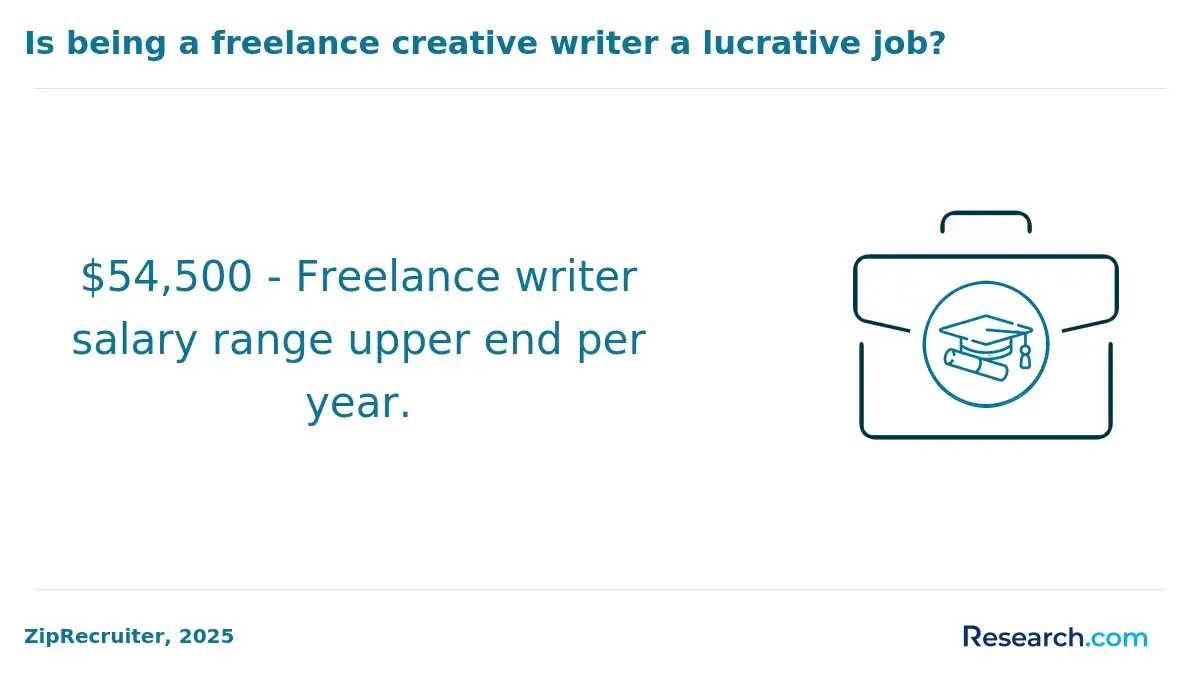
According to the BLS, writers and authors earn a median annual salary of around $73,000. Writers in religious, grantmaking, civic, professional, and similar organizations received a salary of $61,140. Freelance income is more unpredictable because earnings depend on project volume, rates, client type, and specialization.
Creative writing careers can have wide income ranges. Screenwriting and publishing can be financially rewarding for successful writers, but those outcomes often depend on persistence, reputation, representation, timing, and professional networks. Creative writing instructors can expect to earn between $66,000 and $75,000 annually, while roles in corporate communications, grant writing, and content strategy can offer salaries in the $77,000 to $90,000 range.
| Career Direction | Income Consideration |
| Author, novelist, or screenwriter | Potential earnings can be high, but income may be inconsistent and competitive. |
| Editor or publishing professional | Income often depends on employer type, experience, and whether the role is staff-based or freelance. |
| Content writer, copywriter, or strategist | Corporate and marketing roles may provide steadier income than literary publication alone. |
| Creative writing instructor | Teaching income can vary by institution type, appointment status, and experience. |
- Best Online Master's in Creative Writing Degree Programs for 2027
- How long does it take to complete an online master's in creative writing degree?
- How does an online master's in creative writing degree compare to an on-campus program?
- What is the average cost of an online master's in creative writing degree?
- What are the financial aid options for students enrolling in a master's in creative writing degree?
- What are the prerequisites for enrolling in a master's in creative writing degree?
- What courses are typically in a master's in creative writing degree?
- What types of specializations are available in master's in creative writing degrees?
- How do you choose the best online master's in creative writing degree?
- What career paths are available for graduates of master's in creative writing degrees?
- How can additional certifications boost my creative writing career?
- What is the job market for graduates with master's in creative writing degrees?
- What challenges might I face in an online master's in creative writing program?
- How can I streamline the application process for online creative writing programs?
- Are online graduate certificates a cost-effective way to enhance creative writing skills?
- What emerging trends are shaping online creative writing degrees?
- Is an online master's in creative writing degree a worthwhile investment?
- Can accelerated pathways enhance your online creative writing education?
- Can a doctoral degree further advance your creative writing career?
- Can I earn my creative writing master's quickly without sacrificing quality?
- What accreditation and faculty credentials should I look for in an online master's in creative writing program?
- How can online creative writing programs bolster professional networking and mentorship?
Best Online Master's in Creative Writing Degree Programs for 2027
How do we rank schools?
Research.com reviews online master's in creative writing programs using data from trusted education sources, including the IPEDS database, Peterson's Distance Learning Licensed Data Set, College Scorecard database, and the National Center for Education Statistics.
Readers who want more detail on how programs are evaluated can review the Research.com methodology, which explains the data collection and analysis process.
1. Bay Path University, MFA in Creative Nonfiction Writing
Bay Path University offers a fully online MFA in Creative Nonfiction Writing focused on voice, style, literary craft, and narrative development. The program emphasizes diversity, equity, inclusion, and belonging, and students complete a 100-120-page thesis.
- Program Length: Varies
- Track/Concentration: Publishing, Teaching Creative Writing, Narrative Medicine
- Cost: $795 oer credit
- Required Units: 39
- Accreditation: New England Association of Schools and Colleges, Inc.
2. Lindenwood University, MFA in Writing
Lindenwood University provides an online MFA in Writing with workshops, craft classes, literature study, and individualized faculty feedback. The program can be completed fully online and does not require a residency.
- Program Length: Approximately 2 years
- Tracks/Concentrations: Fiction, Creative Nonfiction, Poetry, Young Adult & Middle-Grade Writing
- Cost: $561 per credit hour
- Required Units: 48
- Accreditation: Higher Learning Commission (HLC)
3. Fairfield University, MFA in Creative Writing
Fairfield University offers a low-residency MFA in Creative Writing with bi-annual residencies that connect students with faculty, guest writers, editors, agents, and peers. Students may pursue dual concentrations or add focused study in areas such as editing and publishing or literary health and healing.
- Program Length: 2 years
- Track/Concentration: Poetry, Fiction, Creative Nonfiction, Screenwriting, and more
- Tuition: $765 per credit hour; additional residency fee of $1,265 per residency
- Required Credits: 60
- Accreditation: New England Commission of Higher Education (NECHE)
4. Harvard Extension School, Master of Liberal Arts (ALM) in Creative Writing and Literature
Harvard Extension School offers an ALM in Creative Writing and Literature that is available online with an on-campus requirement. Students study multiple genres through writing workshops and literature courses and must complete 12 courses, including a thesis.
- Program Length: Varies
- Track/Concentration: Creative Writing and Literature
- Tuition: $3,340 per course
- Required Units: 48
- Accreditation: NECHE
5. University of Texas at El Paso, MFA in Creative Writing
The University of Texas at El Paso offers a fully online MFA in Creative Writing with study in fiction, poetry, or nonfiction. It is the world's only bilingual master's in creative writing program, taught in English and Spanish, and courses are led by faculty who are published authors.
- Program Length: 3 years
- Tracks/Concentrations: Fiction, Poetry, Nonfiction
- Estimated Total Cost: $490 per credit hour
- Required Credits: 48
- Accreditation: Southern Association of Colleges and Schools Commission on Colleges (SACSCOC)
6. University of Nebraska Omaha, MFA in Writing
The University of Nebraska Omaha offers a low-residency MFA in Writing that blends online coursework with bi-annual residencies. The program uses mentorship-based study plans and includes 16 weeks of virtual writing seminars and 5 10-day conference-style Nebraska residency sessions. Students comparing institution profiles should note that this listing is separate from Mercy University.
- Program Length: 2 years
- Tracks/Concentrations: Fiction, Creative Nonfiction, Poetry, Young Adult Fiction
- Estimated Tuition: Starts at $375
- Required Units: 60
- Accreditation: HLC
7. University of Houston-Victoria, MFA in Creative Writing
The University of Houston-Victoria offers a fully online MFA in Creative Writing built around workshops, literature study, poetics, creative development, critique, and publication. Students complete a thesis project as part of the degree.
- Program Length: 2-3 years
- Track/Concentration: Fiction, Creative Nonfiction, Poetry
- Cost: Starts at $503.04
- Required Units: 36
- Accreditation: HLC
8. University of Denver, MA in Professional Creative Writing
The University of Denver offers an online MA in Professional Creative Writing for students preparing for professional writing roles across genres. The program uses an asynchronous, hybrid online format and includes core courses, concentration coursework, electives, and a capstone project.
- Program Length: As few as 18 months
- Tracks/Concentrations: Professional Creative Nonfiction Writing, Professional Dramatic Writing, Professional Fiction Writing, Professional Poetry Writing
- Estimated Tuition: $835 per credit hour
- Required Credits: 48 credit hours
- Accreditation: HLC
9. Mount St. Mary's University, MFA in Creative Writing
Mount Saint Mary's University in Los Angeles offers an MFA in Creative Writing for students who want to write professionally in novels, short stories, playwriting, poetry, screenwriting, or nonfiction. The program is available through weekend, hybrid, and fully online formats and includes workshops, literary theory, humanities and film electives, and a thesis project.
- Program Length: 2 years
- Tracks/Concentrations: Novel, Poetry, Writing for Screen & Television, Nonfiction, Playwriting
- Tuition: No information available
- Required Credit: 36
- Accreditation: WASC Senior College and University Commission (WSCUC)
10. Queens University of Charlotte, MFA in Creative Writing
Queens University of Charlotte offers a low-residency MFA in Creative Writing that combines distance learning with two annual in-person residencies in Charlotte or Latin America. Students can study writing for the page, stage, and screen while receiving faculty support and post-graduation resources.
- Program Length: 2 years
- Tracks/Concentrations: Fiction, Creative Nonfiction, Poetry, Writing for Stage & Screen
- Tuition: $815 per credit hour
- Required Credit: 52
- Accreditation: SACSCOC
How long does it take to complete an online master's in creative writing degree?
Most online master's in creative writing degrees take 18 months to 3 years. Full-time students commonly finish in about two years, especially in programs with a fixed course sequence, regular workshops, and a thesis or capstone. Some accelerated options resemble the pacing found in an accelerated communication degree, allowing highly focused students to finish in as little as 12 to 18 months.
Part-time students may need three years or more, particularly if they work full-time, manage family responsibilities, or choose a program with residencies. Before applying, check whether required workshops are offered every term and whether thesis advising can be completed on your schedule.
How does an online master's in creative writing degree compare to an on-campus program?
Online and on-campus creative writing master's programs can cover similar academic material, but the learning experience differs. Online programs are often better for working adults, students who cannot relocate, and writers who prefer flexible scheduling. On-campus programs may suit students who want face-to-face workshops, campus literary events, and frequent in-person interaction.
| Factor | Online Master's in Creative Writing | On-Campus Master's in Creative Writing |
| Schedule | Often more flexible, especially with asynchronous coursework | Usually follows set class times and campus schedules |
| Workshop Experience | Uses discussion boards, video meetings, digital annotations, and virtual peer critique | Centers on in-person workshop discussion and campus-based critique groups |
| Networking | Can connect students across regions through online communities and residencies | Provides local literary events, campus readings, and face-to-face mentorship |
| Costs Beyond Tuition | May reduce relocation and commuting costs but can include technology fees or residency travel | May require housing, transportation, meal plans, and other campus-based expenses |
| Best Fit | Self-directed writers who need flexibility | Students who want a highly immersive campus writing community |
A recent report has broken down the room and board costs between public and private institutions.
What is the average cost of an online master's in creative writing degree?
The average total cost of an online master’s in creative writing degree typically ranges from $10,000 to $35,000. The final price depends on the school, credit requirements, tuition rate, residency status, and whether the program includes travel-based residencies.
Tuition is only part of the cost. Students should also budget for technology fees, books, course materials, application fees, thesis expenses, and any required campus or low-residency sessions. Some universities offer online tuition discounts, fellowships, assistantships, or tuition waivers, but availability varies by program.
What are the financial aid options for students enrolling in a master's in creative writing degree?
Creative writing graduate students may use a mix of scholarships, grants, fellowships, assistantships, employer tuition benefits, and federal aid if eligible. Students focused on affordability can also compare program-level pricing through resources on the cheapest online creative writing degree options.
- Fulbright U.S. Student Program: Fulbright offers opportunities across academic fields for graduating college students, graduate students, and young professionals who pursue graduate study, research, or English teaching abroad.
- Paul & Daisy Soros Fellowships for New Americans: This fellowship supports immigrants and children of immigrants in the U.S. and funds one to two years of full-time graduate study in any field and any advanced degree-granting program.
- American Association of University Women (AAUW) Dissertation Fellowship: AAUW supports women pursuing higher education by helping offset expenses during the final dissertation year, with preference for research related to gender issues.
- East-West Center Graduate Degree Fellowship: The East-West Center provides graduate degree fellowships for students from Asia, the Pacific, and the U.S. who participate in educational and research programs at the University of Hawai‘i. Support can include tuition and fees, housing, and a living stipend.
What are the prerequisites for enrolling in a master's in creative writing degree?
Admissions requirements vary, but most creative writing graduate programs care deeply about the writing sample. A strong manuscript can matter more than a perfectly traditional academic background.
- Bachelor's degree: Most programs require a bachelor's degree from an accredited institution. English, creative writing, communications, and literature are common backgrounds, but applicants from fast track college programs or unrelated majors may be considered if their writing sample is strong.
- Writing sample: Applicants usually submit fiction, poetry, nonfiction, screenwriting, or another genre sample that shows voice, originality, structure, and command of language.
- Statement of purpose: This essay should explain why you want graduate study, what you write, which faculty or genres interest you, and how the program connects to your goals.
- GPA and test scores: Many programs look for a minimum undergraduate GPA, typically around 3.0. Some may request GRE scores, though many creative writing programs now emphasize portfolio review instead.
- Professional experience: Published work, editorial experience, journalism, teaching, marketing, or content creation can strengthen an application. Applicants also comparing adjacent fields may review online master's in communications programs to understand broader communication-focused graduate options.
What courses are typically in a master's in creative writing degree?
A master's in creative writing curriculum helps students understand craft, read like writers, revise with intention, and develop a polished body of work. Courses vary by program, but many include the following areas.
- Fiction Writing: Students practice plot, point of view, character, dialogue, pacing, scene design, and revision for short fiction or novels.
- Poetry Writing: Coursework may cover poetic form, sound, image, lineation, voice, and contemporary poetic traditions.
- Nonfiction Writing: Students study memoir, essays, literary journalism, and creative nonfiction techniques that combine factual accuracy with narrative craft.
- Screenwriting: This course introduces screenplay structure, dialogue, scene formatting, visual storytelling, and industry expectations for film or television scripts.
- Writing for Digital Media: Students learn how writing changes across blogs, online publications, social media, multimedia platforms, and search-driven content environments.
What types of specializations are available in master's in creative writing degrees?
Specializations help students build deeper expertise in a genre or professional writing niche. The best choice depends on what you want to produce after graduation and which audiences you hope to reach.
- Creative Nonfiction: Focuses on factual storytelling through memoir, personal essays, travel writing, biography, and narrative nonfiction.
- Speculative Fiction: Covers science fiction, fantasy, horror, world-building, genre conventions, and writing for highly engaged niche audiences.
- Nonfiction Writing: Emphasizes memoir, personal essays, biography, history-based writing, and narrative journalism. Students interested in history-centered careers may also explore the best careers to pursue with an history masters when pairing historical expertise with literary nonfiction.
- Children’s and Young Adult (YA) Literature: Trains students to write for younger audiences with attention to age-appropriate voice, theme, pacing, and reader expectations.
- Genre Fiction: Focuses on categories such as romance, mystery, thriller, and historical fiction, including audience expectations and market conventions.
How do you choose the best online master's in creative writing degree?
The best online creative writing master's program is the one that fits your genre, budget, schedule, mentorship needs, and professional goals. Rankings can help you build a shortlist, but the final decision should be based on fit.
| Question to Ask | Why It Matters |
| Is the institution accredited? | Accreditation affects academic credibility, transferability, employer recognition, and financial aid eligibility. |
| Does the program support my genre? | A strong poetry program may not be ideal for a screenwriter, and a literary fiction program may not fit a genre fiction writer. |
| Who teaches the workshops? | Faculty publishing records, editorial experience, and mentorship style can shape your development. |
| Are classes synchronous or asynchronous? | Live workshops can build community, while asynchronous courses may be easier for students with demanding schedules. |
| Are residencies required? | Residencies can be valuable, but travel, lodging, and time away from work can add cost. |
| What does the thesis or capstone require? | The final project should help you build a manuscript, portfolio, or professional writing sample that supports your goals. |
- Accreditation: Choose an institution accredited by a recognized accrediting agency. Also review whether the program is connected to professional communities such as the Association of Writers & Writing Programs (AWP).
- Curriculum and Specializations: Look for workshops, literature courses, and electives aligned with your writing goals.
- Program Flexibility: Confirm whether the program is full-time, part-time, asynchronous, or cohort-based. Students exploring very short online options may also ask, "What degree can I get online in 6 months?" although graduate creative writing programs usually require a deeper time commitment.
- Residency Requirements: If a program includes in-person residencies, calculate travel, housing, food, and time away from work.
- Technology and Learning Resources: Review the learning platform, online library access, digital workshop tools, tutoring, writing center access, and career support.
Common mistakes to avoid when choosing a program
- Choosing a program because of name recognition without checking whether faculty teach your genre.
- Comparing tuition only and ignoring fees, residency travel, books, and lost work time.
- Assuming an online MFA will automatically lead to publication, an agent, or a teaching job.
- Ignoring accreditation or institutional reputation.
- Applying with a rushed writing sample instead of revising it carefully.
- Relying only on rankings instead of speaking with admissions staff, current students, or alumni when possible.
What career paths are available for graduates of master's in creative writing degrees?
A creative writing master's degree can support careers in writing, editing, publishing, education, marketing, media, and communications. The strongest outcomes usually come from pairing the degree with a polished portfolio, internships or freelance work, and a clear professional niche.
Students can also review the best jobs for creative writing masters degree holders to compare writing-related career options.
- Author or Novelist: Writers may produce novels, short stories, memoirs, essays, or hybrid works for traditional publishing or self-publishing. Authors who want to control visual branding may also explore how to become a graphic designer to better understand layout, cover design, and visual storytelling.
- Screenwriter: Screenwriters develop scripts for film, television, streaming, and digital media, often working with producers, studios, agencies, or independent collaborators.
- Content Writer: Content writers create articles, blog posts, website copy, newsletters, and social media content for brands, agencies, publishers, and organizations.
- Editor: Editors improve manuscripts, articles, web content, academic materials, or marketing copy through developmental editing, line editing, proofreading, and style review.
- Copywriter: Copywriters produce persuasive messaging for advertising, product pages, campaigns, email marketing, and corporate communications.
How can additional certifications boost my creative writing career?
Certifications can make a creative writing graduate more competitive by adding marketable skills that are not always central to an MFA or MA curriculum. Useful areas may include copyediting, digital marketing, SEO writing, UX writing, grant writing, technical communication, instructional design, or multimedia storytelling. Students who want shorter, skill-specific training can compare online certification programs that align with their target roles.
What is the job market for graduates with master's in creative writing degrees?
The job outlook for graduates with an online master's in creative writing degree is 4% from 2024 to 2034. Opportunities exist in publishing, media, education, marketing, entertainment, nonprofit work, and corporate communications, though competition can be intense for traditional literary roles.
Demand for strong writing remains especially relevant in digital content, brand storytelling, copywriting, and technical communication. Students interested in teaching can also compare creative writing study with an online school for teaching degree, since some education roles require specific teaching credentials beyond a writing degree.
What challenges might I face in an online master's in creative writing program?
Online creative writing programs require independence. Students must keep up with reading, critique deadlines, revision schedules, and thesis milestones without the routine of a physical classroom. Common challenges include isolation, inconsistent peer engagement, limited spontaneous conversation, and the need to learn digital workshop tools.
Some students prefer a tighter structure, such as a 1 year masters program, because shorter timelines can create urgency. However, faster is not always better for creative work. Writers need time to draft, receive feedback, revise, and rethink major projects.
How can I streamline the application process for online creative writing programs?
Start by building a spreadsheet of deadlines, required genres, writing sample page limits, recommendation requirements, transcripts, fees, and residency expectations. Then revise your writing sample for each program's emphasis. A literary nonfiction program, a screenwriting program, and a poetry program may require very different submissions.
Applicants can reduce friction by preparing transcripts early, requesting recommendations well before deadlines, and using resources such as free online college applications when cost is a concern. The writing sample should receive the most time because it is often the clearest evidence of readiness for graduate-level creative work.
Can I earn my creative writing master's quickly without sacrificing quality?
Yes, some students can complete an online creative writing master's quickly and still receive a strong education, but only if the program preserves meaningful workshop time, faculty feedback, revision cycles, and thesis support. A compressed timeline should not remove the parts of the degree that make it valuable.
Before choosing an accelerated option, compare course load, mentorship availability, thesis expectations, and alumni outcomes. Students researching fast academic pathways can also review broader resources on the quickest online degree, but creative writing students should be cautious about programs that move too quickly for serious manuscript development.
What accreditation and faculty credentials should I look for in an online master's in creative writing program?
Choose a program offered by an institution accredited by a recognized accrediting agency. Accreditation supports institutional credibility and may affect financial aid, transfer options, employer perception, and future doctoral study.
Faculty credentials also matter. Review instructors' published books, journal credits, screenwriting experience, editing background, awards, teaching history, and genre expertise. A strong program should make faculty information easy to find. Students comparing graduate credentials more broadly may also review top paying master's degrees, though creative writing outcomes depend heavily on portfolio, specialization, and market strategy.
How can online creative writing programs bolster professional networking and mentorship?
Strong online programs create community through virtual workshops, visiting writer events, webinars, online readings, peer critique groups, alumni networks, and faculty mentorship. Low-residency programs may add in-person intensives where students meet agents, editors, authors, and classmates.
Networking should be practical, not just social. Look for programs that help students submit work, build portfolios, understand publishing pathways, enter contests, explore teaching opportunities, or connect creative writing with adjacent fields. Students comparing online learning formats across disciplines may also review easy degrees, but creative writing success depends less on ease and more on sustained revision, feedback, and professional persistence.
What do graduates say about online master's in creative writing programs?
-
: "
"Studying for my master’s in creative writing online allowed me to pursue my passion without sacrificing my career or personal commitments. The flexibility of the program let me balance my writing projects while learning from experienced faculty and engaging with a diverse community of writers worldwide. The online format provided valuable resources and support that helped me refine my craft and build a strong portfolio." – Sonny
"
-
: "
"Completing my creative writing degree online was an incredible experience that pushed me to grow both creatively and professionally. The interactive workshops and constructive peer feedback helped me develop my storytelling skills, and I loved being able to connect with writers from different backgrounds and perspectives. The convenience of learning from home while receiving top-notch mentorship was truly invaluable." – Rob
"
-
: "
"I was initially unsure about pursuing an online master's in creative writing, but the program exceeded my expectations in every way. The structured yet flexible curriculum allowed me to work at my own pace while gaining insights into different writing genres and industry trends. Studying online gave me the freedom to explore my creativity without the constraints of a traditional classroom setting." – Gene
"
Are online graduate certificates a cost-effective way to enhance creative writing skills?
Online graduate certificates can be a practical alternative for writers who want targeted training without committing to a full master's degree. Certificates may focus on digital storytelling, copywriting, editing, grant writing, narrative technique, or professional communication. They can also supplement a master's degree for students who want a clearer employment niche.
Before enrolling, compare cost, length, faculty qualifications, portfolio outcomes, and whether credits can transfer into a future degree. Students focused on affordability can review the cheapest online graduate certificate programs to identify lower-cost options.
What emerging trends are shaping online creative writing degrees?
Online creative writing education is being shaped by digital publishing, multimedia storytelling, remote collaboration, and the growing use of AI-assisted writing tools. Programs are increasingly expected to teach writers how to adapt voice, structure, and audience strategy across platforms rather than focusing only on print publication.
AI is also changing writing workflows. Writers may use tools for brainstorming, outlining, editing support, or market research, but graduate programs should still emphasize originality, ethical authorship, critical judgment, and human voice. Students comparing broader online writing study options can review writing programs online to see how programs differ in format and focus.
Is an online master's in creative writing degree a worthwhile investment?
An online master's in creative writing is most likely to be worthwhile when it helps you produce stronger work, build a serious portfolio, receive mentorship, expand your professional network, and move toward a specific career goal. It is less likely to pay off if you enroll without a writing habit, a financial plan, or a realistic understanding of the job market.
To evaluate return on investment, compare total cost, time to completion, faculty fit, alumni outcomes, career services, and how the thesis or capstone will serve your goals. Students prioritizing speed can use resources such as the fastest masters degree ranking resource, but speed should not come at the expense of mentorship or revision quality.
Can accelerated pathways enhance your online creative writing education?
Accelerated pathways can help students move efficiently, especially when they have transfer credits, prior writing experience, or a clear professional objective. However, creative writing is built on drafting, critique, and revision, so students should make sure an accelerated curriculum still provides enough time for meaningful creative development.
Some learners begin with a related undergraduate or associate-level pathway before graduate study. For example, a quick associate degree in a communication-related field may help build foundational writing, analysis, and media skills. The key is to verify credit transfer policies, academic quality, and alignment with long-term writing goals.
Can a doctoral degree further advance your creative writing career?
A doctoral degree may benefit writers who want advanced literary scholarship, university teaching, research, or leadership in academic and creative fields. It can also support writers interested in interdisciplinary study, critical theory, pedagogy, or original research connected to creative practice.
Doctoral study is a major commitment, so it should match a clear professional purpose. Students who need flexibility can explore accelerated online doctoral programs, but they should compare rigor, faculty supervision, dissertation expectations, and career relevance before applying.
Key Insights
- An online master's in creative writing is best for writers who want structured critique, faculty mentorship, and a stronger manuscript or portfolio.
- The degree can support careers in publishing, content writing, editing, copywriting, screenwriting, teaching, corporate communications, and freelancing, but it does not guarantee publication or high earnings.
- Total program cost often ranges from $10,000 to $35,000, and students should also account for technology fees, books, and possible residency travel.
- Some online master's in creative writing programs include in-person residencies, which can improve networking but increase cost and scheduling demands.
- The average room and board costs range from $10,390-$15,250.
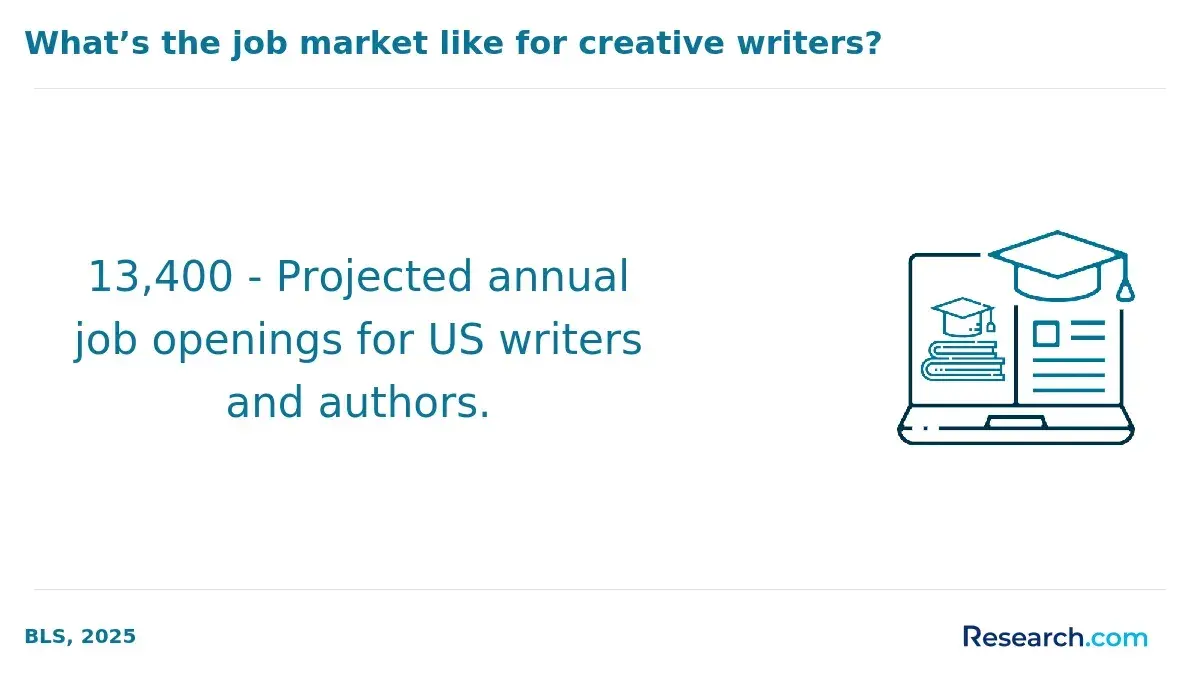
- As of 2025, there are 135,400 writers and authors in the U.S.
- The job outlook for online master's in creative writing degree graduates is 4% from 2024 to 2034.
- The strongest program choice depends on genre fit, accreditation, faculty expertise, workshop quality, cost, schedule, and thesis support.
- Professional writing experience can strengthen an application to an online master's in creative writing degree.
References:
- BLS. (2025, August 28). Writers and Authors: Job Outlook. Retrieved January 21, 2025, from BLS.
- BLS. (2025, August 28). Writers and Authors: Pay. Retrieved January 21, 2025, from BLS.
- edX. (n.d.). Explore online writing courses and programs. Retrieved from edX.
- Glatch, S. (2026, January 29). Creative Writing Programs: Finding the Right Fit for Your Learning. Retrieved from Writers.com.
Other Things You Should Know About an Online Master's in Creative Writing Degree
Submit the FAFSA online using the school’s federal code and list any assistantships or scholarships you expect to receive. For 2027–28 aid, complete the form as soon as it opens, because some state and institutional grants are awarded on a first-come, first-served basis.
Admission requirements for 2027 programs typically include a bachelor's degree, a writing sample, and letters of recommendation. Some programs may also require a statement of purpose and a minimum GPA, usually around 3.0. Check specific program websites for precise details.