
2027 Best Master’s in Sports Journalism Programs

Co-Founder and Chief Data Scientist
While general journalism jobs are projected to decline by 4%, the sports media and tech market is exploding into a projected $28.62 billion industry. For aspiring professionals, this creates a critical question: how do you break into the growth side of the field and avoid the shrinking one?
This guide is your playbook. Created by career planning experts with over a decade of experience, it details how the best master's in sports journalism is the strategic credential for accessing premier roles. We'll show you the programs that build elite networks and the modern skills needed to win in this competitive arena.
What are the benefits of getting a master's in sports journalism?
- Gain access to premier roles as a producer, on-air analyst, or digital strategist for top-tier employers like ESPN, major leagues, and national networks.
- Unlock a higher earning potential, with salaries at leading media companies like ESPN averaging around $82,600.
- An online format offers the flexibility to gain these career-advancing skills while balancing your current professional and personal commitments.
What can I expect from a master's in sports journalism?
You should expect an immersive, professional bootcamp. A top-tier master's program operates less like a classroom and more like a fast-paced, modern newsroom. The curriculum is intensive and hands-on from day one.
The focus is on producing broadcast-quality work for your portfolio under real-world deadlines. You'll be using industry-standard equipment and receiving direct mentorship from faculty who are veteran journalists, producers, and editors. This is your chance to hone your skills, experiment, and get critical feedback in a high-stakes environment before you're on the job.
Where can I work with a master's in sports journalism?
This degree is designed to open doors at the highest level of the industry. Graduates are targeted by national broadcast networks like ESPN and Fox Sports, major digital outlets such as The Athletic, and the media arms of professional leagues and teams.
But it's not just for on-air talent. The best master's in sports journalism prepares you for a range of critical roles. You could be working as a producer shaping a live broadcast, an editor crafting a feature story, a data analyst finding trends, or a social media strategist building a team's digital brand.
The credential signals to elite employers that you have the specialized skills and strategic thinking to contribute immediately.
How much can I make with a master's in sports journalism?
The real value of this master's degree isn't about a small, incremental pay bump. It's about gaining access to the top tier of employers who offer significantly higher salaries.
While the median salary for journalists is one thing, this credential puts you in the running for positions at major companies where the compensation is much stronger. For example, the average salary for a sports journalist at a premier employer like ESPN is around $82,600.
- List of the Best Master's in Sports Journalism Programs for 2027 List of Programs
- How long does it take to complete a master's in sports journalism program? Completion Time
- What is the average cost of a master's in sports journalism program? Program Cost
- What are the financial aid options for students enrolling in a master's in sports journalism program? Financial Aid
- What are the prerequisites for enrolling in a master's in sports journalism program? What are the prerequisites for enrolling in a master's in sports journalism program?
- What courses are typically in a master's in sports journalism program? What courses are typically in a master's in sports journalism program?
- What types of specializations are available in a master's in sports journalism program? Specializations
- How to Choose the Best Master's in Sports Journalism Program How to Choose the Best Master's in Sports Journalism Program
- What is the job market for graduates of a master's in sports journalism program? Job Market
Best Master's in Sports Journalism Programs for 2027
A master's in sports journalism can be useful if you want structured training, a stronger portfolio, and direct access to sports media employers, but it is not automatically the right move for every aspiring reporter. The best programs combine reporting, video, audio, data, ethics, and live production with faculty and alumni networks that can help students enter a competitive field.
This guide is designed for students comparing graduate sports journalism programs, working media professionals considering a career upgrade, and applicants trying to decide whether the cost and time commitment make sense. You will find ranked program options, cost and timeline details, admissions guidance, online versus campus trade-offs, career paths, job market context, common mistakes to avoid, and practical questions to ask before enrolling.
Quick Answer: Is a Master's in Sports Journalism Worth It?
A master's in sports journalism is most worthwhile for students who need an industry-ready portfolio, access to live reporting opportunities, and a professional network in sports media. It is less useful for applicants who already have strong newsroom experience, a deep professional network, and a clear path to promotion without another credential. Because the overall journalist job market is projected to decline by 4% over the next decade, the strongest programs are those that help students become multi-platform specialists rather than generalists.
How We Rank the Programs
Because graduate education can be a major financial commitment, our ranking approach prioritizes transparency, practical value, and verifiable school information. The evaluation draws from established education data sources, including the IPEDS database, Peterson's database, the College Scorecard database, and The National Center for Education Statistics.
These sources help assess program structure, institutional information, cost, and student-relevant outcomes. To learn more about how Research.com evaluates programs, see our ranking methodology.
Best Master's in Sports Journalism Programs at a Glance
| Rank | School and Program | Length | Credits | Tuition Information | Accreditation |
| 1 | Arizona State University — MA in Sports Journalism | 12 months (3 semesters) | 36 | $359.42 (in-state); $1,030.14 (out-of-state) per credit | Higher Learning Commission (HLC) |
| 2 | Indiana University — MA in Sports Journalism | 2 years | 30 | $389 (in-state); $1,264 (out-of-state) per credit | Higher Learning Commission (HLC) |
| 3 | Northwestern University — Master of Science in Journalism with a specialization in Sports Media | 2 years | 36-42 quarter credits | $91,892 total tuition | Higher Learning Commission (HLC) |
| 4 | Iona University — Master of Arts in Sports Communication & Media | 2 years | 36 | $1,275 per credit | Middle States Commission on Higher Education (MSCHE) |
| 5 | Emerson College — Master of Arts in Sports Communication | 2 years | 32 | $1,495 per credit | New England Commission of Higher Education (NECHE) |
1. Arizona State University - MA in Sports Journalism
Arizona State University's MA in Sports Journalism is built for students who want a fast, immersive path into professional sports media. Students report from major sports markets such as Phoenix or Los Angeles and develop content for broadcast, digital, and written platforms. The program is best suited for applicants who want a condensed graduate experience with significant hands-on production work.
- Program Length: 12 months (3 semesters)
- Required Credits to Graduate: 36
- Cost per Credit: $359.42 (in-state); $1,030.14 (out-of-state)
- Accreditation: Higher Learning Commission (HLC)
2. Indiana University - MA in Sports Journalism
Indiana University's MA in Sports Journalism emphasizes sports reporting within broader legal, social, business, and cultural contexts. Its downtown Indianapolis location can be valuable for students who want access to sports organizations, venues, and media opportunities while taking evening courses. This program may fit students who want a more analytical approach to sports coverage rather than only production training.
- Program Length: 2 years
- Required Credits to Graduate: 30
- Cost per Credit: $389 (in-state); $1,264 (out-of-state)
- Accreditation: Higher Learning Commission (HLC)
3. Northwestern University - Master of Science in Journalism with a Specialization in Sports Media
Northwestern University's Medill program is a strong option for students who want a high-profile journalism school, intensive portfolio development, and access to a large alumni network. Students can gain reporting experience through the Medill News Service and interact with professionals connected to major sports media organizations such as ESPN. The total tuition is high, so applicants should compare cost against career goals, funding offers, and expected placement support.
- Program Length: 2 years
- Required Quarter Credits to Graduate: 36-42
- Total Tuition: $91,892
- Accreditation: Higher Learning Commission (HLC)
4. Iona University - Master of Arts in Sports Communication & Media
Iona University's Master of Arts in Sports Communication & Media is designed for students who want live sports production experience as part of the curriculum. Through its ESPN+ partnership, students may work with cameras, production workflows, D-1 athletic event coverage, and multimedia facilities. This program is especially relevant for students interested in broadcast production, digital video, and sports communication roles.
- Program Length: 2 years
- Required Credits to Graduate: 36
- Cost per Credit: $1,275
- Accreditation: Middle States Commission on Higher Education (MSCHE)
5. Emerson College - Master of Arts in Sports Communication
Emerson College's Master of Arts in Sports Communication takes a broader communication-focused approach. Students study sports branding, event strategy, crisis communication, fan communities, and the role of sports in culture and public influence. This hybrid program may be a better fit for students who want to work across sports media, brand communication, content strategy, and organizational messaging rather than traditional reporting alone.
- Program Length: 2 years
- Required Credits to Graduate: 32
- Cost per Credit: $1,495
- Accreditation: New England Commission of Higher Education (NECHE)
How Long Does It Take to Complete a Master's in Sports Journalism?
Most master's in sports journalism programs can be completed in one to two years of full-time study. Some programs use an accelerated 12-month format, while others spread coursework, reporting projects, internships, and portfolio development across two years.
One-Year vs. Two-Year Programs
| Program Format | Best For | Main Advantage | Potential Trade-Off |
| 12-month accelerated program | Students who can study full time and want to enter or return to the workforce quickly | Shorter time away from work and faster portfolio completion | Heavy workload with less time for outside employment |
| 2-year full-time program | Students who want more time for internships, campus media, and skill-building | More space to develop reporting depth and professional relationships | Longer time commitment and potentially higher living costs |
| Part-time or flexible format | Working professionals who cannot leave their current job | Allows continued employment while studying | May reduce access to live events, cohorts, and in-person networking |
Think in Terms of Time to Career Impact
The key question is not only how long the degree takes, but how quickly it helps you produce better work, meet employers, and compete for roles. A one-year program can be attractive if you already have journalism experience and need a focused credential. A two-year option may be better if you need more time to build technical skills, reporting clips, and professional confidence.
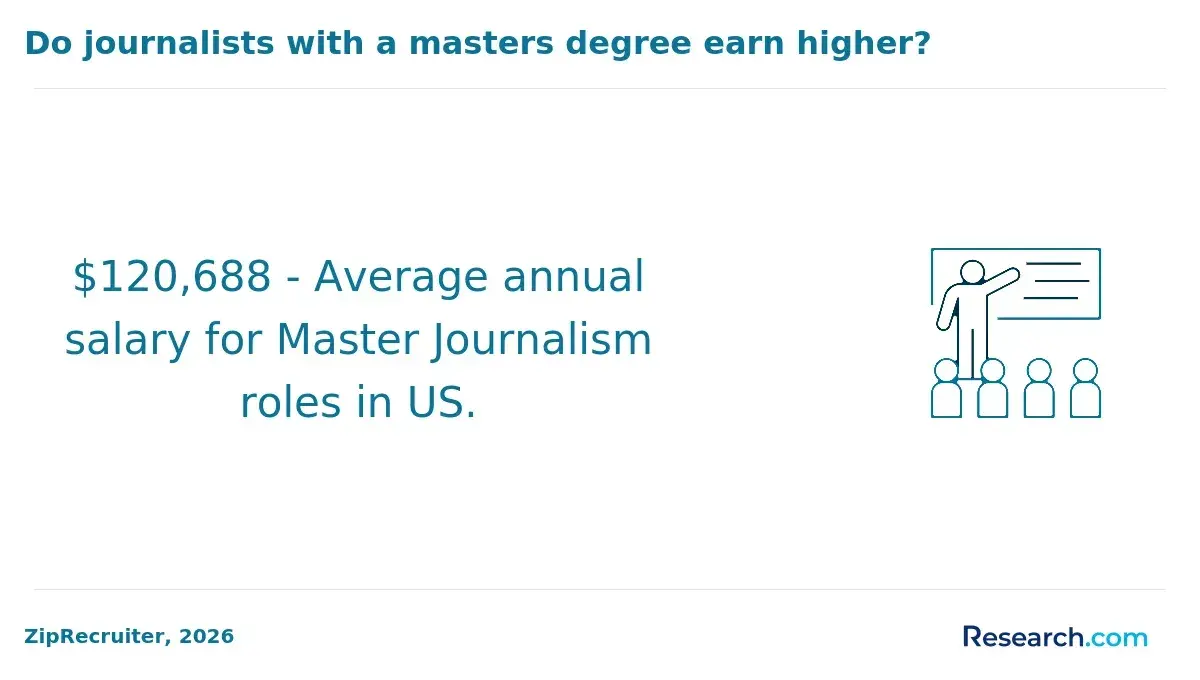
Students who are more interested in data-heavy sports careers may also compare journalism programs with the best online master's degree in sports analytics programs. The right choice depends on whether you want to tell stories about sports, analyze performance and business data, or combine both skill sets. The median annual pay for journalists was $60,280, so program length should be evaluated alongside total cost and realistic career outcomes.
Online vs. On-Campus Master's in Sports Journalism Programs
An online master's in sports journalism can work for students who need schedule flexibility, already have access to local media opportunities, or want to keep working while earning a credential. However, an on-campus program often has a major advantage in this field because sports journalism depends heavily on live production, newsroom collaboration, event access, and relationship-building.
Online and Campus Programs Compared
| Factor | Online Program | On-Campus Program |
| Flexibility | Stronger option for working professionals and students outside major media markets | Less flexible, especially when courses, labs, and events require attendance |
| Broadcast and production access | Depends heavily on remote tools, local partnerships, and student initiative | Usually stronger because students can use studios, equipment, and live production facilities |
| Networking | Possible through virtual events, alumni outreach, and professional groups | Often stronger because of in-person faculty, guest speakers, classmates, and industry visits |
| Portfolio development | Can be strong if the program includes structured assignments and external reporting | Often stronger when students can cover campus athletics, local teams, and live events |
| Best fit | Self-directed students with existing media access or job experience | Students who need hands-on training, mentorship, and direct industry exposure |
Why In-Person Access Can Matter More in Sports Media
Sports media careers are often shaped by who sees your work, who trusts your reporting, and who can recommend you when an opening appears. In-person programs may provide easier access to professors after class, production crews, guest speakers, live events, and alumni working in the industry. Professional organizations such as the National Sports Media Association can also help students expand their network beyond campus.
That does not mean online learning is inferior in every field. For example, online clinical counseling master's programs can be effective when they include appropriate supervised training and meet professional requirements. Sports journalism applicants should evaluate online programs more skeptically by asking how the school replaces studio access, game coverage, mentoring, and employer connections.
How Much Does a Master's in Sports Journalism Cost?
Based on the programs listed in this guide, tuition for a master's in sports journalism can range from around $30,000 to over $70,000 for the full program. This range reflects the schools featured here and should not be treated as the cost of every program in the market.
Cost Factors to Compare Before You Apply
| Cost Factor | Why It Matters | What to Ask |
| Tuition structure | Some schools charge per credit, while others publish total program tuition | Is the listed price the full tuition, or are fees added separately? |
| Residency status | Public universities may charge very different in-state and out-of-state rates | Can I qualify for in-state tuition, scholarships, or residency-based discounts? |
| Fees and equipment | Production courses may require technology, software, travel, or lab fees | What costs are not included in tuition? |
| Living expenses | Campus programs in major media markets may require relocation or higher housing costs | What is the total cost of attendance, not just tuition? |
| Lost income | Full-time study can reduce or eliminate earnings during enrollment | Can I work while enrolled, and will the schedule allow it? |
How to Think About ROI Without Overestimating It
The return on investment depends on the quality of the program, your portfolio, your internships, your networking, your location, and the types of jobs you pursue after graduation. A degree from a recognized program may help you access stronger opportunities, but it does not guarantee a specific salary or employer.
Some applicants compare admissions flexibility across fields before deciding on graduate school. For example, online graduate programs in counseling with no GRE requirement may appeal to students seeking a different professional path with different licensing and career considerations. For sports journalism, the more relevant question is whether the program can help you build publishable work and meet employers. A role at an employer such as ESPN, where the average salary is $82,600, illustrates why some students pursue a premium credential, but individual outcomes vary.
Financial Aid Options for Master's in Sports Journalism Students
Graduate financial aid often relies more on scholarships, fellowships, assistantships, employer support, and loans than on large need-based grants. Students should compare net cost, not just advertised tuition, because funding offers can significantly change the value of a program.
- Fellowships: These competitive awards may cover tuition and sometimes include a living stipend. They are usually based on merit, professional promise, or a specific area of study.
- Graduate assistantships: Assistantships may provide tuition support and wages in exchange for work such as research, teaching support, media production, or departmental duties.
- Department scholarships: Journalism schools, communication departments, and external media organizations may offer awards for graduate students in sports media or journalism.
- Federal loans: Students can apply for Federal Direct Unsubsidized Loans and Grad PLUS Loans by submitting the FAFSA.
- Employer support: Working media professionals should ask whether their employer offers tuition reimbursement or professional development funds.
Students considering advanced credentials in other fields may see similar funding strategies in programs such as a doctorate of management online, where fellowships and assistantships can also influence affordability. For sports journalism applicants, a strong funding package can be a sign that the program sees you as a serious candidate, but you should still compare total debt against realistic earnings.
Admissions Requirements for a Master's in Sports Journalism
Most master's in sports journalism programs expect applicants to hold a bachelor's degree from an accredited institution. Competitive applicants often have a solid undergraduate record, recommendation letters, a clear statement of purpose, and a portfolio that shows reporting, writing, audio, video, editing, or digital media ability. Some schools may request GRE scores, while others no longer require them.
What Matters Most in the Application
| Application Component | What Schools Look For | How to Strengthen It |
| Statement of purpose | Clear career goals and a strong reason for choosing that specific program | Name the skills, faculty, facilities, market access, or curriculum features that match your goals |
| Portfolio | Evidence that you can report, write, produce, analyze, or tell stories across platforms | Include polished clips and explain your role in collaborative projects |
| Recommendations | Support from people who can speak to your work ethic, writing, judgment, or media potential | Choose recommenders who know your work, not only people with impressive titles |
| Academic record | Readiness for graduate-level research, reporting, and deadlines | Address weak spots honestly and point to recent professional or academic growth |
| Interview or additional materials | Communication ability, maturity, and fit with the program | Prepare to discuss your goals, favorite sports journalism work, and ethical judgment |
Who Has an Advantage?
Applicants do not always need an undergraduate journalism degree. A student with a humanities, communications, English, media production, sports management, or social science background may be competitive if the portfolio is strong. Some students begin with flexible undergraduate pathways, including the fastest online humanities degree programs, and then use graduate study to specialize in sports media.
The credential can stand out because only about 8% of professionals in the field have a master's degree. That said, admissions committees are not looking for a credential alone; they want evidence that you understand the industry and can produce work under real deadlines.
Common Courses in a Master's in Sports Journalism Program
A strong sports journalism curriculum should help students report accurately, produce across formats, understand media law, use data responsibly, and adapt stories for audiences across broadcast, digital, audio, and social platforms. Course titles vary by school, but many programs cover the following areas.
- Sports reporting and writing: Students learn how to cover games, athletes, teams, leagues, controversies, and broader issues in sports with accuracy and context.
- Broadcast journalism: This course area usually includes on-camera reporting, live production, interviewing, scripting, editing, and creating packages for television or digital video.
- Media law and ethics: Students study defamation, privacy, sourcing, conflicts of interest, corrections, access, and responsible coverage of sensitive topics.
- Data journalism: Students learn how to find, clean, interpret, and present data to support stronger sports stories. Those who want deeper quantitative training may compare this path with the fastest online master's degree in sports analytics programs.
- Multimedia storytelling: This area combines writing, video, audio, graphics, photography, audience engagement, and social distribution into a single reporting workflow.
- Podcasting and audio production: Students may learn show planning, interviewing, editing, sound design, audience growth, and sports commentary formats.
- Sports business and culture: Programs may examine money, labor, race, gender, law, politics, fandom, and globalization in sports.
These courses are intended to help graduates compete in a field that includes 49,300 existing positions for analysts, reporters, and journalists. The strongest students leave with a portfolio that shows range, not just classroom knowledge.
Sports Journalism Specializations to Consider
A specialization can help you focus your portfolio and position yourself for specific roles. The best choice depends on whether you want to be on air, produce live coverage, investigate sports institutions, build digital audiences, or work inside a team, league, or brand.
| Specialization | Best For | Skills Developed | Possible Roles |
| Broadcasting | Students interested in reporting, anchoring, commentary, or live production | Camera presence, voice work, scripting, interviewing, and studio production | Reporter, anchor, producer, commentator |
| Investigative reporting | Students who want to produce accountability journalism and long-form work | Research, document analysis, sourcing, ethics, and narrative structure | Investigative reporter, enterprise writer, editor |
| Photojournalism and visual media | Students who want to tell sports stories through images and video | Photography, editing, visual sequencing, field production, and multimedia packaging | Sports photographer, video journalist, visual editor |
| Digital strategy | Students interested in audience growth, social platforms, and brand content | Analytics, social media, engagement, content planning, and platform-specific storytelling | Digital producer, social media editor, audience strategist |
| Sports communication | Students who want to work with teams, leagues, athletic departments, or agencies | Media relations, crisis communication, messaging, branding, and event support | Sports information director, communications manager, public relations specialist |
Students drawn to visual storytelling may supplement graduate journalism training by reviewing the best online digital photography degree programs. Those considering other specialized education careers can compare how focused credentials work in areas such as applied behavior analysis in education, where the value of specialization also depends on career goals and employer expectations.
Salaries in sports media can vary by state, employer, platform, experience, and the concentration of media outlets in a given market. Students should avoid choosing a specialization based only on perceived prestige and instead ask which track will produce the strongest portfolio for the jobs they want.
How to Choose the Best Master's in Sports Journalism Program
The best master's in sports journalism program is not always the most famous university. It is the program that gives you the strongest combination of skill development, portfolio opportunities, professional access, affordability, and fit with your career goal.
Decision Checklist for Applicants
| Question | Why It Matters | Strong Sign | Warning Sign |
| Will I produce publishable work? | Your portfolio often matters more than the degree title alone | Students regularly publish, broadcast, or produce real sports coverage | Most work stays inside the classroom |
| Who teaches the courses? | Faculty with current or recent industry experience can provide practical guidance | Professors have credible sports media, journalism, production, or communications backgrounds | Faculty experience is unclear or not connected to your goals |
| Where do graduates work? | Placement outcomes show whether the program has useful employer connections | The school can discuss recent graduate roles and employers | The program avoids sharing placement examples |
| What live opportunities are available? | Sports journalism is built around real events, deadlines, and production pressure | Students cover games, shows, athletic departments, or local sports organizations | There is little access to events or facilities |
| How much debt will I take on? | Media salaries vary, and high debt can reduce career flexibility | The school provides clear net cost, aid options, and assistantship information | Costs are difficult to estimate or heavily dependent on loans |
Questions to Ask Before Enrolling
- What percentage of students receive scholarships, assistantships, or fellowships?
- Can I review examples of student portfolios or recent capstone projects?
- How often do students cover live sporting events?
- Which media organizations, teams, leagues, or athletic departments regularly interact with the program?
- Does the program provide career coaching specific to sports media?
- Are internships required, optional, or student-arranged?
- What equipment, software, studio access, and editing resources are included?
- How does the program help students who enter without prior journalism experience?
If your interests are closer to sports administration, operations, marketing, or facility management than journalism, an accelerated sports management bachelor's degree online may be a better comparison point than a journalism master's.
Career Paths for Master's in Sports Journalism Graduates
A sports journalism master's can lead to reporting, production, editing, digital strategy, and communications roles. The degree is most valuable when it helps graduates demonstrate concrete skills: reporting under deadline, producing multimedia packages, interviewing effectively, using data, editing cleanly, and understanding legal and ethical risks.
| Career Path | What the Role Does | Useful Graduate Training |
| On-air talent or analyst | Reports, anchors, interviews, comments on games or sports issues, and appears on broadcast or digital programs | Broadcast reporting, voice training, live production, interviewing, and sports analysis |
| Producer | Plans segments, shapes scripts, coordinates guests, manages timing, and supports live or recorded shows | Production labs, newsroom workflow, video editing, scripting, and project management |
| Sports reporter or writer | Covers teams, athletes, games, features, investigations, and broader sports issues | Reporting, writing, sourcing, ethics, data journalism, and beat coverage |
| Sports information director | Manages media relations, public information, content, and communications for an athletic department or team | Sports communication, media relations, crisis communication, and digital publishing |
| Senior editor | Shapes coverage strategy, edits stories, manages writers, and sets editorial standards | Editing, editorial judgment, audience strategy, leadership, and legal awareness |
| Digital or social media producer | Creates platform-specific content, tracks audience engagement, and adapts stories for social and digital channels | Multimedia storytelling, analytics, video editing, and audience development |
Job Market Outlook for Master's in Sports Journalism Graduates
The broader job outlook for journalists is challenging: employment for journalists is projected to decline by 4% over the next decade. At the same time, the field is still expected to have an estimated 4,100 openings for reporters and analysts each year. That means opportunity exists, but it is concentrated among candidates who can show strong skills, adaptability, and professional connections.
What Employers Increasingly Expect
Sports media employers often look for candidates who can do more than write a clean game recap. Competitive applicants may need to shoot and edit video, host or produce audio, build a social audience, interpret data, verify information quickly, and work across multiple platforms. AI and automation may assist with transcription, editing workflows, research support, and content distribution, but they also raise the bar for original reporting, judgment, ethics, and audience trust.
The market is less favorable for narrow generalists and more favorable for professionals who bring a distinct combination of reporting ability, technical production skills, subject expertise, and audience awareness. A master's program can help if it gives students repeated practice in those areas and measurable work samples to show employers.
Common Mistakes to Avoid
| Mistake | Why It Can Hurt You | Better Approach |
| Choosing only by university brand | A famous name does not guarantee sports media access or strong portfolio work | Compare faculty, facilities, event coverage, alumni, and placement support |
| Ignoring accreditation | Accreditation affects institutional credibility and may influence financial aid eligibility | Confirm the school’s recognized institutional accreditation before applying |
| Looking only at tuition | Fees, relocation, equipment, and lost income can change the real cost | Calculate total cost of attendance and expected debt |
| Assuming online is automatically equivalent | Remote programs may not provide the same live production or networking access | Ask exactly how the online program supports reporting, production, internships, and mentoring |
| Applying with a weak portfolio | Graduate admissions and employers both want evidence of ability | Build clips, audio, video, photography, or digital packages before applying |
| Expecting the degree to guarantee a job | The media market is competitive and outcomes vary | Use the program to build relationships, skills, internships, and published work |
Student Perspectives on Master's in Sports Journalism Programs
- Valerie: "What changed everything for me was access. I had been trying to enter sports media from the outside, but the program put me near people already doing the work. One of my broadcasting professors was still active in the industry, and that connection helped my resume reach the right person."
- Andrew: "I was working in local sports radio and needed a way to move forward without leaving my job. The online format made that possible. The digital strategy coursework applied directly to what I was doing, and after finishing the program I moved into a program director role."
- Lindsey: "I came in nervous about the technical side. The labs helped me build skills step by step, from podcast editing to graphics and video packages. Having room to practice, make mistakes, and improve made the biggest difference."
References
- Bureau of Labor Statistics, U.S. Department of Labor. (2025, August 28). News analysts, reporters, and journalists. Occupational Outlook Handbook. Retrieved October 5, 2025, from https://www.bls.gov/ooh/media-and-communication/reporters-correspondents-and-broadcast-news-analysts.htm
- Grand View Research. (n.d.). The United States sports broadcasting technology market size & outlook, 2030. Retrieved October 5, 2025, from https://www.grandviewresearch.com/horizon/outlook/sports-broadcasting-technology-market/united-states
- GlobalData. U.S. sports broadcasting media market analysis. https://www.globaldata.com/store/report/usa-sports-broadcasting-media-market-analysis/
- International Federation of Journalists. Education and training resources. https://www.ifj.org
- National Public Radio. About NPR: education and career support. https://www.npr.org/about/
- National Coalition of Independent Scholars. Scholar support and professional development. https://ncis.org
- JobsInSports.com. Sports media jobs and careers. https://blog.jobsinsports.com/2024/09/10/top-sports-media-jobs-careers/
- Zippia. (2024, July 24). Sports journalist job outlook and growth in the US. Retrieved October 5, 2025, from https://www.zippia.com/sports-journalist-jobs/trends/
- U.S. Department of Education. Take charge of your future: Get the education and training you need. https://www.ed.gov/media/document/take-charge-your-futurepdf-37403.pdf
- United Nations. Resolution document. https://docs.un.org/en/A/RES/73/15?
- United Nations. (2025). Youth. https://www.un.org/en/global-issues/youth
Key Insights
- The strongest sports journalism master's programs are career-access programs, not just academic credentials. Look for live reporting, production facilities, alumni connections, internships, and portfolio outcomes.
- Program length usually ranges from one to two years. A 12-month program can reduce time away from work, while a two-year program may provide more time for internships and skill development.
- On-campus study often has an edge in sports journalism. Online options can work, but applicants should verify how the program delivers production experience, event coverage, and networking.
- Cost should be judged by net price and career fit. Tuition among the listed programs ranges from around $30,000 to over $70,000, so scholarships, assistantships, fees, living costs, and debt matter.
- A portfolio is essential. Admissions committees and employers want proof that you can report, write, produce, edit, and tell sports stories across platforms.
- The job market rewards specialists. With a projected 4% decline in the broader journalist market but 4,100 estimated openings each year, graduates need strong multimedia, data, ethical, and audience-focused skills to compete.
- Do not choose by ranking alone. The best program is the one that matches your target role, budget, preferred format, technical needs, and desired sports media market.
Other Things You Need To Know About a Master's in Sports Journalism
Admission requirements typically include a bachelor's degree from an accredited institution, a minimum GPA of 3.0, and submission of GRE scores. Programs often request a portfolio showcasing writing samples, letters of recommendation, and a statement of purpose specific to sports journalism.
Yes. Many 2027 master’s programs in sports journalism ask for a portfolio with published clips, multimedia samples, or broadcast reels. Admissions offices often require 3 to 5 work samples, a resume, transcripts, letters of recommendation, and a statement of purpose.


