2027 What Can I Do With an Associate's in Computer Science?

Co-Founder and Chief Data Scientist
An associate degree in computer science can be a practical way to enter the technology workforce without committing to a four-year program immediately. The key question is not simply whether the degree is “good,” but what it can realistically help you do: qualify for entry-level technical roles, build a portfolio, transfer into a bachelor’s program, or specialize through certifications, boot camps, or advanced study.
Recent figures show that the computer science workforce in the US expanded by roughly 5%—from about 2.21 million in 2021 to 2.32 million in 2022. For students, career changers, and working adults, that growth points to a labor market where practical computing skills remain valuable, but competition also rewards people who can show hands-on ability. This guide explains what you can do with an associate degree in computer science in 2027, which jobs are realistic, how much selected roles pay, when further education makes sense, and how to choose a program that supports your goals.
Quick Answer: What Can You Do With an Associate Degree in Computer Science?
With an associate degree in computer science, you can pursue entry-level or early-career roles in technical support, network support, web development, digital interface support, quality assurance, junior programming, and IT operations. The degree is also a strong transfer pathway into a bachelor’s degree in computer science or a related technology field. To compete for software engineering, cybersecurity, cloud, data, or AI-focused roles, most graduates strengthen the degree with projects, internships, certifications, boot camps, or additional college coursework.
Key Things You Should Know About an Associate’s in Computer Science
- An associate degree can qualify you for several technology roles, especially computer network support specialist, user support specialist, web support, help desk, and junior technical positions.
- Employers hiring for web development and digital design often focus on demonstrated skills, so a portfolio, GitHub projects, internships, and freelance work can matter as much as the credential.
- The degree is often most valuable as a foundation: it can help you enter the workforce sooner, reduce the cost of a bachelor’s degree, and prepare for certifications or specialized training.
- It is not always enough by itself for competitive software engineering, AI, cybersecurity, or data science roles, where employers may expect stronger portfolios, bachelor’s-level coursework, or job-specific credentials.
- What jobs can I get with an associate’s in computer science in 2027?
- How competitive is the job market for associate degree holders in 2027?
- How much can I make with an associate degree in computer science?
- Which states have the highest employment for computer science associate graduates?
- What programming languages are taught in an associate’s in computer science?
- Will I learn cybersecurity with an associate degree in computer science?
- Do associate programs cover AI and machine learning fundamentals?
- Is an associate degree enough to become a software engineer?
- Can I work as a freelance programmer with an associate’s in computer science?
- Can I build a career in game development with an associate’s in computer science?
- What are the best industries for remote work with a computer science associate’s?
- Do coding boot camps complement an associate’s in computer science?
- What industry certifications can accelerate my career after an associate’s degree?
- What should I consider when choosing an associate’s in computer science program?
- Can adding data science skills accelerate my career beyond an associate’s in computer science?
- Can I transfer my associate degree to a bachelor’s in computer science?
- Can a health informatics online masters degree broaden my career path?
- Can integrating interdisciplinary fields like bioinformatics elevate my career prospects?
- Could an online accelerated degree boost my career after an associate’s in computer science?
- How can an advanced degree further boost my career after an associate’s in computer science?
- Should I specialize in artificial intelligence to advance my career?
- What factors should I consider when choosing an accelerated online technology degree?
- What mistakes should I avoid when using an associate degree to start a tech career?
What jobs can I get with an associate’s in computer science in 2027?
An associate degree in computer science is most commonly used for entry-level technical work, support roles, web-related roles, and transfer into a bachelor’s program. It can show employers that you have studied programming, databases, operating systems, networking, problem-solving, and core computing concepts. However, the exact job you can get depends heavily on your projects, internships, certifications, local labor market, and whether the employer requires a bachelor’s degree.
Computer support roles are often the most accessible starting point. Computer network support specialists typically need stronger networking preparation, while computer user support specialist roles may accept candidates with some college coursework, IT experience, and relevant certifications. This flexibility can make the associate degree useful for people trying to enter IT quickly.
Web developer and digital designer roles can also be realistic, especially when the graduate can show a strong portfolio. Educational requirements in these fields vary from a high school diploma to a bachelor’s degree, so an associate degree can be enough for some employers if paired with practical evidence of skill. Students who want to connect computing with business systems may later compare transfer options or the best online MIS programs.
| Career path | Why an associate degree can help | What you may need beyond the degree |
| Computer user support specialist | Builds troubleshooting, operating system, networking, and customer support foundations. | Help desk experience, hardware/software knowledge, and vendor certifications. |
| Computer network support specialist | Supports entry into roles focused on network maintenance, monitoring, and technical assistance. | Networking labs, internships, and networking certifications. |
| Web developer | Provides programming, databases, and web technology basics. | Portfolio sites, JavaScript projects, responsive design experience, and version control. |
| Digital interface or web design support | Combines front-end technical knowledge with design and usability concepts. | UI/UX samples, accessibility knowledge, and design tool experience. |
| Junior programmer or QA tester | Introduces coding logic, testing, debugging, and software development workflows. | GitHub projects, coding challenges, internships, or boot camp-style project work. |
| IT operations or technical support | Prepares students for system maintenance, documentation, and user support. | Cloud, cybersecurity, or systems administration credentials. |
If you are still comparing technology credentials, a broader guide to what can you do with a computer science degree can help you understand how associate, bachelor’s, and graduate pathways differ.
How competitive is the job market for associate degree holders in 2027?
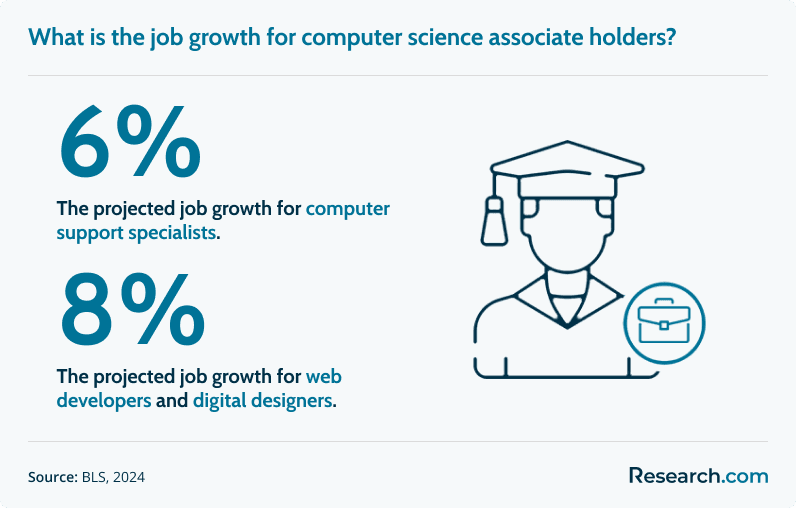
The job market is promising but not automatic. According to the US Bureau of Labor Statistics (BLS), employment for computer support specialists is projected to grow 6% from 2023 to 2033, which is faster than the average for all occupations. The BLS also reports about 62,700 openings for these specialists each year, on average, over the decade, partly because workers retire, change occupations, or move into other roles.
For web developers and digital designers, the BLS projects 8% growth from 2023 to 2033, with roughly 16,500 openings each year on average. That demand can benefit associate degree holders, but web roles are portfolio-driven and competitive because applicants may include self-taught developers, boot camp graduates, bachelor’s degree holders, and experienced freelancers.
The strongest candidates usually do more than finish coursework. They build real projects, learn collaboration tools, document their work, practice technical interviews, and tailor applications to specific roles. If your long-term goal includes public sector technology leadership or digital government work, advanced study outside traditional computer science, such as the best online PhD in public administration programs, may become relevant later in your career, but it is not needed for entry-level technical employment.
| Job market factor | What it means for associate degree holders | How to respond |
| Degree requirements vary | Some employers accept an associate degree; others list a bachelor’s degree as preferred or required. | Target roles that value skills, support experience, certifications, and portfolios. |
| Portfolio quality matters | Especially in web development, employers want evidence that you can build and troubleshoot. | Create completed projects, not only class assignments. |
| Certifications can fill gaps | They can validate networking, security, cloud, or vendor-specific skills. | Choose certifications that match the job descriptions you are pursuing. |
| Experience compounds quickly | Internships, help desk work, and freelance projects can make later roles easier to obtain. | Start applying before graduation and keep records of measurable accomplishments. |
How much can I make with an associate degree in computer science?
Income depends on the role, location, employer, experience level, and whether you continue building specialized skills. BLS wage figures for common technology roles show that an associate-level pathway can lead to solid earning potential, but salaries are not guaranteed by the degree alone.
| Role | Reported wage figure | How the associate degree fits |
| Computer network support specialists | Average of about $78,640 per year | A common fit for graduates with networking coursework and hands-on lab experience. |
| Computer user support specialists | Around $63,640 per year | Often accessible with troubleshooting skills, customer support ability, and IT certifications. |
| Web and digital interface designers | Mean annual wage of approximately $108,820 | May require a strong design and front-end portfolio in addition to technical coursework. |
| Web developers | About $95,570 per year | Best suited for graduates who can show completed websites, applications, and code samples. |
These figures help frame the potential computer science salary range, but your first job may pay more or less depending on your local market and qualifications. A graduate who enters help desk work and then earns cloud or networking credentials may follow a very different path from someone who transfers immediately into a bachelor’s program.
Some technology-adjacent careers focus less on software building and more on information organization, research systems, or digital archives. If that direction interests you, you may also compare options such as what can I do with a master’s in library science. Students researching healthcare-specific career changes may also encounter non-computer-science pathways, including an RN to BSN fastest program, but those are separate from the computer science associate degree route.
Which states have the highest employment for computer science associate graduates?
Employment concentration matters because a state with more roles can offer more opportunities for internships, entry-level hiring, networking, and career mobility. Based on the figures provided, California leads in several technology categories, while Texas is especially strong for computer user support specialists.
| Occupation | State employment highlight | What it suggests for job seekers |
| Computer network support specialists | California employs around 13,400 professionals. | Large technology and business markets may support more network support openings. |
| Computer user support specialists | California reports about 67,630 professionals, while Texas slightly edges out with roughly 72,410 professionals. | Both states can be strong markets for help desk, desktop support, and IT service roles. |
| Web and digital interface designers | California has about 25,370 roles. | Design, media, software, and platform companies can create demand for web and interface skills. |
| Web developers | Approximately 10,590 positions are in California. | Large tech ecosystems can offer opportunities, but competition and cost of living should be weighed carefully. |
High employment does not automatically mean the best choice for every graduate. Compare job volume with cost of living, remote-work availability, local community college transfer agreements, internship access, and whether employers in the region hire associate degree candidates for the roles you want.
What programming languages are taught in an associate’s in computer science?
Most associate programs teach programming as a foundation for problem-solving, software development, databases, and systems work. The exact language mix varies by school, but many programs include several of the following:
- Python: Python is often used for introductory programming because its syntax is readable and flexible. It also appears in web development, automation, data analysis, artificial intelligence, scientific computing, and scripting.
- Java: Java is a common object-oriented language used in enterprise software, Android development, large web applications, and systems that require portability and strong structure.
- C/C++: C helps students understand memory, systems programming, and lower-level computing concepts, while C++ adds object-oriented features useful in game engines, performance-focused applications, and complex software.
- JavaScript: JavaScript is central to modern web development. It powers interactive browser experiences and is also used on servers through environments such as Node.js.
- SQL: SQL is used to query, manage, insert, update, and retrieve information in relational databases, making it useful for software, analytics, reporting, and database administration tasks.
When comparing programs, do not judge the curriculum only by the number of languages listed. A strong program should teach you how to think computationally, debug, use version control, work with databases, write documentation, and complete projects. If cost is your main concern, reviewing the cheapest online associate degree in computer science options can help you compare affordability with course quality.
Will I learn cybersecurity with an associate degree in computer science?
Many associate degree programs include some cybersecurity exposure, but the depth varies widely. A general computer science associate degree may introduce secure coding, operating systems, networks, encryption basics, access control, and common threats. A more specialized cybersecurity associate program may go deeper into network defense, incident response, threat analysis, and security tools.
If your goal is to work in cybersecurity, read the course list carefully. Look for hands-on labs, security electives, networking coursework, and preparation for entry-level security certifications. A general computer science degree can be a useful starting point, but students who already know they want cyber defense may want to compare it with an associate of science in cybersecurity online.
Do associate programs cover AI and machine learning fundamentals?
Some associate programs now introduce artificial intelligence and machine learning concepts, but students should expect introductory coverage rather than advanced specialization. Typical topics may include basic algorithms, pattern recognition, predictive models, data preparation, and examples of how AI tools are used in software, business, and analytics.
For most associate students, the better short-term goal is to master programming, statistics basics, databases, and problem-solving. Those foundations make later AI coursework easier. When comparing schools, consider whether AI content is part of a serious curriculum or simply a short elective. You should also weigh tuition, transfer options, and the broader computer science degree cost before choosing a program because AI specialization often requires additional study.
Is an associate degree enough to become a software engineer?
An associate degree can help you start moving toward software engineering, but it is not always enough by itself for competitive software engineer roles. Some employers will consider candidates without a bachelor’s degree if they have strong projects, internships, open-source contributions, or professional experience. Others use a bachelor’s degree as a screening requirement.
The practical answer is this: an associate degree can qualify you for junior technical roles and help you build the experience needed to become a software engineer, but many graduates eventually transfer to a bachelor’s program or continue with advanced study. If you already have a bachelor’s degree or substantial technical experience and want deeper preparation, an affordable online master’s in computer science may be relevant later. For associate degree students, the more immediate priorities are portfolio depth, internships, algorithms practice, and transfer planning.
| Goal | Is the associate degree enough? | Best next move |
| Help desk or user support | Often enough for entry-level roles. | Add customer service experience and IT certifications. |
| Network support | Often useful, especially with networking coursework. | Build lab experience and pursue networking credentials. |
| Web development | Possibly, if the portfolio is strong. | Build deployable projects and learn modern front-end tools. |
| Software engineering | Sometimes, but a bachelor’s degree is often preferred. | Transfer, complete larger software projects, and prepare for technical interviews. |
| AI, machine learning, or data science | Usually not enough alone. | Strengthen math, statistics, Python, databases, and consider further education. |
Can I work as a freelance programmer with an associate’s in computer science?
Yes. Freelancing is possible with an associate degree, but clients usually care more about your ability to deliver than the title of your credential. You need a portfolio, clear service offerings, communication skills, contracts, pricing discipline, and the ability to manage revisions and deadlines.
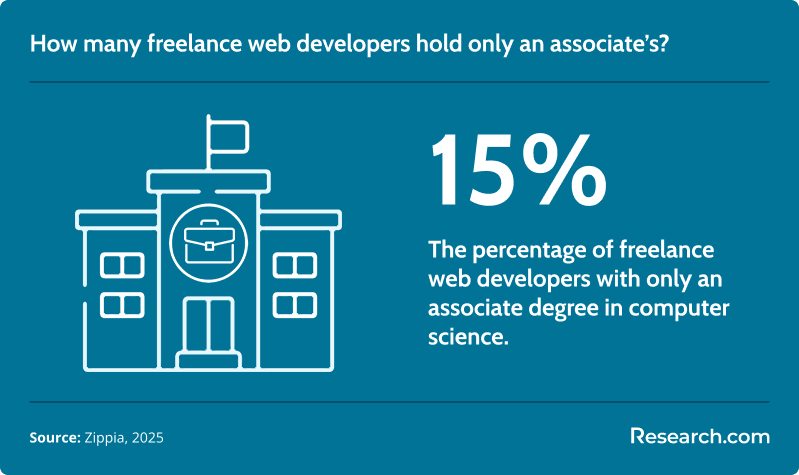
Data from Market.us Scoop suggests that freelance programmers in the US earn between $60 to $70 per hour, translating to an annual salary of around $120,000. However, Zippia reports that most freelance web developers hold a bachelor’s degree, at 68%, while about 15% have an associate degree. That does not make freelancing impossible for associate graduates, but it does mean you must compete on proof of skill.
The most realistic freelance starting points include small business websites, WordPress customization, front-end fixes, automation scripts, database cleanup, QA testing, and maintenance work. As you gain testimonials and completed projects, you can move toward more complex software or web application contracts.
Can I Build a Career in Game Development with an Associate’s in Computer Science?
An associate degree can support an entry point into game development, especially for roles such as quality assurance tester, assistant programmer, technical support specialist, or junior tools support. Game development is highly competitive, so a degree alone is rarely enough. Employers and collaborators usually want to see playable prototypes, engine experience, debugging ability, teamwork, and comfort with math and performance constraints.
If you want to move beyond entry-level support or QA, targeted coursework in interactive design, real-time rendering, physics, game logic, and engine workflows can help. Students who want a more focused curriculum may compare an online game development degree with a general computer science pathway. A general CS associate degree provides flexibility, while a game-focused degree may offer more direct portfolio alignment.
What are the best industries for remote work with a computer science associate’s?
Remote work can be a strong fit for technology roles, but entry-level remote jobs are often competitive because they attract applicants nationwide. The share of remote workers in the tech sector has risen to 41.4% in 2022, which shows that remote and hybrid models are now significant in technology work. Still, associate degree holders may find it easier to begin in hybrid, contract, support, or project-based roles before moving into fully remote positions.
- Private technology firms: Software, SaaS, and IT companies may hire remote support, QA, junior development, and operations staff when candidates can work independently and communicate clearly.
- Startups: Smaller companies may value adaptable workers who can handle web updates, support, testing, documentation, and light scripting, though workloads can change quickly.
- Consulting and IT support: Managed service providers and consulting firms often need remote troubleshooting, ticket resolution, monitoring, and client support skills.
- Digital media and design companies: Web production, UI support, content systems, and interactive development can be remote-friendly when your portfolio is strong.
Remote job seekers should show more than technical knowledge. Hiring managers want evidence that you can document work, manage tickets, communicate asynchronously, protect data, and solve problems without constant supervision. The chart below illustrates the industry distribution of freelance web developers, both remote and in-person.
Do coding boot camps complement an associate’s in computer science?
Coding boot camps can complement an associate degree when they fill a specific skills gap. A computer science associate program often emphasizes fundamentals, while a boot camp may focus on applied projects, a current tech stack, interview preparation, or portfolio development. The combination can work well if the boot camp teaches skills that appear in the job postings you are targeting.
Boot camps are less useful when they repeat what you already learned, cost more than they are worth, or promise unrealistic outcomes. Before enrolling, review graduate support, project requirements, instructor access, refund policies, and whether the curriculum is current. Boot camp training may boost your job readiness when it adds practical experience, but it should be chosen strategically rather than as a shortcut.
| Choose a boot camp if... | Be cautious if... |
| You need a portfolio in web development, data analytics, cybersecurity, or another focused area. | The program guarantees employment or makes salary promises without transparent outcomes. |
| You already understand basic programming and want structured project practice. | The curriculum overlaps heavily with your associate degree coursework. |
| You can verify employer connections, career support, and student project quality. | You would need to take on high debt without clear evidence of value. |
| The boot camp teaches tools commonly required in your target job postings. | The program focuses on hype technologies without enough fundamentals. |
What industry certifications can accelerate my career after an associate’s degree?
Certifications can help associate degree graduates prove job-specific skills, especially in IT support, networking, cybersecurity, cloud computing, and systems administration. They are most valuable when they match the role you want. For example, a networking credential can support network support roles, while a security credential can help you move toward cyber-focused positions.
Do not collect certifications randomly. Start with job postings, list the credentials employers request most often, and choose one that fills a real gap in your resume. If cybersecurity is your target, comparing certification paths with a broader cyber security degree online can help you decide whether you need a short-term credential, a specialized degree, or both.
| Career direction | Certification strategy | Why it helps |
| IT support | Choose entry-level credentials tied to hardware, operating systems, and troubleshooting. | Shows employers you can support users and resolve common technical issues. |
| Networking | Prioritize credentials focused on routing, switching, wireless, and network troubleshooting. | Strengthens your case for network support and infrastructure roles. |
| Cybersecurity | Build from networking fundamentals into security concepts and hands-on labs. | Demonstrates readiness for security operations, monitoring, and risk-focused tasks. |
| Cloud computing | Start with foundational cloud credentials before specializing in architecture or administration. | Supports roles involving cloud platforms, deployment, and systems operations. |
| Web development | Focus less on generic certificates and more on deployed projects and code samples. | Hiring often depends on proof that you can build usable applications. |
What should I consider when choosing an associate’s in computer science program?
The best associate program is the one that matches your next step: employment, transfer, specialization, or career change. A low tuition price is important, but it should not be the only factor. A cheap program that lacks transferability, updated courses, or hands-on projects may cost more in the long run.
- Accreditation: Confirm that the institution is properly accredited before enrolling. This affects credit transfer, financial aid eligibility, and employer confidence.
- Transfer agreements: If you may pursue a bachelor’s degree, ask which four-year schools accept credits and how many credits typically transfer.
- Curriculum relevance: Look for programming, databases, networking, operating systems, software development, cybersecurity exposure, and project-based work.
- Hands-on learning: Labs, capstones, internships, and portfolio projects can make the degree more useful in job searches.
- Faculty and support: Check whether instructors have current technical experience and whether tutoring, career services, and advising are available.
- Scheduling format: Online, hybrid, evening, and part-time options can matter if you work while studying.
- Total cost: Compare tuition, fees, books, technology requirements, exam fees, and transfer costs.
If you expect to specialize later, choose a program that gives you strong foundations rather than narrow training only. Students interested in emerging fields may eventually compare specialized options such as online AI degree programs, but those pathways are usually more appropriate after completing additional undergraduate preparation.
| Question to ask a school | Why it matters |
| Is the institution accredited? | Accreditation affects transfer, aid, and credibility. |
| Which bachelor’s programs accept these credits? | Transfer planning can save time and tuition. |
| Does the program require a capstone or portfolio project? | Projects help you prove skills to employers. |
| Are internships or employer partnerships available? | Experience can make entry-level hiring easier. |
| How often is the curriculum updated? | Technology programs must keep pace with employer expectations. |
| What support is available for online students? | Remote learners need advising, tutoring, and technical help. |
Can adding data science skills accelerate my career beyond an associate’s in computer science?
Data skills can make an associate degree more versatile, especially if you want to work with databases, reporting, automation, analytics, business intelligence, or entry-level data support. However, data science roles usually require more than a short introduction. You will need stronger preparation in Python, SQL, statistics, data cleaning, visualization, and, for advanced roles, machine learning.
A practical plan is to add data projects before pursuing expensive credentials. Build dashboards, analyze public datasets, write SQL queries, and document your process. If you later decide to specialize, an online data scientist degree may support long-term advancement, particularly after you have completed the necessary undergraduate foundation.
Can I transfer my associate degree to a bachelor’s in computer science?
Yes. Many students use an associate degree as the first half of a bachelor’s pathway. This can reduce overall cost, allow you to study close to home or online, and give you time to decide whether computer science is the right field before committing to a four-year program.
The transfer process is not automatic, though. Some credits may transfer as electives rather than major requirements, and some bachelor’s programs have strict prerequisites in calculus, discrete mathematics, data structures, computer architecture, or programming sequences. Before enrolling in the associate program, ask for a written transfer map if a bachelor’s degree is part of your plan.
| Transfer issue | What to check before enrolling | Risk if ignored |
| Articulation agreement | Whether the community college has formal transfer agreements with four-year schools. | You may lose credits or need extra semesters. |
| Major prerequisites | Whether math and CS courses match bachelor’s degree requirements. | You may transfer but still be behind in the major. |
| Grade requirements | Minimum grades required for credits to apply. | Courses may not count toward the major. |
| Online transfer rules | Whether online courses are accepted the same way as campus courses. | Some credits may need additional review. |
| Financial aid timeline | How aid eligibility changes after transfer. | You may underestimate total degree cost. |
Can a health informatics online masters degree broaden my career path?
Health informatics can be a strong fit for people who want to apply computing skills in healthcare. This field combines data management, privacy, electronic health records, analytics, workflow improvement, and secure information systems. For an associate degree holder, the path usually requires additional undergraduate study first, especially if the target program is at the master’s level.
If you eventually want to work in healthcare technology, clinical data systems, or digital health analytics, a health informatics online masters may broaden your career options after you complete the necessary prerequisites. It is best viewed as a later-stage specialization, not an immediate substitute for building core computer science and IT experience.
Can integrating interdisciplinary fields like bioinformatics elevate my career prospects?
Interdisciplinary fields can create specialized career options, but they require careful planning. Bioinformatics, for example, combines computing, biology, statistics, data analysis, and research methods. A computer science associate degree can provide early programming and data foundations, but most bioinformatics roles require additional science and advanced technical preparation.
If you enjoy both computing and life sciences, review bioinformatics career prospects to understand how much biology, statistics, and graduate-level preparation may be expected. This path can be rewarding for the right student, but it is not the fastest route into general technology employment.
Could an online accelerated degree boost my career after an associate’s in computer science?
An accelerated online degree can help you move from an associate degree to a bachelor’s credential faster, especially if you have transfer credits, work experience, or a clear academic plan. This option can be useful for students who want to qualify for roles that frequently prefer a bachelor’s degree, such as software engineering, systems analysis, cloud engineering, or advanced development roles.
The trade-off is intensity. Accelerated programs can compress coursework, which may be difficult if you work full time or need extra support in math and programming. Before committing, compare transfer credit acceptance, weekly workload, course sequencing, academic support, and employer recognition. Reviewing a computer science accelerated degree can help you see how these programs are structured.
How can an advanced degree further boost my career after an associate’s in computer science?
An advanced degree can help after you have built the undergraduate foundation needed for more specialized work. Graduate study may support careers in systems architecture, data science, cybersecurity leadership, research, artificial intelligence, software engineering management, or technical strategy. However, most students do not jump directly from an associate degree into a master’s program; they first complete a bachelor’s degree or equivalent prerequisites.
If your long-term goal includes senior technical or research-oriented roles, an online computer science masters degree may eventually provide deeper theoretical and applied preparation. The decision should be based on career goals, admission requirements, cost, time commitment, and whether the roles you want actually require graduate education.
Should I specialize in artificial intelligence to advance my career?
Artificial intelligence can be a valuable specialization, but it should be approached with realistic expectations. AI roles often require strong programming, data structures, algorithms, statistics, linear algebra, data engineering, and machine learning knowledge. An associate degree can help you start building that foundation, but it is rarely enough on its own for advanced AI roles.
If you are interested in AI, begin by strengthening Python, SQL, statistics, and project work. Then decide whether to pursue a bachelor’s program, graduate certificate, or master’s degree. Students comparing cost-conscious advanced options may review an affordable online master's in artificial intelligence, but only after confirming they meet the academic prerequisites.
What factors should I consider when choosing an accelerated online technology degree?
Accelerated online technology programs can be useful for associate degree graduates who want to finish a bachelor’s degree quickly, but speed should not be the only selling point. A fast program that does not accept your credits, lacks support, or skips important technical foundations may slow your career progress instead of helping it.
- Accreditation: Verify the school’s status before applying.
- Credit transfer: Ask for a preliminary transfer evaluation so you know how much of your associate degree will apply.
- Technical depth: Confirm that the program covers the skills required for your target jobs.
- Hands-on projects: Look for capstones, labs, and portfolio-ready assignments.
- Student support: Accelerated formats require strong advising, tutoring, and instructor access.
- Workload: Estimate weekly study hours honestly, especially if you work or have family responsibilities.
- Outcomes: Review available career services, employer connections, and graduate pathways.
For a broader comparison, you can review an accelerated online technology degree resource and compare speed against cost, transferability, and academic fit.
What mistakes should I avoid when using an associate degree to start a tech career?
The most common mistake is assuming the degree alone will secure a job. Technology hiring is skills-based, and entry-level applicants must show evidence that they can solve problems. A strong associate degree should be paired with projects, internships, certifications when useful, and a clear job-search strategy.
| Common mistake | Why it hurts | Better approach |
| Choosing a school without checking accreditation | Credits may not transfer, and financial aid or employer recognition may be affected. | Verify accreditation before applying. |
| Focusing only on tuition | Low tuition does not guarantee transfer value, support, or current coursework. | Compare total cost, outcomes, transfer agreements, and curriculum quality. |
| Ignoring transfer requirements | You may lose credits or need extra courses after moving to a bachelor’s program. | Use a transfer map and speak with both schools before enrolling. |
| Graduating without a portfolio | Employers may not see proof of your ability. | Build finished projects, document them, and publish code samples when appropriate. |
| Assuming online programs are all equal | Some online programs provide stronger support, labs, and career services than others. | Ask about tutoring, faculty access, labs, and online student outcomes. |
| Collecting unrelated certifications | Credentials that do not match job postings may waste time and money. | Select certifications based on your target roles. |
| Expecting salary figures to apply immediately | Published wage data may reflect workers across experience levels and locations. | Research entry-level pay in your area and plan for advancement. |
Key Insights
- An associate degree in computer science can open doors to technical support, network support, web development, digital interface, QA, and junior technical roles, but practical experience is critical.
- BLS projections show 6% growth for computer support specialists from 2023 to 2033, with about 62,700 openings per year, and 8% growth for web developers and digital designers, with roughly 16,500 openings annually.
- Selected BLS wage figures show strong potential: computer network support specialists average about $78,640 per year, computer user support specialists around $63,640, web developers about $95,570, and web and digital interface designers approximately $108,820.
- California has high employment in several technology roles, including around 13,400 computer network support specialists, about 25,370 web and digital interface designers, and approximately 10,590 web developers; Texas slightly leads California for computer user support specialists with roughly 72,410 professionals.
- The degree is often most powerful as a launchpad. Transfer planning, certifications, boot camps, internships, freelance work, and portfolio projects can determine how far it takes you.
- If your goal is software engineering, AI, cybersecurity, data science, health informatics, or bioinformatics, expect to add specialized training or continue into a bachelor’s or graduate pathway.
- Before choosing a program, verify accreditation, transfer agreements, curriculum quality, hands-on learning, student support, total cost, and alignment with your target career.
References:
- BLS. (2024, April 3). Computer network support specialists. BLS.
- BLS. (2024, April 3). Computer user support specialists. BLS.
- BLS. (2024, April 3). Web and Digital Interface Designers. BLS.
- BLS. (2024, April 3). Web Developers. BLS.
- BLS. (2024, August 29). Computer support specialists. BLS.
- BLS. (2024, August 29). Web developers and digital designers. BLS.
- Data USA. (2023). Computer Science. datausa.io.
- Pangarkar, T. (2025, January 13). Freelance Statistics 2025 by work, Growth, platform. Market.us Scoop.
- Zippia. (2025, January 8). Freelance Web Developer Demographics and Statistics [2025]: Number of freelance web developers in the US. Zippia.
Other Things You Should Know About What You Can Do With an Associate’s in Computer Science
You can earn industry certifications such as CompTIA A+, Network+, Security+, and Cisco’s CCNA after an associate’s degree. These credentials validate entry-level technical skills and are often requested for help desk, networking, and junior cybersecurity roles. Some require passing one exam; others use two-part testing or recertification cycles.
In 2027, an Associate's in Computer Science can lead to various entry-level positions, such as web developer, IT support specialist, or database administrator. The rapid tech progression demands continuous learning to advance in careers like cybersecurity analyst or software engineer, often supplemented by certifications or further education.
By 2027, an Associate's in Computer Science program will teach skills such as programming, database management, networking, and cybersecurity. Students will gain proficiency in languages like Python and Java and learn to use tools like SQL, equipping them for diverse tech roles.