2027 Fastest Online CompTIA Network+ Training Bootcamps

Co-Founder and Chief Data Scientist
Choosing a CompTIA Network+ bootcamp is usually a speed-versus-support decision. You want a program that can prepare you for the Network+ exam quickly, but you also need enough practice with IP addressing, troubleshooting, network devices, security basics, and real-world scenarios to make the certification useful on the job.
That matters because employers continue to use certifications as a practical signal of technical readiness. A CompTIA (2025a) survey found that 93% of HR professionals give more weight to industry-recognized certifications when evaluating candidates. For entry-level IT applicants, Network+ can help show that you understand vendor-neutral networking fundamentals rather than only one company’s tools.
This guide compares the fastest online CompTIA Network+ training bootcamps, explains what they include, and helps you decide whether a short bootcamp is enough for your goals. You will also find salary data, job market context, certification pathways, study advice, common mistakes, and practical questions to ask before enrolling.
Quick answer: Are online CompTIA Network+ bootcamps worth it?
An online CompTIA Network+ bootcamp can be worth it if you already have basic computer knowledge, want a structured study plan, and need to prepare for the certification exam in days or weeks instead of months. The strongest programs combine exam-aligned lessons, hands-on labs, practice tests, and access to instructors or mentors.
A bootcamp is not a guaranteed job offer. It is best viewed as a focused credential-preparation option that can support entry-level roles such as help desk technician, field service technician, IT/network support specialist, and junior network administrator. Learners aiming for advanced architecture, cybersecurity, or cloud roles usually need additional certifications, experience, or a degree.
What are the main benefits of the fastest online CompTIA Network+ training bootcamps?
- Vendor-neutral training: Network+ teaches networking concepts that apply across many hardware, cloud, and operating system environments.
- Faster preparation: Accelerated online programs can help learners organize exam prep into a compressed timeline instead of studying without structure.
- Flexible delivery: Many programs offer live online, evening, weekend, or self-paced options for working adults and career changers.
- Practical labs: Strong bootcamps include simulations or hands-on exercises for troubleshooting, routing, switching, IP addressing, and basic network security.
- Career mobility: Network+ can support entry into technical support and networking roles and can later be paired with security, cloud, or vendor-specific certifications.
What can I expect from an online CompTIA Network+ training bootcamp?
Online CompTIA Network+ bootcamps are short, focused programs built around the CompTIA Network+ exam objectives. They are designed to help learners understand how networks are built, how devices communicate, how connectivity problems are diagnosed, and how basic security controls protect networked systems.
The format varies by provider. Some bootcamps are live and instructor-led, while others are self-paced video courses with quizzes and practice exams. The best fit depends on your current experience, study discipline, available time, and need for instructor feedback.
| Bootcamp feature | What it usually includes | Why it matters |
| Live or self-paced instruction | Instructor-led classes, recorded lessons, or independent modules | Helps you choose between structure and flexibility |
| Hands-on labs and simulations | Exercises involving routers, switches, IP settings, wireless networks, and troubleshooting | Builds practical confidence beyond memorizing terms |
| Exam preparation tools | Practice questions, study guides, exam objectives, and sometimes an exam voucher | Helps you identify weak areas before test day |
| Student support | Instructor Q&A, office hours, discussion boards, or peer communities | Important if you are new to IT or struggle with subnetting and troubleshooting |
| Career support | Resume help, interview coaching, job search resources, or employer guidance | Useful for career changers, but not included equally in every program |
Where can I work after completing an online CompTIA Network+ training bootcamp?
Network+ skills are useful in any organization that depends on stable connectivity, secure data transfer, and reliable IT systems. The certificate may help you compete for support and networking roles in technology companies, healthcare systems, financial institutions, schools, government offices, and retail or e-commerce businesses.
- Computer systems design and related services: Around 56,250 network and computer systems administrators work in this industry (U.S. Bureau of Labor Statistics, 2024). Jobs may involve maintaining client networks, supporting remote access, assisting with cloud migrations, or troubleshooting systems integrations.
- Healthcare: Hospitals, clinics, and research facilities rely on network professionals to help protect patient information and maintain access to clinical systems.
- Finance: Banks, credit unions, insurance companies, and investment firms need secure networks for transactions, customer data, compliance, and uptime.
- Education: School districts, colleges, universities, and online learning platforms hire IT staff to support campus networks, learning management systems, access controls, and student data protection.
- Government: Public agencies need network support for internal communications, citizen-facing digital services, security controls, and service continuity.
- Retail and e-commerce: Employers may need networking support for point-of-sale systems, warehouse systems, inventory platforms, customer data, and online storefront operations.
How much can I make with a CompTIA Network+ bootcamp certificate?
Salary depends on your job title, prior experience, industry, location, and whether you add other certifications or a degree. The Network+ credential alone does not guarantee a specific wage, but it can support roles in several salary ranges.
According to the BLS, network and computer systems administrators earn an average annual salary of $101,190, with wages typically ranging from $60,320 to $150,320. Entry-level computer network support specialists report average annual earnings of $79,610. More advanced roles, such as computer network architects, earn an average of $135,890 annually.
Industry also affects compensation. Professionals in Web Search Portals, Libraries, Archives, and Other Information Services and the Motor Vehicle Manufacturing industries earn more than $130,000 to $180,000 yearly. These higher figures typically reflect complex infrastructure, demanding uptime requirements, and the need for secure, large-scale network operations.
Location matters as well. IT professionals often see higher salaries in states with major technology markets or higher living costs, including Washington, Maryland, California, New York, and Virginia. Stacking credentials or completing advanced education can also improve access to specialized, higher-responsibility roles.
| Role or role group | Average annual salary stated | How Network+ may help |
| Computer network support specialists | $79,610 | Supports troubleshooting, connectivity, and user support responsibilities |
| Network and computer systems administrators | $101,190 | Builds the foundation for managing, configuring, and maintaining networks |
| Computer network architects | $135,890 | Can be an early credential before advanced networking experience and certifications |
- Fastest online CompTIA Network+ training bootcamps for 2027
- How long online Network+ bootcamps take
- Average cost and what is included
- Online versus in-person Network+ bootcamps
- Pros and cons of online Network+ training
- Topics covered in Network+ bootcamps
- Skills you can develop
- Best ways to study for the CompTIA Network+ exam
- Whether to combine Network+ with a degree
- How Network+ can support further academic goals
- How to think about bootcamp ROI
- When advanced education makes sense after Network+
- Certifications that pair well with Network+
- Jobs connected to Network+ training
- Job market and technology trends for Network+ graduatesGraduate perspectives
Fastest Online CompTIA Network+ Training Bootcamps for 2027
How this ranking should be used
A fast bootcamp is not automatically the best bootcamp. Use this list as a starting point, then compare each program’s schedule, exam version, lab access, instructor support, refund policy, exam voucher inclusion, and career services. The right choice is the program that matches your current knowledge and the amount of structure you need to finish.
Research.com evaluates programs using a clear ranking methodology. This guide also considers available information from the Integrated Postsecondary Education Data System, Peterson’s database including its Distance Learning Licensed Data Set, College Scorecard, and the National Center for Education Statistics (NCES).
| Rank | Provider | Program length | Cost | Experience level | Best for |
| 1 | Udemy | 32h 44m | $124.99+ | 9–12 months | Self-paced learners seeking a low-cost study option |
| 2 | CBT Nuggets | 38 hours | $599 | 9–12 months | Learners who want video-based training with practical labs |
| 3 | Cyberkraft | 40 hours | $2,170 (with exam voucher) | 0–12 months | Students who want live online instruction and a bundled voucher |
| 4 | Koenig | 40 hours | $1,575 | 9–12 months | Learners comparing instructor-led and self-paced formats |
| 5 | Infosec | 5 days | $1,499 | 0–12 months | Students who want an intensive boot camp with labs |
| 6 | Indiana University South Bend | 5 days | $1,895 | 9–12 months | Learners who prefer university-affiliated online training |
| 7 | Coursera | 1 month (self-paced) | $49–$59/month (Coursera subscription) | 12+ months | Independent learners who want flexible subscription-based study |
| 8 | New Horizons by Educate 360 | 5 days | $2,495 | 9–12 months | Students who want official materials and extended lab access |
| 9 | Zero to Mastery (ZTM) | 9+ hours | $299 | 0–12 months | Beginners who want a concise networking foundation |
| 10 | General Assembly | 12 weeks/3 months | $7,600 | 0–12 months | Career changers who want broader IT training and career services |
1. Udemy
Udemy offers a self-paced CompTIA Network+ (N10-009) course for learners who want an affordable way to review core networking concepts, exam topics, and practical troubleshooting methods. The course is useful for students who can stay disciplined without live class meetings.
Materials include a study guide, quizzes for knowledge checks, and a full-length practice exam that helps learners become familiar with the testing experience before scheduling the certification exam.
- Program Length: 32h 44m
- Cost: $124.99+
- Experience Level: 9–12 months
2. CBT Nuggets
CBT Nuggets provides a virtual CompTIA Network+ (N10-009) training course focused on practical networking skills. Learners study device configuration, IP network management, connectivity troubleshooting, Zero Trust Architecture, and infrastructure components such as IDF and MDF.
This option can work well for newer IT learners who want a clear networking foundation and prefer video-based instruction supported by hands-on practice.
- Program Length: 38 hours
- Cost: $599
- Experience Level: 9–12 months
3. Cyberkraft
Cyberkraft delivers a live online CompTIA Network+ Bootcamp with weekday, evening, and weekend schedule options. The program includes interactive instruction, hands-on labs, and one-year access to CompTIA’s Learn+Labs platform.
Students review all five exam domains and receive a free exam voucher plus live study sessions. Because no software downloads are required, learners can begin with fewer setup barriers.
- Program Length: 40 hours
- Cost: $2,170 (with exam voucher)
- Experience Level: 0–12 months
4. Koenig
Koenig offers CompTIA Network+ (N10-009) training in instructor-led and self-paced formats. The course covers modern network management, troubleshooting, security, wired and wireless connectivity, cloud technologies, documentation, and virtual networking.
For learners planning to move from networking into security, Network+ can also serve as a foundation before researching options such as the fastest online bachelor's programs in cybersecurity.
- Program Length: 40 hours
- Cost: $1,575
- Experience Level: 9–12 months
5. Infosec
Infosec provides a CompTIA Network+ Boot Camp that combines expert instruction with labs for configuring, managing, and troubleshooting wired and wireless networks.
The curriculum includes IP addressing, routing protocols, network security, and exam preparation. The provider also works with universities to offer expanded training packages for learners who want a more comprehensive option at a slightly higher cost.
- Program Length: 5 days
- Cost: $1,499
- Experience Level: 0–12 months
6. Indiana University South Bend
Indiana University South Bend offers online CompTIA Network+ training in two formats: a live five-day boot camp and a self-paced course. Both are designed to strengthen foundational IT knowledge and prepare learners for network support and administration roles.
The live boot camp includes instructor-led training, hands-on labs, unlimited practice exams, an exam voucher, and one-year access to course materials. The self-paced version is better suited to independent learners who still want expert support and a student chat room.
- Program Length: 5 days
- Cost: $1,895
- Experience Level: 9–12 months
7. Coursera
Coursera hosts a CompTIA Network+ certification course delivered by Packt instructors and aligned with N10-008 objectives. It is a flexible option for learners who want to study at their own pace through a subscription model.
The course covers network models, cabling, security, virtualization, and troubleshooting. Hands-on projects include router configuration, VLAN management, and network security exercises.
- Program Length: 1 month (self-paced)
- Cost: $49–$59/month (Coursera subscription)
- Experience Level: 12+ months
8. New Horizons by Educate 360
New Horizons by Educate 360 offers a CompTIA Network+ (N10-008) course covering the design, configuration, and troubleshooting of wired and wireless networks.
The course uses official CompTIA materials, live instruction from certified professionals, and real-world lab scenarios. Students receive 90-day access to recorded sessions and 180-day access to lab environments, which can help with review after the live class ends.
- Program Length: 5 days
- Cost: $2,495
- Experience Level: 9–12 months
9. Zero to Mastery (ZTM)
Zero to Mastery (ZTM) provides a beginner-friendly, self-paced networking course for learners who want a compact introduction to network concepts and technologies.
Topics include the OSI model, IP addressing, subnetting, protocols, remote communication, data center architecture, cloud connectivity, and network security procedures.
- Program Length: 9+ hours
- Cost: $299
- Experience Level: 0–12 months
10. General Assembly
General Assembly offers an Information Technology Bootcamp for beginners who want broader IT preparation rather than Network+ alone. The live online program includes hands-on training and support for both the CompTIA A+ and Network+ exams, with exam fees included.
The program also provides a learning community, individualized guidance, and career services for job search planning, interview preparation, and salary negotiation.
- Program Length: 12 weeks/3 months
- Cost: $7,600
- Experience Level: 0–12 months
How long does it take to complete an online CompTIA Network+ training bootcamp?
Completion time depends on the format, schedule, and your existing IT background. The fastest intensive programs can be completed in 5 days, while self-paced or part-time options may take several weeks. In general, most bootcamps provide anywhere from 30 to 50 hours of instruction, including lessons, labs, quizzes, and exam preparation.
Shorter programs are best for learners who already understand basic computer systems and can study full time. Longer programs may be better for beginners because they allow more time to practice subnetting, troubleshooting, wireless networking, and security concepts.
Network+ knowledge is also relevant for cloud roles because cloud systems still depend on routing, DNS, IP addressing, segmentation, and secure connectivity. If you are comparing long-term paths, it can help to understand what a cloud consultant does and how networking fundamentals support that career direction.
What is the average cost of an online CompTIA Network+ training bootcamp?
The average cost of online CompTIA Network+ training bootcamps typically ranges from $700 to $3,500, depending on the provider, format, and included resources. Lower-cost self-paced courses may include videos and quizzes, while higher-priced bootcamps often include live instruction, labs, exam preparation, exam vouchers, and career support.
The CompTIA Network+ exam itself costs $390, so always check whether the bootcamp price includes an exam voucher. A program that looks inexpensive may cost more once you add the exam fee, lab access, practice tests, retake options, or extended course access.
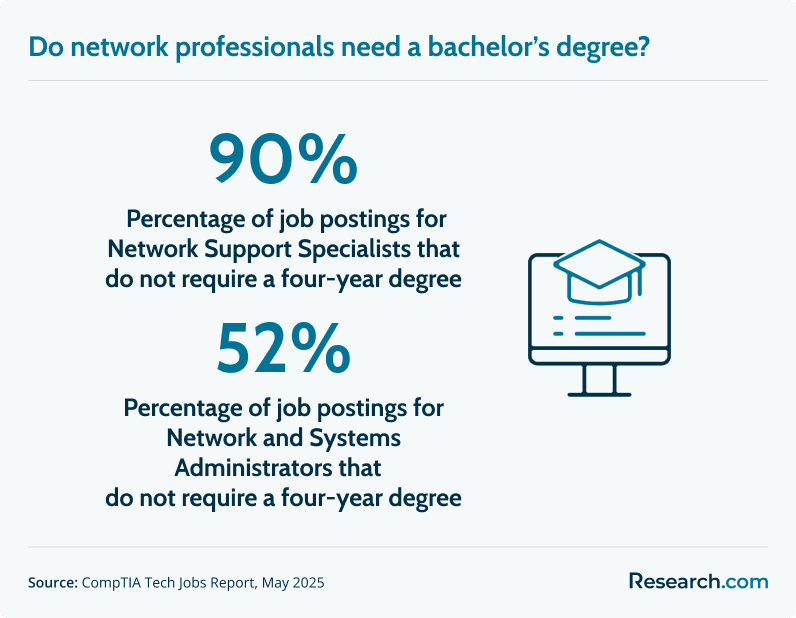
As of April 2025, 90% of job postings for network support specialists and 52% for network and systems administrators did not require a four-year degree (CompTIA, 2025b). This supports the growing relevance of skills-based hiring in some IT roles, but it does not mean every employer will treat a bootcamp certificate and a degree the same way.
If affordability is your priority, compare what is included rather than choosing only by sticker price. The same logic applies when researching related training, such as the cheapest CompTIA cloud training online.
| Cost factor | What to check before enrolling |
| Exam voucher | Ask whether the $390 Network+ exam cost is included |
| Lab access | Confirm how long you can use virtual labs after the course ends |
| Instructor support | Check whether you can ask questions live or only watch recordings |
| Practice exams | Look for full-length practice tests, not only short quizzes |
| Retake or refund policy | Understand what happens if you need more time or do not pass |
| Career services | Verify whether resume, interview, and job search support are included |
Are online CompTIA Network+ training bootcamps as effective as in-person bootcamps?
Online Network+ bootcamps can be as effective as in-person bootcamps when they include live instruction, realistic labs, practice exams, and meaningful instructor access. Many online programs use the same certified instructors and exam objectives as classroom-based training.
The main difference is learning environment. Online bootcamps work best for learners who can manage their time, troubleshoot basic technology issues, and stay engaged without a physical classroom. In-person bootcamps may be better for students who need face-to-face accountability, immediate peer interaction, or access to on-site lab equipment.
Many learners take Network+ before or alongside cybersecurity training. If your goal is security operations or risk-focused IT work, the fastest online CompTIA Security+ training bootcamps may be a logical next comparison after you build networking fundamentals.
| Format | Best for | Potential drawback |
| Online self-paced | Independent learners with irregular schedules | Requires strong discipline and may offer limited feedback |
| Online live instructor-led | Working adults who want structure without commuting | May still offer less informal networking than a classroom |
| In-person bootcamp | Learners who need direct interaction and classroom accountability | Less flexible and may require travel or time away from work |
What are the pros and cons of an online CompTIA Network+ training bootcamp?
An online Network+ bootcamp can be a smart option if you want concentrated exam preparation and practical exposure to networking tasks. It can also be the wrong choice if you need a slower academic pace, extensive career placement, or a degree for your target role.
Pros
- You can study from anywhere with a reliable internet connection.
- Live, part-time, weekend, and self-paced formats can fit around work or family obligations.
- Many programs include labs, simulations, practice tests, and exam vouchers.
- Recorded materials can be reviewed repeatedly before the exam.
- The curriculum is focused on job-relevant networking fundamentals and exam objectives.
Cons
- Some learners miss the accountability and immediate feedback of an in-person classroom.
- Self-paced programs can be difficult to finish without a strict study routine.
- Not every bootcamp provides strong career support or employer connections.
- Advanced roles may require additional experience, vendor-specific certifications, or academic degrees.
- Unreliable internet, outdated devices, or weak home study setups can disrupt learning.
If you want a broader technology pivot, compare Network+ with other short-format pathways. For example, fast-track cybersecurity online training programs may make more sense if your main goal is security rather than networking support.
What topics are covered in an online CompTIA Network+ training bootcamp?
Most Network+ bootcamps are organized around CompTIA exam domains and combine conceptual instruction with practical exercises. The goal is to help you understand not only the vocabulary of networking but also how to diagnose and solve common problems.
- Networking concepts: Learners study the OSI model, protocols, ports, network services, and communication standards used across LANs and WANs.
- Network infrastructure: Courses cover routers, switches, access points, cabling, wireless components, and how physical and virtual networks are configured.
- IP addressing and subnetting: Students learn how IP addresses, subnet masks, gateways, and address allocation affect connectivity and segmentation.
- Network security: Bootcamps introduce firewalls, authentication, encryption, access control, secure network design, and common threats.
- Network operations and troubleshooting: Learners practice using tools and processes for performance monitoring, documentation, fault isolation, change management, and incident response.
- Cloud and virtual networking: Programs may introduce virtualization, cloud deployment models, software-defined networking, and the way traditional network principles apply to scalable cloud systems.
These subjects are also useful outside traditional IT support. Technical literacy can support broader investigative, security, and digital operations roles, including learners exploring what qualifications are needed to become an FBI agent. If your interest is data-focused rather than infrastructure-focused, compare Network+ with accelerated data analytics training programs before committing.
What skills will I develop after an online CompTIA Network+ training bootcamp?
A strong Network+ bootcamp develops both technical and workplace skills. The technical skills help you understand and troubleshoot networks, while the professional skills help you communicate issues clearly and work effectively under pressure.
- Technical troubleshooting: You learn how to isolate connectivity problems, test possible causes, and apply a structured diagnostic process.
- Network configuration awareness: You become more comfortable reading documentation, reviewing settings, and understanding how routers, switches, wireless devices, and IP configurations interact.
- Security thinking: You learn why access control, segmentation, encryption, authentication, and secure configurations matter.
- Attention to detail: Small errors in addresses, cables, documentation, or permissions can break connectivity, so precision becomes a core habit.
- Communication: IT support work requires explaining problems and solutions to both technical teams and nontechnical users.
- Time management: Online programs require learners to plan study blocks, meet deadlines, and keep momentum without constant supervision.
- Adaptability: As technologies change, professionals are expected to help organizations identify hidden skills and build technical and long-term capabilities (Paynter et al., 2024).
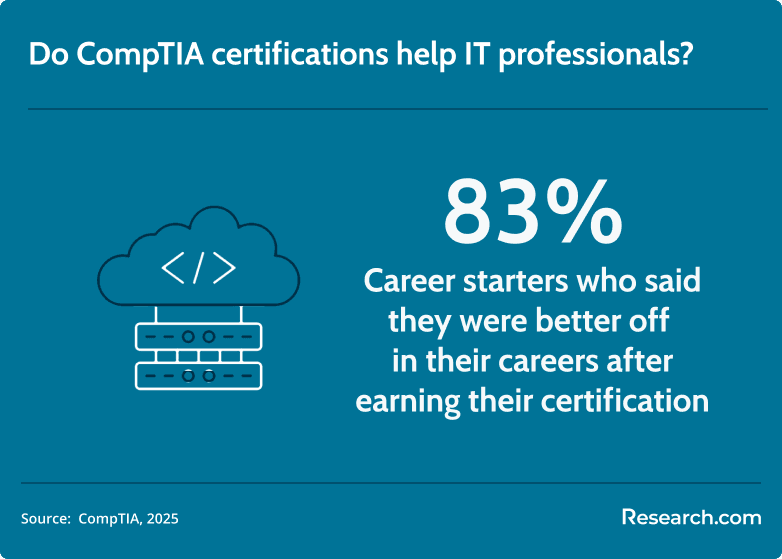
The broader value of these skills is reflected in certification outcomes reported by CompTIA. In 2025, 83% of career starters and 78% of career advancers reported being much better off in their careers after earning a CompTIA certification (CompTIA, 2025a). Network knowledge can also support adjacent fields, including the fraud investigator career path, where digital systems awareness and security fundamentals can be useful.
What is the best way to study for the CompTIA Network+ exam?
The best Network+ study plan combines the official exam objectives, structured lessons, hands-on labs, and repeated practice testing. Avoid relying only on videos or memorization. The exam expects you to understand how networking concepts apply in troubleshooting situations.
- Download and follow the exam objectives: Use the objectives as your checklist so you do not miss a domain.
- Create a weekly study plan: Break topics into manageable blocks and schedule review time before the exam.
- Practice subnetting regularly: Subnetting is easier when you work problems repeatedly instead of trying to learn it all at once.
- Use labs, not only notes: Simulations help connect terms like DNS, DHCP, VLAN, routing, and firewall rules to real tasks.
- Take full-length practice exams: Simulated testing helps you manage time and identify weak areas.
- Review wrong answers carefully: Do not just memorize the correct option; learn why the other choices are wrong.
- Join a study group or discussion forum: Explaining concepts to others can reveal gaps in your own understanding.
- Consider guided training if you are stuck: A bootcamp or related course can help if you need accountability, instructor support, or lab structure.
If cybersecurity is your next goal, you may want to compare Network+ preparation with the fastest online CompTIA Security+ training bootcamps after you understand basic networking.
Should I combine my Network+ certification with a traditional academic degree?
Combining Network+ with a degree can make sense if your long-term goal requires broader technical depth, management preparation, or eligibility for employers that prefer formal education. Network+ is narrow and practical. A degree is usually broader and slower, covering theory, systems design, programming, databases, security, math, project work, and general education.
You may not need a degree for some entry-level support roles, especially when employers prioritize skills and certifications. However, a degree may help if you want to move into network architecture, cybersecurity leadership, cloud engineering, IT management, or software-related roles. Learners exploring very different technology tracks can review options such as a game developer degree online to understand how specialized career goals can influence education choices.
How can Network+ certification support advanced academic opportunities?
Network+ can strengthen an academic profile by showing technical commitment and foundational IT knowledge. It may help you enter a degree program with more confidence, especially if you plan to study cybersecurity, information technology, cloud computing, software engineering, or systems administration.
Professional certifications can also help learners clarify whether they enjoy technical work before committing to a longer degree. Some professionals combine networking knowledge with fields outside traditional IT. For example, someone comparing interdisciplinary graduate options such as a cheap online master's in biotechnology may find that digital infrastructure knowledge is useful in data-heavy research or technology-enabled lab environments.
Does investing in an online CompTIA Network+ bootcamp offer a compelling return on investment?
To evaluate ROI, compare the total cost of the bootcamp with the roles you can realistically pursue afterward. Include tuition, the $390 exam cost if not included, study time, lost work hours, equipment, retake costs, and any additional certifications you may need.
A bootcamp may offer strong value when it helps you pass the exam faster, build practical confidence, and qualify for interviews you could not access before. It may offer weak value if it lacks labs, uses outdated exam content, provides little support, or costs more than comparable programs without clear benefits.
For learners aiming for leadership later, Network+ can be one early step before advanced study such as accelerated online masters in engineering management, but that path is usually relevant only after gaining substantial technical or professional experience.
Is advanced academic education a smart next step after Network+?
Advanced education is most useful after Network+ if it supports a specific career move. A graduate program may make sense for professionals pursuing IT leadership, applied AI, engineering management, cybersecurity strategy, or research-oriented roles. It is usually less urgent for someone still trying to land a first help desk or network support position.
If your goal is to move into automation, machine learning, or AI-supported infrastructure, you may eventually compare technical graduate options such as the cheapest online masters in artificial intelligence. For most beginners, however, the better immediate sequence is Network+, hands-on experience, and then a targeted next credential or degree.
What advanced networking or cloud certifications pair well with Network+?
After Network+, many learners choose a next certification based on the role they want. Security-focused learners often choose Security+. Networking-focused learners may move toward CCNA. Cloud-focused learners may start with AWS or Azure fundamentals. The best next step should align with job postings in your target market.
| Certification | Best next step if you want to... | How it builds on Network+ |
| CompTIA Security+ | Move toward cybersecurity or security operations | Adds risk management, encryption, secure architecture, and threat concepts |
| CompTIA Server+ | Work in systems administration or data center operations | Expands into server architecture, storage, virtualization, and troubleshooting |
| Cisco Certified Network Associate (CCNA) | Develop deeper enterprise networking skills | Applies networking fundamentals in Cisco environments and enterprise-level contexts |
| AWS Certified Cloud Practitioner | Transition toward cloud support or cloud operations | Introduces cloud models, billing, security, and AWS services |
| Microsoft Certified: Azure Fundamentals | Support Microsoft cloud environments | Covers Azure services, cloud concepts, governance, and platform basics |
| Certified Wireless Network Administrator | Specialize in wireless networking | Deepens Wi-Fi protocols, RF fundamentals, wireless security, and troubleshooting |
The CCNA is a common next credential for learners who want to go deeper into networking. If cost is your main concern, compare options such as the cheapest CISCO CCNA training programs online. If you are comparing completely different technical pathways, resources like the shortest data science bootcamp online can help you decide whether networking, cloud, cybersecurity, or data is the better fit.
Continuous learning is becoming more important across technology roles. According to CompTIA (2025c), reskilling and upskilling are now considered 85% more important in the tech industry, making ongoing credential development valuable for long-term competitiveness.
This chart displays the value of upskilling and reskilling across sectors.
What jobs can I get with a CompTIA Network+ training certification?
Network+ can support several entry-level and early-career IT roles. Your exact eligibility depends on your experience, portfolio, interview performance, location, and whether the employer requires a degree or additional certifications.
- Help Desk Technicians ($48,154): Help desk technicians assist users, document incidents, resolve common problems, and escalate issues when needed. Network+ helps with connectivity, remote access, and performance troubleshooting.
- Field Service Technicians ($48,222): Field technicians install, repair, and maintain IT equipment and network hardware at client or employer sites. They often need to troubleshoot independently.
- IT/Network Support Specialists ($79,610): These professionals diagnose connectivity issues, install hardware, support end users, and help maintain stable business networks.
- IT Consultants ($86,843): IT consultants evaluate infrastructure, recommend solutions, assist with implementation, and help organizations improve technology strategy.
- Network Administrators/Engineers ($101,190): These roles involve configuring networks, managing devices, applying security protocols, and maintaining reliable connectivity.
- Cybersecurity Analysts ($127,730): Cybersecurity analysts protect networks and systems from threats, breaches, malware, and compliance risks. Network+ can be a foundation, but additional security training is usually needed.
- Software QA Testers ($110,260): QA testers evaluate application functionality, performance, and reliability. Networking knowledge can help when testing distributed systems or web applications, and learners comparing compensation can review software tester salary trends.
- Network Architects ($135,890): Network architects design network frameworks and plan enterprise infrastructure. This is usually a more advanced role requiring substantial experience beyond Network+.
Network+ can also complement emerging technology education. For example, the fastest online artificial intelligence degree programs may appeal to learners who want to move beyond infrastructure into AI-related systems, while networking knowledge remains useful for understanding how connected systems operate.
This chart displays the average salaries of IT professionals.
What is the job market for graduates with an online CompTIA Network+ training bootcamp certificate?
The job market is mixed, which is why learners should look beyond a single job title. According to the BLS, network and computer systems administrators remain important for maintaining and upgrading networked systems, but employment for that role is projected to decline by -2.6%.
The decline is connected to automation, DevOps practices, and outsourcing models such as Networks-as-a-Service. However, the broader networking field includes roles with stronger projections. Computer network support specialists are expected to see 7.3% growth, while computer network architects are projected to see 13.4% employment growth.
AI and automation are changing the work rather than eliminating the need for networking knowledge. A study by Pearson suggests that network architects may shift away from routine maintenance toward strategic work such as cyber resilience planning, with AI and Robotic Process Automation freeing up as much as 8.8 hours per week for higher-level responsibilities.
To stay competitive, Network+ graduates should keep building skills in security, cloud networking, automation, documentation, and troubleshooting. Some may later pursue degree pathways such as the fastest online bachelor’s in software engineering if they want broader technical mobility.
This chart displays the job outlook for tech professionals.
What do graduates say about online CompTIA Network+ training bootcamps?
- “I was unsure about learning networking online, but the bootcamp schedule gave me enough structure to keep moving. The labs and practice exams helped me connect the exam topics to realistic troubleshooting situations. Being able to study after work made the program manageable, and earning Network+ gave me the confidence to apply for my first IT role.” - Jerome
- “The online format helped me keep my job while preparing for certification. The sessions were more interactive than I expected, and the instructor explained difficult topics clearly. I appreciated that the bootcamp covered technical skills, communication, and the reasoning behind network decisions.” - Kathy
- “I started with no IT background, so I needed a program that explained the basics without rushing past them. The lessons were practical, the support forums helped when I got stuck, and the instructor Q&A made the course feel less isolated. Network+ gave me the push to start applying for IT jobs.” - Martin
Common mistakes to avoid when choosing a Network+ bootcamp
| Mistake | Why it can hurt you | Better approach |
| Choosing only the cheapest program | A low price may exclude labs, exam vouchers, support, or practice tests | Compare total cost and included resources |
| Ignoring the exam version | Outdated content may not match the exam you plan to take | Confirm whether the course aligns with N10-009 or another stated version |
| Skipping hands-on practice | Networking is difficult to learn through memorization alone | Choose a program with labs, simulations, or practical exercises |
| Assuming a bootcamp guarantees employment | Certification can help, but employers also evaluate experience and interview performance | Build a resume, practice interviews, and document projects or labs |
| Not checking support options | Beginners may struggle with subnetting, protocols, or troubleshooting without help | Look for instructor access, office hours, or active discussion channels |
| Overlooking long-term goals | Network+ may not be the final credential for cybersecurity, cloud, or architecture roles | Map your next certification or degree before enrolling |
Questions to ask before enrolling
- Which CompTIA Network+ exam version does the curriculum cover?
- Is the $390 exam voucher included in the listed price?
- How many hours of instruction and lab practice are included?
- Are labs available after the live course ends?
- Can I contact an instructor when I get stuck?
- Does the provider offer full-length practice exams?
- What happens if I need to reschedule or extend access?
- Does the program include career services, and what exactly do those services involve?
- Is the course designed for beginners, or does it assume 9–12 months of experience?
- What certification or role should I pursue after Network+?
References
- CompTIA. (2025a). Assessing Outcomes, Efficacy and Value of Training and Certification 2025. CompTIA Sales Enablement Tools. https://partners.comptia.org/resources/sales-enablement-tools
- CompTIA. (2025b, May). Tech Jobs Report: Monthly #JobsReport May 2025. https://www.comptia.org/en/resources/research/tech-jobs-report
- CompTIA. (2025c, January). Industry Workforce Trends. https://www.comptia.org/en-us/resources/research/industry-workforce-trends
- Indeed. (2025, June 23). Head of IT salary in United States. Retrieved July 1, 2025, from https://www.indeed.com/career/head-of-it/salaries
- U.S. Bureau of Labor Statistics. (2024). Network and Computer Systems Administrators [Interactive data]. May 2024 OEWS Profiles, Occupational Employment and Wage Statistics (OEWS) Profiles. Retrieved July 1, 2025, from https://data.bls.gov/oesprofile
- U.S. Bureau of Labor Statistics. (2025a, April 18). Network and Computer Systems Administrators. Occupational Outlook Handbook. https://www.bls.gov/ooh/computer-and-information-technology/network-and-computer-systems-administrators.htm
- U.S. Bureau of Labor Statistics. (2025b, April 18). Occupational projections, 2023–33, and worker characteristics, 2023 (Numbers in thousands). Employment Projections. https://www.bls.gov/emp/tables/occupational-projections-and-characteristics.htm
- ZipRecruiter. (2025, June 23). IT Consultant Salary. Retrieved July 1, 2025, from https://www.ziprecruiter.com/Salaries/It-Consultant-Salary
Key Insights
- The fastest online CompTIA Network+ bootcamps can take as little as 5 days, while many programs provide 30 to 50 hours of instruction.
- Bootcamp prices vary widely. The average cost typically ranges from $700 to $3,500, and the CompTIA Network+ exam itself costs $390 if a voucher is not included.
- Network+ is most useful for entry-level and early-career roles in IT support, network support, field service, and junior administration. It is not a substitute for experience in advanced roles.
- As of April 2025, 90% of job postings for network support specialists and 52% for network and systems administrators did not require a four-year degree, but employer requirements still vary by role and organization.
- Salary potential depends heavily on role and experience. The BLS reports average annual earnings of $79,610 for computer network support specialists, $101,190 for network and computer systems administrators, and $135,890 for computer network architects.
- The job outlook is uneven: network and computer systems administrators are projected to decline by -2.6%, while computer network support specialists are projected to grow 7.3% and computer network architects 13.4%.
- The best bootcamp is not always the shortest. Prioritize current exam alignment, hands-on labs, practice exams, instructor access, voucher inclusion, and support after the course ends.
- Network+ is a strong foundation, but long-term growth usually requires continued upskilling through Security+, CCNA, cloud certifications, wireless networking credentials, work experience, or a relevant degree.
Other Things You Should Know About the Fastest Online CompTIA Network+ Training Bootcamps
In 2027, numerous online bootcamps offer expedited paths to earning a CompTIA Network+ certification. Notable options include CBT Nuggets, CompTIA’s own training, and Pluralsight. These bootcamps provide intensive courses designed to equip students with the necessary skills and knowledge in just a few weeks.
Some of the fastest online bootcamps for CompTIA Network+ in 2027 include Udemy's accelerated programs, Pluralsight's comprehensive courses, and CompTIA's own fast-track options. These bootcamps provide condensed materials, practice tests, and interactive labs designed to efficiently prepare candidates for certification within a short time frame.