
2027 Best Online Management Information Systems Degree Programs

Co-Founder and Chief Data Scientist
Choosing an online management information systems degree is a business-and-technology decision, not just a college decision. The right MIS program should help you understand how organizations use data, software, networks, cybersecurity, and project management to solve real operational problems. The wrong program can leave you with credits that do not transfer, limited career support, weak technical preparation, or costs that are hard to justify.
This guide is for students comparing online MIS bachelor’s programs, working adults planning a career move into information systems, and business or IT professionals who want a credential that connects both fields. You will learn what online MIS programs cover, how long they take, what they cost, which schools are included in this list, how online study compares with campus learning, what career paths are possible, and how to judge whether a program is worth the investment.
Quick answer: Is an online management information systems degree worth considering?
An online management information systems degree can be a strong option if you want a career that combines business operations with technology. MIS graduates often pursue roles such as systems analyst, business analyst, database administrator, information security analyst, project manager, networking specialist, and IT manager. The degree is especially useful for students who want broader business context than a traditional computer science program but more technical depth than a general business degree.
What are the main benefits of earning an online management information systems degree?
- Career flexibility: An MIS background can prepare graduates for several technology-focused and business-facing roles, including database administrator, information security analyst, networking specialist, systems analyst, and business analyst.
- Early-career earning potential: Graduates with an MIS degree often start with salaries ranging from $50,000 to $70,000.
- Online convenience: Many programs allow students to complete coursework remotely, which can be useful for working adults, parents, military students, and learners who cannot relocate.
- Business and technical balance: MIS programs usually combine programming, databases, analytics, systems design, cybersecurity, project management, and business strategy.
- Pathway to advancement: The degree can support movement into leadership roles because MIS graduates learn how technology decisions affect budgets, operations, risk, and organizational goals.
What can I expect from an online management information systems program?
An online MIS program usually teaches students how to evaluate business problems, design information systems, manage data, support secure technology infrastructure, and communicate technical recommendations to nontechnical stakeholders. Unlike a pure programming degree, MIS focuses on how technology supports organizations. Unlike a general business degree, it includes more technical coursework in systems, databases, networks, analytics, and cybersecurity.
Most online MIS bachelor’s programs combine general education, business core courses, technology courses, electives, and sometimes internships or capstone projects. Many are delivered asynchronously, meaning students can watch lectures and complete assignments on their own schedule as long as they meet deadlines. Some programs may use hybrid formats, live online sessions, group projects, or occasional campus requirements.
| Program component | What it usually covers | Why it matters for MIS careers |
| Business foundation | Accounting, management, marketing, finance, operations, and business communication | Helps students understand how organizations make decisions and measure performance |
| Information systems core | Systems analysis, database management, enterprise systems, IT strategy, and application development | Builds the technical and analytical base needed for systems and analyst roles |
| Data and analytics | Data modeling, reporting, business intelligence, dashboards, and decision support | Prepares students to turn business data into useful insights |
| Cybersecurity and networks | Network fundamentals, security controls, risk management, and compliance concepts | Supports roles that require secure and reliable technology operations |
| Projects or experiential learning | Capstones, simulations, case studies, internships, or team projects | Gives students practice applying MIS concepts to realistic business problems |
Where can I work with an online management information systems program?
MIS graduates are not limited to technology companies. Because nearly every sector depends on information systems, graduates may work in healthcare, finance, insurance, manufacturing, retail, logistics, education, government, consulting, and real estate. Healthcare organizations need professionals who can support data systems, reporting tools, and secure patient-related technology. Financial institutions rely on information systems professionals to manage data, security, compliance, and digital services. Real estate and property management firms use systems for customer records, analytics, transactions, and operations.
| Industry | How MIS skills are used | Possible roles |
| Healthcare | Managing data systems, analytics tools, reporting platforms, and secure IT workflows | Systems analyst, database analyst, health IT specialist |
| Information technology | Supporting software systems, networks, databases, and technology projects | IT analyst, software support engineer, network administrator |
| Finance | Protecting financial data, improving reporting systems, and supporting business intelligence | Business analyst, information security analyst, data analyst |
| Consulting | Helping clients evaluate systems, implement tools, and improve digital processes | Technology consultant, implementation analyst, project coordinator |
| Real estate and operations | Using systems for property data, customer records, workflow automation, and reporting | Systems support specialist, operations analyst, database coordinator |
How much can I make with an online management information systems program?
Salary outcomes vary by role, employer, location, industry, experience, technical skill level, and whether the graduate moves into management. According to ZipRecruiter, the average annual salary for a Management Information System professional is about $105,783 in the U.S., with salaries ranging from $80,000 to $129,500 at the 25th and 75th percentiles respectively. Graduates with an MIS degree often start with salaries ranging from $50,000 to $70,000.
Students should treat salary figures as planning benchmarks, not guarantees. A graduate entering IT support in a smaller market may earn less than someone moving into cybersecurity, analytics, consulting, or management in a higher-cost region. Internships, certifications, portfolio projects, and prior work experience can also affect job offers.
- Best online management information systems programs for 2027
- How long an online MIS degree usually takes
- Online MIS vs. on-campus MIS programs
- Typical online MIS program costs
- Financial aid options for online MIS students
- Admission requirements and prerequisites
- Common online MIS courses
- MIS specialization options
- How to choose the right online MIS program
- Career paths for MIS graduates
- Technology trends affecting MIS careers
- Job market outlook for MIS graduates
- How to evaluate MIS degree ROI
- Challenges in online MIS programs
- Cybersecurity in online MIS curricula
- Using MIS as a path to advanced technology study
- MIS, business strategy, and creative digital innovation
- Interdisciplinary MIS career optionsCreative innovation sectionAdvanced study section
- Advanced data analytics in online MIS programs
- Cybersecurity practices in MIS training
- Student support and career resourcesCybersecurity practicesOnline MIS analytics and supportAdvanced study pathwaysCybersecurity curriculumOnline learning challengesROI evaluationJob market sectionAdditional decision factors
List of Best Online Management Information Systems Programs for 2027
The best online management information systems programs in this guide combine business education with technical coursework in systems analysis, data management, application development, network infrastructure, cybersecurity, analytics, and IT strategy. When reviewing the list, compare more than tuition. Look at accreditation, required credits, transfer policies, online course format, career support, internship options, and whether the curriculum matches your intended role.
How do we rank schools?
Research.com evaluates online MIS programs using available education and institutional data, including accreditation, curriculum structure, affordability, program flexibility, and student-centered factors. Rankings should be used as a starting point, not the only basis for enrollment. Before applying, verify current tuition, fees, transfer credit rules, online learning format, and graduation requirements directly with the institution.
- Integrated Postsecondary Education Data System (IPEDS database)
- Peterson’s database, including their Distance Learning Licensed Data Set
- College Scorecard database
- National Center for Education Statistics
| School | Program length | Required credits | Estimated cost per credit | Accreditation listed |
| University of Memphis | 4 years | 120 | $369 | Association to Advance Collegiate Schools of Business |
| University of Illinois Springfield | 4 years | 120 | $316 | Association to Advance Collegiate Schools of Business |
| Oklahoma State University-Main Campus | 4 years | 120 | $432 | Association to Advance Collegiate Schools of Business |
| Washington State University | 4 years | 120 | $583 | Northwest Commission on Colleges and Universities (NWCCU) |
| Maryville University of St. Louis | 4 years | 128 | $583 | Association to Advance Collegiate Schools of Business |
| Lamar University | 4 years | 120 | $314 | Association to Advance Collegiate Schools of Business |
| Southern New Hampshire University | 4 years | 120 | $330 | New England Commission of Higher Education (NECHE) |
| Northwest Missouri State University | 4 years | 120 | $334 | Association to Advance Collegiate Schools of Business |
| Champlain College | 3 years | 40 | $335 | Association to Advance Collegiate Schools of Business |
| Gardner-Webb University | 4 years | 60 | $375 | Association to Advance Collegiate Schools of Business |
1. University of Memphis Management Information Systems (MIS) Degree
The University of Memphis offers an online Management Information Systems degree through the Fogelman program, with a focus on the connection between business needs and information technology. Students can expect training that supports IT leadership, systems thinking, and decision-making in a changing business environment.
- Program Length: 4 years
- Tracks/concentrations: Management Information Systems
- Estimated Cost per Credit: $369
- Required Credits to Graduate: 120
- Accreditation: Association to Advance Collegiate Schools of Business
2. University of Illinois Springfield Bachelor of Science in Management Information Systems (MIS)
The University of Illinois Springfield (UIS) offers an online Bachelor of Science in Management Information Systems with multiple start dates per year. The program is designed to help students analyze, design, implement, and manage information systems while understanding how hardware, software, and data quality affect organizational decisions.
- Program Length: 4 years
- Tracks/concentrations: Management Information Systems
- Estimated Cost per Credit: $316
- Required Credits to Graduate: 120
- Accreditation: Association to Advance Collegiate Schools of Business
3. Oklahoma State University-Main Campus Management Information Systems (MIS) Degree
Oklahoma State University offers an online MIS degree that emphasizes how organizations use technology and data to improve performance. Coursework blends business subjects with database management, systems analysis and design, networking, cybersecurity, project management, data analytics, business intelligence, and IT strategy.
- Program Length: 4 years
- Tracks/concentrations: Management Information Systems
- Estimated Cost per Credit: $432
- Required Credits to Graduate: 120
- Accreditation: Association to Advance Collegiate Schools of Business
4. Washington State University Management Information Systems (MIS) Degree
The online MIS degree at Washington State University (WSU) combines business preparation with applied technology training. The program emphasizes using technical knowledge to solve organizational problems and improve efficiency. WSU notes that its business faculty is ranked 12th in the world in research productivity and maintains close connections with technology leaders and businesses.
- Program Length: 4 years
- Tracks/concentrations: Management Information Systems
- Estimated Cost per Credit: $583
- Required Credits to Graduate: 120
- Accreditation: Northwest Commission on Colleges and Universities (NWCCU)
5. Maryville University of St. Louis Bachelor of Science in Management Information Systems
Maryville University offers an online Bachelor of Science in Management Information Systems for students who want to connect business requirements with technology solutions. The program is designed to develop professionals who can manage information systems and apply concepts through projects, simulations, and case-based learning.
- Program Length: 4 years
- Tracks/concentrations: Management Information Systems
- Estimated Cost per Credit: $583
- Required Credits to Graduate: 128
- Accreditation: Association to Advance Collegiate Schools of Business
6. Lamar University Bachelor of Business Administration in Management Information Systems
Lamar University offers an online BBA in MIS that combines business analytics methods with technical computer skills. The program prepares students to use data and technology to solve business problems and supports preparation for analyst roles across many organizational functions.
- Program Length: 4 years
- Tracks/concentrations: Management Information Systems
- Estimated Cost per Credit: $314
- Required Credits to Graduate: 120
- Accreditation: Association to Advance Collegiate Schools of Business
7. Southern New Hampshire University BS in Business Administration
Southern New Hampshire University (SNHU) offers a BS in Business Administration with a concentration in Management Information Systems. The program gives students a broad business foundation in areas such as accounting, finance, marketing, and management while adding MIS-focused coursework. Its asynchronous format can be useful for students who need scheduling flexibility within assignment deadlines.
- Program Length: 4 years
- Tracks/concentrations: Management Information Systems
- Estimated Cost per Credit: $330
- Required Credits to Graduate: 120
- Accreditation: New England Commission of Higher Education (NECHE)
8. Northwest Missouri State University Management Information Systems (MIS) Degree
Northwest Missouri State University offers an MIS program that includes topics such as computer programming, network fundamentals, systems analysis and design, database systems, and IT project management. Graduates often move into roles such as system support specialist, solution development engineer, data analyst, software support engineer, or financial analyst. The school reports a high rate of employment or further education within six months of graduation.
- Program Length: 4 years
- Tracks/concentrations: Management Information Systems
- Estimated Cost per Credit: $334
- Required Credits to Graduate: 120
- Accreditation: Association to Advance Collegiate Schools of Business
9. Champlain College Management Information Systems (MIS) Degree
Champlain College offers a 100% online MIS degree intended to connect business knowledge with information technology skills. The curriculum includes IT, business, general education, and elective courses, with emphasis on critical thinking, problem-solving, and practical preparation for changing technologies.
- Program Length: 3 years
- Tracks/concentrations: Management Information Systems
- Estimated Cost per Credit: $335
- Required Credits to Graduate: 40
- Accreditation: Association to Advance Collegiate Schools of Business
10. Gardner-Webb University Management Information Systems (MIS) Degree
Gardner-Webb University offers an online MIS program focused on information management with current technologies. Students study programming, networking, database and information management, and software engineering. MIS students must complete an internship in Computer Science or Management Information Systems, giving them direct practical experience.
- Program Length: 4 years
- Tracks/concentrations: Management Information Systems
- Estimated Cost per Credit: $375
- Required Credits to Graduate: 60
- Accreditation: Association to Advance Collegiate Schools of Business
How long does it take to complete an online management information systems program?
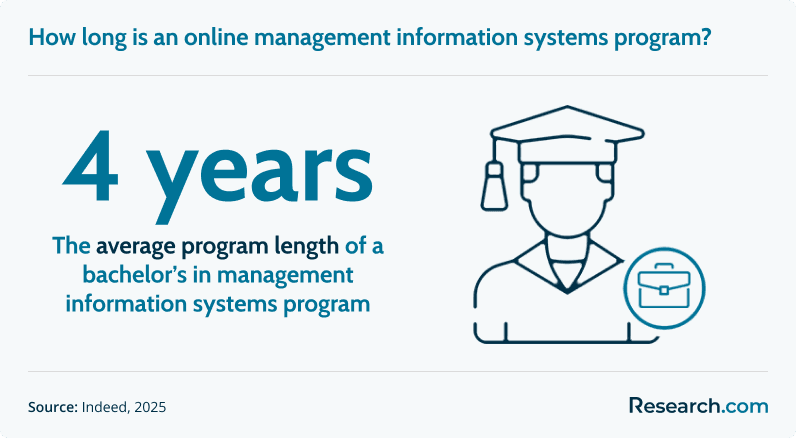
A bachelor’s degree in MIS takes about four years for full-time students. Most bachelor’s programs require approximately 120 credits, including general education, business courses, MIS major courses, and electives. Students comparing MIS with other professional online degrees, such as a construction management degree online, should look closely at credit requirements because program length can vary by transfer credits and course load.
Some students finish faster by transferring prior college credits, enrolling year-round, or choosing an accelerated schedule. Others take longer because they study part time while working. Shorter credentials, such as MIS certificates or diplomas, may take around one year, equivalent to 370 hours, and are usually designed for foundational skill-building rather than full bachelor’s-level preparation. Students interested in fast-track online graduate education in other fields may also compare models such as 1-year online MPH programs to understand how accelerated formats compress coursework.
| Student situation | Likely timeline | What to check before enrolling |
| First-time full-time bachelor’s student | About four years | Total credits, course sequencing, summer availability |
| Transfer student | Less than four years if many credits apply | Transfer credit limits, residency requirements, accepted prior coursework |
| Part-time working student | Often longer than four years | Maximum time to completion, course rotation, advising support |
| Certificate or diploma student | Around one year, equivalent to 370 hours | Whether the credential stacks into a degree |
How does an online management information systems program compare to an on-campus program?
Online and on-campus MIS programs can lead to similar academic outcomes when they are offered by accredited institutions and cover comparable coursework. The difference is usually the learning environment. Online programs offer flexibility and convenience, while campus programs provide more direct face-to-face interaction, structured schedules, and in-person networking.
Online MIS programs are often best for students who can manage deadlines independently, communicate well in digital settings, and need to balance school with work or family responsibilities. Campus programs may be better for students who prefer in-person discussion, immediate access to faculty, labs, student organizations, and local recruiting events. Students interested in combining business and technology at the graduate level may also explore an example of online dual degree program, such as an MBA/MS in Information Systems, if they want a broader credential path.
| Factor | Online MIS program | On-campus MIS program |
| Schedule | Often asynchronous or flexible | Usually fixed class times |
| Networking | Virtual teams, online events, discussion boards, remote career services | In-person classes, clubs, employer events, campus recruiting |
| Learning style | Best for self-directed learners | Best for students who want regular in-person structure |
| Access to faculty | Email, video meetings, learning platforms, office hours | Classroom interaction, office visits, campus advising |
| Best fit | Working adults, remote learners, students needing flexibility | Traditional students, local learners, students who value campus life |
What is the average cost of an online management information systems program?
The average cost of an online Management Information Systems program depends on the school, residency status, transfer credits, fees, and whether the institution is public or private. For undergraduate programs, tuition typically ranges from $225 to $500 per credit hour, or approximately $27,000 to $64,000 for a bachelor’s degree. Students comparing technology and information-focused degrees may see similar cost questions in other fields, including mlis degree cost.
Examples of program pricing vary. Maryville University lists tuition ranging from $426 to $467 per credit hour, while the University of Maryland Global Campus charges around $318 per credit for in-state students. These figures should be confirmed with each school because tuition and fees can change.
Cost should be evaluated alongside career goals. For example, students asking what can I do with an associate's in computer science? may find that a shorter credential supports entry-level IT support, software development, network administration, or cybersecurity roles, while an MIS bachelor’s degree may be more suitable for analyst, systems, and business-technology positions.
Information-focused careers also exist outside traditional IT. Students asking what can you do with a master's in library science? may find roles such as librarian, digital archivist, research analyst, or information specialist, which illustrates how information management skills can apply across sectors.
What are the financial aid options for students enrolling in an online management information systems program?
Online MIS students may qualify for many of the same financial aid options as campus students, provided the program and institution meet eligibility rules. Before borrowing, compare the total cost of attendance, not just tuition. Fees, textbooks, software, hardware, exam costs, and transfer credit policies can change the real price of the degree.
- FAFSA: The Free Application for Federal Student Aid is the first step for most federal grants, loans, and work-study eligibility.
- Grants: Need-based aid such as the Pell Grant and the Federal Supplemental Educational Opportunity Grant (FSEOG) generally does not need to be repaid.
- Institutional scholarships: Schools may offer scholarships for business, technology, MIS, transfer, adult, military, or online students.
- Private scholarships: Professional associations, employers, community foundations, and nonprofit organizations may sponsor awards based on merit, need, background, or career goals.
- Employer tuition assistance: Working adults should ask whether their employer reimburses tuition for job-related technology or business programs.
- Private loans: Banks and financial institutions may offer loans, but students should compare interest rates, repayment terms, and borrower protections against federal options.
| Cost question | Why it matters | What to ask the school |
| Is tuition charged by credit or term? | Pricing models affect part-time and full-time students differently. | What is my estimated total cost after transfer credits? |
| Are online fees separate? | Technology, platform, and distance-learning fees can add up. | Which fees are mandatory for online students? |
| Will my previous credits transfer? | Accepted credits can reduce both time and cost. | Can I receive a written transfer evaluation before enrolling? |
| Does the program require paid software or hardware? | MIS coursework may require database, analytics, security, or development tools. | Which tools are included and which must I buy? |
What are the prerequisites for enrolling in an online management information systems program?
Admission requirements differ by school and degree level. Undergraduate MIS programs typically expect a high school diploma or equivalent, while graduate MIS programs require a bachelor’s degree from an accredited institution. Requirements can vary across disciplines; for instance, accounting certifications online may have a different set of prerequisites than an MIS bachelor’s or master’s program.
- Academic background: Undergraduate applicants usually need a high school diploma or equivalent. Graduate applicants usually need a bachelor’s degree from an accredited institution.
- GPA requirements: Many programs set a minimum GPA, often ranging from 2.5 to 3.0 depending on the institution.
- Prerequisite courses: Some graduate MIS programs expect prior exposure to programming, such as Java or C#, database management, SQL, systems analysis, and systems design. Undergraduate programs may only assume basic computer and business readiness.
- Standardized tests: Some graduate programs may require GMAT or GRE scores.
- Application materials: Graduate admissions may require letters of recommendation, a personal statement, a resume, and evidence of professional goals.
What courses are typically in an online management information systems program?
An online Management Information Systems (MIS) curriculum usually combines business knowledge, technical foundations, and applied problem-solving. Course names vary, but most programs are built around systems, data, software, networks, cybersecurity, and organizational decision-making.
- Introduction to Management of Information Systems: Covers the role of computer systems in organizations, including business software, operating systems, systems development, and databases.
- Business Communications: Develops written, verbal, and digital communication skills for business and technical settings.
- Project Management: Teaches planning, scheduling, resource management, risk tracking, and performance monitoring using project management methods and tools such as Microsoft Project.
- Information Technology Strategic Planning: Explores how organizations align technology investments with goals, budgets, risk, and operational priorities.
- Application Development: Introduces programming languages such as Python or Java and focuses on applications that support business processes.
- Database Management: Covers database design, querying, data integrity, and use of systems such as SQL-based platforms.
- Systems Analysis and Design: Teaches students how to gather requirements, model business processes, evaluate solutions, and support implementation.
- Cybersecurity Fundamentals: Introduces risk, controls, network security, identity management, and compliance concepts.
What types of specializations are available in an online management information systems program?
Specializations help students align an MIS degree with a specific career direction. Not every school offers concentrations, so applicants should review electives and capstone options, not just the program title.
| Specialization | What students study | Career fit |
| Business Analytics | SQL, Tableau, SAS, reporting, dashboards, and interpretation of complex data sets | Data analyst, business intelligence analyst, reporting analyst |
| Cybersecurity | Security protocols, risk management, compliance, threat awareness, and defense strategies | Information security analyst, security coordinator, risk analyst |
| Database Management | Database design, administration, performance, storage, and retrieval | Database administrator, data management analyst |
| Enterprise Systems | Large-scale systems such as SAP or Oracle ERP and business process integration | ERP analyst, implementation consultant, systems analyst |
| Network Administration | Network design, implementation, troubleshooting, and maintenance | Network administrator, infrastructure support specialist |
How to choose the best online management information systems program?
The best online MIS program is the one that fits your career goal, budget, learning style, and prior credits. Students comparing MIS with related business technology paths, such as a project manager degree online, should focus on curriculum depth, accreditation, experiential learning, and career outcomes rather than rankings alone.
- Confirm accreditation: Look for institutional accreditation and relevant business accreditation such as AACSB or ABET when applicable. Accreditation can affect transfer credits, graduate school options, employer recognition, and financial aid eligibility.
- Review the curriculum carefully: A strong MIS curriculum should include databases, systems analysis, programming or application development, project management, cybersecurity, analytics, and business strategy.
- Compare total cost: Evaluate tuition, fees, software, books, transfer credits, and expected time to completion.
- Check online course delivery: Ask whether courses are asynchronous, synchronous, hybrid, self-paced, or cohort-based.
- Look for applied experience: Internships, capstones, case projects, labs, simulations, and employer-connected assignments can strengthen your resume.
- Evaluate career support: Look for resume help, mock interviews, internship placement, employer events, alumni networking, and job boards.
- Ask about transfer and prior learning credit: A generous transfer policy can reduce both cost and time.
- Do not rely only on rankings: Rankings can help identify options, but your final choice should be based on fit, affordability, credibility, and outcomes.
| Common mistake | Why it can hurt you | Better approach |
| Choosing the cheapest tuition without checking fees | The final cost may be higher than expected. | Request a full cost estimate before enrolling. |
| Ignoring accreditation | Credits may not transfer and employers may question the credential. | Verify institutional and program-level accreditation. |
| Assuming all online programs are fully flexible | Some require live sessions, group meetings, or strict course sequences. | Ask how courses are delivered and scheduled. |
| Skipping career services research | You may graduate without strong internship or job-search support. | Ask for examples of career resources for online MIS students. |
| Assuming salary outcomes are guaranteed | Pay depends on role, location, skills, experience, and employer demand. | Compare job postings in your target market before committing. |
What career paths are available for graduates of an online management information systems program?
MIS graduates can work in roles that translate business needs into technology solutions. Common career paths include systems analyst, Business Analyst, project manager, network administrator, software engineer, database administrator, information security analyst, and IT consultant. These roles exist across technology, finance, healthcare, retail, education, government, consulting, and other sectors.
The strongest candidates usually combine the degree with practical experience. Internships, help desk work, analytics projects, database projects, cloud exposure, cybersecurity labs, and business process improvement experience can make an MIS graduate more competitive. Some graduates eventually move into leadership roles such as information systems manager or Chief Information Officer (CIO). Students who want to strengthen communication, documentation, or content strategy skills may also explore complementary education such as writing degrees online, especially if they plan to work in technical documentation, product communication, or training.
| Role | Typical focus | Useful MIS strengths |
| Systems Analyst | Evaluating business processes and recommending technology improvements | Systems analysis, requirements gathering, communication |
| Business Analyst | Using data and stakeholder input to improve operations and decisions | Analytics, business process knowledge, reporting |
| Database Administrator | Managing databases, access, performance, and data integrity | SQL, database design, data governance |
| Information Security Analyst | Protecting systems, monitoring risk, and supporting security controls | Cybersecurity, networks, risk management |
| Project Manager | Planning and coordinating technology or business systems projects | Project planning, stakeholder communication, budgeting |
| Network Administrator | Maintaining network infrastructure and connectivity | Networking, troubleshooting, security basics |
| Information Systems Manager | Overseeing teams, systems, vendors, budgets, and IT strategy | Leadership, IT planning, business alignment |
How will emerging technology trends influence my online MIS career?
Artificial intelligence, machine learning, automation, cloud platforms, cybersecurity risk, and advanced analytics are changing what employers expect from MIS professionals. The core value of MIS remains the same: connecting business needs with useful, secure, and scalable technology. What is changing is the toolset. Employers increasingly value graduates who can understand data workflows, evaluate software platforms, communicate with technical teams, and help organizations adopt technology responsibly.
Students should expect ongoing learning after graduation. Certifications, portfolio projects, vendor-specific tools, and industry experience can help MIS graduates keep pace with changing systems. Guides to computer science degree jobs can also help students understand how deeper technical skills may expand long-term opportunities.
What is the job market for graduates with an online management information systems degree?
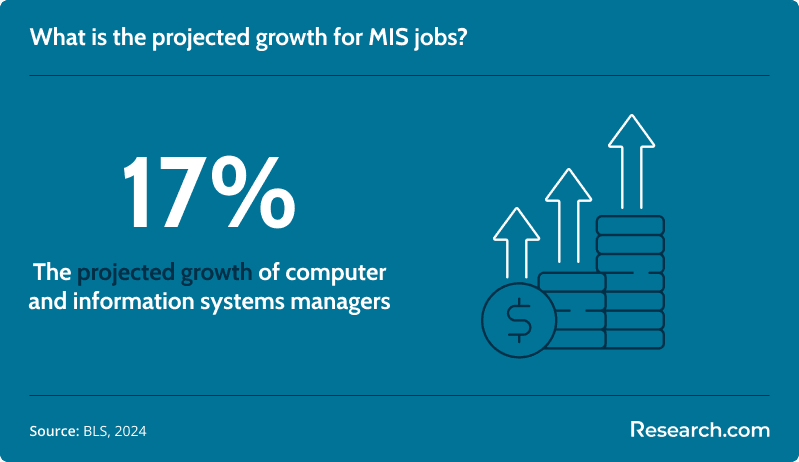
The job market for MIS graduates is supported by the broad use of digital systems across industries. MIS professionals help organizations manage databases, improve workflows, protect information, evaluate technology investments, and translate business needs into technical solutions. The field of computer and information systems management is projected to grow at a rate of 17% from 2023 to 2033, much faster than the average for all occupations. Over 151,862 active positions exist for information systems managers alone.
Graduates should remember that “MIS job market” covers many roles, not a single occupation. Entry-level positions may include analyst, support, database, security, and project coordination roles, while management jobs usually require experience. Related information-focused fields also exist; for example, students researching jobs for library science degrees can see how data, systems, and information organization skills appear in multiple professional contexts.
What is the return on investment for an online management information systems program?
The return on investment for an online MIS program depends on total program cost, transfer credits, financial aid, time to completion, current income, likely job opportunities, and long-term career goals. A lower-cost program is not always the best value if it lacks career support or technical depth. A higher-cost program may be harder to justify if it does not improve your access to internships, employer networks, or relevant skills.
To evaluate ROI, compare your expected total cost against realistic salary ranges for your target roles. Use local job postings, school outcomes data, alumni information, and salary sources. Also consider opportunity cost: if you study part time while working, you may preserve income but take longer; if you study full time, you may finish faster but reduce earnings during school. For a broader discussion of major value and career fit, review this guide to whether a MIS degree makes sense.
What challenges should students anticipate in online MIS programs?
Online MIS programs offer flexibility, but they require discipline. Students must keep up with technical assignments, group projects, discussion deadlines, software tools, and sometimes complex labs without the daily structure of campus classes. Limited face-to-face interaction can also make networking harder unless the program actively provides virtual events, team projects, faculty access, and career support.
Technical readiness matters. Students should have reliable internet, a suitable computer, backup access when possible, and comfort learning new software. Those who want a more intensive technical path may compare MIS with an online accelerated computer science degree, especially if their primary goal is software engineering or advanced computing rather than business technology management.
How do online MIS programs integrate cybersecurity into their curriculum?
Cybersecurity is now a core concern in MIS because business systems must be reliable, compliant, and protected. Online MIS programs often include cybersecurity through courses or modules on risk assessment, network security, incident response, encryption, access control, regulatory compliance, and data protection. The strongest programs connect these topics to business consequences such as downtime, financial loss, privacy obligations, and reputational risk.
Students who want a deeper security focus should compare MIS cybersecurity electives with dedicated security degrees. Cost-focused students can also review options for an affordable online cyber security degree to decide whether a specialized cybersecurity path is a better fit.
Can online MIS programs pave the way for advanced studies in emerging technologies?
An online MIS degree can be a foundation for graduate study or specialized training in analytics, artificial intelligence, cybersecurity, cloud systems, enterprise systems, or technology management. Because MIS sits between business and IT, it can prepare students to move into advanced programs that require both technical awareness and strategic thinking.
Students planning graduate study should confirm whether undergraduate credits, electives, and prerequisites align with future programs. Some may pursue a masters in artificial intelligence online or related certifications after building a foundation in systems, data, and organizational technology.
How can online MIS programs bridge business acumen with creative digital innovation?
MIS is not limited to back-office systems. Many organizations need professionals who understand digital products, user experience, multimedia platforms, customer data, and creative technology workflows. Online MIS programs can support this direction when they include project-based learning, digital strategy, analytics, systems design, and electives that connect technology with customer-facing innovation.
Students interested in creative technology roles should look for programs that allow electives or projects in digital media, product management, UX, interactive systems, or data-driven marketing. Those who want a more specialized creative technology path may compare MIS with an online game design degree to decide whether they want broader business systems training or deeper creative production skills.
How can online MIS programs expand interdisciplinary career opportunities?
Online MIS programs can open interdisciplinary opportunities because information systems are used in nearly every professional field. Students can pair MIS skills with healthcare, finance, operations, supply chain, education, cybersecurity, analytics, or scientific data environments. The key is to choose electives, projects, and internships that match the industry you want to enter.
For students interested in data-heavy scientific or healthcare settings, interdisciplinary study can be especially useful. For example, pairing MIS knowledge with online masters in bioinformatics training may support work in environments that rely on large-scale biological, clinical, or research data systems.
How do online MIS programs develop advanced data analytics skills?
Online MIS programs build analytics skills by teaching students how data is collected, stored, cleaned, analyzed, visualized, and used in business decisions. Coursework may include SQL, dashboards, reporting tools, business intelligence, predictive modeling concepts, and data-driven project work. The goal is not only to calculate results but also to explain what the results mean for managers, teams, customers, and operations.
Students who want analytics-heavy careers should look for programs with database projects, visualization assignments, large dataset work, and industry-standard tools. Those who want deeper statistical and machine learning preparation may compare MIS coursework with a data science master online curriculum.
How do online MIS programs integrate robust cybersecurity practices?
Strong MIS programs teach cybersecurity as part of responsible information systems management. Students may study risk assessment, compliance, incident response, authentication, network defense, data privacy, and security governance. Applied projects are especially valuable because they help students connect technical controls to business priorities.
Students considering an earlier or shorter cybersecurity credential may compare degree levels before committing. This guide, Is an associate's degree in cyber security worth it?, can help clarify when a two-year cybersecurity path may be enough and when a broader MIS bachelor’s degree may offer more flexibility.
What student support services and career resources do online MIS programs offer?
Good online MIS programs should provide more than recorded lectures. Look for academic advising, technical support, tutoring, writing help, library access, faculty office hours, internship assistance, career coaching, resume reviews, mock interviews, virtual career fairs, employer connections, alumni networks, and job boards. These services matter because MIS careers often require both technical skill and professional communication.
Students who want to combine MIS with deeper technical specialization should also ask whether career services support technology fields beyond general business roles. For example, students comparing advanced AI options may review the cheapest online master's programs in artificial intelligence while evaluating how each school supports technical career growth.
Practical steps before you apply to an online MIS program
- Define your target role first: Decide whether you want analytics, cybersecurity, systems analysis, project management, database work, consulting, or IT leadership.
- Map the curriculum to that role: Check whether the program includes the tools, courses, and projects your target jobs require.
- Verify accreditation: Confirm institutional accreditation and any relevant business or technology accreditation.
- Request a transfer evaluation: If you have prior credits, ask how many apply before you commit.
- Calculate total cost: Include tuition, fees, books, software, hardware, and lost income if applicable.
- Ask about career outcomes: Request information on internships, employer partnerships, alumni roles, and career services for online students.
- Test the online format: Ask whether courses are asynchronous, live, self-paced, or cohort-based.
- Plan for experience: Build a portfolio through projects, internships, certifications, labs, or part-time IT work.
Key Insights
- An online MIS degree is best for students who want to connect business strategy with technology systems, data, cybersecurity, and project work.
- A bachelor’s degree in MIS takes about four years for full-time students, though transfer credits and accelerated schedules can shorten the timeline.
- For undergraduate programs, tuition typically ranges from $225 to $500 per credit hour, or approximately $27,000 to $64,000 for a bachelor’s degree.
- Graduates with an MIS degree often start with salaries ranging from $50,000 to $70,000, while ZipRecruiter reports an average annual salary of about $105,783 for a Management Information System professional in the U.S.
- The field of computer and information systems management is projected to grow at a rate of 17% from 2023 to 2033, and over 151,862 active positions exist for information systems managers.
- Accreditation, curriculum quality, career support, transfer credit policy, and total cost are more important than rankings alone.
- Online MIS programs can be flexible, but students need strong time management, reliable technology, and proactive networking habits.
- The strongest ROI usually comes from pairing the degree with practical experience, portfolio projects, internships, certifications, and a clear target role.
References:
- Bureau of Labor Statistics (2024). Computer and Information Systems Managers.
- Institute for Business and Information Technology (2022). Information Systems Job Index 2022.
- National Association of Colleges and Employers (2022). MIS Projected To Be Top-Paid Business Major.
- National Center for Education Statistics (2022). Fast Facts: Most Popular Majors.
- Payscale (2024). Management Information Systems (MIS) Jobs by Salary.
- Society for Information Management (2021). IT Trends Study 2022.
- Solarwinds (2022). IT Trends Report 2022.
Other Things You Should Know About the Best Online Management Information Systems Programs
No, most online MIS programs do not require an internship, but many require a capstone or practicum. If an internship is offered, schools often set a minimum of 120 credit hours completed before enrollment and may require employer approval or faculty supervision.
Admission to an online Management Information Systems degree in 2027 typically requires a high school diploma or GED, proficiency in mathematics, and basic computer skills. Some programs may also require standardized test scores like the SAT or ACT and prior coursework in information systems.


