2027 Best Online CCNA Training Bootcamps

Co-Founder and Chief Data Scientist
The Cisco Certified Network Associate (CCNA) certification is a globally recognized credential that validates your ability to install, configure, and troubleshoot networks—making it a key stepping stone for anyone pursuing a career in information technology or networking.
Earning a CCNA not only enhances your resume but also opens doors to entry-level network engineer roles and positions you for higher salaries and career growth in a tech-driven world.
One of the most efficient ways to prepare for the CCNA exam is through a training bootcamp, which offers a fast-paced, structured learning environment designed to cover core networking concepts in a short amount of time. Opting for online bootcamps adds convenience and flexibility.
In this article, we’ll explore the best online CCNA training bootcamps available today—highlighting their features and pros—so you can confidently choose the right path toward certification success.
What are the benefits of pursuing online CCNA training bootcamps?
Online CCNA training bootcamps have become a go-to option for tech learners who want to gain networking skills quickly and efficiently. Whether you're new to IT or looking to advance your career, these programs offer several key advantages that make them worth considering:
- Flexibility and Convenience: Study from anywhere and access course materials on your own schedule—ideal for working professionals or busy students.
- Accelerated Learning: Bootcamps are designed to be intensive and focused, helping you prepare for the CCNA exam in weeks rather than months.
- Comprehensive Exam Prep: Get access to quizzes, practice exams, and study guides that are aligned with the latest CCNA objectives.
- Cost-Effective Options: Online bootcamps tend to be more affordable than in-person classes, and often offer payment plans or subscriptions.
- Career Advancement: Earning a CCNA through a reputable bootcamp can strengthen your resume, boost job opportunities, and lead to higher salaries in IT roles.
What can I expect from online CCNA training bootcamps?
Online CCNA training bootcamps are designed to prepare you thoroughly and efficiently for the CCNA certification exam. They combine theoretical knowledge with hands-on practice to ensure you're job-ready by the end of the program. Here's what you can typically expect from these courses:
- Structured Curriculum Aligned with the CCNA Exam: Bootcamps follow Cisco’s latest exam objectives, covering topics like networking fundamentals, IP services, security fundamentals, automation, and more.
- Interactive Learning Tools: You’ll engage with video lectures, live or recorded classes, quizzes, and assignments that help reinforce key concepts.
- Virtual Labs and Real-World Simulations: Many bootcamps provide access to lab environments where you can configure routers, switches, and troubleshoot networks—just like you would in a real job.
- Access to Expert Instructors: Expect support from certified instructors and industry professionals who can break down complex networking concepts, answer questions, provide feedback, and guide your study process through exam topics.
- Flexible Learning Pace: Whether it's self-paced or scheduled live sessions, most online bootcamps offer options that fit your availability and preferred learning style.
- Exam Preparation and Support: From practice tests to study guides and community discussion forums, bootcamps often include tools that help you gauge your readiness and stay motivated.
- Certification Guidance and Career Resources: Some programs also offer help with scheduling your exam, resume tips, or even job placement assistance to help you apply your new skills in the workforce.
Where can I work with an online CCNA certification?
With a CCNA certification earned through online CCNA training bootcamps, you can qualify for roles across a variety of industries and work environments. This credential is recognized globally and valued by employers who rely on secure and efficient networks. Here are some common work settings where CCNA-certified professionals are in demand:
- Corporate IT Departments: Large and mid-sized companies across all industries need in-house network professionals to manage internal systems, troubleshoot issues, and maintain network security.
- Managed Service Providers (MSPs): These third-party companies offer IT support and infrastructure services to multiple clients, making them a frequent employer of CCNA-certified technicians and administrators.
- Government Agencies and Public Institutions: Local, state, and federal agencies—including military and public schools—require certified professionals to maintain secure and reliable networks.
- Telecommunications Companies: Internet service providers, telecom firms, and network infrastructure companies rely on CCNA-certified staff to manage and optimize large-scale networks.
- Healthcare Organizations: Hospitals and clinics need secure and stable networks to handle sensitive patient data and support health IT systems, creating demand for skilled networking professionals.
- Educational Institutions: Universities, colleges, and even K–12 school systems employ IT staff to maintain their campus networks and support digital learning technologies.
- Data Centers and Cloud Service Providers: These tech-intensive environments hire professionals to help manage servers, switches, routers, and cloud-based network services.
A CCNA certification gives you the flexibility to work in nearly any industry that depends on digital infrastructure—offering broad career opportunities whether you prefer a corporate setting, public service, or the fast-paced world of tech.
How much can I make with an online CCNA certification?
While salaries can vary based on experience, location, and job role, holding a CCNA certification—regardless of whether it's earned through an online program—can significantly boost your earning potential in the IT field. It shows employers that you have validated, job-ready networking skills, making you a more competitive candidate for both entry-level and mid-level positions.
Here’s a general idea of what you can earn with a CCNA certification:
- Entry-Level Roles (e.g., IT Support Specialist, Network Technician): Typically earn between $50,000 and $70,000 per year, depending on the region and company size.
- Mid-Level Positions (e.g., Network Administrator, Systems Administrator): Salaries often range from $70,000 to $90,000 annually, especially with a few years of experience or additional certifications.
- Advanced Opportunities (e.g., Junior Network Engineer, Security Analyst): Can earn upwards of $90,000 to $110,000+, especially in high-demand sectors or major tech hubs.
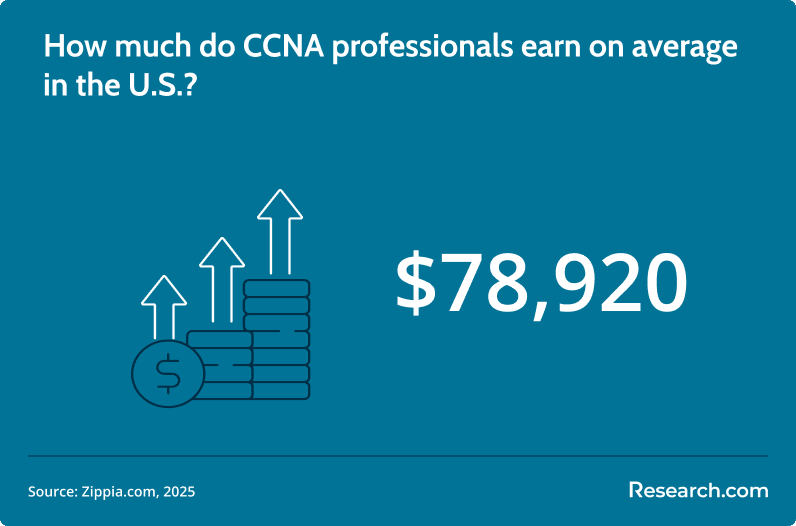
According to Payscale and Glassdoor, the average salary for a CCNA-certified professional in the U.S. is around $80,000 per year, with room to grow as you gain more experience or pursue higher-level Cisco certifications like CCNP or Cisco Certified Internetwork Expert (CCIE).
An online CCNA bootcamp can be your gateway to a lucrative career in networking—even if you’re just starting out.
- List of the Best Online CCNA Training Bootcamps for 2027 List of Bootcamps
- What is the value of a CCNA Certification? What is the value of a CCNA Certification?
- How long do typical CCNA training courses take? How long do typical CCNA training courses take?
- What are the prerequisites for enrolling in online CCNA training bootcamps? Requirements
- What score do I need to pass the CCNA certification exam? What score do I need to pass the CCNA certification exam?
- How much do online CCNA training bootcamps typically cost? Cost
- What are the differences between in-person and online CCNA training bootcamps? In-Person vs. Online
- What are the topics included in online CCNA training bootcamps? Topics
- How do you choose the best online CCNA training bootcamp? How do you choose the best online CCNA training bootcamp?
- What career paths are available for those with Cisco CCNA certification? Career Paths
- Should I Pursue Further Academic Education After Earning a CCNA Certification? Should I Pursue Further Academic Education After Earning a CCNA Certification?
- What Are the Long-Term Career Outcomes of Online CCNA Training Bootcamps? What Are the Long-Term Career Outcomes of Online CCNA Training Bootcamps?
Best Online CCNA Training Bootcamps for 2027
Choosing an online CCNA training bootcamp is not just a question of finding the shortest course or the lowest price. The real decision is whether a program can help you build practical networking skills, practice with labs, understand Cisco exam objectives, and prepare for the CCNA 200-301 exam without wasting time or money. This guide is for beginners entering IT, help desk professionals moving toward networking, systems administrators who need stronger network knowledge, and working adults comparing flexible online IT training options.
Below, you will find a practical comparison of online CCNA bootcamps, what they include, how long they take, what the certification can do for your career, and how to avoid common mistakes when selecting a program. The goal is to help you choose a training path that fits your schedule, budget, experience level, and certification timeline.
Quick Answer: What Is the Best Online CCNA Bootcamp?
The best online CCNA bootcamp is the one that closely follows the Cisco CCNA 200-301 exam objectives, includes hands-on labs or network simulations, provides realistic practice exams, and matches your learning style. Self-paced learners may prefer lower-cost video courses from providers such as Udemy, Pluralsight, or Kevin Wallace Training. Learners who need live instruction, exam vouchers, and a highly structured schedule may prefer intensive bootcamps from university continuing education units or Cisco-authorized training providers.
If you are new to networking, prioritize programs with guided labs, instructor access, and practice exams. If you already work in IT, a shorter intensive program may be enough to organize your knowledge and prepare for the exam.
How do we rank programs and training bootcamps?
Research.com evaluates training options by looking at program structure, curriculum relevance, provider credibility, flexibility, published costs, available support, exam preparation resources, and usefulness for different learner profiles. When institutional data is relevant, our research process may include the IPEDS database, Peterson's database, the College Scorecard database, and the National Center for Education Statistics.
Because CCNA bootcamps vary widely in format, cost, support, and included materials, rankings should be used as a starting point rather than the only factor in your decision. Before enrolling, confirm current tuition, refund terms, exam voucher availability, access length, and whether the curriculum is aligned with the current Cisco CCNA exam. You can read more about our broader evaluation process in our methodology section.
Online CCNA Bootcamps at a Glance
| Program | Format and Best Fit | Length | Published Cost | Notable Features |
| ICOHS College - Cisco CCNA Certification Bootcamp | Structured bootcamp for learners who want instructor-led preparation | 15 weeks | N/A | Official Cisco study resources, video tutorials, practice labs, simulations, and practice tests |
| Pluralsight - Cisco CCNA: Cisco Certified Network Associate (CCNA 200-301) | Self-paced learning path for independent learners | 59 hours | N/A | 22 expert-led courses and a free 10-day trial |
| Morgan State University - Cisco CCNA Dual Certification Training Bootcamp | Live online bootcamp for current IT professionals | 7 days | N/A | CCNA Associate and CyberOps Associate preparation, powered by Infosec |
| Udemy - CCNA 2020 200-125 Video Boot Camp with Chris Bryant | Budget-friendly video course for self-directed review | 62.5 hours | $110 | 46 sections, 467 lectures, downloadable resources, and mobile/TV access |
| Kevin Wallace Training - Cisco CCNA 200-301 Video Training Series | Concise video training from an experienced Cisco instructor | 15 hours | $890 | 10 modules, quizzes, Packet Tracer Labs, and exam-day guidance |
| Boson - CCNA: Implementing and Administering Cisco Solutions Bootcamp | Premium intensive bootcamp with exam and simulation resources | 5 days | $4,195 | Lectures, labs, self-study, CCNA exam voucher, practice exam, simulator, and retake voucher |
| San Diego State University Global Campus - Cisco CCNA Associate & Cybersecurity Associate Training Boot Camp | Dual-certification bootcamp for networking and cybersecurity preparation | 7 days | $4,359 | Exam vouchers for two certifications, labs, expert instruction, and retake voucher |
| California State Polytechnic University, Pomona - Cisco CCNA Dual Certification Training Boot Camp | University-affiliated dual-certification training | 7 days | $3,999 | Industry expert lectures, unlimited practice exam attempts, one-year video access, and Infosec Skills subscription |
| Training Camp - Cisco Official CCNA Boot Camp & Certification Training | Cisco-authorized intensive preparation for learners who want a highly structured bootcamp | 5 days | N/A | Cisco-authorized courseware, labs, recordings, retake option, and provider-stated 97% first-time CCNA exam pass rate |
| Udemy - Cisco CCNA 200-301 - The Complete Guide to Getting Certified | Self-paced comprehensive course for independent learners | 42.5 hours | $139.99 | 40 sections, 326 lectures, over 200 downloadable resources, 31 articles, labs, study guides, flashcards, and active Q&A |
1. ICOHS College - Cisco CCNA Certification Bootcamp
ICOHS College offers a 15-week Cisco CCNA certification bootcamp built around the technical areas tested on the exam, including network fundamentals, routing technologies, LAN switching technologies, infrastructure services, IP services, IP connectivity, infrastructure maintenance, security and automation, and programmability. The longer format may appeal to learners who want more time to absorb networking concepts rather than complete a compressed one-week course.
The program includes instructor guidance and access to Cisco study guides, video tutorials, practice labs, online courses, and whitepapers. Learners also work with simulations and practice tests, which are especially important because the CCNA exam expects more than memorization; you need to understand how to diagnose and configure network environments.
- Program length: 15 weeks
- Cost: N/A
- Accreditation: Accrediting Council for Continuing Education and Training
2. Pluralsight - Cisco CCNA: Cisco Certified Network Associate (CCNA 200-301)
Pluralsight provides a Cisco CCNA 200-301 learning path made up of 22 curated courses. The curriculum covers network fundamentals, network access, IP connectivity, IP services, automation, and programmability, making it a strong option for learners who prefer an organized self-paced library over a scheduled live bootcamp.
This option works best for disciplined learners who can create their own study calendar and supplement video instruction with lab practice. A free 10-day trial is available, which can help you decide whether the teaching style and course platform fit your needs before committing.
- Program length: 59 hours
- Number of courses: 22
- Cost: N/A
3. Morgan State University - Cisco CCNA Dual Certification Training Bootcamp
Morgan State University offers a 7-day live online bootcamp designed to prepare learners for two Cisco credentials: CCNA Associate and CyberOps Associate. The bootcamp is powered by Infosec and focuses on installing, configuring, and operating network devices using Cisco-aligned practices.
This program is most appropriate for working IT professionals, such as network engineers, network administrators, systems engineers, systems administrators, and IT managers or directors. There are no formal prerequisites listed for enrollment, but the provider recommends familiarity with networking concepts. Learners also receive 90 days of replay access to daily video lessons after finishing the bootcamp, which is valuable for review before the certification exam.
- Program length: 7 days
- Cost: N/A
- Accreditation: Middle States Commission on Higher Education, Cisco-authorized
4. Udemy - CCNA 2020 200-125 Video Boot Camp with Chris Bryant
The Udemy CCNA video boot camp with Chris Bryant includes 62.5 hours of on-demand video, 3 downloadable resources, and access through mobile and TV. The course is divided into 46 sections and 467 lectures, with topics such as Ethernet and cabling, configuration modes, IOS Help, VLANs, IP addressing, binary, routing, access lists, EtherChannels, network monitoring, cloud computing, and software-defined networking.
The course page states that the bootcamp has been refreshed for the latest exam version. Because the title references CCNA 2020 200-125, learners should verify current alignment with the Cisco CCNA 200-301 exam before enrolling. The course has a 4.7 rating from over 25,000 reviews on Udemy.
- Program length: 62.5 hours
- Number of sections: 46
- Cost: $110
5. Kevin Wallace Training - Cisco CCNA 200-301 Video Training Series
Kevin Wallace Training, LLC offers a CCNA 200-301 Complete Video Course with 15 hours of downloadable video instruction. The course is taught by Double CCIE Kevin Wallace and is designed to cover topics tested on the CCNA 200-301 exam.
This is a compact training option, so it may work best as a focused review for learners who already understand basic networking or as a supplement to lab-heavy study. The package includes quizzes, multiple Packet Tracer Labs, study advice, and exam-day preparation tips.
- Course length: 15 hours
- Number of modules: 10
- Cost: $890
6. Boson - CCNA: Implementing and Administering Cisco Solutions Bootcamp
Boson offers the CCNA: Implementing and Administering Cisco Solutions Bootcamp, a 5-day program that combines lectures, hands-on labs, and self-study. The course addresses how to install, configure, operate, and verify basic IPv4 and IPv6 networks. It also introduces network programmability, automation, software-defined networking, network component configuration, device management, and basic security threat identification.
This is one of the more complete packages in the list because it includes courseware, a CCNA practice exam, a network simulator for CCNA, a Cisco CCNA exam voucher, and one retake voucher if needed. The higher price may be easier to justify for learners who want a bundled package rather than buying training, simulator access, and exam resources separately.
- Course length: 5 days
- Number of modules: 10
- Cost: $4,195
7. San Diego State University Global Campus - Cisco CCNA Associate & Cybersecurity Associate Training Boot Camp
San Diego State University Global Campus offers a 7-day Cisco CCNA Associate & Cybersecurity Associate Training Boot Camp for network engineers and administrators. The program combines networking instruction with labs that help learners practice installing, operating, and configuring network devices.
The bootcamp includes exam vouchers for two certifications. Learners prepare for the CCNA first; after passing the exam, they move into Cisco Certified Cybersecurity Associate curricula. A retake voucher is available if the learner does not pass on the first attempt.
- Course length: 7 days
- Cost: $4,359
- Number of modules/sections: 11
8. California State Polytechnic University, Pomona - Cisco CCNA Dual Certification Training Boot Camp
California State Polytechnic University, Pomona, through its College of Professional and Global Education, offers a 7-day Cisco CCNA Dual Certification Training Boot Camp. The program prepares learners for the Cisco CCNA and Certified CyberOps Associate exams and is powered by Infosec.
The bootcamp includes instruction from industry experts, unlimited practice exam attempts, one-year access to video lessons, and a one-year Infosec Skills subscription. The Infosec Skills access can be useful for learners who want additional on-demand courses and hands-on labs after the live bootcamp ends.
- Course length: 7 days
- Cost: $3,999
- Number of modules/sections: 11
9. Training Camp - Cisco Official CCNA Boot Camp & Certification Training
Training Camp offers an online Cisco Official CCNA Boot Camp & Certification Training program. The provider states that it has over 20 years of CCNA training experience and a 97% first-time CCNA exam pass rate. As with any provider-reported outcome, students should ask how the rate is calculated and whether it applies to the current version of the course.
The course uses applied scenarios, interactive content, case studies, online flashcards, a networking glossary, discussion opportunities, and 24/7 chat technical support. The package includes Cisco-authorized CCNA courseware, an exam-focused study guide, hands-on labs through network simulations, session recordings, a free CCNA course retake if needed, and 90-day access to over 40 hours of CCNA domain-focused training videos.
- Training length: 5 days
- Cost: N/A
- Number of modules: 7/8
10. Udemy - Cisco CCNA 200-301 - The Complete Guide to Getting Certified
The Cisco CCNA 200-301 - The Complete Guide to Getting Certified course on Udemy is led by Neil Anderson and is designed for learners preparing for the Cisco CCNA 200-301 v1.1 exam. The course includes videos, lab exercises, study guides, Anki flashcards, and an active Q&A area.
The curriculum is designed to support exam preparation while also building Cisco configuration and troubleshooting experience for enterprise production networks. It includes 42.5 hours of video across 40 sections and 326 lectures, more than 200 downloadable resources, 31 articles, and mobile/TV access. The course has a 4.8 rating from over 78,000 reviewers.
- Course length: 42.5 hours
- Number of sections: 40
- Cost: $139.99
What is the value of a CCNA Certification?
The Cisco Certified Network Associate certification is widely recognized in networking and IT infrastructure because it verifies foundational knowledge in network access, IP connectivity, IP services, security fundamentals, automation, and programmability. For entry-level and early-career IT professionals, the CCNA can help demonstrate that you understand how modern networks are built, secured, maintained, and troubleshot.
The CCNA is especially valuable when paired with hands-on practice. Employers do not only want a candidate who can define routing or switching concepts; they want someone who can interpret network behavior, configure devices, identify connectivity problems, and communicate clearly with technical teams.
| CCNA Benefit | Why It Matters | What to Keep in Mind |
| Employer recognition | Cisco is a major networking vendor, and many employers understand what the CCNA represents. | A certification helps, but it does not replace hands-on ability or work experience. |
| Career mobility | CCNA can support movement into roles such as network support, network administration, systems administration, and junior network engineering. | Some roles may still require experience, a degree, additional certifications, or vendor-specific tools. |
| Stronger technical foundation | Studying for the exam builds knowledge of routing, switching, IP addressing, network services, security basics, and automation concepts. | Practice labs are essential because reading alone is rarely enough for real troubleshooting. |
| Pathway to advanced credentials | CCNA can prepare learners for higher Cisco credentials such as CCNP or CCIE. | Advanced certifications typically require deeper specialization and more field experience. |
| Competitive signal | For candidates without a long IT resume, CCNA can show initiative and verified knowledge. | Certification outcomes are not guaranteed; salary and job prospects depend on location, experience, employer, and broader skills. |
If you want to broaden your technical profile beyond networking, you may also compare CCNA preparation with the fastest online cybersecurity bootcamps, especially if your long-term goal is security operations, network defense, or infrastructure security.
How long do typical CCNA training courses take?
Online CCNA training timelines vary because programs serve different learners. Some bootcamps are designed for fast exam review, while others stretch over several weeks or months to help beginners build fundamentals. The right pace depends on your existing networking knowledge, weekly study time, comfort with labs, and exam deadline.
| Training Format | Typical Timeline | Best For | Watch Out For |
| Accelerated bootcamp | 5 to 7 days; some run 4 to 8 weeks | Working IT professionals, exam-ready learners, or those who need a structured push | Beginners may feel overwhelmed if they lack basic networking knowledge. |
| Self-paced online course | 2 to 6 months depending on weekly study time | Learners with irregular schedules or limited budgets | Completion depends heavily on discipline and a realistic study plan. |
| Part-time or weekend program | 8 to 12 weeks | Students balancing work, school, or family responsibilities | Progress can slow if lab work is not scheduled consistently. |
If speed is your top priority, compare the shortest CCNA online training course options carefully. A shorter course is useful only if it includes enough lab practice and review time for your current skill level.
What are the prerequisites for enrolling in online CCNA training bootcamps?
Most online CCNA bootcamps do not require a college degree or a previous certification. However, “no formal prerequisite” does not mean “no preparation needed.” Learners who understand basic computer use, IP addressing concepts, routers, switches, and network troubleshooting vocabulary usually have a smoother experience.
- Basic networking awareness: You do not need to be an expert, but knowing terms such as IP address, subnet, router, switch, VLAN, DNS, and DHCP will help.
- Comfort with computers: You should be able to install software, navigate online platforms, manage files, and use virtual labs or simulation tools.
- Time commitment: CCNA preparation requires regular study and lab practice. A short bootcamp can be intense, while a self-paced course requires strong self-management.
- Reliable internet access: Online learners need stable connectivity for live sessions, video lessons, labs, downloads, and exams or practice platforms.
- No formal degree requirement: Many CCNA training programs accept learners from non-degree backgrounds, although some employers may still prefer or require a degree for certain jobs.
Beginners who are still exploring IT may also compare networking training with broader entry-level technology options, including some of the best programming bootcamps. Coding and networking lead to different career paths, so the better choice depends on whether you prefer infrastructure, software, support, cloud, cybersecurity, or development work.
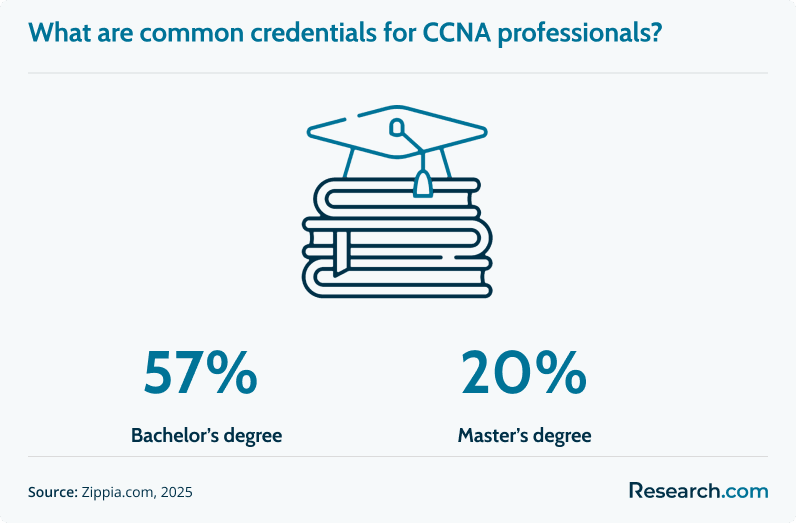
Although a formal degree is not required to earn the CCNA, the visual below shows that many CCNA-certified professionals hold a bachelor's degree, and a meaningful number also hold a master's degree.
What score do I need to pass the CCNA certification exam?
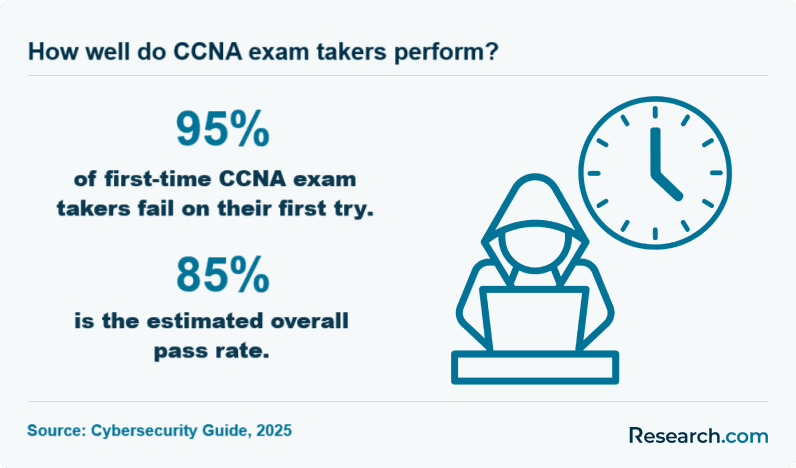
The Cisco 200-301 CCNA exam tests networking fundamentals, network access, IP connectivity, IP services, security fundamentals, and automation and programmability. Cisco does not publicly publish a fixed passing score, and the required score can vary by exam version. According to Cybersecurity Guide, a score between 800-850 points out of 1000 is generally considered enough to pass, so students often aim for a passing score of 85%.
- Score range: The exam is scored on a scale from 300 to 1000.
- Common target score: Many bootcamps and prep tools use 825 as a practical benchmark, although Cisco can adjust the actual threshold.
- Question formats: Learners should prepare for multiple-choice, drag-and-drop, simulation, and lab-based questions.
- Partial credit: Cisco typically does not give partial credit on multi-answer questions, so accuracy matters.
Some reports state that the CCNA 200-301 exam includes between 40 and 60 questions and that candidates may need at least 82% to reach a passing result. Because these figures can change, your study strategy should focus on mastery rather than chasing a minimum number.
To prepare well, combine concept review with configuration practice and troubleshooting scenarios. Learners who want a broader networking foundation may also compare CCNA with comptia network+ online course options, especially if they are deciding between vendor-neutral and Cisco-specific credentials.
How much do online CCNA training bootcamps typically cost?
Online CCNA training costs vary substantially because the market includes low-cost video courses, subscription learning libraries, university-affiliated bootcamps, and premium packages with exam vouchers and retake options. Many general prep courses are often described in the $300 to $2,000 range, but the programs listed in this guide show why students should confirm current pricing: published examples include $110, $139.99, $890, $3,999, $4,195, and $4,359, while several providers list Cost: N/A.
| Cost Factor | Why It Changes the Price | Question to Ask Before Paying |
| Self-paced versus live instruction | Recorded courses are usually cheaper than live instructor-led bootcamps. | Will I get instructor help if I get stuck? |
| Labs and simulators | Hands-on lab platforms and network simulators add value but may increase cost. | Are labs included, and how long will I have access? |
| Exam voucher | Some premium bootcamps include a Cisco CCNA exam voucher. | Is the voucher included in tuition or purchased separately? |
| Retake support | Some packages include a retake voucher or course retake option. | What conditions apply if I do not pass the exam? |
| Career support | Resume help, mentoring, or job search resources may raise the price. | Is career support specific to networking roles or just general advice? |
| Access length | Longer access to recordings, labs, and practice exams can improve review time. | Do I lose access immediately after the bootcamp ends? |
If budget is your main concern, compare affordable Cisco CCNA training programs online. Also look beyond tuition. A course that appears inexpensive may become less affordable if you need to buy lab access, practice exams, books, or an exam voucher separately.
What are the differences between in-person and online CCNA training bootcamps?
Both online and in-person CCNA bootcamps can prepare you for certification, but they create different learning experiences. The better option depends on your schedule, preferred learning environment, budget, access to equipment, and need for face-to-face accountability.
| Factor | Online CCNA Bootcamp | In-Person CCNA Bootcamp |
| Flexibility | Can include self-paced lessons, live virtual sessions, recordings, and remote labs. | Requires travel to a physical location at scheduled times. |
| Learning environment | Works well for independent learners who are comfortable with digital tools. | Can be more engaging for learners who prefer direct classroom interaction. |
| Hands-on practice | Usually relies on virtual labs, simulators, or remote lab environments. | May include physical equipment, depending on the provider and facility. |
| Cost | Often lower because there are no travel or lodging expenses; some affordable online IT training bootcamps use subscriptions or payment plans. | Can cost more when travel, meals, lodging, and time away from work are included. |
| Networking | May include online communities, chat channels, discussion boards, or live Q&A. | Offers more direct interaction with instructors and classmates. |
| Best fit | Working adults, remote learners, budget-conscious students, and self-directed learners. | Learners who need a classroom routine, physical lab access, or in-person support. |
Online training is usually the better fit when flexibility matters most. In-person training may be worth considering if you learn best through direct supervision and can manage the additional time and travel requirements.
What are the topics included in online CCNA training bootcamps?
Strong online CCNA bootcamps follow the Cisco 200-301 CCNA exam domains and combine explanation with lab-based practice. The goal is to help you understand how networks work and how to apply that knowledge when configuring, monitoring, and troubleshooting devices.
- Network fundamentals: Covers the OSI model, TCP/IP, IPv4, IPv6, subnetting, network topologies, cabling, and basic device roles.
- Network access: Includes switch operation, VLANs, wireless concepts, trunking, and spanning tree behavior.
- IP connectivity: Focuses on routing, static routes, dynamic routing concepts such as OSPF, routing tables, and path selection. The chart below notes that IP Connectivity carries the most weight at 25%.
- IP services: Addresses DHCP, NAT, DNS, NTP, and other services that support network communication.
- Security fundamentals: Introduces device hardening, access control lists, firewalls, endpoint security concepts, and basic network protection.
- Automation and programmability: Covers software-defined networking, REST APIs, controller-based networking, and introductory automation concepts, including basic Python awareness where relevant.
Many learners combine CCNA with CompTIA A+ online training when they are still building a general IT foundation. A+ is broader and more entry-level, while CCNA goes deeper into networking.
The chart below illustrates the relative weight of CCNA topic areas. Since IP Connectivity has the highest weight at 25%, strong performance in that domain can improve exam readiness, but candidates still need balanced preparation across all domains.
How do you choose the best online CCNA training bootcamp?
Choosing a CCNA bootcamp should be a decision process, not a quick reaction to a discount or a high rating. A good program should match your starting point, include hands-on practice, prepare you for the current exam, and provide enough support for the way you learn.
Step-by-step checklist for comparing CCNA bootcamps
- Confirm exam alignment. Make sure the curriculum maps to the Cisco CCNA 200-301 exam objectives and, when stated, the current version referenced by the provider.
- Check the lab environment. Ask whether the course uses Packet Tracer, simulators, remote labs, or other hands-on tools, and confirm how long access lasts.
- Review instructor qualifications. Look for instructors with Cisco credentials, real network administration experience, or enterprise networking backgrounds.
- Compare support models. Decide whether you need live Q&A, office hours, mentoring, discussion boards, or only recorded video.
- Calculate the true cost. Include tuition, exam voucher, retake voucher, lab access, books, subscriptions, and practice exams.
- Read reviews carefully. Look for comments about clarity, labs, exam relevance, responsiveness, and whether the material is current.
- Match the pace to your experience. A 5-day bootcamp may be efficient for an IT professional but too compressed for a beginner.
- Ask about access after completion. Recordings, study guides, labs, and practice exams are most useful when you can review them before your exam date.
Common mistakes to avoid
| Mistake | Why It Can Hurt You | Better Approach |
| Choosing only by price | The cheapest course may not include labs, support, or practice exams. | Compare total value, not just tuition. |
| Ignoring hands-on practice | CCNA requires applied knowledge, not just definitions. | Choose a program with labs, simulations, or configuration exercises. |
| Assuming every course is current | Older course titles or outdated modules may not match current objectives. | Verify CCNA 200-301 alignment before enrolling. |
| Overestimating what a bootcamp can do | A bootcamp can guide study, but it cannot guarantee a passing score or job offer. | Plan additional review, labs, and practice exams. |
| Skipping refund and retake policies | Premium bootcamps can be expensive if policies are unclear. | Ask about cancellation, retake access, and exam voucher terms in writing. |
| Relying only on rankings | A highly ranked program may not fit your schedule, budget, or learning style. | Use rankings as a shortlist, then compare details. |
If your long-term plan includes cloud security or security architecture, you may also compare CCNA with a CCSP training course online. CCNA is networking-focused; CCSP is more relevant for professionals moving toward cloud security.
What career paths are available for those with Cisco CCNA certification?
CCNA certification can support several IT and networking career paths because it validates knowledge of network configuration, troubleshooting, connectivity, security basics, and infrastructure operations. It is often most useful for entry-level and early-career professionals who want to move from general support into network-focused roles.
| Role | Typical Responsibilities | How CCNA Helps |
| Network Support Specialist | Troubleshoots connectivity issues, supports network users, and assists with hardware and software maintenance. | Shows understanding of network behavior, IP addressing, and common troubleshooting workflows. |
| Network Administrator | Maintains routers, switches, network performance, access controls, and reliability. | Supports core knowledge in configuration, monitoring, and network services. |
| Systems Administrator | Manages servers, user access, systems, and network-dependent services. | Strengthens the networking side of systems operations. |
| Network Technician | Installs, maintains, and repairs network equipment and infrastructure. | Provides practical understanding of devices, cabling concepts, switching, and connectivity. |
| IT Support Specialist | Handles user support, access problems, device issues, and basic network incidents. | Helps support professionals diagnose network-related tickets more effectively. |
| Junior Network Engineer | Assists with network implementation, maintenance, documentation, and troubleshooting. | Signals readiness for entry-level network engineering tasks under senior supervision. |
| Cybersecurity Associate | Supports basic network defense, monitoring, access control, and security operations. | Builds the network foundation needed for security roles that protect infrastructure. |
Long term, CCNA can lead into advanced Cisco credentials such as CCNP or CCIE, depending on your experience and specialization. If you want to add a security-focused credential later, an accelerated CISSP certification training online option may be relevant once you meet the required experience expectations for that certification.
The chart below shows the academic majors reported among Cisco-certified network associates. It also highlights that only a small percentage have a computer networking degree, which reinforces an important point: CCNA can be useful for people entering networking from several educational backgrounds.
What CCNA Learners Often Say About Online Bootcamps
- Kevin: "Studying online made CCNA preparation realistic while working full time. Being able to replay lessons and review difficult topics helped me stay on track, and the flexible schedule made consistent study possible."
- Nate: "The instructor support mattered most for me. Networking topics that felt confusing at first became easier during live explanations and Q&A sessions, especially when we worked through examples step by step."
- Jared: "The strongest part of the bootcamp was the mix of lectures, labs, and practice exams. It helped connect theory to real troubleshooting, which made exam preparation feel much more practical."
Should I pursue further academic education after earning a CCNA certification?
You do not need a degree to earn the CCNA, but academic education can still be useful depending on your career goals. A degree may help if you want broader computer science knowledge, access to roles that prefer a bachelor's credential, or long-term advancement into engineering, architecture, management, or research-oriented technology work.
For example, an accelerated bachelor's degree in computer science can complement CCNA training by adding programming, algorithms, databases, systems, and theoretical computing foundations. This path makes more sense for learners who want a broader technology career, not just exam preparation.
Further education is not always necessary immediately after CCNA. If your goal is a network support or junior network administration role, hands-on labs, home projects, internships, help desk experience, and targeted certifications may provide a faster return than enrolling in another academic program right away.
What are the long-term career outcomes of online CCNA training bootcamps?
Online CCNA bootcamps can support career progression when they help learners build practical skills and pass the certification exam. Possible outcomes include stronger candidacy for IT support, network support, network technician, systems administration, junior network engineering, and cybersecurity-adjacent roles. However, outcomes vary by prior experience, location, employer demand, interview performance, and the quality of the learner’s hands-on practice.
Some professionals use CCNA as the first step in a longer plan that includes CCNP, cloud certifications, cybersecurity credentials, or a degree. Others use it to move from general IT support into infrastructure roles. If your interests eventually move far outside traditional IT networking, specialized academic programs such as the best online space studies degree programs may be relevant for a different career direction, but they are not a direct next step for most CCNA learners.
Questions to Ask Before Enrolling in an Online CCNA Bootcamp
- Is the course aligned with the current Cisco CCNA 200-301 exam objectives?
- Does the program include hands-on labs, simulations, or Packet Tracer exercises?
- How long will I have access to recordings, labs, practice exams, and study guides?
- Are exam vouchers, retake vouchers, books, and lab tools included in the cost?
- What instructor support is available during and after the course?
- Is the pace realistic for my current networking background?
- What do recent student reviews say about exam readiness and lab quality?
- Does the provider publish pass-rate or job-outcome claims, and how are those claims verified?
- What is the refund policy if my schedule changes?
- Will this program help me reach my next role, or do I need a broader IT foundation first?
Current Trends Affecting CCNA Training
CCNA training has changed because networking roles now intersect with cloud infrastructure, cybersecurity, automation, and software-defined networking. Modern CCNA curricula increasingly include automation and programmability, which reflects how network teams use controllers, APIs, scripts, and centralized management tools alongside traditional routing and switching knowledge.
At the same time, employers still value fundamentals. IP addressing, routing, switching, network services, and troubleshooting remain essential because automation tools are only useful when the professional understands what the network is supposed to do. For this reason, the best CCNA bootcamps balance newer topics with deep practice in core networking tasks.
References:
- Andersen, G. (2025, May 30). The Rise of Cisco Networking Jobs - Trends and Insights for 2024. MoldStud.
- CCNA Classes. (2025, April 2). Effective CCNA Certification Exam Preparation Techniques. ccna-classes.com.
- Easy4Cert. (2025, June 23). Exploring the CCNA Score Report: What's Behind the Numbers? easy4cert.com.
- IPSR Solutions Ltd. (n.d.). The Value of CCNA Certification: Job Opportunities and Essential Skills. IPSR.
- Oshin, G. (2025, July 2). Everything you need to know about the CCNA certification | Cisco Certified Network Associate. Cybersecurity Guide.
- United States Bureau of Labor Statistics. (2025, July 29). Occupational Employment and Wage Statistics Query System. BLS.
Key Insights
- The best online CCNA bootcamp depends on your experience level: beginners usually need more structure and labs, while current IT professionals may benefit from a shorter intensive review.
- Do not choose a program based only on price or speed. Confirm exam alignment, lab access, instructor support, practice exams, voucher details, and post-course access.
- Published costs in this list range from low-cost self-paced courses such as $110 and $139.99 to premium bootcamps listed at $3,999, $4,195, and $4,359, with several providers showing Cost: N/A.
- Cisco does not publicly disclose a fixed passing score, but learners often aim for scores around 800-850 points out of 1000 or a target near 85% to prepare confidently.
- CCNA can support roles in network support, network administration, systems administration, IT support, junior network engineering, and entry-level cybersecurity-adjacent work.
- Hands-on practice is non-negotiable. A CCNA course without labs, simulations, or troubleshooting exercises is unlikely to provide complete preparation.
- Further academic education can be valuable, but it is not automatically required after CCNA. Choose a degree, advanced certification, or job experience based on your actual career target.
Other Things You Should Know About Online CCNA Training Bootcamps
They prepare you for the Cisco Certified Network Associate exam, code 200-301 CCNA. This is the only current CCNA certification exam from Cisco, and most bootcamps map their lessons to its domains: network fundamentals, network access, IP connectivity, IP services, security fundamentals, and automation and programmability.
To enroll in a 2027 CCNA online bootcamp, a basic understanding of networking fundamentals and a familiarity with IP addressing are typically required. Some programs may also recommend prior experience with Cisco equipment to ensure readiness for advanced topics.