2027 Most Affordable Online Space Studies Degree Programs

Co-Founder and Chief Data Scientist
Choosing an online space studies degree is a practical decision about cost, flexibility, and career direction. The field connects space science, satellite operations, remote sensing, aerospace policy, mission planning, and commercial launch activity, which means students do not always need to become engineers to work in the space sector.
This guide is designed for students, military learners, working adults, career changers, and science-minded professionals comparing affordable online space studies programs. You will learn what these degrees cover, how long they take, what they cost, which schools offer relevant online options, and how to evaluate whether the investment fits your career goals.
With program costs that often fall below the $75,000 national average for a bachelor’s degree in 2024, an online space studies degree can offer a more flexible route into aerospace-adjacent work, especially for learners who need to avoid relocation, housing costs, or a full-time campus schedule.
Quick answer: Is an online space studies degree worth considering?
An online space studies degree can be worth considering if you want a career connected to satellite operations, geospatial analysis, space policy, science communication, aerospace consulting, or mission support. The best programs combine technical coursework, remote labs, policy training, and capstone projects while keeping tuition transparent and transfer-friendly.
The degree is strongest for students who want interdisciplinary roles rather than licensed engineering positions. If your goal is to design spacecraft as a professional engineer, you should verify whether the program is engineering-focused and whether it meets any accreditation expectations relevant to your intended role.
What are the main benefits of earning an online space studies degree?
- Career access across several space-related sectors: Graduates may qualify for entry-level or early-career roles such as research associate, operations specialist, program assistant, geospatial analyst, policy assistant, satellite tracking technician, aerospace consultant, or public outreach coordinator.
- Salary potential in advanced technical roles: Some specialized positions, such as remote sensing scientist or technologist, report median pay of $94,870, with the top 10% earning $138,460.
- Flexibility for working learners: Online programs can help adult students, military personnel, and career changers study without moving near a campus or leaving full-time employment.
- Interdisciplinary skill development: Students build knowledge in astronomy, orbital mechanics, GIS, remote sensing, space policy, data interpretation, and mission planning.
- Lower total attendance costs: Online learners often avoid campus housing, commuting, relocation, and some student service expenses, though technology and lab fees can still apply.
What can I expect from online space studies degree programs?
Online space studies programs usually combine science, technology, policy, and applied analysis. Instead of focusing on one narrow discipline, they teach students how space systems operate, how satellite data is used, how missions are planned, and how legal and regulatory rules shape activity beyond Earth.
Most programs begin with foundational work in astronomy, physics, mathematics, and scientific writing. As students advance, courses typically move into orbital mechanics, remote sensing, space law, satellite communications, mission design, planetary science, and geospatial analysis.
Because these programs are delivered online, hands-on learning often happens through cloud-based software, simulated mission environments, satellite imagery datasets, virtual telescope tools, GIS platforms, and collaborative capstone projects. Some schools also offer optional residencies, internships, or practicum experiences.
Students should expect more independent work than in many campus-based programs. Online space studies coursework often includes recorded lectures, asynchronous discussions, instructor-led modules, virtual office hours, group projects, and technical assignments that require strong time management.
| Program feature | What it usually means for students | Why it matters |
| Asynchronous coursework | Students complete lectures and assignments on a flexible weekly schedule. | Helpful for working adults, military learners, and students in different time zones. |
| Virtual labs | Labs may use simulations, GIS tools, remote sensing datasets, or orbital modeling software. | Builds applied skills without requiring frequent campus visits. |
| Capstone project | Students may design a mission proposal, analyze satellite data, or evaluate a space policy issue. | Creates a portfolio artifact for job interviews or graduate school applications. |
| Specialization electives | Programs may let students focus on remote sensing, space policy, planetary science, human spaceflight, or mission design. | Helps align the degree with a specific career path. |
| Limited in-person networking | Online students may have fewer spontaneous faculty and peer interactions than campus learners. | Students should actively seek internships, professional associations, and virtual events. |
Where can I work with an online space studies degree?
Online space studies graduates can work in organizations that use satellite systems, geospatial data, aerospace operations, research support, science communication, or space policy expertise. Employers may include government agencies, defense contractors, commercial satellite companies, aerospace firms, universities, museums, nonprofit research groups, and environmental consulting organizations.
The degree is not limited to astronautics or engineering. Many jobs in the space economy need people who can interpret data, coordinate operations, communicate technical information, understand regulatory frameworks, and support complex projects.
- Satellite operations and ground control: These roles involve monitoring spacecraft, reviewing telemetry, coordinating communications, and supporting anomaly response for civil, defense, or commercial satellite operators.
- Remote sensing and geospatial intelligence: Analysts use satellite imagery and spatial data to support climate monitoring, disaster response, urban planning, agriculture, national security, and environmental assessment.
- Space policy and regulatory affairs: Graduates may help with launch licensing, export compliance, treaty analysis, public policy research, or documentation related to space governance.
- Mission planning and operations support: These positions involve scheduling mission activities, preparing risk assessments, coordinating payload resources, and supporting post-mission analysis.
- Education and public engagement: Space studies graduates may work in museums, planetariums, science centers, curriculum development, K–12 outreach, or postsecondary support roles.
- Research and consulting: Graduates may contribute to studies on orbital debris, satellite sustainability, Earth observation, space commercialization, or technology policy.
Common job titles include analyst, coordinator, technician, program assistant, operations specialist, research associate, and outreach specialist. More advanced roles may require graduate education, security clearance, programming skills, GIS experience, or specialized certifications.
How much can I make with an online space studies degree?
Salary outcomes vary by job title, employer type, geographic region, technical skill level, security clearance, and experience. A space studies degree can support several career paths, but it does not guarantee a specific income.
The strongest earnings tend to come from roles that combine scientific knowledge with applied technical skills, such as GIS, Python, remote sensing, operations research, mission planning, or regulatory compliance.
| Role or career area | Salary benchmark stated | Skills that may improve competitiveness |
| Remote Sensing Scientist or Technologist | Median pay is $94,870, with the top 10% earning $138,460. | GIS, Python modeling, image interpretation, spatial statistics, and satellite data analysis. |
| Aerospace Engineering and Operations Technologist or Technician | Often titled Satellite Operations Specialist with median wage of $78,620. | Telemetry monitoring, shift operations, systems troubleshooting, and mission control procedures. |
| Operations Research Analyst in Aerospace | Overall median pay is $98,220, while launch logistics and orbital traffic modeling roles frequently advertise six-figure starting salaries in major space hubs. | Optimization, mathematical modeling, data visualization, logistics analysis, and programming. |
| Public Policy or Regulatory Analyst with a Space Focus | Median pay across policy roles is $79,510, while positions requiring International Traffic in Arms Regulations (ITAR) expertise or export-control auditing commonly list ranges in the mid-$90,000s. | Space law, export controls, licensing documentation, treaty analysis, and policy writing. |
| Postsecondary Teacher in Atmospheric and Space Sciences | Faculty positions carry a median of $92,040, with tenure-track roles at research universities trending higher, especially for candidates who publish in remote sensing or planetary science. | Graduate education, research publication, teaching experience, and disciplinary specialization. |
Experience and credential stacking can also affect earnings. Professionals who add project-management certification, security clearance, or advanced programming skills often see 15% to 25% jumps within five years.
The strongest financial case for an online space studies degree usually comes from controlling tuition, finishing on time, using transfer credit, and selecting a curriculum that leads to marketable technical skills.
- Online Space Studies Degree Programs for 2027
- How long does an online space studies degree take?
- Online vs. on-campus space studies programs
- Average cost of an online space studies degree
- Financial aid for online space studies students
- Admission requirements and prerequisites
- Typical online space studies courses
- Common space studies specializations
- Challenges of studying space studies online
- How space studies builds interdisciplinary expertise
- How management training can support space careers
- ROI of an online space studies degree
- Industry partnerships and internships
- How to choose the right online space studies program
- Career paths for online space studies graduates
- Job market outlook for space studies graduates
List of Online Space Studies Degree Programs for 2027
How do we rank schools?
For this guide, programs were evaluated with affordability, flexibility, accreditation, curriculum relevance, and career alignment in mind. A strong online space studies program should make tuition easy to understand, offer relevant technical or policy coursework, provide meaningful applied learning, and hold institutional accreditation from a recognized agency.
Our ranking methodology explains how Research.com evaluates schools and programs so readers can compare options using consistent criteria rather than marketing claims.
Program research draws on reliable higher education and distance learning sources, including the Integrated Postsecondary Education Data System (IPEDS), the U.S. Department of Education’s College Scorecard, the National Center for Education Statistics (NCES), and Peterson’s database of accredited distance education programs.
1. Embry-Riddle Aeronautical University Worldwide
Embry-Riddle Aeronautical University Worldwide offers an online Bachelor of Science in Space Operations for students interested in mission control, satellite systems, launch coordination, and operational planning. The curriculum includes a senior capstone that mirrors real-time mission operations and requires students to complete a minor in space policy, systems engineering, or applied mathematics.
The school reports a 93% placement rate and offers reduced tuition for civilian and military learners, making it a notable private aerospace option for cost-conscious students.
- Program Length: 4 years full-time, or 2–3 years with transfer credit.
- Tracks/concentrations: Space Operations core plus a required minor in Systems Engineering, Space Policy, Human Factors, or Applied Mathematics.
- Cost per Credit: $522 civilian; $250 military (2025–26 rate).
- Required Credits to Graduate: 120
- Accreditation: Southern Association of Colleges and Schools Commission on Colleges (SACSCOC)
2. University of North Dakota
The University of North Dakota offers an online bachelor’s in space studies through the John D. Odegard School of Aerospace Sciences. Students study orbital mechanics, mission design, and related aerospace topics while participating in live evening webinars.
A senior project sequence places students in virtual mission teams using professional tools, with faculty guidance connected to NASA and Department of Defense research. A flat online tuition rate and active-duty student discounts make UND one of the more affordable public options in this area.
- Program Length: 4 years full-time, or 2–3 years with approved transfer credit.
- Tracks/concentrations: Elective emphasis in Space Law, Human Factors, Remote Sensing, or Planetary Science.
- Cost per Credit: $385 online base; $250 active-duty military (2025–26).
- Required Credits to Graduate: 120
- Accreditation: Higher Learning Commission (HLC)
3. American Public University System
The American Public University System provides a fully online Undergraduate Certificate in Space Studies that uses virtual telescope access, orbital modeling tools, and individualized research projects. Courses are offered in eight-week blocks with monthly start dates, and faculty bring experience from NASA, military space operations, and commercial launch environments.
Flat tuition, included digital textbooks, and a military grant that aligns rates with federal aid limits make this a budget-friendly space-focused credential.
- Program Length: 4 years full-time with accelerated options with transfer credit.
- Tracks/concentrations: Astronomy, Aerospace Science, Space Policy, and Astrobiology.
- Cost per Credit: $325 standard; $250 military and veteran rate (2025–26).
- Required Credits to Graduate: 120
- Accreditation: HLC
4. Arizona State University Online
Arizona State University Online offers a Bachelor of Science in Astronomical and Planetary Sciences through the School of Earth and Space Exploration. Coursework covers stellar evolution, planetary geology, and computational methods, with virtual labs that use real telescope data.
Students may also participate in the Space Works initiative, where they contribute to small-sat mission concepts and co-authored research. Competitive tuition and scholarship opportunities support affordability for students pursuing planetary science and observational astronomy.
- Program Length: 4 years full-time, or 2–3 years with approved transfer credit.
- Tracks/concentrations: Elective focus areas in Astrophysics, Planetary Geology, or Space Instrumentation.
- Cost per Credit: $561–$661 undergraduate online rate (2025–26).
- Required Credits to Graduate: 120
- Accreditation: HLC
5. University of Arizona Online
University of Arizona Online offers a Bachelor of Science in Geographic Information Systems Technology through the School of Geography, Development and Environment. The program emphasizes geospatial modeling, cartographic design, remote sensing, and spatial data tools.
Students complete virtual labs using industry GIS software and may choose an optional capstone or internship with public agencies or private aerospace firms. As a Carnegie R1 research university with competitive online tuition, the program can serve students aiming for space-related geospatial careers.
- Program Length: 4 years full-time, or 2–3 years with accepted transfer credit.
- Tracks/concentrations: Remote Sensing, Geospatial Analysis, or Spatial Data Science electives.
- Cost per Credit: $525 undergraduate online rate (2025–26).
- Required Credits to Graduate: 120
- Accreditation: HLC
6. Capitol Technology University
Capitol Technology University offers an online Bachelor of Science in Astronautical and Space Engineering. Students begin mission-control simulations early in the program and later complete team projects in cube-sat design and balloon-based testing.
Real-time telemetry labs use proprietary ground-station software, and students receive mentorship from faculty connected to Department of Defense and commercial launch work. Small classes and a flat online tuition rate make the program an accessible route toward an ABET-aligned space engineering credential.
- Program Length: 4 years full-time, or 2–3 years with accepted transfer credit.
- Tracks/concentrations: Core in Astronautical and Space Engineering with electives in Propulsion, Satellite Communications, and Mission Operations.
- Cost per Credit: $450 undergraduate online rate (2025–26).
- Required Credits to Graduate: 120
- Accreditation: Middle States Commission on Higher Education (MSCHE)
7. Florida Institute of Technology Online
Florida Institute of Technology Online offers a Bachelor of Arts in Aviation Management with a Space Studies specialization. The program combines business fundamentals with orbital systems, spaceport logistics, and launch regulation.
Courses run in eight-week terms with six start dates per year, and applied projects connect students to commercial space sector issues. Digital materials are included in tuition, helping students better estimate total costs.
- Program Length: 4 years full-time, or 2–3 years with qualifying transfer credit.
- Tracks/concentrations: Space Studies specialization within Aviation Management.
- Cost per Credit: $510 undergraduate online rate (2025–26).
- Required Credits to Graduate: 120
- Accreditation: SACSCOC
8. Mississippi State University
Mississippi State University offers an online Bachelor of Science in Geosciences with a Broadcast and Operational Meteorology concentration. Students study radar interpretation, weather modeling, and Geostationary Operational Environmental Satellite (GOES) data analysis.
Weekly virtual weather briefings and an optional summer practicum give students forecasting experience. A flat online tuition rate helps keep the program more affordable than many atmospheric science degrees at similar research institutions.
- Program Length: 4 years full-time, or 2–3 years with approved transfer credit.
- Tracks/concentrations: Broadcast Meteorology or Operational Meteorology.
- Cost per Credit: $385 distance-education rate (2025–26).
- Required Credits to Graduate: 124
- Accreditation: SACSCOC
9. Oregon State University
Oregon State University offers a fully online Bachelor of Science in Geography and Geospatial Science. The curriculum prepares students to work with satellite imagery, lidar, and Unmanned Aerial Vehicle (UAV) data.
Virtual labs use professional GIS tools, and remote fieldwork draws on datasets from agencies such as the U.S. Geological Survey (USGS) and the National Oceanic and Atmospheric Administration (NOAA). A flat per-credit rate for online learners supports affordability.
- Program Length: 4 years full-time, or 2–3 years with qualifying transfer credit.
- Tracks/concentrations: Elective clusters in Remote Sensing, Spatial Analysis, and Cartography.
- Cost per Credit: $350 online rate (2025–26).
- Required Credits to Graduate: 180 quarter credits (equivalent to 120 semester credits)
- Accreditation: Northwest Commission on Colleges and Universities (NWCCU)
10. Boise State University Online
Boise State University offers a fully online Bachelor of Applied Science in Multidisciplinary Studies that allows students to build a space studies emphasis through coursework in physics, remote sensing, and aerospace policy.
Students may attend live seminars with faculty involved in NASA-funded research and complete optional virtual internships with regional aerospace firms. A single online tuition rate makes the program especially relevant for transfer students targeting commercial space roles.
- Program Length: 4 years full-time, or 2–3 years with qualifying transfer credit.
- Tracks/concentrations: Customized Space Studies emphasis within Multidisciplinary Studies.
- Cost per Credit: $375 undergraduate online rate (2025 – 26).
- Required Credits to Graduate: 120
- Accreditation: NWCCU
How long does it take to complete an online space studies degree?
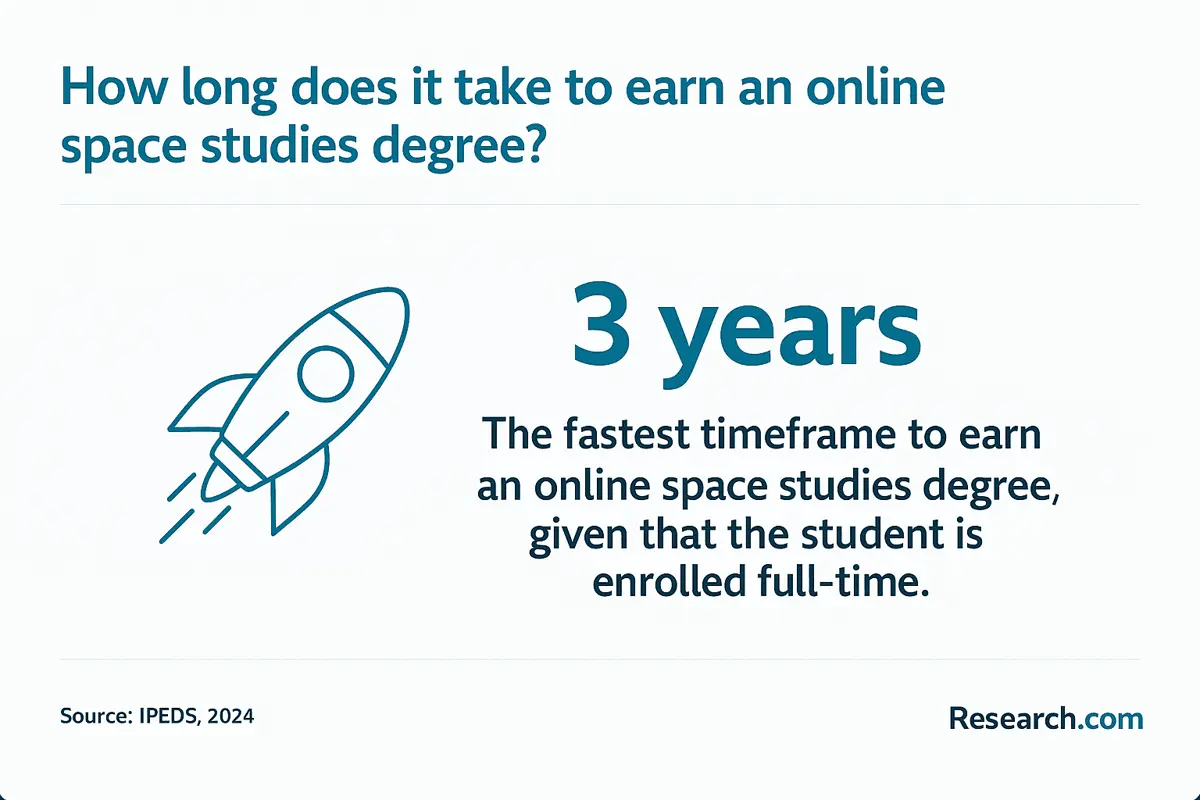
Most online bachelor’s-level space studies degrees are built around 120 credits and take about 4 years for full-time students starting from scratch. The actual timeline can be shorter or longer depending on transfer credit, course load, term structure, summer enrollment, and whether the program offers accelerated or competency-based options.
| Completion path | Typical timeline | Best fit |
| Traditional full-time plan | 4 years | Students entering with little or no college credit who can study full time. |
| Summer-enrollment plan | About 3.5 years | Learners who can take additional summer courses without overloading fall and spring terms. |
| Accelerated online format | 30–36 months | Highly organized students who can manage continuous 8-week sessions and 12 to 15 hours weekly. |
| Competency-based model | Varies by pace | Students who can complete assessments quickly during six-month subscription terms. |
| Part-time enrollment | 5 or 6 years | Working adults, military learners, caregivers, and students with limited weekly study time. |
| Transfer completion route | 18 to 24 months | Associate degree holders or students with up to 60 lower-division credits. |
- Standard 4-year sequence: Students complete 120 credits across eight 15-week semesters.
- Trimmed 3.5-year calendar: Adding two shorter summer terms each year can reduce the total timeline without dramatically increasing the regular-semester load.
- Accelerated 30–36 month track: Programs with six 8-week terms per year can help motivated students finish in three years or less.
- Competency-based route: Students progress by demonstrating mastery, and fast assessment completion can reduce time in school.
- Part-time flex plan: Taking two courses per term may extend the degree to 5 or 6 years but can be more realistic for students with demanding jobs.
- Transfer completion path: Students with an associate degree or substantial prior coursework may complete remaining upper-division requirements in 18 to 24 months.
- Virtual lab intensives: Short simulation periods may add one or two weeks per year, but they rarely change the overall graduation timeline.
- Career-aligned planning: Students pursuing a GIS specialist career path may benefit from choosing programs with remote sensing, geospatial analysis, and satellite imagery coursework.
Before enrolling, ask an advisor for a degree map that includes transfer credit, expected course rotations, lab requirements, prerequisites, and the number of terms needed at your intended pace.
How does an online space studies degree program compare to an on-campus program?
Online and campus-based space studies programs can lead to similar credentials when they are offered by the same accredited institution, but the student experience is different. The right choice depends on your schedule, learning style, budget, location, and need for physical lab access.
| Factor | Online space studies program | On-campus space studies program |
| Schedule | Often asynchronous or partly asynchronous, with more control over study time. | Usually follows fixed class times and campus academic calendars. |
| Labs and applied work | Uses simulations, satellite datasets, cloud GIS tools, and virtual mission exercises. | May offer direct access to observatories, labs, faculty offices, and physical equipment. |
| Networking | Requires more intentional outreach through forums, virtual events, internships, and professional groups. | Provides easier access to campus events, peer groups, research labs, and informal faculty interaction. |
| Cost structure | May reduce housing, commuting, and relocation costs; technology or lab fees may still apply. | Can include housing, transportation, campus fees, and location-based living expenses. |
| Best for | Working adults, transfer students, military learners, and students who cannot relocate. | Students who want in-person labs, campus research culture, and structured daily interaction. |
- Curriculum and accreditation: Regionally accredited institutions generally apply the same credit standards and learning outcomes to online and on-campus programs.
- Instructional delivery: Campus courses rely more on scheduled lectures and in-person discussion, while online programs often use recorded modules, digital forums, and virtual simulations.
- Hands-on learning: Online students may work with satellite imagery, orbital modeling platforms, or GIS software, while campus students may gain access to physical observatories and labs.
- Student support: Online advising usually occurs through video meetings, email, learning platforms, and digital office hours. Campus advising may be easier for students who prefer face-to-face support.
- Accessibility: Online study is often practical for professionals, service members, and students comparing related flexible options such as an online military studies degree.
Choose online if flexibility and cost control are your top priorities. Choose campus-based study if hands-on facilities, research lab participation, and in-person networking are central to your goals.
What is the average cost of an online space studies degree?
Online space studies tuition depends on the institution, public or private status, residency rules, course format, transfer credits, and lab or software fees. NCES reports an average annual tuition of $9,750 at four-year public institutions for distance learners, but specialized programs may cost more or less depending on structure.
| Cost category | Stated cost range or example | What students should check |
| Low-cost public option | In-state tuition at regional universities starts near $285 per credit, placing a 120-credit degree close to $34,000 before fees. | Confirm whether online students receive in-state, out-of-state, or special online tuition rates. |
| Midrange private or out-of-state public option | Many programs charge $430 to $480 per credit, bringing total tuition to approximately $52,000 to $58,000. | Ask whether virtual lab licenses, advising, and digital materials are included. |
| Subscription model | Competency-based institutions use six-month terms priced near $3,920. Students who complete coursework in three years invest about $23,500 in tuition. | Estimate whether you can realistically complete enough credits each term to save money. |
| Premium research university | Flagship schools with extensive faculty research may list online space studies tuition at $570 per credit or higher, totaling $68,000 or more. | Compare research access, faculty expertise, career outcomes, and total net price. |
| Additional fees | Virtual lab courses may add $250 to $400 each, technology fees may be around $50 per term, and a one-time graduation fee averages at around $150. | Request a complete cost sheet before applying or enrolling. |
- Look beyond tuition: Software licenses, virtual labs, textbooks, technology fees, graduation fees, and exam proctoring can change the real cost.
- Compare net price: Grants, military benefits, employer reimbursement, and institutional scholarships can make a higher published tuition less expensive in practice.
- Use transfer credit strategically: Bringing in approved community college, military, or prior university credits can reduce both time and total tuition.
- Compare with adjacent STEM degrees: Some affordable space studies options resemble the pricing structures found in low-cost online physics degree programs, especially when offered by public universities with asynchronous delivery.
The chart below shows the average costs of off-campus and distance learning programs in public institutions.
What are the financial aid options for students enrolling in online space studies degree programs?
Students in accredited online space studies programs can often use the same federal financial aid options available to campus-based students. The key is to confirm that the institution is accredited, the program is aid-eligible, and your enrollment level meets aid requirements.
- Pell Grants: Eligible undergraduate students can receive up to $7,395 annually through the Federal Pell Grant, which does not need to be repaid.
- FAFSA-based federal loans: Completing the Free Application for Federal Student Aid (FAFSA) can provide access to Subsidized and Unsubsidized federal loans with repayment options after graduation.
- Work-study: Qualified students may earn wages in part-time university, research, or technical roles while building experience.
- Department of Defense funding: The SMART Scholarship for Service may provide full tuition and a stipend for students who agree to work at approved defense facilities after graduation.
- NASA MUREP scholarships: Students from underrepresented groups in space-related fields may qualify for up to $10,000 per year plus a summer internship through the NASA Minority University Research and Education Project.
- Institutional scholarships: Schools may offer merit, need-based, transfer, military, or program-specific awards tied to research, academic achievement, or STEM participation.
- Employer tuition assistance: Aerospace firms, federal agencies, and technical employers may provide up to $5,250 per year in tuition assistance.
- Military education benefits: Eligible veterans may use the Post-9/11 GI Bill for tuition, fees, and a monthly housing allowance while enrolled in online programs.
How to reduce the cost of an online space studies degree
- Complete the FAFSA early and review federal, state, and institutional aid offers.
- Ask whether the school accepts military training, CLEP exams, community college credits, or prior university coursework.
- Request a total program cost estimate that includes tuition, fees, textbooks, software, labs, and graduation charges.
- Compare per-credit tuition with total degree cost, not just the advertised rate.
- Ask your employer whether tuition reimbursement applies to aerospace, GIS, data, policy, or STEM-related study.
- Choose a pace you can sustain so you do not pay for repeated courses or unnecessary extra terms.
What are the prerequisites for enrolling in online space studies degree programs?
Admission requirements differ by school, but online space studies programs usually look for students who are prepared for quantitative science, analytical writing, and technical software use. Degree-completion programs may also require a certain amount of transferable college credit.
- Science preparation: Many programs expect one year each of high school physics and chemistry, both with labs, and a recent grade of B or higher. Some schools may accept introductory astronomy in place of chemistry.
- Mathematics readiness: Precalculus is commonly expected, and some programs require an online calculus placement or readiness exam. Students below the benchmark may need a bridge course.
- General education credits: Degree-completion tracks often require 30–60 transferable credits in English composition, social science, mathematics, and other general education areas.
- Programming and data skills: Basic Python or MATLAB familiarity is increasingly useful, especially for orbital analysis, remote sensing, GIS, and spatial data work. These skills also align with many geospatial analyst career requirements.
- Technology requirements: Students may need a laptop with at least 8GB RAM, reliable high-speed internet, and the ability to run GIS or orbital simulation software.
- Statement of purpose or writing sample: Applicants may be asked to explain their interest in mission operations, space policy, research, aerospace business, or science outreach.
- English proficiency: Non-native English speakers may need a TOEFL iBT score of 79 or an IELTS score of 6.0.
- Background checks for some placements: Internships involving defense, national security, or restricted facilities may require clearance screening or a background review.
If you are missing prerequisites, ask whether the school offers bridge courses, recommended community college equivalents, self-paced modules, or provisional admission.
What courses are typically in online space studies degree programs?
Online space studies curricula usually move from broad science foundations into applied space systems, policy, data analysis, and mission design. The strongest programs use assignments that require students to work with realistic datasets, technical writing, and collaborative planning.
Like an affordable online master's in emergency management, space studies often prepares students for interdisciplinary work where technical knowledge, planning, regulation, and public-sector decision-making overlap.
| Course area | What students learn | Career relevance |
| Introductory Astronomy | Stellar evolution, planetary systems, observation methods, telescopes, and detectors. | Research support, science outreach, planetary science preparation. |
| Orbital Mechanics | Two-body and three-body motion, launch windows, maneuver planning, and numerical methods. | Satellite operations, mission planning, trajectory support. |
| Space Environment | Radiation belts, microgravity, atmospheric drag, and mission risk factors. | Spacecraft operations, risk assessment, mission support. |
| Remote Sensing and Earth Observation | Multispectral imaging, radar interpretation, GIS, and satellite data analysis. | Geospatial analysis, environmental monitoring, defense applications. |
| Space Policy and Law | The Outer Space Treaty, export controls, licensing, and governance frameworks. | Policy analysis, regulatory affairs, compliance documentation. |
| Propulsion and Launch Systems | Chemical propulsion, electric propulsion, staging, and launch performance concepts. | Launch support, aerospace operations, technical coordination. |
| Mission Design Capstone | End-to-end mission planning, science objectives, budgets, risk mitigation, and team coordination. | Portfolio development, project planning, interview preparation. |
- Introductory Astronomy: Covers stars, planets, observational tools, and the basic science behind space environments.
- Orbital Mechanics: Introduces trajectory modeling, orbital motion, launch timing, and maneuver planning.
- Space Environment: Examines radiation, drag, microgravity, and other mission risk factors.
- Remote Sensing and Earth Observation: Teaches students how satellite imagery and GIS support environmental, security, and planning decisions.
- Space Policy and Law: Reviews treaty obligations, export control rules, licensing systems, and governance issues.
- Propulsion and Launch Systems: Explains launch vehicle concepts, propulsion types, staging, and performance calculations.
- Mission Design Capstone: Requires students to build a full mission proposal, often including objectives, costs, operational plans, and risk controls.
- Elective options: Students may explore planetary geology, astrobiology, human spaceflight, science communication, or applied data analysis. Learners interested in unusual interdisciplinary combinations can also compare how technical leadership differs across fields, including through an affordable online graduate certificate for nurse administrators.
What types of specializations are available in online space studies degree programs?
Many programs let students use twelve to eighteen elective credits to build a concentration. The right specialization should match your target job, not just your favorite subject.
| Specialization | Focus | Best for students interested in |
| Orbital Mechanics and Mission Design | Trajectory analysis, maneuver planning, and mission modeling. | Satellite operations, launch planning, and mission coordination. |
| Remote Sensing and Geospatial Intelligence | Satellite imagery, synthetic aperture radar, multispectral data, and GIS analysis. | Earth observation, environmental monitoring, defense analysis, and spatial data careers. |
| Space Policy and Governance | Treaties, licensing, export controls, national policy, and commercial regulation. | Policy research, compliance, advocacy, and regulatory affairs. |
| Planetary Science and Astronomy | Planetary geology, exoplanets, observational astronomy, and scientific research methods. | Research support, science communication, graduate study, and observatory work. |
| Human Spaceflight Operations | Life support, crew psychology, space medicine, and mission control support. | Astronaut training support, human factors, and crewed mission operations. |
| Small Satellite Development | Cube satellite systems, payload integration, subsystem design, and testing. | Commercial nanosatellites, university missions, and applied technical roles. |
| Astrobiology | Origins of life, extremophile biology, biosignatures, and habitability. | Research, public engagement, science writing, and interdisciplinary bioscience. |
| Space Entrepreneurship and Management | Finance, project management, market analysis, and business planning. | Private space ventures, program coordination, and aerospace business roles. |
- Orbital Mechanics and Mission Design: Best for students who want technical operations roles supporting trajectory planning, satellites, or launch activities.
- Remote Sensing and Geospatial Intelligence: A strong choice for students who want to work with satellite imagery, GIS, and spatial data. Students exploring this route often ask, what a GIS analyst does and how that work connects to Earth observation.
- Space Policy and Governance: Useful for learners drawn to regulation, international space law, licensing, export controls, or public policy.
- Planetary Science and Astronomy: A fit for students interested in research support, observatories, science education, or graduate study.
- Human Spaceflight Operations: Relevant for learners interested in crewed missions, astronaut support systems, life support, and human factors.
- Small Satellite Development: Helpful for students who want exposure to cube satellites, payload integration, and nanosatellite projects.
- Astrobiology: A strong interdisciplinary option for students interested in life detection, habitability, and science communication.
- Space Entrepreneurship and Management: Suits students interested in private space firms, startup operations, project planning, and commercial strategy.
What challenges do students face in online space studies degree programs?
Online space studies programs can be rewarding, but they are not easy simply because they are flexible. Students must manage technical assignments, quantitative coursework, software platforms, and independent scheduling with less in-person structure.
| Challenge | Why it happens | How to manage it |
| Limited physical lab access | Online learners may not regularly use observatories, campus labs, or mission-control facilities. | Choose programs with robust virtual labs, optional residencies, software-based simulations, or internship options. |
| Heavy self-management | Asynchronous courses require students to set their own weekly study rhythm. | Block fixed study times and avoid taking too many accelerated courses at once. |
| Technical software learning curve | GIS, orbital modeling, data visualization, and remote sensing platforms may be unfamiliar. | Use tutorials early, attend virtual office hours, and ask whether software training is built into courses. |
| Reduced networking | Online students may have fewer informal conversations with peers, faculty, and recruiters. | Join professional associations, attend virtual aerospace events, and pursue capstone projects with external partners. |
| Connectivity and hardware demands | Simulations, cloud labs, and large datasets can require reliable internet and capable devices. | Confirm laptop, RAM, software, and bandwidth requirements before enrollment. |
Students who are comparing technology-heavy online programs may also find it useful to review how other digital fields structure remote labs and applied portfolios, such as in guides to the best online game development schools.
How Can Online Space Studies Degrees Enhance Interdisciplinary Expertise?
Space studies is valuable because it connects fields that are often taught separately. Students may study physics, astronomy, data science, policy, project management, communication, environmental science, and law within one degree plan.
This interdisciplinary structure is useful because space-sector problems rarely fit into one academic category. Satellite sustainability involves engineering, regulation, economics, and risk analysis. Earth observation work requires geospatial data skills, environmental understanding, and communication with decision-makers. Human spaceflight research may draw from biology, psychology, medicine, and systems operations.
Students interested in life sciences applications can compare how space bioscience overlaps with topics covered in online biochemistry degrees, especially in areas such as life-support systems, astrobiology, human adaptation, and biosignature detection.
Can management training complement an online space studies degree?
Management training can strengthen a space studies degree when your goal is to move beyond entry-level analysis into coordination, leadership, operations planning, or program management. Space projects often involve multiple teams, strict timelines, technical risks, budgets, vendors, and regulatory requirements.
Students and professionals who pair space studies with management skills may be better prepared to oversee mission schedules, coordinate technical teams, evaluate risk, and communicate with business or government stakeholders. A related option for technically trained professionals is an affordable online master's in engineering management, which can add training in operations, risk management, efficiency, and strategic planning.
What is the return on investment for an online space studies degree?
The ROI of an online space studies degree depends on what you pay, how quickly you finish, how much aid you receive, and whether the program leads to skills employers actually request. A lower-cost program with strong technical coursework, internship access, and transfer credit can produce a better ROI than a more expensive program with weak career support.
Students should compare tuition against likely career paths, not against the broad idea of working “in space.” Entry-level outreach or coordinator roles may pay differently from geospatial analysis, operations research, policy compliance, or satellite operations roles.
| ROI factor | Why it matters | Question to ask before enrolling |
| Total net cost | Published tuition does not reflect scholarships, transfer credits, employer aid, or fees. | What is my total cost after grants, transfer credit, and all required fees? |
| Time to completion | Extra semesters can add tuition and delay earnings. | Can the school provide a realistic graduation plan based on my available time? |
| Technical skill alignment | Employers often value GIS, Python, remote sensing, modeling, and data visualization. | Will I graduate with portfolio-ready projects using industry-relevant tools? |
| Career support | Internships, capstones, alumni networks, and employer partnerships can affect job access. | What companies, agencies, or labs have recently worked with online students? |
| Credential strategy | Some students may need graduate education or additional certifications for advanced roles. | Does this degree prepare me for the next credential I may need? |
Some learners also explore cross-sector credentials to strengthen their data or operational profile. For example, students interested in health, space medicine data, or informatics-heavy roles may compare space studies with a fast online master's in health informatics to understand how data systems training differs across industries.
What industry partnerships and internship opportunities do online space studies degree programs offer?
Not all online space studies programs offer the same access to employers. Some programs maintain formal relationships with aerospace firms, defense labs, government agencies, observatories, environmental organizations, or commercial satellite companies. Others rely mainly on faculty projects and capstones.
Students should ask direct questions about internship placement, virtual project partnerships, security requirements, capstone sponsors, and whether online learners receive the same career services as campus students.
- Capstone partnerships: Some programs build final projects around problems supplied by aerospace companies, public agencies, or regulatory organizations.
- Remote internships: Students may support data analysis, policy research, technical writing, GIS mapping, or mission planning from a distance.
- Government and defense connections: Opportunities may require background checks, citizenship criteria, or security-related eligibility.
- Faculty research access: Online students may be able to assist with satellite data, planetary research, remote sensing, or space sustainability studies.
- Cross-disciplinary operations exposure: Students interested in administration and complex systems can compare aerospace operations with other regulated fields, such as a healthcare administration online degree, to understand how leadership training changes by industry.
How to choose the best online space studies degree programs?
The best online space studies program is the one that matches your career target, budget, academic background, and preferred learning format. Do not choose based only on a school name or a low per-credit price. Compare the full package: accreditation, curriculum, labs, faculty, cost, transfer policies, and employer connections.
- Verify accreditation: Confirm the institution is accredited by a recognized accreditor. You can use the Council for Higher Education Accreditation directory to check recognized providers.
- Review the curriculum carefully: Look for current coursework in orbital mechanics, remote sensing, space policy, GIS, mission design, technical writing, and data analysis.
- Check engineering expectations: If you want an engineering role, review whether the curriculum aligns with the ABET Engineering Accreditation Commission handbook and whether the program is appropriate for your intended career.
- Confirm applied learning access: Strong programs include simulations, virtual labs, satellite datasets, GIS software, capstones, internships, or short residencies.
- Evaluate faculty experience: Look for instructors who publish research, work with aerospace organizations, mentor student projects, or bring relevant industry experience.
- Demand cost transparency: Ask for tuition, fees, lab charges, software costs, books, transfer-credit impact, and graduation fees in writing.
- Prioritize transfer-friendly policies: If you have military, community college, or previous university credits, ask whether the school accepts at least thirty lower-division credits or offers competency exams.
- Review career support: Ask about internship partners, employer connections, alumni outcomes, capstone sponsors, and online student access to career services.
- Use retention and graduation data: NCES trend tables can help you evaluate whether online students receive enough advising and support.
Common mistakes to avoid
- Choosing without checking accreditation: Accreditation affects aid eligibility, transfer credit, and employer recognition.
- Comparing only tuition per credit: Fees, software, labs, textbooks, and extra terms can change the total price.
- Assuming every online program has strong labs: Ask what tools, datasets, simulations, and hands-on assignments are required.
- Ignoring transfer policies: Poor transfer-credit rules can add unnecessary semesters and costs.
- Assuming salary outcomes are guaranteed: Earnings depend on role, location, experience, and technical skills.
- Relying only on rankings: Rankings are a starting point; your final choice should fit your career goal and budget.
- Skipping career services questions: Online students should confirm they receive internship guidance, resume support, and employer access.
What career paths are available for graduates of online space studies degree programs?
Because space studies combines science, technology, policy, and communication, graduates can pursue several job families. Some roles emphasize technical operations. Others focus on data analysis, regulation, education, or research support.
| Career path | Typical responsibilities | Helpful skills |
| Satellite Operations Specialist | Monitor spacecraft health, review telemetry, coordinate anomaly response, and support ground-control operations. | Systems thinking, telemetry basics, shift operations, technical documentation. |
| Geospatial Data Analyst | Use GIS, satellite imagery, and spatial datasets to support climate, disaster, agriculture, defense, or infrastructure decisions. | GIS, remote sensing, Python, spatial statistics, visualization. |
| Space Policy Analyst | Review treaty obligations, licensing rules, ITAR issues, regulatory proposals, and public policy documents. | Policy writing, legal research, export controls, communication. |
| Mission Planning Coordinator | Build schedules, coordinate payload resources, prepare risk assessments, and support launch or satellite mission teams. | Project coordination, mission design basics, communication, data analysis. |
| Orbital Debris Mitigation Researcher | Model collision risks, study space-traffic safety, and prepare recommendations for government, insurance, or commercial clients. | Modeling, statistics, orbital mechanics, technical writing. |
| STEM Outreach Specialist | Create lessons, exhibits, digital content, and public programs that explain space science to broad audiences. | Science communication, education design, writing, presentation. |
- Satellite Operations Specialist: Supports spacecraft monitoring, telemetry review, anomaly response, and control-center coordination.
- Geospatial Data Analyst: Works with GIS and multispectral imagery to monitor climate trends, disasters, land use, agriculture, or defense issues. Students interested in this path may also compare the best GIS programs in the U.S..
- Space Policy Analyst: Evaluates treaty compliance, International Traffic in Arms Regulations, export control rules, and licensing frameworks.
- Mission Planning Coordinator: Builds timelines, allocates resources, supports payload planning, and prepares risk documentation.
- Orbital Debris Mitigation Researcher: Studies collision probability, avoidance strategies, and space-traffic safety.
- STEM Outreach Specialist: Designs curriculum, exhibits, digital content, and public programs for K–12 audiences, science centers, and museums.
Career growth often begins with analyst, technician, associate, or coordinator titles. After five or more years of experience, graduates may move into senior analyst, team lead, project manager, mission operations, or policy leadership roles.
The following chart compares employment numbers for the top architecture and engineering occupations, a category which includes careers for space studies graduates.
What is the job market for graduates of online space studies degree programs?
The job market for space studies graduates is shaped by commercial launch activity, satellite constellations, Earth observation, national defense priorities, climate monitoring, and regulatory needs. Entry-level roles are most accessible for graduates who can combine scientific literacy with applied tools such as GIS, coding, data visualization, and technical writing.
- Commercial launch growth: The number of U.S. commercial launches more than doubled between 2019 and 2024, increasing the need for people who can support mission schedules, payload operations, and trajectory modeling.
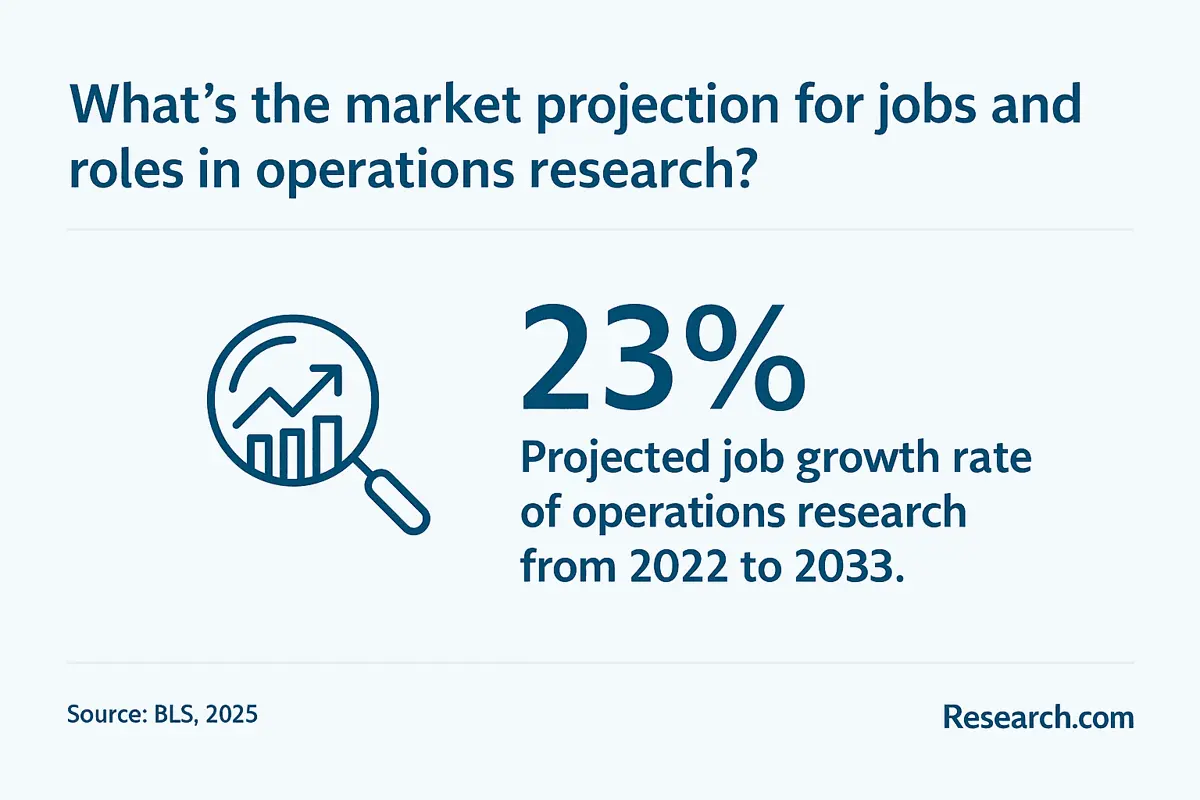
- Operations research roles: Jobs in operations research, including launch logistics and collision-avoidance applications, are projected to grow 23% from 2022 to 2032, according to the BLS.
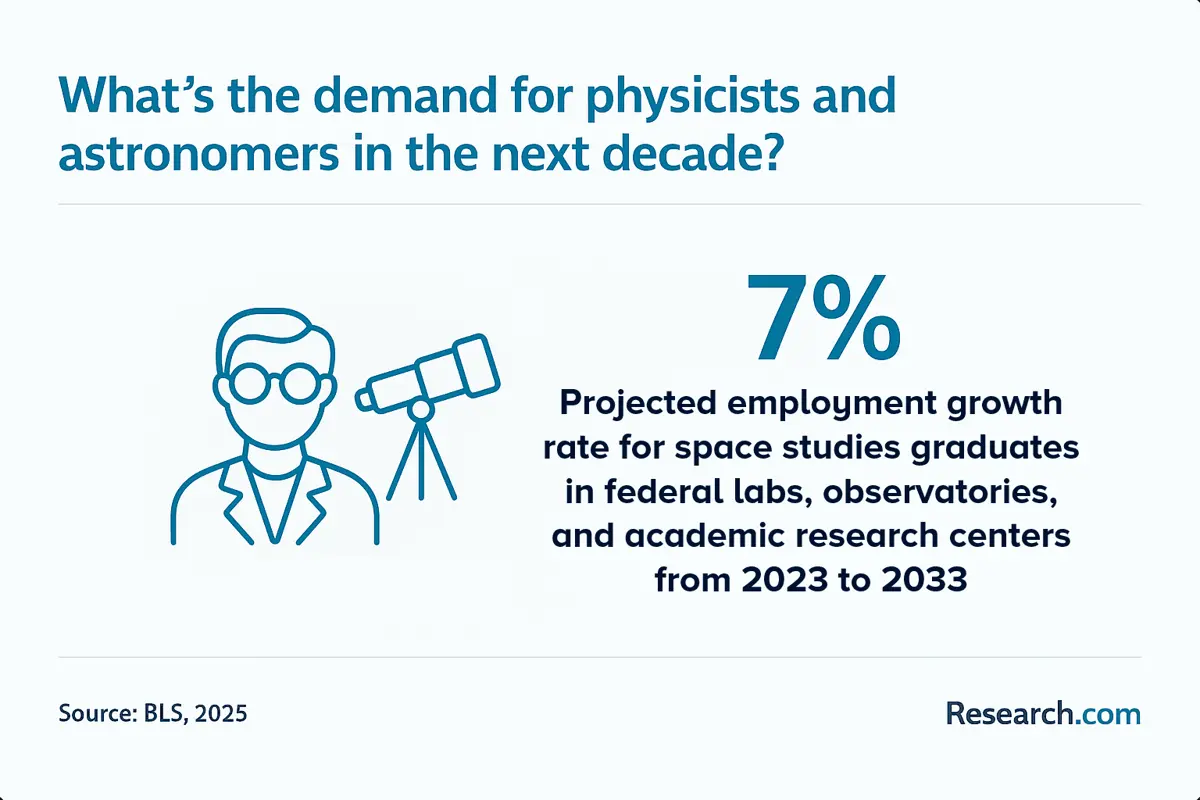
- Physics and astronomy demand: Employment for physicists and astronomers is expected to grow 7% in the same period, with opportunities at federal labs, observatories, and research centers.
- Earth systems and climate applications: Atmospheric scientists, including many who use satellite-based weather and climate models, are projected to see job growth of 4%.
- Cross-disciplinary advantage: Employers often value candidates who can connect technical analysis with policy, compliance, communication, and operations. This is similar to how graduates of the cheapest online MSN nurse executive leadership degree and the cheapest MSN nurse administrator online program may combine specialized knowledge with leadership and compliance skills in healthcare systems.
Students should watch employer postings before choosing electives. If job ads repeatedly mention GIS, Python, remote sensing, ITAR, systems engineering, or project management, build those skills into your degree plan whenever possible.
What graduates report about online space studies degree programs
- Kurt: As an active-duty service member, Kurt valued the ability to study online while continuing military responsibilities. Coursework in orbital mechanics and space policy helped him transition into a civilian role with a federal contractor after separation.
- Christie: Christie used the degree to shift from earth sciences into satellite-based environmental work. She now applies satellite data to coastal change analysis.
- Colin: Colin found the capstone especially useful in interviews because it allowed him to present a simulated mission profile connected to real satellite operations. That project helped him move toward trajectory modeling work.
Questions to ask before applying
- Is the institution regionally accredited by a recognized accreditor?
- Does the program fit my target career: satellite operations, GIS, space policy, planetary science, outreach, or engineering?
- Are labs delivered through real datasets, professional software, simulations, or only written assignments?
- What is the total cost after tuition, fees, software, textbooks, labs, and transfer credits?
- How many of my previous credits will apply toward the degree?
- Do online students receive the same internship, advising, library, tutoring, and career services as campus students?
- Will the program help me build a portfolio through capstones, research, or applied projects?
- Does the curriculum include marketable tools such as GIS, Python, remote sensing, modeling, or policy analysis?
- If I want a defense-related role, what background check, citizenship, or clearance considerations should I understand?
- If I may pursue graduate school later, will this degree meet the prerequisites for my intended program?
Key Insights
- An online space studies degree is best for students who want interdisciplinary careers in satellite operations, remote sensing, geospatial analysis, space policy, mission support, research, or STEM outreach.
- Most bachelor’s programs take 3 to 6 years depending on transfer credits, enrollment pace, accelerated terms, and part-time or full-time study.
- Stated total tuition examples range from about $23,500 through subscription pricing to $68,000 or more at premium research universities, before considering aid and fees.
- Financial aid can include Pell Grants up to $7,395 annually, federal loans, work-study, NASA MUREP awards up to $10,000 per year, SMART Scholarship funding, employer reimbursement up to $5,250 per year, and Post-9/11 GI Bill benefits.
- Salary potential is strongest in roles that combine space knowledge with technical skills. Examples include Remote Sensing Scientist or Technologist median pay of $94,870 and top 10% earnings of $138,460, Aerospace Engineering and Operations Technologist or Technician median wage of $78,620, and Operations Research Analyst median pay of $98,220.
- Do not choose a program only because it is online or inexpensive. Verify accreditation, total cost, transfer policies, applied labs, faculty expertise, and career support.
- The highest-value programs help students graduate with practical evidence of skill: GIS projects, satellite data analysis, mission design capstones, policy briefs, or technical portfolios.
- Online study works best for disciplined learners who can manage asynchronous coursework, software tools, and proactive networking without a campus routine.
References:
- ABET Engineering Accreditation Commission. (2023). 2024–2025 Criteria for Accrediting Engineering Programs (pp. 21–22, Aerospace and Similarly Named Engineering Programs). https://www.abet.org/wp-content/uploads/2023/05/2024-2025_EAC_Criteria.pdf
- Bureau of Labor Statistics. (2024). Atmospheric Scientists, Including Meteorologists. https://www.bls.gov/ooh/life-physical-and-social-science/atmospheric-scientists.htm
- Bureau of Labor Statistics. (2024). Operations Research Analysts. https://www.bls.gov/ooh/math/operations-research-analysts.htm
- Bureau of Labor Statistics. (2024). Physicists and Astronomers. https://www.bls.gov/ooh/life-physical-and-social-science/physicists-and-astronomers.htm
- Bureau of Labor Statistics. (2025, April 2). Data tables for the overview of May 2024 occupational employment and wages. https://www.bls.gov/oes/2024/may/featured_data.htm#eng1
- Federal Student Aid. (2025). Federal Pell Grants. https://studentaid.gov/understand-aid/types/grants/pell
- IPEDS. (2023). IPEDS average cost table. https://nces.ed.gov/ipeds/search/viewtable?tableId=35947
- National Center for Education Statistics. (2024). Average Tuition and Fees for Distance Education Students. https://nces.ed.gov/programs/coe/indicator/cua
- National Center for Education Statistics. (2024). Undergraduate Retention and Graduation Rates, Indicator CTR. https://nces.ed.gov/programs/coe/indicator/ctr
- SMART Scholarship Program. (2025). About SMART. https://www.smartscholarship.org/
- U.S. Department of Veterans Affairs. (2025). Post-9/11 GI Bill Overview. https://www.va.gov/education/about-gi-bill-benefits/post-9-11/
Other Things You Should Know About Online Space Studies Degree Programs
Most online space studies bachelor’s degrees require about 120 semester credits, including general education, science, and upper-level major courses. Programs that accept transfer credit may let eligible students apply up to 90 credits, which can shorten time to graduation and lower total tuition.
Yes, 2027 online space studies degree programs are typically eligible for federal financial aid, including grants and loans. Students must complete the Free Application for Federal Student Aid (FAFSA) to determine their eligibility based on income and other factors.