2027 Best Online Master’s in Industrial Engineering Programs

Co-Founder and Chief Data Scientist
Choosing an online Master’s in Industrial Engineering is a high-stakes decision because the degree can affect your technical depth, career mobility, salary potential, and access to leadership roles in operations, manufacturing, logistics, analytics, and systems optimization. The challenge is that many programs look similar on the surface: most advertise flexibility, advanced engineering coursework, and strong faculty. The real differences appear in accreditation, curriculum focus, software access, cost, employer connections, research options, and how well the program fits your current work schedule.
This guide is designed for working engineers, STEM graduates, operations professionals, and career changers who want to understand whether an online industrial engineering master’s degree is worth pursuing. You will learn what these programs cover, how online study compares with campus-based study, what admissions requirements to expect, how much programs may cost, which schools stand out, and how to evaluate return on investment before enrolling.
Quick answer: Is an online Master’s in Industrial Engineering worth it?
An online Master’s in Industrial Engineering can be worth it if you want to move into higher-level roles in systems engineering, operations research, manufacturing optimization, supply chain management, quality engineering, logistics, or engineering project management while continuing to work. The strongest programs combine quantitative coursework, applied projects, simulation tools, and flexible delivery. However, the degree is not automatically the best choice for everyone. It makes the most sense when the curriculum aligns with your target role, the school is properly accredited, and the total cost is reasonable compared with your expected career gains.
What are the benefits of getting a Master’s in Industrial Engineering?
- A graduate degree can prepare industrial engineers for specialized work in operations research, supply chain management, process improvement, quality systems, manufacturing strategy, and project leadership.
- Professionals with a Master’s in Industrial Engineering degree can earn an average annual salary of $87,000.
- Online programs allow working professionals to build advanced engineering skills without leaving their jobs or relocating, provided they can manage the workload and deadlines.
What can I expect from an online Master’s in Industrial Engineering?
An online Master’s in Industrial Engineering focuses on designing, improving, and managing complex systems involving people, machines, data, materials, money, and time. Unlike some engineering fields that concentrate on a single product or technology, industrial engineering looks at whole systems and asks how they can operate more safely, efficiently, profitably, and reliably.
Most online programs are built for students who already have a foundation in engineering, mathematics, statistics, or a related technical field. Coursework usually emphasizes analytical modeling, optimization, operations research, statistical methods, production systems, quality control, human factors, logistics, and systems thinking.
- Students typically study advanced industrial engineering concepts such as optimization, systems engineering, statistical analysis, simulation, and operations research.
- Many programs introduce software and technical tools used for modeling, data analysis, process simulation, forecasting, and decision support.
- Applied assignments may include case studies, production-system analysis, supply chain models, quality improvement projects, and simulations based on practical engineering problems.
- Some programs require a capstone, thesis, or final project that asks students to apply multiple areas of industrial engineering to a real or realistic operational challenge.
Who should consider this degree?
| Student profile | Why the degree may fit | What to check before enrolling |
| Working engineer | The degree can deepen expertise in optimization, operations, quality, logistics, or systems analysis while allowing continued employment. | Confirm whether courses are asynchronous, synchronous, or hybrid, and whether project deadlines fit your work schedule. |
| Manufacturing or operations professional | Graduate training can support advancement into process improvement, production planning, quality, or supply chain roles. | Look for coursework in manufacturing systems, lean methods, simulation, and engineering economy. |
| STEM graduate seeking applied analytics work | Industrial engineering can connect quantitative skills to real business and operational problems. | Review prerequisite expectations in calculus, statistics, programming, and engineering fundamentals. |
| Future engineering manager | The curriculum often blends technical decision-making with project management and systems-level leadership. | Consider programs with project management, engineering economy, and business-oriented electives. |
Who may want a different path?
- If you want a research-intensive academic career, a thesis-based campus program may provide stronger access to labs and faculty research groups.
- If your goal is pure software engineering, data science, or AI model development, a computer science, analytics, or AI-focused program may be more direct.
- If you are primarily seeking general management roles, an MBA or engineering management degree may be more aligned than a technical industrial engineering master’s.
- If you lack the required quantitative background, you may need prerequisite coursework before you can succeed in graduate-level industrial engineering courses.
Where can I work with an online Master’s in Industrial Engineering?
Industrial engineers held 327,300 jobs in 2022 (US BLS, 2023). Their work settings vary widely. Some industrial engineers evaluate assembly lines or production floors in person, while others analyze data, develop models, or redesign workflows from an office. Depending on the employer, travel may be required to observe processes, interview stakeholders, or assess facilities.
According to the U.S. Bureau of Labor Statistics (2023), the largest employment areas for industrial engineers include:
- transportation equipment manufacturing (16%)
- professional, scientific, and technical services (13%)
- computer and electronic product manufacturing (12%)
- machinery manufacturing (9%)
- fabricated metal product manufacturing (6%)
These industries illustrate why industrial engineering remains a flexible discipline: the same core skills in optimization, systems analysis, and process improvement can apply to factories, logistics networks, healthcare systems, technology companies, consulting firms, and public infrastructure projects.
How much can I make with an online Master’s in Industrial Engineering?
- Industrial engineers with a bachelor’s degree can earn a median annual salary of $74,046, while graduate-level education can raise earnings to around $87,000 per year (PayScale, 2023). These figures compare with a small business accountant salary, though pay varies by industry, location, experience, and role.
- Based on U.S. Bureau of Labor Statistics data, employment in this field is projected to grow by 12% from 2022 to 2032.
- Most industrial engineers begin with a bachelor’s degree in industrial engineering or a closely related engineering field.
- Related undergraduate backgrounds such as mechanical engineering, electrical engineering, or industrial engineering technology may also support entry into the field, depending on the employer and graduate program requirements.
- Demand is tied to the ability of industrial engineers to improve productivity, reduce waste, streamline systems, and support data-informed operational decisions across industries.
- A bachelor’s degree can be enough for many entry-level roles, but an online Master’s in Industrial Engineering may help professionals compete for analytical, specialized, or leadership-oriented positions.
- Best online Master’s in Industrial Engineering programs for 2027
- Online versus campus-based industrial engineering master’s programs
- Skills needed for graduate-level industrial engineering study
- Admissions requirements for online industrial engineering master’s programs
- Common courses in an online Master’s in Industrial Engineering
- Typical completion timeline
- Average cost and major price drivers
- How to choose the right online industrial engineering school
- Financial aid options for online graduate engineering students
- How to evaluate return on investment
- Common challenges of earning the degree online
- How artificial intelligence is changing industrial engineering
- How interdisciplinary study can strengthen career outcomes
- How virtual labs and simulation tools support online learning
- Emerging industrial engineering specializations
- Accreditation and industry partnerships to review
- Job prospects after an online Master’s in Industrial Engineering
- Current trends affecting industrial engineering
- Professional certifications that can strengthen your profile
- Career paths beyond traditional industrial engineering roles
- How alumni networks and mentoring can support advancement
- How online master’s programs support research and innovation
- Why business acumen matters in industrial engineering
Best online Master’s in Industrial Engineering
How do we rank schools?
Research.com evaluates graduate programs with the goal of helping students compare options using transparent, decision-relevant information rather than marketing claims alone.
For this ranking of online Master’s in Industrial Engineering programs, the research team reviewed data from IPEDS, Peterson’s database and its Distance Learning Licensed Data Set, the College Scorecard database, and the National Center for Education Statistics. Program duration, cost, credit requirements, and accreditation status were also considered. To understand the broader ranking process, review the Research.com methodology.
Program comparison at a glance
| School | Program length | Cost information | Credits required | Accreditation |
| Georgia Institute of Technology | Two years | $16950 | 30 | Southern Association of Colleges and Schools Commission on Colleges (SACSCOC) |
| Columbia University | Two years | $2,462 per credit | 30 | Middle States Commission on Higher Education (MSCHE) |
| University of Southern California | Two years | $2,424 per credit | 28 | Western Association of Schools and Colleges (WASC) |
| North Carolina State University | Two years | $553.29 per credit | 30 | SACSOC |
| New York University | Two years | $39935 | 30 | MSCHE |
| Texas A&M University | One and a half years | $19118 | 18 | SACSOC |
| University of Central Florida | Two years | $327.32 | 30 | SACSCOC |
| University of Illinois at Urbana-Champaign | Two years | $1,137 | 36 | Higher Learning Commission (HLC) |
| Purdue University | Two years | $11898 | 30 | HLC |
| Clemson University | 30 months | $19508 | 30 | SACSOC |
1. Georgia Institute of Technology
Georgia Institute of Technology offers online industrial engineering master’s study through the H. Milton Stewart School of Industrial and Systems Engineering, described as the nation’s largest industrial engineering program. The curriculum is broad and interdisciplinary, with coursework that may include Manufacturing Systems, Warehousing Systems, Transportation and Supply Chain Systems, and Advanced Engineering Economy. Students looking for a research-active environment and a highly established industrial and systems engineering department may find this program especially compelling.
- Program Length: Two years
- Cost of Tuition: $16950
- Required Credits to Graduate: 30
- Accreditation: Southern Association of Colleges and Schools Commission on Colleges (SACSCOC)
2. Columbia University
Columbia University delivers its online industrial engineering and systems engineering master’s program through the Columbia Video Network (CVN), a format built with working professionals in mind. Students may study Probability and Statistics, Applied Systems Engineering, Systems Engineering: Tools and Methods, Optimization Models and Methods, and Stochastic Models. The program is well suited for learners who want a quantitative, systems-focused graduate experience connected to a major research university.
- Program Length: Two years
- Cost per Credit: $2,462
- Required Credits to Graduate: 30
- Accreditation: Middle States Commission on Higher Education (MSCHE)
3. University of Southern California
The University of Southern California (USC) offers an online Master of Science in Industrial and Systems Engineering through DEN@Viterbi. The program covers technical areas such as Enterprise Information Systems, Production Systems Design Engineering, Data Modeling, Reliability Engineering, and Applied Deterministic Operations Research. USC may appeal to students who want a systems engineering perspective, access to experienced faculty, and a curriculum connected to practical industry applications.
- Program Length: Two years
- Cost per Credit: $2,424
- Required Credits to Graduate: 28
- Accreditation: Western Association of Schools and Colleges (WASC)
4. North Carolina State University
North Carolina State University (NC State) provides an online Master of Industrial Engineering through Engineering Online. The program includes coursework in areas such as Economic Analytics and Decision-Making, Human Factors and Ergonomics, Manufacturing Systems, Supply Chain, and Systems Analytics and Optimization. Because it does not require an on-campus residency, it may be a practical option for employed students who need a fully distance-based format.
- Program Length: Two years
- Cost per Credit: $553.29
- Required Credits to Graduate: 30
- Accreditation: SACSOC
5. New York University
New York University offers an online Master’s in Industrial Engineering with coursework that may include Enterprise Information Systems, Production Systems Design Engineering, Data Modeling, Reliability Engineering, Applied Deterministic Operations Research, Applied Stochastic Operations Research, Human Factors Engineering, and Manufacturing Systems Engineering. The program is designed to combine technical rigor with real-world relevance for students seeking advanced industrial engineering preparation.
- Program Length: Two years
- Cost of Tuition: $39935
- Required Credits to Graduate: 30
- Accreditation: MSCHE
6. Texas A&M University
Texas A&M University offers online graduate study in industrial engineering with topics such as Engineering Economy and Cost Analysis, Human Factors and Ergonomics, Manufacturing Systems and Operations Research, Statistical Design and Analysis of Experiments, Simulation and Modeling, and Engineering Project Management. Students who value alumni connections and a curriculum with management, modeling, and production-system content may want to compare this option closely.
- Program Length: One and a half years
- Cost of Tuition: $19118
- Required Credits to Graduate: 18
- Accreditation: SACSOC
7. University of Central Florida
The University of Central Florida (UCF) offers an online Master’s in Industrial Engineering with courses that may cover Enterprise Information Systems, Production Systems Design Engineering, Data Modeling, Reliability Engineering, and Human Systems Engineering/Ergonomics. The program is structured to help students understand system optimization from multiple industrial engineering angles, making it relevant for professionals who want a broad applied skill set.
- Program Length: Two years
- Cost of Tuition: $327.32
- Required Credits to Graduate: 30
- Accreditation: SACSCOC
8. University of Illinois at Urbana-Champaign
The University of Illinois at Urbana-Champaign offers an online industrial engineering master’s program with coursework such as Operations Research, Statistical Methods for Industrial Engineering, Design and Analysis of Experiments, Engineering Economy, Optimization Methods, Human Factors and Ergonomics, and Simulation Modeling and Analysis. Students may also pursue a concentration in Advanced Analytics in Industrial and Enterprise Systems Engineering. The availability of thesis and non-thesis options gives students flexibility based on whether they are more interested in applied professional advancement or research-oriented work.
- Program Length: Two years
- Cost of Tuition: $1,137
- Required Credits to Graduate: 36
- Accreditation: Higher Learning Commission (HLC)
9. Purdue University
Purdue University offers an online Master’s in Industrial Engineering with a non-thesis pathway and entry options in both fall and spring. The curriculum may include Engineering Economy, Human Factors and Ergonomics, Statistical Methods for Engineers, Operations Research, Simulation and Modeling, Quality Control, and Manufacturing Systems. Purdue may be a strong fit for students seeking an established engineering brand, experienced faculty, and professional networking through a broad alumni community.
- Program Length: Two years
- Cost of Tuition: $11898
- Required Credits to Graduate: 30
- Accreditation: HLC
10. Clemson University
Clemson University offers an online Master’s in Industrial Engineering with core topics such as Engineering Economy and Cost Analysis, Human Factors and Ergonomics, Statistical Methods for Engineers, Operations Research, Simulation and Modeling, and Quality Management. Students may choose between thesis and non-thesis options, which allows them to align the degree with either applied professional goals or a more research-focused academic path.
- Program Length: 30 months
- Cost of Tuition: $19508
- Required Credits to Graduate: 30
- Accreditation: SACSOC
Key Findings
- Industrial engineering has a projected growth rate of 12% from 2022 to 2032.
- Online Master’s in Industrial Engineering programs in this guide show tuition figures from $1,137 to $39,935 and credit requirements from 18 to 36.
- Typical online program length ranges from one year to two years, although some part-time paths may extend to three years or more.
- Among Industrial Engineering graduates, 2,483 earned Master’s degrees.
- Related online industrial engineering degree jobs can report average annual salaries ranging from $74,307 to $79,602.
How does an online master’s in industrial engineering compare to an on-campus program?
An online master’s in industrial engineering can provide the same advanced academic focus as a campus program, but the learning experience is different. The better choice depends on your schedule, learning style, need for physical lab access, networking goals, and whether you plan to study while working full time.
| Factor | Online master’s program | On-campus master’s program | Best fit |
| Schedule flexibility | Often better for students balancing work, family, and graduate study. | Usually follows a fixed class and campus schedule. | Online is often better for working professionals. |
| Networking | Relies on virtual meetings, discussion boards, group projects, and alumni platforms. | Provides more spontaneous face-to-face interaction with faculty and peers. | Campus may be better if in-person networking is a top priority. |
| Access to facilities | Uses digital libraries, remote software, virtual labs, and online collaboration tools. | May offer direct access to physical labs, makerspaces, and campus facilities. | Campus may be better for lab-heavy or research-intensive goals. |
| Learning environment | Requires self-direction, time management, and comfort with digital tools. | Provides more structured in-person routines and immediate classroom interaction. | Online fits independent learners; campus fits students who prefer face-to-face structure. |
| Employer perception | Online degrees are more common, but reputation and accreditation still matter. | Traditional campus degrees may be preferred by some employers or industries. | Either can work if the program is reputable, accredited, and relevant to the role. |
- Flexibility: Online study usually gives students more control over when and where they complete coursework, which can be essential for employed engineers.
- Networking: Campus programs often make relationship-building easier through in-person classes, labs, and events, while online students must be more intentional about building connections.
- Resources: On-campus students may have easier access to physical laboratories and campus facilities, while online students typically depend on virtual labs, remote software access, and digital support services.
- Interaction: Campus classes can offer immediate discussion, while online classes rely on video meetings, forums, collaborative tools, and instructor office hours.
- Course delivery: Online programs use recorded lectures, live sessions, interactive modules, and digital assignments; campus programs rely more heavily on in-person lectures and hands-on activities.
- Employer expectations: Employers increasingly understand online education, but students should still prioritize institutional reputation, accreditation, skill relevance, and project quality.
What are the important qualities required to get an online Master’s in Industrial Engineering degree?
Success in online engineering degree programs depends on more than technical intelligence. Graduate industrial engineering students must be able to work independently, solve quantitative problems, communicate clearly, and apply theory to messy operational problems.
- Creativity. Industrial engineers often improve systems that already exist. Creativity helps them redesign workflows, reduce waste, shorten cycle times, improve safety, and find practical ways to do more with fewer resources.
- Math Skills. Graduate-level industrial engineering requires comfort with quantitative thinking. Students may use calculus, statistics, probability, optimization, simulation, and advanced mathematical reasoning to analyze systems and make recommendations.
- Communication Skills. Industrial engineers work with managers, operators, vendors, customers, production teams, and technical specialists. They must translate data and models into recommendations that non-specialists can understand and use.
Additional skills that matter in online programs
- Self-management: Online graduate courses require consistent weekly effort, especially in quantitative subjects.
- Software adaptability: Students may need to learn simulation platforms, statistical tools, spreadsheets, programming environments, or optimization software.
- Systems thinking: Industrial engineers must understand how one change affects people, equipment, cost, quality, and delivery.
- Collaboration: Many online courses include team projects, so students should be comfortable coordinating across time zones and work schedules.
What are the admission requirements for an online Master’s in Industrial Engineering degree?
Admissions requirements differ by university, and online programs may have slightly different expectations than campus programs. Students preparing for industrial engineering careers should review each school’s requirements carefully rather than assuming all programs use the same criteria.
- Application. Applicants usually complete an online application that requests academic history, work experience, personal information, and sometimes essays or statements of purpose. Students seeking financial aid may also need to provide financial information through the appropriate aid process.
- Official Transcripts. Graduate programs typically require official transcripts from all prior colleges or universities. Applicants may need to pay transcript fees and arrange for documents to be sent directly from previous institutions to the admissions office.
- Test Scores. Some programs require the Graduate Record Examination (GRE), which evaluates verbal reasoning, quantitative reasoning, and analytical writing. Students who need or want to submit GRE scores should plan early enough to allow for preparation and possible retesting.
- Letters of Recommendation. Many programs request recommendations from professors, supervisors, advisors, or professional mentors who can speak to the applicant’s technical ability, work ethic, leadership potential, or readiness for graduate study.
Students can strengthen their applications by showing evidence of quantitative preparation, relevant engineering or operations experience, programming or analytics exposure, and a clear reason for pursuing industrial engineering at the graduate level.
The degree distribution shown below highlights how graduate credentials are less common than bachelor’s credentials in this field: in 2021, 2,483 Master’s degrees were awarded in industrial engineering, compared with 5,867 Bachelor’s degrees.
What are the core courses in an online master’s in industrial engineering program?
Online industrial engineering master’s programs usually combine foundational quantitative courses with electives in manufacturing, logistics, analytics, systems design, quality, and human factors. Course names vary, but the subjects below are common across many programs.
- Project Management. This course helps students plan, estimate, schedule, control, and lead engineering projects. Topics may include risk management, resource allocation, project leadership, lifecycle planning, small-group dynamics, project methodologies, and project controls.
- Advanced Engineering Statistics. Students study statistical methods used to analyze industrial systems, including hypothesis testing, regression analysis, time series analysis, and data interpretation for engineering decision-making.
- Human Integration with Computers Course. This subject examines how people interact with computer-based systems. It may cover human-computer interaction, ergonomics, occupational safety and health, and the design of systems that improve both productivity and user safety.
- Supply Chain and Logistics Systems. This course focuses on inventory, transportation, procurement, distribution, and systemwide logistics performance. Students learn how to analyze and improve supply chain processes.
Common curriculum areas and why they matter
| Course area | Skills developed | Career relevance |
| Operations research | Optimization, modeling, resource allocation, decision analysis | Useful for operations research, logistics, scheduling, and systems planning roles |
| Simulation and modeling | Process simulation, scenario testing, bottleneck analysis | Helpful in manufacturing, healthcare operations, distribution, and production planning |
| Quality engineering | Statistical process control, defect reduction, reliability thinking | Relevant for quality assurance, manufacturing, process improvement, and compliance work |
| Human factors and ergonomics | Human-centered design, safety analysis, workplace efficiency | Valuable in production environments, product design, safety, and systems usability |
| Engineering economy | Cost analysis, economic decision-making, investment evaluation | Important for project justification, capital planning, and management roles |
How long does it take to complete an online master’s in industrial engineering program?
- Completion time depends on credit requirements, course availability, enrollment status, and whether the student chooses a thesis, non-thesis, or capstone path. Full-time students can often finish in one to two years.
- Part-time students who are working while enrolled may need two to three years or more.
- Before applying, students should review required credits, course sequencing, summer options, and whether accelerated or extended tracks are available.
- Individual pace, workload, prerequisite needs, and the number of courses taken per term can significantly affect total time to graduation.
What is the average cost of an online master’s degree in industrial engineering?
The average annual cost of an online master’s degree in industrial engineering is $19,792, according to the National Center for Education Statistics. This is broadly comparable to the general cost of a master's degree, but students should evaluate the full cost of attendance rather than relying only on tuition.
- Institution Reputation: Universities with strong engineering reputations may charge more because of faculty expertise, research infrastructure, brand recognition, and student demand.
- Program Specialization: Programs with specialized tracks in analytics, logistics, manufacturing, human factors, or systems engineering may have different costs depending on faculty and technology requirements.
- Online Learning Infrastructure: Tuition may reflect investments in virtual labs, remote software access, instructional design, learning platforms, and technical support.
- Faculty Expertise and Support: Programs with experienced faculty, advising, career services, and dedicated online student support may cost more but can also provide stronger academic structure.
- Geographic Location: Even online tuition can be influenced by institutional location, state funding models, residency rules, and the cost structure of the university.
Cost factors students often overlook
| Cost item | Why it matters | Question to ask |
| Technology fees | Online programs may charge platform, distance learning, or software-related fees. | Are all required online and technology fees included in the published tuition estimate? |
| Software access | Industrial engineering courses may use simulation, statistics, optimization, or modeling tools. | Does the program provide licenses, or must students purchase software separately? |
| Books and materials | Graduate engineering texts and digital resources can add to the total cost. | What are the estimated materials costs per term? |
| Residency requirements | Some online programs may require campus visits, exams, or intensive sessions. | Is the program fully online, and are travel costs possible? |
| Time away from work | Even online study can affect overtime, travel, or promotion timing. | Can I realistically complete the workload without reducing income? |
How to choose the best online Master’s Degree in Industrial Engineering school?
The best online industrial engineering master’s program is the one that fits your career target, budget, schedule, academic background, and preferred learning format. A highly ranked program is not automatically the right program if it lacks your specialization, costs more than you can justify, or does not provide the support you need as an online student.
- Accreditation. If you are asking how do you check if a school is accredited in USA, start with the institution’s recognized accreditor and then review any relevant programmatic accreditation. Engineering students should understand the role of organizations such as the Accreditation Board for Engineering and Technology (ABET). Accreditation supports degree recognition, financial aid eligibility, and confidence in academic quality.
- Program Offerings. Online Master’s in Industrial Engineering programs may emphasize manufacturing systems, industrial economics, operations research, production planning, quality engineering and management, logistics, or transportation systems. Students interested in logistics careers, for example, should look for supply chain, transportation, and optimization coursework.
- Flexibility and Delivery Format. Review whether courses are asynchronous, live, hybrid, cohort-based, or self-paced. Also confirm access to software, virtual labs, faculty office hours, tutoring, and library resources. Students who want a faster path may compare one year masters programs, but accelerated formats require careful workload planning.
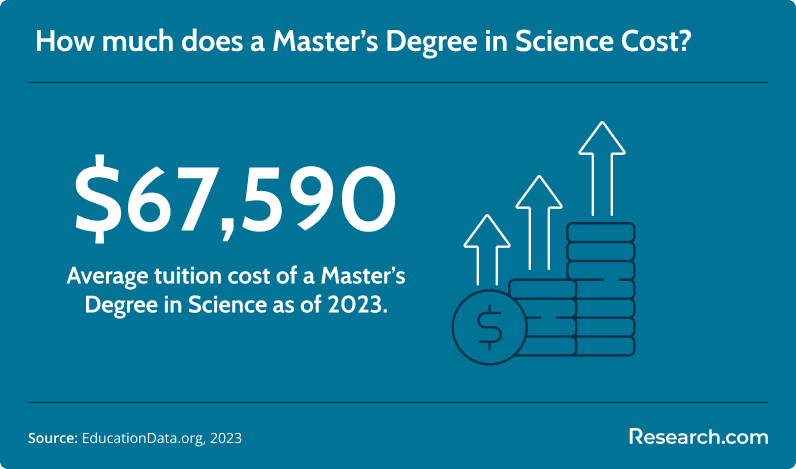
- Cost and Financial Aid. Engineering master’s programs can be valuable, but cost discipline matters. The average cost of a Master’s degree in Science is $67,590. Compare total tuition, fees, residency expenses, employer reimbursement, scholarships, and the likely career value of the degree before committing.
Questions to ask before applying
- Is the institution regionally accredited or otherwise recognized by an appropriate accrediting body?
- Does the curriculum match my target role in operations research, manufacturing, supply chain, quality, analytics, or management?
- Are courses delivered live, asynchronously, or through a mix of both?
- Will I have access to required software, virtual labs, faculty, and technical support?
- Can I complete the degree part time without delaying required course sequences?
- What are the total costs, including fees, books, software, and possible travel?
- What career support, alumni access, employer partnerships, or capstone opportunities are available to online students?
What are the options for financial aid for online master’s in industrial engineering programs?
Financing graduate school requires early planning. Engineering graduates numbered 176,557 in the Fall of 2022, a year-on-year increase of 4.60%, and competition for affordable, high-quality graduate options can make funding strategy important.
Financial aid availability depends on the institution, program, enrollment level, and student eligibility. Common options include:
- Grants and Loans. Eligible students may use federal or state grants and loans to help cover graduate education costs.
- Scholarships. Universities, professional associations, and industry organizations may offer scholarships for graduate engineering students or online learners. One example is the American Institute of Chemical Engineers.
- Employer Funding. Some employers provide tuition reimbursement or tuition assistance for employees pursuing online industrial engineering master’s coursework related to their current or future roles.
Ways to reduce the total cost
- Ask your employer whether tuition reimbursement applies to online engineering programs.
- Compare cost per credit and total credit requirements, not tuition labels alone.
- Check whether out-of-state online students pay different rates.
- Look for programs that include software access in tuition or fees.
- Apply early for institutional scholarships and department-based awards.
- Avoid taking more credits than required unless electives clearly support your career goal.
How Do I Evaluate the ROI of an Online Master’s in Industrial Engineering Program?
Return on investment should be evaluated by comparing the total cost of the program with realistic career benefits. Tuition is only one part of the calculation. Students should also consider fees, software, books, time commitment, potential income disruption, employer reimbursement, and the value of new skills in their target labor market.
On the benefit side, review whether the program can help you qualify for roles with more responsibility, stronger technical specialization, or leadership potential. Useful indicators include curriculum relevance, faculty expertise, employer partnerships, alumni outcomes, capstone quality, and whether the school has career services for online students. A broader look at a master degree pathway can also help students compare cost, completion time, and professional outcomes across fields.
| ROI factor | What to evaluate | Red flag |
| Total cost | Tuition, fees, materials, software, travel, and financing costs | The school cannot provide a clear total cost estimate. |
| Career alignment | Whether coursework matches your intended role or industry | The program has few electives related to your career goal. |
| Time to completion | How long you will be enrolled and how that affects work and income | Required courses are offered infrequently, delaying graduation. |
| Employer value | Whether employers in your field recognize the degree and skills | The program has weak industry connections or limited applied projects. |
| Opportunity cost | What you give up in time, energy, money, and career focus | The workload is unrealistic for your current professional obligations. |
What Are the Challenges of Pursuing a Master’s in Industrial Engineering Online?
Online graduate engineering study can be convenient, but it is not easier than campus study. The main challenges include staying disciplined in asynchronous courses, building relationships without face-to-face contact, completing technical assignments remotely, and finding enough time for demanding quantitative coursework.
Students can reduce these risks by choosing programs with strong virtual labs, responsive faculty, live support options, active peer interaction, and clear expectations. Reputable non-profit colleges may also provide structured academic services, advising, and online learner support that can improve the student experience.
Common mistakes to avoid
| Mistake | Why it can hurt you | Better approach |
| Choosing based only on tuition | A cheap program may still be a poor value if it lacks relevant courses or support. | Compare total cost, curriculum fit, software access, and career services. |
| Ignoring accreditation | Accreditation affects credibility, transferability, and aid eligibility. | Verify institutional accreditation and review any relevant engineering accreditation details. |
| Underestimating workload | Graduate engineering courses can be mathematically and technically intensive. | Ask how many hours students typically spend per course each week. |
| Assuming online means self-paced | Many online programs still have weekly deadlines, group projects, and live sessions. | Confirm the delivery format before enrolling. |
| Skipping career outcome research | A degree may not help if it does not align with your target industry or role. | Review alumni roles, employer partnerships, capstone topics, and career support. |
How can artificial intelligence enhance industrial engineering?
Artificial intelligence is increasingly relevant to industrial engineering because it can support predictive analytics, automated decision-making, process monitoring, demand forecasting, predictive maintenance, quality control, and supply chain optimization. Industrial engineers who understand AI tools can help organizations use data more effectively while still considering cost, people, safety, constraints, and operational feasibility.
Students who want deeper AI preparation may compare industrial engineering programs with analytics or AI electives, or explore related graduate options such as masters in AI. The best choice depends on whether you want to apply AI to operations problems or specialize primarily in AI development.
Can interdisciplinary studies enhance industrial engineering career outcomes?
Interdisciplinary study can strengthen industrial engineering because modern systems often involve data, software, supply chains, human behavior, business constraints, and regulation. Combining industrial engineering with analytics, information technology, business, sustainability, or computational science can help professionals solve broader and more complex problems.
For example, students interested in technically diverse environments may pair industrial engineering with data analytics, health systems, bioinformatics, or AI-related coursework. Programs such as an online masters in bioinformatics show how analytical and systems-oriented thinking can extend into data-heavy scientific and healthcare settings.
How are virtual labs and simulation tools integrated into online industrial engineering programs?
Online industrial engineering programs often use virtual labs, simulation platforms, remote software access, and case-based modeling assignments to approximate practical engineering work. These tools allow students to test process changes, model production flows, evaluate system constraints, and analyze trade-offs without being physically present in a lab.
Students should ask whether software access is included, whether training is provided, and whether assignments use realistic datasets or industry-style scenarios. Learners who want to build stronger data skills alongside engineering modeling may also compare options such as cheap online data science masters programs.
What are the emerging specializations in industrial engineering?
Industrial engineering is expanding as organizations rely more heavily on automation, analytics, sustainability, connected systems, and resilient supply chains. Emerging and high-value areas include data analytics, artificial intelligence, sustainability engineering, advanced manufacturing, human-centered systems, supply chain resilience, and digital operations.
Data analytics helps industrial engineers use large datasets to improve decisions, forecast demand, reduce bottlenecks, and optimize system performance. AI skills can support predictive maintenance, intelligent scheduling, quality inspection, and adaptive logistics. Sustainability engineering focuses on reducing waste, improving energy efficiency, and designing processes that meet environmental goals and regulatory expectations.
Students should select a program with electives and projects that match the specialization they want to pursue. If affordability is a priority, an online accredited engineering degree program can help students compare lower-cost options without losing sight of accreditation and curriculum quality.
| Specialization | Best for students interested in | Look for coursework in |
| Operations research | Optimization, decision models, resource allocation, scheduling | Linear programming, stochastic models, optimization, simulation |
| Supply chain and logistics | Transportation, inventory, distribution, procurement, resilience | Supply chain analytics, logistics systems, transportation modeling |
| Manufacturing systems | Production, automation, quality, plant operations | Manufacturing systems, quality control, lean methods, reliability |
| Human factors | Safety, usability, ergonomics, human-centered system design | Ergonomics, human-computer interaction, occupational safety |
| Analytics and AI applications | Data-driven improvement, predictive modeling, smart operations | Data modeling, machine learning applications, simulation, statistics |
What accreditation and industry partnerships should I consider?
Accreditation should be one of the first items you verify when comparing online industrial engineering programs. Institutional accreditation helps confirm that a university meets recognized academic standards, and program-related accreditation or recognition can matter depending on your career plans. Students should also review industry partnerships because they may influence capstone projects, applied research, internships, employer networking, and access to current tools.
Strong programs often connect coursework with real operational problems through employer-sponsored projects, industry datasets, consulting-style assignments, or research collaborations. Partnerships related to emerging technologies, including programs connected to an online degree AI, may signal that the institution is adapting to changing technical demands.
What are the job prospects for graduates of online master’s in industrial engineering programs?
Industrial engineering is broad, and a master’s degree can support movement into more specialized, analytical, or leadership-oriented engineering roles. Graduates with an online master’s in industrial engineering degree may pursue positions such as:
- Industrial Engineer
- Manufacturing Engineer
- Logistics Engineer
- Process Engineer
- Quality Assurance (QA) Engineer
These roles can report average annual salaries ranging from $74,307 to $79,602 (PayScale, 2023).
The chart below shows PayScale data on jobs available to online Master’s in Industrial Engineering graduates and their corresponding median annual pay.
What are the current trends in the industrial engineering industry?
Industrial engineering is being reshaped by technology, automation, sustainability goals, supply chain complexity, and investment in manufacturing and infrastructure. These trends increase the need for engineers who can connect data, systems, people, and cost-effective process improvement.
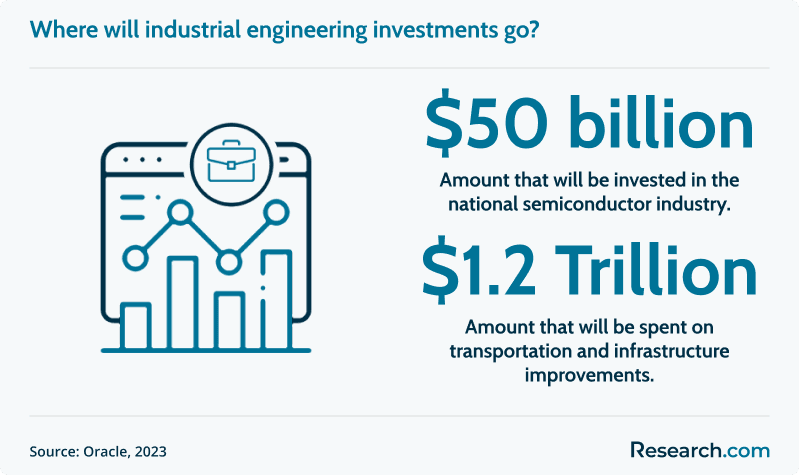
- Technology Investment. Industrial organizations are investing in advanced technologies to improve production, logistics, infrastructure, and system performance. The US CHIPS and Science Act designates $50 billion specifically for the national semiconductor industry, while the Infrastructure Investment and Jobs Act earmarks $1.2 trillion for transportation and infrastructure improvements (Oracle, 2023).
- Automation and Robotics. Industrial engineers help integrate automation and robotics into manufacturing and operational environments to improve productivity, consistency, safety, and throughput.
- Artificial Intelligence and Machine Learning. As organizations collect more operational data, industrial engineers are using AI and machine learning to support predictive analytics, smarter decision-making, and system optimization.
- Internet of Things (IoT). Connected devices and sensors allow industrial engineers to collect real-time data, monitor equipment, analyze workflows, and identify performance issues more quickly.
- Investing in Sustainability. Industrial engineers increasingly support efforts to reduce energy use, lower environmental impact, improve facility design, and make production processes more resource-efficient.
What professional certifications can enhance an industrial engineer's career prospects?
A Master’s in Industrial Engineering can strengthen your academic and technical foundation, while certifications can validate specific workplace skills. The right certification depends on your target role. A quality engineer, supply chain analyst, project manager, and manufacturing improvement leader may benefit from different credentials.
- Certified Six Sigma Black Belt (CSSBB): Offered by the American Society for Quality (ASQ), this credential focuses on Six Sigma methods for reducing defects, improving processes, and leading data-driven improvement projects.
- Lean Manufacturing Certification: Lean training focuses on reducing waste while protecting or improving productivity. Providers such as the Lean Enterprise Institute teach methods used in manufacturing, healthcare, logistics, and service operations.
- Certified Supply Chain Professional (CSCP): Offered by the Association for Supply Chain Management (ASCM), this certification covers end-to-end supply chain concepts and can support industrial engineers working in logistics, procurement, planning, or distribution.
- Project Management Professional (PMP): Administered by the Project Management Institute (PMI), the PMP credential validates project planning, execution, monitoring, and leadership skills that are useful for engineering project management.
- Certified in Production and Inventory Management (CPIM): Also offered by ASCM, CPIM focuses on production planning, inventory control, and manufacturing operations, making it relevant for engineers involved in production systems.
- Professional Engineering (PE) License: In the U.S., the PE license is a professional engineering credential that generally involves passing the FE and PE exams and meeting experience requirements. For industrial engineers in certain roles, it can signal professional competence and responsibility.
What career paths can industrial engineers pursue outside traditional roles?
Industrial engineers are trained to improve systems, which makes their skills useful outside conventional factory or production roles. Their background in optimization, analytics, workflow design, and efficiency can transfer to healthcare operations, technology, public systems, consulting, e-commerce, entertainment production, humanitarian logistics, sustainability, and policy implementation.
In sustainability and green energy, industrial engineers may redesign processes to reduce waste and improve energy efficiency. In entertainment and gaming, they may help optimize production workflows or operational algorithms. In public administration, they may improve transportation networks, healthcare delivery, emergency response systems, or resource allocation.
Professionals who want to broaden their credentials for nontraditional paths may compare flexible graduate options such as the cheapest master’s degree online. The key is to choose additional education that complements industrial engineering rather than duplicating skills you already have.
How can alumni networks and mentoring opportunities boost career advancement?
Alumni networks and mentoring can help online students turn coursework into career movement. Mentors may provide guidance on role selection, promotion strategy, technical skill gaps, interview preparation, and transitions into leadership. Alumni can also help students understand which industries value industrial engineering skills and which certifications or projects matter most.
Strong online programs create connection points through virtual events, employer panels, capstone showcases, career fairs, peer groups, and direct mentoring. Students interested in combining industrial engineering with newer technical fields may also explore options such as the cheapest AI online degree to build digital skills that complement systems optimization.
How do online Master’s programs foster research and innovation?
Online Master’s in Industrial Engineering programs can support applied research through capstones, faculty-led projects, industry case studies, simulation-based assignments, and interdisciplinary collaboration. Students may analyze operational datasets, model production systems, test process improvements, or develop recommendations for real-world engineering problems.
Research opportunities vary significantly by school, so students who want publishable research, thesis supervision, or doctoral preparation should ask about faculty availability, thesis options, research groups, and access to data or laboratory resources. Students exploring broader graduate career possibilities can also review what can you do with a masters in biotechnology for examples of how graduate education can open different applied research and industry pathways.
The Role of Business Acumen in Industrial Engineering
Industrial engineers often make recommendations that affect cost, staffing, production schedules, customer service, capital investment, safety, and profitability. That means technical skill alone is not enough for many senior roles. Business acumen helps engineers explain trade-offs, justify investments, manage teams, and align process improvements with organizational strategy.
Professionals who want to move toward management may benefit from coursework in finance, operations strategy, organizational behavior, marketing, analytics, and technology leadership. An affordable online MBA in Information Technology may be appropriate for engineers who want to combine technical systems knowledge with management and digital strategy.
The strongest career path may not be either engineering or business alone. For many professionals, advancement comes from combining industrial engineering expertise with the ability to communicate financial impact, lead cross-functional teams, and make decisions that improve both operations and long-term business performance.
Key Insights
- An online Master’s in Industrial Engineering is best for students who want advanced skills in optimization, systems analysis, operations research, logistics, manufacturing, quality, analytics, or engineering leadership without leaving the workforce.
- The degree can support career advancement, but ROI depends on total cost, curriculum relevance, accreditation, employer recognition, and whether the program helps you reach a specific role.
- Do not choose a program based on ranking or tuition alone. Compare accreditation, course delivery, software access, capstone requirements, faculty support, and career services for online students.
- Program timelines vary. Full-time students may finish in one to two years, while part-time students may need two to three years or more.
- Industrial engineering is increasingly connected to AI, automation, IoT, sustainability, supply chain resilience, and data analytics, so students should look for programs that include modern tools and applied projects.
- Certifications such as CSSBB, CSCP, CPIM, PMP, Lean Manufacturing Certification, and the PE license can strengthen the value of a graduate degree when aligned with a specific career path.
- The best program is the one that fits your goals: choose analytics-heavy curricula for data-driven roles, manufacturing and quality coursework for production environments, supply chain electives for logistics careers, and business-oriented options for management advancement.
References:
- Data USA. (2021). Industrial Engineering. https://datausa.io/profile/cip/industrial-engineering-143501
- EducationData.org. (2023). Average Cost of a Master’s Degree. https://educationdata.org/average-cost-of-a-masters-degree
- National Student Clearinghouse. (2023). Current Term Enrollment Estimates. https://nscresearchcenter.org/current-term-enrollment-estimates/
- Oracle. (2023). Top 5 Industrial Manufacturing Trends in 2023. https://www.oracle.com/industrial-manufacturing/industrial-manufacturing-trends/
- PayScale. (2023). Average Industrial Engineer Salary. https://www.payscale.com/research/US/Job=Industrial_Engineer/Salary
- PayScale. (2023). Average Logistics Engineer Salary. https://www.payscale.com/research/US/Job=Logistics_Engineer/Salary
- PayScale. (2023). Average Manufacturing Engineer Salary. https://www.payscale.com/research/US/Job=Manufacturing_Engineer/Salary
- PayScale. (2023). Average Process Engineer Salary. https://www.payscale.com/research/US/Job=Process_Engineer/Salary
- PayScale. (2023). Average Quality Assurance (QA) Engineer Salary. https://www.payscale.com/research/US/Job=Quality_Assurance_(QA)_Engineer/Salary
- PayScale. (2023). Master of Science (MS), Industrial Engineering (IE) Degree. https://www.payscale.com/research/US/Degree=Master_of_Science_(MS)%2C_Industrial_Engineering_(IE)/Salary
- US BLS. (2023). Industrial Engineers. https://www.bls.gov/ooh/architecture-and-engineering/industrial-engineers.htm
Other things you should know about online Master’s in Industrial Engineering
In 2027, the top online Master's in Industrial Engineering programs include those offered by Georgia Institute of Technology, Purdue University, and University of Southern California. These programs are recognized for their comprehensive curriculum, expert faculty, and strong industry connections, preparing graduates for the evolving demands of the field.
An MBA focuses on general business management, covering areas like finance, marketing, and leadership. A master's in industrial engineering emphasizes optimizing complex systems, concentrating on topics like operations research and systems analysis. Both have unique strengths depending on career goals, with industrial engineering offering technical proficiency suitable for processes and systems optimization roles.
In 2027, standout online Master's programs in Industrial Engineering feature a strong curriculum alignment with industry trends, experienced faculty, robust support services, and technological resources for virtual learning. Programs with partnerships with leading industries and opportunities for practical, real-world project experiences also distinguish themselves.