2027 Best Online Environmental Science Degree Programs

Co-Founder and Chief Data Scientist
Choosing an online environmental science degree is really a decision about how you want to work on climate, pollution, conservation, sustainability, and environmental risk. Some students want field-based science careers. Others want policy, corporate sustainability, GIS, environmental health, consulting, or graduate study. The right program depends on your career target, budget, schedule, transfer credits, and need for hands-on experience.
This guide explains what an online environmental science degree covers, how online programs compare with campus programs, what they cost, which careers they can support, and how to evaluate program quality before enrolling. It also highlights online programs that can prepare students for environmental science, sustainability, conservation, environmental policy, and related roles.
Quick answer: Is an online Environmental Science degree worth it?
An online environmental science degree can be worth it if you choose an accredited program with strong science coursework, field or research experience, and a curriculum aligned with your career goal. Graduates may pursue roles such as environmental scientist, environmental consultant, sustainability specialist, conservation scientist, hydrologist, environmental policy analyst, GIS analyst, and environmental health and safety officer. According to 2023 data from the U.S. Bureau of Labor Statistics (BLS), environmental scientists and specialists earned an average annual wage of $86,710, while employment for environmental scientists and specialists is projected to grow 7% from 2023 to 2033.
What are the benefits of getting an online Environmental Science degree?
- Flexible career options: Graduates can work in government, private consulting, nonprofit conservation, sustainability departments, energy, agriculture, manufacturing, research, and environmental compliance.
- Relevant earning potential: According to 2023 BLS data, professionals in environmental science-related roles can earn competitive wages, with the top 10% of environmental scientists and specialists earning more than $133,000.
- More accessible study format: Online delivery can help working adults, parents, military learners, and students outside major college towns complete a degree without relocating.
- Lower indirect costs: Students may save on commuting, housing, parking, and some campus-based fees, although tuition, technology fees, lab materials, and field expenses still matter.
- Pathway to graduate study: A bachelor’s degree can prepare students for master’s programs in sustainability, environmental management, natural resources, public policy, biotechnology, and related STEM fields.
What can I expect from an online Environmental Science degree?
An online environmental science degree teaches students how natural systems work, how human activity affects those systems, and how science, policy, and data can be used to reduce environmental harm. Because environmental problems rarely fit into one discipline, most programs combine biology, chemistry, geology, ecology, statistics, policy, sustainability, and geographic information systems.
- Students usually study ecosystem processes, biodiversity, pollution, climate change, water resources, environmental law, and sustainability planning.
- Online programs may use virtual labs, mailed lab kits, simulations, local field assignments, data projects, and community-based observation work.
- Many programs require research projects, case studies, internships, field courses, or experiential learning to help students build practical skills.
- Coursework often prepares students to evaluate environmental data, identify risks, recommend mitigation strategies, and communicate findings to technical and nontechnical audiences.
- The strongest programs connect science training with real-world applications, such as regulatory compliance, conservation planning, environmental assessment, or corporate sustainability.
Where can I work with an online Environmental Science degree?
Environmental science graduates can work wherever organizations need help understanding environmental impact, meeting regulations, managing natural resources, improving sustainability practices, or reducing pollution. The degree is broad, so students should use electives, internships, certificates, and projects to build a more specific career direction.
Public-sector employers include federal and state agencies such as the Environmental Protection Agency (EPA), National Park Service, U.S. Geological Survey (USGS), and Department of Energy (DOE). These jobs may involve environmental monitoring, conservation, permitting, policy implementation, public land management, research support, or environmental protection.
Local governments and regional agencies also hire environmental science graduates for waste management, stormwater planning, land-use review, sustainability programs, environmental health, and resilience initiatives. Nonprofit organizations such as the World Wildlife Fund (WWF) and The Nature Conservancy may offer roles in advocacy, conservation research, education, fundraising support, and community engagement.
In the private sector, graduates may work for environmental consulting firms, renewable energy companies, agriculture firms, manufacturers, construction firms, utilities, and corporations with environmental, social, and governance or sustainability teams. These roles often focus on environmental impact assessments, regulatory compliance, site remediation, sustainability reporting, risk analysis, and environmental management systems.
| Work setting | Common environmental science work | Best fit for students interested in |
| Federal or state agencies | Monitoring, permitting, conservation, environmental regulation, public lands, research support | Public service, policy, regulation, conservation science |
| Local government | Waste programs, stormwater, sustainability planning, urban environmental issues | Community impact, city planning, environmental health |
| Environmental consulting | Site assessments, compliance reports, remediation support, client advising | Applied science, business clients, problem-solving, fieldwork |
| Corporate sustainability | Resource use, emissions tracking, sustainability initiatives, reporting | Business strategy, data analysis, sustainability operations |
| Nonprofits and conservation groups | Advocacy, conservation projects, education, ecosystem protection | Mission-driven work, biodiversity, outreach |
| Research institutions | Data collection, environmental modeling, lab or field research | Graduate study, scientific research, technical specialization |
How much can I make with an online Environmental Science degree?
Salary depends on job title, experience, employer type, location, specialization, and degree level. The online format itself is usually less important than whether the school is accredited, whether the curriculum is rigorous, and whether the student gains relevant experience.
According to the U.S. Bureau of Labor Statistics, the average annual wage for environmental scientists and specialists was $86,710 as of May 2023. The top 10% of earners in this occupation can earn more than $133,000, while the lower 10% can make around $48,000.
Entry-level graduates may begin in technician, field assistant, compliance assistant, sustainability coordinator, or junior analyst roles. Higher earnings are more common for professionals with specialized skills in consulting, hazardous waste management, GIS, environmental health and safety, policy analysis, remediation, or advanced research. A master’s or Ph.D. can also improve access to senior, research-intensive, or leadership roles.
Location can significantly affect wages. Using the most current annual mean wage data from BLS, the top-paying states for environmental scientists and specialists as of May 2023 are:
- District of Columbia - $115,910
- Connecticut - $109,710
- Massachusetts - $102,700
- California - $102,350
- Colorado - $102,250
- List of the Best Online Environmental Science Degree Programs for 2027
- How long does it take to complete an online Environmental Science degree program?
- How does an online Environmental Science degree compare to an on-campus program?
- What is the average cost of an online Environmental Science degree program?
- What are the financial aid options for students enrolling in an online Environmental Science degree program?
- What are the prerequisites for enrolling in an online Environmental Science degree program?
- What courses are typically in an online Environmental Science degree program?
- What types of specializations are available in online Environmental Science degree programs?
- How to choose the best online Environmental Science degree program?
- What are the benefits of pursuing an advanced degree in sustainability for career advancement?
- How Can I Verify Accreditation and Program Quality?
- Can an online Environmental Science degree open doors to roles in biotechnology?
- How Does the ROI of an Online Environmental Science Degree Compare with Other STEM Fields?
- What career paths are available for graduates of online Environmental Science degree programs?
- What is the job market for graduates with an online Environmental Science degree?
List of the Best Online Environmental Science Degree Programs for 2027
How do we rank schools?
A bachelor’s degree is the usual starting point for many environmental science careers, but program quality varies. For this list, the focus is on online bachelor’s options that combine scientific foundations with applied environmental training, flexible delivery, and preparation for graduate study or entry-level work. The research process uses credible education data sources, including the College Scorecard database, the IPEDS database, the National Center for Education Statistics (NCES), and Peterson’s database, including the Distance Learning Licensed Data Set. More detail is available in the Research.com ranking methodology.
1. Arizona State University BA in Earth and Environmental Sciences
Arizona State University (ASU) offers an online Bachelor of Arts in Earth and Environmental Sciences for students who want to understand Earth systems, environmental change, natural resources, sustainability, and policy. The program includes seven tracks, giving students room to tailor the degree toward conservation management, environmental education, public policy, sustainability, or graduate study in fields such as environmental management, natural and environmental sciences, public policy, or science journalism.
- Program Length: Four years
- Tracks/concentrations:
- Earth and Environmental Sciences General Elective
- Climate and Environmental Change
- Environmental Education
- Environmental Management
- Environmental Policy
- Natural Resources
- Sustainability
- Cost per Credit: $574 per credit for online tuition
- Required Credits to Graduate: 120 credit hours
- Accreditation: Higher Learning Commission (HLC), member of the State Authorization Reciprocity Agreement (SARA)
2. Virginia Wesleyan University BA in Environmental Studies
Virginia Wesleyan University (VWU) is a private institution in Coastal Virginia with a liberal arts and sciences foundation. Its online Bachelor of Arts in Environmental Studies is designed for students who want a flexible, interdisciplinary program focused on environmental problems, applied skills, and broader social context. VWU advertises that 90% of its alumni are working or in graduate school within one year after graduation.
- Program Length: Approximately four years
- Tracks/concentrations: BA in Environmental Studies
- Cost per Credit: $399 per credit hour
- Required Credits to Graduate: 128 credit hours
- Accreditation: Southern Association of Colleges and Schools Commission on Colleges (SACSCOC)
3. Wilmington University BS in Environmental Science and Policy
Wilmington University (WilmU) offers an online Bachelor of Science in Environmental Science and Policy that blends scientific reasoning with policy analysis and digital problem-solving. The interdisciplinary STEM curriculum emphasizes critical thinking, hypothesis testing, scientific tools, and scholarly writing. Students receive home lab kits and faculty support, and the school offers rolling admission with classes starting every eight weeks.
- Program Length: Approximately four years
- Tracks/concentrations: BS in Environmental Science and Policy
- Cost per Credit: WilmU provides an estimate of $1,257 per course
- Required Credits to Graduate: 120 credit hours
- Accreditation: Middle States Commission on Higher Education (MSCHE)
4. Oregon State University BS in Environmental Science
Oregon State University (OSU) offers an online Bachelor of Science in Environmental Science with four start terms per year. The curriculum combines science, math, and policy, and it includes three credits of experiential learning through a field course, internship, research, or study abroad. Students choose a specialization with help from an academic adviser and may also pursue a minor in education, graduate-level coursework that applies to the bachelor’s degree, online certificates, or microcredentials.
- Program Length: Approximately four years
- Tracks/concentrations:
- Alternative Energy
- Applied Ecology
- Aquatic Biology
- Chemistry and the Environment
- Conservation, Resources, and Sustainability
- Earth Systems
- Environmental Agriculture
- Environmental Policy and Economics
- Environmental Water Resources
- Accelerated Master’s Platform
- Minor in Education
- Cost per Credit: $366 per credit
- Required Credits to Graduate: 120 credit hours
- Accreditation: Northwest Commission on Colleges and Universities (NWCCU)
5. University of West Alabama BA/BS in Environmental Science
The University of West Alabama (UWA) offers a fully online bachelor’s degree in Environmental Science with BA and BS options. The program may be especially useful for transfer students because students from a two-year college can transfer up to 60 credits, while students from a four-year college can transfer up to 90 credits. Courses run for eight or 16 weeks, and the curriculum includes environmental law, applied experience, and preparation for several environmental science fields.
- Program Length: Approximately four years
- Tracks/concentrations:
- BA in Environmental Science
- BS in Environmental Science
- Cost per Credit: $325 per credit
- Required Credits to Graduate: 123 credit hours
- Accreditation: Southern Association of Colleges and Schools Commission on Colleges (SACSCOC)
How long does it take to complete an online Environmental Science degree program?
Completion time depends on degree level, transfer credits, course load, program calendar, prerequisites, and whether the student studies full time or part time. A traditional bachelor’s degree usually takes four years, but adult learners with transfer credit may finish sooner.
| Credential | Typical full-time length | Best for |
| Certificate | Six months to one year | Students or professionals who want a focused skill in sustainability, environmental policy, GIS, or a related area |
| Associate degree | Around two years | Students seeking a lower-cost transfer pathway or entry-level technical preparation |
| Bachelor’s degree | Four years | Students preparing for environmental science careers or graduate school |
| Master’s degree | One to two years | Professionals seeking specialization, leadership roles, or advanced technical work |
| Doctoral degree | Three to five years or more | Students pursuing advanced research, academic careers, or high-level scientific roles |
Before enrolling, review the school’s academic calendar, credit requirements, lab or field expectations, transfer credit policy, and course rotation. Some online programs offer accelerated terms, while others require sequential science courses that cannot be rushed. Students comparing flexible programs may also want to review easiest bachelor degree options, especially if they are looking for programs with generous transfer policies or adult-friendly formats.
Zippia published data in 2025 showing that a bachelor’s is the most common degree among environmental scientists, which supports the idea that a baccalaureate can be enough to begin building a career in this field. The chart below provides more detail on the educational background of environmental scientists.
How does an online Environmental Science degree compare to an on-campus program?
An accredited online environmental science degree can cover the same academic foundations as an on-campus program, but the learning experience is different. The best choice depends on your schedule, learning style, access to field opportunities, and need for in-person labs or campus networking.
| Factor | Online environmental science degree | On-campus environmental science degree |
| Flexibility | Often better for working adults, caregivers, military students, and students who cannot relocate | Usually requires attendance at set times and physical presence near campus |
| Labs and fieldwork | May use virtual labs, simulations, mailed kits, local field assignments, or short residencies | Often provides direct access to campus labs, field stations, equipment, and faculty-led fieldwork |
| Networking | Can include online discussion, virtual events, remote advising, and local internships | May offer more frequent face-to-face contact with faculty, peers, labs, clubs, and employers |
| Cost considerations | May reduce commuting and housing costs, though fees and lab materials still apply | May involve housing, transportation, parking, meal plans, and campus-based expenses |
| Employer perception | Accreditation and institution reputation usually matter more than delivery format | Traditional format may be preferred by students who want in-person science training |
Online students often complete virtual labs, interactive simulations, data analysis assignments, and fieldwork in their own communities. However, some activities remain easier to do face-to-face. Student preference data show that some activities that college students prefer to do in person rather than online include hands-on and campus-based experiences.
According to Data USA, 9,482 universities in the U.S. offer environmental science programs, and many now provide online or hybrid options. That variety is useful, but it also means students need to compare accreditation, curriculum depth, fieldwork expectations, graduation requirements, and student support carefully.
What is the average cost of an online Environmental Science degree program?
The cost of an online environmental science degree varies by school type, residency status, tuition model, transfer credits, fees, and total credits required. Published tuition is only one part of the total cost, so students should ask each school for a full cost-of-attendance estimate.
- Based on the programs reviewed for this guide, several leading online environmental science degree programs cost about $300 to $600 per credit in tuition.
- Tuition cost figures from Data USA show that an environmental science degree from an in-state public college is $7,350 on average, while tuition at out-of-state private institutions is $38,644.
- Some universities charge online students the same tuition regardless of state residency, while others keep different pricing for in-state and out-of-state learners.
- Possible extra costs include technology fees, textbooks, lab kits, proctoring, field travel, internship expenses, graduation fees, and equipment.
| Cost item | Why it matters | Question to ask |
| Tuition per credit | Determines the baseline academic cost | Is the listed tuition the same for online, in-state, and out-of-state students? |
| Total credits | A lower per-credit rate may not mean a lower total cost if the program requires more credits | How many credits are required to graduate? |
| Transfer credits | Accepted credits can shorten time and reduce tuition | How many previous credits will apply to this major? |
| Lab and field costs | Science programs may require kits, travel, or field materials | Are lab kits, fieldwork, or internship expenses included in tuition? |
| Fees | Online, technology, proctoring, or graduation fees can add up | What mandatory fees will I pay each term? |
| Financial aid eligibility | A lower-cost school is less helpful if aid cannot be used | Is the institution accredited and eligible for federal financial aid? |
Students should not rely only on advertised tuition. Contact the school’s financial aid or admissions office and request a program-specific estimate that includes tuition, fees, materials, expected transfer credits, and the likely time to completion.
What are the financial aid options for students enrolling in an online Environmental Science degree program?
Online environmental science students may qualify for several forms of financial aid, as long as the institution and program meet eligibility requirements. The first step for most U.S. students is completing the Free Application for Federal Student Aid (FAFSA), which determines eligibility for federal grants, loans, and work-study.
- Federal aid: Pell Grants, Federal Work-Study, and federal student loans may be available to eligible students enrolled in accredited programs.
- State aid: Some states provide grants or scholarships for residents attending approved online programs.
- Institutional aid: Colleges may offer scholarships, grants, tuition discounts, or transfer awards for online learners.
- Employer tuition assistance: Some employers help pay for degrees related to sustainability, environmental compliance, safety, natural resources, or corporate responsibility.
- Military and veteran benefits: Service members and veterans may be able to use GI Bill benefits or other military education support. Students comparing schools can also review military friendly colleges online.
- Private scholarships: Environmental organizations, professional associations, nonprofits, and industry groups may provide targeted funding.
Organizations that may provide scholarships or related support include:
- The Air and Waste Management Association
- Environmental Research and Education Foundation (EREF)
- National Wildlife Federation
- The National Environmental Health Association
- World Wildlife Fund
- The National Oceanic and Atmospheric Administration (NOAA)
- American Geophysical Union (AGU)
Because tuition can be a major barrier, students should compare total cost, not just sticker price. Even cheap accredited online bachelor degree programs can be difficult to afford without grants, scholarships, transfer credits, or employer support. Apply broadly and early, and prioritize aid that does not need to be repaid.
What are the prerequisites for enrolling in an online Environmental Science degree program?
Admission requirements depend on the school and degree level. Bachelor’s programs generally require a high school diploma or GED and official transcripts. Strong preparation in biology, chemistry, earth science, algebra, statistics, or related math and science courses can make the transition easier. Some schools may request SAT or ACT scores, although many online programs have moved away from standardized test requirements.
Master’s programs usually expect a bachelor’s degree in environmental science, biology, chemistry, or a related field. A minimum GPA is often required, usually 2.5–3.0. Applicants may also need letters of recommendation, a statement of purpose, a resume, and evidence of relevant research or work experience. Students from unrelated undergraduate majors may need prerequisite or bridge coursework in ecology, statistics, environmental policy, chemistry, or biology before beginning advanced courses.
| Applicant type | Common requirements | How to prepare |
| First-year bachelor’s applicant | High school diploma or GED, transcripts, possible test scores | Build a foundation in science, math, writing, and data interpretation |
| Transfer student | College transcripts, minimum GPA, transfer credit review | Ask how general education and science credits apply to the major |
| Graduate applicant | Bachelor’s degree, minimum GPA, recommendations, statement, possible prerequisites | Document research, fieldwork, policy, lab, or professional experience |
| Career changer | May need science prerequisites or bridge courses | Take missing foundational courses before or during early enrollment |
What courses are typically in an online Environmental Science degree program?
Environmental science programs are interdisciplinary by design. Students learn core scientific concepts, then apply them to environmental systems, human health, policy, resource management, and sustainability problems.
- Biology: Introduces biodiversity, ecology, organism-environment interactions, and biological systems.
- Chemistry: Covers chemical principles, pollutants, environmental chemistry, and biogeochemical cycles.
- Geology: Examines Earth materials, soils, rocks, minerals, natural hazards, and geologic processes.
- Ecology: Focuses on ecosystems, species interactions, population dynamics, and environmental relationships.
- Climate Change and Sustainability: Explores climate causes, impacts, adaptation, mitigation, and sustainable development.
- Environmental Policy and Law: Reviews environmental regulation, governance, compliance, and laws such as the Clean Air Act.
- Geographic Information Systems (GIS): Teaches spatial analysis, mapping, environmental data visualization, and remote sensing basics.
- Toxicology and Environmental Health: Studies pollutants, hazardous materials, exposure risks, and effects on human and ecological health.
- Statistics and Data Analysis: Builds skills for analyzing environmental data, interpreting research, and communicating evidence.
Many programs also require a capstone, internship, research project, local field assignment, or experiential learning component. For online students, these experiences are especially important because they help demonstrate applied skills to employers and graduate schools.
What types of specializations are available in online Environmental Science degree programs?
Specializations help turn a broad environmental science degree into a clearer career pathway. Availability varies by institution, so students should review the course catalog and confirm that the concentration is offered fully online.
| Specialization | What it emphasizes | Possible career direction |
| Conservation and Biodiversity | Wildlife, ecosystems, habitat protection, restoration, conservation biology | Conservation science, natural resource management, nonprofit conservation, graduate study |
| Environmental Policy and Management | Environmental law, policy analysis, compliance, sustainability planning | Policy analyst, compliance specialist, environmental program coordinator |
| Sustainability | Resource management, renewable energy, sustainable development, environmental ethics | Sustainability coordinator, corporate responsibility, energy and resource planning |
| Geospatial Technologies | GIS, remote sensing, spatial data, mapping, visualization | GIS analyst, environmental data analyst, planning support |
| Water Resources | Hydrology, watershed management, water quality, aquatic systems | Water resource specialist, watershed technician, environmental monitoring |
| Environmental Health | Toxicology, pollution, public health, hazardous materials | EHS roles, environmental health specialist, risk assessment support |
| Climate Change | Climate science, impacts, modeling, mitigation, adaptation | Climate analyst, resilience planning, sustainability consulting |
| Environmental Education | Curriculum, outreach, public communication, environmental literacy | Environmental educator, park interpreter, nonprofit outreach coordinator |
Students interested in biotechnology-adjacent pathways may benefit from conservation, environmental health, microbiology, ecology, or data-heavy coursework. A student considering later graduate study can also compare programs such as an online masters in biotechnology to understand how scientific training may transfer across fields.
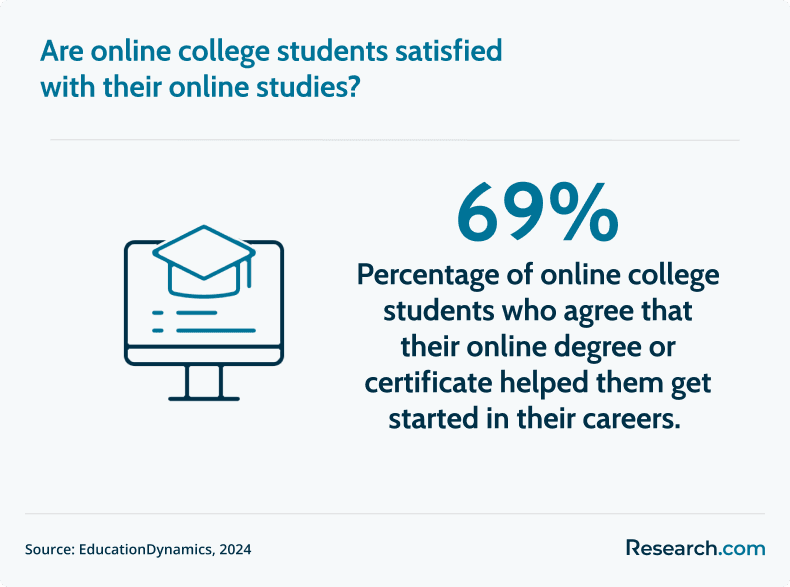
The best specialization is not necessarily the most popular one. Choose the track that builds the skills employers or graduate programs expect for your target role. The 2024 Online College Students Report from EducationDynamics reveals that 69% of respondents agree that their online degree or certificate helped them get started in their careers, but outcomes still depend on program quality, persistence, experience, and labor market fit. Students should look for programs that develop practical green skills to begin your career.
How to choose the best online Environmental Science degree program?
The best online environmental science degree is the one that fits your career goal, budget, schedule, and need for scientific training. Do not choose only by ranking or tuition. Use a structured comparison process.
- Confirm accreditation first. Make sure the institution is accredited by a recognized accrediting body. Accreditation affects credit transfer, graduate school options, employer confidence, and federal financial aid eligibility.
- Match the curriculum to your target career. A future GIS analyst needs different electives than a future conservation scientist, sustainability coordinator, or environmental policy analyst.
- Check lab and fieldwork requirements. Ask whether the program uses virtual labs, home lab kits, local field assignments, internships, campus visits, or field courses.
- Compare total cost after aid. Include tuition, fees, transfer credits, books, lab supplies, travel, and time to completion.
- Review online format. Determine whether courses are asynchronous, synchronous, self-paced, cohort-based, eight-week, 16-week, or semester-based.
- Look for practical experience. Internships, capstones, research, employer projects, and fieldwork can be decisive for entry-level hiring.
- Evaluate student support. Strong online programs should provide advising, tutoring, library access, technical support, career services, and help finding internships.
- Ask about stackable credentials. Some schools let undergraduates pursue advanced courses, certificates, or affordable graduate certificate programs while completing the bachelor’s degree.
| Question to ask before enrolling | Why it matters |
| Is the school institutionally accredited? | Protects degree credibility and financial aid eligibility |
| Can all major requirements be completed online? | Prevents surprise campus visits or unavailable online courses |
| How are labs and fieldwork handled? | Environmental science requires applied learning, not only reading and exams |
| How many transfer credits will count toward the major? | Can reduce cost and time to completion |
| What career outcomes do graduates report? | Helps evaluate practical value, though outcomes are never guaranteed |
| Does the program offer GIS, statistics, policy, or sustainability electives? | These skills can improve flexibility across career paths |
| Are internships required or optional? | Experience can make a major difference for entry-level job searches |
| What support is available to online students? | Advising, tutoring, and career help matter more when studying remotely |
Common mistakes to avoid when choosing a program
- Choosing without checking accreditation: A low-cost program is risky if credits do not transfer or the degree is not recognized.
- Looking only at tuition per credit: Fees, required credits, transfer policy, and lab costs can change the true price.
- Assuming online means no fieldwork: Good environmental science programs often require hands-on experience through local assignments, research, or internships.
- Ignoring specialization fit: A general program may be fine, but students with specific goals should verify that the right electives are available.
- Relying only on rankings: Rankings can help create a shortlist, but curriculum, cost, advising, and career alignment should drive the final decision.
- Assuming salaries are guaranteed: Salary depends on location, role, experience, employer, graduate education, and market demand.
What are the benefits of pursuing an advanced degree in sustainability for career advancement?
An advanced sustainability degree can help professionals move beyond entry-level environmental work into management, strategy, policy, analytics, consulting, or leadership roles. Graduate study may be useful for students who want deeper expertise in sustainable business practices, climate strategy, environmental management, ESG-related reporting, resource planning, or applied research.
A master’s degree is not required for every environmental career, but it can be valuable when employers prefer advanced technical training or when a professional wants to shift from field or coordinator roles into senior planning and decision-making. Students comparing graduate options can review an affordable online masters degree in sustainability to see how cost, curriculum, and career direction align.
How Can I Verify Accreditation and Program Quality?
Start with accreditation. Confirm the institution’s accreditation status through the school website and recognized accreditor databases. Accreditation helps validate institutional quality, faculty standards, student services, and financial aid eligibility. It is also important for credit transfer and graduate admissions.
Program quality requires a deeper review. Look at the curriculum, faculty backgrounds, lab requirements, fieldwork options, internship support, graduation requirements, student services, and career outcomes. If affordability is a priority, compare quality and price together by reviewing resources such as the cheapest online environmental science degrees.
Can an online Environmental Science degree open doors to roles in biotechnology?
An online environmental science degree can support some biotechnology-adjacent pathways, especially when the student builds strong skills in biology, chemistry, ecology, toxicology, data analysis, environmental health, or sustainability. However, biotechnology roles often require more specialized lab, molecular biology, microbiology, or graduate-level training than a general environmental science curriculum provides.
Students interested in biotech should choose electives carefully, seek research or lab experience, and consider whether a graduate credential is needed. Environmental science graduates may be most competitive for biotech-related work involving environmental monitoring, sustainability, regulatory compliance, environmental risk, bioremediation, or data analysis. To understand the broader field, review the biotech career path.
How Does the ROI of an Online Environmental Science Degree Compare with Other STEM Fields?
The return on investment for an online environmental science degree depends on cost, time to completion, financial aid, transfer credits, career target, location, and willingness to gain field or technical experience. Environmental science can lead to meaningful and stable work, especially as organizations respond to sustainability goals, environmental regulations, climate risks, and resource management needs. Still, some other STEM fields may have different salary ranges, licensing expectations, or technical barriers to entry.
Students should compare environmental science with related STEM options by looking at total program cost, required credentials, job market strength, expected wages, graduate school needs, and personal fit. For example, someone who wants more engineering-focused technical work may compare environmental science with an affordable electrical engineering online degree before committing.
What career paths are available for graduates of online Environmental Science degree programs?
Environmental science graduates can pursue careers across science, policy, consulting, sustainability, education, public health, and natural resource management. Some roles are available with a bachelor’s degree, while others may require graduate study, specialized experience, or additional technical training.
| Career path | What the role does | Helpful preparation |
| Environmental Scientist | Studies environmental problems, collects and analyzes data, supports pollution control, and helps organizations meet regulations | Field methods, chemistry, ecology, statistics, report writing |
| Environmental Consultant | Advises clients on environmental risks, impact assessments, compliance, remediation, and sustainability practices | Regulatory knowledge, fieldwork, technical writing, client communication |
| Conservation Scientist/Natural Resource Manager | Helps manage forests, parks, habitats, wildlife areas, and natural resources | Ecology, conservation biology, GIS, land management, field experience |
| Environmental Policy Analyst | Researches laws, regulations, programs, and policy options related to environmental protection | Policy coursework, economics, statistics, writing, public administration |
| GIS Analyst | Uses mapping and spatial data tools to support planning, conservation, environmental monitoring, and disaster management | GIS software, spatial analysis, remote sensing, data visualization |
| Environmental Educator | Teaches communities, students, park visitors, or nonprofit audiences about environmental topics | Communication, curriculum design, ecology, outreach experience |
| Environmental Engineer | Applies engineering principles to pollution control, water systems, waste management, and environmental remediation | Engineering-specific education is often required, though environmental science can be a starting point |
Some environmental policy and health-related roles overlap with public health. Students interested in that direction may compare environmental science with some of the cheapest online public health degree programs to see which curriculum better fits their goals.
A bachelor’s degree can help graduates enter the field, but advancement often depends on experience, technical tools, certifications, graduate education, and professional networks. Students who want research-heavy, senior scientific, or faculty roles should expect to consider a master’s or doctoral degree.
For students comparing career options, salary data can help clarify trade-offs. Using the most current data from O*NET OnLine, the chart below shows the median annual wages of selected environmental science roles.
What is the job market for graduates with an online Environmental Science degree?
The labor market for environmental science graduates is supported by regulation, sustainability initiatives, environmental risk management, climate adaptation, conservation needs, and demand for technical environmental data. According to the U.S. Bureau of Labor Statistics, employment for environmental scientists and specialists is projected to grow 7% from 2023 to 2033.
Factors supporting environmental science career demand
- Environmental regulation: Businesses and public agencies need professionals who understand compliance, permitting, monitoring, and environmental reporting.
- Climate and resilience planning: Governments, nonprofits, and companies are working on adaptation, risk reduction, and resource planning.
- Corporate sustainability: Organizations are creating sustainability initiatives and tracking environmental performance.
- Renewable energy development: Solar, wind, and other energy projects may require environmental assessment, permitting, land-use review, and impact analysis.
- Consulting demand: Environmental consulting firms support clients with site assessments, remediation, compliance, and environmental impact studies.
Factors that can limit or shape opportunities
- Public-sector hiring can depend on government funding and policy priorities.
- Private consulting may be affected by economic cycles, construction activity, energy markets, and client budgets.
- Job availability varies by region, especially in areas with strong environmental regulation, natural resource industries, coastal risk, or major infrastructure projects.
- Competition can be stronger in desirable locations, conservation roles, or positions with well-known agencies and nonprofits.
- Students without fieldwork, internships, GIS, statistics, or technical writing experience may face a harder entry-level search.
Students can improve job prospects by gaining applied experience before graduation. Strong options include internships, undergraduate research, GIS projects, volunteer conservation work, local field assignments, environmental monitoring, and professional association involvement. Specializing in areas such as GIS, sustainability, environmental consulting, water resources, or environmental health can also make a graduate’s skills easier for employers to understand.
The chart below shows the latest employment predictions from O*NET OnLine for selected environmental science professions for 2023-2033.
Here’s What Graduates Have to Say About Their Online Environmental Science Degree
- “Studying online helped me keep my job while finishing my environmental science coursework. I could manage assignments around my schedule and still build experience in conservation. That flexibility helped me move into environmental consulting.” — Sil
- “I thought an online program might feel too theoretical, but the field assignments, virtual labs, and case-based projects gave me practical skills. I now use that training in my work as a sustainability coordinator.” — Paulie
- “The online format made the degree more affordable and connected me with instructors and classmates from different places. The program helped me see career options in environmental work that I had not considered before.” — Adriana
Key Insights
- An online environmental science degree can be a practical pathway into environmental consulting, conservation, sustainability, GIS, environmental policy, environmental health, and government or nonprofit roles.
- Accreditation should be the first filter. It affects financial aid eligibility, credit transfer, graduate school options, and employer confidence.
- Online programs can be credible, but students should verify how labs, fieldwork, internships, research, and experiential learning are delivered.
- Cost varies widely. Programs reviewed for this guide often cost about $300 to $600 per credit in tuition, while Data USA reports average tuition of $7,350 for an environmental science degree from an in-state public college and $38,644 at out-of-state private institutions.
- According to the U.S. Bureau of Labor Statistics, the average annual wage for environmental scientists and specialists was $86,710 as of May 2023, and employment is projected to grow 7% from 2023 to 2033.
- The strongest career preparation usually combines the degree with applied experience, GIS or data skills, technical writing, internships, and a specialization aligned with a specific job target.
- Students should compare programs by total cost, transfer credit policy, curriculum depth, online format, student support, career services, and specialization options rather than relying only on rankings.
References:
- Aslanian, C.B. and Fischer, S. (2024). 2024 Online College Students Report. EducationDynamics. https://insights.educationdynamics.com/rs/183-YME-928/images/EDDY-Online-College-Students-2024.pdf
- Data USA (n.d.). Environmental Science. https://datausa.io/profile/cip/environmental-science
- O*NET OnLine (n.d.). O*NET OnLine Help. https://www.onetonline.org/help/online/find_occ Data Retrieved on February 2025
- U.S. Bureau of Labor Statistics (April 2024). Occupational Employment and Wages, May 2023, 19-2041 Environmental Scientists and Specialists, Including Health. https://www.bls.gov/oes/current/oes192041.htm
- U.S. Bureau of Labor Statistics (September 2024). Environmental Scientists and Specialists. https://www.bls.gov/ooh/life-physical-and-social-science/environmental-scientists-and-specialists.htm
- Zippia (January 2025). Environmental Scientist Education Requirements. https://www.zippia.com/environmental-scientist-jobs/education
Other Things You Need to Know About Online Environmental Science Degrees
In 2027, students enrolling in top online environmental science degree programs can explore various financial aid options, including federal grants, scholarship opportunities from universities, private scholarships aimed at environmental studies, and employer tuition assistance programs. It’s essential to research specific program offerings and consult financial aid offices for more details.
To enroll in a top online environmental science degree program in 2027, applicants generally need a high school diploma or equivalent. Some programs may require standardized test scores, letters of recommendation, or a personal statement. Prior coursework in science or math can also be advantageous.
Most accredited online environmental science bachelor’s programs require 120 semester credit hours. That usually includes general education, core science courses, and upper-division environmental science classes. Some programs also require a capstone course or senior project before graduation.