
2027 Best Online Applied Sciences Degree Programs

Co-Founder and Chief Data Scientist
The U.S. is projected to add nearly 7 million STEM jobs by 2033, including numerous applied science jobs. This high demand creates a massive opportunity, but it also puts intense pressure on you to choose the right educational path. You want a direct route to a secure career but worry that your investment won't pay off in the long run.
Prepared by career planning experts, this guide will show you how an online applied sciences degree can be a strategic pathway to a stable, in-demand career. It offers clear, data-backed insights to help you move from uncertainty to confidence.
What are the benefits of getting an online applied sciences degree?
- Provides a direct pathway to stable, in-demand jobs across sectors like technology, biotechnology, and environmental management.
- Offers strong earning potential, with entry-level salaries around $42,598 and a clear trajectory for significant income growth.
- Delivers a flexible and accessible education through an online applied sciences degree format, allowing you to balance your studies with other life commitments.
What can I expect from an online applied sciences degree?
You can expect a curriculum focused on practical, hands-on learning. Coursework incorporates real-world case studies, project-based assignments, and virtual labs, teaching you to apply scientific theory to solve actual problems. This approach ensures you develop job-ready skills alongside foundational knowledge.
An accredited online applied sciences degree delivers academic standards equivalent to on-campus programs. This practical focus prepares graduates to contribute effectively in their chosen fields from day one.
Where can I work with an online applied sciences degree?
Graduates find opportunities across a wide range of growing sectors. These include information technology, biotechnology, healthcare administration, and environmental consulting. This degree prepares you for diverse roles and a broad professional field.
You can advance from roles like lab supervisor or data analyst towards senior leadership or management. The program also positions you well for emerging hybrid roles that blend science, technology, and business skills.
How much can I make with an online applied sciences degree?
You can expect a strong return on your investment. Entry-level salaries are typically around $42,000, while mid-career professionals average about $58,000. Senior-level roles can command salaries of more than $71,000.
While your specific income will depend on your specialization, industry, and location, the essential point is the clear potential for salary growth. This degree provides a reliable trajectory for increasing your earnings as you gain experience.
- List of the Best Online Applied Sciences Degree Programs for 2027 List of Programs
- How long does it take to complete an online applied sciences degree program? Completion Time
- How does an online applied sciences degree program compare to an on-campus program? How does an online applied sciences degree program compare to an on-campus program?
- What is the average cost of an online applied sciences degree program? Program Cost
- What are the financial aid options for students enrolling in an online applied sciences degree program? Financial Aid
- What are the prerequisites for enrolling in an online applied sciences degree program? What are the prerequisites for enrolling in an online applied sciences degree program?
- What courses are typically in an online applied sciences degree program? What courses are typically in an online applied sciences degree program?
- What types of specializations are available in an online applied sciences degree program? What types of specializations are available in an online applied sciences degree program?
- How to Choose the Best Online Applied Sciences Degree Program How to Choose the Best Online Applied Sciences Degree Program
- Can Additional Certifications Enhance Your Online Applied Sciences Career? Can Additional Certifications Enhance Your Online Applied Sciences Career?
- What career paths are available for graduates of an online applied sciences degree program? Career Paths
- What is the job market for graduates with an online applied sciences degree program? Job Market
Best Online Applied Sciences Degree Programs for 2027: Rankings, Costs, Timelines, and How to Choose
An online applied sciences degree is often designed for adults who already have technical training, an associate of applied science, military experience, or career-specific coursework and want to convert that background into a bachelor’s degree. The main decision is not simply which school ranks highest. You need to know how much credit the program will accept, whether the degree fits your field, how quickly you can finish, and whether the credential will be recognized by employers or graduate schools.
This guide compares the best online applied sciences degree programs for 2027 and explains how to evaluate cost, accreditation, transfer policies, format, specializations, financial aid, and career outcomes. It is written for working adults, transfer students, career changers, military learners, and technical professionals who want a practical bachelor’s degree without starting over.
Quick Answer: What is the best online applied sciences degree program?
The best online applied sciences degree program is the one that accepts the most relevant transfer credit, offers a specialization aligned with your career goals, holds institutional accreditation, fits your budget, and provides enough academic and career support for online learners. Boise State University, East Tennessee State University, Siena Heights University, University of the Cumberlands, Mississippi State University, California Southern University, Loyola University New Orleans, Campbell University, University of Maine at Presque Isle, and University of Michigan-Flint are among the programs reviewed in this guide.
How Research.com evaluates online applied sciences programs
Because a bachelor’s degree can be a major financial commitment, program comparisons should be based on verifiable information rather than marketing claims. Research.com reviews data from established education sources, including the IPEDS database, Peterson's database, the College Scorecard database, and The National Center for Education Statistics.
These sources help support comparisons related to institutional profile, program availability, cost, completion factors, and student outcomes where available. To understand how Research.com evaluates schools and programs, see the full Research.com methodology.
Best Online Applied Sciences Degree Programs for 2027
| Rank | School and Program | Best Fit | Program Length | Credits | Cost per Credit | Accreditation |
| 1 | Boise State University - Bachelor of Applied Science (Online) | Students with prior technical education who want a highly customizable online completion path | ~1 year | 120 | $395 | Northwest Commission on Colleges and Universities (NWCCU) |
| 2 | East Tennessee State University - Bachelor of Applied Science | Associate of applied science graduates who want liberal arts breadth plus career-focused study | ~ 2 to 4 years | 120 | $464 (In-State); $599 (Out-of-State) | Southern Association of Colleges and Schools Commission on Colleges (SACSCOC) |
| 3 | Siena Heights University - Bachelor of Applied Science (B.A.S.) — Online | Working professionals with technical, allied health, prior learning, or work experience | 20 months | 120 | $540 | Higher Learning Commission (HLC) |
| 4 | University of the Cumberlands - Bachelor of Applied Science | Technical professionals who want to add management and leadership preparation | ~4 years | 120 | $220 | Southern Association of Colleges and Schools Commission on Colleges (SACSCOC) |
| 5 | Mississippi State University - Bachelor of Applied Science (BAS) | Community college graduates who want to apply associate of applied science credits toward a bachelor’s degree | ~2 years | 120 | $435.75 | Southern Association of Colleges and Schools Commission on Colleges (SACSCOC) |
| 6 | California Southern University - Bachelor of Applied Science (BAS) Degree Program | Students seeking an advisor-guided interdisciplinary plan that recognizes prior academic and vocational coursework | ~4 years | 120 | $425 | Higher Learning Commission (HLC) |
| 7 | Loyola University New Orleans - Bachelor of Applied Science (Online) | Adult and non-traditional learners who want a transfer-friendly online degree with multiple specialization options | ~2 to 4 years | 120 | $468 | Southern Association of Colleges and Schools Commission on Colleges (SACSCOC) |
| 8 | Campbell University - Bachelor of Applied Science Programs (Adult & Online Education) | Associate of applied science graduates or military-trained learners pursuing areas such as clinical research or homeland security | ~2 to 4 years | 124 | $465 | Southern Association of Colleges and Schools Commission on Colleges (SACSCOC) |
| 9 | University of Maine at Presque Isle - Bachelor of Applied Science | Self-directed students who want a competency-based online model and flexible pacing | ~1 year | 120 | $268 (In-State); $457 (Out-of-State) | New England Commission of Higher Education (NECHE) |
| 10 | University of Michigan-Flint - Bachelor of Applied Science (BAS) | Associate in Applied Science graduates who want to strengthen communication, critical thinking, and problem-solving skills | ~2 years | 124 | $561 (In-State); $1,122 (Out-of-State) | Higher Learning Commission (HLC) |
1. Boise State University - Bachelor of Applied Science (Online)
Boise State University offers an online Bachelor of Applied Science intended for students who already bring technical education into the degree. The program is flexible, includes multiple start dates, and allows learners to shape concentrations around career interests. Full-time students may complete the program in as little as one year.
- Program Length: ~1 year
- Required Credits to Graduate: 120
- Cost per Credit: $395
- Accreditation: Northwest Commission on Colleges and Universities (NWCCU)
2. East Tennessee State University - Bachelor of Applied Science
East Tennessee State University provides a Bachelor of Applied Science for students with an associate of applied science who want to combine professional preparation with a broader academic foundation. The individualized study plan can help students connect prior technical coursework with career advancement goals.
- Program Length: ~ 2 to 4 years
- Required Credits to Graduate: 120
- Cost per Credit: $464 (In-State); $599 (Out-of-State)
- Accreditation: Southern Association of Colleges and Schools Commission on Colleges (SACSCOC)
3. Siena Heights University - Bachelor of Applied Science (B.A.S.) — Online
Siena Heights University uses an “inverted major” model that builds the degree around prior technical, allied health, and professional learning. This structure can be useful for working adults who do not want their earlier training or experience treated as unrelated elective credit.
- Program Length: 20 months
- Required Credits to Graduate: 120
- Cost per Credit: $540
- Accreditation: Higher Learning Commission (HLC)
4. University of the Cumberlands - Bachelor of Applied Science
The University of the Cumberlands offers an online applied science pathway that emphasizes leadership and management skills for technical fields. Students can choose from a range of career concentrations, making the program a practical option for those who want to move from hands-on technical work into supervisory or administrative responsibilities.
- Program Length: ~4 years
- Required Credits to Graduate: 120
- Cost per Credit: $220
- Accreditation: Southern Association of Colleges and Schools Commission on Colleges (SACSCOC)
5. Mississippi State University - Bachelor of Applied Science (BAS)
Mississippi State University is designed for community college graduates and working professionals who want to complete a bachelor’s degree without losing the value of prior applied coursework. The program permits transfer of up to 60 hours from an accredited associate of applied science degree, including 45 hours of technical credit.
- Program Length: ~2 years
- Required Credits to Graduate: 120
- Cost per Credit: $435.75
- Accreditation: Southern Association of Colleges and Schools Commission on Colleges (SACSCOC)
6. California Southern University - Bachelor of Applied Science (BAS) Degree Program
California Southern University offers an interdisciplinary Bachelor of Applied Science that accounts for previous academic and vocational study. Students work with an academic advisor to build a degree plan that reflects prior learning and supports professional goals.
- Program Length: ~4 years
- Required Credits to Graduate: 120
- Cost per Credit: $425
- Accreditation: Higher Learning Commission (HLC)
7. Loyola University New Orleans - Bachelor of Applied Science (Online)
Loyola University New Orleans serves adult and non-traditional learners through a flexible online Bachelor of Applied Science. The transfer-friendly structure and specialization options help students build a course plan around current work experience and future career direction.
- Program Length: ~2 to 4 years
- Required Credits to Graduate: 120
- Cost per Credit: $468
- Accreditation: Southern Association of Colleges and Schools Commission on Colleges (SACSCOC)
8. Campbell University - Bachelor of Applied Science Programs (Adult & Online Education)
Campbell University offers applied science programs for adults preparing for fields such as clinical research and homeland security. The programs are structured for learners who already hold an Associate of Applied Science in a related field or have comparable military training.
- Program Length: ~2 to 4 years
- Required Credits to Graduate: 124
- Cost per Credit: $465
- Accreditation: Southern Association of Colleges and Schools Commission on Colleges (SACSCOC)
9. University of Maine at Presque Isle - Bachelor of Applied Science
The University of Maine at Presque Isle offers the competency-based “YourPace” Bachelor of Applied Science. Students can move through coursework based on demonstrated knowledge, making the program especially relevant for motivated working adults who can manage independent online study.
- Program Length: ~1 year
- Required Credits to Graduate: 120
- Cost per Credit: $268 (In-State); $457 (Out-of-State)
- Accreditation: New England Commission of Higher Education (NECHE)
10. University of Michigan-Flint - Bachelor of Applied Science (BAS)
The University of Michigan-Flint offers a Bachelor of Applied Science for students who already completed an Associate in Applied Science. The curriculum is designed to expand workplace-ready skills, including communication, critical thinking, creative problem-solving, and career adaptability.
- Program Length: ~2 years
- Required Credits to Graduate: 124
- Cost per Credit: $561 (In-State); $1,122 (Out-of-State)
- Accreditation: Higher Learning Commission (HLC)
How Long Does an Online Applied Sciences Degree Take?
A traditional bachelor’s degree in applied science usually requires four years of full-time study. An associate’s degree generally takes two years. However, many online Bachelor of Applied Science programs are built for transfer students, so your actual timeline may be much shorter if you already completed an associate of applied science or relevant technical training.
Completion time depends on transfer credits, course load, start dates, prior learning credit, military credit, work obligations, and whether the school offers accelerated or competency-based options. Students with significant accepted credit may finish in about one to two years, while students entering with fewer credits or studying part time may need closer to two to four years or longer.
| Student Situation | Likely Timeline | What to Check Before Enrolling |
| Starting without college credit | About four years full time | General education requirements, major sequence, and whether summer courses are available |
| Entering with an associate of applied science | Often about one to two years, depending on transfer acceptance | How many technical credits apply toward the bachelor’s degree |
| Working full time while studying part time | Often two to four years or more | Course rotation, weekly workload, and maximum time to completion |
| Competency-based learner with strong prior knowledge | Potentially faster if the program allows self-paced progress | Assessment format, tuition model, and academic support availability |
Online vs. On-Campus Applied Sciences Degree: Which Format Is Better?
An accredited online applied sciences degree can carry the same academic legitimacy as an accredited campus-based degree from the same type of institution. The better choice depends on your schedule, learning style, location, need for in-person labs, and access to campus resources. Students considering healthcare-related online options may also want to compare applied science pathways with more specialized programs, such as the best online family nurse practitioner graduate certificate programs.
| Factor | Online Applied Sciences Degree | On-Campus Applied Sciences Degree |
| Flexibility | Best for students balancing work, family, military service, or irregular schedules | Best for students who want a fixed schedule and campus routine |
| Instruction | Delivered through learning platforms, recorded or live sessions, discussion boards, virtual labs, and online projects | Delivered through face-to-face classes, campus labs, office hours, and in-person group work |
| Hands-on requirements | May use simulations, local placements, virtual labs, or transferred technical coursework | May offer direct access to campus labs, equipment, and field experiences |
| Networking | Requires more intentional effort through online groups, faculty outreach, internships, and career services | Often easier to build through campus events, clubs, faculty interaction, and local employer visits |
| Best for | Working adults, transfer students, rural learners, military learners, and students who cannot relocate | Students who prefer in-person structure or need frequent access to physical facilities |
When an online applied sciences degree makes sense
Choose an online format if your priority is schedule control, transfer credit flexibility, and the ability to study without leaving your job. Online programs are especially useful for students who already completed technical education and need the bachelor’s degree for promotion, management roles, or graduate school eligibility.
When an on-campus program may be the better option
A campus program may be a stronger fit if you need frequent in-person lab access, learn best through direct classroom interaction, or want the traditional campus experience. It may also be better for students who need more daily structure and immediate access to faculty, tutors, and peer study groups.
What Does an Online Applied Sciences Degree Cost?
The cost of an online applied sciences degree varies by institution type, tuition model, residency status, transfer credit, fees, books, technology requirements, and the number of credits you still need to complete. Public, in-state colleges average around $8,982 for a full program, while private colleges average about $34,680. Per-credit pricing is often the clearest way to estimate cost if you are transferring credits or studying part time.
Do not compare programs by tuition alone. A school with a higher per-credit rate may cost less overall if it accepts more of your previous coursework. Conversely, a lower tuition rate may not be the best value if many of your technical credits transfer only as electives or do not apply toward graduation.
| Cost Factor | Why It Matters | Question to Ask |
| Transfer credit acceptance | Accepted credits reduce the number of courses you must pay for | How many credits from my associate degree, military training, certifications, or prior coursework will apply to the degree? |
| Residency tuition | Some public universities charge different rates for in-state and out-of-state online students | Will I pay in-state, out-of-state, or a separate online tuition rate? |
| Fees | Technology, graduation, online course, and student service fees can change the total price | What is the full estimated cost, including mandatory fees? |
| Time to completion | Longer enrollment can increase total cost and delay career benefits | Based on my transfer evaluation, how many terms will I need? |
| Career alignment | A degree has more value when it supports realistic job or promotion goals | What roles do graduates pursue, and what career support is available? |
Online study may also reduce indirect expenses such as campus housing, meal plans, and commuting. If you are comparing multiple training routes, it can help to evaluate this degree against shorter credentials, such as the cost of medical assistant certification, because the right investment depends on the career outcome you want.
Financial Aid Options for Online Applied Sciences Students
Online students at eligible accredited institutions may qualify for many of the same financial aid options as campus-based students. Aid availability depends on the school, enrollment status, program eligibility, citizenship or residency status, and federal or institutional rules. Students comparing applied science with advanced healthcare programs, including the best online DNP adult-gerontology primary care NP programs, should verify aid rules for each credential level.
- Federal Grants: Grants generally do not have to be repaid and are usually based on financial need. Students begin by completing the FAFSA.
- Federal Student Loans: Federal loans must be repaid with interest, but they may offer repayment protections and options that differ from private loans.
- Scholarships: Scholarships from colleges, employers, professional associations, nonprofits, and community groups may be based on merit, financial need, field of study, location, or background.
- Employer Tuition Reimbursement: Many working adults use employer education benefits to reduce out-of-pocket costs, especially when the degree supports advancement within the company.
- Military and Veteran Benefits: Eligible service members, veterans, and family members may use education benefits such as the GI Bill®.
Ways to lower the total cost
- Request an official transfer credit evaluation before committing to a program.
- Ask whether the school awards credit for military training, certifications, exams, or prior learning.
- Compare total remaining credits, not only per-credit tuition.
- Check whether online students pay additional fees.
- Use employer reimbursement before taking on private loans, if available.
Admission Requirements for Online Applied Sciences Degree Programs
Admission requirements vary, but most programs expect applicants to show readiness for college-level coursework. Some Bachelor of Applied Science programs are degree-completion pathways, meaning they may require or strongly prefer applicants with an associate of applied science, technical credits, military training, or career-specific coursework. Students comparing allied health bridge options, such as the best online dental assistant to dental hygienist bridge programs online, should pay close attention to prerequisites and licensure-related requirements.
- High School Diploma or GED: A completed secondary credential is commonly required for bachelor’s-level admission.
- Minimum GPA: Some schools set a minimum GPA, often around 2.5, though the required threshold differs by institution.
- Foundational Math: Applicants may need prior coursework in subjects such as Algebra and Geometry.
- Foundational Science: Programs may expect previous exposure to Biology, Chemistry, or other science courses, especially for science-focused tracks.
- Application and Essays: Schools may require an application, transcripts, personal statement, resume, or explanation of career goals.
- Transfer or Technical Credit Documentation: Degree-completion programs may ask for official transcripts from community colleges, technical schools, military training records, or prior colleges.
Common Courses in an Online Applied Sciences Degree
Applied sciences programs combine broad academic study with practical, career-connected coursework. The exact curriculum depends on your concentration and transfer credits, but most programs include general education, quantitative reasoning, technical communication, applied problem-solving, and specialization courses.
| Course Area | What You Learn | Why It Matters at Work |
| General Education | Writing, humanities, social science, history, and related subjects | Builds communication, reasoning, and workplace adaptability |
| Foundational Mathematics | College algebra, statistics, and quantitative analysis | Supports data interpretation, budgeting, measurement, and evidence-based decisions |
| Core Sciences | Biology, chemistry, physics, or science courses connected to the chosen field | Provides the scientific foundation for technical and applied roles |
| Specialization Courses | Career-specific technical or professional coursework | Develops role-ready knowledge for fields such as healthcare, IT, environmental management, or biotechnology |
| Project Management | Planning, scheduling, budgeting, team coordination, and deliverables | Prepares graduates to manage projects, teams, and operational improvements |
| Ethics in Science | Professional responsibility, ethical decision-making, and applied science dilemmas | Helps graduates handle safety, data, compliance, and public impact issues responsibly |
| Technical Communication | Reports, presentations, documentation, and field-specific communication | Strengthens the ability to explain technical information to managers, clients, patients, or teams |
For healthcare-focused students, some applied coursework may overlap with workplace responsibilities described in a clinical medical assistant job description, although a bachelor’s degree and a job-specific clinical credential are not the same thing.
Popular Online Applied Sciences Specializations
A specialization helps turn a broad applied sciences degree into a career-focused credential. Before choosing one, review job postings in your target field and compare the required skills with the courses offered by the program.
- Applied Data Science: Focuses on using data to identify patterns, create reports, support business decisions, and solve practical problems.
- Information Technology & Cybersecurity: Prepares students to work with networks, systems, digital tools, security practices, and technology operations.
- Applied Biotechnology: Connects biology with practical technology applications, including processes, products, research support, and lab-based problem-solving.
- Environmental Management: Covers sustainability, environmental compliance, resource management, and applied environmental problem-solving. Students who later want management preparation can compare options such as a fast-track MBA in environmental management online.
- Healthcare Administration: Emphasizes healthcare operations, leadership, compliance, budgeting, and organizational management.
How to choose a specialization
| If Your Goal Is... | Consider This Specialization | Look for Courses In... |
| Analyzing business, operational, or technical data | Applied Data Science | Statistics, databases, visualization, analytics tools, and reporting |
| Moving into technology operations or security | Information Technology & Cybersecurity | Networking, systems administration, cybersecurity fundamentals, cloud tools, and risk management |
| Working in labs, biotech support, or life science operations | Applied Biotechnology | Biology, lab methods, quality control, research support, and regulatory basics |
| Solving sustainability or compliance problems | Environmental Management | Environmental policy, sustainability, risk assessment, and technical reporting |
| Advancing in healthcare operations | Healthcare Administration | Healthcare systems, finance, compliance, leadership, and quality improvement |
How to Choose the Best Online Applied Sciences Degree Program
The best program is not automatically the fastest or the cheapest. For applied sciences students, the most important issue is fit: how well the program uses your previous credits and prepares you for the role you want. Students comparing hands-on technical routes may also want to review related options such as the best online landscaping technology trade school programs.
- Verify institutional accreditation: Accreditation affects transfer credit, employer recognition, graduate school eligibility, and access to federal financial aid. Confirm the accreditor through official school and accreditor sources.
- Request a transfer credit review: Do this before enrolling. Ask which credits apply to major requirements, which count as electives, and which do not transfer.
- Compare total program cost: Calculate remaining credits, tuition, fees, books, technology costs, and time to completion.
- Check specialization depth: A concentration should include enough relevant coursework to support your career goal, not just one or two broad electives.
- Review faculty and industry relevance: Look for instructors with academic preparation and practical experience related to your chosen field.
- Evaluate online student support: Strong advising, tutoring, library access, tech support, and career services matter more in online programs because students must navigate more independently.
- Ask about experiential learning: Projects, internships, capstones, fieldwork, simulations, or employer-based assignments can help translate coursework into job evidence.
- Confirm licensure or certification limits: If your target job requires a license or credential, ask whether the degree meets those requirements in your state or field.
Questions to ask admissions before you apply
- How many of my previous credits will count toward the 120 or 124 credits required for graduation?
- Will my technical credits apply to the major, concentration, electives, or only general credit?
- Are courses asynchronous, live, self-paced, or offered in fixed terms?
- How often are required courses offered?
- What support is available for online students after business hours?
- Does the program include a capstone, internship, practicum, lab, or field project?
- What graduate programs or jobs have recent alumni pursued?
- Are there additional fees for online courses, technology, graduation, or transfer evaluation?
Can Certifications Strengthen an Applied Sciences Degree?
Certifications can be valuable when they add a specific skill that employers request. An applied sciences degree may provide broad academic and professional preparation, while certifications can document targeted abilities in areas such as IT support, project management, healthcare billing, data tools, safety, or technical operations.
The strongest approach is to choose certifications that match your specialization and job postings in your target market. For example, a healthcare administration student may use short, skills-based training to supplement the degree. Students looking for lower-cost healthcare credential options can compare affordable online medical billing and coding courses.
| Degree Focus | Certification Strategy | When It Makes Sense |
| Information technology | Add a credential tied to systems, support, networking, or cybersecurity | When job postings ask for specific platforms or technical competencies |
| Healthcare administration | Choose credentials related to billing, coding, compliance, or operations | When you want to demonstrate job-ready healthcare office or administrative skills |
| Data science | Build evidence of analytics, visualization, database, or programming ability | When employers expect a portfolio or tool-specific experience |
| Environmental management | Look for credentials related to safety, compliance, sustainability, or field procedures | When roles require regulatory awareness or applied field knowledge |
Careers You Can Pursue With an Online Applied Sciences Degree
An applied sciences degree can support careers where technical knowledge, analysis, communication, and problem-solving are used in practical settings. Career outcomes depend on your specialization, prior experience, certifications, location, employer requirements, and whether the role requires additional licensure or graduate education.
1. Data Analyst
Data analysts gather, clean, organize, and interpret information so organizations can make better decisions. They may build dashboards, prepare reports, identify patterns, and explain findings to managers or technical teams.
2. IT Manager
IT managers oversee technology systems, staff, budgets, security practices, software implementation, and operational reliability. Many people move into these roles after gaining technical experience and adding management or leadership preparation.
3. Lab Supervisor
Lab supervisors coordinate day-to-day laboratory activity, including safety procedures, staff training, inventory, documentation, workflow, and quality control. Students interested in broader public health careers may also want to compare this path with graduate-level public health options by reviewing what you can do with an MPH degree.
4. Environmental Consultant
Environmental consultants help organizations evaluate environmental risks, prepare technical reports, support compliance, assess field conditions, and recommend sustainability or remediation strategies.
5. Applied Scientist
Applied scientists use scientific methods to solve real-world problems. Depending on the industry, they may design experiments, test prototypes, analyze results, support product development, or collaborate with engineering, research, and operations teams.
Entry-level and advancement paths
| Career Area | Possible Entry-Level Roles | Advancement Direction |
| Data and analytics | Junior data analyst, reporting analyst, operations analyst | Senior analyst, analytics manager, business intelligence lead |
| Information technology | IT support specialist, systems technician, network support associate | Systems administrator, IT manager, cybersecurity lead |
| Laboratory and life sciences | Lab technician, research assistant, quality control assistant | Lab supervisor, quality manager, applied research specialist |
| Environmental fields | Environmental technician, compliance assistant, sustainability coordinator | Environmental consultant, compliance manager, sustainability manager |
| Healthcare operations | Healthcare administrative coordinator, operations assistant, records or billing support | Department supervisor, practice manager, healthcare operations manager |
Job Market Outlook for Applied Sciences Graduates
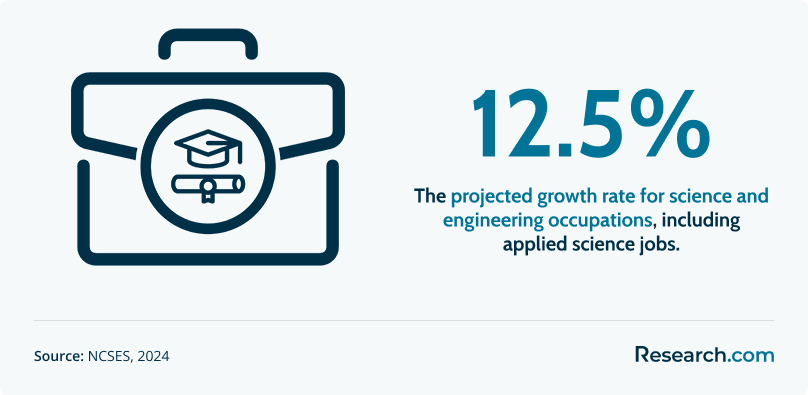
The labor market for applied sciences graduates is strongest when students align the degree with high-need technical, healthcare, environmental, data, or technology roles. Science and engineering occupations, including applied science jobs, are projected to grow by 12.5%, compared with the 1.7% average for non-STEM jobs. This does not guarantee employment, but it does show why applied technical skills remain relevant across many industries.
To compete effectively, students should not rely on the degree alone. Build a portfolio, complete projects, document software or lab skills, pursue internships if possible, use career services, and network with employers in your target field. Graduates aiming for leadership in healthcare settings may eventually compare graduate pathways such as the shortest healthcare management master's programs.
Current trends affecting applied sciences students
- AI and automation are changing task expectations: Employers increasingly value workers who can use digital tools, interpret outputs, troubleshoot systems, and apply judgment rather than simply follow procedures.
- Skills evidence matters: Portfolios, capstones, certifications, lab documentation, dashboards, and project examples can help show what you can do beyond listing a degree.
- Transfer-friendly bachelor’s completion programs are important for adults: Many applied science students already have technical training and need efficient pathways that do not waste prior credits.
- Online learning is now a mainstream option: The format can work well when programs provide strong advising, clear course design, and access to support services.
- Licensure rules still matter in regulated fields: Healthcare, education, safety, and certain technical roles may require credentials beyond the degree.
Student Perspectives on Online Applied Sciences Programs
- : "I had a full-time job and two small children, so I needed a program that worked around my life instead of replacing it. Being able to study online after my kids went to bed made finishing a degree possible. — Orland"
- : "I was unsure how science coursework would work online, especially labs. The virtual simulations in my biotech courses were more useful than I expected because I could repeat procedures until the ideas finally made sense. — Chloe"
- : "Before enrolling, I only knew that I wanted a better career. Seeing clear specialization options in areas like IT and environmental management helped me turn that goal into an actual academic plan. — Axle"
Common Mistakes to Avoid When Choosing an Online Applied Sciences Degree
| Mistake | Why It Can Hurt You | Better Approach |
| Choosing based only on rankings | A highly ranked program may not accept your credits or offer your preferred specialization | Use rankings as a starting point, then compare transfer fit, cost, and curriculum |
| Ignoring accreditation | Unaccredited or poorly recognized credentials can limit financial aid, transfer, employment, or graduate school options | Confirm institutional accreditation before applying |
| Looking only at per-credit tuition | Total cost depends on credits remaining, fees, and time to completion | Ask for a full degree plan and total estimated cost |
| Assuming all credits will transfer | Technical credits may transfer as electives or may not satisfy major requirements | Get a written transfer evaluation before enrolling |
| Assuming online means self-paced | Many online programs still use deadlines, weekly modules, or live sessions | Ask whether courses are asynchronous, synchronous, accelerated, or competency-based |
| Overlooking licensure requirements | Some fields require separate credentials, exams, or state approval | Check licensing rules for your intended occupation and state |
| Skipping career planning until graduation | You may finish without job-ready evidence or a professional network | Use projects, internships, certifications, and career services early |
Who Should Consider an Online Applied Sciences Degree?
An online applied sciences degree is a strong fit for students who already have practical training and want a bachelor’s credential that builds on it. It is especially useful for associate of applied science graduates, technical professionals, military learners, healthcare support workers, IT staff, lab personnel, and adults seeking advancement without relocating.
This degree may be a good fit if you:
- Already completed technical or career-focused college credits.
- Need a bachelor’s degree for promotion or management eligibility.
- Want a practical curriculum rather than a purely theoretical major.
- Need online flexibility because of work, family, or location.
- Want to combine prior hands-on training with leadership, communication, analytics, or technical management skills.
You may want a different path if you:
- Need a degree that directly leads to a regulated license and the applied sciences program does not meet those requirements.
- Want a highly specialized engineering, nursing, teaching, or clinical degree with strict professional standards.
- Have no prior technical credits and would be better served by a traditional major in your target field.
- Need extensive in-person labs that the online program cannot provide.
- Are choosing the degree only because it is flexible, without a clear career plan.
References
- Bureau of Labor Statistics. (n.d.). STEM employment projections. Retrieved from BLS STEM employment projections.
- Business Research Insights. (n.d.). Life sciences market. Retrieved from Business Research Insights life sciences market report.
- Data USA. (n.d.-a). Applied sciences. Retrieved from Data USA applied sciences profile.
- National Center for Science and Engineering Statistics. (2024). U.S. STEM workforce: Size, growth, and employment. Retrieved from NCSES STEM workforce report.
- ZipRecruiter. (n.d.-a). Applied science salary. Retrieved from ZipRecruiter applied science salary data.
- Zippia. (n.d.). Biotechnologist jobs education. Retrieved from Zippia biotechnologist education data.
Key Insights
- The best online applied sciences degree is transfer-friendly. For many students, the biggest savings come from how many associate, technical, military, or prior learning credits the school accepts.
- Accreditation is non-negotiable. It affects financial aid, employer recognition, graduate school options, and transferability.
- Cost should be calculated by total remaining credits, not sticker tuition. A higher per-credit program may still be cheaper if it applies more of your previous coursework toward graduation.
- Online and on-campus degrees can hold similar value when properly accredited. The right format depends on your schedule, learning style, hands-on requirements, and support needs.
- Specialization choice drives career relevance. Data science, IT and cybersecurity, biotechnology, environmental management, and healthcare administration can lead to very different roles.
- The degree alone is not always enough. Projects, certifications, internships, portfolios, and documented technical skills can make your application stronger.
- Applied sciences is best for practical career advancement. It is especially useful for adults who already have technical education and want a bachelor’s degree that builds on existing experience rather than starting from scratch.
Other Things You Need To Know About an Online Applied Sciences Degree
Admission requirements for top online applied sciences programs in 2027 typically include a high school diploma or equivalent, a strong background in math and science, and possibly standardized test scores. Some programs might also require a personal statement or letters of recommendation.
Students enrolling in online applied sciences degree programs in 2027 generally need a reliable internet connection, a computer with updated operating systems, and specific software tools related to their field, such as CAD or lab simulation programs, ensuring seamless participation in coursework.
Most programs require a laptop or desktop computer, reliable broadband internet, a webcam, a microphone, and current browsers such as Chrome or Firefox. Courses with labs may also need specific software, often listed in the program handbook or syllabus before enrollment.


