2027 Best Online Urban Planning Degree Programs

Co-Founder and Chief Data Scientist
A passion for space and infrastructures can translate into building smarter cities of tomorrow. This is where urban planning comes to play, which combines design, policy, and environmental considerations to create functional, sustainable, and livable spaces.
With online urban planning degree programs, you can gain this expertise without pausing your career or relocating. These programs combine flexible scheduling with rigorous coursework in areas like zoning, transportation, and land use. Many also integrate real-world projects, giving you practical experience alongside academic learning.
Graduates of online urban planning degree programs pursue roles in public policy, environmental design, and community development. The right program can help you master both technical skills and strategic thinking needed for these careers. This guide highlights the best online urban planning degrees, outlining their strengths, formats, and potential career outcomes.
What are the benefits of getting an online urban planning degree?
- Urban and regional planners earn a median salary of $75,033 per year, reflecting the value and demand for their expertise in shaping communities (ZipRecruiter, n.d.).
- Employment in this field is projected to grow 4% from 2023 to 2033, driven by the need for sustainable development and efficient land use (BLS, 2025).
- Online programs let you study urban planning concepts such as zoning, infrastructure, and environmental policy while applying them directly to projects in your own community.
What can I expect from an online urban planning degree?
An online urban planning degree delivers focused training in designing, managing, and improving urban environments. Students gain expertise in land use, transportation systems, environmental policy, and community development. Programs often integrate real-world applications to prepare graduates for professional planning roles.
Here are some key elements you can expect in most programs:
- Urban Planning Fundamentals: Subjects include zoning regulations, urban design principles, transportation planning, and geographic information systems (GIS).
- Planning Research and Data Analysis: Training in collecting, interpreting, and applying demographic, environmental, and spatial data to guide development strategies.
- Applied Planning Projects: Virtual simulations, case studies, and local field projects connect planning theory to real-world challenges.
- Stakeholder Collaboration in Planning: Group projects and peer discussions build the ability to work with policymakers, developers, and community organizations.
- Flexible Online Learning in Planning: Online lectures, interactive modules, and part-time study options allow you to complete coursework without disrupting your schedule.
Where can I work with an online urban planning degree?
An online urban planning degree can prepare you for careers in sectors that influence how communities grow and function. Graduates find opportunities in organizations that manage development, transportation, housing, and environmental sustainability.
Here are some of the most common industries and workplaces for graduates:
- Local and Regional Government Agencies: Oversee zoning, land use, and infrastructure projects within cities, counties, and metropolitan regions.
- Transportation Authorities: Plan and manage public transit systems, road networks, and mobility initiatives.
- Environmental and Sustainability Organizations: Promote responsible land use, conservation, and climate resilience in development projects.
- Urban Planning and Design Consultancies: Provide planning expertise and project management for private developers and municipalities.
- Non-Profit and Community Development Groups: Support affordable housing, neighborhood revitalization, and equitable urban growth.
How much can I make with an online urban planning degree?
Earnings for professionals with an online urban planning degree can hit six figures, while entry-level roles offer competitive starting salaries. As skills and responsibilities grow, so does income potential.
Here is a breakdown of annual salaries in this field:
- Top Earners: $105,500 annually for highly experienced planners leading large-scale projects or holding senior management positions.
- 75th Percentile: $84,500 for professionals with several years of experience and advanced expertise in specialized areas such as transportation or environmental planning.
- Average: $75,033 as the median salary for planners across industries, reflecting steady demand for urban development expertise.
- 25th Percentile: $59,000 for early-career professionals or those working in smaller municipalities or entry-level planning roles.
- List of the Best Universities for Online Urban Planning Degree Programs for 2027 List of Programs
- How long does it take to complete an online urban planning degree program? Completion Time
- How does an online urban planning degree compare to an on-campus program? How does an online urban planning degree compare to an on-campus program?
- What is the average cost of an online urban planning degree program? Average Cost
- What are the financial aid options for students enrolling in an online urban planning degree program? Financial Aid
- What are the prerequisites for enrolling in an online urban planning degree program? Prerequisites
- What courses are typically in an online urban planning degree program? What courses are typically in an online urban planning degree program?
- What types of specializations are available in online urban planning degree programs? What types of specializations are available in online urban planning degree programs?
- How to choose the best online urban planning degree program? How to choose the best online urban planning degree program?
- What career paths are available for graduates of online urban planning degree programs? Career Paths
- What is the job outlook for graduates with an online urban planning degree? Job Outlook
- How can emerging technologies enhance your urban planning curriculum? How can emerging technologies enhance your urban planning curriculum?
Best Online Urban Planning Degree Programs for 2027
Choosing an online urban planning degree is not just about finding a school that offers remote classes. It is a decision about cost, accreditation, career direction, schedule flexibility, and whether the program will give you the technical and policy skills employers expect from planners. The right program can prepare you to work on land use, transportation, housing, sustainability, GIS, public policy, and community development; the wrong fit can leave you with unnecessary debt or a degree that does not align with your goals.
This guide is designed for students comparing online bachelor’s and master’s programs in urban planning, working professionals considering a career change, and applicants trying to understand whether an online format can provide the same preparation as a campus-based planning degree. You will find ranked program options, cost and time-to-completion details, admissions expectations, course topics, specializations, career paths, job outlook, and practical questions to ask before enrolling.
Research.com’s ranking draws on established education data sources, including the IPEDS database, Peterson’s Distance Learning Data Set, the College Scorecard database, and the National Center for Education Statistics. For transparency, readers can review the ranking process in our methodology section.
Quick Answer: Is an Online Urban Planning Degree Worth Considering?
An online urban planning degree can be a strong option if you need flexibility, want to keep working while studying, or cannot relocate for a campus program. The best programs combine planning theory with applied projects, GIS training, policy analysis, land use law, and community engagement. Bachelor’s programs usually take 4 years and often require 120 credits, while master’s programs commonly take 2 years full-time or 3 to 4 years part-time, depending on the school and enrollment format.
Before enrolling, confirm accreditation, total cost, software access, capstone or internship expectations, faculty expertise, and whether the curriculum supports your intended career path. Students seeking professional planning roles should also pay close attention to Planning Accreditation Board recognition where relevant, especially if they plan to pursue American Institute of Certified Planners certification later.
What Is an Online Urban Planning Degree?
An online urban planning degree teaches students how communities grow, how land is used, how transportation systems function, and how public policy affects housing, economic development, sustainability, infrastructure, and neighborhood quality of life. Programs may be offered at the bachelor’s or master’s level, and many use virtual studios, GIS labs, mapping assignments, policy briefs, case studies, and capstone projects to help students apply planning concepts to real places.
Urban planning is interdisciplinary. Students study geography, economics, law, design, public administration, environmental policy, statistics, data visualization, and community engagement. A graduate may work for a city planning department, county agency, regional transportation authority, consulting firm, nonprofit organization, real estate development group, or environmental policy organization.
Ranked Online Urban Planning Degree Programs
The programs below represent online options for students seeking undergraduate or graduate study in urban planning and closely related planning fields. Use the list as a starting point, then compare each school’s accreditation, cost, curriculum, format, and career support against your goals.
| Rank | University | Degree | Program Length | Credits | Cost Information | Accreditation |
| 1 | Arizona State University | Bachelor of Science in Planning in Urban Planning | 4 years | 120 | $7,582 annually | Higher Learning Commission (HLC) |
| 2 | University of Arizona | BS in Urban and Regional Development | 4 years | 120 | $525 per credit | WASC Senior College and University Commission (WSCUC) |
| 3 | Liberty University | Master of Public Administration in Urban Planning | 2 years | 36 | $580 per credit | Southern Association of Colleges and Schools Commission on Colleges (SACSCOC) |
| 4 | New York University | Master of Urban Planning | 2 years full-time; 3-4 years part-time | 45 | $2,491 per credit | Middle States Commission on Higher Education (MSCHE) |
| 5 | University of Florida | Master of Urban and Regional Planning | 3-4 years | 52 | $865 per credit | Southern Association of Colleges and Schools Commission on Colleges (SACSCOC) |
1. Arizona State University
Arizona State University offers an online Bachelor of Science in Planning in Urban Planning for students who want to understand how cities, neighborhoods, commercial districts, transportation networks, and public spaces can be planned more equitably and sustainably. The program is built around practical planning issues, including healthy communities, urban development, environmental quality, and the systems that shape daily life in cities and regions.
- Program Length: 4 years
- Estimated Cost: $7,582 annually
- Required Credits to Graduate: 120
- Accreditation: Higher Learning Commission (HLC)
2. University of Arizona
The University of Arizona offers a BS in Urban and Regional Development that focuses on the economic, environmental, geographic, and demographic patterns that influence communities. Students build quantitative and spatial skills through coursework in statistics, economics, geography, cartography, GIS, and applied planning methods.
- Program Length: 4 years
- Cost per Credit: $525
- Required Credits to Graduate: 120
- Accreditation: WASC Senior College and University Commission (WSCUC)
3. Liberty University
Liberty University offers a Master of Public Administration in Urban Planning for students interested in the administrative and leadership side of city and regional planning. The curriculum emphasizes public budgeting, economics, public relations, law, politics, and municipal operations, making it a fit for professionals who want to connect planning decisions with public-sector management.
- Program Length: 2 years
- Cost per Credit: $580
- Required Credits to Graduate: 36
- Accreditation: Southern Association of Colleges and Schools Commission on Colleges (SACSCOC)
4. New York University
New York University offers a Master of Urban Planning that develops analytical, organizational, financial, technical, and policy skills for students preparing to work on complex urban issues. Students study land use, community development, public finance, planning analysis, and policy design while completing applied work tied to real planning problems.
- Program Length: 2 years full-time; 3-4 years part-time
- Cost per Credit: $2,491
- Required Credits to Graduate: 45
- Accreditation: Middle States Commission on Higher Education (MSCHE)
5. University of Florida
The University of Florida offers the nation’s first and only accredited online Master of Urban and Regional Planning (MURP) degree. The online program uses the same courses and faculty as the campus version and is designed to be 100% online and primarily asynchronous, which can make it more manageable for working professionals.
- Program Length: 3-4 years
- Cost per Credit: $865
- Required Credits to Graduate: 52
- Accreditation: Southern Association of Colleges and Schools Commission on Colleges (SACSCOC)
How Long Does It Take to Complete an Online Urban Planning Degree?
The time required depends mainly on degree level, credit load, transfer credits, and whether you study full-time or part-time. A typical online bachelor’s degree in urban planning takes 4 years and may require 120 credits. Programs such as Arizona State University’s online bachelor’s option use a flexible format while covering planning topics such as transportation systems, GIS, neighborhoods, public spaces, and urban development.
Online master’s degrees vary more widely. New York University’s Master of Urban Planning takes 2 years for full-time students or 3 to 4 years for part-time students. Other graduate programs may be designed specifically for working professionals and may offer asynchronous coursework to reduce scheduling conflicts.
Students who want a shorter route can compare accelerated online urban planning degree programs. Some accelerated options, such as the program offered by East Carolina University, typically take 10 to 15 months. Shorter programs can be attractive, but students should verify workload, accreditation, fieldwork expectations, and whether the compressed format allows enough time to build GIS, policy, and portfolio skills.
| Degree Path | Typical Completion Time | Best For | Important Trade-Off |
| Bachelor’s degree | 4 years | Students starting college or moving into planning from high school or another undergraduate major | Longer time commitment, but provides broad academic preparation |
| Master’s degree full-time | 2 years | Students who can prioritize graduate study and want faster entry into advanced planning roles | May be difficult to combine with full-time employment |
| Master’s degree part-time | 3 to 4 years | Working professionals who need flexibility | Longer path to graduation, though often easier to manage financially and professionally |
| Accelerated program | 10 to 15 months | Students who already meet prerequisites and can handle an intensive schedule | Less time for internships, networking, and portfolio development if the program is not carefully structured |
Online vs. On-Campus Urban Planning Degrees: Which Format Fits You?
Online and on-campus urban planning programs can cover the same core academic areas, including land use, zoning, transportation, GIS, sustainability, housing, policy analysis, and planning law. The bigger difference is how students learn, collaborate, access software and studio resources, and build professional networks.
If you are comparing community-focused fields, you may also want to review how a social work degree online prepares students for public service and community-based work. Urban planning and social work are different disciplines, but both can involve policy, equity, public programs, and direct engagement with communities.
| Factor | Online Urban Planning Degree | On-Campus Urban Planning Degree |
| Schedule | Often more flexible, especially when courses are asynchronous | Usually follows fixed class, studio, and seminar times |
| Location | Can be completed without relocating, depending on fieldwork requirements | Requires regular access to campus and nearby planning sites |
| Technology access | Should include remote access to GIS, planning software, databases, and digital collaboration tools | May provide direct use of GIS labs, design studios, archives, and campus equipment |
| Networking | Works best when the program offers virtual events, alumni connections, and local applied projects | Often offers easier in-person contact with faculty, classmates, municipal officials, and visiting professionals |
| Best fit | Working adults, caregivers, remote students, and learners who need flexibility | Students who prefer face-to-face collaboration, studio culture, and local professional immersion |
Choose an Online Urban Planning Degree If:
- You need to keep working while completing coursework.
- You cannot relocate for school or commuting would add too much cost.
- You are comfortable using digital mapping, planning, collaboration, and research tools.
- You can stay organized without daily in-person structure.
- You want to complete applied planning projects in your own community, if the program allows it.
Choose an On-Campus Urban Planning Degree If:
- You learn best through in-person studios, workshops, and design critiques.
- You want frequent face-to-face contact with faculty and classmates.
- You need direct access to campus GIS labs, urban design spaces, archives, or local planning networks.
- You are targeting internships or jobs in the city or region surrounding the school.
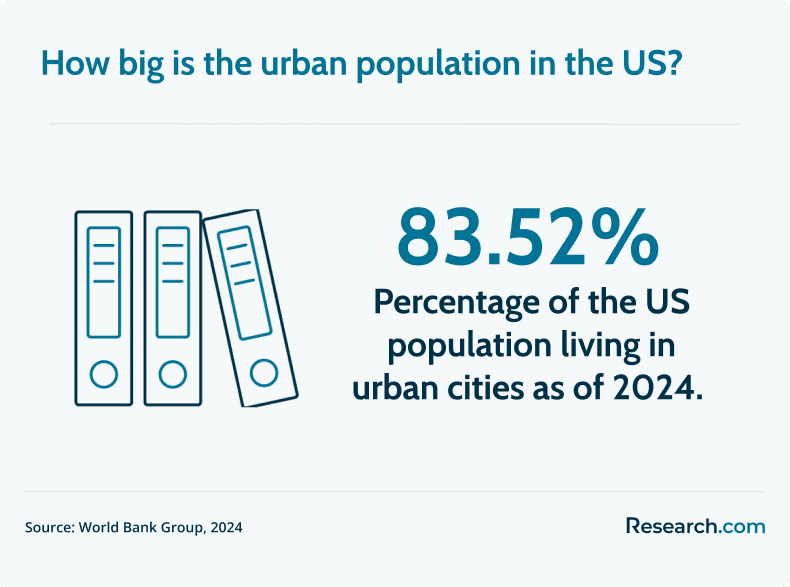
The stakes are significant because 83.52% of the US population lives in urban areas. That level of urbanization helps explain why planners are needed to support sustainable development, transportation access, housing policy, infrastructure decisions, and community quality of life.
What Is the Average Cost of an Online Urban Planning Degree?
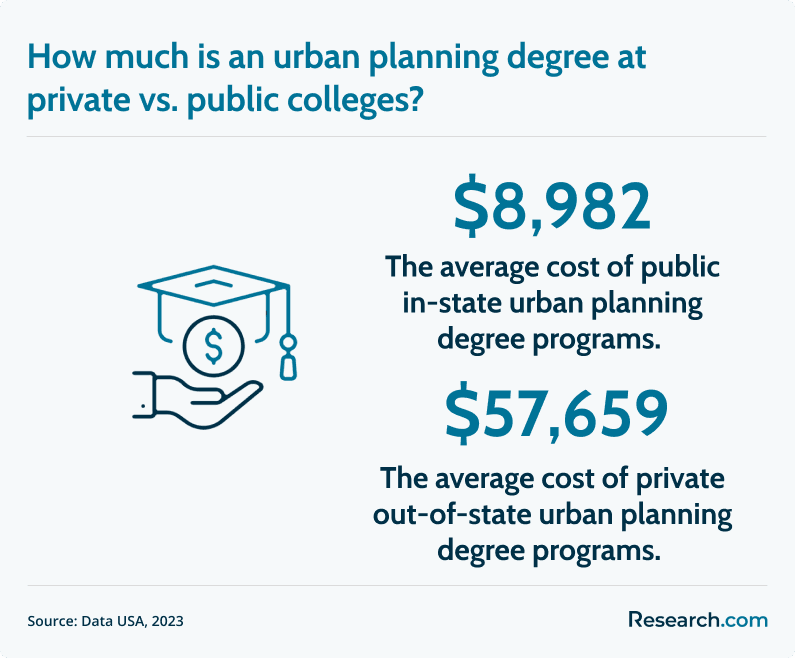
Online urban planning costs vary widely by institution type, degree level, residency status, credit requirements, and whether the school charges online students a separate tuition rate. According to Data USA, the median in-state tuition at public universities is $8,982 per year, increasing at about 1.89% annually. Out-of-state private tuition averages $57,659 and is growing at 3.75% each year.
Per-credit pricing can make a large difference in total cost. New York University lists a cost of $2,491 per credit, while Liberty University lists $580 per credit. Because graduate programs may require 36, 45, or 52 credits, students should multiply the per-credit rate by the required credits and then add fees, software, books, and any travel related to residencies, internships, fieldwork, or capstone projects.
| Cost Item | Why It Matters | What to Ask Before Enrolling |
| Tuition | This is usually the largest expense and may be charged annually or per credit. | Is tuition the same for online, in-state, and out-of-state students? |
| Fees | Technology, student services, online course, and graduation fees can add to the bill. | What mandatory fees are not included in the advertised tuition? |
| Software | Planning students may need GIS, mapping, design, statistics, or visualization tools. | Does the program provide remote access to required software? |
| Books and materials | Planning law, policy, methods, and design courses may require textbooks or digital materials. | What is the estimated annual cost for books and course materials? |
| Fieldwork or travel | Some programs may require site visits, local projects, internships, or occasional in-person components. | Can all applied requirements be completed near where I live? |
Do not compare programs by sticker price alone. A higher-cost program may offer stronger alumni connections, applied studio work, or specialized faculty, while a lower-cost program may provide a better return if it has solid accreditation, career support, and relevant technical training.
Financial Aid Options for Online Urban Planning Students
Financial aid can make an online urban planning degree more manageable, especially for students who are balancing tuition with living costs, software needs, and reduced work hours. Start with institutional aid, federal aid, and planning-specific scholarships, then compare the net price after grants and scholarships rather than relying only on published tuition.
- American Planning Association (APA) Scholarships: These APA Foundation awards provide $5,000 scholarships intended to expand access and support diversity in the planning profession.
- Charles Abrams Scholarship: This $5,000 annual scholarship from the American Planning Association honors Charles Abrams, a leader in housing and urban affairs, and is available to students enrolled in a planning program.
- Brian & Leah Swanton Urban Planning Scholarship: This $1,000 scholarship supports students who want to use planning to improve distressed communities and advance social equity for low-income populations.
- Agile Mile Scholarship: This award provides $2,000 and a one-year student membership with the Association for Commuter Transportation for Black undergraduate and graduate students pursuing urban planning.
- Federal Student Aid (FAFSA): Submitting the FAFSA can help eligible students access federal grants, low-interest loans, and work-study funding based on financial need and enrollment status.
If you are comparing urban planning with shorter or more vocational training options, it may be useful to review alternatives such as pet grooming certification online. The career outcomes are very different, but comparing program length, aid availability, and total cost can help you clarify whether you want a professional planning degree or a faster career-training route.
How to Reduce the Cost of an Online Urban Planning Degree
- Ask whether transfer credits can reduce the number of courses you must complete.
- Compare total program cost, not just per-credit tuition.
- Apply for planning-specific scholarships before relying on loans.
- Check whether your employer offers tuition reimbursement for public administration, GIS, sustainability, or planning-related study.
- Choose a program that provides required GIS and planning software instead of requiring students to purchase tools independently.
- Consider part-time enrollment if it allows you to keep earning income and avoid excessive borrowing.
Admission Requirements for Online Urban Planning Degree Programs
Admissions requirements vary by school and degree level, but most programs look for academic readiness, writing ability, quantitative preparation, and interest in cities, regions, land use, sustainability, housing, transportation, or public policy. Graduate programs may also evaluate professional experience, previous coursework, a statement of purpose, recommendations, and samples of relevant work.
| Requirement | Usually Applies To | Why It Matters |
| High school diploma or equivalent | Bachelor’s applicants | Shows basic eligibility for undergraduate admission, often supported by transcripts in English, math, and social sciences. |
| Bachelor’s degree in a related field | Master’s applicants | Most graduate programs require prior undergraduate study, often in urban planning, geography, architecture, public policy, environmental studies, or a related area. |
| GIS, design, or data experience | Some undergraduate and graduate applicants | May strengthen an application and help students succeed in mapping, spatial analysis, and planning methods courses. |
| Reliable internet access | Online students | Needed for lectures, assignments, live sessions, digital collaboration, and access to course platforms. |
| Computer capable of running planning tools | Online students | Important for GIS, mapping, modeling, visualization, and data analysis assignments. |
| Time management skills | All online students | Online learning requires consistent progress on readings, discussion posts, technical projects, and deadlines. |
| Awareness of urban and regional issues | Especially graduate applicants | Helps demonstrate motivation and readiness to study zoning, transportation, sustainability, housing, and public engagement. |
| Portfolio or work samples | Some design-oriented programs | May be requested for applicants with mapping, design, community engagement, or spatial analysis experience. |
If your interest is more strongly tied to spatial analysis, land systems, or environmental geography than professional planning, compare accelerated online geography degree programs. Geography can be a useful alternative for students who want a faster path focused on spatial data, sustainability, and human-environment relationships.
Common Courses in an Online Urban Planning Degree
Urban planning curricula combine public policy, design thinking, data analysis, environmental awareness, legal frameworks, and community engagement. While course titles differ by school, most programs include a mix of theory, methods, technical tools, and applied planning projects.
- Introduction to Urban Planning: Explains the history, purpose, and major concepts of planning, including how communities make decisions about growth, land use, infrastructure, and public space.
- Geographic Information Systems (GIS): Teaches mapping, spatial data analysis, and visualization so students can evaluate land use patterns, transportation access, demographics, and environmental conditions.
- Urban Design and Development: Examines how buildings, streets, housing, transportation, and public spaces work together to shape livability and community identity.
- Land Use Planning: Covers zoning, development regulation, land allocation, and the trade-offs between economic growth, environmental protection, and community needs.
- Transportation Planning: Focuses on mobility systems, public transit, traffic patterns, pedestrian and bicycle access, congestion, and transportation equity.
- Environmental Planning: Looks at how environmental policy, climate concerns, conservation, and sustainability affect development decisions. Students drawn to this area may also compare accelerated online environmental science programs.
- Urban Economics: Studies the economic forces behind housing markets, taxation, development patterns, employment centers, and regional growth.
- Public Policy and Urban Governance: Explores how governments, agencies, community groups, and private stakeholders influence planning decisions.
- Planning Law and Ethics: Introduces legal responsibilities, professional standards, property rights, equity issues, public participation, and ethical dilemmas faced by planners.
Urban Planning Specializations to Consider
Specializations help you focus your degree on the type of planning work you want to do after graduation. Some students prefer technical GIS and spatial analysis, while others want to work in housing, transportation, environmental policy, community development, or real estate. If you are comparing planning with other specialized online credentials, a post-master's graduate certificate PMHNP online is an example of a very different professional track that also serves community needs, but through healthcare rather than urban systems.
| Specialization | What You Study | Best For Students Interested In |
| Sustainable Development | Long-term growth strategies that balance environmental, social, and economic priorities | Climate resilience, green infrastructure, sustainability planning, and equitable development |
| Transportation Planning and Design | Transit systems, mobility networks, accessibility, congestion, pedestrian planning, and multimodal design | Public transit, traffic planning, active transportation, and regional mobility |
| Environmental Policy | Land use rules, conservation, environmental regulation, and sustainable development policy | Environmental protection, climate adaptation, and policy analysis |
| Historic Preservation | Conservation, adaptive reuse, cultural heritage, architecture, and preservation policy | Protecting historic districts, buildings, and culturally significant sites |
| Real Estate Development | Property markets, zoning, investment, development feasibility, and urban growth | Development consulting, housing projects, and land-use decision-making |
| Geography and Spatial Planning | Location analysis, physical landscapes, human activity, mapping, and spatial relationships | GIS, regional analysis, environmental planning, and data-informed decision-making |
Students who want to connect planning with development and property markets may also compare the fastest online real estate degree programs. Real estate and planning overlap in land use, zoning, housing, and development feasibility, but they lead to different professional roles and incentives.
The chart below shows common college majors that can lead to work as an urban planner.
How to Choose the Best Online Urban Planning Degree Program
The best online urban planning degree is the one that matches your career target, budget, learning style, and timeline while giving you credible academic preparation. Do not choose based on rankings alone. Compare what you will actually study, who will teach you, what software you will use, how you will complete applied projects, and whether the degree supports the roles you want.
Program Selection Checklist
- Accreditation from the Planning Accreditation Board (PAB): PAB accreditation signals that a planning program meets recognized professional standards and may matter for students who plan to pursue American Institute of Certified Planners certification.
- Relevant specializations: Look for focused coursework in transportation planning, environmental planning, housing, community development, real estate development, or GIS if those areas match your goals.
- Faculty with planning experience: Instructors who have worked in city agencies, consulting firms, transportation authorities, nonprofit organizations, or policy roles can connect coursework to real planning problems.
- Remote access to planning software: Online students should confirm access to tools such as ArcGIS or AutoCAD. Students especially interested in spatial analysis may also explore the geospatial analyst career path.
- Applied projects and community engagement: Strong online programs include capstones, virtual fieldwork, public meeting simulations, local planning assignments, or collaborations with government or community organizations.
- Flexible scheduling: Asynchronous and part-time options can be important for students who are employed, caring for family, or balancing other responsibilities.
- Capstone structure: Ask whether the final project can be completed remotely or in your local area, and whether it produces work samples useful for a portfolio.
- Career support and alumni access: Look for virtual career fairs, planning-focused advising, internship support, alumni panels, and connections to public-sector or consulting employers.
Questions to Ask Admissions Advisors
- Is the program accredited, and is it recognized by the Planning Accreditation Board where applicable?
- What planning software will I use, and is remote access included in tuition or fees?
- Are internships, studios, fieldwork, or residencies required?
- Can applied projects be completed in my local community?
- What percentage of courses are asynchronous?
- How many credits can I transfer?
- What is the full estimated cost after fees, software, books, and travel?
- What career services are available specifically for planning students?
- What types of capstone projects have online students completed?
- Do graduates work in public agencies, consulting, nonprofits, transportation, housing, GIS, or environmental planning?
Some students also compare planning with design-oriented or hands-on education. For example, woodworking courses online are not a substitute for an urban planning degree, but they may appeal to learners interested in built environments, materials, construction, or design at a much smaller scale.
Who Should Choose an Online Urban Planning Degree?
An online urban planning degree is a good fit for students who want to influence how communities grow but need a flexible way to study. It is especially practical for working adults, public-sector employees, GIS technicians, community organizers, sustainability professionals, and students who live far from a campus-based planning program.
| You May Be a Good Fit If... | You May Want Another Path If... |
| You are interested in land use, housing, transportation, sustainability, or community development. | You want a highly hands-on design studio experience every week and prefer in-person collaboration. |
| You can manage deadlines independently in an online environment. | You struggle with self-paced learning or need daily structure to stay on track. |
| You want to keep working while earning a degree. | You can attend a full-time campus program and want maximum in-person networking. |
| You are comfortable learning GIS, mapping, and data tools remotely. | You do not have reliable internet or a computer capable of running required software. |
| You want to apply planning concepts to your own city or region. | You need a program with guaranteed local internships in a specific metropolitan area. |
Common Mistakes When Choosing an Online Urban Planning Program
- Ignoring accreditation: Regional accreditation matters for transfer credits, financial aid eligibility, and employer recognition. Planning-specific accreditation may also matter for professional goals.
- Comparing only tuition: Fees, software, books, fieldwork, and travel can change the true cost of attendance.
- Assuming online means easier: Online planning programs can be rigorous, especially courses involving GIS, statistics, research methods, and applied projects.
- Overlooking software access: If the program does not provide tools remotely, students may face added costs or technical barriers.
- Choosing without a career target: Transportation planning, housing policy, GIS, sustainability, and real estate development require different course choices and portfolio evidence.
- Relying only on rankings: Rankings can help narrow the list, but your best fit depends on cost, curriculum, schedule, faculty, accreditation, and career support.
- Underestimating the value of applied work: Employers often want evidence that you can analyze real planning problems, communicate with stakeholders, and use data effectively.
Career Paths for Online Urban Planning Degree Graduates
Urban planning graduates can work in public agencies, consulting firms, nonprofit organizations, environmental groups, transportation authorities, housing organizations, and private development companies. The strongest candidates usually combine policy knowledge, communication skills, GIS competence, data analysis, and experience with community engagement or applied planning projects.
| Career Path | Typical Responsibilities | Useful Skills |
| Urban and Regional Planner | Creates land use plans, reviews development proposals, supports zoning decisions, and helps guide community growth and revitalization. | Policy analysis, public engagement, GIS, zoning, writing, stakeholder communication |
| Transportation Planner | Studies transportation systems, mobility needs, transit access, congestion, pedestrian routes, and long-term infrastructure plans. | Data analysis, transportation modeling, public transit knowledge, GIS, equity analysis |
| Housing Specialist | Analyzes housing needs, supports affordable housing strategies, works with developers and community groups, and evaluates housing policy. | Housing policy, demographic analysis, finance basics, community engagement |
| Community Development Manager | Leads neighborhood improvement, economic development, revitalization, and public engagement initiatives. | Project management, grant coordination, communication, local policy knowledge |
| GIS Specialist | Uses geographic information systems to map, analyze, and visualize spatial data for planning decisions. | GIS software, spatial analysis, data visualization, cartography, statistics |
| Environmental Policy Analyst | Evaluates environmental rules, sustainability strategies, land use policies, and development impacts. | Environmental regulation, research, policy writing, sustainability analysis |
Students leaning toward environmental regulation, sustainability policy, or climate-related planning can also compare top environmental policy degree programs. Environmental policy and urban planning often overlap, but policy programs may focus more heavily on regulation, advocacy, and environmental governance.
The chart below highlights top-paying industries for urban and regional planners.
Job Outlook for Graduates With an Online Urban Planning Degree
The labor market for urban and regional planners is expected to remain steady. The need for planners is connected to population change, transportation demands, housing pressure, environmental concerns, infrastructure planning, and the ongoing need to manage growth in cities, suburbs, and rural regions.
- Projected Growth Rate: Employment of urban and regional planners is expected to grow 4% from 2023 to 2033, which matches the average for all occupations.
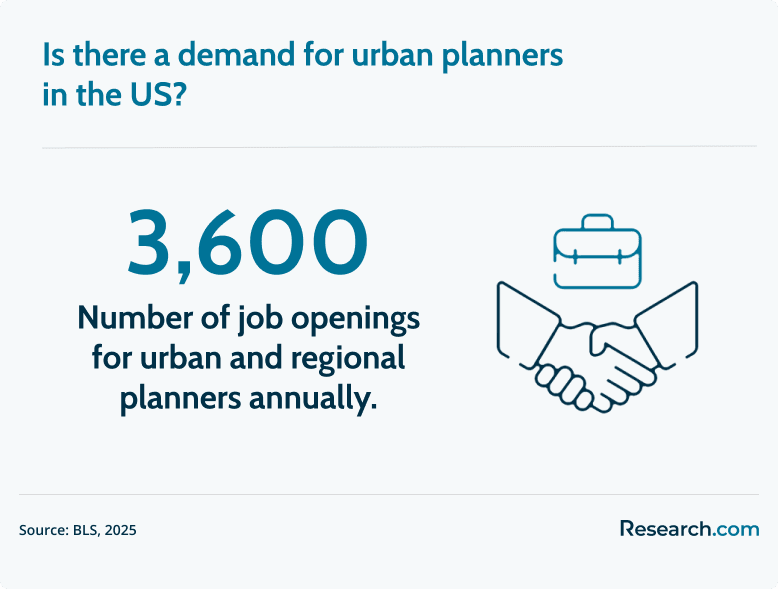
- Job Openings: About 3,600 urban planner openings are projected each year across the decade, with many openings tied to retirements or workers moving into other careers.
- Growth Drivers: Demographic shifts, transportation needs, environmental issues, and changes in development patterns continue to create demand for planning expertise.
- Urban Needs: City planners help manage redevelopment, population growth, environmental stress, infrastructure constraints, and resource allocation.
- Suburban and Rural Needs: Planners also support housing, transportation, land use, and economic development decisions outside major urban centers.
A degree alone does not guarantee a planning job or a specific salary. Graduates improve their prospects by building a strong portfolio, learning GIS and data tools, completing applied projects, gaining internship or public-sector experience, and developing clear writing and presentation skills.
How Technology Is Changing Urban Planning Education
Technology is now central to planning work. Online urban planning programs increasingly use GIS, data dashboards, remote collaboration platforms, digital mapping, scenario modeling, visualization tools, and smart infrastructure concepts. These tools help students analyze population patterns, transportation access, environmental risks, land use conflicts, and community needs more effectively.
Students who enjoy the technical side of planning may benefit from additional coursework in coding, data analysis, software tools, or systems thinking. Comparing planning with an affordable online software engineering degree can help clarify whether your long-term interest is city and regional policy or software-centered problem solving. Some planning careers increasingly reward professionals who can bridge both worlds.
What Graduates Say About Online Urban Planning Degrees
- : "The online format made it possible for me to continue working and caring for my family while learning how planning decisions affect local growth. The applied projects and case-based assignments helped me connect course concepts to real community issues. I came away feeling ready to contribute in a planning role. — Veronica"
- : "Studying online introduced me to classmates and instructors from different regions, which broadened how I think about urban problems. Remote GIS training gave me practical experience with tools that planners use every day. The program changed the way I approach sustainable development. — Manny"
- : "Earning the degree online gave me flexibility without removing the challenge or quality of the coursework. The mix of planning theory and applied assignments helped me prepare for revitalization work and advocacy for more equitable neighborhoods. It was demanding, but it was worth the effort. — Stefano"
Practical Steps Before You Apply
- Define your planning goal: Decide whether you are aiming for public-sector planning, transportation, housing, GIS, sustainability, community development, or private consulting.
- Check accreditation: Verify regional accreditation and planning-specific accreditation where relevant.
- Calculate total cost: Include tuition, fees, software, books, fieldwork, travel, and the cost of taking fewer work hours if applicable.
- Review the curriculum: Make sure the program includes GIS, planning law, land use, policy analysis, and applied projects.
- Ask about online student support: Confirm advising, tutoring, career services, library access, software support, and faculty availability.
- Evaluate flexibility: Look closely at asynchronous courses, required live sessions, part-time options, and deadlines.
- Request career outcomes information: Ask where graduates work and what types of roles they pursue.
- Build a portfolio early: Save mapping projects, policy memos, site analyses, community engagement work, and capstone materials.
References
- Arizona State University. (n.d.). Bachelor of Science in Urban Planning (Online). Asuonline.asu.edu. Retrieved 11 August 2025.
- Arizona State University, School of Geographical Sciences and Urban Planning. (n.d.). Brian & Leah Swanton Urban Planning Scholarship. Sgsup.asu.edu. Retrieved 11 August 2025.
- Data USA. (n.d.). Urban planning. Datausa.io. Retrieved 11 August 2025.
- Harvard University, Graduate School of Design. (n.d.). Charles Abrams Scholarship. Gsd.harvard.edu. Retrieved 11 August 2025.
- Liberty University. (n.d.). Master of Public Administration (MPA) in Urban Planning. Liberty.edu. Retrieved 11 August 2025.
- New York University. (n.d.). Master of Urban Planning. Wagner.nyu.edu. Retrieved 11 August 2025.
- Our World in Data. (n.d.). Urbanization. Ourworldindata.org. Retrieved 11 August 2025.
- Planning.org. (n.d.). APA Foundation scholarships. Planning.org. Retrieved 11 August 2025.
- US Bureau of Labor Statistics. (2024). Occupational employment and wages, May 2023: Urban and regional planners. Bls.gov. Retrieved 11 August 2025.
- US Bureau of Labor Statistics. (2024). Urban and regional planners. Bls.gov. Retrieved 11 August 2025.
- University of Arizona Online. (n.d.). Online Bachelor of Science in Urban and Regional Development. Online.arizona.edu. Retrieved 11 August 2025.
- ZipRecruiter. (n.d.). Urban planner salary. Ziprecruiter.com. Retrieved 11 August 2025.
Key Insights
- An online urban planning degree can be a practical route for students who need flexibility but still want training in GIS, land use, transportation, sustainability, public policy, and community development.
- Bachelor’s programs commonly take 4 years and may require 120 credits, while master’s programs vary from 2 years full-time to 3 to 4 years part-time.
- Cost differences are substantial. Compare total program cost, not just tuition, and include fees, software, books, fieldwork, and travel requirements.
- Accreditation matters. Regional accreditation is essential, and Planning Accreditation Board recognition may be important for students pursuing professional planning credentials.
- The strongest online programs include applied projects, GIS access, experienced faculty, flexible scheduling, career support, and opportunities to work on real planning issues.
- Urban planning graduates can pursue roles in city planning, transportation, housing, GIS, environmental policy, community development, and consulting.
- Employment of urban and regional planners is expected to grow 4% from 2023 to 2033, with about 3,600 openings projected each year across the decade.
- Before enrolling, ask whether the program fits your intended specialization, provides the technical tools you need, and helps you build a portfolio that demonstrates planning competence.
Other Things You Need to Know About Online Urban Planning Degree Programs
In 2027, students pursuing online urban planning degrees can access various financial aid options, including scholarships, grants, and federal student loans. Many programs also offer work-study opportunities and payment plans to help lessen the financial burden. Explore specific offers from each institution to maximize your funding potential.
Students should learn GIS, CAD, and mapping software such as ArcGIS, QGIS, AutoCAD, and Adobe Illustrator. Many accredited urban planning programs expect basic spatial analysis skills before graduation, and employers often look for coursework that includes digital mapping, data visualization, and plan preparation.
Typical credit hour requirements for online urban planning programs in 2027 range from 30 to 36 hours for a master's degree. Undergraduate programs generally require around 120 credit hours. These programs may include core courses in urban design, policy, and sustainable development.