2027 Best Online Physics Degree Programs

Co-Founder and Chief Data Scientist
In recent years, online physics degree programs have provided access to rigorous STEM learning regardless of location. Yet, the discipline faces significant challenges. The American Institute of Physics reported recently reported that only 38% of students who initially express interest in a physics major go on to graduate. Reasons include a lack of support structures, a poor departmental climate, or inflexible course progression.
To address these challenges, many universities have redesigned their online physics programs to be more accessible, flexible, and supportive. In this article, we’ll explore some of the best online physics degree programs available today, examining their curriculum, learning formats, costs, and student support services so you can make an informed decision about which program best fits your academic and career goals.
What are the benefits of getting an online physics program?
- Earning a physics degree online leads to data science, engineering, education, and research careers.
- According to 2025 data from the U.S. Bureau of Labor Statistics (BLS), physicists' median annual salary is $166,290.
- Physics programs benefit from the online learning trend through interactive tools like simulations and virtual labs, providing immersive learning experiences.
What can I expect from an online physics program?
An online physics degree program's curriculum entails classical mechanics, electromagnetism, thermodynamics, quantum physics, and modern computational methods.
Courses are delivered through video lectures, interactive modules, digital textbooks, and virtual lab simulations that replicate hands-on experiments. Students can study with asynchronous content to balance school with other commitments.
Many programs incorporate practical problem-solving through software like MATLAB or Python. Collaborative projects, discussion boards, and live sessions with instructors foster a sense of community despite the remote format. Some institutions also offer hybrid options or require short-term residencies for lab-intensive courses.
Expect emphasis on analytical thinking, mathematical modeling, and scientific communication. Depending on the institution, students may also have access to tutoring services, academic advising, and career support tailored for STEM fields.
Where can I work with an online physics program?
Graduates work as research assistants, lab technicians, or analysts in aerospace, defense, healthcare, and energy. Physics majors are especially valued in data science, software development, and artificial intelligence. Because physics is a foundational science, employers prioritize skills and experience over the degree format.
In government and academia, opportunities exist in national laboratories, meteorological services, and research institutions. Here, physics knowledge contributes to space exploration, climate science, and nuclear research.
Teaching is another common path, with online graduates often entering secondary education or getting certification for community college instruction. For those interested in further specialization, an online bachelor's in physics can serve as a stepping stone to graduate programs in physics, engineering, medicine, or patent law.
How much I can make with an online physics program?
The latest reported median annual wage for physicists is $166,290. The bottom 10% earn under $80,020, and the top 10% earn above $239,200.
Salaries also differ by industry. Physicists working in ambulatory healthcare services earn $225,930, those in scientific R&D earn $167,980, and federal government roles earn $143,170.
For early-career physicists (0–2 years of experience), the average salary is $125,400. It can reach up to $152,900 for those with 2–5 years of experience.
To sum it up, graduates of online physics programs should anticipate median salaries in the $160,000–$170,000 range, with pay raises depending on sector and years of experience.
- Best Online Physics Programs for 2027 Best Programs
- How long does it take to complete an online physics program? Completion Time
- How does an online physics compare to a traditional program? How does an online physics compare to a traditional program?
- What is the average cost of an online physics program? Average Cost
- What are the financial aid options for students enrolling in an online physics program? Financial Aid
- What are the prerequisites for enrolling in an online physics program? Requirements
- What courses are typically in an online physics program? What courses are typically in an online physics program?
- What types of specializations are available in online physics programs? What types of specializations are available in online physics programs?
- How to choose the best online physics program? How to choose the best online physics program?
- What career paths are available for graduates of online physics programs? Career Paths
- What is the job market for graduates of online physics programs? Job Market
- Can online physics programs prepare you for interdisciplinary engineering careers? Can online physics programs prepare you for interdisciplinary engineering careers?
Best Online Physics Programs for 2027
Choosing an online physics program is a high-stakes decision because physics is not a lecture-only subject. You need rigorous math, access to lab or simulation work, faculty support, and a curriculum that can support your next goal—whether that is graduate school, radiation safety, engineering-adjacent work, data science, teaching, or research.
This guide is for students comparing online physics degrees at the bachelor’s and master’s levels. It explains which programs stand out, how online physics differs from campus-based study, what the degree may cost, how long it can take, what courses and specializations to expect, and how to evaluate whether a program is strong enough for your career or graduate school plans.
Our ranking process uses Research.com’s research methodology and draws from established education data sources, including the IPEDS database, Peterson’s database, the College Scorecard database, and the National Center for Education Statistics. Use the list below as a starting point, then confirm admissions rules, tuition, lab requirements, transfer policies, and graduation requirements directly with each school.
Quick Answer: What Is the Best Online Physics Program?
The best online physics program depends on your goal. Arizona State University is a strong option for students seeking a broad online BS in Physics. Thomas Edison State University is better suited for students interested in radiation protection and health physics, especially those with transfer credits. Oregon State University is a graduate-level option for professionals focused on health physics, radiation safety, nuclear energy, or regulatory work.
Before choosing a program, verify three things: the institution’s accreditation, whether the curriculum includes the physics and math depth you need, and whether the online format provides adequate lab, research, advising, and career support.
Best Online Physics Programs for 2027: Side-by-Side Comparison
| School | Program | Best Fit | Credits | Length | Published Cost Information |
| Arizona State University | BS in Physics | Students seeking a broad undergraduate physics degree online | 120 | 7.5-week terms; full completion timeline varies by enrollment load | For Arizona residents, online tuition is lower for the initial 11 credit hours than in-person; after that, it matches in-person rates. Nonresidents face full tuition beyond 11 credits. |
| Thomas Edison State University | BS in Radiation Protection/Health Physics | Transfer students and students targeting radiation safety or health physics roles | 120 | Variable; TESU’s online model allows accelerated pace depending on transfer credits and pacing. | $418 per credit for undergraduate partner students; flat-rate tuition of $3,522 per term for NJ residents or $4,561 per term for out-of-state students for 9+ credits; includes an Edison Accelerate Fee of $3,400 if transferring fewer than 15 credits |
| Liberty University | BS in Physics | Students who want a physics curriculum taught from a Christian worldview | 120 | 4 years | $250 per credit hour discounted rate for undergraduates; full-time per-credit approximately $390, part-time approximately $455; veterans may see lower rates |
| Indiana Wesleyan University | BS in Physics | Students seeking a Christian university with physics, mathematics, and chemistry coursework | 58 credits for major-specific physics/math/chemistry coursework as part of a 120-credit bachelor’s degree | 4 years | $1,062 per credit over 17 credits; varies by load |
| Oregon State University | Master of Health Physics | Working professionals in radiation safety, nuclear energy, medical physics, or environmental protection | 30 | 2–3 years | $726 per credit |
| University of Southern Mississippi | Master of Science in Physics | Educators, technical professionals, research-focused students, and students preparing for doctoral study | 30 | 1-2 years | $578.12 per credit |
1. Arizona State University – BS in Physics
ASU Online offers a Bachelor of Science in Physics designed around the same academic standards used for campus-based instruction. The program emphasizes scientific reasoning, mathematical modeling, and core physics theory. Students study subjects such as advanced quantum mechanics, electromagnetism, statistical mechanics, and mathematical foundations while completing 43 courses across core and elective requirements.
- Tuition: For Arizona residents, online tuition is lower for the initial 11 credit hours than in-person; after that, it matches in-person rates. Nonresidents face full tuition beyond 11 credits.
- Required Credits to Graduate: 120
- Program Length: 7.5-week terms; full completion timeline varies by enrollment load
2. Thomas Edison State University – BS in Radiation Protection/Health Physics
TESU provides a Bachelor of Science in Radiation Protection/Health Physics for students who want a physics-related degree with a clear applied focus. The curriculum combines general education with specialized study in personnel dosimetry, radiation measurement instrumentation, radiation shielding, and the biological effects of radiation. Its structure may be especially useful for adults, transfer students, and learners who already have applicable prior credits.
- Tuition: $418 per credit for undergraduate partner students; flat-rate tuition of $3,522 per term for NJ residents or $4,561 per term for out-of-state students for 9+ credits; includes an Edison Accelerate Fee of $3,400 if transferring fewer than 15 credits
- Required Credits to Graduate: 120
- Program Length: Variable; TESU’s online model allows accelerated pace depending on transfer credits and pacing.
3. Liberty University – BS in Physics
Liberty University offers a BS in Physics that covers mechanics, electromagnetism, thermodynamics, and quantum mechanics while integrating a Christian worldview. The program is designed to strengthen quantitative reasoning and problem-solving skills for students interested in engineering-related work, laboratory settings, data analysis, research support, or graduate study. Students also complete a capstone project that brings together concepts from across the curriculum.
- Cost Per Credit: $250 per credit hour discounted rate for undergraduates; full-time per-credit approximately $390, part-time approximately $455; veterans may see lower rates
- Required Credits to Graduate: 120
- Program Length: 4 years
4. Indiana Wesleyan University – BS in Physics
Indiana Wesleyan University offers a BS in Physics that develops both theoretical and experimental understanding in classical and modern physics. The curriculum reflects the university’s Christian mission and includes 58 credit hours across physics, mathematics, and chemistry, with at least 38 credit hours in physics. IWU’s online learning formats include week-long workshops, which may appeal to students who want structured interaction rather than a fully self-paced model.
- Cost Per Credit: $1,062 per credit over 17 credits; varies by load
- Required Credits to Graduate: 58 credits for major-specific physics/math/chemistry coursework as part of a 120-credit bachelor’s degree
- Program Length: 4 years
5. Oregon State University – Master of Health Physics
Oregon State University offers a Master of Health Physics through its Ecampus for students already working in or preparing for radiation-related fields. The program focuses on radiation detection, dosimetry, nuclear regulations, and environmental protection. It is designed for professionals in radiation safety, medical physics, nuclear energy, and related regulatory environments and can help prepare students for certification from the American Board of Health Physics.
- Cost Per Credit: $726
- Required Credits to Graduate: 30
- Program Length: 2–3 years
6. University of Southern Mississippi – Master of Science in Physics
The University of Southern Mississippi offers an online MS in Physics that covers advanced topics such as classical mechanics, electromagnetism, quantum physics, and computational methods. The program may fit educators, working technical professionals, students preparing for doctoral programs, and learners who want a research-oriented graduate physics experience. A thesis option is available for students who want a stronger research component.
- Cost Per Credit: $578.12
- Required Credits to Graduate: 30
- Program Length: 1-2 years
How Long Does It Take to Complete an Online Physics Program?
An online bachelor’s degree in physics can take less than four years for full-time students, but the actual timeline depends on transfer credits, course availability, math placement, lab requirements, and whether the student attends during summer terms. Part-time students may need five or six years, while students with substantial transfer credit may reduce the timeline to two to three years.
Online master’s programs in physics or closely related fields typically take 1.5 to 3 years. Students who are balancing work, teaching, or family responsibilities may choose a slower pace, while students in structured or accelerated formats may finish sooner. Learners comparing teaching-focused graduate routes may also want to review the shortest online education specialist programs if their long-term goal is school leadership rather than advanced physics research.
| Program Type | Typical Timeline | What Can Shorten It? | What Can Extend It? |
| Online bachelor’s in physics | Less than four years full time; five or six years part time | Transfer credits, summer courses, heavier course loads | Part-time enrollment, prerequisite gaps, required lab sequencing |
| Online master’s in physics or health physics | 1.5 to 3 years | Year-round enrollment, thesis planning, employer support | Thesis delays, work schedule conflicts, course rotation limits |
How Does an Online Physics Program Compare With a Traditional Campus Program?
An online physics degree can cover the same major theoretical areas as a campus-based program, including mechanics, electromagnetism, thermodynamics, quantum mechanics, and mathematical methods. The biggest differences usually involve lab access, peer interaction, research opportunities, and the amount of self-direction required.
Campus programs typically give students direct access to laboratory equipment, in-person faculty office hours, informal study groups, and research spaces. Online programs may use virtual labs, simulation tools, remote assignments, mailed lab kits, proctored assessments, or occasional in-person requirements. That can work well for disciplined students, but it requires careful planning.
Employers and graduate schools generally focus on whether the school is accredited, whether the degree title and transcript show appropriate physics preparation, and whether the student can demonstrate technical skill. Students comparing STEM majors by difficulty and fit may find it useful to review Research.com’s guide to the easiest and hardest science majors.
| Factor | Online Physics Program | Campus Physics Program | Decision Tip |
| Flexibility | Better for working adults, caregivers, military students, and students far from campus | Less flexible but more structured | Choose online if schedule control is essential. |
| Labs | May use simulations, remote labs, kits, or limited in-person components | Usually offers direct access to equipment and lab spaces | Ask exactly how lab competencies are assessed. |
| Faculty access | Often through video meetings, email, discussion boards, and virtual office hours | Includes in-person office hours and informal contact | Online students should confirm response-time expectations. |
| Research opportunities | May be available but can be harder to access remotely | Often easier to join faculty research groups | Students aiming for a PhD should ask about research mentorship early. |
| Self-management | Requires strong independence and time management | Provides more built-in routine | Online physics is best for students who can keep up without daily reminders. |
What Is the Average Cost of an Online Physics Program?
For public institutions, the average total tuition for an online bachelor’s degree in physics is about $40,536 for in-state students and $59,011 for out-of-state students. Residency can make a meaningful difference because state-supported tuition policies often lower prices for in-state learners.
Private universities generally cost more, with the average total cost around $63,185. That number does not always equal the final amount a student pays because institutional aid, transfer credits, employer support, military benefits, and scholarships can reduce the net cost.
On a per-credit basis, public schools average around $337 per credit hour, while private institutions average about $516 per credit hour. Most online physics programs require between 120 and 128 credit hours to graduate, so transfer credit policies can significantly affect total price.
Students should also budget for expenses beyond tuition. Physics programs may charge technology fees, online learning fees, exam proctoring fees, textbooks, lab kits, simulation access, and possible travel costs if the program requires any in-person lab session or campus visit. Students who want a broader STEM path rather than a physics-specific degree can compare alternatives through Research.com’s guide to online natural sciences degrees.
| Cost Category | Why It Matters | Question to Ask |
| Tuition per credit | This is the base price, but it may vary by residency, enrollment load, or student status. | Is the rate different for full-time, part-time, in-state, out-of-state, military, or partner students? |
| Transfer credits | Accepted credits can reduce both cost and time to graduation. | How many credits can I transfer, and which physics or math courses must be taken through the school? |
| Lab and technology fees | Physics may require software, virtual labs, kits, or proctored testing. | Are lab materials included in tuition or billed separately? |
| Books and digital resources | Advanced physics texts and online platforms can add to the budget. | Does the program use open educational resources or required paid platforms? |
| Travel requirements | Some online programs may still include campus visits or supervised labs. | Are there any required in-person sessions, and who pays for travel? |
What Financial Aid Options Are Available for Online Physics Students?
Students in accredited online physics programs may be eligible for federal aid, institutional aid, employer tuition assistance, military benefits, scholarships, and STEM-focused funding. Students comparing accelerated STEM-related education options can also review Research.com’s guide to fast track STEM education online.
Physics students should look beyond general scholarships and search for awards connected to physics, physical science, defense, nuclear science, education, and underrepresented groups in STEM. Examples include:
- SPS Leadership Scholarship: The Society of Physics Students awards between $2,500 and $6,000 annually to undergraduate physics majors who show leadership through SPS participation and strong academic performance. The application deadline is around mid-March each year.
- American Physical Society Minority Scholarship: The APS Minority Scholarship supports African American, Hispanic American, or Native American U.S. citizens planning to major in physics. Applicants must submit transcripts, test scores, recommendation letters, and a personal statement by the early-February deadline.
- SMART Scholarship Program from the Department of Defense: The SMART Scholarship provides full tuition coverage, monthly stipends, health insurance, book allowances, and paid summer internships in exchange for civilian service after graduation. This STEM-focused program offers between $30,000 and $46,000.
- National Physical Science Consortium Fellowships: The NPSC Graduate Fellowships offer up to $20,000 per year for master’s and PhD students in physics and related fields. The program supports women and underrepresented minorities.
What Are the Prerequisites for Enrolling in an Online Physics Program?
Online physics programs usually expect applicants to be prepared for demanding mathematics and science coursework. Requirements vary by school and degree level, but most programs review academic history carefully because physics builds sequentially from algebra and calculus into advanced theoretical and applied work.
- High School Diploma or GED: Undergraduate applicants generally need a high school diploma or GED from an accredited institution. This confirms the applicant has completed the foundational education needed for college-level math and science.
- Math and Science Preparation: Strong applicants often have coursework in algebra, trigonometry, calculus, and general science. AP or honors coursework may strengthen an application when available.
- Official Transcripts: Schools use transcripts to evaluate academic readiness and transfer credit. Students with prior college work, including coursework from an accelerated master's degree in data analytics online, should ask how credits will be reviewed and whether they apply to physics, math, elective, or general education requirements.
- Statement of Purpose or Personal Statement: Some programs ask applicants to explain why they want to study physics, what careers or graduate programs they are considering, and what academic experiences have prepared them for the major.
Many physics students first develop interest in the field during high school, but a later start does not automatically rule out the major. Students who are less confident in calculus, programming, or laboratory work should ask whether the program offers placement support, tutoring, bridge courses, or academic coaching.
What Courses Are Typically Included in an Online Physics Program?
Physics curricula usually move from foundational mechanics and mathematics into modern physics, quantum theory, computational methods, and specialized electives. Bachelor’s programs emphasize breadth and core preparation, while master’s programs typically require more advanced theory, research, or applied technical coursework.
- Classical Mechanics: Students study motion, force, energy, momentum, rotational dynamics, and mathematical models of physical systems. This course is central to later work in engineering, astronomy, and applied physics.
- Electromagnetism: Coursework covers electric fields, magnetic fields, circuits, and Maxwell’s equations. Students learn both the mathematical theory and applied uses of electromagnetic principles.
- Thermodynamics and Statistical Mechanics: This subject examines heat, energy, entropy, and the laws of thermodynamics while showing how microscopic interactions explain large-scale physical behavior.
- Quantum Mechanics: Students explore wave-particle duality, uncertainty, Schrödinger’s equation, atomic models, and the shift from classical to modern physics.
- Modern Physics: This course often introduces relativity, quantum theory, nuclear physics, and particle physics. Students considering a healthcare technical route instead of a physics major may also compare shorter training paths such as the best online phlebotomy technician certificate programs.
| Course Area | Skills Developed | Why It Matters |
| Mechanics | Mathematical modeling, force analysis, problem solving | Forms the base for engineering, aerospace, and applied physics topics |
| Electromagnetism | Vector calculus, field analysis, circuit concepts | Supports work in electronics, optics, energy, and instrumentation |
| Quantum mechanics | Abstract reasoning, probability models, advanced mathematics | Essential for graduate study, materials science, and emerging technology areas |
| Computational methods | Programming, simulation, numerical analysis | Useful for data science, modeling, research, and technical industry roles |
| Laboratory or simulation work | Measurement, uncertainty analysis, scientific reporting | Shows whether students can apply theory to observations and evidence |
What Specializations Are Available in Online Physics Programs?
Specializations help students connect physics to a clearer career or graduate study direction. Not every online program offers every concentration, so students should check course rotations, faculty expertise, and whether advanced electives are offered frequently enough to graduate on time.
- Astrophysics: Astrophysics focuses on the physical behavior of stars, galaxies, black holes, cosmology, and space-time. It is a strong fit for students interested in astronomy, space science, or research-intensive graduate study.
- Computational Physics: This path emphasizes numerical methods, programming, data analysis, and simulations used to solve complex physical problems. It can be useful for students considering data science, modeling, machine learning, or technical computing roles.
- Biophysics: Biophysics applies physics principles to biological systems such as protein folding, cellular processes, and neural activity. It may fit students interested in biotechnology, medical research, or healthcare innovation.
- Engineering Physics: Engineering physics connects advanced physics with applied engineering problems. Students learn to analyze and design systems using mechanics, electronics, thermodynamics, and materials concepts.
- Physics Education: This track supports students who want to teach physics or develop science curriculum. Students focused on nursing leadership rather than physics education may find a better fit in an RN to BSN to MSN online pathway.
Students drawn to astrophysics should also look carefully at research access, mathematics requirements, and graduate school expectations because many advanced roles in that area require education beyond the bachelor’s level.
How Should You Choose the Best Online Physics Program?
The best online physics program is not simply the one with the lowest tuition or the most recognizable name. A good fit should match your academic preparation, career goal, preferred learning format, financial situation, and need for laboratory or research experience.
- Confirm accreditation first: Accreditation affects credit transfer, graduate school eligibility, employer recognition, and access to certain forms of financial aid. Look for institutional accreditation from recognized bodies such as the Higher Learning Commission (HLC) or Middle States Commission on Higher Education (MSCHE).
- Review the full curriculum: A credible physics program should include substantial mathematics, core physics theory, and lab or simulation-based work. If you plan to attend graduate school, make sure the program includes advanced coursework that supports that goal.
- Evaluate faculty expertise: Review instructors’ academic backgrounds, research areas, and availability to online students. Faculty support matters in physics because difficult concepts often require repeated explanation and guided problem solving.
- Ask about online labs: Do not assume every online physics program handles labs the same way. Ask whether labs are virtual, remote, kit-based, proctored, or partly in person.
- Compare student support: Physics students often need tutoring, advising, career counseling, technical support, and help planning course sequences. Weak support can delay graduation.
- Investigate career and alumni outcomes: Ask what graduates do after completing the program. Strong career services can help with internships, resumes, graduate school applications, and employer connections.
| Question to Ask | Why It Matters | Warning Sign |
| Is the institution accredited? | Accreditation affects recognition, transfer, financial aid, and graduate school options. | The school is vague about accreditation or uses unfamiliar accreditor names without explanation. |
| How are labs completed online? | Physics requires more than reading and exams. | The program cannot clearly explain lab requirements or equipment access. |
| How often are required courses offered? | Course rotation can affect graduation speed. | Core courses are offered infrequently or only when enough students enroll. |
| What support exists for math-heavy courses? | Calculus, differential equations, and advanced problem sets can be major barriers. | No tutoring, office hours, or academic coaching is available for online learners. |
| Can the degree support graduate school? | Research and advanced coursework matter for master’s or PhD applications. | The curriculum lacks upper-level theory, lab work, or faculty mentoring. |
Who Should Choose an Online Physics Program?
An online physics degree can be a smart choice for students who need flexibility but still want a rigorous quantitative education. It is especially useful for motivated learners who can manage weekly problem sets, study independently, and seek help before they fall behind.
| Online Physics May Be a Good Fit If... | You May Want a Different Path If... |
| You need to study around work, caregiving, military service, or location limits. | You learn best through frequent in-person lab work and face-to-face study groups. |
| You are comfortable with advanced math, independent learning, and technical software. | You are not ready for calculus-based science and do not want to complete bridge coursework. |
| You want a foundation for data science, technical analysis, engineering-adjacent roles, teaching, or graduate study. | You need a program with extensive hands-on research facilities from the first year. |
| You can verify that the program’s lab model fits your career or graduate school plans. | You are considering a licensed profession and have not checked state or program requirements. |
What Career Paths Are Available for Graduates of Online Physics Programs?
Physics graduates can work in research, technology, education, engineering-adjacent fields, healthcare-related technical areas, energy, aerospace, and public-sector science roles. The right career path depends heavily on degree level, internships, programming ability, lab experience, graduate education, and specialization.
- Physicist: Physicists study natural laws through mathematical models, experiments, and theory testing. Advanced research positions often require graduate education.
- Data Scientist or Data Analyst: Physics graduates often have strong quantitative reasoning and modeling skills that translate well to data analysis, statistical tools, coding, and machine learning.
- Engineer in Related Fields: Physics training in mechanics, electronics, thermodynamics, and materials can support work in mechanical, aerospace, electrical, or systems-focused environments, though some engineering roles may require specific engineering credentials.
- Software Developer: Students with strong programming and computational physics experience may move into software roles involving simulations, algorithms, technical tools, or scientific applications. Students who want a more direct software credential can compare options in Research.com’s guide to the fastest online bachelor's in software engineering.
- Science or Physics Teacher: Graduates interested in teaching should check state certification requirements. Educators comparing advanced education credentials can also review Research.com’s explanation of EDS vs EDD pathways.
| Career Direction | Helpful Preparation | Typical Next Step |
| Research or academia | Advanced physics coursework, research experience, faculty mentoring | Master’s or PhD study |
| Data science or analytics | Programming, statistics, computational physics, machine learning projects | Portfolio, internship, analytics role, or graduate certificate |
| Radiation safety or health physics | Dosimetry, radiation detection, regulations, environmental protection | Health physics graduate study or certification preparation |
| Engineering-adjacent technical work | Mechanics, electronics, materials, modeling, applied projects | Technical role, engineering master’s, or employer-specific training |
| Teaching | Physics content, pedagogy, classroom experience, certification alignment | Teacher certification or education graduate program |
What Is the Job Market for Online Physics Graduates?
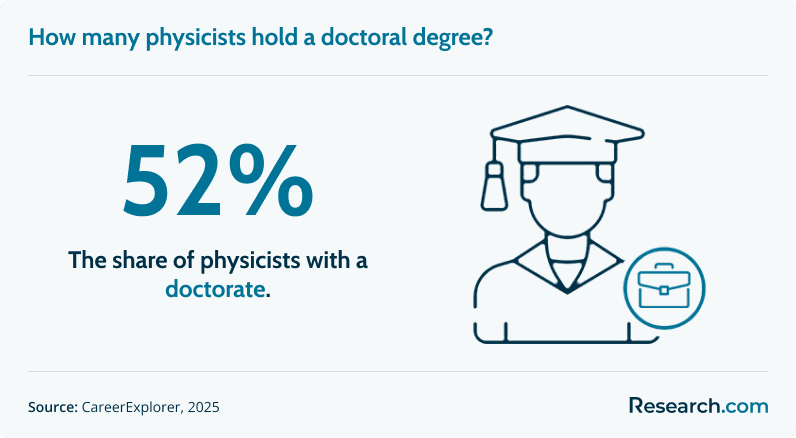
Demand for physicists and physical scientists is projected to grow 7% between 2023 and 2033, with about 1,600 annual job openings expected. Physics graduates can also compete for roles outside the physicist job title because the major develops skills in analysis, modeling, mathematics, programming, and scientific reasoning.
Technology, renewable energy, data science, aerospace, healthcare, and regulatory fields continue to value workers who can work with complex systems and quantitative evidence. Students who like the mathematical side of physics may also compare related programs such as the shortest bachelor's in mathematics online.
That said, outcomes are not automatic. Bachelor’s-level graduates often improve their job prospects by adding internships, undergraduate research, coding projects, laboratory experience, or industry-recognized technical skills. Higher-level research and academic roles commonly require graduate study.
How AI, Computing, and Technology Are Changing Physics Careers
Physics education increasingly overlaps with computing, simulation, data analysis, and automation. Students who build programming and modeling skills can broaden their options beyond traditional laboratory or academic paths. Computational physics, machine learning, materials modeling, quantum-related technologies, and scientific software all reward graduates who can combine physics theory with technical implementation.
For online students, this trend makes course selection important. A physics degree with no programming, data analysis, or computational work may be less versatile than one that includes numerical methods, coding assignments, simulations, or applied projects. Students should ask whether Python, MATLAB, scientific computing tools, data visualization, or computational modeling are part of the curriculum.
Can Online Physics Programs Prepare You for Interdisciplinary Engineering Careers?
Online physics programs can support engineering-adjacent careers when they include applied mechanics, computational methods, electronics, materials science, and project-based learning. Physics graduates often bring strong mathematical and analytical preparation, but they should be realistic: some engineering positions require an engineering degree, specific licensure, or ABET-aligned preparation.
If your main goal is to become an engineer, compare physics programs with engineering programs before enrolling. Students looking for lower-cost engineering pathways can use Research.com’s guide to cheap engineering schools as a starting point for comparing cost and program fit.
Can an Online Physics Degree Accelerate Advanced Study?
An online physics degree can prepare students for graduate study if the curriculum includes rigorous upper-level physics, advanced mathematics, lab or simulation experience, and faculty support for research or recommendations. Students planning to pursue a master’s or PhD should choose programs carefully because graduate admissions committees may look for evidence of research readiness and strong quantitative preparation.
Physics graduates can also move into interdisciplinary graduate fields where analytical and technical training is valuable. For example, students interested in healthcare technology and data systems may compare options such as an accelerated health informatics online masters, especially if they want to apply quantitative skills in a healthcare-focused environment.
Common Mistakes to Avoid When Choosing an Online Physics Program
- Choosing a school before checking accreditation: Accreditation should be verified before reviewing tuition, course lists, or rankings.
- Looking only at tuition: A cheaper program can become expensive if credits do not transfer, required courses are delayed, or lab fees are separate.
- Ignoring lab delivery: Physics is not only theoretical. Ask exactly how experiments, measurements, simulations, and lab reports are completed online.
- Assuming online means easier: Online physics can be just as demanding as campus study and may require more self-discipline.
- Overlooking math readiness: Weak preparation in calculus, algebra, or trigonometry can slow progress in core physics courses.
- Not checking graduate school alignment: Students aiming for research careers should make sure the program includes advanced coursework, faculty mentorship, and research opportunities.
- Relying only on rankings: Rankings can narrow your search, but your final decision should account for cost, schedule, transfer credits, faculty access, and career goals.
What Graduates Say About Online Physics Programs
-
: "Completing physics coursework online made it possible for me to keep my full-time job while earning the degree. The schedule was flexible, but the academic expectations were still serious. The virtual labs and problem-solving meetings challenged me, and I finished the program prepared to move into data analysis.
Alexa"
-
: "I did not expect an online physics program to feel interactive, but the simulations, recorded lectures, and discussion spaces helped me stay engaged. Being able to replay difficult lessons was especially useful when I was working through complex topics.
Mei"
-
: "Because I live in a rural area, studying physics online was the only realistic option. The program connected me with instructors and classmates in other locations and forced me to become much better at managing long technical projects on my own.
Jordan"
References
- American Institute of Physics. (2024, July 2023). Attrition and Persistence in Undergraduate Physics Programs. Retrieved August 7, 2025, from AIP.
- BLS. (2025, April 18). Physicists and Astronomers. Retrieved August 7, 2025, from BLS.
- Education Data Initiative. (2025, February 22). Average Cost of Online College. Retrieved August 7, 2025, from Education Data Initiative.
- Indeed. (2025, June 9). 30 Jobs for Physics Majors. Retrieved August 7, 2025, from Indeed.
Key Insights
- Online physics is viable, but lab quality matters: The strongest programs explain clearly how students complete experiments, simulations, measurement work, and technical reports.
- Program fit depends on your goal: A general BS in Physics, a radiation protection degree, and a health physics master’s serve different career paths.
- Cost varies widely: Public online bachelor’s programs average about $40,536 for in-state students and $59,011 for out-of-state students, while private universities average around $63,185.
- Transfer credit can change the value equation: Students with prior coursework should request a formal transfer evaluation before committing.
- Career outcomes depend on added skills: Programming, data analysis, research experience, internships, and specialization can make a physics degree more marketable.
- Graduate study may be necessary for advanced research roles: Students aiming for physicist, astronomer, academic, or research-intensive positions should plan for master’s or doctoral education.
- Do not choose by ranking alone: Accreditation, curriculum depth, lab delivery, faculty access, support services, and total net cost should drive the final decision.
Other Things You Should Know About Online Physics Degree Programs
Yes, if the degree comes from a regionally accredited institution and includes the required physics coursework, most graduate schools accept it. Admissions committees usually review GPA, research experience, recommendation letters, and advanced courses such as classical mechanics, quantum mechanics, and electromagnetism.
In 2027, online physics degree programs manage laboratory work through virtual labs and simulation software. Some institutions also offer on-site lab intensives or partnerships with local labs to provide hands-on experience, ensuring students grasp essential practical skills alongside theoretical knowledge.
Admission requirements for online physics degree programs in 2027 typically include a high school diploma or GED, standardized test scores like the SAT or ACT, and prerequisite coursework in mathematics and science. Some programs may also require letters of recommendation or a personal statement.