2027 Fastest Online STEM Education Degree Programs

Co-Founder and Chief Data Scientist
An online STEM education degree is for students who want to become math, science, technology, engineering, or integrated STEM teachers without putting their lives on hold for a traditional campus program. The decision matters because STEM teacher shortages, licensure rules, online learning quality, tuition costs, and state certification requirements can all affect whether a program actually leads to the job you want.
This guide explains what online STEM education programs include, how fast they can be completed, what they cost, how licensure works, which schools offer accelerated options, and how to compare programs before enrolling. It is designed for first-time college students, transfer students, paraprofessionals, career changers, and working adults who want a practical path into STEM teaching.
Quick Answer: Is an Online STEM Education Degree Worth It?
An online STEM education degree can be worth it if the program is regionally accredited, aligned with your state’s teacher licensure requirements, and able to place you in approved local field experiences or student teaching. The strongest programs combine STEM content knowledge, teaching methods, classroom management, assessment, educational technology, and supervised clinical practice.
Students should not choose a program based only on speed. The best option is the fastest accredited program that fits your certification area, budget, transfer credits, schedule, and state licensing plan.
What are the benefits of completing an online STEM education degree program?
- Competitive teaching pay: Median annual pay for STEM teachers is around $63,000 in 2024—well above non-STEM educators.
- Steady hiring needs: Teacher job openings projected at 41,400 per year through 2033, ensuring steady demand.
- Flexible career use: STEM educators access careers in K–12 teaching, curriculum design, instructional coaching, and educational consulting.
What can I expect from an online STEM education degree?
An online STEM education bachelor’s program usually blends subject-area coursework in science, mathematics, technology, or engineering with teacher-preparation courses. Students study how learners develop, how to design standards-based lessons, how to manage classrooms, how to assess student progress, and how to teach STEM concepts through inquiry, labs, projects, and problem-solving.
Most programs also include field observations, practicum hours, and a supervised student-teaching placement. Even when coursework is online, licensure-track programs normally require in-person classroom experiences in an approved school setting. These placements may happen near the student’s home, but students should confirm this with the college before applying.
Graduation alone does not always equal automatic certification. To become licensed, students may need to complete state-specific testing, background checks, student teaching, portfolio assessments, and application paperwork. Because teacher licensure is regulated by states, an online program that works for one state may not meet requirements in another.
| Program Component | What It Usually Covers | Why It Matters |
| STEM content courses | Math, science, technology, engineering, computer science, or integrated STEM topics | Builds the subject knowledge needed for certification exams and classroom teaching |
| Teaching methods | Lesson planning, inquiry-based instruction, assessment, and differentiation | Shows students how to turn STEM knowledge into teachable classroom experiences |
| Educational technology | Learning platforms, simulations, virtual labs, digital assessment tools, and classroom software | Prepares teachers for technology-rich schools and hybrid learning environments |
| Field experience | Observation, practicum hours, and student teaching | Provides required supervised practice for licensure-track programs |
| Licensure preparation | Praxis, edTPA, state exams, portfolio tasks, or equivalent requirements | Helps candidates meet state certification rules |
Where can I work with an online STEM education degree?
Most graduates use an online STEM education degree to enter K–12 teaching, especially in math, science, computer science, elementary STEM integration, or career and technical education. The degree can also support work in curriculum development, tutoring, education technology, instructional coaching, museums, science centers, and educational support organizations.
Top-employing industries include:
- Elementary & Secondary Education: public and private schools remain the main employment route.
- Educational Support Services: tutoring companies, learning centers, enrichment programs, and intervention providers hire STEM-trained educators.
- State and Local Education Agencies: experienced teachers may move into policy, curriculum, assessment, or program support roles.
Graduates may also find opportunities in museums, science centers, youth STEM programs, nonprofit education initiatives, and corporate training settings where technical instruction is needed.
Top states hiring STEM education graduates include:
- California
- Texas
- New York
- Massachusetts
- Georgia
These states show the highest employment numbers and annual STEM teaching job openings in the U.S. (BLS).
How much can I make with an online STEM education degree?
Middle-school STEM teachers in the U.S. earn a median salary of $62,970 as of May 2024.
Reported salary figures from major employment and compensation platforms include:
- Zippia: Avg. science teacher salary is $59,788.
- Salary.com: Range is $44,851–$60,286 (typical).
- ZipRecruiter: Avg. STEM teacher earns $29.08/hour (~$60,494 annually).
- Indeed: Avg. STEM Academy teacher salary is $50,274.
- Payscale: High‑school STEM teachers earn $62,755 on average.
- Glassdoor: EnCorps STEM Teachers report $73,000 - $136,000 per year.
Actual pay depends on state salary schedules, district contracts, years of experience, grade level, subject area, advanced degrees, and additional endorsements. A STEM degree can improve eligibility for high-need teaching roles, but it does not guarantee a specific salary.
- Fastest Online STEM Education Degree Programs for 2027
- Program Length: How Long Online STEM Education Degrees Take
- Online vs. Campus STEM Education Degrees
- Average Cost of an Online STEM Education Degree
- Financial Aid for Online STEM Education Students
- Admission Requirements and Prerequisites
- Common Online STEM Education Courses
- STEM Education Specializations
- Graduate Study Options After a STEM Education Degree
- Challenges in Online STEM Education Programs
- How STEM Education Differs from Other Accelerated Degrees
- Interdisciplinary Career Options
- How to Choose the Best Fast Online STEM Education Program
- Career Paths for STEM Education Graduates
- Job Market for Online STEM Education Graduates
Fastest Online STEM Education Degree Programs for 2027
Accelerated online STEM education programs can help transfer students, paraprofessionals, substitute teachers, and career changers move more quickly toward licensure. The programs below are ranked by shortest typical completion time, not by tuition cost. Each is connected to a U.S.-based accredited college listed in Research.com’s best colleges database and is described as leading toward teacher licensure.
Use this list as a starting point, not as an automatic enrollment decision. Before applying, verify that the program fits your state’s licensure rules, your intended grade level, your subject area, your transfer credits, and your ability to complete in-person clinical requirements.
How do we rank schools?
Our rankings use a structured Research.com ranking methodology that combines institutional research, data analysis, and review by our expert team. We compare programs using multiple reputable sources rather than relying on one data set.
Institutional information from the IPEDS database helps verify college characteristics and federal education data. We also use Peterson’s database, including distance learning information, to evaluate online offerings. Cost and outcome context from the College Scorecard database helps readers compare affordability and student results.
Because online education programs can change admissions policies, tuition, licensure alignment, and field-placement rules, students should confirm all details directly with the university before enrolling.
| Rank | School and Program | Typical Fast-Track Time | Best Fit |
| 1 | Texas Tech University – B.S. in Education, TechTeach Across Texas | 1 year after prerequisites | Students who already completed major lower-division requirements and want an intensive residency model |
| 2 | Northern Arizona University – B.S.Ed. in Career and Technical Education | Approximately 12 months with maximum transfer credits | Transfer students pursuing career and technical education pathways |
| 3 | East Carolina University – Partnership Teach B.S. in Elementary Education | 2 years after transfer | Community college transfers and teacher assistants |
| 4 | Ball State University – B.A. in Elementary Education | Approximately 18–22 months | Students seeking an accelerated online elementary education route |
| 5 | University of North Carolina Wilmington – B.A. in Elementary Education | Approximately 16–20 months | Students interested in an accelerated elementary education track |
1. Texas Tech University – B.S. in Education, TechTeach Across Texas (Accelerated Teacher Preparation)
Texas Tech University is a public research university in Lubbock. Its TechTeach Across Texas pathway is built as an accelerated one-year teacher preparation residency within the online B.S. in Education. Students who have already completed general education requirements enter an intensive senior-year model that combines professional coursework with full-time clinical student teaching.
The structure is designed for candidates who can commit to a demanding calendar year. During that period, students complete remaining bachelor’s credits while working toward initial teacher certification. The program’s district partnerships and coaching model support rapid preparation for Texas licensure, with potential reciprocity considerations in other states.
- Program cost: ~$338/credit (estimated Texas resident online rate; scholarships often available)
- Program duration: 1 year (full-time accelerated residency, after 3 years of prerequisites)
- Total credits: 120 credits (approximately 90 prior + 30 in the TechTeach senior-year program)
- Accreditation: SACSCOC (regional); CAEP (Education)
2. Northern Arizona University – B.S.Ed. in Career and Technical Education
Northern Arizona University is a public research university in Flagstaff, Arizona, founded in 1899. Its online B.S.Ed. in Career and Technical Education is designed for students preparing to teach applied, technical, and workforce-focused subjects. For students who bring substantial transfer credit, the program can offer a shorter route to degree completion.
This option may be especially relevant for learners with prior college coursework, industry experience, or an interest in preparing students for technical careers. Applicants should confirm how the program maps to their state’s CTE or STEM-related teaching requirements.
- Program cost: $455/credit
- Program duration: Approximately 12 months (with maximum transfer credits)
- Total credits needed to graduate: 120 credits
- Program/School Accreditation: HLC
3. East Carolina University – Partnership Teach B.S. in Elementary Education
East Carolina University is a public university in North Carolina with a College of Education known for teacher preparation. Partnership Teach is an online degree-completion pathway for students such as community college transfers and teacher assistants who want to finish a BS in Elementary Education while completing local school internships.
Students generally enter with about two years of completed college credit, then finish upper-division education coursework online. The model is intended to expand access to teacher preparation across North Carolina and can support future K–6 teachers who plan to integrate STEM instruction in elementary classrooms.
- Program cost: $205/credit (NC resident online rate; ~$883/credit for non-resident)
- Program duration: 2 years (full-time after transfer; includes one full-time internship semester)
- Total credits: ~60 ECU credits (approx. 120 total with transfer)
- Accreditation: SACSCOC (regional); CAEP (Education)
4. Ball State University – B.A. in Elementary Education (Online)
Ball State University is a public research university in Muncie, Indiana, established in 1918. Its online B.A. in Elementary Education supports students who want a flexible path into elementary teaching while completing professional education coursework at an accelerated pace.
This program may be a good match for students who want online coursework, transfer-credit options, and preparation for elementary teaching roles where math and science foundations are important. As with any licensure program, students should confirm state certification compatibility before enrolling.
- Program cost: $371/credit (in-state), $603/credit (out-of-state)
- Program duration: Approximately 18–22 months
- Total credits needed to graduate: 120 credits
- Program/School Accreditation: CAEP, HLC
5. University of North Carolina Wilmington – B.A. in Elementary Education
The University of North Carolina Wilmington is a public research university founded in 1947 and part of the University of North Carolina system. Its B.A. in Elementary Education prepares candidates for elementary classrooms, where early math, science, and problem-solving instruction can shape long-term STEM readiness.
The accelerated track can appeal to students with clear teaching goals and the ability to handle a compressed course sequence. Students should ask how field placements are arranged and whether program completion aligns with their intended certification state.
- Program cost: $211.14/credit (in-state)
- Program duration: Approximately 16–20 months (accelerated track)
- Total credits needed to graduate: 124 credits
- Program/School Accreditation: SACSCOC, CAEP
6. Liberty University – B.Ed. in Mathematics Education (Grades 6–12)
Liberty University is a private Christian university in Virginia founded in 1971. Its online B.Ed. in Mathematics Education prepares students for middle and high school math teaching through a licensure-focused curriculum. The program uses eight-week online courses and multiple start dates, which can support students who want a faster, structured schedule.
This program is best suited for students committed to secondary mathematics teaching and comfortable with Liberty’s faith-based institutional environment. Because certification rules vary, students outside Virginia should verify licensure transferability before enrolling.
- Program cost: $390/credit (full-time online rate)
- Program duration: 3.5 years (approximately 8 semesters of accelerated 8-week terms)
- Total credits: 120 credits (includes practicum & student teaching)
- Accreditation: SACSCOC (regional); CAEP (Education)
7. National University – B.A. Early Childhood Development with Inspired Teaching and Learning & Preliminary Multiple Subject Credential
National University is a nonprofit university founded in 1971 in San Diego. It is known for short, intensive course formats and support for adult learners, veterans, and working students. This integrated bachelor’s program combines early childhood development with a California preliminary multiple-subject teaching credential.
For students planning to teach elementary grades, the program can support broad instruction across subjects, including foundational STEM learning. Candidates should pay close attention to California credential requirements and out-of-state reciprocity if they plan to teach elsewhere.
- Program cost: $370/quarter credit (approx. $555 per semester credit
- Program duration: ~3.3 years (accelerated year-round; 4-week classes)
- Total credits: 180 quarter credits (equivalent to 120 semester credits)
- Accreditation: WSCUC (regional); NCATE/CAEP (Education)
8. Chaminade University of Honolulu – B.S. in Secondary Education (Grades 6–12)
Chaminade University of Honolulu is a Catholic university in Hawaii with an online secondary education bachelor’s program. The degree prepares students for teaching fields that may include math, science, English, or social studies, depending on concentration and licensure planning.
The program uses 10-week course terms and includes field-based learning. It was ranked #1 Best Online Secondary Education Degree of 2024 by Forbes. Students can complete coursework online while arranging student teaching in an approved school setting, but they should verify Hawaii licensure and reciprocity requirements.
- Program cost: $550/credit (estimated; tuition is aligned with private rates)
- Program duration: ~3.5–4 years (accelerated 10-week terms, year-round)
- Total credits: 120 credits (includes content area specialization)
- Accreditation: WSCUC (regional); Hawaii Teacher Standards Board approved
9. Grand Canyon University – B.S. in Elementary Education, STEM Emphasis
Grand Canyon University is a private Christian university in Arizona with extensive online programming. Its BS in Elementary Education with a STEM Emphasis prepares future K–8 educators to integrate science, technology, engineering, and math into elementary instruction.
The program’s eight-week courses and multiple annual start dates may help students maintain momentum. Although the degree is built around 120 credits, students may shorten the overall timeline through year-round study, transfer credit, or careful scheduling.
- Program cost: $455/credit (online Education & Science programs)
- Program duration: ~3.5–4 years (8-week courses, can accelerate by taking courses year-round)
- Total credits: 120 credits (with built-in STEM coursework and student teaching)
- Accreditation: HLC (regional); Arizona State Board of Education approved
10. University of West Florida – B.A. in Exceptional Student & Elementary Education (K–6)
The University of West Florida is a public university in Pensacola. Its online B.A. in Exceptional Student & Elementary Education prepares graduates for both Elementary Education (K–6) and Exceptional Student Education (K–12), with embedded ESOL and Reading endorsements.
This option can be useful for students who want broader certification coverage and plan to teach in inclusive elementary settings where differentiated STEM instruction is needed. The dual focus may reduce the need for separate credential programs later, but students should confirm all Florida and out-of-state licensure details.
- Program cost: $219/credit (Florida e-rate for online undergrad)
- Program duration: ~4 years (can be shortened slightly with summer courses or credits by exam)
- Total credits: 120 credits (leads to Florida K–6 and K–12 ESE certifications, plus ESOL/Reading endorsements
- Accreditation: SACSCOC (regional); CAEP (Education)
How long does it take to complete an online STEM education degree program?
Most online STEM education degree pathways require about 120 semester credits, which is roughly 40 courses. A traditional full-time bachelor’s schedule usually takes about four academic years. National Center for Education Statistics data show half of traditional-age learners complete the bachelor’s in 45 months, or 3.75 years.
Online programs may shorten that timeline by using eight-week terms, year-round enrollment, summer sessions, and transfer-friendly degree-completion formats. BestColleges finds many two-year bachelor’s pathways condense requirements into 18–36 months. Research.com’s fastest-degree ranking lists programs advertising 16- to 24-month finishes for highly motivated candidates.
Transfer credit is often the biggest time-saver. Students who bring an associate degree or 60–90 credits may only need 12–18 months of upper-division coursework, depending on the school. Competency-based formats may reduce time further when students can prove mastery quickly.
| Student Profile | Likely Timeline | What Can Speed It Up | What Can Slow It Down |
| First-time full-time student | About four academic years | Summer courses, eight-week terms, year-round study | Part-time enrollment, failed courses, delayed field placements |
| Transfer student with 60 credits | Often 18–36 months | Strong transfer policy and completed general education courses | Credits that do not apply to teacher-prep requirements |
| Student with 60–90 credits | Often 12–18 months of upper-division work | Degree-completion format and local placement support | Missing prerequisites or state-required testing delays |
| Working adult enrolled part time | Varies by course load | Predictable schedule and employer support | Limited study time and unpaid student-teaching requirements |
How does an online STEM education degree compare to an on-campus program?
A high-quality online STEM education degree can cover the same curriculum, faculty-led instruction, and licensure preparation as a campus program. This is also true in many graduate programs, such as an online Masters in Education, when the institution is properly accredited and the program is designed around state certification standards.
Accreditation is the key difference between a credible online degree and a risky one. Drexel University emphasizes three quality markers: regional accreditation, a reputable brick-and-mortar home campus, and consistent academic branding. Employer acceptance has also improved; NACE’s 2024 Job Outlook survey reports 87.4% of recruiters hire online-degree graduates and pay them the same starting salaries as on-campus alumni.
Online education is no longer unusual. According to NCES, 61% of undergraduates took at least one online course in fall 2021. Still, teaching programs are different from many online majors because they require supervised school-based practice. Students should ask exactly how labs, observations, practicum hours, and student teaching are handled.
| Factor | Online STEM Education Degree | On-Campus STEM Education Degree |
| Flexibility | Best for working adults, transfer students, and learners who need location flexibility | Best for students who want a set campus routine |
| Field experience | Usually completed locally if the school approves placements | Often arranged through nearby partner schools |
| Labs and STEM practice | May use virtual labs, simulations, mailed kits, or local arrangements | Often includes in-person labs and campus resources |
| Peer interaction | Discussion boards, video meetings, group projects, and online cohorts | Face-to-face study groups, campus events, and informal networking |
| Best choice when... | You need flexibility and can manage independent learning | You prefer in-person structure and immediate access to campus support |
What is the average cost of an online STEM education degree program?
Education Data Initiative’s 2024 survey of 199 public colleges reports average online in-state tuition of $337 per credit, which equals about $40,400 for a 120-credit program. Private colleges average $516 per credit, or roughly $61,900 for the same amount of coursework. Program-level data show Elementary or STEM-teaching majors have an average annual sticker price of $27,256 at four-year institutions, with some specialized tracks topping $37,338.
Across all majors, nationwide tuition averages are $9,214 for in-state public schools and $28,501 for private schools per year. These benchmarks help students decide whether a specific STEM education program is priced fairly. Online students may also reduce indirect costs because they often avoid room, board, commuting, and campus relocation. Education Data estimates online learners save $11,000–$13,000 over four years compared with campus peers. Technology fees are usually much smaller than tuition, and some are under $40 per term.
Cost comparisons should include more than tuition. Students should calculate fees, books, testing costs, background checks, travel to field placements, lost wages during student teaching, and whether transfer credits will actually reduce the bill.
| Cost Item | Why It Matters | Question to Ask |
| Tuition per credit | Main driver of total degree cost | Is tuition different for online, in-state, or out-of-state students? |
| Transfer credit policy | Can reduce both time and cost | How many credits will apply directly to my degree plan? |
| Clinical placement expenses | May require travel, schedule changes, or unpaid hours | Will I need to travel, relocate, or stop working during student teaching? |
| Licensure testing | Required in many teacher-prep pathways | Which exams are required, and are preparation resources included? |
| Fees and materials | Can include technology, lab kits, software, or background checks | What required costs are not included in advertised tuition? |
The chart below shows that in-state undergraduates in education programs paid an average of $10,578 in 2024–2025, while out-of-state students faced $35,723. These figures help put online STEM teaching degree costs into a broader institutional pricing context.
What are the financial aid options for students enrolling in an online STEM education degree program?
Online students in accredited degree programs can usually use the same major financial aid sources as campus students. Nearly 72% of undergraduates received financial aid in 2019-20, averaging $14,100 in total assistance. NCES reports 64% obtained grants, 36% used federal loans, and 5% earned work-study awards.
Students evaluating an online STEM education degree should complete the FAFSA, compare net prices, and ask whether the program qualifies for teacher-specific grants or state incentives. Learners comparing other accelerated online pathways, such as the shortest degree in corrections online, should use the same approach: focus on total cost after grants and scholarships, not just advertised tuition.
- Federal Pell Grant: need-based, up to $7,395 per year.
- TEACH Grant: up to $4,000 annually for students who commit to four years in high-need schools.
- Direct Subsidized and Unsubsidized Loans: federal student loans with fixed rates and income-driven repayment options.
- Federal Work-Study: part-time work opportunities that may help cover education costs.
- State “Grow Your Own” scholarships: funding programs in some states for future teachers, including STEM educators.
- Institutional merit grants: school-based scholarships that may be available to online students.
- Teacher Loan Forgiveness/Public Service Loan Forgiveness: federal forgiveness pathways after five to ten years of eligible service.
Students considering long-term advancement can also compare funding patterns in affordable online master's programs for teaching, especially if a graduate degree may be needed for salary advancement, leadership roles, or additional endorsements.
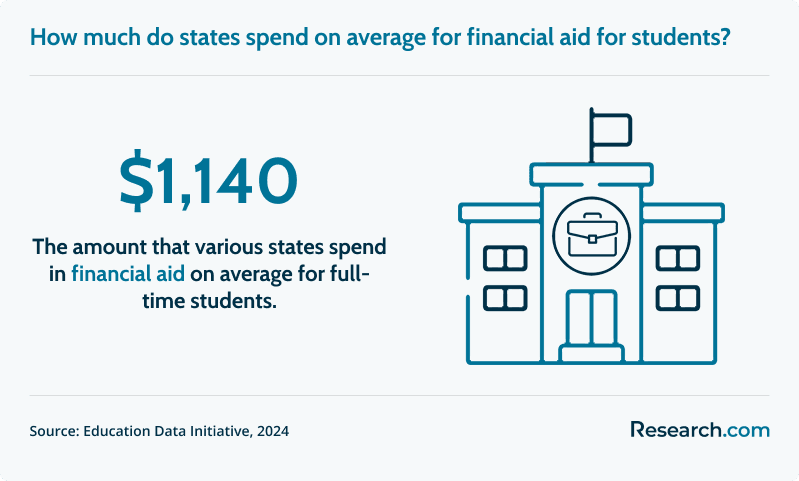
The image below reinforces the financial support available to aspiring teachers, showing that states spend an average of $1,140 in financial aid per full-time student. This figure highlights why students should check state aid programs in addition to federal grants and loans.
What are the prerequisites for enrolling in an online STEM education degree program?
Most online STEM education programs have two layers of admission: entry into the university and admission into the teacher-preparation program. General university admission usually requires a high-school diploma or GED and a minimum 2.5–3.0 GPA. Many schools publicly waive SAT/ACT scores or list them as “optional” for 2025 cohorts.
Degree-completion programs for paraprofessionals, transfer students, and working adults often require 60 transferable credits and a cumulative 2.5 GPA before upper-division enrollment. This is similar to the way other accelerated programs, including the shortest online master's in sustainability, use prior academic preparation to determine readiness.
After admission to the university, teacher-prep candidates commonly must complete additional checkpoints:
- Pass a basic-skills exam such as Praxis Core, SAT, ACT, or a state-approved alternative covering reading, writing, and mathematics.
- Complete a criminal-background check and fingerprinting before entering K-12 classrooms.
- Maintain a required program GPA, with many states now accepting 2.5–2.8 instead of the historical 3.0 standard to respond to shortages.
- Show access to required technology, including reliable broadband, webcam, and productivity software.
- Complete pre-clinical observation hours, often 10–30 hours, before student teaching.
Before applying, ask whether all admission requirements are published clearly and whether failing to meet a later teacher-prep checkpoint could delay graduation or licensure.
What courses are typically in an online STEM education degree program?
Online STEM education curricula combine content knowledge with practical teaching skill. Students usually take general education courses, STEM subject courses, education foundations, teaching methods, assessment, classroom management, and clinical practice. Students exploring different accelerated humanities or social science routes, such as the shortest online history bachelor's degree programs, may also encounter education-adjacent courses in instructional design, communication, and learning theory if they pursue teaching.
- Concepts in Science: introduces biology, chemistry, physics, earth science, scientific reasoning, and data interpretation.
- Natural Science Lab: uses mailed kits, simulations, or approved local activities to practice scientific inquiry safely.
- Educational Technology for Teaching: examines classroom software, digital equity, learning platforms, and technology-supported instruction.
- Educational Psychology & Human Development: connects developmental stages, motivation, cognition, and learner differences to classroom practice.
- Curriculum, Instruction, & Assessment: teaches students to design standards-aligned lessons and evaluate learning evidence.
- Secondary Science Methods: focuses on inquiry-based science teaching, lab safety, and phenomena-based instruction.
- Mathematics Methods: prepares teachers to teach problem-solving, reasoning, modeling, and conceptual understanding.
- Classroom Management for STEM: covers routines for labs, group work, equipment use, safety, and project-based learning.
- Clinical Residency / Student Teaching: places candidates in a supervised classroom for 12–20 weeks and may include edTPA or Praxis performance tasks.
A strong curriculum should make students practice teaching, not just read about teaching. Look for assignments that require lesson design, data analysis, feedback cycles, simulated or live teaching, and reflection on student learning.
What types of specializations are available in STEM education degree programs?
STEM education degrees often divide into licensure-focused tracks because teaching requirements differ by grade level and subject. Students considering other accelerated fields, including the shortest online bachelor's programs in sustainability, should apply the same rule: choose a specialization based on the credential or career outcome it supports.
| Specialization | Typical Focus | Best For |
| Secondary Mathematics Education | Algebra, statistics, geometry, quantitative reasoning, and math pedagogy | Future grades 6-12 math teachers |
| Secondary Science Education | Biology, chemistry, physics, lab safety, and NGSS-aligned inquiry lessons | Students planning to teach middle or high school science |
| Computer Science Education | Coding, algorithms, computational thinking, and CS endorsement preparation | Teachers interested in K-12 computer science |
| Engineering & Technology Education | Design thinking, robotics, CAD, engineering projects, and technical problem-solving | Students drawn to hands-on STEM classrooms and career-tech settings |
| Elementary STEM Integration | Science and math instruction across K-6 classrooms | Elementary teachers who want stronger STEM preparation |
| STEAM / Arts-Infused STEM | Creative design, innovation, arts integration, and interdisciplinary projects | Teachers who want to blend STEM with creativity and design |
| STEM Leadership & Curriculum Specialist | Teacher coaching, curriculum planning, and district-wide STEM initiatives | Experienced educators preparing for leadership roles |
| Robotics & Coding Enrichment | After-school programs, summer camps, coding tools, robotics kits, and enrichment pathways | Teachers interested in supplemental STEM programming |
Specialization choice can affect licensure exams, field placements, salary schedule eligibility, and future graduate study. Some advanced education roles are also reflected in Masters in Education career rankings, especially positions involving leadership, coaching, and curriculum design.
How does an online STEM education degree pave the way for advanced studies?
An online STEM education degree can support later graduate study in curriculum and instruction, educational technology, STEM leadership, special education, educational leadership, or doctoral-level education. Classroom experience strengthens graduate applications because many advanced programs expect applicants to understand school systems, student learning, and instructional practice.
Educators who want leadership, research, policy, or district-level roles may eventually consider the quickest online EdD programs. These programs can build on teaching experience while preparing graduates for roles beyond the classroom. Students should compare admissions requirements carefully because doctoral programs may require a master’s degree, professional experience, recommendation letters, writing samples, and a clear research or leadership focus.
What challenges might students face in online STEM education degree programs?
Online STEM education programs are flexible, but they are not easy. Students must manage weekly coursework, group projects, technology platforms, exams, lesson planning, and field-placement requirements without the built-in structure of a campus schedule.
- Self-discipline: asynchronous courses require students to plan their own study time and meet deadlines consistently.
- Technology access: unreliable internet, software issues, and limited device access can interrupt labs, video meetings, and assessments.
- STEM lab limitations: virtual labs, simulations, or mailed kits may not feel the same as campus lab work.
- Clinical placement logistics: students must complete in-person school experiences, which can conflict with work schedules.
- Networking gaps: online students may need to be more intentional about building relationships with faculty, mentors, and peers.
- Licensure complexity: out-of-state students must confirm whether the program satisfies their state’s certification rules.
For educators who later reach a career ceiling, low cost online doctoral programs in educational leadership may offer a pathway into administration, policy, or systems-level school improvement.
What distinguishes an online STEM education degree from other accelerated online degree programs?
An online STEM education degree is different from many accelerated online majors because it must satisfy both academic degree requirements and teacher licensure expectations. It is not only about completing courses quickly. Students must prove they can teach real learners, manage classrooms, apply STEM concepts, and meet state certification standards.
Other accelerated programs may focus more heavily on reading, writing, analysis, or independent research. For example, the fastest online philosophy degree emphasizes critical thinking and abstract reasoning, while a STEM education degree adds clinical practice, lab-oriented instruction, standards-based teaching, and school placement requirements.
| Feature | Online STEM Education Degree | Many Other Accelerated Online Degrees |
| Licensure alignment | Often required for public school teaching | Usually not tied to state teacher certification |
| Field experience | Practicum and student teaching are central | May not require in-person placement |
| STEM application | Includes labs, technology, data, and inquiry-based instruction | May focus more on theory, writing, or professional knowledge |
| Assessment | May involve Praxis, edTPA, or state exams | Usually assessed through coursework and projects |
Can an online STEM education degree facilitate interdisciplinary career advancement?
Yes. STEM educators often work across subjects because strong STEM instruction involves literacy, data interpretation, technology, communication, design, and problem-solving. With experience, graduates may move into curriculum design, educational technology, STEM program coordination, library media support, instructional coaching, tutoring leadership, or nonprofit education.
Some educators combine STEM teaching with another credential to broaden their career options. For example, pairing STEM education experience with library and information science can support work in digital literacy, research instruction, makerspaces, and school library programs. Educators interested in that route can compare the cheapest online MLIS degree programs as one possible interdisciplinary option.
How do you choose the best among the fastest STEM education degree programs?
The fastest program is not always the best program. The right online STEM education degree should help you become licensed in the correct state, teach the subject and grade level you want, complete fieldwork without major disruption, and graduate with manageable debt. Students comparing an online teaching degree should use a structured checklist before applying.
- Verify regional accreditation and education accreditation: regional accreditation supports federal aid eligibility and transferability; CAEP accreditation can indicate teacher-prep quality.
- Check state licensure alignment: ask whether the program meets requirements in the state where you plan to teach.
- Match the specialization to your certification goal: secondary math, elementary STEM, computer science, and science education can lead to different licenses.
- Confirm clinical placement support: make sure the school helps arrange approved placements near you instead of leaving you to solve it alone.
- Compare pace honestly: eight-week courses and year-round starts can be helpful, but only if you can handle the workload.
- Calculate total cost after aid: include tuition, fees, lost wages, travel, testing, and transfer-credit savings.
- Review outcomes: ask for completion rates, licensure exam pass rates, student-teaching placement data, and graduate employment information.
Questions to ask before enrolling
- Will this program meet teacher licensure requirements in my state?
- Who arranges my practicum and student-teaching placement?
- How many of my transfer credits apply to the degree, not just to electives?
- What exams, background checks, and portfolio assessments are required?
- Can I complete student teaching while working, or will I need to reduce my hours?
- Are lab kits, software, textbooks, and testing fees included in tuition?
- What happens if I move to another state before graduation?
Common mistakes to avoid
| Mistake | Why It Can Hurt You | Better Approach |
| Choosing only the fastest program | A quick degree may not align with your state license | Choose the fastest accredited program that meets your certification goal |
| Ignoring accreditation | Credits, aid eligibility, and licensure may be affected | Confirm regional accreditation and teacher-prep approvals |
| Looking only at tuition | Fees, fieldwork costs, and lost wages can change the real price | Compare total net cost after aid and transfer credit |
| Assuming online means fully remote | Student teaching is usually in person | Ask how local placements are arranged |
| Assuming salary outcomes are guaranteed | Teacher pay varies by district, experience, and contract | Review salary schedules in the state and districts where you want to work |
What career paths are available for graduates of STEM education degree programs?
A STEM education degree most often leads to classroom teaching, but it can also support advancement into coaching, curriculum, administration, policy, and educational program leadership. Some roles require additional graduate education, leadership credentials, or years of classroom experience. Research.com’s broader guide to education career paths can help students compare classroom and non-classroom options.
- Substitute or Paraprofessional Teacher: an entry point for building classroom experience while completing degree or licensure requirements.
- Middle/High School STEM Teacher: full-time math, science, or technology instructor; 64 000 openings each year through 2033.
- Lead Teacher / Grade-Level Chair: supports peers, models lessons, and helps implement new curriculum.
- Department Chair: coordinates instruction, materials, budgets, labs, and assessment across a science or math department.
- Instructional Coach: trains teachers in inquiry-based labs, data use, classroom technology, and lesson design; growth parallels 8% rise in post-secondary instructors.
- District STEM Curriculum Specialist: develops standards-aligned units, reviews instructional materials, and supports district-wide implementation.
- Assistant Principal / Principal: oversees staff, budgets, student outcomes, and program evaluation.
- District Director of STEM Education: leads K-12 STEM initiatives, partnerships, grants, and curriculum strategy across multiple schools.
- State STEM Policy Advisor: contributes to certification policy, teacher development, curriculum priorities, and education funding decisions.
The chart below shows average salaries tied to different STEM education roles, from classroom teaching to state-level policy work. It helps illustrate how responsibility, credentials, and leadership scope can affect compensation over time.
What is the job market for graduates with an online STEM education degree?
The job market for STEM education graduates is shaped by two competing realities: projected employment changes may be modest in some teaching categories, but schools still need qualified teachers because of retirements, turnover, shortages, and subject-specific vacancies. Despite a modest -1% employment change projected for high-school teachers between 2023 – 2033, retirements still create 64 000 openings annually.
Elementary and middle-school science vacancies mirror that scale, while post-secondary teaching grows 8%—nearly double the national average. Shortages remain a major concern: the Learning Policy Institute notes that 37 states reported math or science teacher gaps in 2024, and NCES found 86% of public schools struggled to hire teachers for 2023-24.
Zippia projects ~60 200 new teacher jobs overall each year through 2035, supported in part by STEM demand. Shortage severity differs by location; Arizona still lacked qualified educators for 25% of vacancies in 2025. Pay pressure also affects the profession. NEA’s 2025 data show an average starting salary of $46 526, yet inflation has eroded real wages and pushed 40% of educators into second jobs.
For candidates with strong STEM content knowledge, completed licensure requirements, and willingness to work in high-need schools or shortage areas, hiring prospects can be stronger than broad employment projections suggest. Candidates should still research local district salary schedules, contract conditions, certification rules, and vacancy data before choosing a program.
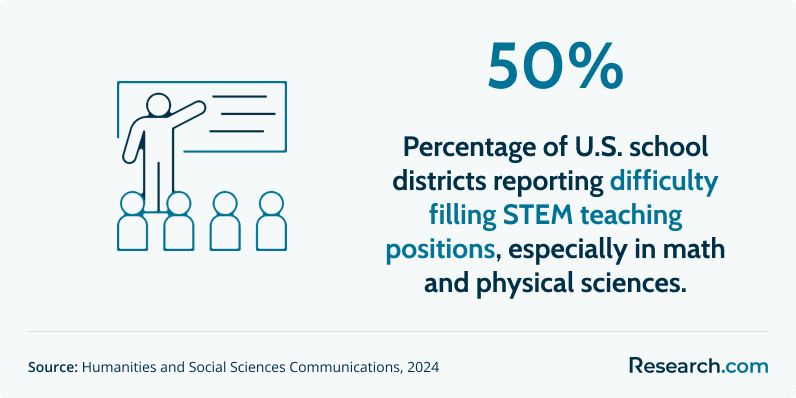
The image below adds context to the shortage issue. It highlights that half of all U.S. school districts report difficulty filling STEM teaching roles, especially in math and physical sciences, which can increase demand for qualified graduates of online STEM education programs.
Here's What Graduates Have to Say About Their Online STEM Education Degree
- I completed my accelerated program in 22 months while working full-time as a substitute teacher. Because I transferred 63 credits, I cut down both time and tuition, and I passed my Praxis® on the first attempt. The late-night webinars were demanding, but watching my seventh-graders finally understand fractions made the effort feel worthwhile. Lars
- I was unsure about virtual science labs at first, but the mailed lab kit and live coaching helped me build confidence. I designed NGSS-aligned experiments, added them to my e-portfolio, and entered student teaching feeling prepared. My district offered me a job before graduation and included a moving bonus. Kenneth
- The online format gave me more community than I expected. Discussion boards connected me with teachers from six states, and we exchanged lesson plans and Python notebooks regularly. That network helped me land a summer coding-camp position and later a full-time STEM-coach role. Soraya
Key Insights
- An online STEM education degree is most valuable when it is accredited, licensure-aligned, and able to support approved local field placements.
- Median middle-school teacher salary hit $62,970 in May 2024, but actual earnings depend on district salary schedules, experience, subject area, and state policy.
- Public online tuition averages $337 /credit; private averages $516 /credit for 2024-25, so transfer credits and financial aid can substantially affect total cost.
- 72 % of undergrads received financial aid in 2023; average federal aid $8,700, and future teachers should also investigate TEACH Grants, state scholarships, and loan forgiveness programs.
- Teacher shortages reported in 37 states for math or science in 2024 can improve opportunities for well-prepared, licensed STEM educators.
- Accelerated online paths allow completion in 2–3 years versus the usual four, but speed should never outweigh licensure fit, accreditation, field-placement quality, and affordability.
- Eight states now grant full teacher-license reciprocity, easing interstate moves, but students should still verify certification rules before enrolling or relocating.
References:
- Bureau of Labor Statistics (BLS). Middle School Teachers occupational profile.
- Bureau of Labor Statistics (BLS). Postsecondary Teachers, All Other — Occupational Employment and Wage Statistics.
- Chaminade University. Online Secondary Education program information.
- East Carolina University (ECU). Partnership Teach program.
- EducationData.org. Average Cost of College.
- Glassdoor. Teacher salary data.
- Grand Canyon University (GCU). Bachelor of Science in Elementary Education with STEM emphasis.
- Indeed. STEM Academy teacher salary information.
- Liberty University. Online B.Ed. in Mathematics.
- National Center for Education Statistics (NCES). IPEDS Trend Generator.
- National University. Inspired Teaching and Learning with a Preliminary Multiple Subject Credential.
- Nature. The supply and quality of STEM teachers.
- Northern Arizona University. B.S.Ed. in Career and Technical Education catalog page.
- Payscale. STEM Education skill salary data.
- Salary.com. STEM teacher salary information.
- Texas Tech University. TechTeach Across Texas program information.
- U.S. Facts. Teacher pay in the U.S.
- University of North Carolina Wilmington. B.A. in Elementary Education.
- University of West Florida (UWF). Exceptional Student Education B.A..
- Walden University. BS in Elementary Education.
- Zippia. Science teacher job trends.
- ZipRecruiter. STEM teacher salary estimates.
Other Things You Should Know About Online STEM Education Degree Programs
Yes. Programs that lead to teacher licensure usually require student teaching, practicum, or field placement, often 12 to 16 weeks in a school setting. Some states also require a supervised internship and a state-approved background check before placement begins.
Admission requirements typically include a high school diploma or equivalent, transcripts, and sometimes standardized test scores. Some programs may also require personal statements or interviews. Always check specific program demands for detailed insights.
In 2027, institutions like the University of Florida and Arizona State University are known for offering some of the fastest online STEM education degree programs, often allowing completion in just 12-18 months with options to accelerate further based on transfer credits or intensive summer courses.