
2027 Fastest Online Philosophy Degree Programs

Co-Founder and Chief Data Scientist
A fast online philosophy degree is for students who want the reasoning, writing, ethics, and argumentation training of a philosophy program without spending longer than necessary in school. The right program can help transfer students, working adults, military learners, and motivated full-time students finish a bachelor’s degree sooner through online delivery, shorter terms, year-round starts, transfer credits, or accelerated bachelor’s-to-master’s pathways.
This guide explains how accelerated online philosophy degrees work, which programs stand out for speed and flexibility, what they cost, how to compare online and campus formats, and what career options may follow. It also covers accreditation, financial aid, admissions requirements, common courses, specializations, student support, and mistakes to avoid before enrolling.
Quick answer: What is the fastest way to earn a philosophy degree online?
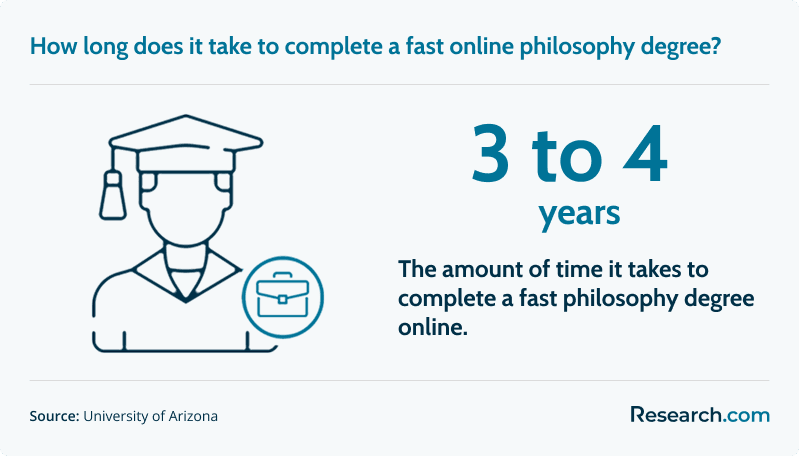
The fastest route is usually an accredited online bachelor’s program that accepts substantial transfer credit, offers 5- to 8-week or 7- to 8-week courses, and allows year-round enrollment. Full-time students often finish in three to four years, while students with prior college credits may move faster depending on the school’s transfer policy. Students who want graduate-level training may consider accelerated B.A./M.A. options that combine undergraduate and master’s coursework in about five years.
Why choose a fast online philosophy degree?
- It builds transferable reasoning skills. Philosophy develops logic, critical reading, ethical judgment, persuasive writing, and structured argumentation, which can support careers in law, technology, business, education, public policy, communications, and nonprofit work.
- It can shorten your timeline. Accelerated formats and transfer-friendly policies may help you complete the degree sooner and move into work, graduate school, law school, or another professional path earlier.
- It may lower total education costs. Finishing faster can reduce the number of terms you pay for and may also limit expenses tied to commuting, relocation, or time away from work.
- It fits nontraditional schedules. Many fast online programs use asynchronous classes, allowing students to study around jobs, caregiving responsibilities, military service, or other commitments.
What can I expect from a fast online philosophy degree program?
A fast online philosophy degree is usually an accelerated version of a traditional bachelor’s program. Instead of relying only on long fall and spring semesters, many schools use condensed terms, multiple start dates, transfer-credit pathways, and online course delivery to help students progress more efficiently.
The academic work should still be demanding. Students typically study logic, ethics, metaphysics, epistemology, political philosophy, philosophy of science, and the history of philosophical thought. In accelerated programs, those subjects may be delivered in shorter 5- to 8-week terms, which means readings, discussion posts, essays, and exams can arrive quickly.
These programs are best suited to students who can manage deadlines independently. Some schools also offer minors, interdisciplinary tracks, or dual-degree options that let qualified undergraduates begin graduate coursework before finishing the bachelor’s degree.
| Program feature | What it means for students | Who benefits most |
| Accelerated terms | Courses may run in shorter sessions instead of traditional semesters. | Students who can handle concentrated reading and writing workloads. |
| Generous transfer credit | Prior college coursework may reduce the number of credits left to complete. | Transfer students, returning adults, and military learners. |
| Asynchronous coursework | Students complete weekly work without attending live classes at fixed times. | Working adults and students with family or location constraints. |
| Dual-degree pathway | Eligible students may begin master’s courses during the bachelor’s program. | Students planning graduate study, academic work, law, or advanced analytical careers. |
Where can I work with an online philosophy degree?
An online philosophy degree can lead to many fields, but the degree is usually not a direct job-training credential in the way nursing, accounting, or engineering programs are. Its value comes from broad intellectual skills: careful reading, logical analysis, ethical reasoning, argument construction, and clear writing.
Graduates commonly apply those skills in law-related work, public policy, education, journalism, nonprofit management, business consulting, communications, user experience research, marketing, technology, and administrative leadership. Students interested in academic teaching or research typically need graduate education beyond the bachelor’s degree.
How much can I earn with an online degree in philosophy?
Salary outcomes for philosophy graduates vary widely because graduates enter many different industries. Entry-level roles in communications, nonprofit organizations, administrative support, and related fields may pay $45,000 to $60,000. With experience or additional education, some philosophy graduates move into higher-paying roles in law, management consulting, education administration, technology, or policy work.
Mid-career professionals with philosophy backgrounds can earn upwards of $90,000, especially when they combine philosophical training with graduate study, legal credentials, management experience, technical skills, or specialized industry knowledge. These figures should be treated as broad career-context examples, not guaranteed earnings from the degree itself.
- Fastest Online Philosophy Degree Programs for 2027
- How long does it take to complete a fast online philosophy degree program?
- How does an online philosophy degree compare to an on-campus program?
- What is the average cost of an online philosophy degree program?
- What are the financial aid options for students enrolling in an online philosophy degree program?
- What are the prerequisites for enrolling in an online philosophy degree program?
- What courses are typically in an online philosophy degree program?
- What types of specializations are available in an online philosophy degree program?
- What challenges might I face in an online philosophy degree program?
- What student support resources are available in accelerated online philosophy programs?
- How can I verify the accreditation and credibility of an online philosophy degree program?
- Can accelerated online philosophy programs be both affordable and high-quality?
- How do I choose the best online philosophy degree program?
- What career paths are available for graduates of an online philosophy degree program?
- What is the job market for graduates with an online philosophy degree?
Fastest Online Philosophy Degree Programs for 2027
How do we rank schools?
Research.com evaluates online philosophy programs with the goal of helping students compare credible options, not simply identify the shortest advertised timeline. Our rankings are informed by our methodology and draw on trusted education datasets and institutional information, including:
- IPEDS database
- Peterson's database, including the Distance Learning Licensed Data Set
- College Scorecard database
- National Center for Education Statistics
| School | Program | Typical length | Tuition or cost listed | Accreditation |
| University of Missouri–St. Louis | B.A. in Philosophy | Three to four years | $645 per credit | Higher Learning Commission (HLC) |
| University of Arizona | Accelerated M.A. in Philosophy | 5 years total (4 years undergrad + 1 year master's) | $16,145 (out-of-state); in-state ~$6,359 per year | Higher Learning Commission |
| Marquette University | Accelerated B.A./M.A. in Philosophy | 5 years total | Graduate tuition is discounted to $500 per credit hour | HLC |
| Oregon State University | Online Philosophy, B.A. or B.S. | Three to four years | $384 per credit | Northwest Commission on Colleges and Universities (NWCCU) |
| Liberty University | B.S. in Philosophy, Politics, and Economics | Four years | $390 per credit full-time; $455 per credit part-time | SACSCOC |
| American Public University | Online Bachelor of Arts in Philosophy | Four years | $350 per credit and $250 with preferred military rate | Higher Learning Commission (HLC) |
| University of North Carolina at Greensboro | Online Philosophy, B.A. | Four years | $7,731 in-state per year; $24,705 out-of-state per year | SACSCOC |
| Arizona State University | Online Bachelor of Arts in Philosophy | Four years | $663 | Higher Learning Commission (HLC) |
| University of New Orleans | Online BA in Philosophy | Four years | $9,454 per year | Southern Association of Colleges and Schools Commission on Colleges (SACSCOC) |
| University of Colorado Colorado Springs | BA in Philosophy Online | Four years | $435 per credit in-state; $636 per credit out-of-state | HLC |
1. University of Missouri–St. Louis – B.A. in Philosophy
The University of Missouri–St. Louis offers a Bachelor of Arts in Philosophy that students may complete online or on campus. The 30-credit major focuses on critical analysis, formal reasoning, ethical theory, philosophical history, argumentation, and writing. The program can support students preparing for graduate entrance exams or careers in areas such as law, medicine, academia, technology, journalism, and public policy.
- Program Length: Three to four years
- Tracks/concentrations: Metaphysics, epistemology, ethics, logic, history of philosophy; no formal sub-tracks, but multiple requirement areas
- Cost per Credit/Tuition: $645 per credit
- Accreditation: Higher Learning Commission (HLC)
2. University of Arizona - Accelerated M.A. in Philosophy
The University of Arizona offers an Accelerated Master’s Program in Philosophy for eligible undergraduates majoring in Philosophy or Philosophy, Politics, Economics & Law. Students apply in the spring of junior year by March 11 and may begin graduate coursework during senior year, making it possible to complete the B.A. and M.A. in approximately five years.
- Program Length: 5 years total (4 years undergrad + 1 year master's)
- Tracks/concentrations: N/A
- Cost per Credit/Tuition: $16,145 (out-of-state); in-state ~$6,359 per year.
- Accreditation: Higher Learning Commission
3. Marquette University - Accelerated B.A./M.A. in Philosophy
Marquette University’s Accelerated Degree Program in Philosophy allows qualified students to complete a B.A. and M.A. in Philosophy in five years instead of six. Students apply during junior year and can take up to 12 graduate credit hours in senior year that count toward both degrees. The M.A. requires 30 credit hours, with full- and part-time options available.
- Program Length: 5 years total (including both B.A. and M.A.)
- Tracks/concentrations: Social & Applied Philosophy; History of Philosophy
- Cost per Credit/Tuition: Graduate tuition is discounted to $500 per credit hour
- Accreditation: HLC
4. Oregon State University - Online Philosophy (B.A. or B.S.)
Oregon State University delivers an online Bachelor of Arts or Bachelor of Science in Philosophy through Ecampus. The program connects classical philosophical study with contemporary issues such as social media, artificial intelligence, and politics. Students complete 180-quarter credits, equivalent to 120 semester credits, and may start in one of four annual terms. Online students receive the same diploma as campus-based students.
- Program Length: Three to four years
- Tracks/concentrations: N/A
- Cost per Credit/Tuition: $384 per credit
- Accreditation: Northwest Commission on Colleges and Universities (NWCCU)
5. Liberty University - B.S. in Philosophy, Politics, and Economics
The Bachelor of Science in Philosophy, Politics, and Economics at Liberty University combines philosophical reasoning, political theory, and economic analysis within a Christian educational framework. The 120-credit curriculum examines topics such as American economic development, ethical debates related to socialism, and relationships among government, business, and labor.
- Program Length: Four years
- Tracks/concentrations: American Economy, Ethics, Politics
- Cost per Credit/Tuition: $390 per credit (full-time), and $455 per credit (part-time).
- Accreditation: SACSCOC
6. American Public University - Online Bachelor of Arts in Philosophy
American Public University (APU) offers a fully online Bachelor of Arts in Philosophy centered on Western philosophical traditions. Students study logic, ethics, metaphysics, epistemology, and the philosophy of science. Courses begin monthly and are available in 8- to 16-week formats.
- Program Length: Four years
- Tracks/concentrations: Ethics, History of Philosophy, Social Justice
- Cost per Credit/Tuition: $350 per credit and $250 with preferred military rate
- Accreditation: Higher Learning Commission (HLC)
7. University of North Carolina at Greensboro - Online Philosophy, B.A.
The University of North Carolina at Greensboro (UNCG) offers a fully online Bachelor of Arts in Philosophy with 120 credit hours. Students complete at least 27 credits in philosophy, including 21 upper-division credits. The curriculum includes ethics, logic, metaphysics, applied ethics, and philosophy of mind, with a flexible liberal arts structure.
- Program Length: Four years
- Tracks/concentrations: Pre-law
- Cost per Credit/Tuition: $7,731 (in-state per year), and $24,705 (out-of-state per year).
- Accreditation: SACSCOC
8. Arizona State University - Online Bachelor of Arts in Philosophy
Arizona State University’s online Bachelor of Arts in Philosophy emphasizes analytical reasoning, logical argument, and clear communication. The 120-credit program introduces students to foundational philosophical areas, including metaphysics, epistemology, and ethics.
- Program Length: Four years
- Tracks/concentrations: Metaphysics, Epistemology, Ethics
- Cost per Credit/Tuition: $663
- Accreditation: Higher Learning Commission (HLC)
9. University of New Orleans - Online BA in Philosophy
The University of New Orleans offers a fully online Bachelor of Arts in Philosophy for students who need flexibility because of work, family, or location. The online program is taught by the same faculty as the campus program and covers core areas such as logic, ethics, metaphysics, and epistemology.
- Program Length: Four years
- Tracks/concentrations: N/A
- Cost per Credit/Tuition: $9,454 per year
- Accreditation: Southern Association of Colleges and Schools Commission on Colleges (SACSCOC)
10. University of Colorado Colorado Springs - BA in Philosophy Online
The University of Colorado Colorado Springs (UCCS) offers a fully online 120-credit Bachelor of Arts in Philosophy with no campus requirement. Students can study through 16-week fall and spring semesters or 8-week summer sessions. Coursework covers areas such as cosmology, world religions, virtue ethics, epistemology, and political philosophy.
- Program Length: Four years
- Tracks/concentrations: Religious Studies, Asian Studies, Pre-Law
- Cost per Credit/Tuition: $435 per credit (in-state), and $636 per credit (out-of-state).
- Accreditation: HLC
How long does it take to complete a fast online philosophy degree program?
Most online bachelor’s degrees in philosophy require about 120 semester credits and take three to four years for full-time students. Students who enroll part time while working or managing family responsibilities may need 5 or 6 years.
Programs move faster when they offer accelerated 7- or 8-week sessions, several start dates per year, summer enrollment, and flexible transfer-credit policies. The shortest realistic timeline usually belongs to students who already have college credits, an associate degree, military training that qualifies for credit, or the ability to study full time year-round.
Students who want to continue past the bachelor’s level can consider accelerated B.A./M.A. options. These programs allow qualified undergraduates to start graduate coursework during junior or senior year and complete both degrees in about 5 years rather than the 6 or more years often required when pursuing them separately.
This pathway can make sense for students preparing for academic work, law school, policy research, ethics-focused roles, or advanced analytical careers. Students who want to combine philosophy with a more technical path may also compare options such as the best online information technology bachelor degree programs.
| Student situation | Likely timeline | Best strategy |
| First-time full-time student | Three to four years | Choose a program with accelerated terms and summer courses. |
| Part-time working student | 5 or 6 years | Prioritize predictable course rotation and strong advising. |
| Transfer student | Varies by accepted credits | Request a written transfer-credit evaluation before enrolling. |
| Student pursuing B.A./M.A. | About 5 years | Confirm GPA requirements, application timing, and dual-credit rules. |
How does an online philosophy degree compare to an on-campus program?
Online and on-campus philosophy degrees can cover the same academic content, but the learning experience differs. The better option depends on how you learn, how much schedule flexibility you need, and whether you value campus discussion, independent study, or lower relocation-related costs.
| Factor | Online philosophy degree | On-campus philosophy degree |
| Academic rigor | Often mirrors the campus curriculum and may be taught by the same faculty. | Uses traditional classroom discussion, seminars, and in-person assignments. |
| Schedule | Usually more flexible, especially when courses are asynchronous. | Requires attendance at set times and may be harder for working students. |
| Discussion | Relies on forums, video meetings, written responses, and online peer interaction. | Offers face-to-face debate, office hours, and spontaneous classroom dialogue. |
| Cost and convenience | May reduce commuting, housing, and relocation expenses. | May involve campus fees, transportation, and housing costs. |
| Best fit | Self-directed students who need flexibility. | Students who want in-person community and structured daily routines. |
Online study can also pair well with career paths built around personal development, ethics, and communication. For example, students exploring coaching-related work may find relevant context in a transformational coach career guide.
What is the average cost of an online philosophy degree program?
The cost of an online philosophy degree depends on the school, tuition model, transfer credits, residency status, course load, military or veteran benefits, and available grants. Students should compare total program cost, not only the listed per-credit tuition.
Some learners also compare philosophy with related communication-focused programs, such as the best online strategic communication degree programs, because both fields can support careers involving writing, persuasion, ethics, and analysis.
| Tuition scenario | Approximate cost listed | Who it may apply to | Decision note |
| Military rate | ~$30,000 | Active-duty service members, National Guard, and reservists receiving a rate around $250 per credit hour. | Ask whether the rate applies to all courses and fees. |
| Veteran or grant-supported rate | ~$37,800 | Students receiving support such as a Veteran Grant, APUS Opportunity Grant, or merit- or need-based aid at a rate such as $315 per credit hour. | Confirm renewal rules and eligibility requirements. |
| Full-time tuition | ~$42,000 | Students paying approximately $350 per credit hour for a 120-credit program. | Often a straightforward path for full-time students aiming to finish in 3 to 4 years. |
| Part-time tuition | ~$54,600 | Students taking fewer credits per term at a higher per-credit rate, around $455. | May improve flexibility but can increase total tuition. |
| Dual degree | ~$150,000 | Students pursuing an accelerated undergraduate and master’s pathway. | Evaluate whether the advanced degree is necessary for your target career. |
As with the easiest library science degree, affordability depends on more than tuition. Transfer credits, fees, books, technology needs, military benefits, grants, and time to completion can all change the real cost.
Before enrolling, ask the school for a full cost estimate that includes tuition, mandatory fees, expected course materials, transfer-credit results, and any tuition changes that may apply if you switch from full-time to part-time enrollment.
What are the financial aid options for students enrolling in an online philosophy degree program?
Students in accredited online philosophy programs generally have access to many of the same aid options available to campus students. Eligibility depends on the institution, enrollment status, citizenship or residency status, financial need, academic record, and program participation rules.
- Federal financial aid: Students at eligible accredited institutions may qualify for Pell Grants, subsidized and unsubsidized loans, and work-study opportunities. The starting point is the Free Application for Federal Student Aid (FAFSA), which must be completed each academic year.
- State grants and scholarships: Many states offer need-based or merit-based funding that may apply to online students. Residency, academic performance, and enrollment level often affect eligibility.
- Institutional scholarships and tuition discounts: Schools may offer awards for online learners, transfer students, military students, veterans, high-achieving applicants, or students with financial need.
- Employer tuition assistance: Some employers reimburse tuition or provide education benefits when coursework supports professional development. Online programs can be especially useful for employees who cannot pause work to attend campus full time.
- Private scholarships and loans: Foundations, nonprofits, businesses, banks, and credit unions may provide additional funding. Private loans should be compared carefully because rates, repayment terms, and borrower protections vary.
What are the prerequisites for enrolling in an online philosophy degree program?
Admissions requirements for online philosophy programs are usually similar to those for campus-based bachelor’s degrees. Exact criteria vary, but most schools expect applicants to show readiness for college-level reading, writing, and discussion.
- High school diploma or equivalent: Applicants typically need a high school diploma or GED. Some schools request official transcripts and may look for a minimum GPA, often around 2.0 to 2.5, while more selective programs may expect stronger academic performance.
- Standardized test scores: Many schools are test-optional, especially for online applicants, but some may still consider SAT or ACT scores in admissions or placement decisions.
- Application and personal statement: Programs may ask students to explain their academic goals, interest in philosophy, and reasons for choosing the online format.
- Letters of recommendation: Some institutions request recommendations from teachers, counselors, supervisors, or other people who can speak to the applicant’s readiness.
- Technology readiness: Online students need reliable internet access, a suitable computer, and the ability to use learning-management systems, video tools, library databases, and document-submission platforms.
Students planning to connect philosophy with leadership or data-informed decision-making may later consider graduate business options such as the best online MBA in business analytics.
What courses are typically in an online philosophy degree program?
Online philosophy programs usually combine historical study with practical reasoning and contemporary ethical issues. Students should expect substantial reading, analytical writing, discussion, and argument evaluation.
| Course | What students study | Why it matters |
| Introduction to Philosophy | Major questions, methods, and thinkers across philosophical traditions. | Gives students a foundation for later courses in ethics, knowledge, reality, and human nature. |
| Ethics | Moral theories such as utilitarianism, deontology, and virtue ethics, plus real-world ethical problems. | Supports decision-making in law, healthcare, business, policy, and human services. |
| Logic | Valid reasoning, informal fallacies, symbolic logic, and argument structure. | Builds precision in analysis, writing, debate, and problem-solving. |
| Metaphysics | Reality, identity, causation, free will, and related questions. | Trains students to examine assumptions behind complex arguments. |
| Applied Ethics | Ethical reasoning in medicine, environment, technology, business, and public life. | Helps students connect philosophical theory to professional dilemmas. |
| Epistemology | Knowledge, belief, justification, skepticism, perception, and reason. | Strengthens critical evaluation of evidence and claims. |
| Philosophy of Science | Scientific methods, realism, theory change, and the boundaries of scientific inquiry. | Useful for students interested in research, technology, science communication, or policy. |
Ethics coursework can also be relevant to roles that require interpersonal judgment and workplace responsibility, including paths described in human resources assistant career requirements.
What types of specializations are available in an online philosophy degree program?
Specializations help students connect philosophical study to a focused academic or career interest. Availability varies by school, and some programs offer informal elective clusters rather than official concentrations.
- Ethics: Focuses on moral reasoning, professional responsibility, social justice, healthcare ethics, business ethics, and public decision-making.
- Political philosophy: Examines justice, rights, law, power, civic life, and the ethical foundations of government.
- Philosophy of religion: Studies faith, reason, belief, religious experience, and arguments about the existence of God. Students interested in spiritual support roles may also review a guide to becoming a spiritual counselor.
- Logic and critical thinking: Emphasizes argument structure and formal reasoning, which can be useful for law, mathematics, computer science, and analytical work.
- Philosophy of mind: Investigates consciousness, mental states, identity, and connections to cognitive science.
- Philosophy, Politics, and Economics (PPE): Combines philosophical reasoning with political and economic analysis for students interested in policy, law, public affairs, or graduate study.
- Pre-law: Uses logic, ethics, political theory, and writing-intensive coursework to prepare students for legal education or law-adjacent careers.
What challenges might I face in an online philosophy degree program?
Online philosophy can be demanding because the work is reading-heavy, writing-intensive, and discussion-based. In accelerated terms, students may need to analyze dense texts, write arguments, respond to classmates, and complete assessments within a compressed schedule.
- Time pressure: Shorter courses leave little room to fall behind.
- Limited face-to-face debate: Online discussions can be meaningful, but they may not feel the same as seminar-style classroom conversations.
- Self-direction: Students must track deadlines, ask questions early, and maintain steady weekly progress.
- Technical issues: Internet problems, software access, and learning-platform errors can disrupt progress if students do not plan ahead.
- Isolation: Online learners may need to be intentional about joining virtual office hours, peer groups, and academic communities.
Working adults who need to manage academic progress and affordability can compare broader options through low cost online universities for working adults.
What student support resources are available in accelerated online philosophy programs?
Support services matter more in accelerated programs because students have less time to recover from confusion, missed deadlines, or registration errors. A strong online philosophy program should make academic and technical help easy to access.
- Academic advising: Helps students select courses in the right order, use transfer credits, and stay on track for graduation.
- Writing support: Philosophy relies heavily on argumentative essays, so tutoring and writing-center access can be valuable.
- Library and research help: Online access to scholarly databases, citation tools, and librarian support is important for upper-level work.
- Faculty access: Virtual office hours, timely feedback, and clear communication policies support student success.
- Career services: Resume reviews, graduate-school planning, internship guidance, and networking support can help students translate philosophy skills into career language.
- Technology support: Fast help with login, video, file-submission, and platform issues can prevent small problems from becoming course failures.
Students who plan to move quickly from a bachelor’s degree into graduate education may also compare 1 year masters programs USA.
How can I verify the accreditation and credibility of an online philosophy degree program?
Accreditation is one of the most important checks before enrolling. It affects credit transfer, graduate-school eligibility, employer recognition, and access to many forms of financial aid. Do not rely only on marketing language from a school website.
- Confirm institutional accreditation. Check whether the school is accredited by a recognized regional or national accreditor. For example, you can verify information through the Higher Learning Commission (HLC) when a school claims HLC accreditation.
- Use official sources. Review the accreditor’s website and government or third-party education databases rather than depending only on admissions pages.
- Review the department and faculty. Look for faculty qualifications, research areas, course availability, and whether online students learn from the same academic department as campus students.
- Check transfer and graduate-school outcomes. Ask whether credits transfer and whether graduates have been admitted to graduate, law, or professional programs.
- Compare speed with rigor. A shorter program should still include substantive philosophy coursework, writing expectations, and qualified instruction. Students comparing accelerated bachelor’s options can also review fast bachelor's degree online.
Can accelerated online philosophy programs be both affordable and high-quality?
Yes, but speed and low price are not enough. A high-value accelerated program should combine recognized accreditation, transparent tuition, qualified faculty, strong advising, transfer-credit flexibility, and enough course availability to prevent delays.
Students should compare total cost against likely benefits. For some, the best value is the lowest net price after aid. For others, it may be a program with a stronger pre-law pathway, better writing support, or a B.A./M.A. option that shortens graduate study.
To reduce costs without sacrificing credibility, confirm FAFSA eligibility, compare institutional grants, ask about military or veteran rates, and review schools listed among online colleges that offer financial aid.
How do I choose the best online philosophy degree program?
The best online philosophy degree is the one that matches your timeline, budget, academic interests, transfer-credit situation, and career plans. Do not choose based only on speed or ranking. A fast program that lacks the courses, support, or credibility you need can cost more in the long run.
| Question to ask | Why it matters | What to look for |
| Is the school accredited? | Accreditation affects aid, transfer credits, and degree recognition. | Recognized institutional accreditation verified through official sources. |
| How many credits will transfer? | Transfer credits can significantly shorten completion time. | A written transfer evaluation before enrollment. |
| Are courses offered often enough? | Limited course rotation can delay graduation. | Multiple start dates, summer options, and clear degree maps. |
| Does the curriculum fit my goals? | Philosophy programs vary by emphasis. | Ethics, logic, political philosophy, pre-law, PPE, religion, or other relevant areas. |
| What support do online students receive? | Accelerated study requires fast access to help. | Advising, writing support, library access, career services, and tech support. |
| What is the real total cost? | Per-credit tuition does not show the full price. | Tuition, fees, books, transfer impact, aid, and time to completion. |
Common mistakes to avoid when choosing a fast online philosophy degree
- Choosing the shortest program without checking accreditation. A fast degree is only useful if the institution is credible.
- Looking only at tuition per credit. Fees, books, residency rates, transfer credits, and course availability can change the total cost.
- Assuming online means self-paced. Many online courses have weekly deadlines even when they are asynchronous.
- Ignoring transfer-credit rules. Some schools accept many credits; others limit how many major or upper-division credits can transfer.
- Skipping career planning. Philosophy is versatile, but students should intentionally pair it with internships, writing samples, certifications, graduate plans, or complementary skills.
- Relying only on rankings. Rankings are useful starting points, but fit, cost, support, and course availability determine whether a program works for you.
What career paths are available for graduates of an online philosophy degree program?
Philosophy graduates can pursue many careers because the degree strengthens reasoning, communication, ethical analysis, and problem-solving. Some roles require only a bachelor’s degree and relevant experience, while others require graduate school, law school, certifications, or specialized training.
| Career path | How philosophy helps | Additional preparation to consider |
| Policy analyst | Supports evaluation of laws, social issues, ethical implications, and public arguments. | Internships, statistics, public policy coursework, or graduate study. |
| Ethics consultant | Applies moral reasoning to healthcare, corporate governance, technology, or AI-related decisions. | Industry experience, graduate study, compliance knowledge, or applied ethics training. |
| Nonprofit or program manager | Builds skills in mission-driven communication, grant writing, analysis, and leadership. | Project management, fundraising, budgeting, or volunteer coordination experience. |
| Communications or public relations specialist | Uses clear writing, persuasive argument, and audience-aware messaging. | Portfolio samples, internships, media tools, or marketing experience. |
| Technical writer or content strategist | Translates complex ideas into structured, understandable information. | Writing portfolio, UX knowledge, technical tools, or subject-matter specialization. |
| Lawyer or legal assistant | Relies on logic, close reading, argumentation, and ethical reasoning. | Law school, paralegal training, LSAT preparation, or legal internships. |
| Educator or academic | Uses philosophical research, teaching, writing, and discussion leadership. | Graduate degree and research credentials. |
Students drawn to counseling, advocacy, or social support may find related career context in a rehabilitation counselor career guide or may pair philosophy with a human services online degree.
What is the job market for graduates with an online philosophy degree?
The job market for philosophy graduates is broad rather than single-track. According to the most recent data referenced in this guide, individuals with degrees in philosophy and religion work across many occupational fields, showing that the degree can support several professional directions.
Graduates may pursue project management, consulting, education administration, ethics compliance, journalism, marketing analysis, software-adjacent work, data-related roles, legal support, public service, and nonprofit leadership. Some also bring philosophical analysis into creative fields; students interested in visual storytelling may compare options such as the best online cinematography degree programs.
Academic philosophy positions are much more competitive. Students who want to become tenure-track professors usually need advanced degrees, strong research credentials, teaching experience, and a willingness to compete in a narrow academic job market.
The key is to translate philosophy into employer language. Instead of listing only “philosophy,” graduates should show evidence of writing ability, research experience, ethical analysis, policy knowledge, quantitative or technical skills, internships, leadership, or industry-specific preparation.
What do graduates say about fast online philosophy programs?
-
: "
Completing philosophy coursework online gave me room to keep working while finishing in just under three years. Studying ethics and political theory from a distance was challenging, but it made the degree practical for my schedule. – Rachel
"
-
: "
I expected online study to feel disconnected, but the discussions and instructor feedback were more engaging than I anticipated. The program improved the way I write, analyze arguments, and communicate in my work as a communications specialist. – Jason
"
-
: "
The flexible structure helped me study metaphysics and logic seriously while still making time for my family. Finishing early required discipline, but it let me complete a rigorous degree on a timeline that worked for me. – Amira
"
Key Insights
- Fast online philosophy degrees are best for disciplined students who can handle intensive reading, writing, and discussion in condensed formats.
- The fastest bachelor’s timelines are usually three to four years, but transfer credits, year-round enrollment, and accelerated terms can make a major difference.
- Accelerated B.A./M.A. pathways may allow qualified students to complete both degrees in about five years, but the added cost only makes sense if the master’s degree supports a clear goal.
- Philosophy is versatile but not a direct pipeline to one job. Students should connect the degree with internships, writing samples, legal preparation, policy work, technical skills, communications experience, or graduate study.
- Reported salary examples range from $45,000 to $60,000 for some entry-level roles, while mid-career professionals with philosophy backgrounds can earn upwards of $90,000 depending on field, experience, and additional credentials.
- The total cost of an online philosophy bachelor’s degree can range from about $40,000 to $150,000 depending on school, transfer credits, enrollment status, military or veteran benefits, and whether the student pursues a dual degree.
- There were around 537,520 professionals working in fields related to philosophy and religion as of 2023.
- Before enrolling, verify accreditation, request a transfer-credit evaluation, compare total cost, review course availability, and confirm that online students receive advising, writing support, library access, and career services.
References:
- American Public University. (2025). Online Bachelor of Arts in Philosophy (BA). APU
- Liberty University. (2025). Liberty University Online Tuition and Fees. Liberty University
- Data USA. (2023). Philosophy. Data USA
- Marquette University. (2025). Tuition and costs 2025-26. Marquette University
- U.S. Bureau of Labor Statistics. (2023). Field of degree: Philosophy and religion. U.S. BLS
- University of Arizona. (2025). Philosophy: Ethics Specialization: Bachelor of Arts. University of Arizona
Other Things You Should Know About Online Philosophy Degree Programs
Yes. Many online philosophy bachelor’s programs accept up to 90 transfer credits, which can cover most of a 120-credit degree. Schools usually require official transcripts, a minimum 2.0 GPA, and approved course equivalency before transfer credits count toward graduation.
In 2027, universities like Arizona State University, University of Massachusetts, and Southern New Hampshire University offer some of the fastest online philosophy degree programs, typically allowing completion in 18-24 months through accelerated courses and flexible scheduling options.


