2027 Fastest Online General Studies Degree Programs

Co-Founder and Chief Data Scientist
Most American adults successfully finish high school, but far fewer continue to complete a college degree. The National Center for Education Statistics reports that 94.7% of individuals ages 25–29 hold at least a high school diploma. However, the drop-off in college completion suggests that many face barriers to advancing their education. This reality points to the increasing need for flexible, accessible pathways to higher learning.
For many adults, online programs offer a realistic pathway to achieving long-delayed academic and career goals. Moreover, an online general studies degree provides a versatile and customizable route for students seeking professional growth.
In this guide, I've identified the fastest online general studies degree programs to help you find efficient and affordable options. We’ll also cover essential details such as admissions requirements, career pathways, earning potential, and job market trends.
What are the benefits of getting into accelerated online general studies degree programs?
- Online general studies degree programs offer flexible learning options that are more manageable for working professionals, adult learners returning to school, or students balancing multiple responsibilities.
- Graduates can enter a range of fields, including healthcare, management, education, and the government, or continue on to more specialized academic programs.
- Depending on the specific role, location, and experience level, professionals with a general studies degree can earn between $37,000 and $85,000 or more.
What can I expect from accelerated online general studies degree programs?
Accelerated online general studies degree programs help students earn their degrees at a much faster timeline without compromising the quality of their education. They are ideal for adult learners, transfer students, or anyone looking to advance their career with a flexible schedule.
Key features of these programs include:
- Condensed Course Formats: Classes often run in five- to eight-week sessions instead of traditional 16-week semesters, enabling students to complete more credits in a shorter time frame. Some programs may also offer rolling admissions or monthly start dates.
- Transfer-Friendly Credit Policies: Many programs accept a high number of transfer credits. This allows students to build on previous academic work, and it can also help reduce tuition costs.
- Versatile Learning: Most courses are delivered asynchronously, with some programs incorporating occasional in-person or live virtual sessions to enhance the online learning experience.
Where can I work with an online general studies degree?
Graduates of an online general studies degree often find employment in industries that value communication, problem-solving, and adaptability. Because the degree provides a well-rounded education, it prepares students for a wide range of roles rather than a specific job title.
Here are common work settings for general studies graduates:
- Corporate Offices: Many graduates find roles in administrative support, human resources, or project coordination.
- Government Agencies: General studies degrees meet requirements for civil service, compliance, or program support roles at local, state, or federal levels.
- Nonprofit Organizations: These roles often allow for meaningful community engagement in advocacy groups, foundations, or nonprofit service providers.
- Business Management: Graduates may assist in operations, logistics, or office management, especially in small to mid-sized companies that value cross-functional skill sets.
How much can I make with an online general studies degree?
Because graduates of an online general studies degree can pursue careers in a wide range of industries, their salaries can vary significantly depending on their chosen path. In general, earnings can range from $37,000 to $85,000 or more annually.
Entry-level roles in support, administrative, or service-based sectors tend to fall on the lower end of the spectrum, while specialized or leadership positions offer higher compensation. Here are a few sample median salaries for common jobs of General Studies graduates based on the most recent data from US BLS:
- Healthcare support roles: $37,180
- Sales roles: $37,460
- Office and administrative professionals: $46,320
- Educators and education support staff: $59,220
- Community and social service professionals: $57,530
- Media and communications professionals: $56,480 to $70,300
- Business, legal, or IT roles: $80,920 to $105,990
- Management roles: Around $122,090
Several factors can influence these salary ranges. Individuals with more experience or who take on specialized roles often earn higher wages due to their advanced skills and proven track record. Likewise, professionals who pursue graduate degrees or earn certifications tend to see increased earning potential as a result of their qualifications.
Geographic location also plays a role, with states like California, Massachusetts, and New York often offering higher salaries due to cost of living and demand for skilled workers.
Ultimately, a general studies degree provides a foundation for entering diverse fields with competitive earning potential. While starting salaries may vary by industry, experience, and location, the broad skill set you develop can lead to meaningful career growth and advancement.
- Fastest Online General Studies Degree Programs for 2027 List of Programs
- What is a general studies degree and what can you do with it? Degree Overview
- How long does it take to complete an accelerated online general studies degree program? Completion Time
- What is the average cost of an accelerated online general studies degree program? Average Cost
- What courses are included in an accelerated online general studies degree program? What courses are included in an accelerated online general studies degree program?
- What are the admissions requirements for a general studies degree program? Admissions Requirements
- What skills do you develop in a general studies degree program? What skills do you develop in a general studies degree program?
- How can I finish an online general studies degree faster? How can I finish an online general studies degree faster?
- What career paths are available to graduates of accelerated online general studies degree programs? Career Paths
- What is the job market for graduates with an accelerated online general studies degree? Job Outlook
- Is an accelerated online general studies degree worth it? Is an accelerated online general studies degree worth it?
- What support services are available to enhance student success in accelerated online general studies programs? What support services are available to enhance student success in accelerated online general studies programs?
- Are accelerated online general studies programs accredited and how can you verify their quality? Are accelerated online general studies programs accredited and how can you verify their quality?
- What are the potential challenges of accelerated online general studies programs? What are the potential challenges of accelerated online general studies programs?
- How can you secure financial aid and reduce costs for an accelerated online general studies degree? How can you secure financial aid and reduce costs for an accelerated online general studies degree?
Fastest Online General Studies Degree Programs for 2027
A general studies degree can be one of the fastest ways to finish college if you already have transfer credits, want a flexible major, or need a broad credential for career advancement. The challenge is choosing a program that is not only quick, but also accredited, affordable, transfer-friendly, and useful for your next step.
This guide is for working adults, returning students, military learners, transfer students, and undecided undergraduates comparing accelerated online general studies programs. You will learn which programs offer flexible completion paths, how long they can take, what they cost, what courses and skills to expect, and how to decide whether this degree is the right investment.
Quick Answer: What is the fastest online general studies degree?
The fastest online general studies degree is usually an accelerated associate or bachelor’s program that accepts transfer credits, offers short course terms, and allows year-round enrollment. Associate programs commonly require 60 credits and are often listed as 2 years, while bachelor’s programs generally require 120 credits and are often listed as 3–4 years. Students with substantial transfer credit, prior learning credit, or an existing associate degree may finish sooner.
For most students, the best choice is not simply the shortest program. The stronger option is the program that accepts the most applicable credits, maintains recognized accreditation, fits your budget, and supports your intended career or future degree plan.
How Research.com ranked these programs
Because a college degree requires a serious financial and time commitment, Research.com evaluated accelerated online general studies options using a transparent ranking methodology. The goal is to help students compare programs with practical factors in mind, including completion time, tuition, accreditation, credit requirements, and online flexibility.
To support accuracy and consistency, Research.com reviewed data from the Integrated Postsecondary Education Data System, Peterson’s database, including its Distance Learning Licensed Data Set, College Scorecard, and the National Center for Education Statistics (NCES).
Best fast online general studies programs at a glance
| Rank | School | Degree Type | Program Length | Credits Required | Cost | Accreditation |
| 1 | University of New Hampshire | AA in General Studies | 2 years | 60 | $330 per credit hour | New England Commission on Higher Education (NECHE) |
| 2 | Columbia Southern University | AA in General Studies | 2 years | 60 | $278 per credit hour | Southern Association of Colleges and Schools Commission on Colleges (SACSCOC) |
| 3 | National University | AA in General Education | 2 years | 69 quarter units | $16,850 estimated yearly cost | WASC Senior College and University Commission (WSCUC) |
| 4 | University of Maryland Global Campus | AA in General Studies | 2 years | 60 | $330 resident, $499 non-resident per credit hour | Middle States Commission on Higher Education (MSCHE) |
| 5 | Louisiana State University Eunice | Associate of General Studies | 2 years | 60 | $260 per credit hour | SACSCOC |
| 6 | Arkansas State University | Associate of General Studies | 2 years | 60 | $282 per credit hour | Higher Learning Commission (HLC) |
| 7 | University of South Florida | Bachelor of General Studies | 3–4 years | 120 | $211.19 resident, $575.01 non-resident per credit hour | SACSCOC |
| 8 | University of North Dakota | Bachelor of General Studies | 3–4 years | 120 | $485.24 per credit hour | HLC |
| 9 | University of Central Florida Online | BGS in Integrative General Studies | 3–4 years | 120 | $179.19 resident, $715.80 non-resident per credit hour | SACSCOC |
| 10 | Minot State University | Bachelor of General Studies | 3–4 years | 120 | $382.94 per credit hour | HLC |
1. University of New Hampshire
The online AA in General Studies from the University of New Hampshire is built for students who want a broad academic base before choosing a more specialized direction. The program covers general education while allowing students to explore subjects that match their transfer, career, or personal goals. It can also serve as a practical starting point for students who plan to move into a bachelor’s program later.
- Program Length: 2 years
- Tracks/Concentrations: General Studies
- Cost per Credit Hour: $330
- Required Credits to Graduate: 60
- Accreditation: New England Commission on Higher Education (NECHE)
2. Columbia Southern University
The fully online AA in General Studies at Columbia Southern University gives students a wide foundation in arts and sciences courses. Its interdisciplinary design supports learners who want transferable workplace skills, future bachelor’s preparation, or a flexible academic route. Coursework is designed to strengthen critical thinking, civic understanding, and adaptability in professional and community settings.
- Program Length: 2 years
- Tracks/Concentrations: General Studies
- Cost per Credit Hour: $278
- Required Credits to Graduate: 60
- Accreditation: Southern Association of Colleges and Schools Commission on Colleges (SACSCOC)
3. National University
National University offers an online AA in General Education focused on core academic abilities such as written communication, speech, mathematics, reasoning, and cultural understanding. Students begin with foundational subjects and then move into broader interdisciplinary coursework. To complete the degree, students must finish 90 quarter units, including 69 in general education, and at least 18 must be earned directly through National University.
- Program Length: 2 years
- Tracks/Concentrations: Business Administration, Criminal Justice Administration, Spanish
- Estimated Yearly Cost: $16,850
- Required Credits to Graduate: 69 quarter units
- Accreditation: WASC Senior College and University Commission (WSCUC)
4. University of Maryland Global Campus
The online AA in General Studies at the University of Maryland Global Campus is designed for students who want to shape an interdisciplinary program around their goals. The curriculum emphasizes communication, critical thinking, information literacy, and quantitative reasoning. Students complete general education and core requirements, then use 21 elective credits to explore different disciplines or follow available elective tracks.
- Program Length: 2 years
- Tracks/Concentrations: General Studies
- Cost per Credit Hour: $330 (resident), $499 (non-resident)
- Required Credits to Graduate: 60
- Accreditation: Middle States Commission on Higher Education (MSCHE)
5. Louisiana State University Eunice
Louisiana State University Eunice offers an Associate of General Studies that lets students tailor coursework with help from a faculty advisor. Learners can select from areas such as liberal arts and business while building broad academic and professional skills. The program is a useful option for students who want flexibility without losing structure.
- Program Length: 2 years
- Tracks/Concentrations: General Studies
- Cost per Credit Hour: $260
- Required Credits to Graduate: 60
- Accreditation: SACSCOC
6. Arkansas State University
The online Associate of General Studies at Arkansas State University gives students room to combine foundational courses with electives that fit their personal or professional direction. The program can be especially useful for students who are still clarifying their long-term plans, want to preserve transfer options, or need a flexible credential that develops communication, analysis, and problem-solving skills.
- Program Length: 2 years
- Tracks/Concentrations: General Studies
- Cost per Credit Hour: $282
- Required Credits to Graduate: 60
- Accreditation: Higher Learning Commission (HLC)
7. University of South Florida
The University of South Florida offers a Bachelor of General Studies for students who want a customized route to degree completion instead of a traditional major. Students select concentration areas tied to academic or career interests. Each concentration includes 24 to 27 credits and combines core classes, electives, and a capstone component.
- Program Length: 3–4 years
- Tracks/Concentrations: Criminal Justice, Information Architecture, Leadership Studies, Public Service and Leadership, Public Health
- Cost per Credit Hour: $211.19 (resident), $575.01 (non-resident)
- Required Credits to Graduate: 120
- Accreditation: SACSCOC
8. University of North Dakota
The online Bachelor of General Studies from the University of North Dakota is a flexible completion pathway for students who want to design a broad academic plan. It is a strong fit for transfer students seeking to finish a bachelor’s degree or prepare for additional education and career mobility. Students may choose self-paced courses that start anytime or semester-based courses that follow the university calendar and qualify for financial aid.
- Program Length: 3–4 years
- Tracks/Concentrations: General Studies
- Cost per Credit Hour: $485.24
- Required Credits to Graduate: 120
- Accreditation: HLC
9. University of Central Florida Online
The BGS in Integrative General Studies at University of Central Florida Online supports students who need a highly flexible, customizable degree-completion option. The program is particularly relevant for learners who already hold an AA degree or have prior college credit. Offered fully online, it includes two required core courses and a broad elective structure that can support several academic and career directions.
- Program Length: 3–4 years
- Tracks/Concentrations: Integrative General Studies
- Cost per Credit Hour: $179.19 (resident), $715.80 (non-resident)
- Required Credits to Graduate: 120
- Accreditation: SACSCOC
10. Minot State University
The fully online Bachelor of General Studies from Minot State University is intended for students whose academic or career goals do not fit neatly into a single major. With advisor support, students build an interdisciplinary plan and use upper-division coursework to satisfy degree requirements. Returning students and transfer learners may find this structure useful when trying to complete a degree efficiently.
- Program Length: 3–4 years
- Tracks/Concentrations: General Studies
- Cost per Credit Hour: $382.94
- Required Credits to Graduate: 120
- Accreditation: HLC
What is a general studies degree and what can you do with it?
A general studies degree is an interdisciplinary college program that lets students complete coursework across several fields instead of concentrating on one traditional major. It typically includes classes in the humanities, social sciences, natural sciences, mathematics, communication, and applied or professional studies.
NCES reports that 50.9% of Americans ages 25–29 have earned an associate degree or higher, while 40.2% hold a bachelor’s degree or above. That gap points to a common reality: many students start college, earn credits, pause their education, or change direction before finishing a full degree.
General studies programs are often built for those situations. They can help students return to school, apply previous credits, complete a credential, and create a broader academic base without starting over. Students gain transferable abilities in writing, research, analysis, communication, and problem-solving.
In many programs, students in general studies cannot add a second or double major because the degree itself is already designed as a flexible interdisciplinary pathway. However, some schools allow learners to build focus through concentrations, minors, elective clusters, or advisor-approved course plans.
Graduates may use the degree in different ways. Some continue into more specialized bachelor’s or graduate programs after identifying a clearer direction. Others move into roles in business support, nonprofit work, government, sales, communications, operations, or technology-adjacent fields. For example, students who later build technical skills may explore some of the best paying jobs in technology, while others may apply their broad training in public service, administration, or organizational leadership.
| If your goal is... | A general studies degree may help by... | What to add for better outcomes |
| Finish college after stopping out | Applying prior credits toward a flexible degree plan | Transfer evaluation, advisor planning, year-round enrollment |
| Prepare for a bachelor’s program | Completing general education and lower-division requirements | Confirm transfer agreements before enrolling |
| Move into a broad business or administrative role | Building writing, organization, communication, and research skills | Electives in management, data, accounting, or professional communication |
| Explore multiple interests | Allowing coursework across several academic areas | A concentration, minor, certificate, or internship |
| Qualify for roles requiring a degree | Providing an accredited credential in a flexible format | Relevant work experience and role-specific skills |
How long does it take to complete an accelerated online general studies degree program?
Completion time depends on the degree level, course format, transfer credits, and how many classes you can handle each term. A traditional associate degree is commonly structured for two years, while a bachelor’s degree is commonly structured for four. Accelerated formats may shorten that timeline to 12–18 months for an associate degree or 18–36 months for a bachelor’s degree.
The speed usually comes from shorter academic terms, frequent start dates, and the ability to complete more credits throughout the year. Many accelerated courses run in five- to eight-week terms rather than traditional 16-week semesters. This format can help motivated students move quickly, but it also compresses reading, assignments, exams, and projects into a much tighter schedule.
Students with previous college credits, an associate degree, military training, professional certifications, or eligible work experience may be able to shorten the path further. Prior learning credit and transfer credit policies matter more than marketing claims about speed.
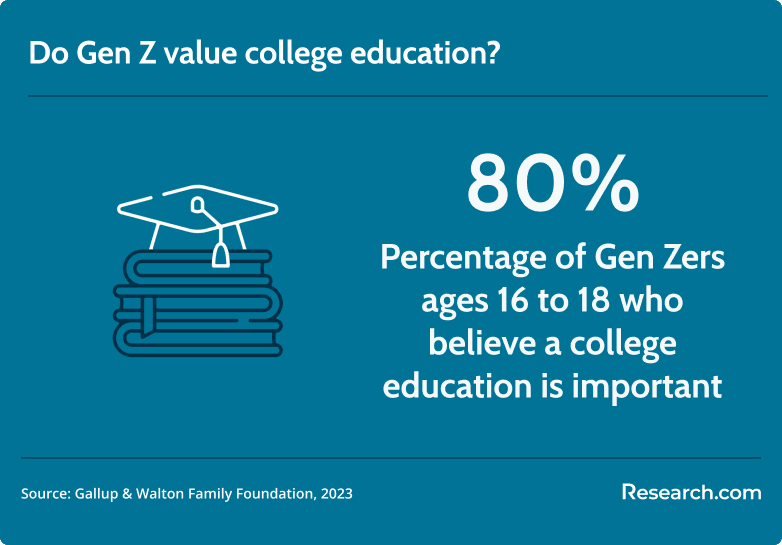
Gallup & Walton Family Foundation reported in 2023 that 85% of Gen Z ages 19–21 and 80% ages 16–18 considered a college education important. For students who want the value of a degree without delaying employment or advancement, an accelerated general studies program can provide a faster route, provided the workload is realistic.
Some students also use general studies as a foundation before moving into targeted credentials such as online healthcare certificate programs, business certificates, or specialized undergraduate majors.
| Student situation | Likely fastest strategy | What to verify first |
| No prior college credit | Choose an accelerated associate or bachelor’s program with year-round terms | Course load expectations and total tuition |
| Some prior credits | Request a formal transfer evaluation before enrolling | How many credits apply to graduation requirements |
| Completed associate degree | Apply to a bachelor’s completion-oriented general studies program | Whether the associate degree satisfies lower-division requirements |
| Military or professional experience | Ask about credit for prior learning | Portfolio, exam, certification, or training documentation rules |
| Working full time | Use shorter terms carefully and avoid overload | Weekly time commitment and support services |
What is the average cost of an accelerated online general studies degree program?
Costs vary by school type, degree level, residency status, credit requirements, fees, and the number of transfer credits accepted. The sticker price is only one part of the total cost; students should compare the cost to complete the remaining credits they actually need.
Average tuition and fees at public two-year colleges are around $4,050. At public four-year schools, in-state students pay about $11,610, while out-of-state learners may pay as much as $30,780. Private nonprofit institutions average approximately $43,350 (Ma et al., 2024).
Online study can reduce expenses tied to relocation, commuting, campus housing, and some on-campus services. However, students may still pay technology fees, online course fees, digital textbook costs, proctoring charges, and other program-related expenses.
Students should also compare general studies against more career-specific programs when ROI is a priority. For example, learners who already know they want a technology career may want to compare this path with the best online bachelor's degree in information technology. General studies offers flexibility, but targeted programs may align more directly with certain technical roles.
Common ways to reduce the cost
- Institutional scholarships: These awards come from the school and may be based on academic performance, financial need, program choice, or student background.
- External scholarships: Private foundations, professional associations, nonprofits, and community organizations may offer awards tied to identity, location, field, or career interest.
- Federal, state, or local grants and scholarships: These funds generally do not need to be repaid and may depend on residency, financial need, or enrollment status.
- Employer tuition assistance: Some employers help pay tuition for workers whose studies support current or future roles, sometimes with service commitments.
- Military and veteran education benefits: Active-duty service members, veterans, and eligible family members may qualify for education benefits that reduce out-of-pocket costs.
College affordability remains a major concern. In a Sallie Mae survey (2024), about 53% of at-risk students, including lower-income, first-generation, LGBTQ+, and working students, said paying tuition and other expenses is a major challenge.
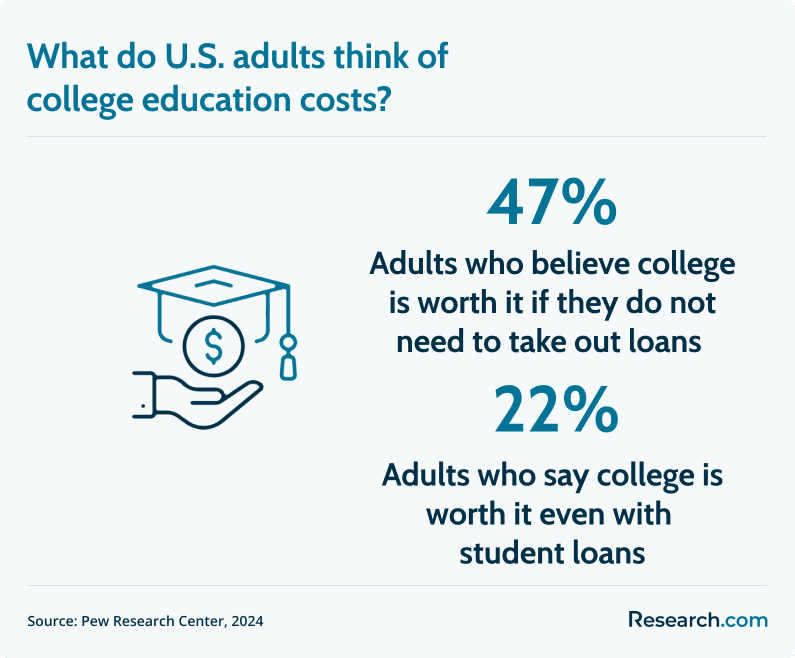
Public skepticism about college value is also important. A Pew Research Center report found that only 22% of Americans believe a four-year degree is worth the cost even with loans, while 47% say it is worthwhile only if debt is not required. For that reason, students should compare net price, debt, credit transfer, graduation timeline, and career plans before enrolling.
| Cost factor | Why it matters | Question to ask |
| Transfer credits | Accepted credits reduce the number of courses you must pay for | How many of my credits apply to this specific degree? |
| Residency tuition | Some public universities charge different rates for resident and non-resident students | Will online students pay resident, non-resident, or separate online tuition? |
| Fees | Online, technology, graduation, and course fees can raise the total cost | What is the full estimated cost, not just tuition? |
| Financial aid eligibility | Not every self-paced or continuing education option qualifies for aid | Is this program eligible for federal financial aid? |
| Course pacing | Accelerated terms can save time but may affect work hours and income | How many hours per week should I expect per course? |
What courses are included in an accelerated online general studies degree program?
General studies programs usually begin with general education courses and then allow students to choose electives, concentrations, or interdisciplinary clusters. This structure helps students build broad academic skills while shaping the degree toward a career field or future transfer plan.
Students who want communications-focused careers can use electives to build a stronger foundation before considering more specialized options such as the best strategic communication degree online.
Common courses in online general studies programs
- Introduction to Literature: Students read fiction, poetry, drama, or other genres while learning how to interpret themes, form, cultural context, and historical background.
- Writing and Communication: This course strengthens academic writing, workplace communication, public speaking, group interaction, and audience-focused messaging.
- College Algebra: Students study functions, equations, inequalities, graphing, and other mathematical concepts that support quantitative reasoning and data interpretation.
- General Biology: This course introduces major biological concepts and may include online lab activities, virtual simulations, or at-home lab kits.
- World Civilizations: Students examine major cultural, philosophical, historical, and artistic developments across global societies from ancient through modern periods.
Electives are where students can make the degree more strategic. Someone researching how to become a human resource coordinator might choose courses in management, organizational behavior, employment law, or professional communication. A student interested in public health might select epidemiology, community health, healthcare policy, or medical ethics.
Many bachelor’s programs require a mix of lower-division and upper-division coursework. Some also include capstones, portfolios, internships, or final projects that require students to connect ideas from several disciplines and apply them to practical problems.
| Interest area | Useful elective choices | Possible next step |
| Human resources | Management, organizational behavior, professional writing | HR assistant or coordinator pathway |
| Healthcare support | Medical ethics, healthcare policy, community health | Healthcare certificate or allied health training |
| Marketing and communications | Digital media, public relations, writing, data basics | Marketing assistant or communications role |
| Public service | Political science, sociology, public administration | Government, nonprofit, or community service work |
| Technology-adjacent roles | Information systems, data literacy, project management | Technical support, project coordination, or further IT study |
What are the admissions requirements for a general studies degree program?
Admissions requirements vary by institution and degree level. Associate programs are often more straightforward, while bachelor’s programs may require more detailed transfer evaluations, especially for students bringing in credits from multiple schools.
Students who eventually want graduate-level business or analytics credentials should understand that those programs usually involve different and often more competitive requirements. For comparison, review options such as the top online MBA in business analytics.
Typical admissions requirements
- High school diploma or GED: Schools generally require proof that applicants completed high school or an equivalent credential.
- College transcripts: Transfer students must usually submit official transcripts from every college previously attended so the school can evaluate applicable credits.
- Minimum GPA requirement: Some programs set minimum GPA expectations, often around 2.5 to 2.75, though conditional or provisional admission may be available.
- Personal statement or essay: Certain schools ask applicants to explain their academic goals, career interests, or reasons for choosing general studies.
- Letters of recommendation: Some programs request recommendations from teachers, supervisors, mentors, or others who can speak to the applicant’s readiness.
Degree requirements in hiring are changing, but credentials still matter. Indeed reported that the share of job postings requiring a bachelor’s degree fell from 20% in 2019 to 18% in 2024, with fields such as project management, information design and documentation, and software development showing notable shifts (Stahle, 2024).
This trend can benefit general studies students who combine a flexible degree with job-relevant skills, certificates, internships, or work experience. Students considering specialized paths, such as becoming a stenographer, should verify whether the target occupation requires additional training, certification, or licensure beyond the general studies curriculum.
This chart shows the share of employers who lowered their bachelor’s degree requirements for applicants.
What skills do you develop in a general studies degree program?
An online general studies degree is valuable when students intentionally connect coursework to skills employers can recognize. The degree is broad by design, so students should be ready to describe what they learned, how they applied it, and how it supports the jobs they want.
| Skill | How the program builds it | Where it can be useful |
| Critical thinking | Students analyze arguments, compare perspectives, and evaluate evidence through readings, discussions, and research assignments. | Operations, management support, policy work, customer-facing roles |
| Written and oral communication | Courses require essays, presentations, discussion posts, group projects, and professional communication tasks. | Marketing, HR, administration, sales, nonprofit work |
| Research and information literacy | Students learn to locate credible sources, interpret information, and use evidence appropriately. | Business research, community services, communications, public service |
| Problem-solving | Case studies, projects, and interdisciplinary assignments require students to define problems and propose workable solutions. | Project coordination, customer success, logistics, team leadership |
| Time management and self-discipline | Online and accelerated courses require students to plan around deadlines with limited in-person supervision. | Remote work, management training, entrepreneurship, adult learning |
| Cultural awareness and ethical reasoning | Humanities and social science courses expose students to social issues, global perspectives, and ethical decision-making. | Healthcare support, education, public service, community outreach |
| Collaboration and teamwork | Group assignments and peer discussions help students practice shared decision-making and conflict resolution. | Project teams, client services, event planning, office administration |
Students should choose electives that make these skills more targeted. For example, a learner exploring how to become a hotel manager could select courses in leadership, business communication, customer service, and operations.
How can I finish an online general studies degree faster?
Finishing quickly requires more than choosing a program labeled “accelerated.” Students need a credit strategy, a realistic course load, and advisor support to avoid taking classes that do not count toward graduation.
Students in creative fields can use similar planning methods when comparing flexible programs such as cinematography online degrees.
Steps to shorten your completion time
- Request a transfer credit review before committing. Ask the school to evaluate all prior college transcripts and show exactly how each accepted course applies to the degree.
- Choose condensed terms only if you can handle the pace. Shorter courses can speed up graduation, but they usually require steady weekly work and strong time management.
- Enroll year-round when possible. Taking courses in fall, spring, and summer can reduce gaps and help students maintain progress.
- Ask about credit for prior learning. Some institutions award credit for work experience, military training, certifications, exams, or portfolio assessment.
- Use the maximum course load carefully. A heavier schedule may save time, but withdrawing from classes can slow progress and increase cost.
- Meet with an advisor before every term. Advisors can help sequence courses correctly, identify prerequisites, and avoid duplicate or unnecessary classes.
Common mistakes that slow students down
| Mistake | Why it causes problems | Better approach |
| Choosing based only on advertised speed | The fastest schedule may not fit your transfer credits or workload | Compare actual remaining credits and course availability |
| Ignoring accreditation | Credits may not transfer and financial aid eligibility may be affected | Confirm institutional accreditation before applying |
| Assuming all credits will transfer | Schools may accept credits as electives but not apply them to requirements | Get a written degree audit or transfer evaluation |
| Taking too many courses at once | Overload can lead to poor grades, withdrawals, or burnout | Start with a manageable load and increase only if sustainable |
| Skipping career planning | A broad degree can be harder to explain without a focus | Use electives, certificates, internships, or projects to build a career story |
What career paths are available to graduates of accelerated online general studies degree programs?
General studies graduates can pursue many entry-level and some mid-level roles, depending on work experience, elective choices, internships, certifications, and local hiring conditions. The degree does not prepare students for one specific licensed occupation, so career outcomes depend heavily on how students shape the program.
For example, a student interested in a medical assistant career path may use general studies coursework as a starting point before moving into healthcare-specific training.
| Career path | Salary listed | Typical work | How general studies can help |
| Human Resources Assistants | $50,950 | Support recruiting, onboarding, personnel records, and internal HR processes | Communication, organization, writing, and workplace professionalism |
| Community and Social Services Specialists | $58,360 | Connect individuals and groups with support resources in areas such as housing, mental health, youth services, or rehabilitation | Cultural awareness, ethics, research, and interpersonal communication |
| Social Media Managers | $64,845 | Plan content, manage audience engagement, and monitor social platforms | Writing, digital communication, creativity, and audience analysis |
| Event Planners | $65,090 | Coordinate vendors, budgets, schedules, logistics, and client expectations | Project planning, communication, problem-solving, and teamwork |
| Sales Representatives | $81,260 | Promote products or services and maintain client relationships | Persuasion, presentation, research, and relationship-building |
| Marketing Assistants | $86,480 | Assist campaigns, conduct research, create content, and track performance | Writing, data interpretation, communication, and creative thinking |
| Project Management Specialists | $108,100 | Plan, coordinate, and monitor projects so they stay within scope, schedule, and budget | Organization, leadership, collaboration, and analytical thinking |
| Software Developers | $144,570 | Design, build, test, and maintain applications, programs, and systems | A general studies degree alone is not enough; students need strong programming and technical training |
This chart displays the average salaries of various jobs general studies graduates can explore.
What is the job market for graduates with an accelerated online general studies degree?
The job market for general studies graduates is broad rather than occupation-specific. That flexibility can be useful, but it also means students must connect the degree to a clearer employment goal through electives, internships, certificates, portfolios, or prior work experience.
Several fields connected to general studies skills show projected demand. According to the U.S. Bureau of Labor Statistics, software and web developers, programmers, and testers are projected to see a 14.7% employment increase from 2023 to 2033. Community and social service occupations are projected to grow by 8.1%, while marketing, promotions, and public relations roles are projected to increase by 6.6%.
At the same time, employers are rethinking how credentials and skills should be weighed. The World Economic Forum (2024) reported that about 46% of employees say their formal credentials do not match their current job requirements. However, only 6% of global employers believe removing degree requirements would improve access to qualified talent. In other words, skills matter more than ever, but degrees still influence many hiring decisions.
Automation and digital tools are also changing the value of general workplace skills. Routine tasks may be automated, while roles involving communication, judgment, project coordination, service delivery, and cross-functional collaboration continue to require human decision-making. Students who pair general studies with digital literacy, data basics, communication strengths, and industry-specific experience can make the degree more competitive.
This chart displays the job growth of various occupations in the U.S.
Is an accelerated online general studies degree worth it?
An accelerated online general studies degree can be worth it for students who need flexibility, want to finish with existing credits, or plan to use the degree as a bridge to a clearer career or academic goal. It is less ideal for students who need a highly specialized credential for a licensed or technical occupation.
| It may be worth it if... | It may not be the best fit if... |
| You have transfer credits and want a faster route to completion | You are starting from zero and already know you want a specialized major |
| You need an accredited degree for advancement or eligibility | Your target career requires licensure, clinical training, or a specific degree |
| You want to combine several interests into one flexible plan | You prefer a tightly sequenced curriculum with one defined career outcome |
| You can choose electives strategically | You are unsure how to explain the degree to employers |
| You need online study that fits around work or family obligations | You struggle with independent learning and compressed deadlines |
The return on this degree depends on the details: how much you pay, how much credit transfers, whether the school is accredited, how quickly you graduate, and whether your course choices support a real career plan. The students who benefit most usually treat general studies as a customizable strategy, not as a default option.
What support services are available to enhance student success in accelerated online general studies programs?
Strong support services can make a major difference in accelerated online programs because students move quickly and have less time to recover from advising mistakes or technical issues. Look for schools that offer proactive academic advising, online tutoring, writing support, library access, 24/7 or extended technical assistance, transfer credit guidance, and career services.
Career support should be practical, not just informational. Useful services include resume feedback, mock interviews, virtual career fairs, internship guidance, job search coaching, alumni networking, and help translating interdisciplinary coursework into employer-friendly language. Working students comparing affordability and flexibility may also want to review resources such as the cheapest online universities for job holders.
Are accelerated online general studies programs accredited and how can you verify their quality?
Accreditation is one of the most important checks before enrolling. Students should confirm that the institution holds recognized accreditation because it can affect credit transfer, graduate school admission, employer recognition, and financial aid eligibility.
Do not rely only on a school’s marketing page. Verify accreditation through official accreditor information, school disclosures, and trusted higher education databases. Also confirm whether the specific program format you want, including self-paced or accelerated online options, is part of the accredited institution and eligible for the same student services and aid. Comparing curriculum design with other accelerated online bachelor degree programs can also help you judge whether the program offers appropriate academic depth, faculty access, and transfer policies.
Questions to ask before enrolling
- Is the institution accredited by a recognized accrediting agency?
- Will my credits transfer to another college or bachelor’s program?
- How many credits can I transfer into this specific degree?
- Does the accelerated or self-paced format qualify for federal financial aid?
- Are online students assigned academic advisors?
- How often are required courses offered?
- What career services are available to online students?
- Can I add a concentration, minor, certificate, internship, or capstone project?
Here’s what graduates say about accelerated online general studies programs
- : "My online general studies program let me return to college in a way that worked for my life. I had enough structure to stay focused, but enough independence to keep moving at my own pace. The experience sharpened my critical thinking and helped me discover an interest in community-based work. — Irma"
- : "I had been away from college for years, so going back felt intimidating. The online general studies format made the process manageable because I could transfer earlier credits, complete new courses remotely, and finish my degree in under two years. The pace was demanding, but flexible scheduling and academic support helped me stay on track. — Joseph"
- : "Completing my general studies degree online gave me a path forward without forcing me to leave my full-time job. Being able to work on assignments around my schedule changed everything. I also valued the chance to study several subjects before moving toward nonprofit work, and the coursework pushed me to write, communicate, and think more clearly. — Preston"
What are the potential challenges of accelerated online general studies programs?
Accelerated online general studies programs are convenient, but they are not easy. Short terms can mean weekly deadlines, fast reading loads, frequent assignments, and limited time to absorb complex material. Students who work full time, care for family members, or have inconsistent schedules should compare pacing carefully.
Networking can also be more limited than in traditional campus programs unless the school intentionally provides virtual events, group projects, mentoring, career services, and alumni access. Transfer credit rules may create another challenge: credits accepted by the university may not always satisfy degree requirements in the way students expect.
Students planning to continue into graduate school should also think ahead. Fast bachelor’s completion can be useful, but future specialization may require prerequisites, grades, recommendations, or field-specific experience. Learners exploring accelerated graduate options may want to compare alternatives such as 1 year masters programs.
How can you secure financial aid and reduce costs for an accelerated online general studies degree?
Start financial planning before applying. Complete the required aid forms, ask each school for a full cost estimate, and compare net price after grants, scholarships, employer benefits, military benefits, and transfer credits. Do not assume the lowest tuition rate is the cheapest total option; a higher tuition program that accepts more credits may cost less overall.
Students should confirm whether the program is eligible for federal aid, especially if it uses self-paced courses, competency-based formats, or continuing education divisions. Comparing schools through resources such as online colleges that accept FAFSA can help students identify options that balance affordability, legitimacy, and flexibility.
References:
- Fry, R., Braga, D., & Parker, K. (2024, May 23). Is College Worth It? Pew Research Center. https://www.pewresearch.org/social-trends/2024/05/23/is-college-worth-it-2
- Ma, J., Pender, M., & Oster, M. (2024). Trends in College Pricing and Student Aid 2024. https://research.collegeboard.org/trends/college-pricing
- National Center for Education Statistics. (2024, December). Percentage of persons 25 to 29 years old with selected levels of educational attainment, by race/ethnicity and sex: Selected years, 1920 through 2024. Digest of Education Statistics. https://nces.ed.gov/programs/digest/d24/tables/dt24_104.20.asp
- Nicola, T. P. (2023, September 14). Majority of Gen Z Consider College Education Important. Gallup. https://news.gallup.com/opinion/gallup/509906/majority-gen-consider-college-education-important.aspx
- Stahle, C. (2024, February 27). Educational Requirements Are Gradually Disappearing From Job Postings. Indeed Hiring Lab. https://www.hiringlab.org/2024/02/27/educational-requirements-job-postings
- U.S. Bureau of Labor Statistics. (2024a). Software Developers [Interactive data]. May 2024 OEWS Profiles, Occupational Employment and Wage Statistics (OEWS) Profiles. Retrieved July 15, 2025, from https://data.bls.gov/oesprofile
- U.S. Bureau of Labor Statistics. (2024b). Occupation Groups. Retrieved July 15, 2025, from https://www.bls.gov/ooh
- U.S. Bureau of Labor Statistics. (2025b, April 18). Occupational projections, 2023–33, and worker characteristics, 2023 (Numbers in thousands). Employment Projections. https://www.bls.gov/emp/tables/occupational-projections-and-characteristics.htm
- ZipRecruiter. (2025, July 9). Social Media Manager Salary. Retrieved July 15, 2025, from https://www.ziprecruiter.com/Salaries/Social-Media-Manager-Salary
Key Insights
- An accelerated online general studies degree is best for students who need flexibility, have transfer credits, or want to complete a broad accredited credential without committing to one traditional major.
- Associate programs commonly require 60 credits and are often listed as 2 years; bachelor’s programs commonly require 120 credits and are often listed as 3–4 years. Transfer credit and prior learning credit can significantly affect actual completion time.
- The cheapest program is not always the best value. Compare total remaining cost, accepted transfer credits, fees, financial aid eligibility, and how quickly required courses are offered.
- Accreditation is essential. It affects credit transfer, financial aid, employer recognition, and future education options.
- General studies works best when paired with a plan. Choose electives, certificates, internships, projects, or concentrations that point toward a specific field such as HR, communications, public service, healthcare support, marketing, operations, or technology-adjacent work.
- Accelerated online learning requires discipline. Short terms can help students finish faster, but they also demand consistent weekly time, strong organization, and frequent advisor communication.
- Before enrolling, ask for a written transfer evaluation, confirm aid eligibility, review support services, and make sure the degree structure supports your career or transfer goals.
Other Things You Should Know About the Fastest Online General Studies Degree Programs
Admission requirements for these programs typically include a high school diploma or equivalent and submission of transcripts. Some may require a minimum GPA and standardized test scores, though the fastest programs often focus on accessibility and may waive these requirements.
In 2027, the fastest online General Studies degree programs often offer accelerated formats that allow students to finish their degrees in less than two years. These programs typically provide flexible scheduling, credit transfer options, and intensive short-term courses to expedite completion time, making them ideal for those looking to quickly advance their education.
Online General Studies degrees in 2027 can be completed quickly due to flexible scheduling, accelerated course options, and self-paced learning. Schools often offer multiple start dates throughout the year and allow credit transfers, contributing to a faster completion time.
Yes, a general studies degree can lead to graduate school, especially if students meet prerequisites for their intended field of study. Many graduate programs value the critical thinking, writing, and analytical skills developed in a general studies curriculum.
Students may need to take additional coursework or gain experience depending on their desired graduate program. With careful planning and advising, general studies graduates can successfully transition into master’s programs in education, business, communication, and more.