
2027 Best Online Medical & Healthcare Certificate Programs

Co-Founder and Chief Data Scientist
Choosing an online medical certificate program is usually a practical career decision: you want healthcare training that is faster than a degree, flexible enough to fit around work or family, and credible enough to help you qualify for entry-level roles or certification exams. The challenge is that “online medical certificate” can mean many different things, from medical assisting and billing and coding to pharmacy technician, phlebotomy, EKG, patient care, and healthcare administration.
This guide is designed for career changers, recent high school graduates, working adults, and healthcare support workers who want to compare online medical certificate programs for 2027. You will learn what these programs cover, which career paths they can support, how long they usually take, what they may cost, how employers view online certificates, and what to check before enrolling.
Healthcare remains one of the more active employment sectors. The Bureau of Labor Statistics (2023) reports that healthcare occupations are expected to grow faster than the average for all occupations from 2023 to 2033. That growth does not mean every certificate will produce the same outcome, but it does mean well-chosen training can be a useful entry point into a field with many support, administrative, technical, and patient-care roles.
Quick answer: Are online medical certificate programs a good option?
Online medical certificate programs can be a strong option if you want job-focused healthcare training without committing to a full degree. They are especially useful for roles such as medical assistant, pharmacy technician, medical billing and coding specialist, EKG technician, phlebotomy technician, patient care technician, medical administrative assistant, and healthcare administration support. The best programs are accredited or offered by reputable institutions, prepare students for recognized certification exams, include any required clinical or externship experience, and clearly disclose tuition, fees, exam costs, and job placement support.
They are not the right fit for every healthcare career. If your goal is nursing, diagnostic imaging licensure, advanced clinical practice, or healthcare leadership, a certificate may be only the first step toward additional education, licensing, or a degree.
Why students choose online medical certificate programs
- Healthcare hiring is broad. Approximately 1.9 million openings are projected annually because of industry growth and worker replacement needs. This creates pathways into healthcare support roles, including home health aides and medical transcriptionists.
- They can lead to entry-level healthcare work. The median annual wage for healthcare support occupations, including home health aides and medical transcriptionists, was $36,140 in May 2023 (BLS, 2023). This is below the median for all occupations ($45,760), but healthcare support roles may offer stability and room to build experience, specialize, or continue into higher credentials.
- They are built for faster training. Many online certificates can be completed in a few months, depending on the program and pace. Compared with a traditional degree, they often require less time and may cost less, though students should still compare total tuition, fees, textbooks, exam vouchers, and externship requirements.
- They fit adult learners. Online formats can help students manage coursework while working, caregiving, or preparing for a career change.
What should students expect from online medical certificate programs?
Online medical certificate programs usually combine career-specific healthcare coursework with exam preparation and, in some fields, practical training. A student in a medical assistant program may study patient intake, vital signs, infection control, clinical procedures, and front-office workflows. A billing and coding student may focus on medical terminology, insurance claims, coding guidelines, ICD-10, and CPT. A pharmacy technician student may study medication safety, dosage calculations, pharmacy law, and prescription processing.
Many programs are asynchronous, meaning students complete lessons on their own schedule. Others follow weekly deadlines, live sessions, or instructor-led modules. Programs that prepare students for hands-on roles may include virtual labs, simulations, lab kits, skills checkoffs, or clinical externships arranged through healthcare partners.
A strong program should also explain which certification exam it prepares students for. Common certifying organizations in this space include the National Healthcareer Association (NHA) and the American Health Information Management Association (AHIMA). Exam alignment matters because a certificate of completion from a school is not always the same thing as national certification.
| What to check | Why it matters |
| Certification exam alignment | Confirms whether the program prepares you for exams such as NHA, AHIMA, PTCB, CBCS, CPT, CET, or CPCT/A, depending on the field. |
| Hands-on or externship requirements | Important for patient-care and technical roles such as phlebotomy, EKG, medical assisting, surgical technology, and dental assisting. |
| Accreditation and institutional reputation | Helps employers and certification bodies verify that the training provider meets recognized academic or professional standards. |
| Total cost | Tuition alone may not include textbooks, supplies, exam fees, background checks, drug screening, uniforms, or clinical placement costs. |
| Career support | Resume help, interview preparation, externship coordination, and employer partnerships can make the transition into work easier. |
Where can an online medical certificate lead?
Online medical certificates can prepare students for several healthcare environments, including clinics, hospitals, outpatient centers, pharmacies, laboratories, insurance organizations, telehealth companies, dental offices, and administrative departments. The number of allied health workers or Healthcare Support Occupations in 2023 is 7,063,530 (BLS, 2023), showing the size of the workforce these programs often serve.
- Healthcare support roles. Students may prepare for medical assistant, pharmacy technician, patient care technician, dental assistant, or similar support positions that involve direct or indirect patient care.
- Health information and revenue cycle work. Certificates in billing and coding, health information technology, or medical records can support roles in hospitals, physician offices, insurers, and billing companies.
- Medical office administration. Administrative certificates may lead to work in scheduling, patient registration, medical records coordination, insurance verification, and front-office communication.
- Diagnostic and clinical support settings. Phlebotomy and EKG programs can prepare students for laboratories, hospitals, outpatient centers, and cardiovascular clinics.
- Telemedicine and remote healthcare services. As more care coordination and patient communication move online, certificates in healthcare administration, billing, coding, or telehealth support may be relevant for remote or hybrid roles.
How much can graduates earn after completing an online medical certificate?
Earnings depend on the occupation, employer, location, schedule, certification status, and prior experience. Completing an online medical certificate does not guarantee a specific salary, but it can help students qualify for roles where recognized training or certification is preferred. According to ZipRecruiter (2025), these seven healthcare roles have the following average annual salaries in the United States:
| Career path | Average annual salary |
| Certified Medical Assistant | $43,221 per year |
| Pharmacy Technician | $40,074 per year |
| Medical Billing and Coding Specialist | $45,672 per year |
| Health Information Technician | $37,767 per year |
| Medical Transcriptionist | $ 42,722 per year |
| Patient Care Technician | Approximately $38,476 per year |
| Dental Assistant | Approximately $42,143 per year |
Students should use salary figures as a starting point, not a promise. Local labor markets can vary sharply, and employers may pay differently based on certification, shift type, union status, specialty setting, and years of experience.
- Best online medical certificate programs for 2027
- Types of online medical certificate programs
- How long online medical certificates take
- Online versus on-campus medical certificate programs
- Average cost of online medical certificate programs
- Financial aid and payment options
- Admission requirements and prior experience
- Student support services in online healthcare programs
- Online programs for diagnostic imaging preparation
- Whether an online medical certificate is worth the investment
- Cost-effectiveness of online healthcare programs
- Technology trends in online medical certificate training
- Advanced management credentials after a certificate
- Common challenges for online medical certificate students
- How to choose the right online medical certificate program
- Certification and licensing exam preparation
- Employer views of online healthcare certificates
- Career advancement after online medical certification
Best Online Medical Certificate Programs for 2027
How Research.com evaluates programs
Choosing a healthcare certificate is a financial and career decision, so rankings should be transparent rather than promotional. Research.com’s methodology uses information from trusted education data sources, including the IPEDS database, Peterson’s database, College Scorecard, and the National Center for Education Statistics (NCES). These sources help evaluate schools and programs using consistent data points relevant to students considering medical and healthcare certificates.
| School or provider | Online certificate focus | Duration | Credential or certification target | Accreditation |
| University of the District of Columbia (UDC) | Certified Clinical Medical Assistant program with clinical and administrative training | 6 to 12 months | Certified Clinical Medical Assistant (CCMA) | Middle States Commission on Higher Education |
| Morgan State University | Certified Medical Administrative Assistant program through the Center for Continuing and Professional Studies | Varies; typically a few months | Certified Medical Administrative Assistant (CMAA) | Middle States Commission on Higher Education |
| Western Nevada College | Pharmacy technician course with preparation for the Pharmacy Technician Certification Board (PTCB) National Certification exam | Varies; typically completed in a few months | Certified Pharmacy Technician (CPhT) | Northwest Commission on Colleges and Universities |
| Health Tech Academy | Surgical technologist training with self-paced learning and on-the-job training | 16 weeks | Surgical Technologist Certification (TS-C) | Institutionally accredited; programmatic accreditation may vary |
| Franklin University | Patient Care Technician Certificate offered in partnership with MedCerts | 24 weeks | Patient Care Technician Certificate | Higher Learning Commission (HLC) |
| University of Houston | Certified phlebotomy technician course with lab kit assignments and aligned simulations | 12 months or 200 course hours | Certified Phlebotomy Technician (CPT) | Southern Association of Colleges and Schools Commission on Colleges |
| Penn Foster | Self-paced medical billing and coding program with exam preparation | 10-14 months (self-paced) | Certified Billing & Coding Specialist (CBCS) | Accrediting Commission of the Distance Education Accrediting Commission |
| Southern Crescent Technical College | EKG technician training covering heart anatomy, EKG procedures, equipment, and externship experience | 12 months or 170 course hours | Certified EKG Technician (CET) | Southern Association of Colleges and Schools Commission on Colleges (SACSCOC) |
| The Andrews School of Medical Transcription | Medical transcription training using live dictations and specialized transcription software | Approximately 1 year (self-paced) | Certified Medical Transcriptionist (CMT) | Accrediting Council for Continuing Education and Training (ACCET) |
| University of Phoenix | Healthcare administration certificate covering healthcare law, patient care management, and healthcare policy | 9 months (full-time) | Healthcare Administration Certificate | Higher Learning Commission (HLC) |
Program notes for each option
- University of the District of Columbia (UDC): UDC’s 100% online Certified Clinical Medical Assistant program is designed to prepare students for National Healthcare Association (NHA) certification and covers the clinical and administrative duties used in medical assistant roles. Cost per Credit: Contact UDC for current pricing.
- Morgan State University: Morgan State University offers a 100% online Certified Medical Administrative Assistant (CMAA) program focused on healthcare office workflows, scheduling, patient flow, and administrative support. The program is designated by the National Healthcare Association (NHA). Cost per Credit: Varies; contact the institution for current pricing.
- Western Nevada College: Western Nevada College provides a 100% online pharmacy technician course that prepares students for the PTCB National Certification exam and includes a practicum experience with a leading pharmacy chain. Cost per Credit: Varies; contact the institution for current pricing.
- Health Tech Academy: Health Tech Academy’s online surgical technologist certification program combines self-paced instruction with on-the-job training and prepares students for the TS-C certification exam. Students study diagnostics, infection control surgical technique, and information technology. Cost per Credit: Varies; contact the institution for current pricing.
- Franklin University: Franklin University, through MedCerts, offers a 24-week online Patient Care Technician Certificate that includes medical records, phlebotomy, EKG testing, and medical laws while preparing students for the CPCT/A certification exam. Cost per Credit: Contact Franklin University for current pricing.
- University of Houston: The University of Houston offers a 100% online certified phlebotomy technician course that trains students to draw blood, assess whether patients can tolerate the procedure, and support patient comfort. Cost per Credit: Contact the University of Houston for current pricing.
- Penn Foster: Penn Foster’s online medical billing and coding program is self-paced and prepares graduates for the National Healthcareer Association (NHA) Certified Billing & Coding Specialist (CBCS) exam. Penn Foster includes the exam cost and exam prep package for graduates. Cost per Credit: Contact Penn Foster for current pricing.
- Southern Crescent Technical College: Southern Crescent Technical College’s online EKG technician program prepares students for NHA certification and includes clinical externships for hands-on experience. Cost per Credit: Contact Southern Crescent Technical College for current pricing.
- The Andrews School of Medical Transcription: The Andrews School provides online medical transcription training with extensive practice in medical reports, clinical documentation, dictation, and transcription software. Cost per Credit: Varies; contact the institution for current pricing.
- University of Phoenix: The University of Phoenix offers a 100% online healthcare administration certificate designed for students who want foundational knowledge in healthcare organizations, policy, legal issues, and patient care management. Cost per Credit: $398 per credit hour.
Types of Online Medical Certificate Programs
If your goal is to qualify for medical jobs without a college degree, a certificate can help you build targeted skills for entry-level healthcare employment. The right program depends on whether you prefer direct patient care, administrative work, technical testing, pharmacy support, medical records, or dental office work.
| Certificate type | Best for students who want to... | Common work settings |
| Certified Medical Assistant (CMA) | Work on the medical assistant career path by combining clinical tasks with administrative support. | Hospitals, physician offices, outpatient clinics, private practices |
| Certified Medical Administrative Assistant (CMAA) | Focus on front-office healthcare operations, scheduling, records, insurance paperwork, and patient communication. | Hospitals, outpatient care centers, physicians' offices |
| Certified Pharmacy Technician (CPhT) | Support pharmacists by preparing prescriptions, managing inventory, maintaining records, and following pharmaceutical law. | Retail pharmacies, hospitals, healthcare facilities |
| Certified Phlebotomy Technician (CPT) | Draw blood safely for testing, transfusions, and donations while maintaining sterile technique and patient comfort. | Hospitals, diagnostic laboratories, blood banks, outpatient centers |
| Surgical Technologist (TS-C) | Assist surgical teams by preparing operating rooms, sterilizing equipment, and supporting procedures. | Hospitals, surgery centers, specialty clinics |
| Certified Patient Care Technician (CPCT/A) | Provide broad support for bedside care, patient monitoring, basic testing, and care team assistance. | Hospitals, nursing homes, home healthcare settings |
| Medical Billing and Coding Specialist | Translate diagnoses, services, and procedures into standardized codes for claims and reimbursement. | Hospitals, physician practices, insurance companies, billing services |
| Health Information Technician (RHIT) | Manage health data, electronic records, privacy requirements, and health information systems. | Hospitals, insurers, government agencies, healthcare organizations |
| Medical Transcriptionist | Convert provider dictation and clinical recordings into accurate medical documentation. | Hospitals, clinics, transcription service companies |
| Dental Assistant | Support dentists during procedures, take X-rays, sterilize instruments, and maintain patient records. | Dental offices, orthodontic clinics, oral surgery centers |
| EKG Technician | Use electrocardiogram machines to record and monitor heart activity. | Hospitals, cardiovascular clinics, outpatient centers |
Students comparing pharmacy training can also review pharmacy technician certification online free options. Those considering patient care can compare earnings in our guide to what a patient care technician salary may look like. Students interested in claims and reimbursement can evaluate accredited medical billing and coding training online, while transcription-focused learners may want to compare the best medical transcription course online. If you are weighing dental assisting against medical assisting, our comparison of which is better dental assistant or medical assistant can help clarify the differences.
Demand for healthcare support professionals spans several industries. As shown in the chart below, the largest number of jobs are found in Individual and Family Services (1,958,380 employees), followed by Home Health Care Services (1,032,810 employees). General Medical and Surgical Hospitals (745,400 employees) and Nursing Care Facilities (536,160 employees) also employ large numbers of healthcare support workers.
How long does it take to finish an online medical certificate?
Completion time depends on the field, weekly workload, clinical requirements, and whether the program is self-paced or cohort-based. Many certificates take a few months to a year. Shorter programs usually focus on a narrow skill set, while longer programs may cover broader clinical, administrative, or management topics.
A Certified Medical Assistant (CMA) program often takes about 6 to 12 months. A Phlebotomy Technician program may take as little as 4 to 6 months. Some focused options, such as a 4 week online course for medical coding and billing, may be much shorter. Broader programs in Healthcare Administration or Health Information Management can require 9 months to a year or more, depending on pace and structure.
| Program type | Typical timeline stated in this guide | What can affect the timeline |
| Medical assistant | 6 to 12 months | Externship requirements, clinical skill practice, weekly course load |
| Phlebotomy technician | 4 to 6 months | Clinical blood draw requirements and scheduling availability |
| Focused billing and coding course | As short as 4 weeks | Prior knowledge of terminology, course intensity, exam preparation needs |
| Healthcare administration or health information management | 9 months to a year or more | Program depth, number of courses, student pace, work or family obligations |
Before enrolling, ask how many hours per week students typically spend studying, whether deadlines are fixed, and how long students have access to course materials after enrollment.
Online vs. on-campus medical certificate programs: Which format is better?
The better format depends on your schedule, learning style, and the amount of hands-on practice required for your target role. Online programs are often more flexible because students can complete lectures, readings, quizzes, and simulations from home. This format can work well for learners balancing employment, caregiving, transportation limits, or irregular schedules.
On-campus programs provide more direct supervision, immediate instructor feedback, and in-person lab practice. That can be valuable for skills involving patient interaction, equipment handling, X-rays, dental instruments, blood draws, or clinical procedures. For example, an online EKG Technician program may teach heart rhythms and procedures through interactive lessons, virtual labs, and simulations, while an on-campus Dental Assistant program may give students direct access to labs for X-ray practice, instrument preparation, and chairside procedure support.
| Factor | Online certificate | On-campus certificate |
| Scheduling | Often more flexible and sometimes self-paced | Usually follows set class and lab times |
| Location | Coursework can be completed remotely, though externships may be in person | Requires travel to campus or clinical sites |
| Hands-on learning | May use simulations, lab kits, virtual labs, and local externships | Provides more immediate lab access and face-to-face skills practice |
| Instructor interaction | Often through email, video, learning platforms, or scheduled support | More in-person feedback and peer interaction |
| Best fit | Working adults, self-directed learners, students with limited travel flexibility | Students who want structured schedules and frequent hands-on supervision |
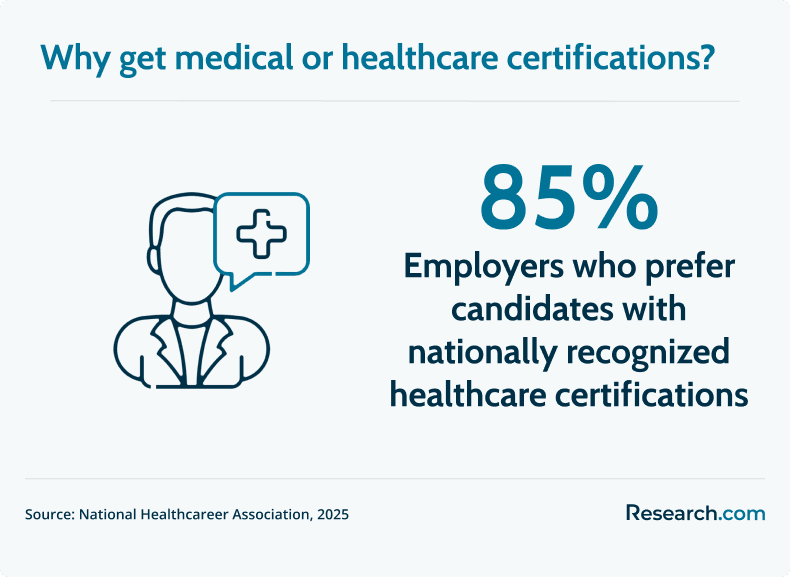
Employers generally care less about whether the coursework was online or on campus and more about whether the program is credible, the training is relevant, and the graduate holds the required certification. According to the 2025 NHA Industry outlook, 85% of employers prefer candidates with nationally recognized certifications.
What is the average cost of online medical certificate programs?
Online medical certificate program costs vary by school, credential, duration, included materials, clinical requirements, and exam preparation. On average, online medical certificate programs can range from $1,000 to $5,000 for completion. A Certified Medical Assistant (CMA) program typically costs between $1,500 and $5,000, with an additional $125 exam fee.
A Pharmacy Technician certification can range from $1,200 to $3,500. More specialized programs, including Health Information Management or Surgical Technologist training, may cost anywhere from $3,000 to $7,000 because of the depth, length, or practical training involved.
| Cost item | Why students should ask about it |
| Tuition | Some schools charge a flat program price, while others charge by course or credit. |
| Textbooks and digital materials | These may be included or billed separately. |
| Certification exam fees | Some programs include exam vouchers; others require students to pay separately. |
| Lab supplies or kits | Hands-on programs may require equipment, lab kits, uniforms, or clinical supplies. |
| Externship-related expenses | Background checks, immunizations, drug screening, transportation, and documentation may add costs. |
| Retake or extension fees | Self-paced programs may charge extra if students need more time or must retake assessments. |
Location can also affect return on investment because pay varies by state. The chart below shows that in Hawaii, healthcare support occupations offer an average annual wage of $51,980, among the nation's highest. In Texas, the average annual wage for similar roles is $31,370.
Students should compare cost against realistic local earnings, not only national averages. A lower-cost certificate may be a smart choice if it prepares you for a recognized exam, includes the practical experience you need, and connects to employers in your area.
What financial aid options can help pay for online medical certificate programs?
Some certificate programs qualify for financial aid, scholarships, grants, employer funding, military spouse benefits, or payment plans. Availability depends heavily on the school, program length, accreditation status, and whether the training is approved for a particular funding source.
- Scholarships and grants: Some institutions offer healthcare certificate scholarships. Stepful provides scholarships ranging from $1,600 to $2,200 for its online Certified Medical Assistant program. MedCerts supports scholarship and funding options such as MyCAA for military spouses, WIOA for workforce development, and other nonprofit funding sources.
- Payment plans: Many programs allow students to divide tuition into monthly or weekly payments instead of paying everything upfront. Ask whether payment plans include extra fees or interest.
- Federal financial aid: Eligibility depends on whether the program is accredited and approved by the U.S. Department of Education. Eligible programs may allow students to use Pell Grants or Stafford Loans. Temple College's Electrocardiography Technician certificate program is eligible for federal financial aid, with students potentially receiving up to 50% of the program cost through such aid.
- Employer and military benefits: Some employers reimburse tuition for workers entering or advancing in healthcare roles. Military personnel and family members may also qualify for education benefits, including MyCAA, which provides up to $2,000 for military spouses pursuing certifications in healthcare fields.
| Question to ask | Why it matters |
| Is this program eligible for federal financial aid? | Not all certificate programs qualify, even if the school itself is accredited. |
| Are exam fees included? | Exam vouchers can reduce out-of-pocket costs at the end of training. |
| Does the school accept workforce funding? | Programs aligned with WIOA or similar funding may lower costs for eligible students. |
| Are payment plans available? | Installments may help cash flow, but students should check for added fees. |
| Can my employer reimburse the program? | Some healthcare employers support training for hard-to-fill roles. |
Do online medical certificate programs require healthcare experience?
Most entry-level online medical and healthcare certificate programs do not require previous healthcare work experience. Many are designed for students entering healthcare for the first time or changing careers from another field. However, admission requirements and clinical requirements differ by program and specialty.
- Basic education requirement: Most programs require a high school diploma or equivalent. Coursework in biology, chemistry, mathematics, or health science may help, even when it is not required.
- Prerequisite coursework: Some programs may expect familiarity with medical terminology, basic healthcare concepts, anatomy, or office procedures. Medical billing and coding programs, for example, may be easier for students who already understand medical terminology.
- Work experience: Many certificates do not require prior employment in healthcare. Some programs, however, include clinical externships or practical components, especially in medical assisting and phlebotomy.
- Advanced program expectations: Healthcare Administration or Surgical Technology certificates may have additional requirements, such as prior healthcare experience or relevant coursework, because the responsibilities can involve more complex technical or administrative decision-making.
Students without healthcare experience can still succeed if they choose a program with strong academic support, clear clinical expectations, certification preparation, and enough time to practice unfamiliar terminology and procedures.
What student support services should online medical certificate programs provide?
A good online healthcare program should offer more than recorded lessons. Students should look for technical support, academic advising, instructor access, practice exams, tutoring, clinical or externship coordination, and career services. For job-focused programs, career support can be especially valuable because many students are trying to move quickly from training into employment.
Before enrolling, ask whether the program offers resume reviews, interview practice, job search guidance, employer connections, and help documenting certification eligibility. Students comparing cost should also review what is included in the tuition; for example, understanding medical coding certification cost can help prevent surprise expenses.
Can online programs prepare students for specialized diagnostic imaging roles?
Some online healthcare programs introduce students to diagnostic imaging concepts, but specialized imaging roles often have stricter clinical, accreditation, and licensing expectations than general healthcare support certificates. Ultrasound, radiologic technology, and similar fields typically require extensive supervised clinical experience and may have programmatic accreditation requirements.
Online coursework can be useful for theory, patient safety, medical terminology, anatomy, and simulated learning, but students should confirm whether the program includes required clinical placements and meets employer or certification expectations. Students exploring ultrasound-focused training can compare options through an online school for ultrasound tech resource before committing.
Is an online medical certificate worth the investment?
An online medical certificate can be worth it when it is affordable, recognized by employers, aligned with a certification exam, and connected to a realistic job path in your area. It may not be worth it if the provider is unclear about accreditation, does not prepare you for a recognized credential, charges high fees without career support, or fails to include required hands-on training.
To judge value, compare total program cost with likely wages, local job openings, certification requirements, and advancement options. Students considering medical assisting should review the full medical assistant certification online cost, including exam fees and materials, before deciding whether the expected return justifies the investment.
| A certificate is more likely worth it if... | You should be cautious if... |
| The program prepares students for a recognized national certification. | The school only offers a completion certificate with no clear exam pathway. |
| Tuition includes exam prep, materials, and career support. | Costs are advertised narrowly and extra fees are hard to find. |
| The field has local employers hiring entry-level workers. | The career requires licensure or clinical training the program does not provide. |
| The school is transparent about accreditation and outcomes. | Accreditation, externship placement, or certification eligibility is vague. |
Are online healthcare programs cost-effective?
Online healthcare certificates may be cost-effective because they can reduce commuting time, fit around employment, and often take less time than degree programs. They can also help students start earning sooner if the program leads directly to entry-level work. However, cost-effectiveness depends on choosing the right credential for the target job.
Students interested in broader administrative roles may compare certificates with degree options, including the cheapest online healthcare administration degree. A certificate may be sufficient for entry-level support, while a degree may be more appropriate for long-term management goals.
How are online medical certificate programs adapting to healthcare technology?
Healthcare training is increasingly shaped by electronic health records, telehealth workflows, digital diagnostics, remote patient communication, simulation-based learning, and online exam preparation. Online certificate programs are responding by using virtual labs, interactive simulations, digital case studies, and modules that reflect current healthcare documentation and communication tools.
Administrative and management-focused programs may also introduce healthcare data systems, compliance workflows, digital patient communication, and remote operations. Students interested in moving quickly through administrative training can compare technology-supported models in healthcare administration degree online fastest programs.
Should certificate graduates pursue advanced healthcare management credentials?
An advanced management credential can make sense if your long-term goal is supervision, operations, clinic management, revenue cycle leadership, or healthcare administration. A certificate may help you enter the field, but leadership roles often require broader knowledge of finance, staffing, compliance, quality improvement, and organizational strategy.
Graduates who already have healthcare experience and want a faster route toward leadership may explore MBA in healthcare management online fast track programs. This path is not necessary for every certificate holder, but it may be useful for professionals who want to move beyond technical or support roles.
What challenges do students face in online medical certificate programs?
Online learning can be convenient, but it requires discipline. Students must manage deadlines, practice unfamiliar terminology, prepare for exams, and sometimes coordinate clinical requirements without the daily structure of a campus program. Technical problems, limited hands-on feedback, and weak externship support can also create obstacles.
Prospective students should evaluate practical training, student services, accreditation, instructor access, and career support with the same care they would use when comparing any online professional program, even one in an unrelated field such as a sports management MBA. The core question is the same: does the program provide enough structure and support to help students complete the credential and use it professionally?
| Common challenge | How to reduce the risk |
| Falling behind in a self-paced program | Create a weekly study schedule and choose programs with progress check-ins. |
| Unclear clinical or externship expectations | Ask whether the school arranges placements or expects students to find their own site. |
| Limited instructor feedback | Confirm office hours, response times, tutoring, and skills support before enrolling. |
| Unexpected fees | Request a full cost breakdown, including exams, books, supplies, background checks, and extensions. |
| Weak certification preparation | Look for mock exams, exam blueprints, study guides, and pass-preparation resources. |
How to choose the best online medical certificate program
The best online medical certificate program is not necessarily the cheapest, fastest, or most advertised option. It is the program that matches your target role, prepares you for the credential employers expect, fits your schedule, and offers transparent costs and support.
- Start with the job title you want. Decide whether you prefer patient care, administrative work, pharmacy support, diagnostics, health information, or dental assisting.
- Check certification requirements. Identify which national certification, exam, or license employers in your area prefer or require.
- Verify accreditation. Look for recognized institutional or programmatic accreditation. In allied health, relevant accreditors may include the Commission on Accreditation of Allied Health Education Programs (CAAHEP) or the Accrediting Bureau of Health Education Schools (ABHES), depending on the field.
- Compare total cost. Include tuition, books, technology, lab supplies, exam fees, clinical costs, and extension fees.
- Review curriculum fit. Make sure courses cover the skills needed for your role, such as patient care, coding systems, EHR use, pharmacology, phlebotomy, EKG, or office administration.
- Ask about externships. For hands-on roles, confirm whether practical experience is required, included, local, and supported by the school.
- Evaluate career services. Job placement assistance, resume help, interview coaching, and employer networks can improve your transition from training to work.
- Read student reviews carefully. Look for patterns in complaints about billing, instructor access, clinical placement, exam preparation, or career support.
- Compare job outlook and advancement. Choose a program connected to real opportunities in your region and aligned with your long-term goals.
Common mistakes to avoid
- Choosing based only on speed. A very short program may not provide enough preparation for certification or hands-on work.
- Ignoring accreditation. Employers and certifying organizations may not recognize training from weak or unverified providers.
- Looking only at tuition. Exam fees, supplies, background checks, and externship costs can change the real price.
- Assuming online means fully remote. Programs in phlebotomy, EKG, medical assisting, surgical technology, and dental assisting may require in-person practice or externships.
- Believing salary outcomes are guaranteed. Earnings vary by location, employer, experience, schedule, and certification.
- Relying only on rankings. Rankings can narrow options, but the best program for you must match your state, budget, schedule, and target credential.
Do online medical certification programs prepare students for certification or licensing exams?
Many online medical certification programs are designed to prepare students for certification exams through structured coursework, practice questions, mock exams, case scenarios, simulations, and exam-focused review materials. The level of preparation varies, so students should confirm the exact exam the program targets before enrolling.
Certified Medical Assistant (CMA) programs may include simulated patient scenarios and practice exams aligned with the AAMA certification exam. Medical Billing and Coding programs may use coding exercises and case-based practice to prepare students for the CPC exam. Some programs also provide study guides, webinars, virtual labs, and instructor feedback. Students comparing exam-focused healthcare routes can also review how accelerated clinical programs, such as 1-year nursing program online degrees, handle intensive preparation and clinical expectations.
Licensing is different from certification. Some healthcare roles require state licensing or specific clinical hours. Always check state and employer requirements before assuming an online certificate is enough.
How do employers view online healthcare certificates?
Employers may accept online healthcare certificates for entry-level roles when the program is credible, the credential is recognized, and the applicant can demonstrate the required skills. Accreditation from recognized bodies such as ABHES or CAAHEP can strengthen employer confidence because it signals that the program meets established education standards.
For many entry-level positions, including medical billing and coding, patient care technician, pharmacy technician, and medical administrative assistant, employers may value focused certificate training and national certification. Traditional degrees may still be preferred or required for advanced clinical, management, or licensed roles.
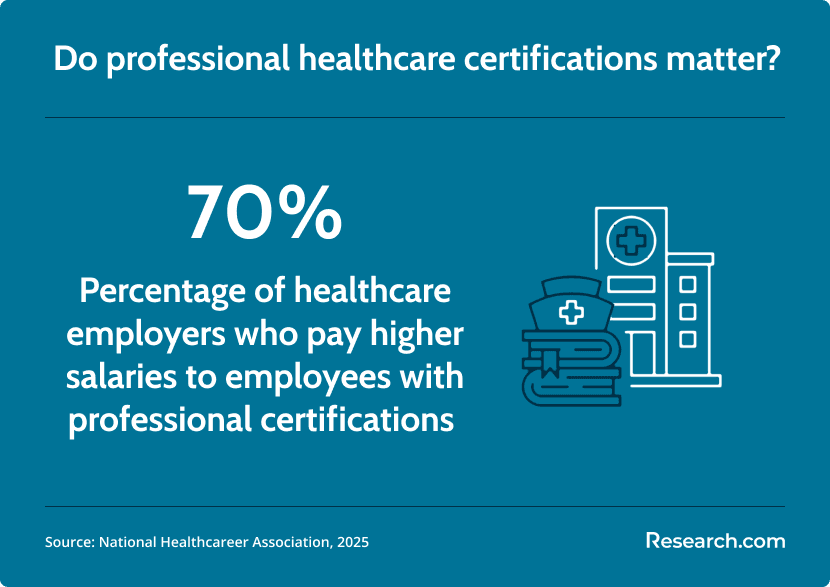
According to NHA, 70% of healthcare employers provide higher compensation to employees with professional certifications. This suggests that certification can support career mobility and earning potential, though actual pay still depends on employer policies, location, experience, and role responsibilities.
What career advancement opportunities are available after an online medical certification?
An online medical certification can be a first step rather than an endpoint. After gaining experience, healthcare support professionals may specialize, move into supervisory roles, pursue additional certifications, teach or train others, or continue into degree programs.
- Specialization: A Certified Medical Assistant (CMA) may build expertise in a specialty such as pediatrics or dermatology after gaining experience.
- Leadership: A Medical Billing and Coding Specialist may advance to a Billing Supervisor role and manage workflow, compliance, and staff responsibilities.
- Related healthcare pathways: A Certified Nursing Assistant (CNA) may continue toward Licensed Practical Nurse (LPN) training or enter one of the best associate degree in nursing programs to work toward Registered Nurse (RN) eligibility.
- Higher earning potential: Additional credentials, experience, and specialized skills may help workers qualify for better-paid roles or negotiate improved compensation.
- Teaching and training: Experienced professionals, such as medical billing specialists, may eventually train new workers or support instructional programs.
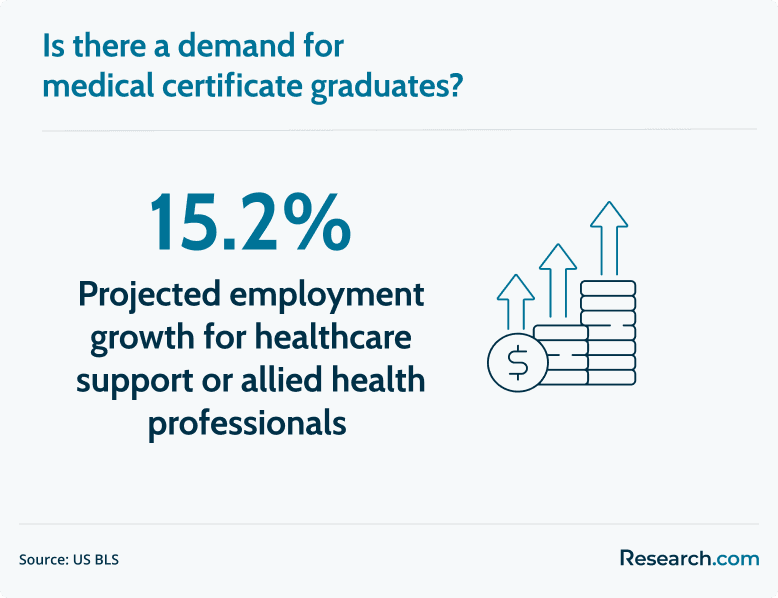
The healthcare support occupational group is projected to see a 15.2% employment growth, the fastest rate across all industries, adding the most jobs from 2023 to 2033 (BLS). This projected growth supports strong interest in healthcare certificates, but students should still choose programs tied to recognized credentials and real local hiring demand.
Key Insights
- Online medical certificate programs are best for targeted entry-level training. They can prepare students for roles in medical assisting, billing and coding, pharmacy support, phlebotomy, EKG, patient care, transcription, dental assisting, and healthcare administration support.
- Certification alignment matters more than online format. Employers are more likely to value a program that prepares graduates for recognized credentials and includes required practical experience.
- Costs vary widely. Online medical certificate programs can range from $1,000 to $5,000, while some specialized programs may cost $3,000 to $7,000. Always compare total cost, not just advertised tuition.
- Hands-on requirements can still apply. Even if coursework is online, patient-care and technical roles may require labs, externships, clinical hours, or local skills practice.
- Salary outcomes are role- and location-dependent. ZipRecruiter (2025) salary figures show several healthcare certificate-related roles in the $37,767 to $45,672 range, but state, employer, certification, and experience can change earnings.
- A certificate can be a stepping stone. Many graduates use certificates to enter healthcare, then pursue specialization, supervisory roles, nursing pathways, health information roles, or management education.
- The safest choice is a transparent program. Before enrolling, verify accreditation, certification eligibility, clinical placement support, exam fees, refund policies, student support, and job search services.
References:
- Stepful. (2025). Online medical assistant program with financial aid. Retrieved from https://www.stepful.com/post/online-medical-assistant-program-with-financial-aid
- U.S. Bureau of Labor Statistics. (2025). Healthcare support occupations. Retrieved from https://www.bls.gov/oes/2023/may/oes310000.htm
- ZipRecruiter. (2025). Certified Medical Assistant salary. Retrieved from https://www.ziprecruiter.com/Salaries/Certified-Medical-Assistant-Salary
- ZipRecruiter. (2025). Dental Assistant salary. Retrieved from https://www.ziprecruiter.com/Salaries/Dental-Assistant-Salary
- ZipRecruiter. (2025). Health Information Technician salary. Retrieved from https://www.ziprecruiter.com/Salaries/Health-Information-Technician-Salary
- ZipRecruiter. (2025). Medical Billing And Coding Specialist salary. Retrieved from https://www.ziprecruiter.com/Salaries/Medical-Billing-And-Coding-Specialist-Salary
- ZipRecruiter. (2025). Medical Transcription salary. Retrieved from https://www.ziprecruiter.com/Salaries/What-Is-the-Average-Medical-Transcription-Salary-by-State
- ZipRecruiter. (2025). Patient Care Technician salary. Retrieved from https://www.ziprecruiter.com/Salaries/Patient-Care-Technician-Salary
- ZipRecruiter. (2025). Pharmacy Technician salary. Retrieved from https://www.ziprecruiter.com/Salaries/Pharmacy-Technician-Salary
Other Things You Need To Know About Online Medical Certificate Programs
Admission requirements for online medical and healthcare certificate programs in 2027 typically include a high school diploma or equivalent, relevant work experience, and sometimes prerequisite coursework in science or healthcare-related fields. International students may need to provide proof of English proficiency through exams like TOEFL or IELTS.
Yes. Many online medical and healthcare certificate programs require supervised clinical hours, practicum work, or skills labs, especially in patient-facing fields such as medical assisting, phlebotomy, and health information management. Programs may place students in approved clinical sites and set minimum completion hours before certification is awarded.
Financial aid options for online medical and healthcare certificate programs in 2027 include federal student loans, scholarships, grants, and employer tuition assistance. Eligibility often depends on financial need and program specifics. Check with the program’s financial aid office for detailed information.


